Overview
Conditional statements with any represent one of the most frequently tested patterns in LSAT logical reasoning questions. The word "any" functions as a universal quantifier that creates conditional relationships, but its interpretation can be surprisingly nuanced and counterintuitive for test-takers. Understanding how "any" operates within conditional logic is essential because it appears across multiple question types, including Must Be True, Sufficient Assumption, Necessary Assumption, and Flaw questions.
The challenge with "any" lies in its contextual flexibility. Depending on sentence structure and logical context, "any" can indicate either a sufficient condition or a necessary condition, and sometimes it functions as a universal quantifier that applies to all members of a category. Misinterpreting "any" leads to reversed conditional relationships, which is one of the most common errors test-takers make on the LSAT. This single word can determine whether a student selects the correct answer or falls into a carefully constructed trap answer.
Mastering lsat conditional statements with any builds directly upon foundational conditional logic skills and serves as a gateway to more complex logical structures involving quantifiers, formal logic, and argument evaluation. This topic integrates with sufficient and necessary condition identification, contrapositive formation, and the broader skill of translating natural language into precise logical relationships—all critical competencies for achieving a competitive LSAT score.
Learning Objectives
- [ ] Identify how conditional statements with any appears in LSAT questions
- [ ] Explain the reasoning pattern behind conditional statements with any
- [ ] Apply conditional statements with any to solve LSAT-style problems accurately
- [ ] Distinguish between "any" as a sufficient condition indicator versus a necessary condition indicator based on context
- [ ] Translate complex sentences containing "any" into proper conditional notation
- [ ] Recognize and avoid common trap answers that exploit misinterpretations of "any"
- [ ] Form accurate contrapositives of conditional statements containing "any"
Prerequisites
- Basic conditional logic notation: Understanding the arrow notation (A → B) is essential for representing conditional statements with any in symbolic form
- Sufficient and necessary conditions: Recognizing the difference between these condition types allows proper interpretation of where "any" fits in the conditional relationship
- Contrapositive formation: The ability to form contrapositives (A → B becomes ~B → ~A) is required to fully analyze statements with "any"
- Universal and existential quantifiers: Basic familiarity with "all," "some," and "none" provides context for understanding how "any" functions as a quantifier
- Logical translation skills: The capacity to convert natural language into logical notation enables accurate representation of "any" statements
Why This Topic Matters
In real-world legal reasoning and argumentation, the word "any" appears frequently in statutes, regulations, contracts, and legal arguments. Attorneys must precisely interpret whether "any" establishes a sufficient condition (if any X, then Y) or a necessary condition (Y only if any X), as this distinction can determine case outcomes. The LSAT tests this skill because it reflects the analytical precision required in legal practice.
On the LSAT, conditional statements with any appear in approximately 15-20% of Logical Reasoning questions across all sections. This topic is particularly prevalent in Must Be True questions (where test-takers must identify what necessarily follows from statements containing "any"), Sufficient Assumption questions (where "any" often appears in answer choices that complete conditional chains), and Flaw questions (where arguments may improperly interpret "any" statements). The topic also appears regularly in Logic Games, particularly in rule interpretation and inference questions.
Common manifestations include: statements like "Any student who studies will pass" (sufficient condition), "The committee will approve any proposal that meets the criteria" (sufficient condition), "You may choose any dessert" (universal availability), and "The policy applies to any employee" (universal scope). The LSAT frequently constructs wrong answers by reversing the conditional relationship or by confusing "any" with "some" or "all" in subtle ways that trap unprepared test-takers.
Core Concepts
The Dual Nature of "Any"
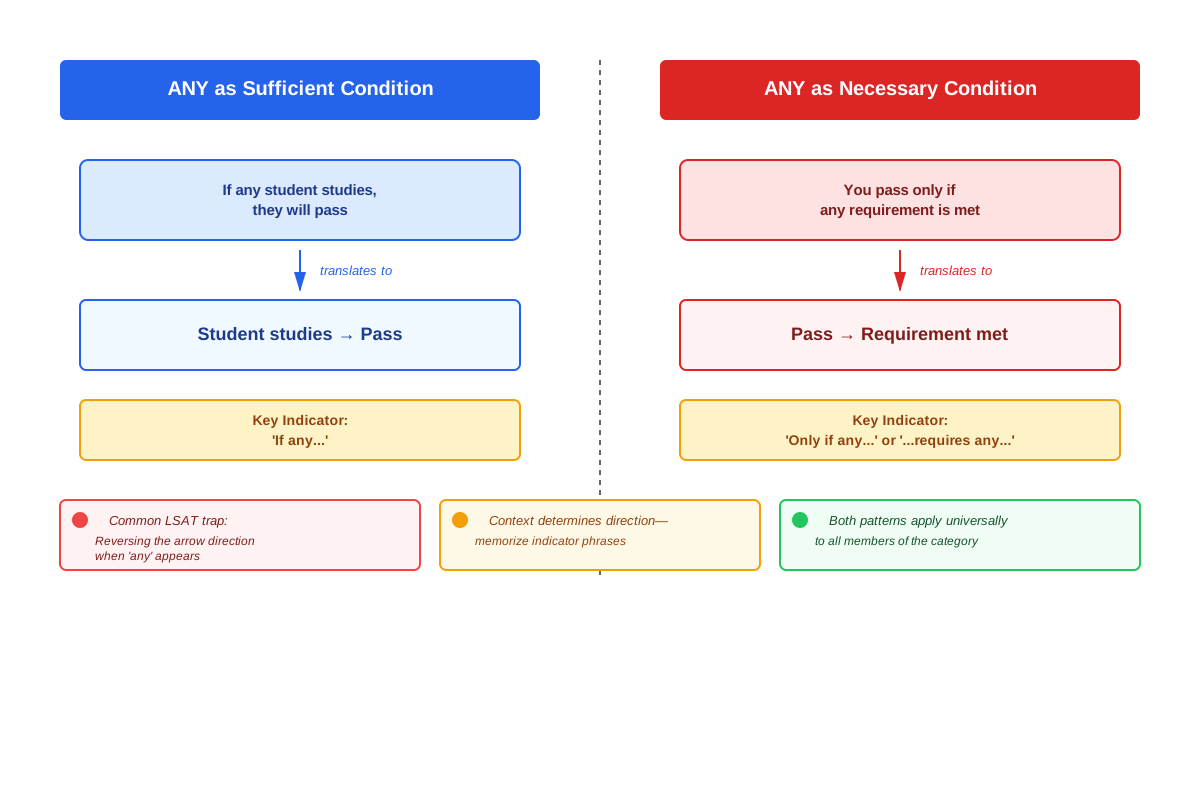
Conditional statements with any function differently depending on their grammatical position and logical context. The word "any" serves as a universal quantifier, meaning it refers to every member of a category without exception, but this universal quality manifests in two distinct logical patterns.
When "any" appears in the sufficient condition position (the "if" part of a conditional), it creates a statement meaning "if you select any member of this category, then the consequence follows." For example: "Any person who enters the building must show identification" translates to: If someone is a person who enters the building → that person must show identification. The "any" here means that this rule applies to every single person without exception—there are no special cases.
When "any" appears in the necessary condition position (the "then" part or in "only if" constructions), it indicates that the consequence or requirement applies universally. For example: "You can select any book from this shelf" means: If you are selecting from this shelf → you are permitted to select any book. The universal quantifier here indicates the full range of permissible options.
Translating "Any" into Conditional Notation
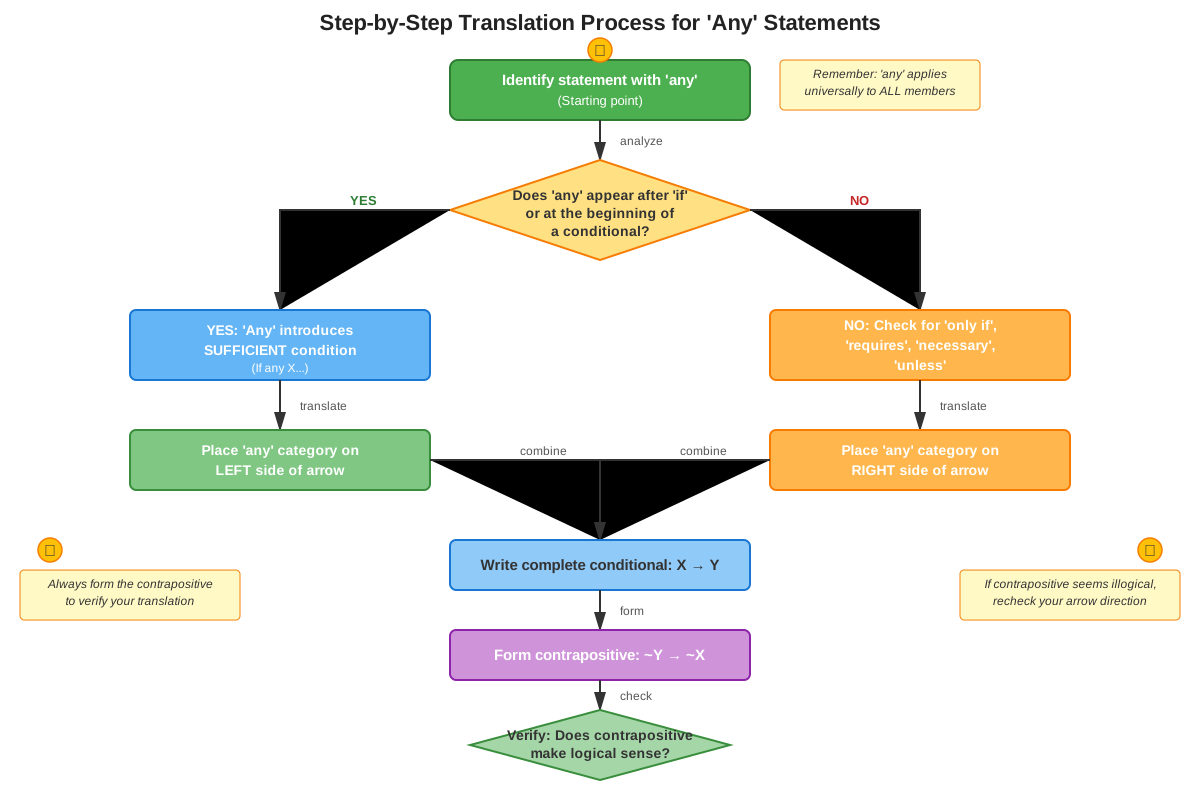
The translation process for lsat conditional statements with any follows specific patterns based on sentence structure:
Pattern 1: "Any X is Y" or "Any X will Y"
- Translation: X → Y
- Example: "Any student who studies will improve" = Study → Improve
- The "any" indicates that being a student who studies is sufficient for improvement
Pattern 2: "If any X, then Y"
- Translation: X → Y
- Example: "If any alarm sounds, evacuate the building" = Alarm sounds → Evacuate
- The "any" emphasizes that it doesn't matter which alarm—any instance triggers the consequence
Pattern 3: "Y if any X"
- Translation: X → Y
- Example: "The system shuts down if any error occurs" = Error occurs → System shuts down
- Grammatically inverted but logically identical to Pattern 2
Pattern 4: "Only if any X, then Y" (rare but important)
- Translation: Y → X
- Example: "You may enter only if any guard approves" = Enter → Guard approves
- The "only if" reverses the relationship, making the "any" clause necessary rather than sufficient
Distinguishing "Any" from "All" and "Some"
Understanding the relationship between these quantifiers is crucial for logical reasoning:
| Quantifier | Logical Meaning | Conditional Form | Example |
|---|---|---|---|
| Any | Universal (each individual) | Creates conditional | Any student who studies passes |
| All | Universal (entire group) | Creates conditional | All students who study pass |
| Some | Existential (at least one) | Does NOT create conditional | Some students who study pass |
| None | Universal negative | Creates conditional with negation | No students who study fail |
The key distinction: "any" and "all" are logically equivalent when creating conditional statements, but "any" emphasizes individual selection or application, while "all" emphasizes group membership. On the LSAT, these are treated as interchangeable in conditional contexts. However, "some" is fundamentally different—it makes an existential claim that cannot be converted into a conditional relationship.
Contrapositive Formation with "Any"
When forming the contrapositive of a conditional statement containing "any," the universal quantifier must be preserved in the negated form:
- Original: Any X → Y (If any X, then Y)
- Contrapositive: ~Y → ~X (If not Y, then not any X, which means "not X at all")
Example:
- Original: "Any employee who arrives late will be reprimanded" (Late → Reprimanded)
- Contrapositive: "If an employee is not reprimanded, then that employee did not arrive late" (~Reprimanded → ~Late)
The contrapositive maintains logical equivalence, and the universal scope of "any" ensures that the negation applies absolutely—if the consequence doesn't occur, then the sufficient condition definitely didn't occur.
Context-Dependent Interpretation
The LSAT frequently tests whether students can correctly interpret "any" in complex sentence structures:
Permissive "Any": "You may select any option" does not create a conditional in the traditional sense; rather, it establishes universal permission. This translates to: For all options in the set, selection is permitted.
Conditional "Any": "Any violation will result in penalties" creates a clear conditional: Violation → Penalties.
Restrictive "Any": "Only any certified technician may perform repairs" combines "only" with "any" to create: Perform repairs → Certified technician. The "any" here indicates that certification is necessary, and any certified technician (regardless of which one) satisfies this requirement.
Common Sentence Structures with "Any"
The LSAT employs various grammatical constructions that incorporate "any":
- "Any X that Y will Z": Creates a conditional with a compound sufficient condition
- Example: "Any student that submits late will lose points" = (Student AND Submit late) → Lose points
- "If any X, all Y will Z": Combines "any" in the sufficient condition with "all" in the necessary condition
- Example: "If any alarm triggers, all personnel must evacuate" = Alarm triggers → All personnel evacuate
- "Without any X, Y": "Without any" functions as a negation in the sufficient condition
- Example: "Without any evidence, the case will be dismissed" = ~Evidence → Dismissed
- "Any X unless Y": "Unless" creates a necessary condition, with "any" modifying the scope
- Example: "Any application will be rejected unless complete" = ~Complete → Rejected (contrapositive: ~Rejected → Complete)
Concept Relationships
The interpretation of conditional statements with any builds directly upon foundational conditional logic. The relationship flows as follows:
Basic Conditional Logic → enables → Identification of Sufficient and Necessary Conditions → enables → Proper Interpretation of "Any" → enables → Complex Conditional Reasoning
Within this topic, the concepts connect in this sequence:
Understanding "Any" as Universal Quantifier → leads to → Recognizing Conditional Structure → leads to → Accurate Translation into Notation → leads to → Contrapositive Formation → leads to → Application to LSAT Questions
The topic also connects laterally to:
- Formal Logic: "Any" statements often appear in formal logic questions involving multiple conditional chains
- Argument Structure: Understanding "any" helps identify the scope and strength of premises and conclusions
- Flaw Recognition: Many flawed arguments misinterpret or overgeneralize "any" statements
The relationship to prerequisite topics is foundational: without understanding basic conditionals, students cannot properly interpret "any"; without contrapositive skills, students cannot fully analyze the logical implications of "any" statements.
High-Yield Facts
⭐ "Any" functions as a universal quantifier that typically creates a sufficient condition when it appears before the conditional trigger
⭐ "Any X → Y" is logically equivalent to "All X → Y" in conditional reasoning contexts
⭐ The contrapositive of a statement with "any" must preserve the universal scope: "Any X → Y" becomes "~Y → ~X" (not any X, meaning no X at all)
⭐ "Any" in the sufficient condition means every individual instance triggers the consequence, with no exceptions
⭐ "Only if any X" reverses the conditional relationship, making the "any" clause necessary rather than sufficient
- "Any" is distinct from "some"—"any" creates conditionals while "some" makes existential claims that do not
- When "any" appears with "unless," the "unless" clause becomes the necessary condition in the contrapositive form
- Permissive uses of "any" (e.g., "you may choose any") indicate universal availability rather than conditional relationships
- "Without any" functions as a negated sufficient condition: "Without any X, Y" = ~X → Y
- The LSAT often creates trap answers by reversing conditionals with "any" or by confusing "any" with "some"
Quick check — test yourself on Conditional statements with any so far.
Try Flashcards →Common Misconceptions
Misconception: "Any" means "some" and therefore doesn't create a strong conditional relationship.
Correction: "Any" is a universal quantifier equivalent to "all" in conditional contexts. It creates absolute conditional relationships where every instance of the sufficient condition triggers the necessary condition, with no exceptions.
Misconception: "Any X → Y" means the same as "Y → Any X" (reversing the conditional).
Correction: Reversing a conditional is a logical error called "affirming the consequent." The correct logical equivalent is the contrapositive: "~Y → ~X." The direction of the arrow matters critically, and "any" doesn't make conditionals reversible.
Misconception: When forming the contrapositive of "Any X → Y," the result is "Any ~Y → ~X."
Correction: The contrapositive is "~Y → ~X" (not any X). The negation of "any X" is "no X" or "not X at all," not "any not-X." The universal quantifier applies to the original category, not to its negation.
Misconception: "Any" makes a statement weaker or more qualified than "all."
Correction: In conditional logic, "any" and "all" have equivalent logical strength. Both create universal conditionals. The difference is primarily stylistic: "any" emphasizes individual selection while "all" emphasizes group membership, but both mean every member without exception.
Misconception: "You may select any option" creates a conditional: If you select → any option is acceptable.
Correction: Permissive "any" statements grant universal permission rather than creating conditional relationships. This statement means all options are available for selection, not that selection triggers a consequence. It's a statement about the scope of permission, not a conditional trigger.
Misconception: "Any" in a conclusion makes the argument stronger because it's universal.
Correction: While "any" does create universal claims, an argument concluding with "any" requires universal support from its premises. If premises only support "some" cases, concluding with "any" represents an overgeneralization flaw. The strength depends on whether the premises justify the universal scope.
Worked Examples
Example 1: Must Be True Question
Stimulus: "Any attorney who specializes in corporate law must complete continuing education in securities regulation. Maria has completed continuing education in securities regulation."
Question: Which of the following must be true?
Answer Choices:
(A) Maria specializes in corporate law
(B) Maria is an attorney
(C) If Maria is an attorney who specializes in corporate law, she has met this requirement
(D) Anyone who completes continuing education in securities regulation specializes in corporate law
(E) Maria must be an attorney who specializes in corporate law
Solution Process:
Step 1: Translate the conditional statement with "any"
- "Any attorney who specializes in corporate law must complete continuing education"
- Translation: (Attorney AND Specializes in corporate law) → Continuing education
- Shorthand: A + C → E
Step 2: Identify what we know for certain
- Maria has completed continuing education (E is true for Maria)
Step 3: Analyze what must be true
- We know E is true
- Can we conclude A + C? NO—this would be affirming the consequent (a logical error)
- The contrapositive is: ~E → ~(A + C), which means ~E → (~A OR ~C)
- Since E is true, the contrapositive doesn't apply
Step 4: Evaluate each answer choice
- (A) INCORRECT: We cannot conclude Maria specializes in corporate law; that would be reversing the conditional
- (B) INCORRECT: We cannot conclude Maria is an attorney; completing the education doesn't prove attorney status
- (C) CORRECT: This restates the original conditional. IF Maria is an attorney who specializes in corporate law, THEN she must complete the education. Since she has completed it, she has met the requirement (if she is indeed an attorney specializing in corporate law)
- (D) INCORRECT: This reverses the original conditional—a classic trap
- (E) INCORRECT: This affirms the consequent; we cannot conclude the sufficient condition from the necessary condition
Key Takeaway: The "any" creates a sufficient condition (attorney specializing in corporate law), and we cannot work backward from the necessary condition (continuing education) to conclude the sufficient condition occurred.
Example 2: Sufficient Assumption Question
Stimulus: "The museum will acquire any painting that is both authenticated by experts and offered at a reasonable price. The Vermeer has been authenticated by experts."
Question: Which of the following, if assumed, would allow the conclusion that the museum will acquire the Vermeer?
Answer Choices:
(A) The Vermeer is offered at a reasonable price
(B) Any painting authenticated by experts is valuable
(C) The museum acquires only paintings that are authenticated
(D) All reasonable prices are acceptable to the museum
(E) Some authenticated paintings are offered at reasonable prices
Solution Process:
Step 1: Translate the conditional with "any"
- "The museum will acquire any painting that is both authenticated AND offered at reasonable price"
- Translation: (Authenticated AND Reasonable price) → Acquire
- Shorthand: A + R → Q
Step 2: Identify what we know
- The Vermeer has been authenticated (A is true for the Vermeer)
Step 3: Identify the conclusion we need to reach
- The museum will acquire the Vermeer (Q must be true for the Vermeer)
Step 4: Determine what's missing
- We have: A (authenticated)
- We need: A + R → Q, and we want to conclude Q
- Missing piece: R (reasonable price)
- If we assume R is true, then we have both A and R, which triggers Q
Step 5: Evaluate answer choices
- (A) CORRECT: This provides the missing sufficient condition component (R), which combined with A, triggers Q
- (B) INCORRECT: Information about value is irrelevant to the conditional about acquisition
- (C) INCORRECT: This would be the contrapositive (~Q → ~A OR ~R), but doesn't help us conclude Q
- (D) INCORRECT: This is too broad and doesn't specifically establish that the Vermeer's price is reasonable
- (E) INCORRECT: "Some" is existential and doesn't tell us about this specific Vermeer
Key Takeaway: When "any" creates a compound sufficient condition (requiring multiple elements), a sufficient assumption question often requires providing the missing element of that compound condition.
Exam Strategy
Trigger Words and Recognition
When approaching LSAT questions, immediately flag these trigger phrases that indicate conditional statements with any:
- "Any [noun] that/who [condition] will/must [consequence]"
- "If any [noun]"
- "Any [noun] is [characteristic]"
- "Without any [noun]"
- "Only if any [noun]"
Exam Tip: The moment you see "any" in a stimulus or answer choice, draw an arrow and begin translating into conditional notation. This prevents misinterpretation under time pressure.
Systematic Approach
Step 1: Identify and Translate (15-20 seconds)
- Locate "any" in the statement
- Determine what comes before and after "any"
- Translate into arrow notation: X → Y
- Write the contrapositive: ~Y → ~X
Step 2: Analyze the Question Type (5 seconds)
- Must Be True: Look for what follows logically from the conditional
- Sufficient Assumption: Identify what would complete the conditional chain
- Flaw: Check if the argument reverses or misinterprets the "any" statement
- Necessary Assumption: Determine what must be true for the conditional to hold
Step 3: Predict the Answer (10-15 seconds)
- Based on the conditional structure, predict what the correct answer will do
- For Must Be True: Apply the conditional or its contrapositive
- For Assumptions: Identify the logical gap in the conditional chain
Step 4: Eliminate Wrong Answers (20-30 seconds)
- Eliminate answers that reverse the conditional (X → Y becoming Y → X)
- Eliminate answers that confuse "any" with "some"
- Eliminate answers that negate both sides without reversing (X → Y becoming ~X → ~Y)
- Eliminate answers that add information not supported by the conditional
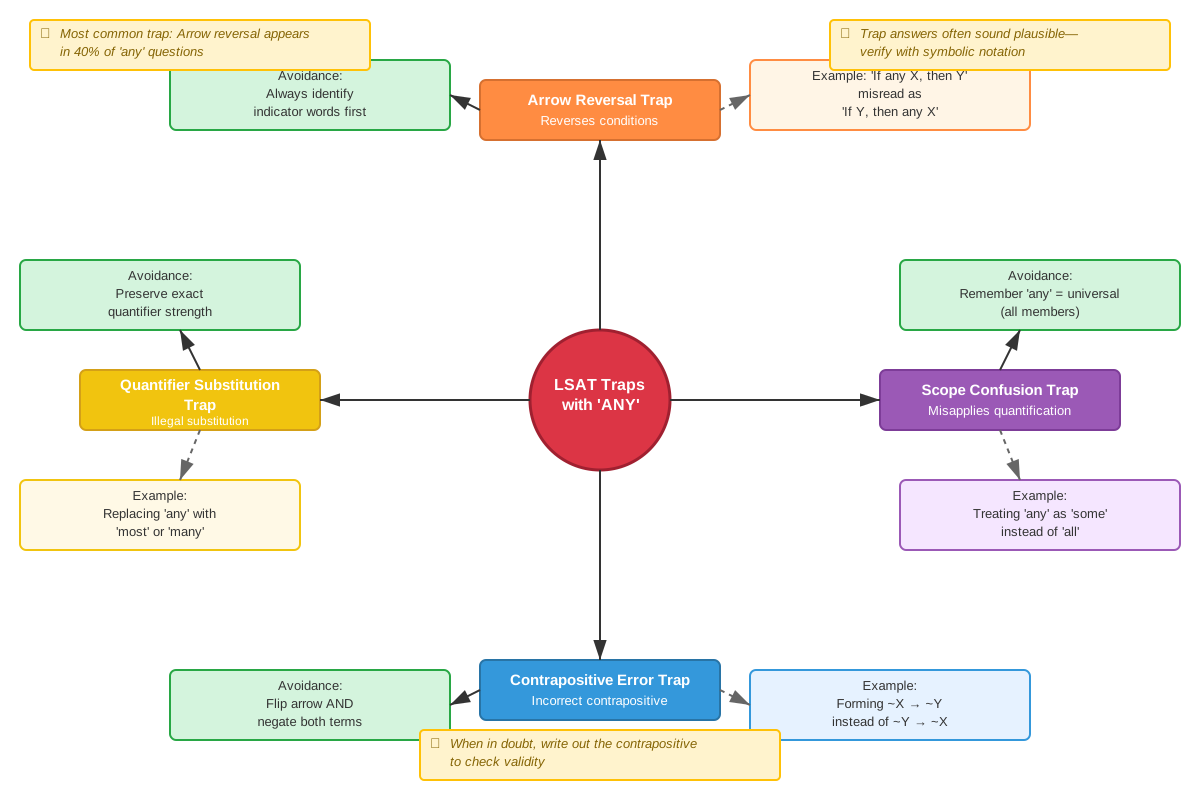
Common Trap Patterns
The LSAT consistently uses these trap answer constructions with "any" statements:
- The Reversal Trap: Original states "Any X → Y"; trap answer concludes "Y → X"
- The Negation Trap: Original states "Any X → Y"; trap answer concludes "~X → ~Y"
- The Quantifier Confusion Trap: Original uses "any" (universal); trap answer uses "some" (existential) as if equivalent
- The Incomplete Compound Trap: Original requires "A AND B → C"; trap answer provides only A and concludes C
Time Allocation
For questions involving conditional statements with any:
- Simple conditional identification: 45-60 seconds total
- Complex conditional chains: 75-90 seconds total
- Formal logic with multiple "any" statements: 90-120 seconds total
If translation takes longer than 20 seconds, mark the question and return to it—you may be overcomplicating the logical structure.
Memory Techniques
The "ANY = ALL" Mnemonic
Remember: Any Necessitates Yielding to Absolute Logical Laws
This reminds you that "any" functions like "all" in creating universal conditionals with no exceptions.
The Arrow Direction Visualizer
Visualize "any" as a launching pad: whatever comes after "any" launches the arrow forward to the consequence.
"Any student who studies" → [launches arrow] → "will pass"
The "any" is always on the launching (sufficient condition) side unless "only if" reverses it.
The Contrapositive Flip-and-Negate
For statements with "any," use this physical memory technique:
- Write the original on paper
- Physically flip the paper upside down (representing reversal)
- Draw a line through each term (representing negation)
- This represents: flip the arrow direction AND negate both terms
The "Some vs. Any" Hand Technique
- Hold up ONE finger for "some" (at least one, existential)
- Hold up ALL fingers for "any" (every single one, universal)
- This physical reminder helps distinguish these quantifiers under pressure
The Compound Condition Checklist
For "any" statements with compound sufficient conditions, visualize a checklist:
- "Any attorney who specializes in corporate law" = ☐ Attorney + ☐ Corporate law
- Both boxes must be checked before the arrow fires
- Missing even one box means the conditional doesn't trigger
Summary
Conditional statements with any represent a high-yield LSAT topic that tests precise logical interpretation. The word "any" functions as a universal quantifier that typically creates sufficient conditions, meaning every individual instance of the category triggers the stated consequence without exception. Proper translation requires identifying whether "any" appears in the sufficient condition position (creating "Any X → Y") or in necessary condition constructions (particularly with "only if"). The key to mastering this topic lies in recognizing that "any" is logically equivalent to "all" in conditional contexts, distinguishing it clearly from "some," and avoiding the common trap of reversing conditionals. Contrapositive formation must preserve the universal scope while negating and reversing the relationship. Success on LSAT questions involving "any" depends on systematic translation into conditional notation, careful attention to compound conditions, and recognition of trap answers that exploit reversal errors or quantifier confusion.
Key Takeaways
- "Any" creates universal conditionals equivalent to "all"—every instance triggers the consequence with no exceptions
- Translate "Any X → Y" systematically and immediately form the contrapositive "~Y → ~X" to see all logical implications
- Never reverse a conditional with "any"—the most common trap answers exploit this error by presenting "Y → X" as if it follows from "Any X → Y"
- Distinguish "any" (universal, creates conditionals) from "some" (existential, does not create conditionals)
- Compound sufficient conditions with "any" require all elements to be present before the conditional triggers
- "Only if any X" reverses the typical relationship, making the "any" clause necessary rather than sufficient
- Under time pressure, flag "any" immediately, translate to notation, and check answer choices against both the original conditional and its contrapositive
Related Topics
Sufficient and Necessary Conditions: Mastering conditional statements with any provides the foundation for analyzing more complex sufficient and necessary condition relationships, including those with multiple conditional chains and formal logic scenarios.
Formal Logic and Quantifiers: This topic extends naturally into formal logic questions that combine "any," "all," "some," and "none" in complex logical structures requiring multiple translation steps.
Conditional Chains and Transitive Reasoning: Understanding "any" statements enables progression to multi-step conditional reasoning where "Any X → Y" and "Y → Z" combine to yield "Any X → Z."
Flaw Question Types: Recognizing proper interpretation of "any" is essential for identifying flaws in arguments that misinterpret conditional relationships, overgeneralize, or commit reversal errors.
Argument Assumption Questions: Both sufficient and necessary assumption questions frequently involve completing or supporting conditional chains that include "any" statements, making this topic foundational for assumption question mastery.
Practice CTA
Now that you understand the logical structure and interpretation of conditional statements with any, it's time to cement this knowledge through active practice. Attempt the practice questions designed specifically for this topic, focusing on translating each "any" statement into proper conditional notation before evaluating answer choices. Use the flashcards to drill rapid recognition of different "any" constructions and their correct translations. Remember: the difference between a good LSAT score and a great one often comes down to mastering these precise logical distinctions. Every practice question you complete builds the pattern recognition and analytical speed you need for test day success. You've got this!
Sign up free to keep reading
Create a free AnvayaPrep account to finish this LSAT guide on Conditional statements with any — plus flashcards and practice questions.