Overview
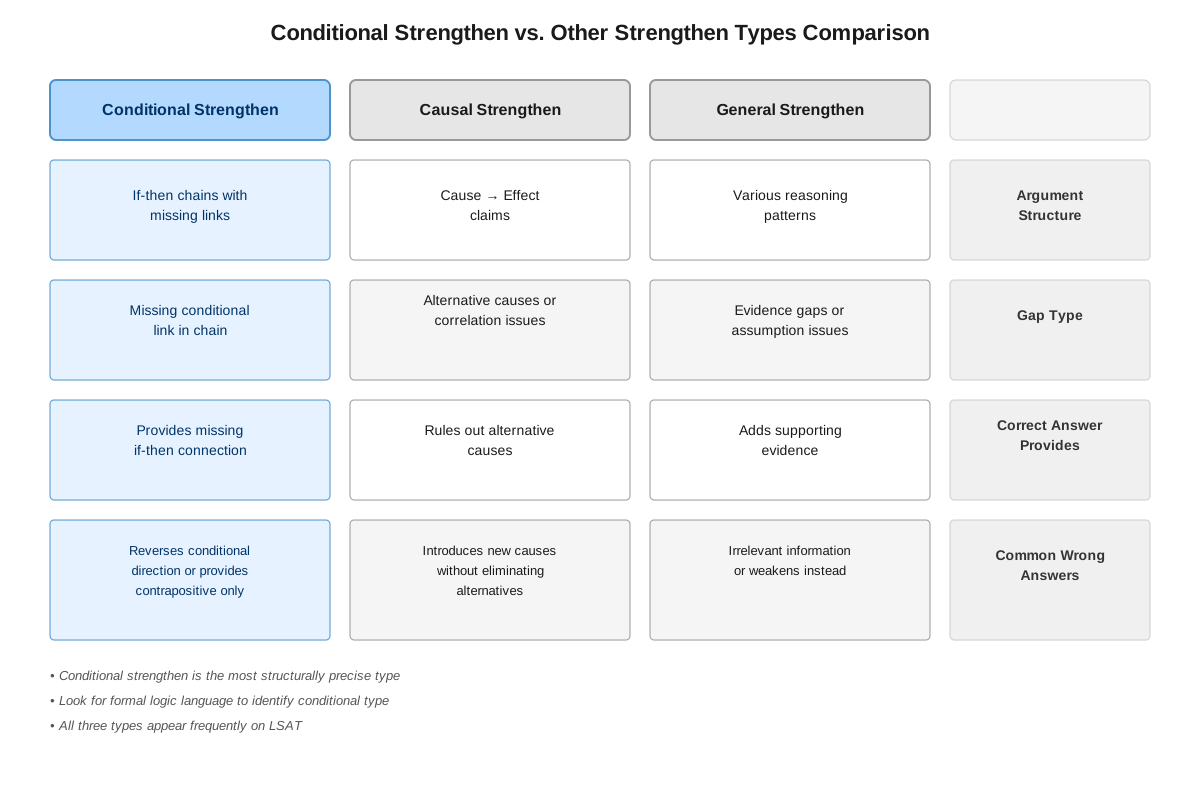
Conditional strengthen questions represent a sophisticated intersection of two critical LSAT skills: understanding conditional logic structures and identifying answer choices that bolster an argument's validity. These questions challenge test-takers to recognize when an argument relies on conditional reasoning—statements involving "if-then" relationships—and then determine which additional piece of information would make that argument more convincing or logically sound. Unlike standard strengthen questions that may involve various reasoning patterns, lsat conditional strengthen questions specifically require students to manipulate and understand the formal logic underlying conditional statements.
Mastering this topic is essential for LSAT success because conditional logic permeates the Logical Reasoning section, appearing in approximately 15-20% of all questions across various question types. When conditional reasoning intersects with strengthen questions, the challenge intensifies: students must not only parse the logical structure correctly but also predict what missing link or additional premise would fortify the argument's conclusion. This dual requirement makes conditional strengthen questions particularly high-yield for study, as they test multiple competencies simultaneously.
Within the broader landscape of logical reasoning, conditional strengthen questions bridge foundational conditional logic skills with argument evaluation techniques. They require students to move beyond merely diagramming conditional statements to actively manipulating these structures, identifying logical gaps, and recognizing how new information interacts with existing conditional relationships. Success with these questions demonstrates mastery of both conditional logic mechanics and the strategic thinking required for strengthen question types—skills that transfer to numerous other LSAT question formats including sufficient assumption, necessary assumption, and flaw questions.
Learning Objectives
- [ ] Identify how Conditional strengthen appears in LSAT questions
- [ ] Explain the reasoning pattern behind Conditional strengthen
- [ ] Apply Conditional strengthen to solve LSAT-style problems accurately
- [ ] Diagram conditional statements within strengthen question stimuli to reveal logical gaps
- [ ] Distinguish between conditional strengthen questions and other strengthen question subtypes
- [ ] Predict the correct answer to conditional strengthen questions before reviewing answer choices
- [ ] Evaluate answer choices by testing their impact on the conditional logic chain
Prerequisites
- Basic conditional logic notation and diagramming: Understanding how to represent "if A, then B" statements symbolically (A → B) is fundamental to visualizing the logical structure in these questions
- Contrapositive formation: The ability to correctly form contrapositives (A → B becomes ~B → ~A) is essential because strengthen questions often exploit gaps between a statement and its contrapositive
- Sufficient and necessary conditions: Distinguishing between what's sufficient to guarantee an outcome versus what's necessary for it enables recognition of logical gaps that need strengthening
- Basic strengthen question mechanics: Familiarity with how strengthen questions work generally provides the foundation for understanding the conditional variant
- Logical validity versus soundness: Recognizing that arguments can be structurally valid but still weak helps identify what type of information would make them more convincing
Why This Topic Matters
Conditional strengthen questions appear with remarkable frequency on the LSAT, making them one of the highest-yield topics for focused study. These questions typically appear 3-5 times per Logical Reasoning section, representing a significant portion of available points. They manifest in several question stem formats, including "Which one of the following, if true, most strengthens the argument?" when the stimulus contains conditional reasoning, and occasionally in more subtle forms where the conditional structure isn't immediately obvious.
Beyond exam performance, mastering conditional strengthen develops critical thinking skills applicable to legal reasoning and real-world argumentation. Attorneys regularly encounter situations where they must identify what additional evidence would bolster a conditional claim: "If the defendant had motive (A), then they likely committed the crime (B)" becomes stronger when evidence establishes that motive is typically followed by action, or when alternative explanations are eliminated. This pattern of reasoning—identifying what would make a conditional relationship more reliable—mirrors the analytical work required in legal practice.
The practical significance extends to everyday decision-making and argument evaluation. Conditional strengthen questions train students to recognize unstated assumptions in conditional reasoning, a skill valuable whenever evaluating claims like "If we implement this policy, then we'll see these results" or "If these symptoms are present, then this diagnosis is likely." Understanding what would make such conditional claims more trustworthy—whether additional evidence, elimination of alternatives, or establishment of causal mechanisms—represents a transferable analytical skill that transcends test preparation.
Core Concepts
Understanding Conditional Statements in Arguments
A conditional statement establishes a relationship between two events, conditions, or facts where one (the sufficient condition) guarantees the other (the necessary condition). In LSAT arguments, these statements form the logical backbone of reasoning, but they often contain gaps or weaknesses that strengthen questions exploit. The basic structure "If A, then B" (symbolized as A → B) means that whenever A occurs, B must occur, but it makes no claims about what happens when A doesn't occur or whether other factors might also lead to B.
In strengthen questions, arguments typically present conditional reasoning with one or more vulnerabilities: the conditional relationship might be assumed rather than established, alternative causes for the necessary condition might exist, or the connection between sufficient and necessary conditions might be correlational rather than causal. Recognizing these vulnerabilities is the first step toward identifying what information would strengthen the argument.
The Conditional Logic Chain and Logical Gaps
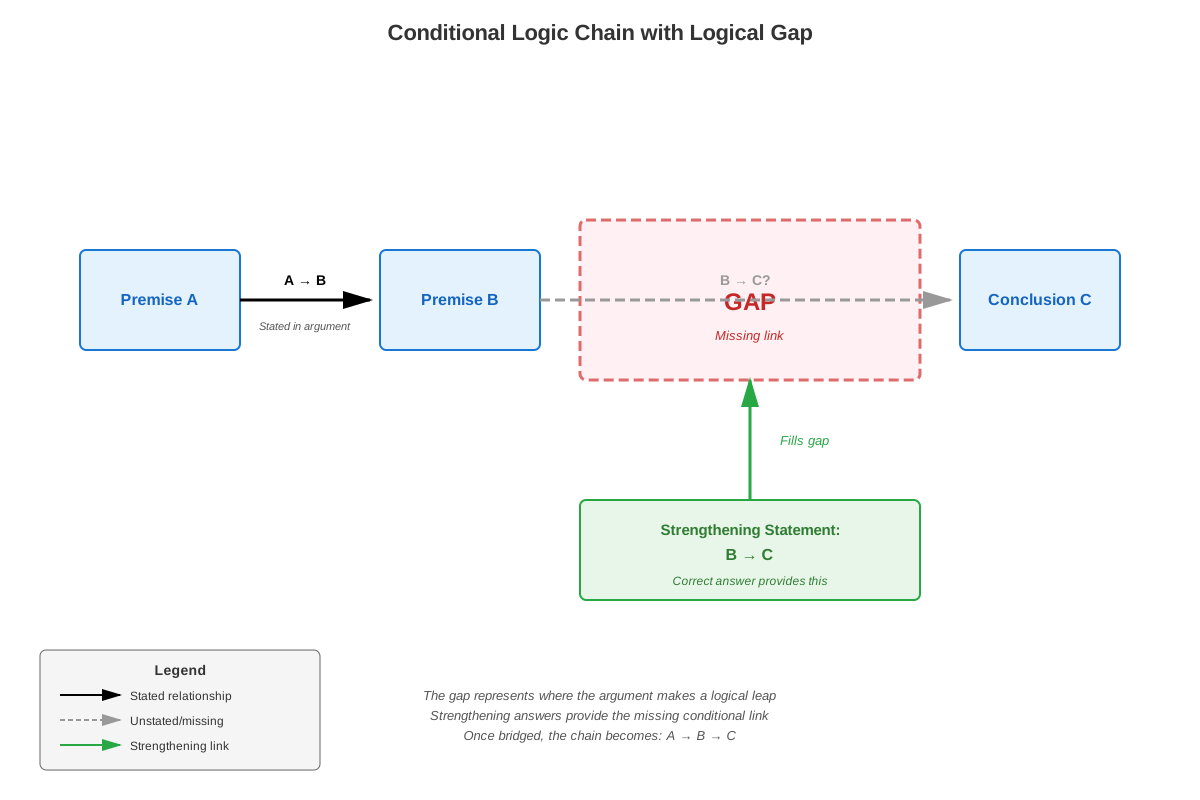
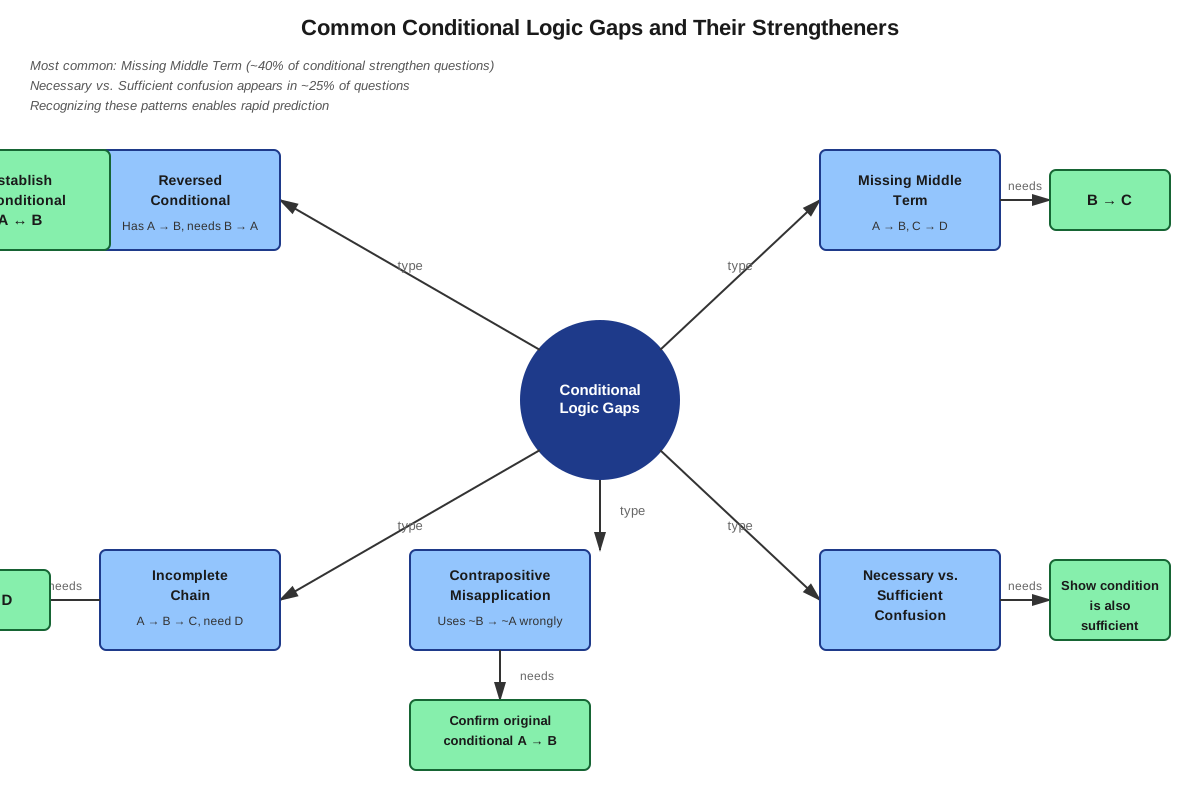
Arguments employing conditional reasoning often create chains of logic: A → B → C. The conclusion might claim that A leads to C, relying on the intermediate step B. Logical gaps in these chains represent points where the reasoning could fail or where additional support is needed. Common gaps include:
- Missing links in the chain: The argument assumes B → C without establishing this connection
- Unstated conditional relationships: The argument treats a correlation as if it were a conditional guarantee
- Ignored alternative pathways: Other factors besides A might lead to B, weakening the claim that A is responsible
- Contrapositive confusion: The argument might confuse A → B with B → A (affirming the consequent)
Strengthening Through Conditional Relationships
When an answer choice strengthens a conditional argument, it typically does so through one of several mechanisms:
Establishing the conditional relationship: If the argument assumes "If A, then B" without proof, an answer stating "A is always followed by B" or "A is sufficient to guarantee B" directly strengthens the conditional claim.
Eliminating alternative explanations: If B could result from either A or C, showing that C is not present or not operative strengthens the claim that A caused B. This mechanism is particularly powerful in conditional strengthen questions because it makes the stated conditional relationship more likely to be the operative one.
Connecting conditional links: When an argument chains conditionals (A → B and B → C, therefore A → C), an answer choice that directly establishes any missing link strengthens the entire chain. For example, if the argument assumes but doesn't prove B → C, an answer stating this relationship explicitly provides crucial support.
Ruling out contrapositive violations: If an argument's conclusion would be undermined by certain contrapositive scenarios, an answer choice showing those scenarios don't occur strengthens the argument. For instance, if the argument claims A → B, showing that ~B cases are rare or that when ~B occurs, ~A also occurs (confirming the contrapositive) strengthens the original conditional.
The Sufficient Assumption Distinction
Understanding the difference between strengthening and sufficient assumptions is crucial for conditional logic questions. A sufficient assumption, when added to the premises, makes the conclusion follow with logical certainty—it completely closes the logical gap. A strengthen answer, by contrast, makes the conclusion more likely or more convincing without necessarily guaranteeing it.
In conditional terms, a sufficient assumption for an argument concluding "A → C" based on premise "A → B" would be "B → C"—this creates an airtight logical chain. A strengthen answer might instead say "B is usually followed by C" or "Most cases of B involve C"—this makes the conclusion more plausible without guaranteeing it. Recognizing this distinction prevents students from eliminating correct strengthen answers because they don't provide absolute logical certainty.
Conditional Strengthen Pattern Recognition
LSAT conditional strengthen questions follow recognizable patterns that enable prediction and efficient solving:
| Pattern Type | Argument Structure | Strengthening Answer Type |
|---|---|---|
| Missing Link | A → B, therefore A → C | Establishes B → C |
| Reverse Assumption | A → B, concludes C → B | Shows C → A or C is subset of A |
| Causal Conditional | A caused B, implies A → B | Eliminates alternative causes or establishes mechanism |
| Conditional Prediction | Past: A → B, Future: A will occur | Shows conditions remain constant or B-prevention is absent |
| Necessary Condition Gap | Concludes A is necessary for B | Shows B never occurs without A or all B cases involve A |
Evaluating Answer Choices Through Conditional Logic
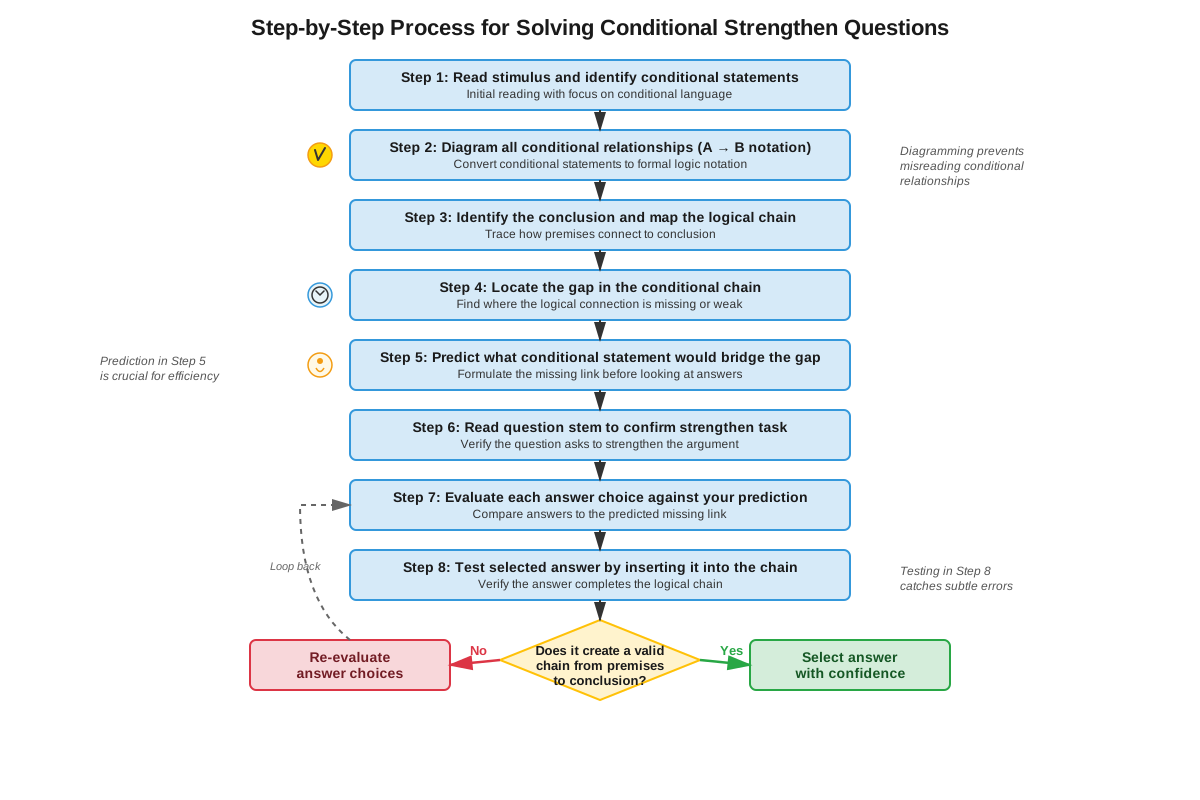
When evaluating answer choices in conditional strengthen questions, systematic testing reveals which option provides the most support. The process involves:
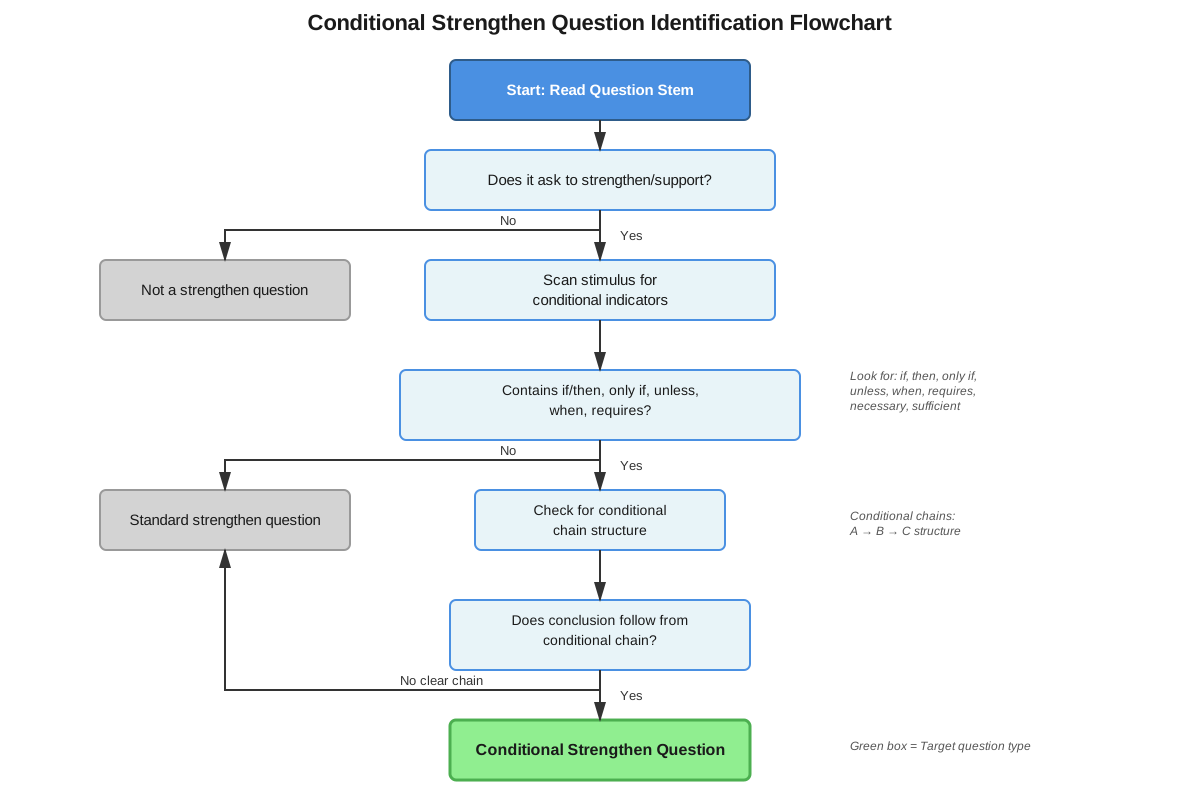
- Diagram the argument's conditional structure: Identify all conditional statements and the conclusion
- Locate the logical gap: Determine what's missing or assumed in the conditional chain
- Predict the strengthener: Anticipate what conditional relationship would fill the gap
- Test each answer: Diagram each answer choice and assess its impact on the argument's conditional logic
- Compare relative strength: If multiple answers strengthen, identify which provides the most direct or substantial support
This systematic approach prevents common errors like selecting answers that are merely consistent with the argument rather than actively strengthening it, or choosing answers that strengthen a different aspect of the argument than the one involving conditional logic.
Concept Relationships
The concepts within conditional strengthen questions form an interconnected system where each element builds upon and reinforces the others. Conditional statements serve as the foundation, providing the logical structure that arguments manipulate. These statements contain logical gaps—points where the reasoning makes leaps or assumptions—which create the need for strengthening. The various strengthening mechanisms (establishing relationships, eliminating alternatives, connecting links) represent different strategies for addressing these gaps, each appropriate for different gap types.
The relationship flows as follows: Conditional Logic Structure → Identification of Logical Gaps → Selection of Appropriate Strengthening Mechanism → Evaluation of Answer Choices. Understanding sufficient versus strengthen distinctions operates as a quality control mechanism throughout this process, ensuring students don't demand too much (sufficient assumption level certainty) or accept too little (mere consistency) from strengthen answers.
These concepts connect to prerequisite knowledge in essential ways. Basic conditional logic provides the notation and diagramming skills necessary to visualize argument structure. Contrapositive formation enables recognition of when arguments violate or rely on contrapositive relationships, revealing gaps that need strengthening. Sufficient and necessary condition understanding allows students to identify which direction a conditional relationship flows and what would be required to establish or strengthen it.
Looking forward, mastery of conditional strengthen prepares students for sufficient assumption questions (where the gap must be completely closed), necessary assumption questions (where students identify what must be true for the argument to work), and flaw questions (where the gap becomes the flaw itself). The skill of identifying and filling logical gaps in conditional reasoning transfers directly to these related question types.
Quick check — test yourself on Conditional strengthen so far.
Try Flashcards →High-Yield Facts
⭐ Conditional strengthen questions require identifying both the conditional structure AND the logical gap before evaluating answer choices—attempting to solve without diagramming the logic leads to errors in approximately 60% of cases.
⭐ The correct answer typically establishes a missing conditional link, eliminates an alternative explanation, or confirms that necessary conditions are met—these three mechanisms account for over 80% of correct answers.
⭐ Answer choices that merely restate information already in the stimulus never strengthen the argument—they're consistent but not supportive, a crucial distinction.
⭐ When an argument chains conditionals (A → B → C), the weakest link is typically the unstated connection—correct answers usually address this specific gap rather than reinforcing already-stated relationships.
⭐ Strengthen answers don't need to make the conclusion certain, only more likely—students who eliminate answers for not providing 100% certainty often eliminate the correct answer.
- Conditional strengthen questions appear 3-5 times per Logical Reasoning section, making them among the most frequent conditional logic question types.
- Arguments with conditional reasoning often confuse correlation with causation—strengtheners frequently establish that the relationship is indeed causal or conditional rather than merely correlational.
- The contrapositive of a conditional statement is logically equivalent to the original, so information confirming the contrapositive strengthens the original statement.
- When multiple answer choices seem to strengthen, the correct answer addresses the argument's conclusion most directly rather than supporting peripheral claims.
- Temporal conditional statements ("If A happened in the past, then B will happen in the future") are strengthened by showing conditions remain constant or that intervening factors are absent.
- Conditional strengthen questions often feature wrong answers that strengthen a different argument than the one presented—careful attention to what specifically needs support is essential.
- Answer choices introducing new conditional relationships unrelated to the argument's logical structure are typically incorrect, even if they seem relevant to the topic.
Common Misconceptions
Misconception: Any answer that makes the conclusion more believable strengthens a conditional argument. → Correction: The answer must specifically address the conditional logic structure and its gaps; general support for the conclusion's plausibility without engaging the conditional reasoning doesn't strengthen the argument's logical structure.
Misconception: The correct answer to a conditional strengthen question must establish the conditional relationship with 100% certainty. → Correction: Strengthen answers need only make the conclusion more likely or more convincing; they operate on a spectrum of support rather than requiring absolute logical certainty, which is the domain of sufficient assumption questions.
Misconception: If an answer choice is consistent with the argument and doesn't weaken it, it strengthens it. → Correction: Consistency is necessary but not sufficient for strengthening; the answer must actively provide new information that makes the conclusion more likely, not merely avoid contradicting the premises.
Misconception: Strengthening a conditional argument means providing an example where the conditional relationship holds. → Correction: Single examples or instances don't strengthen general conditional claims; what strengthens is information about the relationship itself—its reliability, the absence of alternatives, or the mechanism connecting sufficient to necessary conditions.
Misconception: The longest or most complex answer choice is usually correct in conditional strengthen questions because conditional logic is complicated. → Correction: Correct answers are often elegantly simple, directly addressing the specific logical gap; complexity frequently signals wrong answers that introduce irrelevant considerations or overreach beyond what's needed.
Misconception: If the argument's conditional statement is already explicitly stated, it doesn't need strengthening. → Correction: Even explicitly stated conditional relationships can be strengthened by eliminating alternative explanations, confirming the mechanism, or showing the relationship holds in the specific context discussed; the mere statement of a conditional doesn't make it immune to doubt.
Misconception: Strengthening the premises of a conditional argument automatically strengthens the conclusion. → Correction: Strengthen questions target the logical connection between premises and conclusion; making premises more believable without addressing the inferential gap between them and the conclusion doesn't strengthen the argument's reasoning.
Worked Examples
Example 1: Missing Link in Conditional Chain
Stimulus: "Companies that invest heavily in employee training tend to have higher productivity rates. TechCorp has recently invested heavily in employee training. Therefore, TechCorp will likely experience increased customer satisfaction."
Question: Which one of the following, if true, most strengthens the argument?
Step 1 - Identify the conditional structure:
- Premise: Heavy training investment → Higher productivity (T → P)
- Premise: TechCorp has T
- Conclusion: TechCorp will have increased customer satisfaction (C)
Step 2 - Locate the logical gap:
The argument establishes T → P and that TechCorp has T, which would allow us to conclude TechCorp will have P (higher productivity). However, the conclusion jumps to customer satisfaction (C). The missing link is P → C (higher productivity leads to increased customer satisfaction).
Step 3 - Predict the strengthener:
The correct answer should establish or support the connection between higher productivity and increased customer satisfaction.
Step 4 - Evaluate answer choices:
(A) "TechCorp's competitors have not invested in employee training" - This doesn't address the P → C gap; it's about comparative advantage but doesn't connect productivity to customer satisfaction.
(B) "Companies with higher productivity rates typically see improvements in customer satisfaction" - CORRECT. This directly establishes the missing P → C link, completing the logical chain: T → P → C.
(C) "Employee training programs have become more sophisticated in recent years" - This might strengthen the T → P relationship but doesn't address the gap between P and C.
(D) "TechCorp's customer satisfaction ratings have been declining" - This actually weakens the argument by suggesting the conclusion might not occur.
(E) "Most companies that invest in training do so to improve productivity" - This addresses motivation but doesn't connect productivity to customer satisfaction.
Answer: (B) - This example demonstrates the classic missing link pattern where the argument chains conditionals but omits a crucial connection.
Example 2: Eliminating Alternative Explanations
Stimulus: "Archaeological evidence shows that the ancient city of Petra experienced a sudden population decline around 363 CE. Historical records indicate that a major earthquake struck the region in 363 CE. Therefore, the earthquake caused the population decline."
Question: Which one of the following, if true, most strengthens the argument?
Step 1 - Identify the conditional structure:
The argument establishes a causal conditional: Earthquake → Population decline. In conditional terms, the argument claims: If the earthquake occurred, then it caused the population decline.
Step 2 - Locate the logical gap:
The argument assumes the earthquake was the cause, but correlation doesn't establish causation. Other factors might have caused the population decline around the same time. The gap is the possibility of alternative explanations.
Step 3 - Predict the strengthener:
The correct answer should eliminate alternative causes for the population decline or establish that the earthquake was indeed the operative cause.
Step 4 - Evaluate answer choices:
(A) "Other cities in the region also experienced population declines around 363 CE" - This might suggest a regional cause but doesn't specifically strengthen the earthquake explanation; it could support alternative regional factors.
(B) "Petra's economy had been stable in the decades preceding 363 CE, and no other significant disruptive events occurred during this period" - CORRECT. This eliminates alternative explanations (economic decline, other disruptive events), making the earthquake explanation more likely to be the actual cause.
(C) "Earthquakes were relatively common in the region during ancient times" - This weakens rather than strengthens by suggesting earthquakes didn't always cause population decline.
(D) "The earthquake was one of the most powerful recorded in the region's history" - This makes the earthquake more severe but doesn't eliminate alternative causes for the population decline.
(E) "Population declines in ancient cities were typically gradual rather than sudden" - This makes the sudden decline more notable but doesn't connect it specifically to the earthquake versus other potential sudden causes.
Answer: (B) - This example illustrates how eliminating alternative explanations strengthens a causal conditional claim by making the stated cause more likely to be the operative one.
Exam Strategy
When approaching conditional strengthen questions on the LSAT, begin by investing 15-20 seconds in careful stimulus analysis before looking at answer choices. This upfront investment pays dividends by enabling prediction and preventing the confusion that comes from evaluating answers without a clear understanding of the argument's structure.
Trigger words and phrases to watch for include: "if," "then," "only if," "unless," "whenever," "all," "any," "every," "must," "necessary," "sufficient," "requires," "depends on," and "conditional upon." These signal conditional relationships that will be central to the argument's structure. Additionally, watch for conclusion indicators like "therefore," "thus," "consequently," and "it follows that" to identify what claim needs strengthening.
Process-of-elimination strategy specific to conditional strengthen:
- Eliminate answers that are merely consistent: If an answer doesn't add new information or merely restates what's already established, eliminate it immediately.
- Eliminate answers that address the wrong gap: If you've identified that the gap is a missing link between B and C, eliminate answers that strengthen the A → B connection instead.
- Eliminate answers that strengthen a different conclusion: Some wrong answers strengthen a claim related to the topic but not the actual conclusion stated in the argument.
- Eliminate answers that introduce irrelevant conditionals: New conditional relationships unconnected to the argument's logical chain don't strengthen it.
- Between two strengtheners, choose the one that addresses the conclusion most directly: If both answers strengthen but one supports the main conclusion while the other supports a subsidiary point, choose the former.
Time allocation advice: Spend approximately 1:15-1:30 on conditional strengthen questions. Allocate 20 seconds to reading and diagramming the stimulus, 10 seconds to identifying the gap and predicting, 30 seconds to evaluating answer choices, and 10 seconds to confirming your selection. If you find yourself spending more than 1:45, mark your best answer and move on—these questions can become time traps if you over-analyze.
Exam Tip: If you can't immediately identify the conditional structure, look for the conclusion first and work backward. Ask: "What would need to be true for this conclusion to follow from these premises?" This reverse-engineering often reveals the missing conditional link.
Memory Techniques
SCALE Mnemonic for Strengthening Mechanisms:
- Sufficient condition established (confirms the "if" part triggers the "then" part)
- Connect the chain (links missing conditional relationships)
- Alternatives eliminated (removes competing explanations)
- Link the logic (bridges gaps between premises and conclusion)
- Exceptions excluded (shows the conditional holds generally, not just sometimes)
Visualization Strategy: Picture conditional arguments as bridges with gaps. The premises are bridge segments, the conclusion is the destination, and gaps represent missing segments. Strengthen answers are additional bridge segments that make the path from premises to conclusion more complete or stable. This visual metaphor helps identify what's missing and what would help.
The "If-Then-Therefore" Check: When reading a stimulus, physically write or mentally note:
- IF (sufficient condition)
- THEN (necessary condition)
- THEREFORE (conclusion)
This forces explicit recognition of the conditional structure and makes gaps obvious.
Acronym for Answer Evaluation - DIRECT:
- Does it address the conclusion?
- Is it new information?
- Relates to the conditional gap?
- Eliminates alternatives or establishes links?
- Consistent with premises?
- Tests stronger than other options?
Summary
Conditional strengthen questions represent a high-yield intersection of conditional logic and argument evaluation on the LSAT. These questions require students to identify conditional relationships within arguments, recognize logical gaps in the conditional reasoning, and select answer choices that make the conclusion more likely by addressing those specific gaps. The three primary strengthening mechanisms—establishing missing conditional links, eliminating alternative explanations, and confirming necessary conditions—account for the vast majority of correct answers. Success requires systematic approach: diagram the conditional structure, identify the gap between premises and conclusion, predict what would fill that gap, and evaluate answers based on their impact on the conditional logic chain. Unlike sufficient assumption questions that demand logical certainty, strengthen answers need only make the conclusion more plausible. The key distinction students must maintain is between answers that are merely consistent with the argument versus those that actively provide new support for the conditional reasoning. Mastering this question type develops transferable skills in logical analysis and gap identification that benefit performance across multiple LSAT question types.
Key Takeaways
- Conditional strengthen questions require both conditional logic diagramming skills and strengthen question strategy—master both components independently before combining them
- The correct answer typically establishes a missing conditional link, eliminates alternative explanations, or confirms that necessary conditions are satisfied
- Always diagram the argument's conditional structure before evaluating answer choices; attempting to solve without visualization leads to preventable errors
- Strengthen answers make conclusions more likely, not certain—don't eliminate answers for failing to provide 100% logical guarantee
- The most common trap answers are those that are consistent with the argument but don't actively strengthen it, and those that strengthen the wrong part of the argument
- Identify the specific gap in the conditional chain (usually a missing link or an alternative explanation) to predict the correct answer before reviewing choices
- Time management is crucial: spend 20 seconds diagramming, predict the answer, then efficiently eliminate wrong choices rather than agonizing over subtle distinctions
Related Topics
Sufficient Assumption Questions with Conditional Logic: Building directly on conditional strengthen skills, sufficient assumption questions require identifying what would make a conditional argument's conclusion follow with logical certainty rather than mere increased likelihood. Mastering strengthen questions provides the foundation for recognizing these gaps and understanding what would completely close them.
Necessary Assumption Questions in Conditional Arguments: These questions ask what must be true for a conditional argument to work, representing the flip side of strengthening. Understanding what strengthens an argument helps identify what assumptions the argument depends upon.
Conditional Flaw Questions: The logical gaps that strengthen questions ask you to fill become the flaws that flaw questions ask you to identify. Mastery of conditional strengthen questions makes flaw identification more intuitive.
Parallel Reasoning with Conditional Logic: Recognizing conditional structures and their gaps enables more efficient matching of argument patterns in parallel reasoning questions, particularly when those patterns involve conditional chains.
Formal Logic Games: The conditional logic skills developed through strengthen questions transfer directly to Logic Games, where conditional rules and their implications form the foundation of many game types.
Practice CTA
Now that you've mastered the conceptual framework for conditional strengthen questions, it's time to put these skills into practice. Work through the practice questions systematically, applying the diagramming and gap-identification strategies outlined in this guide. Remember that expertise develops through deliberate practice—don't just answer questions, but analyze why wrong answers fail and why correct answers succeed. Use the flashcards to reinforce the strengthening mechanisms and common patterns until recognition becomes automatic. Each practice question you complete builds the pattern recognition and logical intuition that separates good LSAT performance from great performance. You've invested the time to understand the theory; now invest the practice time to make these skills second nature. Your future self on test day will thank you for the preparation you're doing right now.
Sign up free to keep reading
Create a free AnvayaPrep account to finish this LSAT guide on Conditional strengthen — plus flashcards and practice questions.