Overview
Conditional flaw represents one of the most frequently tested error patterns in LSAT Logical Reasoning sections. This flaw occurs when an argument incorrectly manipulates conditional logic statements, typically by confusing the direction of a conditional relationship or mistaking one valid conditional form for another. Understanding conditional flaws is essential because they appear in approximately 15-20% of all Logical Reasoning questions, making them one of the highest-yield topics for score improvement.
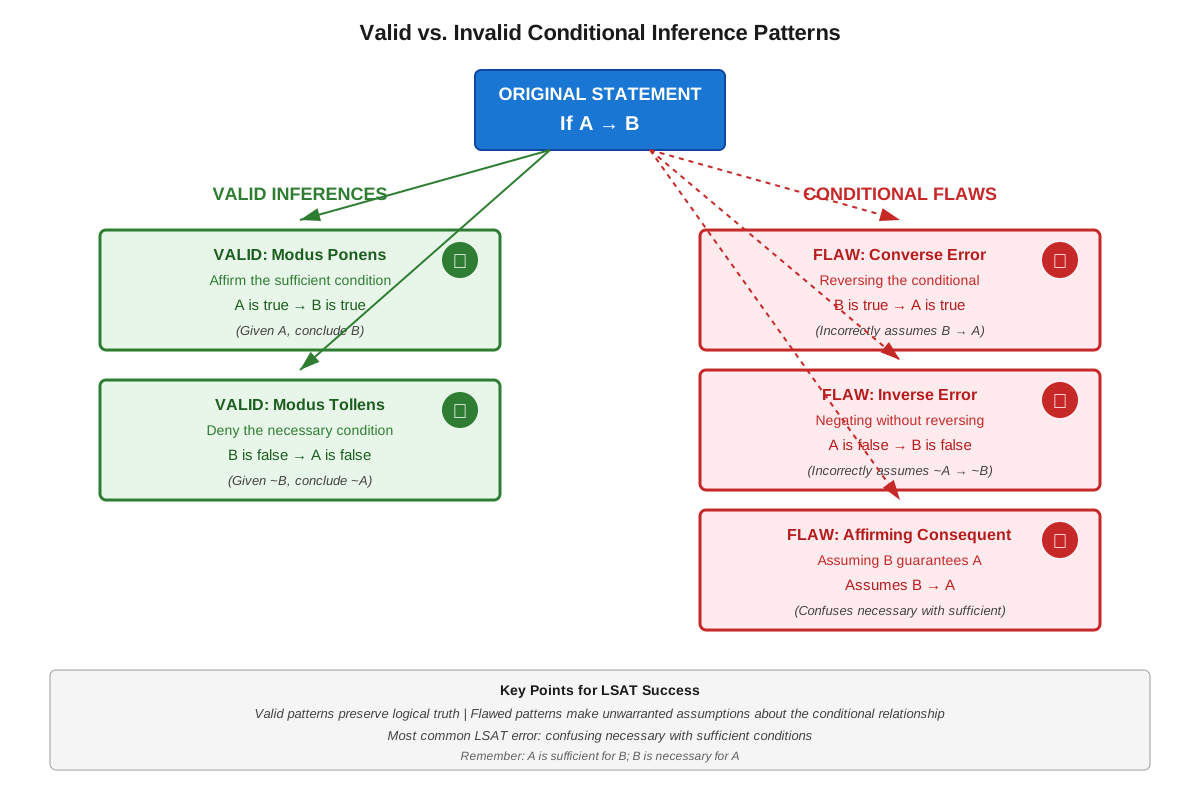
The LSAT conditional flaw manifests in several predictable patterns: confusing a sufficient condition with a necessary condition, reversing the direction of a conditional statement (the converse error), negating both terms without reversing them (the inverse error), or negating and reversing incorrectly. These errors exploit common intuitive mistakes that test-takers make when processing "if-then" relationships. Mastering this topic requires both recognizing the formal logical structure and understanding why these patterns constitute flawed reasoning.
Within the broader landscape of LSAT Logical Reasoning, conditional flaws sit at the intersection of formal logic and critical reasoning. They connect directly to valid conditional reasoning patterns (such as modus ponens and modus tollens), assumption identification, and sufficient/necessary condition analysis. Questions testing conditional flaws appear most commonly in Flaw in the Reasoning questions, but also surface in Parallel Flaw, Weaken, Strengthen, and Necessary Assumption question types. The ability to spot and articulate these errors provides a foundation for understanding more complex logical structures throughout the exam.
Learning Objectives
- [ ] Identify how Conditional flaw appears in LSAT questions
- [ ] Explain the reasoning pattern behind Conditional flaw
- [ ] Apply Conditional flaw to solve LSAT-style problems accurately
- [ ] Distinguish between the four major types of conditional flaws (converse, inverse, negation, and necessity/sufficiency confusion)
- [ ] Translate conditional statements from natural language into formal logical notation
- [ ] Predict answer choice language that correctly describes conditional flaws
- [ ] Recognize conditional flaws embedded within complex argument structures containing multiple conditional statements
Prerequisites
- Basic conditional logic structure: Understanding "if-then" statements and their components (sufficient and necessary conditions) is fundamental because conditional flaws involve the misapplication of these relationships
- Valid conditional inference patterns: Familiarity with modus ponens (affirming the sufficient) and modus tollens (denying the necessary) provides the baseline against which flawed reasoning is measured
- Logical notation: Ability to represent conditional statements symbolically (A → B) enables clearer analysis of where reasoning goes wrong
- Argument structure identification: Recognizing premises and conclusions allows students to isolate where the conditional error occurs within an argument's reasoning chain
Why This Topic Matters
Conditional flaws represent a critical vulnerability in everyday reasoning that the LSAT exploits systematically. In real-world contexts, people regularly confuse correlation with causation, mistake necessary conditions for sufficient ones, or assume that reversing a true statement preserves its truth. Legal reasoning demands precision in understanding conditional relationships—contract law, statutory interpretation, and precedent application all require careful attention to the direction and nature of conditional claims. Attorneys must distinguish between what is required for a legal outcome versus what guarantees that outcome.
On the LSAT, conditional flaws appear with remarkable frequency and predictability. Approximately 3-5 questions per Logical Reasoning section involve conditional reasoning errors, accounting for roughly 15-20% of all scored questions. These questions appear most commonly as Flaw in the Reasoning questions (where test-takers must identify the error) and Parallel Flaw questions (where test-takers must match the flawed reasoning pattern). They also surface in Weaken questions (where the correct answer exploits the conditional gap), Strengthen questions (where the correct answer fills the conditional gap), and Necessary Assumption questions (where the assumption bridges the conditional error).
The LSAT presents conditional flaws in several characteristic ways: arguments about policies and their effects, scientific hypotheses and their predictions, categorical statements about groups, and causal claims. The test writers deliberately embed these flaws in complex language to obscure the underlying logical structure, using varied phrasing like "only if," "unless," "requires," "depends on," "whenever," and "provided that" to express conditional relationships. Success requires cutting through this linguistic complexity to identify the core logical error.
Core Concepts
The Structure of Conditional Statements
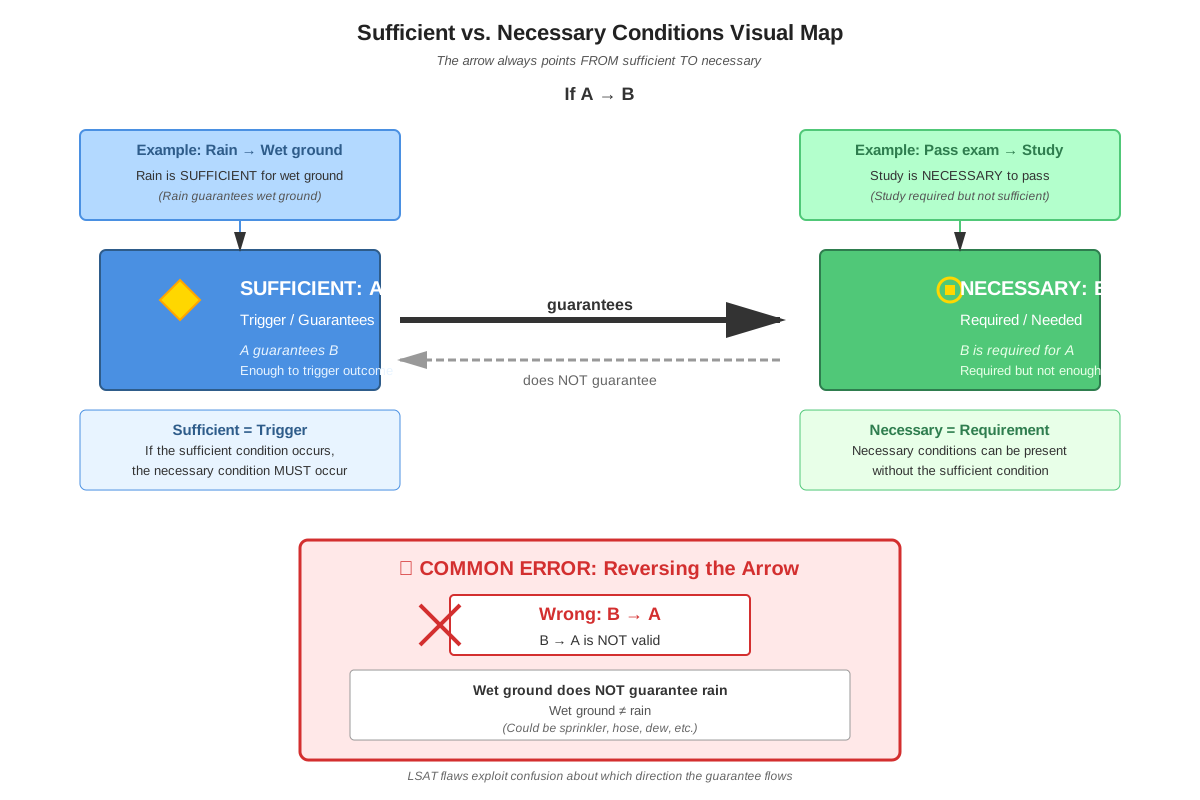
A conditional statement establishes a relationship between two conditions where one guarantees the other. The standard form is "If A, then B" (symbolized as A → B). The "if" clause (A) is the sufficient condition—its occurrence is sufficient to guarantee B. The "then" clause (B) is the necessary condition—it must occur whenever A occurs. Understanding this directional relationship is crucial because conditional flaws arise from mishandling this directionality.
Consider the statement: "If it rains, the ground gets wet." Rain is sufficient for wet ground (rain guarantees wetness), while wet ground is necessary for the conditional relationship (whenever it rains, wet ground must follow). However, wet ground is not sufficient for rain (other things cause wetness), and rain is not necessary for wet ground (sprinklers also cause wetness).
The Four Major Conditional Flaws
1. The Converse Error (Reversing)
The converse error occurs when an argument assumes that a conditional statement works in both directions. If the original statement is A → B, the converse error treats it as though B → A is also true. This is the most common conditional flaw on the LSAT.
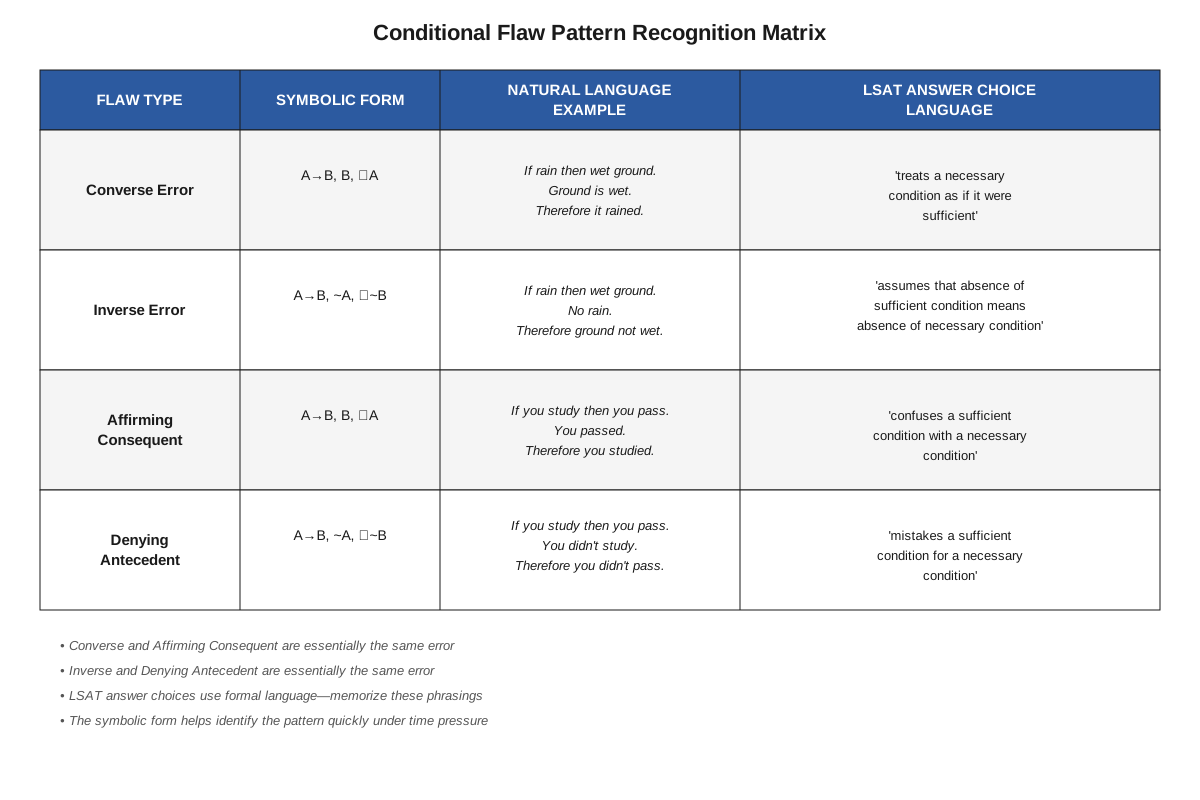
Example: "If you study hard, you will pass the exam. Sarah passed the exam, so she must have studied hard." The argument reverses the conditional relationship. Studying hard is sufficient for passing, but passing doesn't prove studying occurred—perhaps the exam was easy or Sarah was naturally talented.
2. The Inverse Error (Negating)
The inverse error occurs when an argument negates both terms of a conditional without reversing them. If the original statement is A → B, the inverse error treats "not A → not B" as valid. This error assumes that the absence of the sufficient condition guarantees the absence of the necessary condition.
Example: "If you study hard, you will pass the exam. John didn't study hard, so he will fail the exam." The argument negates both terms without reversing. The absence of studying doesn't guarantee failure—other factors might lead to passing.
3. The Contrapositive Confusion (Improper Negation)
While the contrapositive (not B → not A) is the only valid reversal of a conditional statement, arguments sometimes negate and reverse incorrectly. This creates a hybrid error combining elements of both the converse and inverse errors.
Example: "If you are a lawyer, you passed the bar exam. Tom didn't pass the bar exam, so he cannot be a lawyer." This reasoning is actually valid (it's proper contrapositive reasoning). The flaw occurs when arguments reverse without negating or negate without reversing properly.
4. Confusing Sufficient and Necessary Conditions
This flaw occurs when an argument treats a necessary condition as though it were sufficient, or vice versa. The argument recognizes that a condition is required but incorrectly concludes that meeting this requirement guarantees the outcome.
Example: "To become a doctor, you must attend medical school. Jennifer attended medical school, so she must be a doctor." Medical school is necessary for becoming a doctor but not sufficient—one must also complete residency, pass licensing exams, etc.
Formal Representation and Valid Inferences
Understanding what inferences ARE valid helps identify flaws by contrast:
| Original Statement | Valid Inference (Contrapositive) | Invalid Inference (Converse) | Invalid Inference (Inverse) |
|---|---|---|---|
| A → B | ~B → ~A | B → A | ~A → ~B |
| If rain, then wet | If not wet, then no rain | If wet, then rain | If no rain, then not wet |
The contrapositive is logically equivalent to the original statement and always valid. The converse and inverse are not logically equivalent and represent flawed reasoning patterns.
Recognizing Conditional Indicators in Natural Language
The LSAT rarely uses simple "if-then" language. Instead, conditional relationships appear through various linguistic markers:
Sufficient condition indicators (these introduce the "if" part):
- If, when, whenever, every time
- All, any, each, every
- People who, those who
Necessary condition indicators (these introduce the "then" part):
- Then, only, only if, only when
- Must, required, necessary, need
- Unless (introduces the necessary condition in negative form)
- Without, depends on, requires
Example translations:
- "All lawyers passed the bar" = If lawyer → passed bar
- "You can vote only if you're registered" = If vote → registered
- "Unless you study, you'll fail" = If not study → fail (or equivalently: If pass → studied)
Conditional Chains and Complex Structures
LSAT arguments often contain multiple conditional statements that chain together: A → B, B → C, therefore A → C. Conditional flaws in these contexts involve breaking the chain incorrectly, such as concluding C → A or assuming that ~A → ~C.
Example: "All doctors are educated. All educated people are respected. Therefore, all respected people are doctors." This commits the converse error on the entire chain. While doctor → educated → respected is valid, the conclusion reverses this to respected → doctor.
Concept Relationships
The concepts within conditional flaws form a hierarchical structure. At the foundation lies the basic conditional structure (sufficient → necessary), which establishes the directional relationship that all flaws violate. From this foundation, the four major flaw types branch out, each representing a specific way to mishandle the conditional relationship: the converse error reverses direction, the inverse error negates without reversing, the contrapositive confusion involves improper negation and reversal, and the sufficiency/necessity confusion mistakes which condition guarantees which.
These flaw types connect to valid inference patterns through contrast—understanding modus ponens (if A → B and A is true, then B is true) and modus tollens (if A → B and B is false, then A is false) illuminates why the converse and inverse are invalid. The contrapositive serves as the bridge between valid and invalid reasoning, being the only valid way to reverse and negate a conditional.
Linguistic indicators overlay all these concepts, providing the practical mechanism for identifying conditionals in natural language. These indicators connect to conditional chains, which represent more complex applications where multiple conditional statements interact. Finally, all these concepts feed into argument structure analysis, where conditional flaws appear embedded within broader reasoning patterns.
Relationship map: Basic Conditional Structure → Four Flaw Types → Valid Inference Patterns (by contrast) → Contrapositive (valid reversal) → Linguistic Indicators (recognition tool) → Conditional Chains (complex applications) → Argument Structure Analysis (practical application)
The connection to prerequisite topics is direct: basic conditional logic provides the framework, valid inference patterns provide the standard of correctness, and logical notation provides the analytical tool. Related topics include causal reasoning (which often involves conditional relationships), formal logic (which provides the theoretical foundation), and assumption questions (which often require identifying missing conditional links).
High-Yield Facts
⭐ The converse error (reversing A → B to conclude B → A) is the single most common conditional flaw on the LSAT
⭐ The contrapositive (~B → ~A) is the ONLY valid way to reverse a conditional statement
⭐ "Only if" introduces the necessary condition, not the sufficient condition (opposite of "if")
⭐ A necessary condition can be present without the sufficient condition being present—necessity doesn't guarantee sufficiency
⭐ "Unless" introduces a necessary condition in its negative form: "A unless B" means "If not B, then A" or equivalently "If not A, then B"
- The inverse error (negating both terms without reversing) is invalid because the absence of a sufficient condition doesn't guarantee the absence of the necessary condition
- Conditional chains are transitive: if A → B and B → C, then A → C is valid
- Multiple sufficient conditions can lead to the same necessary condition without any of them being necessary
- Confusing correlation with conditional relationship is a related but distinct error from pure conditional flaws
- In Flaw questions, correct answers describing conditional errors often use language like "treats a condition sufficient for X as though it were necessary for X" or "confuses a necessary condition with a sufficient condition"
- The phrase "if and only if" establishes a biconditional relationship where both directions are valid (A ↔ B)
- Conditional statements make no claim about what happens when the sufficient condition is absent
Quick check — test yourself on Conditional flaw so far.
Try Flashcards →Common Misconceptions
Misconception: If a conditional statement is true, its converse must also be true.
Correction: The converse (reversing the direction) is not logically valid. Only the contrapositive (reversing AND negating both terms) preserves logical validity. "If A then B" does not mean "If B then A."
Misconception: "Only if" means the same thing as "if."
Correction: "Only if" introduces the necessary condition, which is the opposite direction from "if." "You can vote only if you're registered" means registration is necessary for voting (If vote → registered), not that registration is sufficient for voting.
Misconception: A necessary condition must be present for the outcome to occur, so if the necessary condition is present, the outcome must occur.
Correction: Necessary conditions are required but not sufficient. Their presence doesn't guarantee the outcome. Oxygen is necessary for fire, but oxygen's presence doesn't guarantee fire—you also need fuel and heat.
Misconception: The inverse (negating both terms without reversing) is valid reasoning.
Correction: The inverse is a logical fallacy. "If A then B" does not mean "If not A then not B." The absence of a sufficient condition tells us nothing definitive about the necessary condition.
Misconception: Conditional flaws only appear in Flaw in the Reasoning questions.
Correction: While most common in Flaw questions, conditional errors appear across question types including Parallel Flaw, Weaken, Strengthen, Necessary Assumption, and Sufficient Assumption questions. The error might be what you're identifying, matching, exploiting, or fixing depending on question type.
Misconception: "Unless" means "if."
Correction: "Unless" introduces a necessary condition in negative form. "A unless B" translates to "If not B, then A" (or equivalently, "If not A, then B"). It's a necessary condition indicator, not a sufficient condition indicator.
Misconception: If multiple conditions are each sufficient for an outcome, then all of them together are necessary.
Correction: Multiple sufficient conditions can exist independently. If A → C and B → C, neither A nor B is necessary for C—either one alone is sufficient. The presence of multiple paths to an outcome doesn't make any particular path necessary.
Worked Examples
Example 1: Identifying the Converse Error
Argument: "The company policy states that any employee who works overtime will receive additional compensation. Since Marcus received additional compensation this month, he must have worked overtime."
Analysis:
Step 1: Identify the conditional statement in the premise.
- "Any employee who works overtime will receive additional compensation"
- Translation: If overtime → additional compensation
- Overtime is sufficient for additional compensation
Step 2: Identify what the conclusion claims.
- "Marcus received additional compensation, therefore he worked overtime"
- Translation: Additional compensation → overtime
- This reverses the direction of the original conditional
Step 3: Determine the flaw type.
- The argument observes the necessary condition (additional compensation) and concludes the sufficient condition (overtime) must have occurred
- This is the converse error—reversing the conditional relationship
- The flaw: additional compensation is necessary when overtime occurs, but additional compensation could occur for other reasons (bonuses, raises, commissions, etc.)
Step 4: Predict answer choice language.
- Look for descriptions like: "treats a condition sufficient for receiving additional compensation as though it were necessary for receiving additional compensation"
- Or: "mistakes a result of working overtime for something that can only result from working overtime"
- Or: "confuses being sufficient for an outcome with being required for that outcome"
Connection to learning objectives: This example demonstrates how to identify conditional flaws in LSAT questions (Objective 1), explains the converse error reasoning pattern (Objective 2), and shows the application process for solving these problems (Objective 3).
Example 2: Complex Conditional Chain with Necessity/Sufficiency Confusion
Argument: "To be admitted to the graduate program, applicants must have strong recommendation letters. Additionally, strong recommendation letters require that the applicant has formed meaningful relationships with professors. Chen has formed meaningful relationships with her professors, so she will certainly be admitted to the graduate program."
Analysis:
Step 1: Map out the conditional chain.
- Premise 1: If admitted → strong letters (strong letters are necessary for admission)
- Premise 2: If strong letters → meaningful relationships (relationships are necessary for strong letters)
- Chain: If admitted → strong letters → meaningful relationships
- Contrapositive chain: If no relationships → no strong letters → not admitted
Step 2: Identify what the conclusion claims.
- Chen has meaningful relationships → Chen will be admitted
- This reverses the entire conditional chain
Step 3: Identify the specific error.
- The argument treats a necessary condition (meaningful relationships) as though it were sufficient for the outcome (admission)
- Meaningful relationships are required for admission (via the chain), but they don't guarantee admission—other requirements might exist (test scores, GPA, research experience, etc.)
- This is a sufficiency/necessity confusion combined with a converse error on the chain
Step 4: Articulate why this is flawed.
- The argument establishes: Admission requires relationships (via the chain)
- The argument concludes: Relationships guarantee admission
- The gap: Just because X is necessary for Y doesn't mean X is sufficient for Y
- Analogy: Oxygen is necessary for fire, but oxygen alone doesn't create fire
Step 5: Predict answer choice language.
- "Treats a condition necessary for admission as though it were sufficient for admission"
- "Fails to consider that forming meaningful relationships, while necessary for admission, may not guarantee admission"
- "Confuses a requirement for admission with a guarantee of admission"
Connection to learning objectives: This example shows how conditional flaws appear in complex, multi-step arguments (Objective 1), explains the reasoning pattern of confusing necessary and sufficient conditions (Objective 2 and Objective 4), demonstrates translation from natural language to formal logic (Objective 5), and applies the analysis to solve the problem (Objective 3).
Exam Strategy
Recognition Strategy
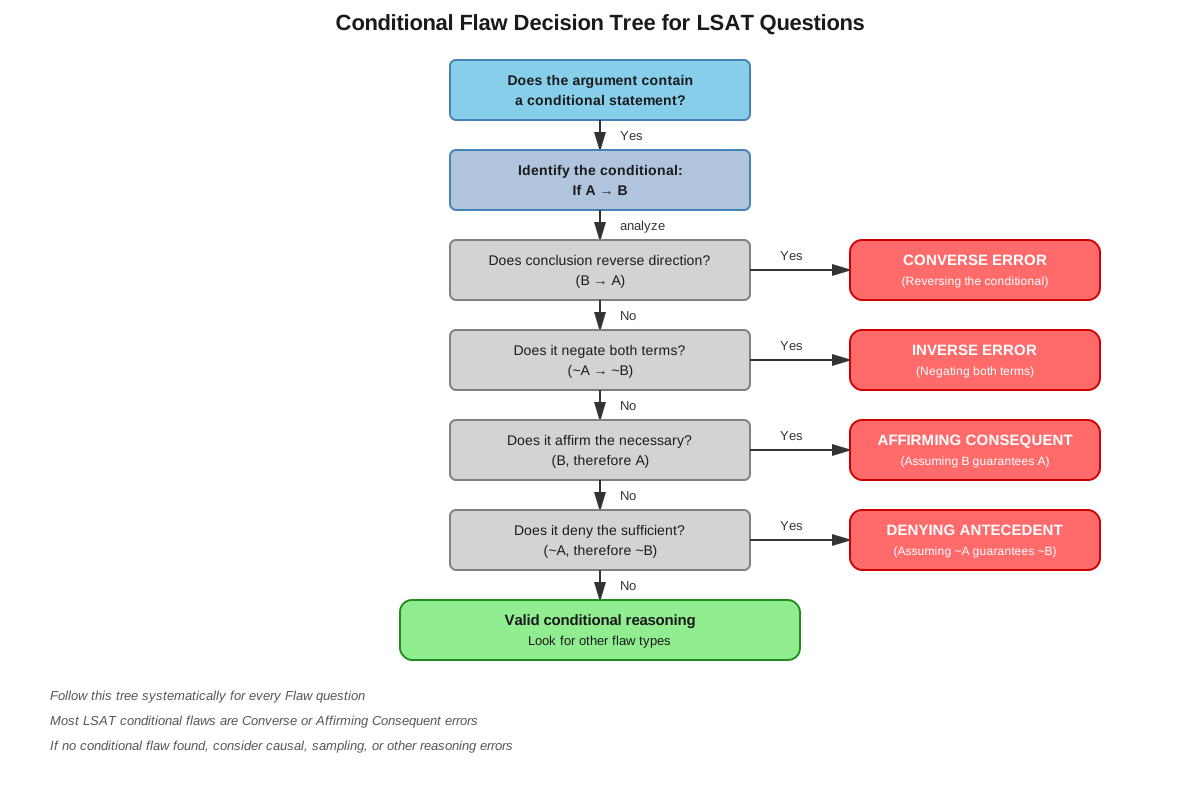
When approaching any Logical Reasoning question, immediately scan for conditional indicators: if, when, only if, unless, all, any, must, required, necessary. These trigger words signal that conditional logic is in play and that a conditional flaw might be present. Pay special attention to arguments that:
- Present a conditional rule or policy in the premise
- Observe one part of that conditional in a subsequent premise
- Draw a conclusion about the other part of the conditional
This three-step structure is the classic setup for conditional flaw arguments.
Translation Strategy
Exam Tip: Always translate conditional statements into formal notation (A → B) before analyzing the argument. This removes linguistic complexity and makes the logical structure transparent.
When you encounter conditional language:
- Identify which condition is sufficient (what guarantees what)
- Identify which condition is necessary (what must be present)
- Write the relationship with an arrow: sufficient → necessary
- Check what the conclusion does with these conditions
Question Type Specific Approaches
For Flaw in the Reasoning questions:
- After identifying the conditional error, predict answer choice language before reading options
- Correct answers typically use formal language: "treats X as sufficient when it's only necessary" or "mistakes a necessary condition for a sufficient condition"
- Eliminate answers that describe valid reasoning patterns or different flaw types
For Parallel Flaw questions:
- Map the conditional structure of the original argument symbolically (A → B, observe B, conclude A)
- Test each answer choice by mapping its structure
- Match the pattern exactly—if the original commits the converse error, the correct answer must also commit the converse error
For Weaken questions:
- Conditional flaws create gaps that Weaken questions exploit
- If an argument commits the converse error (A → B, observe B, conclude A), the correct answer often shows that B can occur without A
- Look for alternative explanations for the observed necessary condition
For Strengthen questions:
- The correct answer often provides the missing conditional link
- If the argument assumes B → A when only A → B is established, the strengthener might provide evidence that B → A is actually true
For Necessary Assumption questions:
- The assumption often bridges the conditional gap
- Use the negation test: if negating the answer choice destroys the argument, it's necessary
- The necessary assumption often rules out alternative sufficient conditions
Time Management
Conditional flaw questions should take 60-90 seconds once you've mastered the patterns. Spend:
- 20-30 seconds reading and translating the argument
- 10-20 seconds identifying the flaw type
- 10-15 seconds predicting answer choice language
- 20-30 seconds evaluating answer choices
If you find yourself spending more than 90 seconds, you may be overthinking. Trust your translation and pattern recognition.
Process of Elimination Tips
Eliminate answer choices that:
- Describe valid reasoning (especially contrapositive reasoning)
- Describe different flaw types (causal, sampling, equivocation)
- Use conditional language incorrectly (confusing which condition is sufficient vs. necessary)
- Are too vague to describe the specific conditional error
Keep answer choices that:
- Use precise language about sufficient and necessary conditions
- Accurately describe the direction of the error (reversing, negating, or confusing)
- Match your predicted answer
Memory Techniques
The "COIN" Mnemonic for Flaw Types
Converse: Changes direction (A → B becomes B → A)
Opposite: Opposite of both without reversing (A → B becomes ~A → ~B) [Inverse]
Improper: Improper negation and reversal [Contrapositive confusion]
Necessity: Necessary treated as sufficient
The "Only If" Reversal Trick
Remember: "Only if" points to the end of the arrow (necessary condition). The word "only" has five letters, and the necessary condition is at the "end" (also four letters, close enough). This helps you remember that "only if" introduces what must be present, not what guarantees the outcome.
The Contrapositive Flip-and-Negate
Visualize the contrapositive as a physical flip: imagine the conditional statement written on a card. To form the contrapositive, flip the card over (reversing the order) and put a negative sign on both conditions. This physical visualization helps remember that both operations (reversing AND negating) must occur together.
The Necessary ≠ Sufficient Mantra
Create a memorable phrase: "Necessary Never Nails it down" (three N's). Necessary conditions are required but don't guarantee the outcome—they never "nail down" or ensure the result. This helps remember that observing a necessary condition doesn't let you conclude the sufficient condition occurred.
The "Unless" Translation Formula
"A unless B" = "If not B, then A"
Remember: "Unless" = "If not" (the opposite of what follows "unless"). Visualize "unless" as a warning sign that means "if this doesn't happen, then..."
Alternative: "Unless" introduces what prevents the outcome. "You'll fail unless you study" means studying prevents failure, so "if you don't study, you'll fail."
Summary
Conditional flaws represent systematic errors in handling "if-then" relationships and constitute one of the highest-yield topics for LSAT Logical Reasoning preparation. These flaws occur when arguments reverse conditional statements (converse error), negate both terms without reversing (inverse error), improperly negate and reverse (contrapositive confusion), or treat necessary conditions as sufficient. Mastery requires three core skills: translating natural language into formal conditional notation, recognizing which valid inferences can be drawn from conditional statements, and identifying where arguments deviate from valid patterns. The contrapositive (reversing and negating both terms) is the only valid way to manipulate a conditional statement, while the converse and inverse represent invalid reasoning. Success on LSAT questions demands attention to conditional indicators like "if," "only if," "unless," "all," and "must," followed by careful analysis of whether the argument's conclusion follows logically from its conditional premises. These flaws appear across multiple question types but are most common in Flaw in the Reasoning and Parallel Flaw questions, where recognizing and articulating the specific error pattern is essential for selecting correct answers.
Key Takeaways
- The converse error (reversing A → B to B → A) is the most frequently tested conditional flaw on the LSAT
- Only the contrapositive (reversing AND negating: A → B becomes ~B → ~A) is logically valid
- "Only if" introduces the necessary condition (the "then" part), not the sufficient condition
- Necessary conditions are required but not sufficient—their presence doesn't guarantee the outcome
- Translate conditional statements into formal notation (A → B) to clarify the logical structure and identify flaws
- Conditional flaws appear across question types: Flaw, Parallel Flaw, Weaken, Strengthen, and Assumption questions
- The inverse error (negating without reversing) is invalid because the absence of a sufficient condition doesn't determine the necessary condition's status
Related Topics
Valid Conditional Reasoning: Understanding modus ponens, modus tollens, and proper contrapositive reasoning provides the foundation for recognizing when conditional reasoning is correct versus flawed. Mastering conditional flaws enables deeper understanding of valid inference patterns.
Necessary and Sufficient Assumptions: Many assumption questions require identifying missing conditional links or recognizing when an argument treats a necessary condition as sufficient. Conditional flaw mastery directly enables success on these question types.
Formal Logic: Advanced formal logic questions involve complex conditional chains, biconditionals, and multiple overlapping conditional relationships. The pattern recognition developed through conditional flaw study transfers directly to these more complex structures.
Causal Reasoning: Causal arguments often contain implicit conditional claims ("If cause, then effect"). Understanding conditional flaws helps identify when causal arguments improperly reverse or confuse the causal relationship.
Parallel Reasoning: Both Parallel Reasoning and Parallel Flaw questions require matching logical structures. The ability to abstract conditional patterns from natural language, developed through conditional flaw study, is essential for these question types.
Practice CTA
Now that you understand the patterns behind conditional flaws, it's time to cement this knowledge through active practice. Attempt the practice questions associated with this topic, focusing on translating each argument into formal notation before identifying the flaw. Use the flashcards to drill conditional indicators and flaw types until recognition becomes automatic. Remember: conditional flaws appear in 15-20% of Logical Reasoning questions, making this one of the highest-return investments of your study time. Each question you practice strengthens your pattern recognition and builds the speed necessary for test-day success. You've learned the framework—now apply it to achieve mastery.
Sign up free to keep reading
Create a free AnvayaPrep account to finish this LSAT guide on Conditional flaw — plus flashcards and practice questions.