Overview
Conditional weaken questions represent a sophisticated fusion of two critical LSAT skills: understanding conditional logic structures and identifying how to undermine arguments. These questions challenge test-takers to recognize when an argument relies on a conditional relationship (if-then reasoning) and then determine which answer choice most effectively weakens that conditional claim. Unlike standard weaken questions that may target various logical vulnerabilities, conditional weaken questions specifically require students to understand how conditional statements function and where they are most susceptible to attack.
Mastering this topic is essential for LSAT success because conditional reasoning permeates the Logical Reasoning section. The LSAT frequently constructs arguments around conditional claims—statements that establish relationships between sufficient and necessary conditions. When these conditional structures appear in weaken questions, students must not only identify the conditional relationship but also recognize the specific ways such relationships can be undermined: by showing the sufficient condition can occur without the necessary condition, by demonstrating alternative causes, or by revealing that the conditional relationship doesn't hold in relevant circumstances.
This topic sits at the intersection of conditional logic fundamentals and argument evaluation skills. While basic conditional logic teaches students to diagram and understand if-then relationships, and standard weaken questions teach how to undermine conclusions, conditional weaken questions demand simultaneous application of both skill sets. Success requires recognizing conditional indicators, accurately mapping logical relationships, understanding what would make a conditional claim false, and selecting answer choices that exploit these vulnerabilities. This integration makes conditional weaken questions among the most challenging—and most frequently tested—question types in Logical Reasoning.
Learning Objectives
- [ ] Identify how Conditional weaken appears in LSAT questions
- [ ] Explain the reasoning pattern behind Conditional weaken
- [ ] Apply Conditional weaken to solve LSAT-style problems accurately
- [ ] Distinguish between conditional weaken questions and other weaken question subtypes
- [ ] Recognize the specific vulnerabilities inherent in conditional reasoning structures
- [ ] Evaluate answer choices by testing them against conditional relationships
- [ ] Construct counterexamples that effectively undermine conditional claims
Prerequisites
- Basic Conditional Logic: Understanding sufficient and necessary conditions is fundamental because conditional weaken questions require recognizing these relationships before attacking them
- Conditional Indicators: Familiarity with words like "if," "only if," "unless," "whenever" enables quick identification of conditional structures in arguments
- Contrapositive Formation: Knowing how to form and apply contrapositives helps identify all logical implications of a conditional statement
- Standard Weaken Questions: General experience with weakening arguments provides the foundation for the specialized skill of weakening conditional claims
- Argument Structure: Ability to identify premises and conclusions allows students to locate where conditional reasoning appears in an argument
Why This Topic Matters
In real-world reasoning, conditional claims are everywhere: legal precedents ("if these conditions are met, then this ruling applies"), scientific hypotheses ("if this variable increases, then that outcome follows"), and policy arguments ("if we implement this measure, then we'll achieve that result"). The ability to critically evaluate such conditional reasoning—to identify when these if-then relationships might not hold—is fundamental to legal thinking, which is precisely what the LSAT assesses.
On the LSAT itself, conditional weaken questions appear with remarkable frequency. Approximately 15-20% of all Logical Reasoning questions involve conditional logic, and among weaken questions specifically, conditional structures appear in roughly 25-30% of cases. This translates to 3-5 conditional weaken questions per test, making this one of the highest-yield topics for score improvement. These questions typically appear at medium to high difficulty levels, often serving as the questions that separate good scores from excellent ones.
Conditional weaken appears in several distinct formats on the exam. Most commonly, the stimulus presents an argument whose conclusion is itself a conditional claim ("If X, then Y"), and the question asks which answer choice most weakens this conclusion. Alternatively, the argument might rely on an unstated conditional assumption, requiring test-takers to identify and then undermine that hidden conditional relationship. Some questions present causal arguments that can be reframed as conditional claims, testing whether students recognize that causation implies a conditional relationship. Finally, some stimuli contain explicit conditional premises that the argument misapplies or overgeneralizes, and the correct answer exposes this flaw.
Core Concepts
Understanding Conditional Statements in Arguments
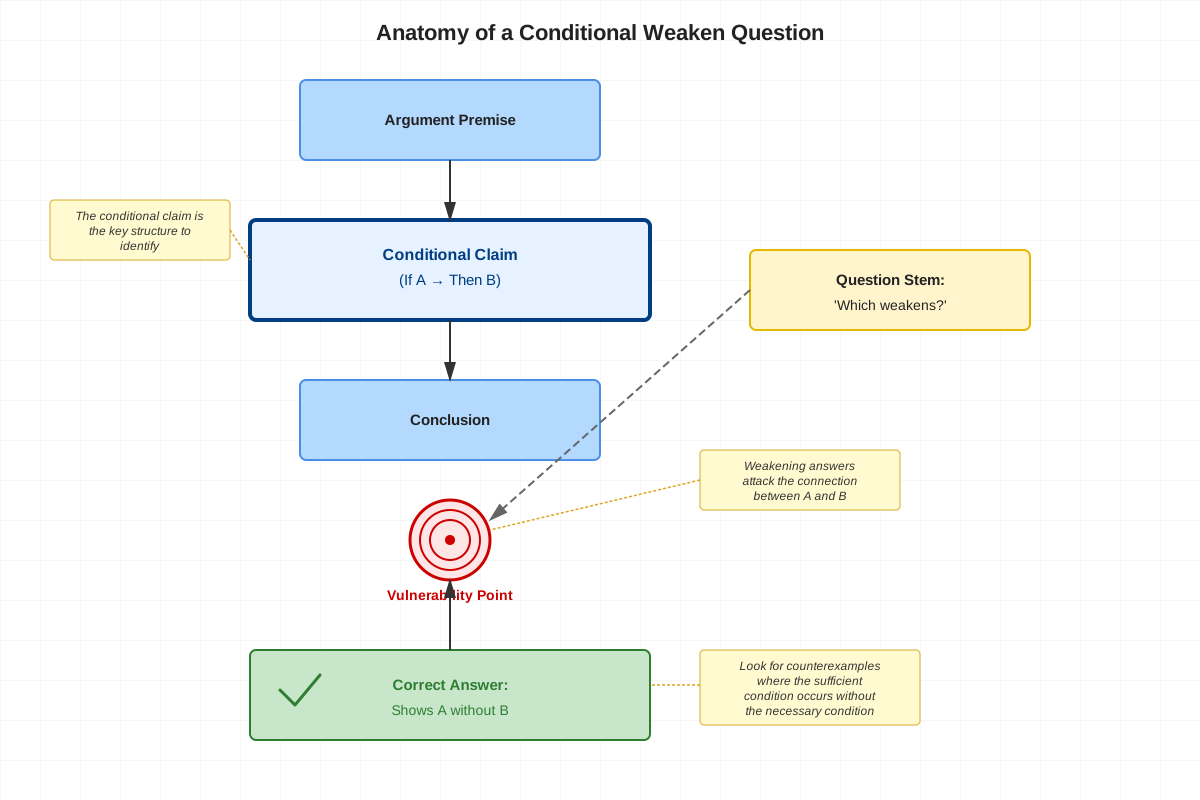
A conditional statement establishes a relationship between two conditions: a sufficient condition (the "if" part) and a necessary condition (the "then" part). In LSAT conditional weaken questions, arguments frequently conclude with or rely upon such statements. The basic structure is: "If A, then B" (symbolized as A → B), meaning that whenever A occurs, B must also occur. The sufficient condition (A) is enough to guarantee the necessary condition (B), while the necessary condition (B) must be present whenever the sufficient condition (A) is present.
In argument contexts, conditional claims often appear disguised in various linguistic forms. An argument might state "All lawyers must pass the bar exam" (Lawyer → Pass Bar), or "Economic growth occurs only when investment increases" (Economic Growth → Investment Increase), or "The policy will fail unless we secure funding" (¬Funding → Fail, or equivalently, ¬Fail → Funding). Recognizing these varied formulations as conditional statements is the first critical step in addressing conditional weaken questions.
How Conditional Relationships Can Be Weakened
To weaken a conditional claim effectively, one must understand what would make it false. A conditional statement "If A, then B" is false only when the sufficient condition occurs without the necessary condition—that is, when we have A but not B. This is the fundamental vulnerability of any conditional claim. Therefore, the most direct way to weaken a conditional argument is to provide evidence that A can occur without B, or that A has occurred without B in relevant circumstances.
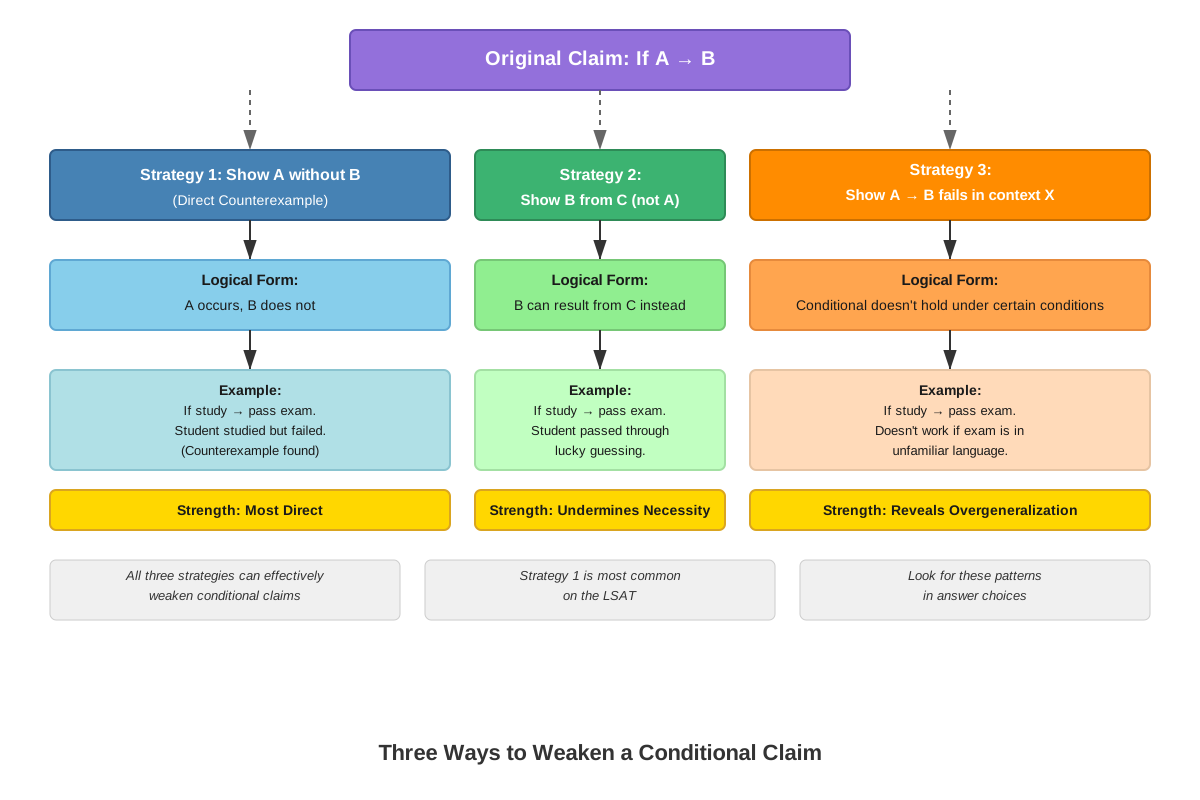
However, LSAT conditional weaken questions rarely present such straightforward counterexamples. Instead, they test more nuanced understanding through several common weakening strategies:
- Showing Alternative Sufficient Conditions: If an argument assumes "If A, then B" is the only way to achieve B, showing that C can also lead to B weakens the claim's significance
- Demonstrating Conditional Failure: Providing cases where A occurred but B did not directly contradicts the conditional relationship
- Revealing Unstated Necessary Conditions: Showing that the conditional relationship only holds when additional conditions are met (If A and C, then B, not just If A, then B)
- Exposing Reversed Logic: Arguments sometimes confuse "If A, then B" with "If B, then A"—showing this reversal is invalid weakens the reasoning
Conditional Assumptions in Arguments
Many logical reasoning questions involve arguments that don't explicitly state a conditional relationship but rely on one as an unstated assumption. For example, an argument might conclude "The company will succeed" based on the premise "The company has secured funding." This reasoning assumes an unstated conditional: "If a company secures funding, then it will succeed" (Funding → Success). Recognizing such hidden conditional assumptions is crucial because they represent prime targets for weakening.
To identify conditional assumptions, look for gaps between premises and conclusions where an if-then relationship would bridge the logical distance. The argument structure typically presents a fact (A is true) and concludes something else (therefore B is true), implicitly assuming A → B. Weakening such arguments requires attacking this assumed conditional relationship by showing that A doesn't guarantee B, or that other factors are necessary for B to follow from A.
Distinguishing Conditional Weaken from Other Question Types
| Question Type | Focus | How to Weaken |
|---|---|---|
| Conditional Weaken | If-then relationship | Show sufficient condition without necessary condition |
| Causal Weaken | Cause-effect claim | Alternative causes, reversed causation, correlation without causation |
| Statistical Weaken | Numerical/percentage claim | Sample bias, unrepresentative data, confounding variables |
| Analogy Weaken | Comparison between cases | Relevant differences between compared situations |
While these categories overlap (causal claims can be expressed conditionally), recognizing the primary logical structure helps select the most effective weakening strategy. Conditional weaken questions specifically target the logical relationship between conditions, not merely the factual accuracy of individual claims.
The Contrapositive in Weakening
Understanding the contrapositive is essential for comprehensive evaluation of conditional claims. The contrapositive of "If A, then B" is "If not B, then not A" (¬B → ¬A), and these statements are logically equivalent—they always have the same truth value. This means that weakening a conditional statement also weakens its contrapositive, and vice versa.
In practical terms, if an argument concludes "If we implement the policy, costs will decrease" (Policy → Decrease Costs), the contrapositive is "If costs don't decrease, we didn't implement the policy" (¬Decrease Costs → ¬Policy). An answer choice that shows costs failing to decrease despite policy implementation weakens both the original statement and its contrapositive. Recognizing this equivalence prevents confusion when answer choices attack the conditional relationship from different angles.
Common Conditional Structures in LSAT Arguments
The LSAT employs several recurring conditional patterns that appear frequently in weaken questions:
Sufficient-Necessary Confusion: Arguments that treat a necessary condition as if it were sufficient, or vice versa. For example, concluding "If you study hard, you'll pass" when the evidence only supports "If you pass, you must have studied hard."
Conditional Chains: Arguments linking multiple conditional statements (A → B, B → C, therefore A → C). These can be weakened by breaking any link in the chain.
Unless Statements: The word "unless" introduces a necessary condition for the negation. "X will occur unless Y happens" means "If not Y, then X" or equivalently "If not X, then Y." Misinterpreting these structures creates vulnerabilities.
Conditional Generalizations: Arguments that establish a conditional rule based on limited evidence, vulnerable to counterexamples showing the rule doesn't hold universally.
Concept Relationships
The concepts within conditional weaken form an integrated system. Understanding begins with recognizing conditional statements in their various linguistic forms → this enables identifying the sufficient and necessary conditions → which allows determining what would make the conditional false → leading to evaluating answer choices for their ability to show the sufficient condition without the necessary condition.
Simultaneously, recognizing conditional assumptions (unstated if-then relationships) connects to argument structure analysis → identifying the gap between premises and conclusion → recognizing the conditional bridge the argument assumes → selecting answers that show this bridge is faulty.
The relationship to prerequisite topics is direct: basic conditional logic provides the foundation for understanding how conditional statements work → contrapositive formation extends this understanding to recognize all implications of a conditional claim → standard weaken questions provide the general framework for undermining arguments → conditional weaken applies this framework specifically to conditional structures.
Looking forward, mastering conditional weaken enables progression to sufficient assumption questions (which require strengthening conditional reasoning), necessary assumption questions (which test understanding of what conditional relationships require), and flaw questions (which often identify errors in conditional reasoning). The skill of analyzing conditional relationships also transfers to formal logic questions and logic games, where conditional rules govern the entire setup.
Quick check — test yourself on Conditional weaken so far.
Try Flashcards →High-Yield Facts
⭐ A conditional statement "If A, then B" is weakened by showing A can occur without B
⭐ The most common error in conditional reasoning is confusing sufficient and necessary conditions
⭐ Conditional weaken questions appear in 25-30% of all weaken questions on the LSAT
⭐ An unstated conditional assumption bridges the gap between premise and conclusion in many arguments
⭐ The contrapositive of a conditional statement is logically equivalent to the original statement
- Showing alternative ways to achieve the necessary condition doesn't weaken "If A, then B" unless the argument claims A is the only way
- "Unless" introduces a necessary condition for the negation: "X unless Y" means "If not Y, then X"
- Conditional chains (A → B → C) can be weakened by breaking any single link
- Reversing a conditional (treating "If A, then B" as "If B, then A") is a logical error called affirming the consequent
- Conditional statements can be weakened by showing they only hold under additional unstated conditions
- Causal claims can often be reframed as conditional statements: "X causes Y" implies "If X, then Y"
- Providing a single clear counterexample (A occurred but B didn't) is often sufficient to weaken a universal conditional claim
Common Misconceptions
Misconception: Any evidence against the conclusion weakens a conditional argument equally well.
Correction: Conditional weaken questions require specifically showing the sufficient condition can occur without the necessary condition. General evidence against the conclusion may not address the conditional relationship itself.
Misconception: Showing the necessary condition can occur without the sufficient condition weakens "If A, then B."
Correction: "If A, then B" allows B to occur without A—this doesn't weaken the conditional. Only showing A without B weakens the statement. The necessary condition can have multiple sufficient conditions.
Misconception: The contrapositive is a different claim that might be true even if the original conditional is false.
Correction: The contrapositive is logically equivalent to the original conditional statement. They must have the same truth value—if one is weakened, both are weakened equally.
Misconception: Conditional statements are weakened by showing they don't always lead to the necessary condition.
Correction: This is actually the correct way to weaken them, but the misconception is thinking "don't always" means "rarely." Even one legitimate counterexample weakens a universal conditional claim.
Misconception: In conditional weaken questions, the correct answer must completely disprove the conditional relationship.
Correction: Weaken questions ask which answer most weakens the argument, not which proves it false. The correct answer need only make the conditional claim less likely to hold, not impossible.
Misconception: Conditional statements in LSAT arguments always use explicit "if-then" language.
Correction: Conditional relationships appear in many linguistic forms: "all," "only," "unless," "whenever," "requires," "depends on," and others. Recognizing these varied formulations is essential.
Worked Examples
Example 1: Direct Conditional Weaken
Stimulus: "Companies that invest heavily in employee training consistently outperform their competitors. Therefore, if a company wants to outperform its competitors, it should invest heavily in employee training."
Question: Which of the following, if true, most weakens the argument?
Analysis:
Step 1: Identify the conditional structure. The conclusion states: "If a company wants to outperform competitors, then it should invest heavily in employee training" (Want to Outperform → Invest in Training).
Step 2: Recognize the logical structure. The premise tells us that companies that invest in training outperform competitors (Invest in Training → Outperform). The argument reverses this to conclude that wanting to outperform means you should invest in training.
Step 3: Identify the vulnerability. The argument commits a sufficient-necessary confusion. The premise establishes that training investment is sufficient for outperformance, but the conclusion treats it as necessary for outperformance. The argument also assumes training investment is the only or best way to achieve outperformance.
Step 4: Determine what would weaken this. Evidence that companies can outperform competitors without investing heavily in training would weaken the conditional conclusion. Alternatively, showing that training investment doesn't reliably lead to outperformance would weaken the premise.
Correct Answer Type: "Many companies outperform their competitors through superior product innovation rather than employee training investment."
Why this weakens: This shows that the necessary condition (outperforming competitors) can be achieved without the sufficient condition (training investment), directly undermining the conditional claim that training investment is required for outperformance.
Example 2: Hidden Conditional Assumption
Stimulus: "The new medication has been shown to reduce symptoms in 85% of patients in clinical trials. The clinical trials included only patients with severe cases of the disease. Therefore, the medication will be effective for patients with mild cases of the disease."
Question: Which of the following, if true, most weakens the argument?
Analysis:
Step 1: Identify the argument structure. Premise: medication works for severe cases. Conclusion: medication will work for mild cases.
Step 2: Recognize the unstated conditional assumption. The argument assumes: "If the medication works for severe cases, then it will work for mild cases" (Works for Severe → Works for Mild).
Step 3: Identify the vulnerability. This conditional assumption is unstated and undefended. The argument provides no evidence that effectiveness in severe cases translates to effectiveness in mild cases.
Step 4: Determine what would weaken this. Evidence showing that the medication's mechanism or effectiveness differs between severe and mild cases would break the assumed conditional relationship. Showing that severe cases respond to treatments that don't work for mild cases would be particularly effective.
Correct Answer Type: "The medication works by targeting a specific protein that is present in high concentrations in severe cases but largely absent in mild cases of the disease."
Why this weakens: This directly attacks the unstated conditional assumption by showing that the sufficient condition (working for severe cases) doesn't guarantee the necessary condition (working for mild cases). The mechanism that makes it effective for severe cases doesn't apply to mild cases, breaking the conditional relationship.
Exam Strategy
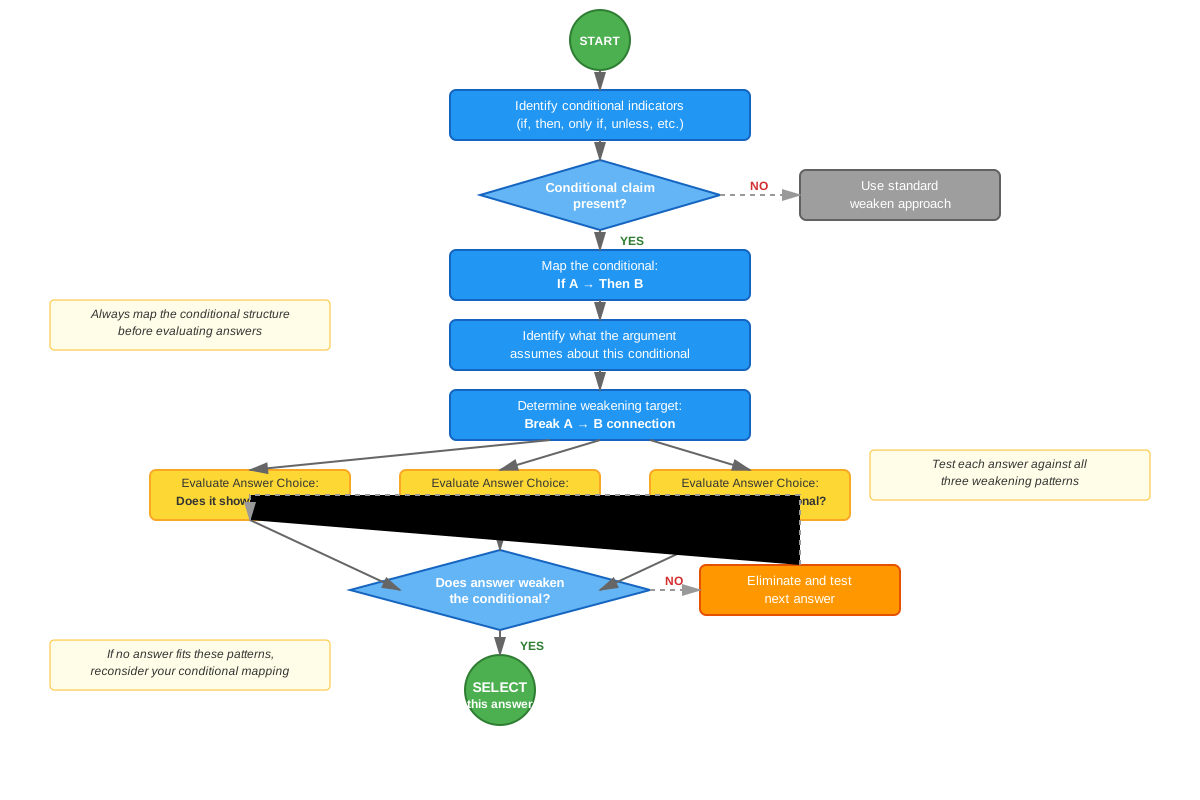
When approaching LSAT conditional weaken questions, follow this systematic process:
Step 1: Identify Conditional Indicators (15-20 seconds)
Scan the stimulus for conditional language: "if," "then," "only if," "unless," "all," "any," "whenever," "requires," "depends on," "necessary," "sufficient." Circle or mentally note these indicators.
Step 2: Diagram the Conditional Relationship (10-15 seconds)
Quickly diagram the main conditional claim, whether explicit or assumed. Use arrows (→) to map sufficient to necessary conditions. If the argument contains multiple conditional statements, diagram the chain.
Step 3: Identify the Argument's Vulnerability (10-15 seconds)
Ask: "What would make this conditional claim false?" The answer is always: showing the sufficient condition without the necessary condition. Also consider: Does the argument confuse sufficient and necessary? Does it assume this is the only conditional relationship? Does it overgeneralize from limited cases?
Step 4: Predict the Correct Answer (5-10 seconds)
Before reading answer choices, predict what type of information would weaken the conditional relationship. This prediction prevents distraction from attractive wrong answers.
Step 5: Evaluate Answer Choices (30-40 seconds)
Test each answer against the conditional relationship. Ask: "Does this show the sufficient condition occurring without the necessary condition?" or "Does this reveal an unstated condition that must also be present?"
Exam Tip: The word "only" is a necessary condition indicator. "Only if B" means B is necessary, so "A only if B" translates to A → B. Many wrong answers exploit confusion about "only."
Trigger Words to Watch For:
- "All": Introduces a sufficient condition (All A are B = A → B)
- "Only": Introduces a necessary condition (Only B are A = A → B)
- "Unless": Introduces a necessary condition for the negation (A unless B = ¬B → A)
- "Requires": Introduces a necessary condition (A requires B = A → B)
- "Depends on": Introduces a necessary condition (A depends on B = A → B)
Process of Elimination Tips:
- Eliminate answers that show the necessary condition without the sufficient condition—this doesn't weaken the conditional
- Eliminate answers that strengthen the conditional relationship by providing supporting examples
- Eliminate answers that are irrelevant to the specific conditional relationship in the argument
- Be cautious of answers that weaken the conclusion but don't address the conditional reasoning
- Watch for answers that attack a different conditional relationship than the one in the argument
Time Allocation: Spend 1:20-1:30 on conditional weaken questions. They require more careful analysis than standard weaken questions but shouldn't consume excessive time. If you're spending more than 1:45, you may be overanalyzing—trust your diagram and move forward.
Memory Techniques
Mnemonic for Weakening Conditionals: "SWAN"
- Sufficient without
- Without
- Achieving
- Necessary
Remember: Show the Sufficient condition Without Achieving the Necessary condition.
Visualization Strategy: Picture a bridge connecting two islands (sufficient condition island and necessary condition island). The conditional statement claims this bridge is reliable—whenever you're on the sufficient island, the bridge takes you to the necessary island. Weakening the conditional means showing the bridge is broken: you can be on the sufficient island without reaching the necessary island.
Acronym for Conditional Indicators: "IF ONLY UNLESS"
- IF: Standard sufficient condition indicator
- ONLY: Necessary condition indicator (remember: "only" flips the direction)
- UNLESS: Necessary condition for the negation
Memory Palace Technique: Associate each type of conditional weakness with a room in a familiar building:
- Front Door: Direct counterexample (sufficient without necessary)
- Kitchen: Alternative sufficient conditions (other ways to cook up the necessary condition)
- Basement: Hidden necessary conditions (foundations that must be present)
- Attic: Reversed logic (things turned upside down)
Summary
Conditional weaken questions test the ability to identify, analyze, and undermine if-then reasoning structures in LSAT arguments. These questions require recognizing conditional relationships in various linguistic forms, understanding the distinction between sufficient and necessary conditions, and determining how to make conditional claims false. The fundamental principle is that a conditional statement "If A, then B" is weakened by evidence showing A can occur without B—the sufficient condition without the necessary condition. However, LSAT questions complicate this by embedding conditional relationships within complex arguments, using varied conditional indicators, presenting unstated conditional assumptions, and offering answer choices that attack the reasoning from multiple angles. Success requires systematic analysis: identify conditional indicators, diagram the relationship, recognize the specific vulnerability, predict what would weaken it, and evaluate answer choices against the conditional structure. Mastering this topic is essential because conditional reasoning appears throughout the LSAT, and conditional weaken questions represent a significant portion of medium-to-high difficulty Logical Reasoning questions that separate strong scores from exceptional ones.
Key Takeaways
- Conditional weaken questions require showing the sufficient condition can occur without the necessary condition to undermine if-then relationships
- Conditional statements appear in many linguistic forms beyond "if-then," including "all," "only," "unless," and "requires"
- The most common vulnerability is confusing sufficient and necessary conditions—treating what's necessary as if it were sufficient, or vice versa
- Many arguments rely on unstated conditional assumptions that bridge the gap between premises and conclusions
- The contrapositive is logically equivalent to the original conditional statement, so weakening one weakens both
- Systematic diagramming of conditional relationships prevents errors and speeds up analysis
- Correct answers specifically target the conditional relationship, not just the conclusion generally
Related Topics
Sufficient Assumption Questions: After mastering how to weaken conditional reasoning, students can learn how to strengthen it by providing sufficient assumptions that guarantee conclusions. This involves identifying what conditional relationship would make an argument valid.
Necessary Assumption Questions: These questions test understanding of what conditional relationships an argument requires. Mastering conditional weaken provides the foundation for recognizing what must be true for conditional reasoning to work.
Flaw Questions: Many flaw questions identify errors in conditional reasoning—confusing sufficient and necessary conditions, reversing conditionals, or assuming conditional relationships without justification. Understanding conditional weaken helps recognize these flaws.
Formal Logic and Logic Games: The conditional reasoning skills developed through conditional weaken questions transfer directly to formal logic questions and logic games, where conditional rules govern entire scenarios and must be applied systematically.
Practice CTA
Now that you understand the mechanics and strategy of conditional weaken questions, it's time to apply this knowledge. Work through the practice questions to test your ability to identify conditional structures, recognize their vulnerabilities, and select answers that effectively undermine conditional reasoning. Use the flashcards to reinforce your recognition of conditional indicators and common weakening patterns. Remember: conditional logic is one of the most learnable and improvable skills on the LSAT. With systematic practice, you'll develop the pattern recognition and analytical speed that transforms these challenging questions into opportunities to demonstrate your mastery. Each practice question you complete strengthens your ability to see through complex arguments to the underlying conditional structures—exactly the skill the LSAT rewards with higher scores.
Sign up free to keep reading
Create a free AnvayaPrep account to finish this LSAT guide on Conditional weaken — plus flashcards and practice questions.