Overview
Flaw questions represent one of the most frequently tested question types in the LSAT's Logical Reasoning sections, appearing approximately 4-6 times per test. These questions ask test-takers to identify the specific error in reasoning that undermines an argument's validity. Unlike questions that ask whether an argument is strong or weak, flaw questions require precise identification of how and why the reasoning fails. Mastering this question type is essential because it directly tests the ability to analyze argumentative structure—a core skill measured throughout the LSAT and fundamental to legal reasoning.
Flaw questions build upon foundational skills in argument analysis, including identifying premises, conclusions, and assumptions. However, they require an additional layer of critical thinking: recognizing the gap between what the argument establishes and what it claims to prove. The test-taker must understand not just that something is wrong, but must articulate the specific logical misstep the author commits. This precision distinguishes flaw questions from other Logical Reasoning question types and makes them particularly valuable for law school preparation, where identifying weaknesses in legal arguments is paramount.
Within the broader landscape of LSAT flaw questions, these items connect intimately with assumption questions, strengthen/weaken questions, and parallel reasoning questions. All these question types require understanding how arguments can fail, but flaw questions demand explicit recognition and naming of the error. Success on flaw questions translates directly to improved performance across multiple Logical Reasoning question types, making this topic a high-leverage area for score improvement.
Learning Objectives
- [ ] Identify how Flaw questions appears in LSAT questions
- [ ] Explain the reasoning pattern behind Flaw questions
- [ ] Apply Flaw questions to solve LSAT-style problems accurately
- [ ] Categorize flaws into common types (e.g., causal, sampling, sufficiency/necessity confusion)
- [ ] Distinguish between the flaw in an argument and the correct answer choice that describes it
- [ ] Predict common flaws before reading answer choices to improve accuracy and speed
Prerequisites
- Argument structure identification: Understanding premises and conclusions is essential because flaw questions require analyzing how premises fail to support conclusions
- Conditional reasoning basics: Many flaws involve misunderstanding necessary and sufficient conditions, making familiarity with "if-then" logic crucial
- Causal reasoning fundamentals: Recognizing cause-and-effect relationships helps identify when arguments make unwarranted causal claims
- Basic logical validity: Understanding what makes an argument valid versus invalid provides the foundation for recognizing specific reasoning errors
Why This Topic Matters
Flaw questions constitute approximately 15-20% of all Logical Reasoning questions on the LSAT, making them one of the highest-frequency question types. In a typical LSAT, test-takers encounter 8-12 flaw questions across both Logical Reasoning sections. This frequency alone makes mastery essential for achieving competitive scores, but the importance extends beyond mere quantity.
The skills developed through flaw question practice transfer directly to legal practice. Attorneys must constantly evaluate opposing arguments, identify weaknesses in reasoning, and articulate precisely why a particular line of reasoning fails. Law school classes, particularly during the first year, emphasize case analysis where students must recognize flawed judicial reasoning or distinguish between holdings and dicta based on logical soundness.
On the exam itself, flaw questions typically appear in several predictable formats. The most common question stem is "The reasoning in the argument is flawed because it..." or "The argument is vulnerable to criticism on the grounds that it..." These questions may present arguments about scientific studies, political policies, business decisions, or everyday reasoning scenarios. The arguments are deliberately constructed to contain one clear, identifiable flaw that can be precisely described. Understanding the taxonomy of common flaws—from circular reasoning to false dichotomies—enables test-takers to quickly recognize patterns and eliminate incorrect answer choices efficiently.
Core Concepts
Understanding Flaw Question Structure
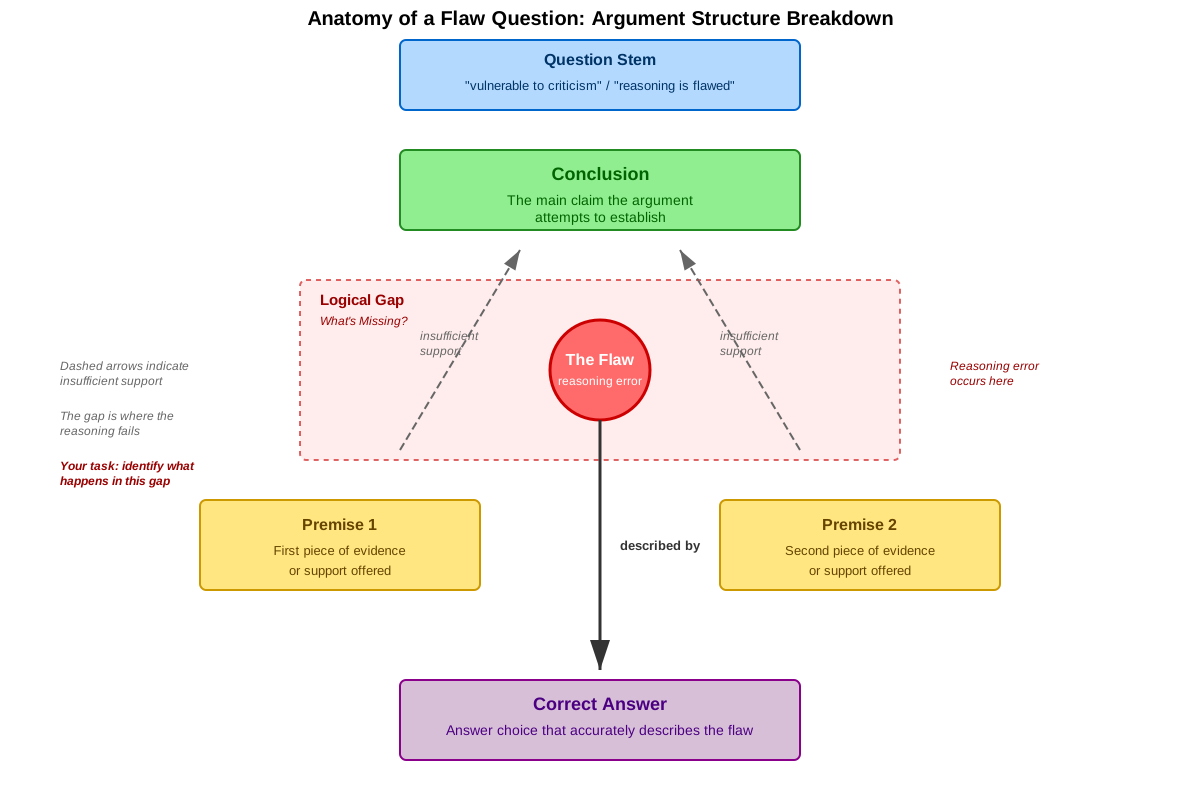
Flaw questions in logical reasoning follow a consistent structure that test-takers must recognize immediately. The stimulus presents an argument containing a specific reasoning error. The question stem explicitly asks the test-taker to identify this flaw. Answer choices describe various potential flaws, but only one accurately characterizes the error present in the stimulus.
The key to success lies in understanding that flaw questions test two distinct skills simultaneously: (1) recognizing that an argument contains a logical gap or error, and (2) matching that error to its precise technical description. Many test-takers can sense something is wrong with an argument but struggle to select the correct answer because they cannot articulate the specific nature of the flaw.
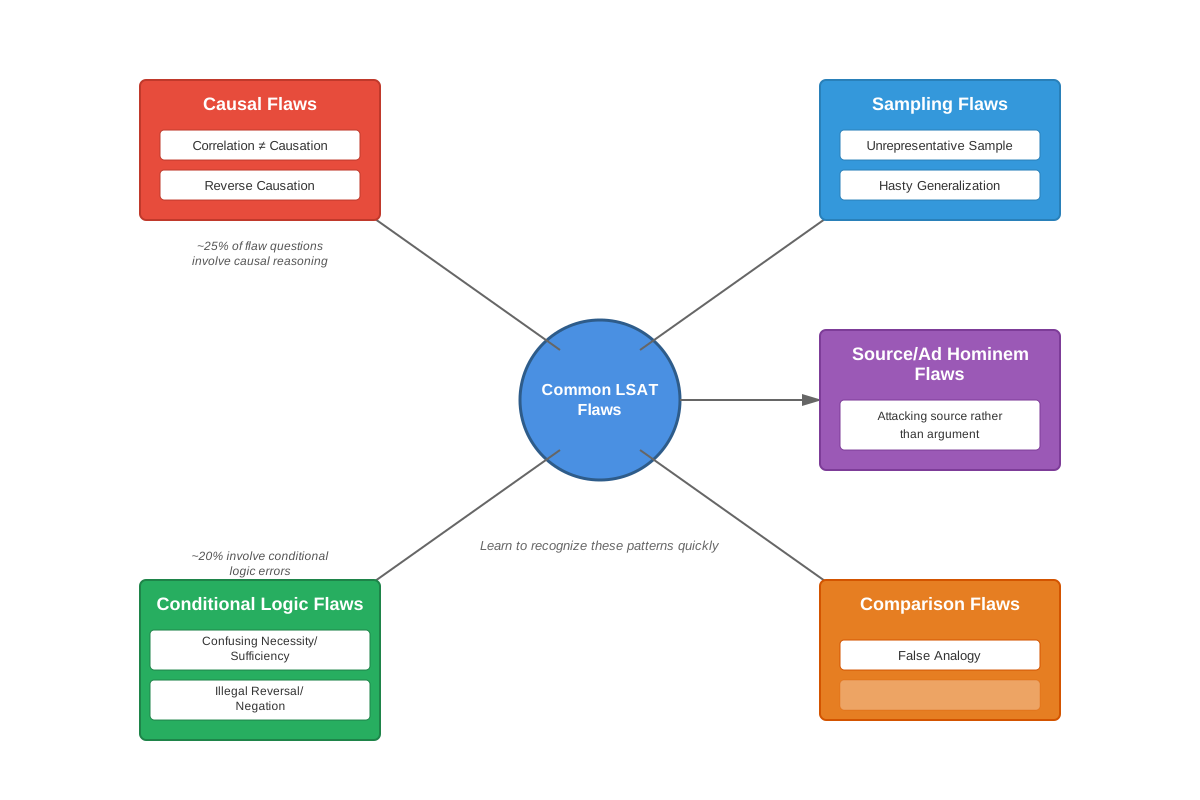
Common Flaw Categories
Causal Reasoning Flaws
Arguments frequently commit errors when establishing cause-and-effect relationships. The most common causal flaw involves confusing correlation with causation—observing that two phenomena occur together and concluding without sufficient evidence that one causes the other. For example, an argument might note that ice cream sales and drowning deaths both increase in summer and conclude that ice cream consumption causes drowning.
Related causal flaws include:
- Reversed causation: Assuming A causes B when B actually causes A
- Common cause neglect: Failing to consider that a third factor might cause both observed phenomena
- Temporal sequence error: Assuming that because A preceded B, A must have caused B (post hoc ergo propter hoc)
Sampling and Generalization Flaws
Arguments often draw conclusions about large groups based on insufficient or unrepresentative samples. A biased sample flaw occurs when an argument generalizes from a sample that systematically differs from the population of interest. For instance, concluding that all voters support a policy based solely on interviews conducted at a political rally for that policy's proponent.
The hasty generalization flaw involves drawing broad conclusions from too few instances, while the unrepresentative sample flaw involves using a sample that, regardless of size, doesn't reflect the relevant population's characteristics.
Sufficiency and Necessity Confusion
Many flaws stem from misunderstanding conditional relationships. A necessary/sufficient confusion occurs when an argument treats a necessary condition as if it were sufficient, or vice versa. For example:
- Necessary condition error: "To become a lawyer, one must attend law school. Therefore, everyone who attends law school becomes a lawyer." (Law school is necessary but not sufficient)
- Sufficient condition error: "Scoring 170+ on the LSAT is sufficient for admission to Harvard Law. Therefore, it is necessary for admission." (The condition is sufficient but not necessary)
Circular Reasoning
Circular reasoning (also called begging the question) occurs when an argument's conclusion is assumed in its premises. The argument provides no independent support for its conclusion because the premise merely restates the conclusion in different words. Example: "This law is just because it is fair, and we know it is fair because it is just."
False Dichotomy
A false dichotomy (or false dilemma) presents only two options when additional alternatives exist. The argument assumes that if one option is eliminated, the other must be true, ignoring middle ground or other possibilities. Example: "Either we ban all cars or accept environmental destruction" ignores regulatory middle grounds.
Ad Hominem and Source Attacks
Ad hominem flaws attack the person making an argument rather than addressing the argument's merits. Example: "The senator's tax proposal must be flawed because the senator was once convicted of tax evasion." The person's character doesn't determine whether their argument is logically sound.
Equivocation
Equivocation occurs when an argument uses a key term with multiple meanings, shifting between meanings to reach an invalid conclusion. Example: "Laws are rules that govern behavior. The law of gravity governs falling objects. Therefore, the law of gravity is a rule about behavior."
Appeal to Inappropriate Authority
This flaw involves citing an authority figure whose expertise doesn't extend to the topic under discussion. Example: "A famous actor endorses this economic policy, so it must be sound." The actor's fame doesn't establish economic expertise.
Recognizing Flaw Question Stems
Flaw questions use specific language patterns that signal their question type:
| Common Stem Language | What It Signals |
|---|---|
| "The reasoning is flawed because..." | Direct flaw identification |
| "Vulnerable to criticism on the grounds that..." | Identifying the argument's weakness |
| "The argument does which of the following?" | May describe a flaw indirectly |
| "The reasoning is questionable because..." | Flaw identification with softer language |
| "Fails to consider the possibility that..." | Often points to overlooked alternatives |
The Anatomy of Wrong Answer Choices
Understanding common wrong answer patterns helps eliminate incorrect options efficiently:
- Accurate but irrelevant: Describes something the argument actually does, but it isn't a flaw
- Flaw not present: Describes a legitimate flaw that simply doesn't appear in this argument
- Reverses the argument: Describes the opposite of what the argument actually claims
- Too extreme: Uses absolute language (always, never, only) when the argument is more moderate
- Confuses elements: Mixes up the argument's premises and conclusion
Concept Relationships
Flaw questions sit at the intersection of multiple Logical Reasoning skills. Understanding argument structure (premises and conclusions) provides the foundation, as one cannot identify how reasoning fails without first understanding what the argument attempts to prove and what evidence it offers.
Assumption questions and flaw questions are closely related: the assumption an argument requires often reveals its flaw. If an argument assumes X without justification, the flaw is often "fails to establish X" or "takes for granted that X." This relationship flows bidirectionally—practice with either question type strengthens performance on the other.
Strengthen and weaken questions also connect intimately with flaw questions. The information that would most strengthen an argument typically addresses its central flaw. Similarly, understanding an argument's flaw helps predict what information would weaken it most effectively.
The relationship map flows as follows:
Argument Structure Analysis → enables → Flaw Identification → informs → Assumption Recognition → guides → Strengthen/Weaken Strategy → all support → Overall Logical Reasoning Mastery
Within flaw questions themselves, recognizing flaw categories (causal, sampling, conditional, etc.) enables pattern recognition → which accelerates answer prediction → leading to efficient answer choice elimination → resulting in accurate answer selection.
Quick check — test yourself on Flaw questions so far.
Try Flashcards →High-Yield Facts
⭐ Flaw questions appear 8-12 times per LSAT, making them one of the highest-frequency question types across both Logical Reasoning sections.
⭐ The correct answer must describe a flaw actually present in the argument—even if other answer choices describe legitimate logical flaws, they're incorrect if those flaws don't appear in the stimulus.
⭐ Causal reasoning flaws are the most common flaw type, particularly confusing correlation with causation and failing to consider alternative explanations.
⭐ The argument's conclusion is always flawed in flaw questions—the premises may be assumed true, but they don't adequately support the conclusion.
⭐ Conditional reasoning flaws frequently involve treating necessary conditions as sufficient or vice versa, making this pattern recognition essential.
- Flaw questions test both recognition (identifying that something is wrong) and articulation (describing precisely what is wrong).
- Wrong answer choices often describe flaws the argument avoids or accomplishments the argument achieves, making careful reading essential.
- The phrase "takes for granted" in answer choices typically signals an assumption-based flaw description.
- Sampling flaws often involve representativeness issues—the sample differs systematically from the population of interest.
- Circular reasoning can be subtle, with the conclusion restated using synonyms or related concepts rather than identical language.
- Arguments containing statistical or numerical evidence frequently commit percentage-versus-absolute-number confusion flaws.
- The word "only" in answer choices often signals necessary/sufficient confusion or false dichotomy descriptions.
- Ad hominem flaws attack the source rather than the substance of an argument or claim.
- Equivocation flaws exploit multiple meanings of key terms, shifting definitions mid-argument.
- Many flaw questions can be pre-phrased—predicting the flaw before reading answer choices significantly improves accuracy.
Common Misconceptions
Misconception: If an argument's premises are false, that constitutes the flaw.
Correction: Flaw questions assess logical structure, not factual accuracy. Even if premises are factually questionable, the flaw lies in how the conclusion follows from those premises, not in the premises' truth value. The LSAT asks test-takers to assume premises are true and evaluate whether the conclusion logically follows.
Misconception: The longest or most complex answer choice is usually correct.
Correction: Answer choice length correlates poorly with correctness on flaw questions. Test-makers deliberately craft lengthy wrong answers that sound sophisticated but describe flaws not present in the argument. The correct answer precisely matches the argument's actual flaw, regardless of length.
Misconception: If an argument seems weak or unconvincing, any answer describing a flaw will work.
Correction: The correct answer must describe the specific flaw present in the argument. An argument might be weak for multiple reasons, but only one answer choice accurately characterizes the particular reasoning error the test-makers have constructed. Precision matters more than general weakness recognition.
Misconception: Flaw questions and weaken questions are essentially the same.
Correction: Flaw questions ask what's wrong with the argument as written, while weaken questions ask what additional information would undermine it. Flaw questions focus on internal logical structure; weaken questions introduce external information. The skills overlap but require different approaches.
Misconception: The argument's conclusion is always explicitly stated at the end.
Correction: Conclusions can appear anywhere in the stimulus—beginning, middle, or end. Some arguments present the conclusion first, then offer supporting premises. Identifying the conclusion requires understanding the argument's logical structure, not relying on position.
Misconception: If the argument makes an assumption, that assumption is automatically the flaw.
Correction: All arguments make assumptions; not all assumptions constitute flaws. A flaw exists when an assumption is unwarranted, unjustified, or creates a logical gap. Some assumptions are reasonable given the context. The flaw lies in problematic assumptions that undermine the argument's validity.
Worked Examples
Example 1: Causal Reasoning Flaw
Stimulus: "A recent study found that students who eat breakfast before school perform better on standardized tests than students who skip breakfast. Therefore, eating breakfast causes improved test performance."
Question Stem: "The reasoning in the argument is flawed because the argument..."
Analysis Process:
- Identify the conclusion: Eating breakfast causes improved test performance
- Identify the premises: Students who eat breakfast perform better than those who don't
- Recognize the reasoning pattern: The argument observes a correlation (breakfast eaters perform better) and concludes causation (breakfast causes better performance)
- Identify the flaw: The argument fails to consider alternative explanations for the correlation. Perhaps students who eat breakfast also get more sleep, have more parental involvement, or come from higher-income families—any of which might actually cause the improved performance.
Pre-phrase the answer: The argument treats a correlation as evidence of causation without ruling out alternative explanations.
Correct Answer: "...fails to consider that the correlation between eating breakfast and test performance might be explained by a third factor that influences both."
Why wrong answers fail:
- "Assumes that all students have equal access to breakfast" - This describes a potential practical concern but not the logical flaw
- "Relies on a sample that is too small" - The argument doesn't specify sample size; this flaw isn't present
- "Confuses a necessary condition with a sufficient condition" - The argument makes a causal claim, not a conditional one
Learning Objective Connection: This example demonstrates how to identify flaw questions (recognizing the question stem), explain the reasoning pattern (correlation-to-causation error), and apply the concept to solve the problem accurately.
Example 2: Necessary/Sufficient Confusion
Stimulus: "To be admitted to the graduate program, applicants must have a minimum GPA of 3.5. Chen has a GPA of 3.8. Therefore, Chen will be admitted to the graduate program."
Question Stem: "The argument is vulnerable to criticism on the grounds that it..."
Analysis Process:
- Identify the conclusion: Chen will be admitted
- Identify the premises: (1) A 3.5 GPA is required for admission, (2) Chen has a 3.8 GPA
- Recognize the reasoning pattern: The argument identifies a necessary condition (3.5 GPA required) and treats it as sufficient (having 3.5+ guarantees admission)
- Identify the flaw: Meeting a necessary condition doesn't guarantee the outcome. Other requirements might exist (test scores, letters of recommendation, interview performance). The 3.5 GPA is necessary but not sufficient.
Pre-phrase the answer: The argument treats a necessary condition as if it were sufficient.
Correct Answer: "...takes a condition that is necessary for admission to be a condition that is sufficient for admission."
Why wrong answers fail:
- "Assumes that GPA is the only factor in admission decisions" - This is close but less precise than the necessary/sufficient distinction
- "Relies on a sample size of one" - The argument makes a claim about Chen specifically, not a generalization
- "Confuses the program's requirements with Chen's qualifications" - This mischaracterizes the argument's structure
Learning Objective Connection: This example illustrates a specific reasoning pattern (necessary/sufficient confusion) and demonstrates how to match the flaw to its precise technical description in the answer choices.
Exam Strategy
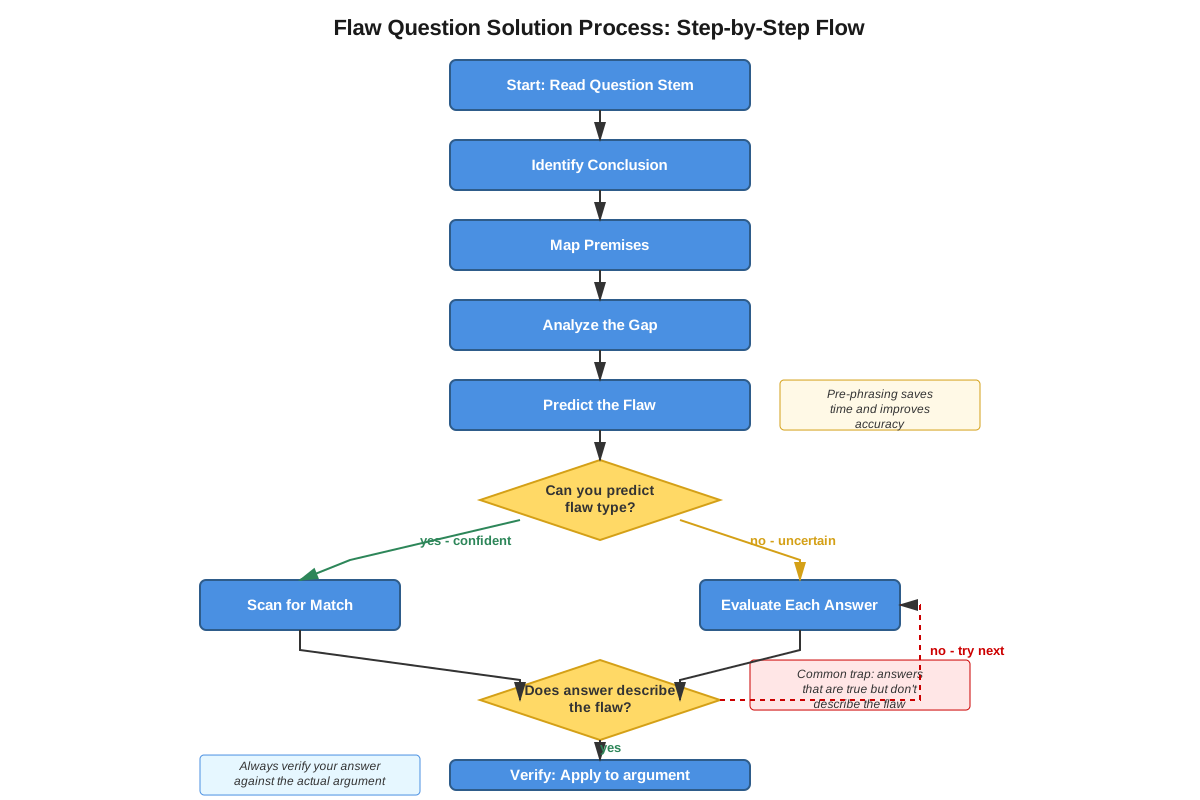
Systematic Approach to Flaw Questions
- Read the question stem first: Confirming it's a flaw question activates the appropriate analytical mindset
- Read the stimulus actively: Identify the conclusion, then the premises, then the gap between them
- Pre-phrase the flaw: Before looking at answer choices, articulate the flaw in your own words
- Predict the answer category: Is this a causal flaw? Sampling issue? Conditional reasoning error?
- Evaluate answer choices systematically: Eliminate those describing flaws not present, keeping those that match your pre-phrase
Trigger Words and Phrases
In the stimulus, watch for:
- Causal language: "causes," "leads to," "results in," "produces," "is responsible for"
- Conditional indicators: "if," "only if," "unless," "requires," "necessary," "sufficient"
- Generalization markers: "all," "most," "typically," "generally," "usually"
- Evidence language: "study shows," "research indicates," "data suggests"
In answer choices, recognize:
- "Takes for granted": Signals an assumption-based flaw
- "Fails to consider": Points to overlooked alternatives or possibilities
- "Treats... as if...": Often describes necessary/sufficient confusion or category errors
- "Presumes without justification": Indicates an unwarranted assumption
- "Overlooks the possibility": Highlights unconsidered alternatives
Process of Elimination Strategy
Eliminate answer choices that:
- Describe the argument's method accurately but not as a flaw: "The argument cites expert testimony" might be true but isn't necessarily a flaw
- Describe flaws the argument explicitly avoids: If the argument qualifies its conclusion with "might" or "could," it doesn't commit the flaw of being too absolute
- Reverse the argument's actual reasoning: Read carefully to ensure the answer choice matches what the argument actually does
- Use extreme language when the argument is moderate: If the argument says "often" but the answer choice says "always," there's a mismatch
Time Allocation
Flaw questions typically require 1:15-1:30 minutes each. Allocate time as follows:
- 15-20 seconds: Read and understand the question stem
- 30-40 seconds: Read and analyze the stimulus, identifying conclusion and premises
- 10-15 seconds: Pre-phrase the flaw
- 20-30 seconds: Evaluate answer choices and select the best match
If pre-phrasing is difficult, don't exceed 20 seconds attempting it—move to answer choices and use process of elimination instead.
Memory Techniques
The CASC Mnemonic for Common Flaws
Causal (correlation ≠ causation)
Assumption (unwarranted assumptions)
Sampling (unrepresentative or biased samples)
Conditional (necessary/sufficient confusion)
This covers approximately 70% of LSAT flaw questions, providing a quick mental checklist when analyzing arguments.
Visualization Strategy: The Bridge Analogy
Visualize the argument as a bridge from premises (one shore) to conclusion (opposite shore). The flaw is the gap or weakness in the bridge structure. Ask: "What's missing that would make this bridge stable?" This mental image helps identify what the argument fails to establish or consider.
The "Reverse Test" for Conditional Flaws
When an argument involves conditional reasoning, mentally reverse the condition and consequence. If the argument treats the reversal as valid without justification, it commits a conditional reasoning flaw. Example: "If admitted, then 3.5+ GPA" reversed to "If 3.5+ GPA, then admitted" reveals the necessary/sufficient confusion.
The "Alternative Explanation" Prompt
For arguments presenting evidence for a conclusion, automatically ask: "What else could explain this evidence?" This question naturally surfaces causal flaws, sampling issues, and overlooked possibilities—three of the most common flaw categories.
Summary
Flaw questions constitute a high-frequency, high-value question type on the LSAT, requiring test-takers to identify specific reasoning errors in arguments. Success demands both recognition (sensing something is wrong) and articulation (precisely describing the error). The most common flaws involve causal reasoning errors (especially correlation-causation confusion), sampling problems (unrepresentative or biased samples), conditional reasoning mistakes (necessary-sufficient confusion), and unwarranted assumptions. Effective strategy involves reading actively to identify conclusions and premises, pre-phrasing the flaw before examining answer choices, and systematically eliminating options that describe flaws not present in the argument. The correct answer must precisely match the actual flaw in the stimulus—not merely describe a flaw that could exist in some argument. Mastering flaw questions improves performance across multiple Logical Reasoning question types because the underlying skill—analyzing how arguments can fail—transfers broadly throughout the section.
Key Takeaways
- Flaw questions appear 8-12 times per LSAT and test the ability to identify and articulate specific reasoning errors
- The four most common flaw categories are causal reasoning errors, sampling problems, conditional reasoning confusion, and unwarranted assumptions (remember: CASC)
- Pre-phrasing the flaw before reading answer choices significantly improves accuracy and efficiency
- The correct answer must describe a flaw actually present in the argument, not just any logical flaw
- Conditional reasoning flaws frequently involve treating necessary conditions as sufficient or vice versa
- Wrong answers often describe things the argument does correctly or flaws the argument avoids
- Active reading to identify conclusions, premises, and the gap between them is essential for flaw recognition
Related Topics
Assumption Questions: These questions ask what must be true for an argument's conclusion to follow from its premises. Mastering flaw questions provides direct insight into assumption questions because an argument's assumptions often reveal its flaws. Understanding what an argument takes for granted helps identify how its reasoning fails.
Strengthen and Weaken Questions: These question types require understanding what would make an argument better or worse. Recognizing an argument's flaw immediately reveals what information would weaken it (evidence that the flaw matters) or strengthen it (evidence addressing the flaw).
Parallel Reasoning Questions: These questions ask test-takers to identify arguments with similar logical structures. Understanding flaw patterns helps recognize structural similarities, as parallel arguments often share parallel flaws.
Method of Reasoning Questions: These questions ask how an argument proceeds or what technique it employs. The skills developed for flaw questions—analyzing argumentative structure and identifying reasoning patterns—transfer directly to method of reasoning questions.
Practice CTA
Now that you understand the core concepts, patterns, and strategies for flaw questions, it's time to apply this knowledge. Work through the practice questions systematically, using the pre-phrasing technique and elimination strategies outlined above. Review the flashcards to reinforce recognition of common flaw types and their technical descriptions. Remember: flaw questions reward precision and pattern recognition, skills that improve dramatically with deliberate practice. Each practice question you analyze strengthens your ability to spot reasoning errors quickly and accurately—a skill that will serve you throughout the LSAT and in law school. You've built the foundation; now build the fluency through consistent application.
Sign up free to keep reading
Create a free AnvayaPrep account to finish this LSAT guide on Flaw questions — plus flashcards and practice questions.