Overview
Except statements represent one of the most strategically important question formats in LSAT logical reasoning. These questions flip the traditional approach by asking test-takers to identify what does NOT fit a particular pattern, rather than what does. Understanding how to navigate LSAT except statements is crucial because they appear frequently across both Logical Reasoning sections and require a fundamentally different analytical approach than standard question types.
The challenge of except statements lies in their cognitive demand: while most LSAT questions ask students to find supporting evidence, valid inferences, or strengthening factors, except questions require systematic elimination of four correct answers to identify the single outlier. This reversal of typical test-taking strategy makes except statements particularly prone to careless errors, even among high-scoring students. The questions test not only content mastery but also mental discipline and methodical analysis under time pressure.
Within the broader framework of conditional logic and logical reasoning, except statements serve as a comprehensive assessment tool that can incorporate any logical reasoning skill—from assumption identification to parallel reasoning. They function as "meta-questions" that test whether students can consistently apply logical principles across multiple answer choices. Mastering except statements requires solid foundational knowledge of all logical reasoning question types, combined with a disciplined approach to systematic answer choice evaluation. This topic bridges individual logical reasoning skills with test-taking strategy, making it essential for achieving a competitive LSAT score.
Learning Objectives
- [ ] Identify how Except statements appears in LSAT questions
- [ ] Explain the reasoning pattern behind Except statements
- [ ] Apply Except statements to solve LSAT-style problems accurately
- [ ] Distinguish between the four correct answers and one exception in except questions
- [ ] Develop a systematic approach to evaluating all five answer choices without premature elimination
- [ ] Recognize the various logical reasoning tasks that can be formatted as except questions
- [ ] Implement time-efficient strategies for tracking answer choice evaluation
Prerequisites
- Basic logical reasoning question types: Understanding standard LSAT question formats (strengthen, weaken, assumption, inference) is essential because except questions can incorporate any of these tasks.
- Conditional logic fundamentals: Knowledge of sufficient and necessary conditions provides the foundation for understanding how except statements create logical boundaries.
- Argument structure analysis: The ability to identify premises, conclusions, and logical gaps enables effective evaluation of multiple answer choices against argument requirements.
- Standard LSAT question stem recognition: Familiarity with typical question language helps students quickly identify when they're facing an except question and adjust their approach accordingly.
Why This Topic Matters
Except statements appear with remarkable frequency on the LSAT, typically showing up 3-5 times per test across the two Logical Reasoning sections. This represents approximately 10-15% of all Logical Reasoning questions, making them too significant to ignore or approach casually. The LSAT uses except questions to test multiple skills simultaneously: students must understand the underlying logical task, evaluate each answer choice independently, and maintain focus across all five options without losing track of their analysis.
In real-world legal practice, attorneys constantly engage in except-style reasoning when identifying outliers in case law, finding the single precedent that doesn't support an argument, or recognizing which piece of evidence fails to corroborate a theory. This pattern of elimination thinking is fundamental to legal analysis, where identifying what doesn't fit is often as important as recognizing what does. The LSAT's emphasis on except questions reflects this practical reality of legal reasoning.
On the exam, except statements most commonly appear in the following formats: "Each of the following weakens the argument EXCEPT," "All of the following are assumptions EXCEPT," "Each of the following could be true EXCEPT," and "All of the following support the conclusion EXCEPT." These questions can incorporate any logical reasoning skill, making them versatile assessment tools. They frequently appear in the middle to later portions of each Logical Reasoning section, often serving as difficulty calibration points. Students who master except statements gain a significant strategic advantage, as these questions offer predictable point-scoring opportunities when approached systematically.
Core Concepts
The Fundamental Structure of Except Questions
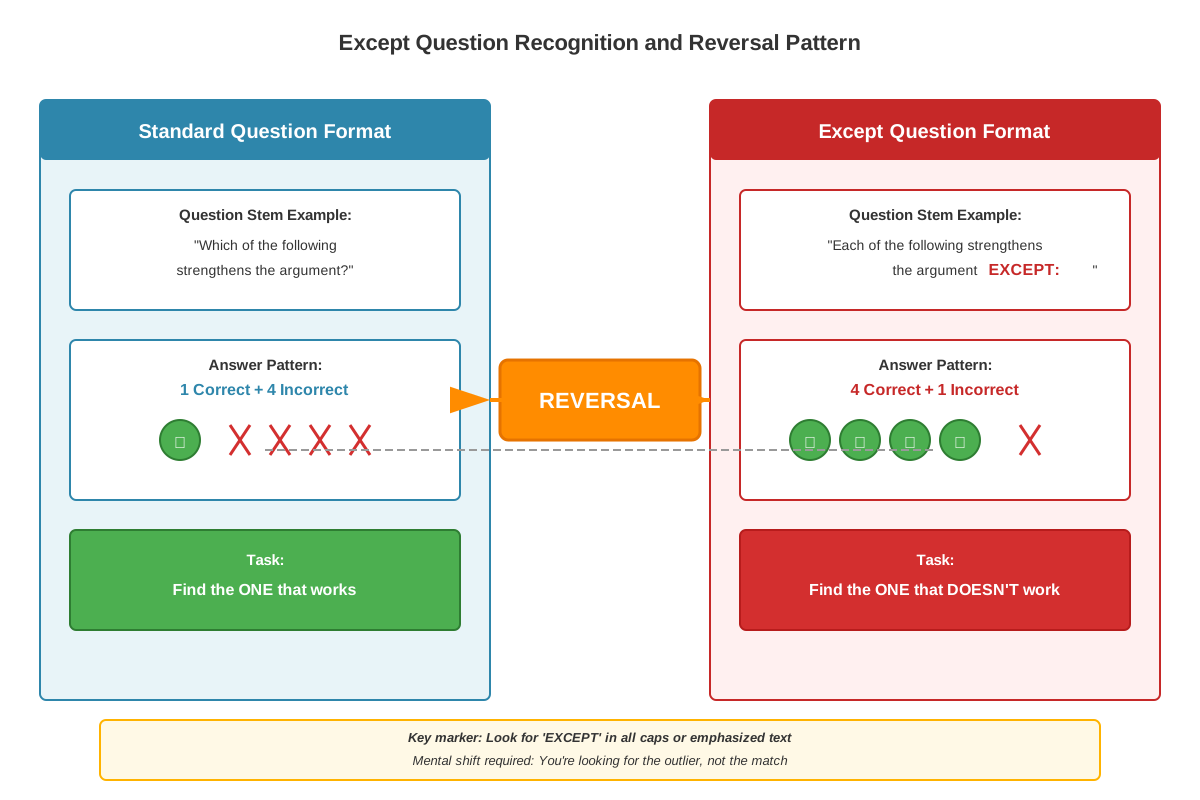
Except statements create a unique logical framework where the question stem establishes a criterion that four answer choices will satisfy, while one answer choice will not. The key structural element is the word "EXCEPT" (or its variants like "with the exception of" or "all...EXCEPT"), which appears in capital letters to signal this reversal. The question stem defines a specific logical task—such as weakening an argument, identifying an assumption, or supporting a conclusion—and then asks which answer choice does NOT perform that task.
The logical structure operates on a principle of exclusion: if the question asks "Each of the following weakens the argument EXCEPT," then four answers will weaken the argument (making them incorrect choices for this question type), while one answer will either strengthen the argument, be irrelevant, or have no effect (making it the correct answer). This reversal requires students to recalibrate their instinctive response patterns, as they must actively seek the answer that fails to meet the criterion rather than the one that best satisfies it.
The Cognitive Challenge of Reversed Polarity
The primary difficulty with except questions stems from what cognitive psychologists call "reversed polarity"—the mental task of searching for what doesn't fit rather than what does. Human brains naturally seek patterns and confirmations, making it cognitively easier to identify what matches a criterion than what violates it. LSAT except questions exploit this cognitive tendency, creating opportunities for careless errors when students fall into automatic pattern-matching mode.
This challenge intensifies because students must evaluate all five answer choices rather than stopping when they find a "good" answer. In standard LSAT questions, test-takers can often identify the correct answer after reviewing two or three choices and then quickly verify their selection. With except questions, premature stopping leads to errors because the first answer that seems to satisfy the criterion is actually incorrect—it's one of the four that should be eliminated. Successful except question strategy requires completing a full evaluation of all five choices before selecting an answer.
Types of Logical Tasks in Except Format
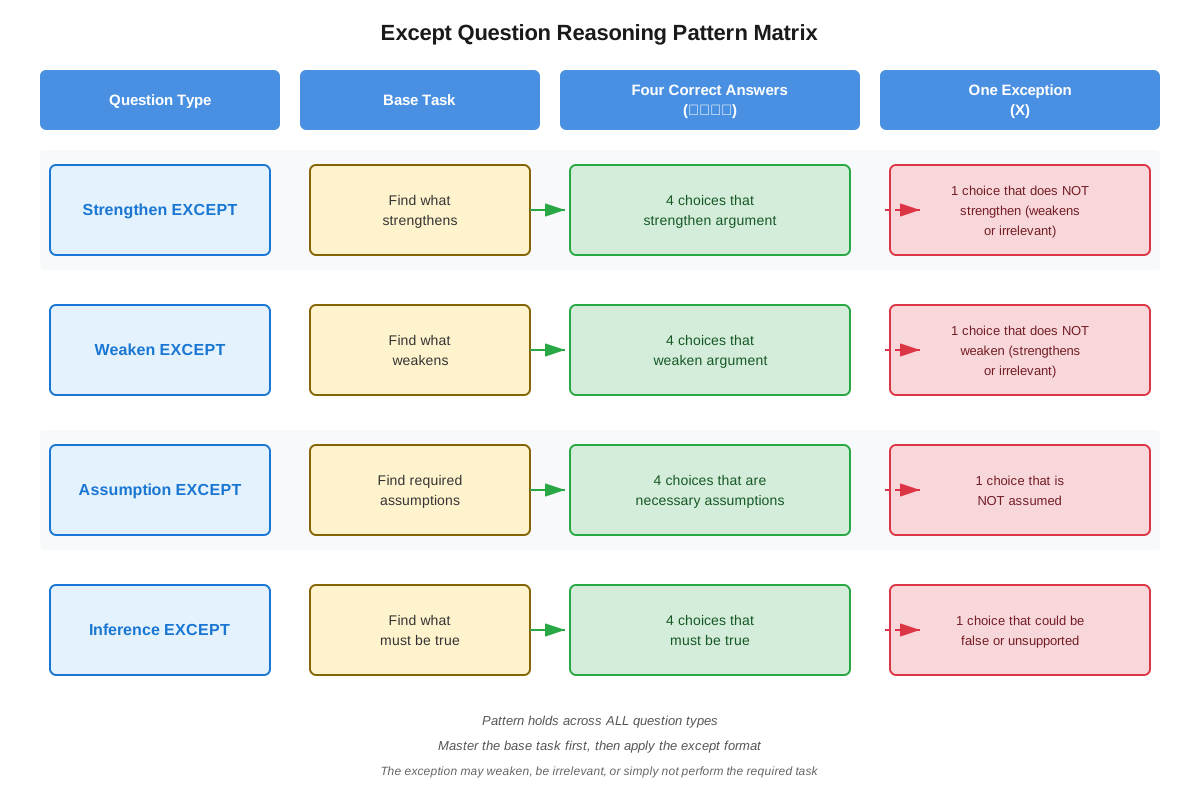
Except questions can incorporate virtually any logical reasoning task, but certain types appear more frequently:
Weakening Except Questions: These ask which answer choice does NOT weaken the argument. The correct answer will either strengthen the argument, be irrelevant, or have neutral impact. These are among the most common except question types.
Assumption Except Questions: These require identifying which answer choice is NOT an assumption upon which the argument depends. The correct answer might be explicitly stated in the argument, be irrelevant, or be contradicted by the argument.
Supporting/Strengthening Except Questions: These ask which answer does NOT support or strengthen the conclusion. The correct answer may weaken the argument, be irrelevant, or have no impact on the conclusion's validity.
Inference Except Questions: These require identifying which statement does NOT follow from the passage. The correct answer will be something that cannot be concluded, might contradict the passage, or goes beyond what can be inferred.
Principle Application Except Questions: These ask which scenario does NOT illustrate or conform to a stated principle. The correct answer will violate the principle or fall outside its scope.
The Systematic Evaluation Method
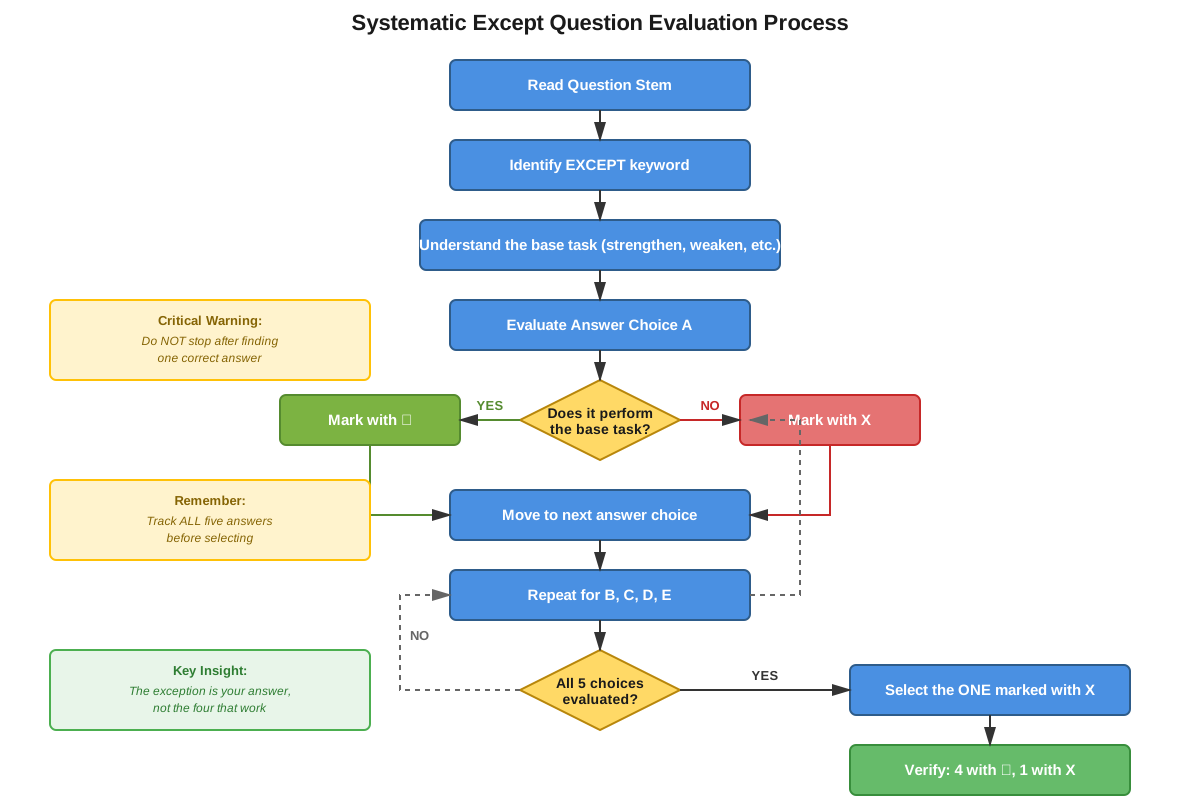
Successful navigation of except questions requires a methodical approach that prevents tracking errors and ensures complete evaluation. The recommended process involves:
- Identify the except format: Recognize the capitalized "EXCEPT" and note the specific logical task being requested.
- Clarify the criterion: Determine exactly what four answers will do (weaken, support, assume, etc.) and what the correct answer will NOT do.
- Use a marking system: Develop a consistent notation method (such as checkmarks for answers that satisfy the criterion, X for the exception) to track evaluation progress.
- Evaluate each answer independently: Resist the urge to compare answers or stop early; assess each choice against the criterion individually.
- Verify the pattern: Before selecting your answer, confirm that you've identified four answers meeting the criterion and one that doesn't.
The Role of Neutral and Irrelevant Answers
A critical concept in except questions is understanding that the correct answer doesn't necessarily do the opposite of what the question asks—it simply doesn't do what the question specifies. For example, in a "weakens EXCEPT" question, the correct answer doesn't have to strengthen the argument; it might simply be irrelevant or have no impact. This distinction is crucial because students often waste time searching for an answer that performs the opposite function when the correct answer might simply be neutral.
| Question Type | Four Incorrect Answers Do | Correct Answer Might |
|---|---|---|
| Weakens EXCEPT | Weaken the argument | Strengthen, be irrelevant, or have no effect |
| Supports EXCEPT | Support the conclusion | Weaken, be irrelevant, or have no effect |
| Assumption EXCEPT | State an assumption | Be stated in passage, be irrelevant, or contradict argument |
| Inference EXCEPT | Follow from the passage | Cannot be concluded, contradict passage, or go beyond scope |
The Trap of Partial Reading
Except questions create a specific trap related to partial reading: students who don't read the entire question stem carefully may miss the "EXCEPT" designation and answer the question as if it were a standard format. This error is particularly common when the "EXCEPT" appears at the end of a long question stem. The LSAT deliberately constructs some except questions with lengthy, complex stems to increase the likelihood of this error. Vigilant reading of complete question stems, with particular attention to capitalized words, is essential for avoiding this trap.
Concept Relationships
The concepts within except statements form an interconnected system where understanding one element reinforces the others. The fundamental structure of except questions establishes the framework that creates the cognitive challenge of reversed polarity. This cognitive challenge necessitates the systematic evaluation method, which in turn requires understanding the role of neutral and irrelevant answers. The various types of logical tasks in except format all operate within this same structural framework, meaning that mastering the general approach to except questions enables handling any specific task type.
Except statements connect to prerequisite topics through their dependence on foundational logical reasoning skills. Each type of logical task (weakening, supporting, assumption identification) must be understood in its standard format before students can effectively identify when an answer choice does NOT perform that function. The connection to conditional logic appears in how except questions create logical boundaries: the question stem establishes a condition that four answers satisfy and one violates, creating a conditional relationship between the criterion and answer choices.
The relationship map flows as follows: Standard Logical Reasoning Skills → provide foundation for → Except Question Structure → creates → Reversed Polarity Challenge → requires → Systematic Evaluation Method → which accounts for → Neutral/Irrelevant Answers → enabling accurate identification of → The Exception Among Five Choices.
High-Yield Facts
⭐ Except questions appear 3-5 times per LSAT, representing approximately 10-15% of Logical Reasoning questions.
⭐ The correct answer in an except question does NOT have to do the opposite of what's asked—it simply doesn't do what the question specifies.
⭐ All five answer choices must be evaluated in except questions; stopping early after finding a "good" answer leads to errors.
⭐ The word "EXCEPT" always appears in capital letters in authentic LSAT questions to signal the reversed format.
⭐ Weakening except and assumption except questions are the most frequently appearing except question types.
- Except questions can incorporate any logical reasoning task, making them comprehensive skill assessments.
- Using a consistent marking system (checkmarks, X's, or +/- symbols) prevents tracking errors across five answer choices.
- The correct answer in an except question might be irrelevant to the argument rather than actively opposing the criterion.
- Except questions typically appear in the middle to later portions of Logical Reasoning sections.
- Reading only the beginning of a question stem without noticing "EXCEPT" at the end is one of the most common errors on these questions.
- In "inference EXCEPT" questions, the correct answer is often something that contradicts the passage or cannot be concluded from it.
- Time management for except questions should allocate slightly more time than standard questions due to the need to evaluate all five choices.
- The four incorrect answers in except questions will all satisfy the criterion to roughly equal degrees—there's no "most" or "best" among them.
Quick check — test yourself on Except statements so far.
Try Flashcards →Common Misconceptions
Misconception: The correct answer in an except question must do the opposite of what the question asks.
Correction: The correct answer simply doesn't perform the specified function; it might be neutral, irrelevant, or have no impact rather than actively opposing the criterion. In a "weakens EXCEPT" question, the right answer doesn't have to strengthen—it might just be irrelevant.
Misconception: You can stop evaluating answer choices once you find one that doesn't meet the criterion.
Correction: All five answer choices must be evaluated to ensure you've correctly identified the pattern of four that satisfy the criterion and one that doesn't. Stopping early risks selecting an answer you misunderstood.
Misconception: Except questions are harder than standard questions and should be skipped.
Correction: Except questions test the same logical reasoning skills as standard questions but require a different approach. With systematic method, they're equally manageable and offer predictable scoring opportunities.
Misconception: The four incorrect answers will all affect the argument in exactly the same way.
Correction: The four incorrect answers will all satisfy the general criterion (all weaken, all support, etc.) but may do so through different mechanisms or to varying degrees. The key is that they all meet the criterion, not that they're identical.
Misconception: If you're unsure about one answer choice in an except question, you should guess and move on.
Correction: Because except questions require identifying a pattern across all five choices, uncertainty about one choice should prompt re-evaluation of all choices. The pattern of four-versus-one provides a built-in verification mechanism that shouldn't be abandoned prematurely.
Misconception: Except questions always appear with "EXCEPT" at the end of the question stem.
Correction: While "EXCEPT" often appears at the end, it can appear anywhere in the question stem. Some questions use phrases like "with the exception of" or "all of the following...EXCEPT" with "EXCEPT" in the middle of the stem.
Worked Examples
Example 1: Weakening Except Question
Passage: "City Council Member: Our city should implement a ban on single-use plastic bags. Studies show that plastic bag bans in other cities have reduced plastic waste in landfills by 30%. Since reducing landfill waste is a priority for our city, we should follow their example."
Question: Each of the following weakens the City Council Member's argument EXCEPT:
(A) Cities that implemented plastic bag bans experienced a 40% increase in the use of paper bags, which require more energy to produce than plastic bags.
(B) The studies cited by the Council Member were conducted in coastal cities, whereas this city is landlocked and has different waste management challenges.
(C) Plastic bags constitute only 2% of the total waste in the city's landfills, making them a minor contributor to the overall waste problem.
(D) Reducing landfill waste has been identified as the city's top environmental priority in recent surveys of residents.
(E) Several cities that implemented plastic bag bans later repealed them due to public opposition and increased costs for retailers.
Analysis:
First, identify the task: we need to find which answer does NOT weaken the argument. Four answers will weaken; one will not.
The argument's structure: Plastic bag bans reduced waste in other cities → Our city should implement a ban.
Evaluating each choice:
(A) Weakens: This suggests the ban might increase overall environmental impact by shifting to paper bags, undermining the environmental benefit. ✓ (Eliminate)
(B) Weakens: This attacks the relevance of the cited studies, suggesting they may not apply to this city's situation. ✓ (Eliminate)
(C) Weakens: This suggests plastic bags are such a small problem that banning them won't significantly advance the goal of reducing landfill waste. ✓ (Eliminate)
(D) Does NOT weaken: This actually supports the argument by confirming that reducing landfill waste is indeed a priority, which is a premise the argument relies on. This strengthens or is neutral to the argument. ✗ (This is our answer)
(E) Weakens: This suggests the policy might not be sustainable or practical, undermining confidence in implementing it. ✓ (Eliminate)
Correct Answer: (D)
The key insight: (D) doesn't weaken because it confirms rather than challenges a premise of the argument. It's not irrelevant—it's actually supportive—but the question only requires that it NOT weaken, which it doesn't.
Example 2: Assumption Except Question
Passage: "Economist: The recent increase in consumer spending indicates that the economy is recovering. When people feel confident about their financial future, they spend more money. Therefore, the rise in consumer spending shows that consumer confidence has increased."
Question: The economist's argument depends on each of the following assumptions EXCEPT:
(A) The increase in consumer spending is not primarily due to factors other than increased consumer confidence.
(B) Consumer confidence is a reliable indicator of economic recovery.
(C) The recent increase in consumer spending represents a significant change from previous spending patterns.
(D) People's spending behavior accurately reflects their confidence about their financial future.
(E) Increased consumer spending will lead to sustained economic growth.
Analysis:
The task: Find which statement is NOT an assumption the argument depends on. Four will be necessary assumptions; one will not.
The argument's logical structure:
- Premise: Consumer spending increased
- Premise: Confident people spend more
- Conclusion: Consumer confidence increased
Evaluating each choice:
(A) Necessary assumption: The argument assumes the spending increase is due to confidence rather than other factors (like temporary sales, government stimulus, etc.). If this weren't assumed, the conclusion wouldn't follow. ✓ (Eliminate)
(B) Necessary assumption: The argument connects consumer confidence to economic recovery in the first sentence, assuming this connection is valid. ✓ (Eliminate)
(C) Necessary assumption: For the increase to be meaningful evidence, it must represent a real change. If spending just fluctuated normally, the conclusion wouldn't follow. ✓ (Eliminate)
(D) Necessary assumption: The entire argument depends on spending behavior reflecting confidence levels. Without this assumption, the conclusion collapses. ✓ (Eliminate)
(E) NOT a necessary assumption: The argument concludes that confidence has increased, not that this will lead to sustained growth. This is about future consequences, which the argument doesn't address. The argument would still work even if increased spending doesn't lead to sustained growth. ✗ (This is our answer)
Correct Answer: (E)
The key insight: (E) goes beyond the scope of the argument's conclusion. The argument is about what the spending increase indicates (past/present confidence), not about what will happen in the future. This demonstrates that the correct answer in an assumption except question might be a statement that's related to the topic but not logically necessary for the specific conclusion drawn.
Exam Strategy
When approaching except questions on the LSAT, implement a three-phase strategy: recognition, systematic evaluation, and verification.
Recognition Phase: Train yourself to spot except questions immediately by scanning for capitalized "EXCEPT" before reading the full question stem. This primes your brain for reversed-polarity thinking. When you identify an except question, take a brief mental pause to shift from "find the right answer" mode to "find the one that doesn't fit" mode. This cognitive reset prevents automatic pattern-matching errors.
Trigger Words and Phrases: Watch for these exact phrasings that signal except questions:
- "Each of the following...EXCEPT"
- "All of the following...EXCEPT"
- "...with the exception of"
- "Which one of the following does NOT..."
- "...EXCEPT which one?"
Exam Tip: Circle or underline "EXCEPT" in the question stem immediately upon recognition. This physical action reinforces the reversed format and provides a visual reminder as you evaluate answer choices.
Systematic Evaluation Process: Develop a consistent notation system and use it religiously. One effective method: place a checkmark (✓) next to each answer that satisfies the criterion and an X next to the one that doesn't. Alternatively, use +/- symbols or simply cross out the four that meet the criterion. The specific system matters less than consistency—your brain should execute the same process for every except question.
Process-of-Elimination Tips Specific to Except Questions:
- Never eliminate an answer choice without actively evaluating it: In standard questions, you can eliminate obviously wrong answers quickly. In except questions, you must verify that each eliminated answer actually satisfies the criterion.
- If you're torn between two answers, re-evaluate all five: When you can't decide between two potential exceptions, it usually means you've misunderstood the criterion or misread an answer. Start fresh with all five choices.
- Use the four-versus-one pattern as verification: Before selecting your answer, count your marks. You should have four of one type (answers meeting the criterion) and one of another (the exception). If your marks don't show this pattern, re-evaluate.
- Watch for subtle differences in scope: The exception often differs from the other four answers in scope rather than direction. It might be too broad, too narrow, or address a different aspect of the argument.
Time Allocation Advice: Budget approximately 1:45-2:00 for except questions, slightly more than the 1:20-1:30 average for standard questions. The additional time accounts for evaluating all five choices and verification. However, don't let except questions become time sinks—if you're struggling beyond two minutes, make your best educated guess and flag the question for review if time permits.
Strategic Approach for Difficult Except Questions: If you're genuinely stuck, use the consensus method: identify which four answers seem most similar in how they relate to the argument. The outlier is likely your answer. This works because the four incorrect answers will all perform the same general function (all weaken, all support, etc.), even if they do so differently.
Memory Techniques
The "Four Friends, One Foe" Mnemonic: Remember that in except questions, you're looking for the one answer that's NOT friends with the criterion—four answers are friends (they satisfy it), one is the foe (it doesn't). This personification helps maintain the reversed-polarity mindset.
The EXCEPT Acronym:
- Evaluate every answer
- X-out the four that fit
- Confirm the pattern
- Examine the outlier
- Pick with confidence
- Track with notation
Visualization Strategy: Picture the question stem as a filter or sieve. Four answer choices pass through the filter (they meet the criterion), while one gets caught (it doesn't fit). Visualizing this physical sorting process helps maintain focus on the elimination pattern.
The "Opposite Day" Reminder: When you see "EXCEPT," mentally note "opposite day"—you're looking for what doesn't work rather than what does. This simple phrase triggers the cognitive shift needed for reversed-polarity thinking.
The Checkmark Chant: As you evaluate each answer, mentally state: "Does this [weaken/support/assume/etc.]?" If yes, checkmark and move on. If no, mark as potential answer. This internal dialogue maintains systematic evaluation and prevents rushing.
Summary
Except statements represent a high-frequency LSAT question format that tests logical reasoning skills through a reversed-polarity framework. These questions require identifying which answer choice does NOT satisfy a specified criterion, while four other choices do satisfy it. The fundamental challenge lies in the cognitive shift from seeking what fits to identifying what doesn't, combined with the necessity of evaluating all five answer choices systematically. Except questions can incorporate any logical reasoning task—weakening, supporting, assumption identification, inference, or principle application—making them comprehensive assessments of logical reasoning mastery. Success requires recognizing the except format immediately, understanding that the correct answer need not do the opposite of what's asked (it simply doesn't do what's specified), implementing a consistent notation system to track evaluation, and verifying the four-versus-one pattern before selecting an answer. The correct answer might strengthen the argument, weaken it, be irrelevant, or have neutral impact—the only requirement is that it doesn't perform the function specified in the question stem. Mastering except statements provides a significant strategic advantage on the LSAT, as these questions offer predictable scoring opportunities when approached with disciplined methodology.
Key Takeaways
- Except questions appear 3-5 times per LSAT and require identifying the one answer that does NOT satisfy the criterion while four others do
- The correct answer doesn't have to do the opposite of what's asked—it simply doesn't do what the question specifies (it might be neutral or irrelevant)
- All five answer choices must be evaluated systematically; stopping early after finding a "good" answer leads to errors
- Implement a consistent notation system (checkmarks, X's, or symbols) to track which answers satisfy the criterion and which doesn't
- The word "EXCEPT" always appears in capital letters—circle it immediately to trigger reversed-polarity thinking
- Verify the four-versus-one pattern before selecting your answer as a built-in accuracy check
- Budget slightly more time (1:45-2:00) for except questions compared to standard questions to allow for complete evaluation
Related Topics
Sufficient and Necessary Conditions: Mastering except statements builds directly toward advanced conditional logic, where identifying what doesn't satisfy a condition is as important as recognizing what does. Except questions provide practice in boundary-case thinking essential for complex conditional reasoning.
Parallel Reasoning Questions: These questions often appear in except format ("parallel reasoning EXCEPT"), requiring students to identify which answer choice does NOT exhibit the same logical structure as the stimulus. Mastering basic except statements prepares students for this advanced combination.
Formal Logic and Logical Equivalence: Understanding except statements enhances ability to work with logical negations and contrapositive relationships, as except questions fundamentally involve identifying what falls outside a logical category.
Advanced Argument Analysis: Except questions that combine multiple logical reasoning tasks (such as "assumption that would strengthen EXCEPT") require sophisticated argument analysis skills that build on except statement mastery.
Practice CTA
Now that you've mastered the conceptual framework of except statements, it's time to cement your understanding through active practice. Attempt the practice questions designed specifically for this topic, focusing on implementing the systematic evaluation method and notation system discussed in this guide. As you work through problems, pay special attention to how the correct answer relates to the criterion—does it do the opposite, or is it simply neutral? Use the flashcards to reinforce trigger words and common except question patterns until recognizing these questions becomes automatic. Remember: except statements are high-yield opportunities for scoring points when approached with disciplined methodology. Your investment in mastering this topic will pay dividends across both Logical Reasoning sections. Approach each practice question as an opportunity to refine your systematic approach, and you'll find these once-challenging questions becoming reliable point-scorers.
Sign up free to keep reading
Create a free AnvayaPrep account to finish this LSAT guide on Except statements — plus flashcards and practice questions.