Overview
If then statements form the backbone of conditional logic, one of the most frequently tested concepts in LSAT logical reasoning sections. These statements establish relationships between conditions, creating a logical chain where one event or circumstance guarantees another. Mastering LSAT if then statements is not merely helpful—it is essential for success on approximately 25-30% of Logical Reasoning questions and a significant portion of Logic Games.
Conditional statements appear in various forms throughout the LSAT, from straightforward "if...then" constructions to disguised conditionals using words like "only," "unless," "whenever," or "requires." Understanding how to identify, diagram, and manipulate these statements enables test-takers to navigate complex argument structures, identify logical flaws, make valid inferences, and eliminate incorrect answer choices with confidence. The ability to recognize the sufficient and necessary conditions within these statements, along with their contrapositives, separates high-scoring test-takers from those who struggle with logical reasoning.
Within the broader landscape of Logical Reasoning, conditional logic serves as a foundational skill that connects to formal logic, argument structure analysis, assumption identification, and inference questions. Students who master if then statements gain a powerful analytical tool that applies across multiple question types, including Must Be True, Sufficient Assumption, Necessary Assumption, Flaw, and Parallel Reasoning questions. This topic represents a high-yield investment of study time, as the skills developed here transfer directly to improved performance across the entire exam.
Learning Objectives
- [ ] Identify how if then statements appear in LSAT questions across different question types
- [ ] Explain the reasoning pattern behind if then statements, including sufficient and necessary conditions
- [ ] Apply if then statements to solve LSAT-style problems accurately and efficiently
- [ ] Diagram conditional statements using standard notation and translate between various linguistic forms
- [ ] Construct valid contrapositives and distinguish them from invalid logical operations
- [ ] Chain multiple conditional statements together to derive valid inferences
- [ ] Recognize common conditional indicator words and translate complex sentence structures into conditional form
Prerequisites
- Basic logical connectives: Understanding "and," "or," and "not" is essential because conditional logic builds upon these fundamental relationships and their manipulation is required for forming contrapositives.
- Argument structure recognition: The ability to identify premises and conclusions helps locate conditional statements within argument contexts and understand their role in supporting or undermining claims.
- Reading comprehension skills: Conditional statements often appear in complex sentence structures, requiring careful parsing to identify the sufficient and necessary conditions accurately.
Why This Topic Matters
Conditional logic represents one of the highest-yield topics for LSAT preparation. Research on LSAT question distribution reveals that conditional reasoning appears in approximately 25-30% of all Logical Reasoning questions and forms the structural foundation for most Logic Games. This translates to roughly 15-20 questions per exam that directly test or require conditional logic skills—a substantial portion of the test that can significantly impact overall scores.
In real-world applications, conditional reasoning underlies legal analysis, contract interpretation, statutory construction, and case law application. Attorneys regularly work with conditional relationships when analyzing whether certain facts trigger specific legal consequences, making this skill directly relevant to legal practice. The LSAT tests this reasoning pattern because it reflects the type of analytical thinking essential for law school success.
On the exam, if then statements appear in multiple contexts: as premises supporting conclusions in argument-based questions, as rules in Logic Games, as answer choices in Must Be True questions, and as logical structures to be paralleled or identified as flawed. Common question types heavily featuring conditional logic include Sufficient Assumption (where the correct answer completes a conditional chain), Necessary Assumption (where the assumption connects conditional elements), Must Be True/Inference (where combining conditionals yields new information), and Flaw questions (where conditional reasoning errors must be identified). Understanding conditional logic is not optional—it is fundamental to LSAT success.
Core Concepts
Basic Structure of Conditional Statements
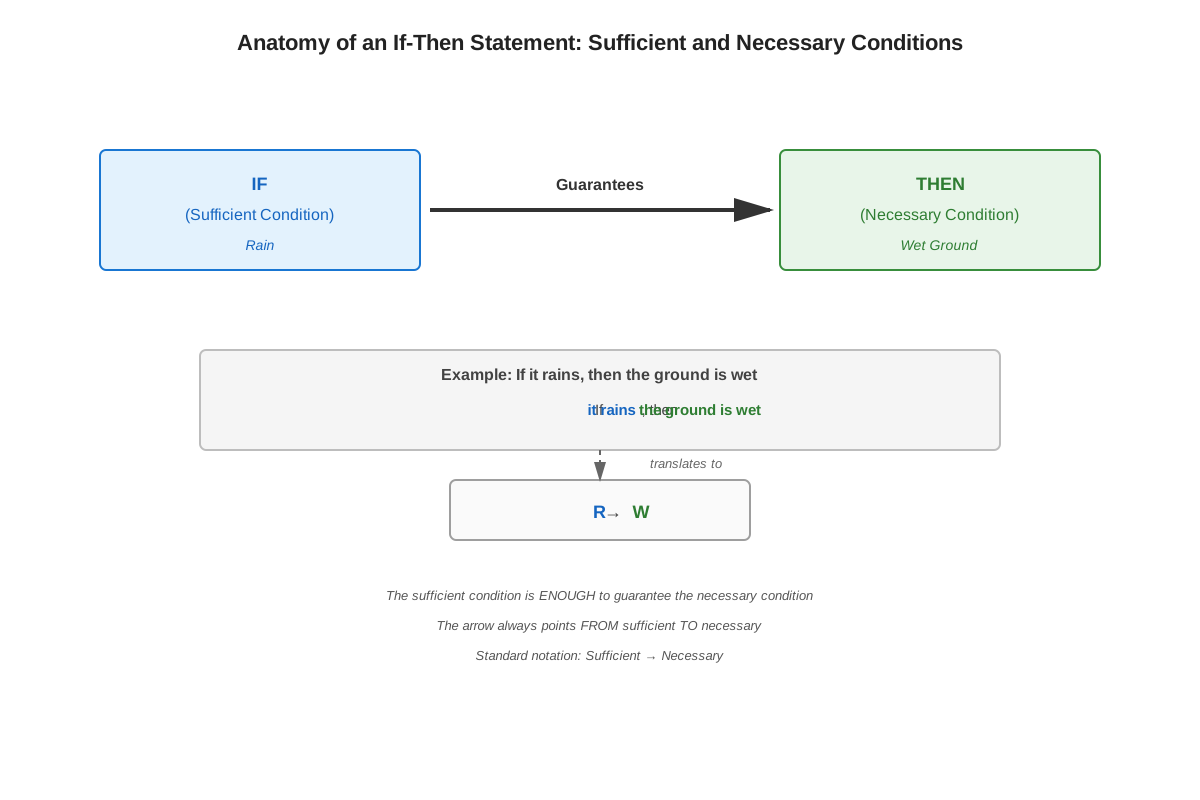
A conditional statement establishes a relationship between two propositions where one condition guarantees another. The standard form uses "if...then" construction: "If A, then B." In this structure, A represents the sufficient condition—it is sufficient (enough) to guarantee that B occurs. B represents the necessary condition—it is necessary (required) whenever A occurs. Understanding this distinction is crucial: the sufficient condition is the trigger, while the necessary condition is the guaranteed result.
The notation commonly used for diagramming is: A → B (read as "if A, then B" or "A implies B"). This arrow represents the logical relationship, not causation. The statement does not claim that A causes B, only that whenever A is true, B must also be true. This distinction matters because the LSAT frequently tests whether students confuse correlation, causation, and conditional relationships.
Sufficient vs. Necessary Conditions
The sufficient condition appears after "if" in standard form and represents what is enough to guarantee the outcome. For example, in "If it rains, the ground gets wet," rain is sufficient to guarantee wet ground. However, rain is not necessary for wet ground—sprinklers could also wet the ground. This illustrates a critical point: sufficient conditions are not the only way for the necessary condition to occur.
The necessary condition appears after "then" in standard form and represents what must be true whenever the sufficient condition occurs. In the rain example, wet ground is necessary whenever it rains. However, wet ground alone does not guarantee rain occurred. This asymmetry in the relationship is fundamental to understanding conditional logic and avoiding common errors.
| Condition Type | Position | Meaning | Example (If rain, then wet) |
|---|---|---|---|
| Sufficient | After "if" | Enough to guarantee | Rain is sufficient for wet ground |
| Necessary | After "then" | Required when sufficient occurs | Wet ground is necessary when it rains |
Contrapositive Formation
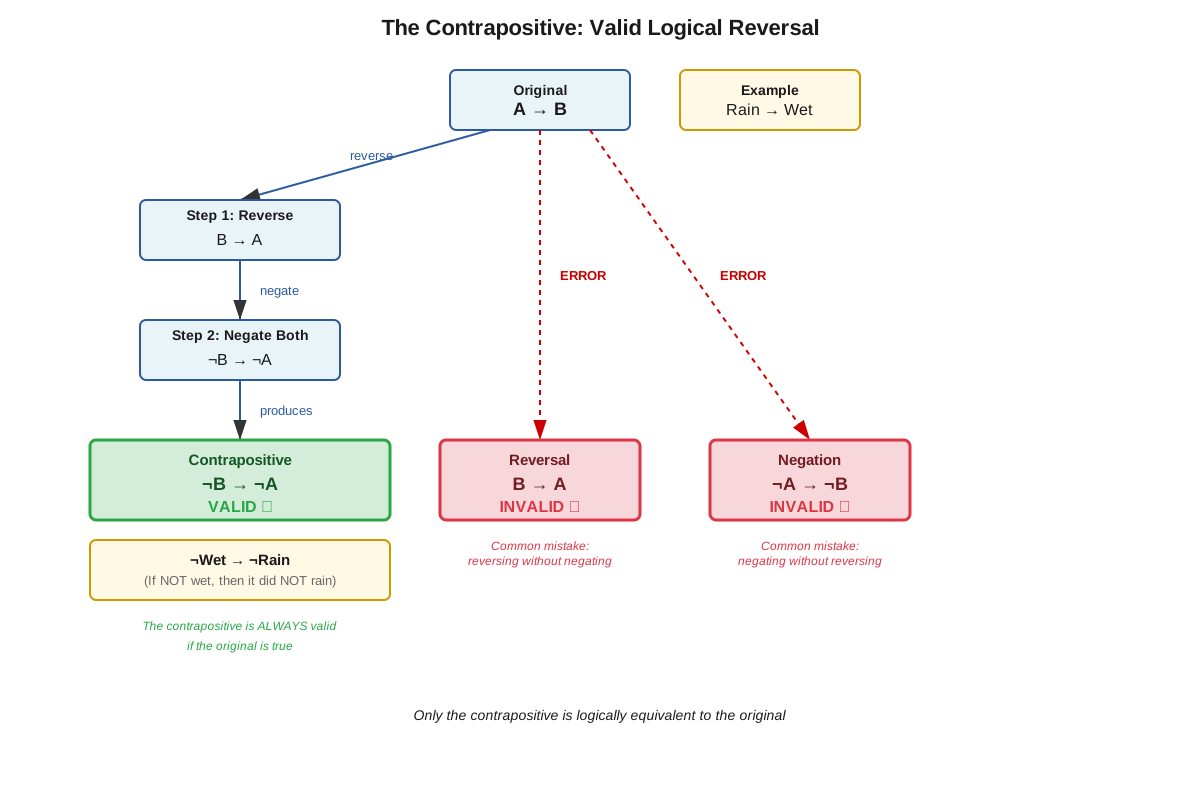
The contrapositive is a logically equivalent statement formed by negating both conditions and reversing their order. For the statement A → B, the contrapositive is: NOT B → NOT A (often written as ~B → ~A or B̄ → Ā). This operation is crucial because the contrapositive is always logically valid—if the original statement is true, the contrapositive must also be true.
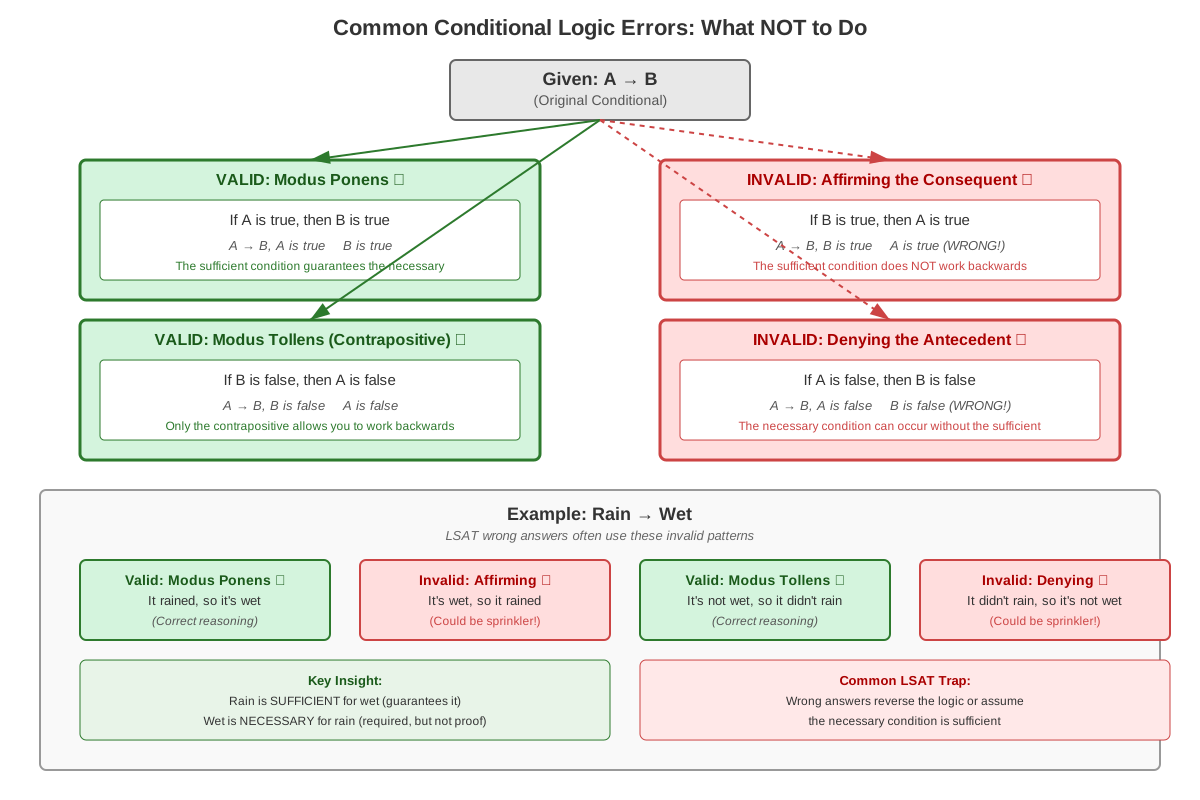
Understanding why the contrapositive works requires recognizing that if A guarantees B, then the absence of B guarantees the absence of A. If rain guarantees wet ground, then dry ground guarantees no rain occurred. This logical equivalence allows test-takers to derive additional valid inferences from any conditional statement. The LSAT frequently tests whether students can correctly form contrapositives and distinguish them from invalid operations.
Invalid Operations: Converse and Inverse
Two common errors involve creating the converse (reversing without negating: B → A) and the inverse (negating without reversing: ~A → ~B). Neither operation is logically valid. The converse error assumes that because A is sufficient for B, B must be sufficient for A—but this reverses the relationship incorrectly. The inverse error assumes that because A guarantees B, the absence of A guarantees the absence of B—but this ignores that other sufficient conditions might exist.
For example, "If it rains, the ground is wet" does not mean "If the ground is wet, it rained" (converse) or "If it doesn't rain, the ground isn't wet" (inverse). Both statements could be false even though the original is true. Recognizing these invalid operations is essential for identifying flawed reasoning and eliminating incorrect answer choices.
Conditional Indicator Words
Conditional relationships appear in many linguistic forms beyond "if...then." Recognizing these indicator words allows test-takers to identify hidden conditionals:
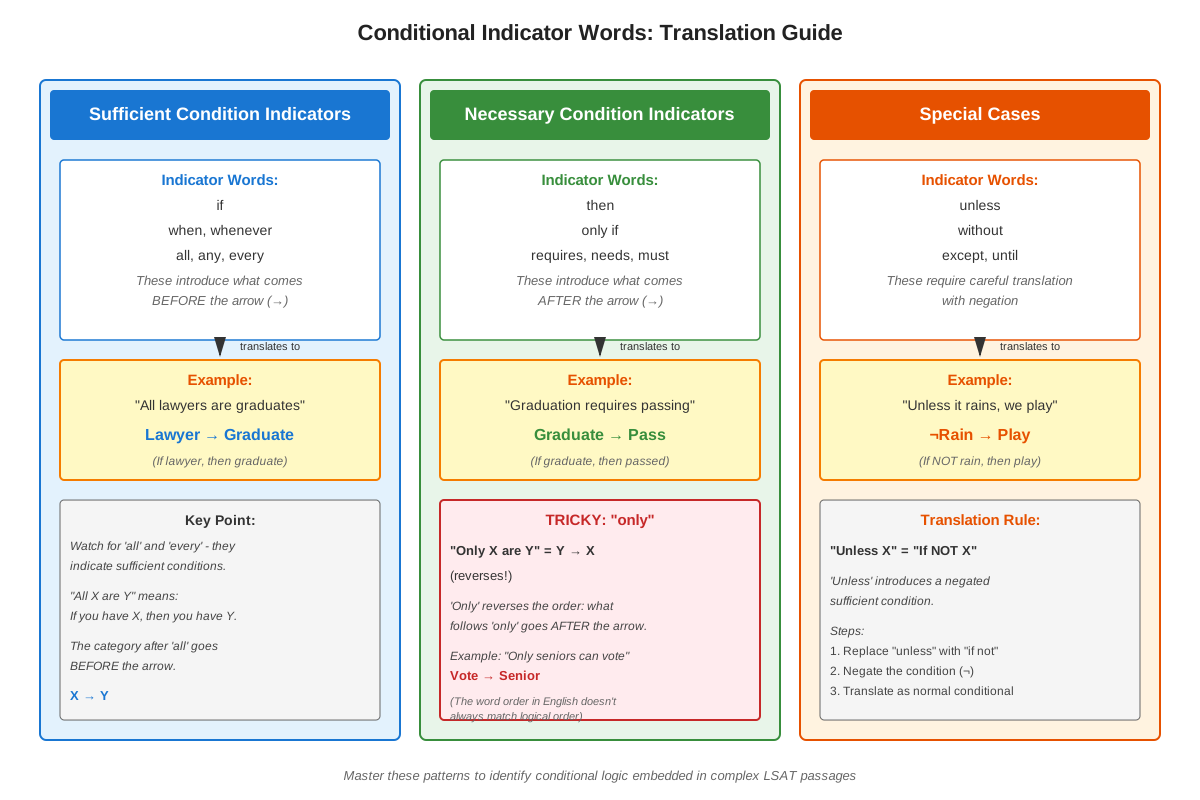
Sufficient condition indicators (what comes after these words is sufficient):
- If, when, whenever, where
- All, any, every, each
- People who, those who
Necessary condition indicators (what comes after these words is necessary):
- Then, must, requires, needs
- Only, only if, only when
- Unless (special case: introduces necessary condition but requires negation)
For example, "All lawyers are college graduates" translates to: Lawyer → College Graduate. The word "all" indicates that being a lawyer is sufficient to guarantee being a college graduate. Similarly, "Only college graduates can be lawyers" translates to: Lawyer → College Graduate (the same relationship), because "only" indicates that being a college graduate is necessary for being a lawyer.
The "Unless" Construction
The word "unless" creates a special conditional form that confuses many test-takers. The rule for "unless" is: negate the condition that follows "unless" and make it sufficient for the other condition. For example, "You will fail unless you study" translates to: NOT study → fail, or equivalently (by contrapositive): NOT fail → study.
The logic behind this translation: "unless" means "if not." So "You will fail unless you study" means "If you don't study, you will fail." This construction appears frequently on the LSAT, and mastering it prevents costly errors.
Chaining Conditional Statements
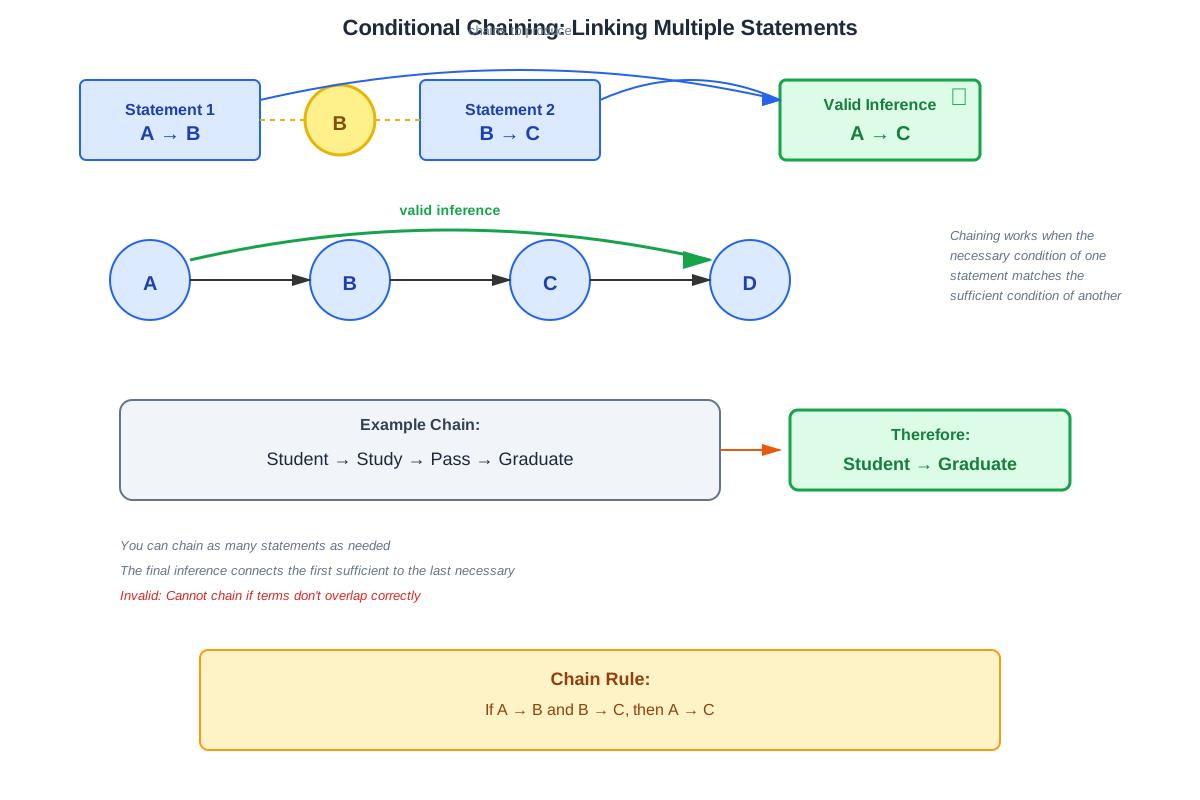
When multiple conditional statements share common terms, they can be chained together to derive new inferences. If A → B and B → C, then by transitivity, A → C. This chaining allows test-takers to combine information from multiple premises to reach valid conclusions.
For example:
- All doctors are college graduates (Doctor → College Graduate)
- All college graduates are high school graduates (College Graduate → HS Graduate)
- Therefore: All doctors are high school graduates (Doctor → HS Graduate)
The LSAT frequently tests this skill by providing multiple conditional statements and asking what must be true, or by requiring test-takers to identify what assumption would complete a conditional chain.
"And" vs. "Or" in Conditionals
When conditional statements contain compound conditions, the placement of "and" versus "or" significantly affects meaning:
- A → (B AND C) means: If A occurs, both B and C must occur
- A → (B OR C) means: If A occurs, at least one of B or C must occur
- (A AND B) → C means: Both A and B together are sufficient for C
- (A OR B) → C means: Either A alone or B alone is sufficient for C
The contrapositive must carefully handle these compounds using De Morgan's Laws: "and" becomes "or" when negated, and vice versa. For example, the contrapositive of A → (B AND C) is: (NOT B OR NOT C) → NOT A.
Concept Relationships
The concepts within conditional logic form an interconnected system where each element builds upon others. The foundation begins with understanding the basic structure of sufficient and necessary conditions, which enables recognition of conditional relationships in various linguistic forms. This recognition skill connects directly to indicator word mastery, as different phrasings express the same logical relationships.
From the basic structure, two critical branches emerge: valid operations (contrapositive formation) and invalid operations (converse and inverse errors). Understanding the contrapositive as logically equivalent to the original statement enables conditional chaining, where multiple statements combine to yield new inferences. Meanwhile, recognizing invalid operations prevents logical errors and helps identify flawed reasoning in arguments.
The relationship map flows as follows:
Basic Conditional Structure (A → B) → Sufficient/Necessary Distinction → Indicator Word Recognition → Translation of Complex Statements → Contrapositive Formation → Conditional Chaining → Valid Inference Generation
Simultaneously: Basic Structure → Recognition of Invalid Operations → Identification of Logical Flaws → Elimination of Incorrect Answers
These concepts connect to prerequisite knowledge of basic logical connectives (and, or, not) through the formation of contrapositives and compound conditions. They also relate to broader Logical Reasoning skills like argument structure analysis, as conditional statements often serve as premises or conclusions in arguments. Mastery of conditional logic enables progression to more advanced topics like formal logic, sufficient and necessary assumptions, and complex inference questions.
High-Yield Facts
⭐ The contrapositive is always logically valid: If A → B is true, then ~B → ~A must also be true; these statements are logically equivalent.
⭐ The converse and inverse are invalid operations: Reversing (B → A) or negating without reversing (~A → ~B) does not produce logically valid statements.
⭐ "Only" introduces a necessary condition: "Only X are Y" translates to Y → X, not X → Y; this reversal is one of the most commonly tested translations.
⭐ "Unless" means "if not": "A unless B" translates to ~B → A; negate what follows "unless" and make it sufficient.
⭐ Sufficient conditions are not necessary: Just because A is sufficient for B does not mean A is necessary for B; other conditions might also be sufficient.
- "All" statements are conditionals: "All X are Y" translates to X → Y, making X sufficient for Y.
- Necessary conditions can occur without sufficient conditions: B can be true even when A is false; the conditional only restricts what happens when A is true.
- Conditional chains are transitive: If A → B and B → C, then A → C is a valid inference.
- Compound conditions require careful contrapositive formation: When negating "and" becomes "or" and vice versa (De Morgan's Laws).
- Conditional statements do not assert that conditions actually occur: A → B does not claim A is true or B is true, only that if A is true, then B must be true.
- Multiple sufficient conditions can lead to the same necessary condition: A → C and B → C are both valid; C can have multiple sufficient conditions.
- The absence of a sufficient condition tells you nothing: If A → B and A is false, you cannot conclude anything about B.
Quick check — test yourself on If then statements so far.
Try Flashcards →Common Misconceptions
Misconception: If A is sufficient for B, then A is also necessary for B.
Correction: Sufficient and necessary are distinct concepts. A condition can be sufficient without being necessary. For example, rain is sufficient for wet ground, but not necessary (sprinklers also work). Only when a condition is both sufficient and necessary (A ↔ B, a biconditional) does the relationship work in both directions.
Misconception: The converse of a conditional statement is logically valid.
Correction: Reversing a conditional (creating B → A from A → B) is not valid. Just because rain guarantees wet ground does not mean wet ground guarantees rain. The only valid operation that preserves truth is the contrapositive (negate and reverse), not simple reversal.
Misconception: "Only if" means the same as "if."
Correction: "Only if" introduces a necessary condition, not a sufficient one. "You can vote only if you are 18" means: Vote → 18 years old. The age requirement is necessary for voting, but being 18 is not sufficient to guarantee you vote. This is the opposite of how "if" works.
Misconception: If the sufficient condition doesn't occur, the necessary condition cannot occur.
Correction: The absence of a sufficient condition tells you nothing about the necessary condition. If A → B and A is false, B could be either true or false. The conditional only restricts what happens when A is true; it places no restrictions on scenarios where A is false.
Misconception: Conditional statements indicate causation.
Correction: Conditionals express logical relationships, not causal ones. "If you are a lawyer, you passed the bar exam" describes a logical requirement, not a claim that being a lawyer causes bar passage. The LSAT frequently includes answer choices that confuse these concepts, and recognizing the distinction is essential.
Misconception: "Unless" simply means "or" and can be translated as such.
Correction: "Unless" creates a conditional relationship with negation, not a simple "or" statement. "You will fail unless you study" is not the same as "You will fail or you study." The correct translation is: ~Study → Fail, which is a conditional statement with specific logical implications including a valid contrapositive.
Worked Examples
Example 1: Translating and Applying a Complex Conditional
Problem: Consider the following statements:
- "Only those who have completed the training program are eligible for promotion."
- "Anyone eligible for promotion must have at least five years of experience."
- Sarah has completed the training program.
What can we validly conclude?
Solution:
Step 1: Translate each statement into conditional form.
Statement 1: "Only those who have completed the training program are eligible for promotion."
- The word "only" introduces a necessary condition
- Translation: Eligible for Promotion → Completed Training (E → T)
Statement 2: "Anyone eligible for promotion must have at least five years of experience."
- "Anyone" indicates a sufficient condition; "must" indicates necessary
- Translation: Eligible for Promotion → 5+ Years Experience (E → Y)
Statement 3: Sarah has completed the training program.
- This is a simple assertion: Sarah has T
Step 2: Determine what we can conclude.
From Statement 3, we know Sarah has T (completed training). However, our conditionals are:
- E → T (promotion eligibility requires training)
- E → Y (promotion eligibility requires experience)
We know Sarah has T, but T is a necessary condition for E, not a sufficient one. The contrapositive of E → T is ~T → ~E (no training means no eligibility), but we cannot reverse it to say T → E.
Step 3: Identify what we CANNOT conclude.
We cannot conclude Sarah is eligible for promotion (we don't know if she has 5+ years experience, and even if she did, having both necessary conditions doesn't guarantee eligibility—there might be other requirements).
We cannot conclude Sarah has 5+ years experience (we have no information connecting training to experience).
Valid Conclusion: We can only conclude that Sarah has met one necessary condition for promotion eligibility (training), but we cannot determine whether she is actually eligible. This example demonstrates how having a necessary condition does not guarantee the sufficient condition occurs.
Example 2: Conditional Chain with Contrapositive
Problem: An argument states:
- "All successful entrepreneurs are risk-takers."
- "No risk-taker avoids uncertainty."
- Therefore, anyone who avoids uncertainty is not a successful entrepreneur.
Is this argument valid? Explain the logical structure.
Solution:
Step 1: Translate each statement.
Statement 1: "All successful entrepreneurs are risk-takers."
- Translation: Successful Entrepreneur → Risk-Taker (S → R)
Statement 2: "No risk-taker avoids uncertainty."
- "No X are Y" means: X → ~Y
- Translation: Risk-Taker → Does NOT Avoid Uncertainty (R → ~A)
- Equivalently: Risk-Taker → Embraces Uncertainty
Statement 3 (Conclusion): "Anyone who avoids uncertainty is not a successful entrepreneur."
- Translation: Avoids Uncertainty → NOT Successful Entrepreneur (A → ~S)
Step 2: Chain the conditionals.
From statements 1 and 2:
- S → R (entrepreneurs are risk-takers)
- R → ~A (risk-takers don't avoid uncertainty)
- By chaining: S → ~A (entrepreneurs don't avoid uncertainty)
Step 3: Form the contrapositive of our chain.
The contrapositive of S → ~A is: A → ~S
- If someone avoids uncertainty, they are not a successful entrepreneur
Step 4: Compare to the conclusion.
The conclusion states: A → ~S
This exactly matches the contrapositive of our chained conditional. Therefore, the argument is logically valid. The conclusion follows necessarily from the premises through conditional chaining and contrapositive formation.
Key Insight: This example demonstrates how the LSAT tests your ability to chain multiple conditionals and recognize that the contrapositive of a chained statement is a valid inference. Many correct answers in Must Be True and Inference questions require exactly this type of reasoning.
Exam Strategy
Approaching Conditional Logic Questions
When encountering LSAT questions involving conditional logic, follow this systematic approach:
- Identify conditional statements immediately: Scan for indicator words (if, only, unless, all, must, requires) that signal conditional relationships.
- Diagram as you read: Translate conditional statements into symbolic notation (A → B) in real-time. This external representation prevents working memory overload and reduces errors.
- Write the contrapositive: Immediately write the contrapositive of each conditional statement. Many correct answers are contrapositives that aren't immediately obvious without diagramming.
- Look for chains: Identify common terms between conditionals that allow chaining. The LSAT frequently requires combining 2-3 conditionals to reach the correct answer.
Trigger Words and Phrases
High-priority indicators to circle or underline:
- "Only," "only if," "only when" (necessary condition indicators—these reverse the intuitive reading)
- "Unless," "until," "without" (require negation and careful translation)
- "All," "every," "any," "each" (sufficient condition indicators)
- "Must," "requires," "needs," "depends on" (necessary condition indicators)
- "If and only if" (biconditional—rare but important)
Exam Tip: When you see "only," pause and carefully determine what is necessary versus sufficient. This single word is responsible for more errors than any other conditional indicator.
Process of Elimination Strategies
For Must Be True/Inference questions:
- Eliminate answers that commit the converse error (reversing without negating)
- Eliminate answers that commit the inverse error (negating without reversing)
- Eliminate answers that assert something about the absence of sufficient conditions
- Keep answers that are valid contrapositives or chains of given conditionals
For Assumption questions:
- Look for answers that complete a conditional chain (sufficient assumptions)
- Look for answers that rule out alternative sufficient conditions (necessary assumptions)
- Eliminate answers that go in the wrong direction (B → A when you need A → B)
For Flaw questions:
- Identify whether the argument commits a converse or inverse error
- Check if the argument treats a necessary condition as sufficient
- Look for confusion between "some" and "all" in conditional contexts
Time Allocation
Conditional logic questions often appear complex but can be solved quickly with proper technique:
- Spend 15-20 seconds diagramming: This upfront investment saves time and prevents errors
- Target 60-90 seconds total for straightforward conditional questions
- Allow up to 2 minutes for questions requiring multiple chains or complex translations
- Skip and return if translation seems ambiguous—these questions are high-value but not worth getting stuck on
Exam Tip: If you find yourself re-reading a conditional statement multiple times, diagram it. The act of translating to symbols often clarifies meaning immediately.
Memory Techniques
The "SANE" Mnemonic for Conditional Structure
Sufficient → Arrow → Necessary → Equivalent contrapositive
This reminds you that the sufficient condition points via an arrow to the necessary condition, and the contrapositive is equivalent (logically valid).
The "ONLY Reverses" Rule
When you see "ONLY," remember it reverses the intuitive reading. "Only X are Y" means Y → X, not X → Y. Visualize the word "ONLY" as a reversal sign.
The "UNLESS = IF NOT" Translation
Simply replace "unless" with "if not" in your mind, then translate normally:
- "A unless B" becomes "A if not B" becomes "If not B, then A" becomes ~B → A
Contrapositive Formation: "Flip and Negate"
Remember the two-step process as "Flip and Negate":
- Flip: Reverse the order (A → B becomes B → A)
- Negate: Add negation to both terms (B → A becomes ~B → ~A)
Visual Memory: The Arrow Never Lies
Visualize the arrow → as a one-way street. Traffic flows from sufficient to necessary, never backward. The only way to go backward is to take the contrapositive detour (flip and negate). This prevents converse and inverse errors.
The "Necessary is Not Sufficient" Mantra
Repeat: "Necessary is not sufficient, necessary is not sufficient." This prevents the most common error of treating necessary conditions as if they were sufficient. Just because something is required doesn't mean it's enough.
Summary
Conditional logic, expressed through if then statements, represents a foundational skill for LSAT success, appearing in approximately 25-30% of all questions. The core principle involves understanding the relationship between sufficient conditions (what is enough to guarantee an outcome) and necessary conditions (what is required when the sufficient condition occurs). Mastery requires the ability to translate various linguistic forms into standard conditional notation, form valid contrapositives by negating and reversing, avoid invalid operations like the converse and inverse, and chain multiple conditionals to derive new inferences. Critical skills include recognizing indicator words (especially "only," "unless," and "all"), understanding that necessary conditions can occur without their sufficient conditions, and distinguishing logical relationships from causal ones. Success on conditional logic questions depends on systematic diagramming, immediate contrapositive formation, and careful attention to the direction of logical relationships. Students who master these concepts gain a powerful analytical tool applicable across multiple question types, from Must Be True to Assumption to Flaw questions, making conditional logic one of the highest-yield investments of study time for LSAT preparation.
Key Takeaways
- Sufficient conditions guarantee necessary conditions, but not vice versa: The arrow flows one direction only; having a necessary condition does not mean the sufficient condition occurred.
- The contrapositive is always valid; the converse and inverse are not: Only negating AND reversing preserves logical validity; reversing alone or negating alone creates invalid statements.
- "Only" introduces necessary conditions and reverses intuitive reading: "Only X are Y" means Y → X, making X necessary for Y, not sufficient.
- Diagram immediately and write contrapositives: External representation prevents errors and reveals inferences that aren't obvious from reading alone.
- Conditional chains are transitive: When conditionals share common terms, they can be combined to derive new valid inferences (if A → B and B → C, then A → C).
- Absence of sufficient conditions tells you nothing: If A → B and A is false, you cannot conclude anything about B; the conditional only restricts scenarios where A is true.
- Master indicator words to identify hidden conditionals: Conditional relationships appear in many linguistic forms beyond "if...then," and recognizing these variations is essential for complete analysis.
Related Topics
Formal Logic and Quantifiers: Building on conditional logic, formal logic introduces quantified statements (some, most, none) and their interactions with conditionals, enabling analysis of more complex logical relationships.
Sufficient and Necessary Assumptions: These question types directly apply conditional logic skills, requiring identification of what must be true (necessary) or what would guarantee (sufficient) an argument's conclusion.
Logical Reasoning Flaws: Many common flaws involve conditional reasoning errors, including treating necessary conditions as sufficient, confusing correlation with causation, and committing converse or inverse errors.
Logic Games Rules: Most Logic Games rules are conditional statements, and success requires translating these rules, forming contrapositives, and chaining them to make deductions about game scenarios.
Argument Structure and Diagramming: Understanding how conditional statements function as premises or conclusions within arguments enhances overall argument analysis skills and connects conditional logic to broader reasoning patterns.
Practice CTA
Now that you understand the fundamental principles of conditional logic and if then statements, it's time to cement this knowledge through active practice. Attempt the practice questions designed for this topic, focusing on applying the systematic approach outlined in the exam strategy section. Work through each problem by diagramming the conditionals, forming contrapositives, and identifying valid chains before selecting your answer. Use the flashcards to reinforce indicator word recognition and contrapositive formation until these skills become automatic. Remember: conditional logic is a skill that improves dramatically with deliberate practice. Every question you work through strengthens your pattern recognition and speeds up your analysis. The investment you make now in mastering these concepts will pay dividends across the entire LSAT. You've got this—now go apply what you've learned!
Sign up free to keep reading
Create a free AnvayaPrep account to finish this LSAT guide on If then statements — plus flashcards and practice questions.