Overview
Multiple necessary conditions represent one of the most frequently tested patterns in LSAT logical reasoning questions. This concept builds upon foundational conditional logic by introducing scenarios where a single sufficient condition triggers not just one, but several necessary conditions that must all be satisfied. Understanding this pattern is crucial because the LSAT regularly presents arguments where multiple requirements must be met for a particular outcome to occur, and test-makers exploit common reasoning errors students make when tracking these relationships.
In conditional logic, students learn that a sufficient condition guarantees its necessary condition (if A, then B). However, real-world reasoning—and LSAT arguments—rarely involve such simple one-to-one relationships. More commonly, achieving a goal or satisfying a condition requires meeting multiple distinct requirements simultaneously. For instance, graduating from law school might require completing all coursework AND passing the bar exam AND maintaining good academic standing. Missing any single necessary condition means the sufficient condition's outcome cannot occur, creating multiple points of logical vulnerability that LSAT questions exploit.
This topic serves as a bridge between basic conditional reasoning and the complex logical structures that appear in the most challenging LSAT questions. Mastering multiple necessary conditions enables students to diagram complex argument structures accurately, identify logical flaws in reasoning, evaluate the strength of conclusions, and predict what must be true given a set of premises. The pattern appears across question types including Must Be True, Sufficient Assumption, Necessary Assumption, Strengthen/Weaken, and Flaw questions, making it one of the highest-yield topics for score improvement.
Learning Objectives
- [ ] Identify how multiple necessary conditions appears in LSAT questions
- [ ] Explain the reasoning pattern behind multiple necessary conditions
- [ ] Apply multiple necessary conditions to solve LSAT-style problems accurately
- [ ] Diagram statements containing multiple necessary conditions using proper notation
- [ ] Recognize contrapositive relationships when multiple necessary conditions are present
- [ ] Distinguish between multiple necessary conditions and multiple sufficient conditions
- [ ] Predict valid inferences from arguments containing multiple necessary conditions
Prerequisites
- Basic conditional logic notation: Understanding "if...then" statements and their symbolic representation (A → B) is essential because multiple necessary conditions build directly on this foundation
- Contrapositive formation: Knowing how to negate and reverse conditional statements is required because contrapositives become more complex with multiple necessary conditions
- Logical operators (AND/OR): Familiarity with how "and" and "or" function logically is necessary because multiple necessary conditions involve conjunction relationships
- Sufficient vs. necessary conditions: Distinguishing between what guarantees an outcome versus what is required for an outcome is fundamental to understanding why multiple conditions can all be necessary
Why This Topic Matters
Multiple necessary conditions appear in approximately 15-20% of all Logical Reasoning questions on the LSAT, making this one of the most frequently tested logical patterns. This topic appears across virtually every question type, but most commonly in Sufficient Assumption questions (where you must identify what additional necessary condition would complete an argument), Must Be True questions (where you must track what follows from multiple requirements), and Flaw questions (where arguments illegitimately assume that meeting one necessary condition is sufficient).
In real-world legal reasoning, attorneys constantly work with multiple necessary conditions. Contract formation requires offer AND acceptance AND consideration. Establishing negligence requires duty AND breach AND causation AND damages. A prosecutor must prove each element of a crime beyond reasonable doubt. The LSAT tests this pattern because it reflects the actual reasoning lawyers perform daily—tracking multiple requirements and identifying when any single requirement fails.
Common manifestations in LSAT passages include: eligibility requirements (to qualify for X, one must have A AND B AND C), procedural rules (the committee will approve proposals only if they meet standards 1, 2, and 3), causal claims with multiple necessary factors (the disease occurs only when genetic predisposition AND environmental trigger AND immune deficiency are all present), and policy recommendations (the plan will succeed only if we secure funding AND obtain permits AND hire qualified staff). Test-makers frequently create wrong answer choices that treat one necessary condition as sufficient, or that confuse which conditions are necessary versus sufficient.
Core Concepts
The Basic Structure of Multiple Necessary Conditions
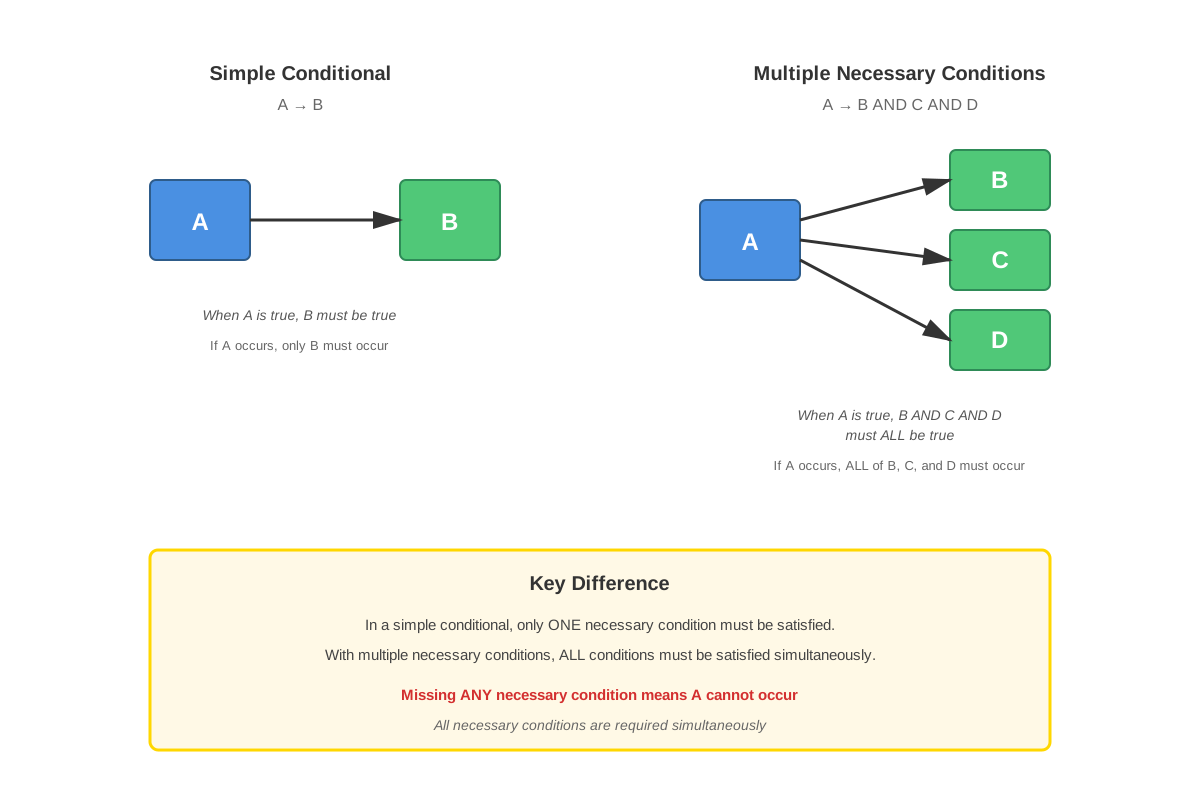
When a statement contains multiple necessary conditions, a single sufficient condition requires two or more distinct necessary conditions to all be satisfied. The standard form is: "If A, then B AND C AND D." This means that whenever A occurs, all of B, C, and D must occur. Symbolically, this is represented as:
A → B + C + D
The plus sign (+) or ampersand (&) indicates conjunction—all conditions must be present simultaneously. This differs fundamentally from having multiple sufficient conditions, which would be written as separate conditional statements or with an "or" relationship.
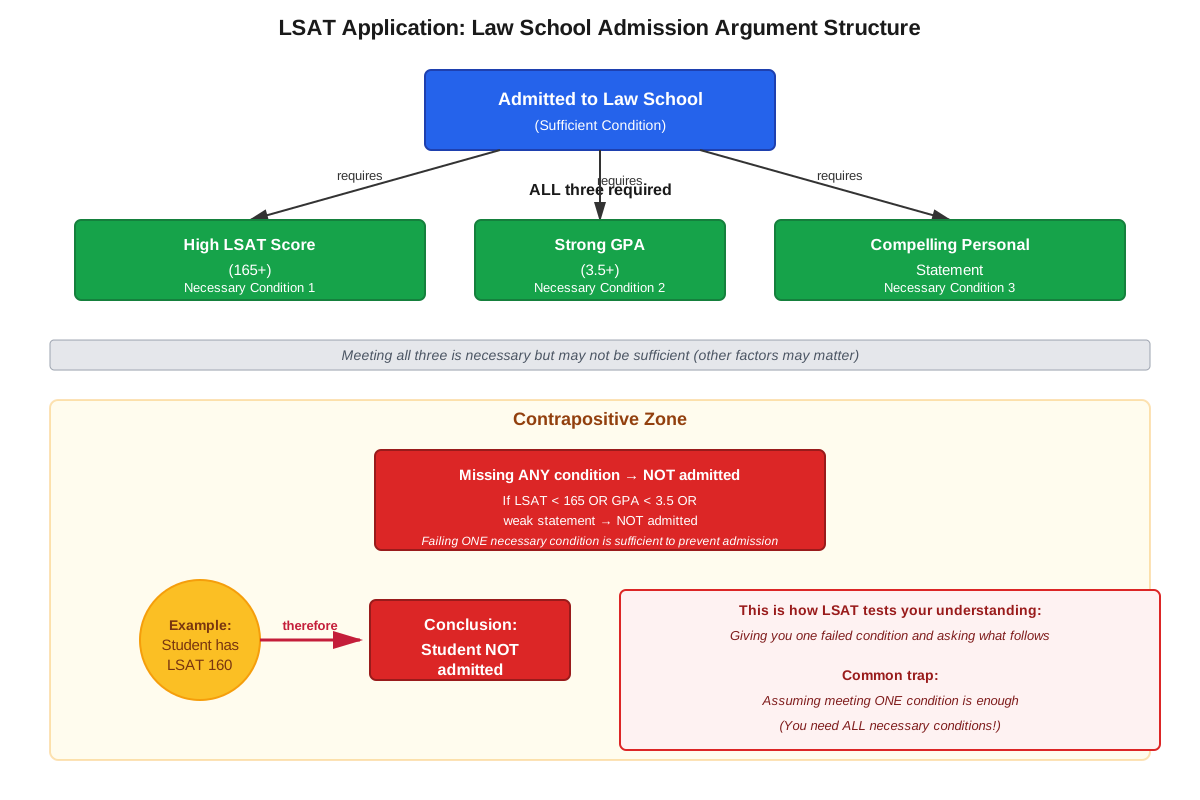
Consider this example: "To be admitted to the program, applicants must have a bachelor's degree AND submit three letters of recommendation AND score above 160 on the LSAT." Here, admission (A) is the sufficient condition, and it requires three distinct necessary conditions. The logical structure is:
Admitted → Bachelor's + Letters + LSAT>160
Critically, this means that lacking ANY ONE of these necessary conditions is sufficient to prevent admission. This insight leads directly to understanding the contrapositive.
The Contrapositive with Multiple Necessary Conditions
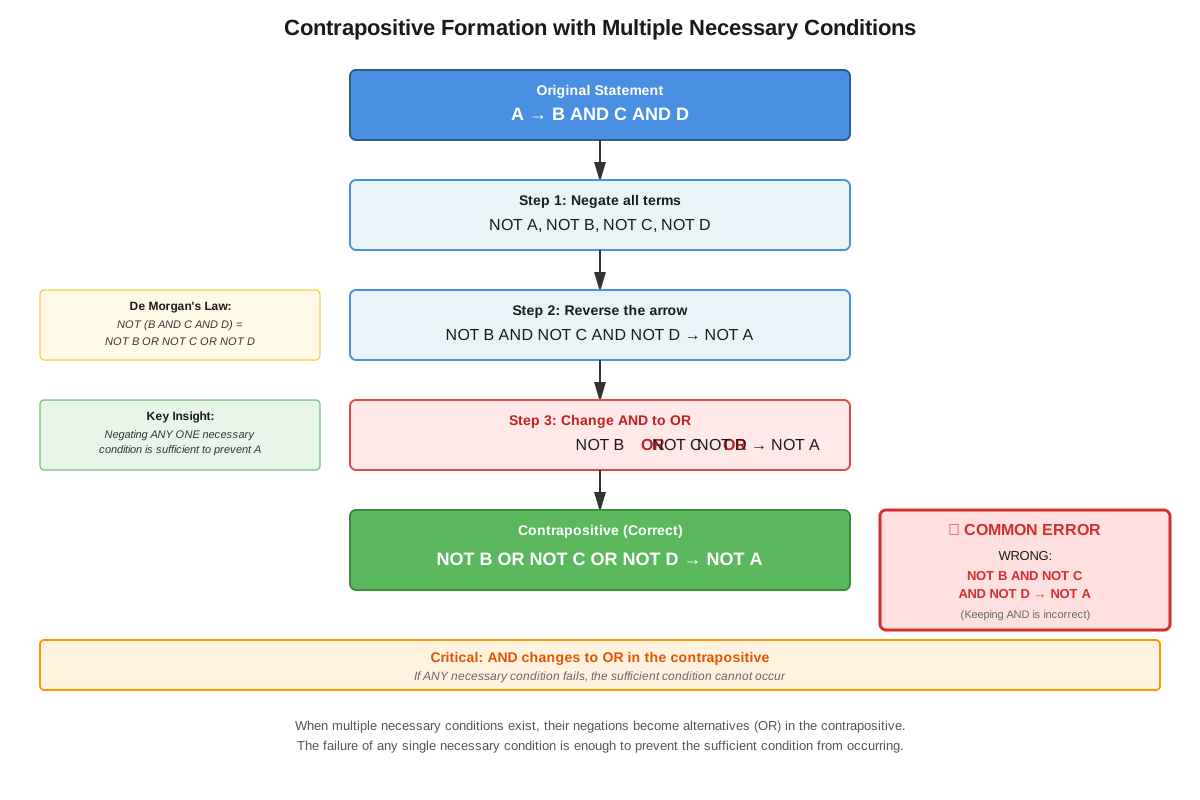
The contrapositive of a conditional statement with multiple necessary conditions follows a specific pattern that students frequently misunderstand. When you have:
A → B + C + D
The contrapositive is:
~B OR ~C OR ~D → ~A
Notice the crucial transformation: the "AND" in the necessary conditions becomes "OR" in the contrapositive, and all terms are negated. This reflects the logical principle that if you lack even one necessary condition, the sufficient condition cannot have occurred.
Using our admission example:
- Original: Admitted → Bachelor's + Letters + LSAT>160
- Contrapositive: ~Bachelor's OR ~Letters OR ~LSAT>160 → ~Admitted
This means: "If an applicant lacks a bachelor's degree, OR failed to submit letters, OR scored 160 or below, then they were not admitted." Lacking any single requirement is sufficient to conclude non-admission.
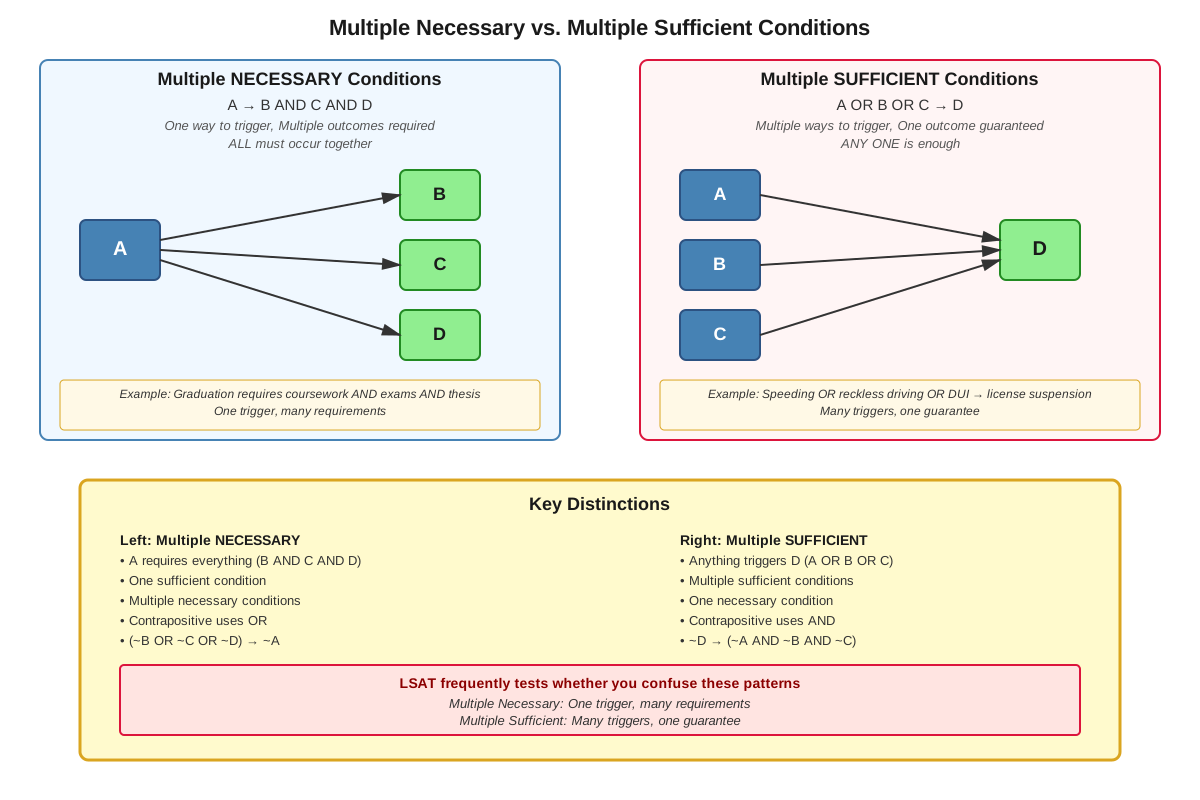
Multiple Necessary vs. Multiple Sufficient Conditions
Students must distinguish between multiple necessary conditions and multiple sufficient conditions, as these represent entirely different logical structures:
| Feature | Multiple Necessary Conditions | Multiple Sufficient Conditions |
|---|---|---|
| Structure | A → B + C + D | A → C; B → C; D → C |
| Meaning | A requires all of B, C, and D | Any of A, B, or D guarantees C |
| Contrapositive | ~B OR ~C OR ~D → ~A | ~C → ~A; ~C → ~B; ~C → ~D |
| Diagram notation | Single arrow with + | Multiple separate arrows |
| Common phrasing | "only if," "requires," "needs" | "if," "whenever," "sufficient" |
Multiple sufficient conditions mean that several different paths can lead to the same outcome. For example: "The alarm sounds if there's a fire OR if there's a break-in OR if someone tests the system." Each condition independently guarantees the alarm. This is fundamentally different from requiring multiple conditions simultaneously.
Identifying Multiple Necessary Conditions in LSAT Language
The LSAT uses specific linguistic patterns to indicate multiple necessary conditions. Recognizing these trigger words is essential for accurate diagramming:
"Only if" constructions: "The proposal passes only if it receives majority support AND the chair approves." The "only if" signals necessary conditions, and the "AND" indicates multiple requirements.
"Requires/needs/demands" with conjunctions: "Success requires dedication AND talent AND opportunity." All three are necessary.
"Unless" with multiple conditions: "The plant dies unless it receives water AND sunlight." (This means: if the plant survives, it must have received both water and sunlight.)
"Without" constructions: "Without both proper training AND adequate equipment, workers cannot perform safely." Both conditions are necessary for safe performance.
Negative sufficient conditions: "The experiment fails if temperature control is inadequate OR if contamination occurs." This is actually stating necessary conditions for success: Success → Adequate temperature + No contamination.
Common Logical Moves with Multiple Necessary Conditions
LSAT questions exploit multiple necessary conditions through several recurring logical patterns:
Establishing sufficiency by confirming all necessary conditions: If an argument states that X requires A, B, and C, and then establishes that all three are present, it can validly conclude X occurs (assuming these are the only necessary conditions and together they're sufficient).
Establishing impossibility by showing one necessary condition fails: If X requires A, B, and C, showing that B is absent is sufficient to conclude X cannot occur. This is the contrapositive in action.
Invalid reasoning—treating one necessary condition as sufficient: A common flaw is concluding X occurs because one necessary condition (say, A) is present, while ignoring that B and C must also be present. This is perhaps the most frequently tested error pattern.
Sufficient assumption questions: These often require identifying an additional necessary condition that, when combined with stated necessary conditions, becomes sufficient for the conclusion.
Chains of Reasoning with Multiple Necessary Conditions
Complex LSAT arguments often chain multiple conditional statements where some contain multiple necessary conditions:
A → B + C
B → D + E
C → F
From this structure, you can derive: A → B + C + D + E + F
When A occurs, it triggers B and C. B then triggers D and E, while C triggers F. Therefore, A ultimately requires all five conditions. The LSAT tests whether students can track these cascading requirements and recognize that failing any downstream necessary condition prevents the initial sufficient condition.
Concept Relationships
Multiple necessary conditions builds directly on basic conditional logic by adding complexity to the necessary condition side of the relationship. Where simple conditionals involve one sufficient condition guaranteeing one necessary condition (A → B), multiple necessary conditions maintain one sufficient condition but require several necessary conditions simultaneously (A → B + C + D).
This topic connects to contrapositive formation because the contrapositive rule must be modified: the conjunction (AND) of necessary conditions becomes a disjunction (OR) of negated conditions in the contrapositive. Understanding this transformation is essential for recognizing valid inferences.
The relationship flows as follows:
Basic Conditional Logic → introduces sufficient and necessary conditions → Multiple Necessary Conditions → adds conjunction of necessary conditions → Contrapositive Formation → transforms AND to OR when negating → Valid Inference Recognition → enables identification of what must be true
Multiple necessary conditions also relates to formal logic and quantification. When arguments state "all X must have properties A, B, and C," this creates a universal statement with multiple necessary conditions for membership in category X.
Furthermore, this topic connects to argument structure analysis. Many LSAT arguments have gaps where the author assumes that stated necessary conditions are sufficient, or where additional unstated necessary conditions exist. Recognizing these gaps requires mastery of multiple necessary conditions.
Quick check — test yourself on Multiple necessary conditions so far.
Try Flashcards →High-Yield Facts
⭐ When a sufficient condition requires multiple necessary conditions (A → B + C), lacking ANY ONE necessary condition is sufficient to prevent the sufficient condition from occurring.
⭐ The contrapositive of A → B + C is ~B OR ~C → ~A. The AND becomes OR, and all terms are negated.
⭐ Meeting only some necessary conditions does NOT allow you to conclude the sufficient condition occurred—all necessary conditions must be satisfied.
⭐ "Only if" introduces necessary conditions. When followed by multiple conditions joined by "and," all are necessary.
⭐ Multiple necessary conditions appear most frequently in Sufficient Assumption, Must Be True, and Flaw questions.
- The phrase "requires both X and Y" indicates X and Y are both necessary conditions for whatever precedes "requires."
- In chains of conditional reasoning, necessary conditions accumulate: if A → B + C and B → D, then A → B + C + D.
- Wrong answer choices frequently treat one necessary condition as if it were sufficient for the conclusion.
- "Unless" statements with multiple conditions create multiple necessary conditions: "X unless Y and Z" means X → Y + Z.
- When an argument concludes something occurred, check whether all necessary conditions were established, not just one or some.
Common Misconceptions
Misconception: If A requires B and C, then having B and C means A must have occurred.
Correction: B and C are necessary for A, but not necessarily sufficient. A might require additional conditions beyond B and C, or B and C might occur without A. Necessary conditions don't work backwards—only sufficient conditions guarantee their necessary conditions.
Misconception: The contrapositive of A → B + C is ~B + ~C → ~A.
Correction: The contrapositive is ~B OR ~C → ~A. The conjunction (AND) becomes a disjunction (OR) when forming the contrapositive. Lacking either necessary condition is sufficient to prevent the sufficient condition.
Misconception: If an argument states that X requires A, B, and C, and the conclusion is that X occurred, the argument is automatically flawed.
Correction: The argument is valid if the premises establish that all three necessary conditions (A, B, and C) are present AND that these conditions are jointly sufficient for X. The flaw only exists if the premises don't establish all necessary conditions or if the conditions aren't sufficient.
Misconception: Multiple necessary conditions and multiple sufficient conditions are the same thing.
Correction: These are opposite structures. Multiple necessary conditions mean one trigger requires several outcomes (A → B + C + D). Multiple sufficient conditions mean several different triggers can each produce the same outcome (A → D; B → D; C → D).
Misconception: In a statement like "The committee approves proposals only if they're innovative and cost-effective," being innovative is sufficient for approval.
Correction: "Only if" introduces necessary conditions, not sufficient ones. Both innovation AND cost-effectiveness are necessary for approval, but the statement doesn't tell us these are sufficient—other requirements might also exist.
Misconception: When diagramming "A requires B and C and D," you should create separate conditional statements: A → B, A → C, A → D.
Correction: While these separate statements are technically true, they miss the crucial logical relationship that all three must occur together. The proper diagram is A → B + C + D, which captures that all are simultaneously necessary and that lacking any one prevents A.
Worked Examples
Example 1: Must Be True Question
Stimulus: "The university grants tenure only to professors who have published at least ten peer-reviewed articles, received positive student evaluations for five consecutive years, and demonstrated significant service to the university. Professor Martinez received tenure last year."
Question: Which of the following must be true?
Analysis:
Step 1: Identify the conditional structure. The word "only" signals necessary conditions. The statement means:
Tenure → 10+ articles + 5 years positive evaluations + Significant service
Step 2: Identify what we know. Professor Martinez received tenure (the sufficient condition occurred).
Step 3: Apply the conditional rule. When the sufficient condition occurs, all necessary conditions must occur. Therefore, Professor Martinez must have:
- Published at least ten peer-reviewed articles, AND
- Received positive student evaluations for five consecutive years, AND
- Demonstrated significant service to the university
Step 4: Evaluate answer choices. The correct answer must state one or more of these necessary conditions. Wrong answers might:
- State something that could be true but isn't required (e.g., "Martinez published more than fifteen articles")
- Reverse the logic (e.g., "Anyone who publishes ten articles receives tenure")
- State only that some necessary conditions were met without acknowledging all are required
Correct answer type: "Professor Martinez published at least ten peer-reviewed articles" or "Professor Martinez received positive student evaluations for five consecutive years" or any statement that must follow from the necessary conditions being satisfied.
Example 2: Flaw Question
Stimulus: "To qualify for the scholarship, students must maintain a GPA above 3.5 and demonstrate financial need. Chen has maintained a GPA above 3.5 throughout her college career. Therefore, Chen qualifies for the scholarship."
Question: The reasoning in the argument is flawed because it:
Analysis:
Step 1: Diagram the conditional relationship.
Scholarship → GPA > 3.5 + Financial need
Step 2: Identify what the premises establish. The argument tells us Chen has a GPA above 3.5 (one necessary condition is met).
Step 3: Identify the conclusion. The argument concludes Chen qualifies for the scholarship (the sufficient condition occurred).
Step 4: Identify the logical gap. The argument establishes only ONE of the TWO necessary conditions. We don't know whether Chen demonstrates financial need. The argument treats one necessary condition as if it were sufficient.
Step 5: Articulate the flaw. The argument fails to establish that all necessary conditions are satisfied before concluding the sufficient condition occurred. Specifically, it ignores that financial need must also be demonstrated.
Correct answer type: "treats a condition that is necessary for scholarship qualification as if it were sufficient for qualification" or "fails to establish that all requirements for the scholarship have been met" or "overlooks the possibility that Chen does not demonstrate financial need."
This flaw pattern—treating one or some necessary conditions as sufficient—is among the most common in LSAT Logical Reasoning and appears frequently when multiple necessary conditions are present.
Exam Strategy
When approaching LSAT questions involving multiple necessary conditions, follow this systematic process:
Step 1: Identify conditional indicators. Watch for "only if," "requires," "needs," "necessary," "must," "unless," and "without." These signal necessary conditions. When multiple conditions follow these indicators connected by "and," you have multiple necessary conditions.
Step 2: Diagram immediately. Write out the conditional relationship using arrow notation with plus signs: A → B + C + D. This external representation prevents mental tracking errors and makes the contrapositive easier to form.
Step 3: Form the contrapositive. Write it out explicitly: ~B OR ~C OR ~D → ~A. Remember the AND-to-OR transformation. Many correct answers require recognizing the contrapositive.
Step 4: Track what's established. As you read the stimulus, note which conditions the argument establishes as present or absent. Check off each necessary condition that's confirmed.
Step 5: Identify logical gaps. Before looking at answer choices, determine whether all necessary conditions have been established. If the conclusion states the sufficient condition occurred but not all necessary conditions were proven, you've found a gap.
Trigger phrases to watch for:
- "Only if" + multiple conditions = multiple necessary conditions
- "Requires both/all" = multiple necessary conditions
- "Without X and Y" = X and Y are necessary
- "Unless X and Y" = X and Y are necessary
- "Must have X, Y, and Z" = multiple necessary conditions
Process of elimination tips:
- Eliminate answers that treat one necessary condition as sufficient
- Eliminate answers that reverse the conditional relationship
- Eliminate answers that claim something is necessary when it's actually sufficient
- In Must Be True questions, eliminate answers that go beyond what the necessary conditions guarantee
- In Sufficient Assumption questions, look for answers that provide missing necessary conditions
Time allocation: Spend 10-15 seconds diagramming the conditional relationship before reading answer choices. This upfront investment prevents re-reading and confusion, ultimately saving time. For complex stimuli with multiple conditional statements, spend up to 20 seconds creating a complete diagram.
Memory Techniques
The "AND-to-OR Flip" mnemonic: When forming contrapositives with multiple necessary conditions, remember "AND Necessary becomes OR Negated" (ANON). The AND in necessary conditions flips to OR in the contrapositive, and everything gets negated.
The "All or Nothing" rule: With multiple necessary conditions, think "ALL necessary conditions must be present, or you get NOTHING" (the sufficient condition cannot occur). This reinforces that lacking even one necessary condition prevents the outcome.
Visual diagram technique: Draw multiple necessary conditions as branches extending from a single trunk:
        B
       /
    A +--- C
       \
        D
This visual shows that A leads to all of B, C, and D simultaneously. When forming the contrapositive, imagine cutting any single branch—cutting any one is sufficient to fell the entire tree (prevent A).
The "Scholarship Checklist" analogy: Think of multiple necessary conditions like a scholarship application checklist. You need to check off every box (essay AND transcript AND letters AND test scores). Missing even one box means automatic rejection. This real-world analogy helps remember that all conditions must be satisfied.
Acronym for common errors—TONS: Watch for Treating necessary as sufficient, Omitting necessary conditions, Negating incorrectly, Switching AND/OR. These four errors account for most wrong answers in multiple necessary conditions questions.
Summary
Multiple necessary conditions represent a fundamental logical pattern where a single sufficient condition requires two or more distinct necessary conditions to all be satisfied simultaneously. This structure appears throughout LSAT Logical Reasoning questions and requires precise diagramming (A → B + C + D) and careful attention to the contrapositive transformation, where the conjunction of necessary conditions becomes a disjunction of negated conditions (~B OR ~C OR ~D → ~A). The most common error pattern—both in LSAT arguments and wrong answer choices—involves treating one or some necessary conditions as if they were sufficient for the conclusion, ignoring that all necessary conditions must be established. Success with this topic requires recognizing linguistic indicators ("only if," "requires," "needs"), accurately diagramming relationships, tracking which conditions have been established, and understanding that lacking any single necessary condition is sufficient to prevent the sufficient condition from occurring. Mastery enables students to navigate Sufficient Assumption questions (by identifying missing necessary conditions), Must Be True questions (by recognizing what follows from established conditions), and Flaw questions (by spotting when arguments illegitimately treat necessary conditions as sufficient).
Key Takeaways
- Multiple necessary conditions occur when one sufficient condition requires two or more necessary conditions simultaneously (A → B + C + D)
- The contrapositive transforms AND to OR: if A → B + C, then ~B OR ~C → ~A
- Lacking ANY ONE necessary condition is sufficient to prevent the sufficient condition from occurring
- The most common flaw is treating one or some necessary conditions as sufficient while ignoring that all must be present
- "Only if" followed by multiple conditions connected by "and" creates multiple necessary conditions
- In Must Be True questions, when the sufficient condition is established, all necessary conditions must be true
- Accurate diagramming is essential—write out the conditional relationship with plus signs to avoid mental tracking errors
Related Topics
Sufficient Assumption Questions: Understanding multiple necessary conditions is crucial for identifying what additional condition would make an argument valid. Often, the correct answer provides a missing necessary condition that, combined with stated conditions, becomes sufficient for the conclusion.
Formal Logic and Quantifiers: Multiple necessary conditions extend into formal logic when dealing with universal statements. "All members of category X must have properties A, B, and C" creates a conditional with multiple necessary conditions for category membership.
Conditional Chains and Complex Reasoning: Multiple necessary conditions become more challenging when embedded in chains of conditional reasoning, where necessary conditions themselves have necessary conditions, creating cascading requirements.
Logical Opposites and Negation: Properly forming contrapositives with multiple necessary conditions requires understanding how to negate compound statements and apply De Morgan's Laws (the principle that negating "A and B" yields "not A or not B").
Argument Structure and Gaps: Recognizing unstated assumptions often involves identifying missing necessary conditions that arguments fail to establish, making this topic foundational for assumption family questions.
Practice CTA
Now that you understand the logical structure and strategic approach to multiple necessary conditions, it's time to cement your mastery through active practice. Attempt the practice questions associated with this topic, focusing on accurately diagramming each conditional relationship before evaluating answer choices. Use the flashcards to drill recognition of trigger phrases and contrapositive formation until these patterns become automatic. Remember: multiple necessary conditions appear in 15-20% of Logical Reasoning questions, making this one of the highest-yield topics for score improvement. Every question you practice strengthens your ability to spot these patterns quickly and avoid the common traps test-makers set. Your investment in mastering this topic will pay dividends across multiple question types throughout the LSAT.
Sign up free to keep reading
Create a free AnvayaPrep account to finish this LSAT guide on Multiple necessary conditions — plus flashcards and practice questions.