Overview
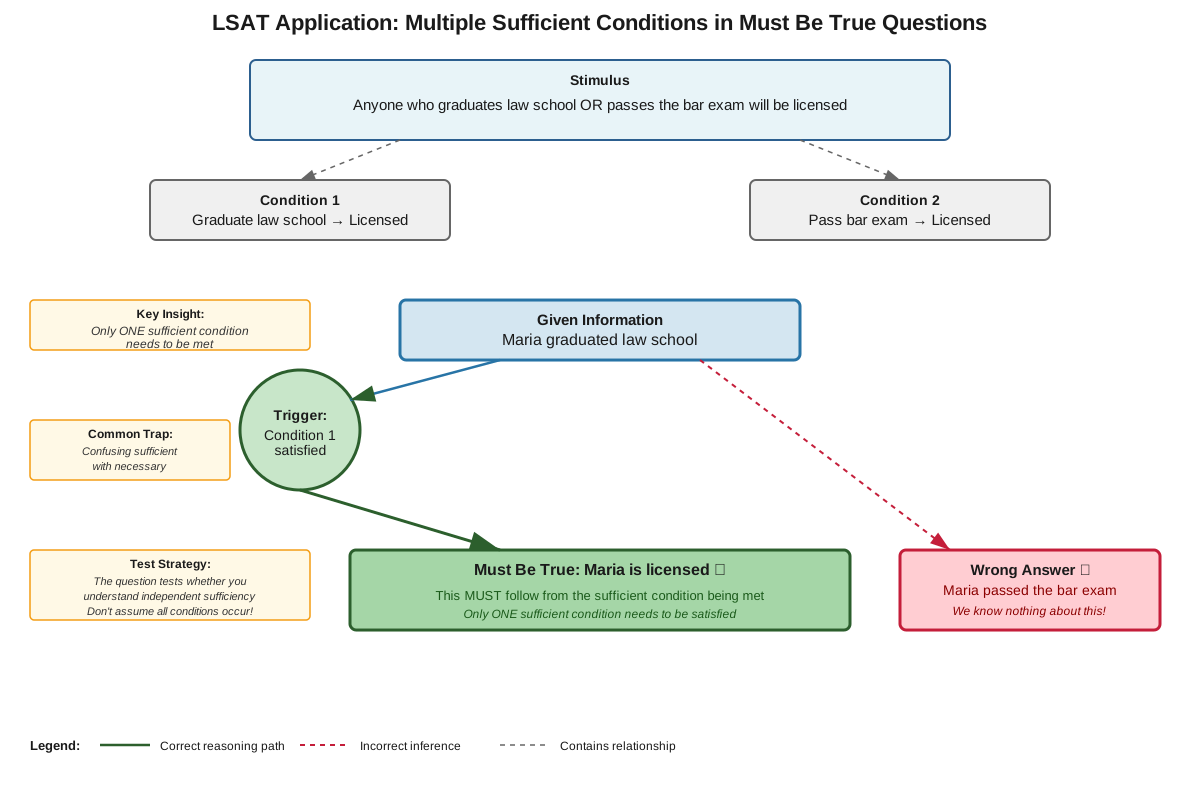
Multiple sufficient conditions represent one of the most frequently tested patterns in LSAT logical reasoning questions. This concept involves understanding how two or more different conditions can each independently guarantee the same outcome. Unlike single conditional statements where one sufficient condition triggers one necessary condition, multiple sufficient conditions create a logical structure where several distinct pathways lead to the same result. For example, if either graduating from law school OR passing the bar exam is sufficient to become a licensed attorney, both conditions independently satisfy the requirement—though in reality, both are typically needed, this illustrates the logical structure.
Mastering multiple sufficient conditions is essential for LSAT success because these patterns appear across numerous question types, including Must Be True, Sufficient Assumption, Parallel Reasoning, and Flaw questions. The LSAT frequently tests whether students can recognize when different conditions independently trigger the same consequence, distinguish between sufficient and necessary conditions in complex statements, and understand how these relationships combine with other logical structures. Students who struggle with this concept often misinterpret "or" statements, confuse multiple sufficient conditions with necessary conditions, or fail to recognize that each sufficient condition operates independently.
Within the broader framework of conditional logic, multiple sufficient conditions build upon basic conditional reasoning (if-then statements) and connect to more advanced topics like conditional chains, contrapositive reasoning, and formal logic. Understanding this topic provides the foundation for analyzing complex argument structures where multiple premises independently support a conclusion, and for recognizing when test-makers present flawed reasoning that confuses these relationships. This concept also integrates with diagramming techniques that help visualize how different logical pathways converge on the same outcome.
Learning Objectives
- [ ] Identify how multiple sufficient conditions appears in LSAT questions
- [ ] Explain the reasoning pattern behind multiple sufficient conditions
- [ ] Apply multiple sufficient conditions to solve LSAT-style problems accurately
- [ ] Diagram multiple sufficient conditions using standard logical notation
- [ ] Distinguish between multiple sufficient conditions and multiple necessary conditions
- [ ] Recognize and apply the contrapositive of statements with multiple sufficient conditions
- [ ] Identify flawed reasoning that incorrectly treats multiple sufficient conditions
Prerequisites
- Basic conditional logic (if-then statements): Understanding simple sufficient and necessary conditions is essential because multiple sufficient conditions build directly on this foundation by adding complexity to the sufficient side of the relationship.
- Contrapositive formation: The ability to form contrapositives is necessary because statements with multiple sufficient conditions have specific contrapositive patterns that differ from simple conditionals.
- Logical operators (AND/OR): Familiarity with how "and" and "or" function in logical statements is critical because multiple sufficient conditions typically involve "or" relationships that students must correctly interpret.
- Basic diagramming conventions: Knowledge of arrow notation and symbolic representation helps visualize multiple sufficient conditions and track their relationships efficiently during timed exam conditions.
Why This Topic Matters
Multiple sufficient conditions appear in approximately 15-20% of all Logical Reasoning questions on the LSAT, making this one of the highest-yield topics for test preparation. This pattern appears most frequently in Must Be True questions, where students must recognize what necessarily follows from premises containing multiple sufficient conditions, and in Sufficient Assumption questions, where the correct answer often provides an additional sufficient condition that guarantees the conclusion. Flaw questions regularly test whether students can identify when an argument incorrectly assumes that a sufficient condition is also necessary, or when reasoning fails to recognize that multiple pathways exist to the same outcome.
Beyond the LSAT, understanding multiple sufficient conditions develops critical thinking skills applicable to legal reasoning, policy analysis, and everyday decision-making. Legal statutes often specify multiple conditions under which certain consequences apply—for instance, various grounds for terminating a contract or different circumstances that establish liability. Recognizing these patterns helps in analyzing complex regulations, understanding precedent, and constructing persuasive arguments.
In real-world applications, multiple sufficient conditions appear whenever different criteria can independently qualify someone for a benefit, different violations can each trigger a penalty, or various circumstances can each justify a particular action. This logical structure underlies much of legal, administrative, and policy reasoning, making it not just an LSAT skill but a fundamental tool for legal practice and analytical thinking.
Core Concepts
Definition and Basic Structure
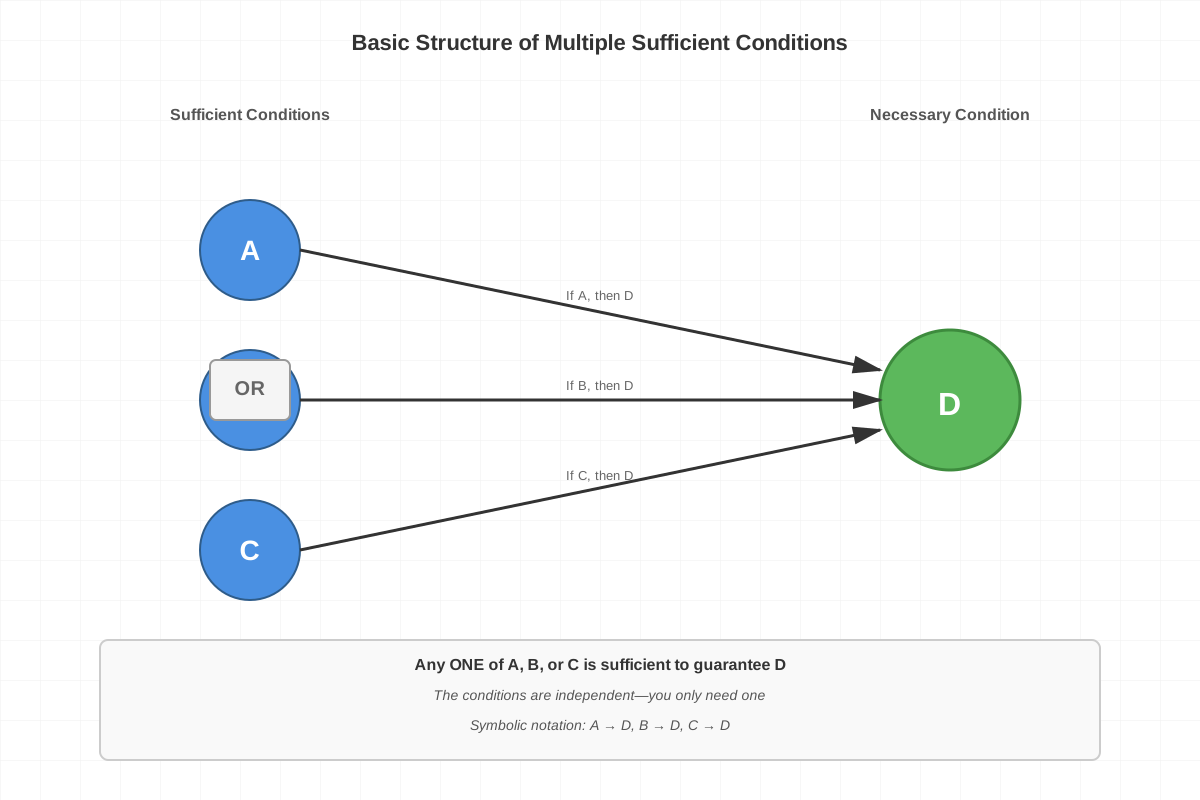
Multiple sufficient conditions occur when two or more distinct conditions each independently guarantee the same necessary condition or outcome. The fundamental structure follows this pattern: "If A, then C" AND "If B, then C." Both A and B are sufficient for C, meaning that either one occurring alone is enough to guarantee C happens. Importantly, this does not mean both must occur—each operates independently as a sufficient trigger.
The standard symbolic representation uses arrows pointing from each sufficient condition toward the shared necessary condition:
A → C
B → C
This can also be written in a combined form: "A or B → C," which reads as "If A or B (or both), then C." The "or" here is inclusive, meaning either condition alone suffices, and both occurring together also guarantees the outcome.
Linguistic Indicators
The LSAT presents multiple sufficient conditions through various linguistic formulations that students must recognize:
- "Either...or" constructions: "Either graduating with honors or receiving a faculty recommendation is sufficient for admission."
- "Any" statements: "Any violation of rules A, B, or C will result in disqualification."
- Multiple "if" clauses: "If the temperature drops below freezing, the pipes will burst. If the insulation fails, the pipes will burst."
- "Whenever" with multiple subjects: "Whenever the alarm sounds or the sensor detects motion, the system activates."
- Lists with sufficient indicators: "Fraud, misrepresentation, or breach of contract each constitutes grounds for termination."
The "Or" Relationship in Sufficient Conditions
A critical concept is understanding how "or" functions differently on the sufficient versus necessary side of conditionals. When "or" appears among sufficient conditions (before the arrow), it means each condition independently suffices. However, when "or" appears in the necessary condition (after the arrow), it means at least one of those conditions must occur, but we cannot determine which one.
| Position of "OR" | Logical Meaning | Example |
|---|---|---|
| Sufficient side (before →) | Each condition independently guarantees the outcome | A or B → C (Either A alone or B alone triggers C) |
| Necessary side (after →) | At least one must occur, but either suffices | A → B or C (If A, then at least one of B or C must happen) |
Contrapositive Formation
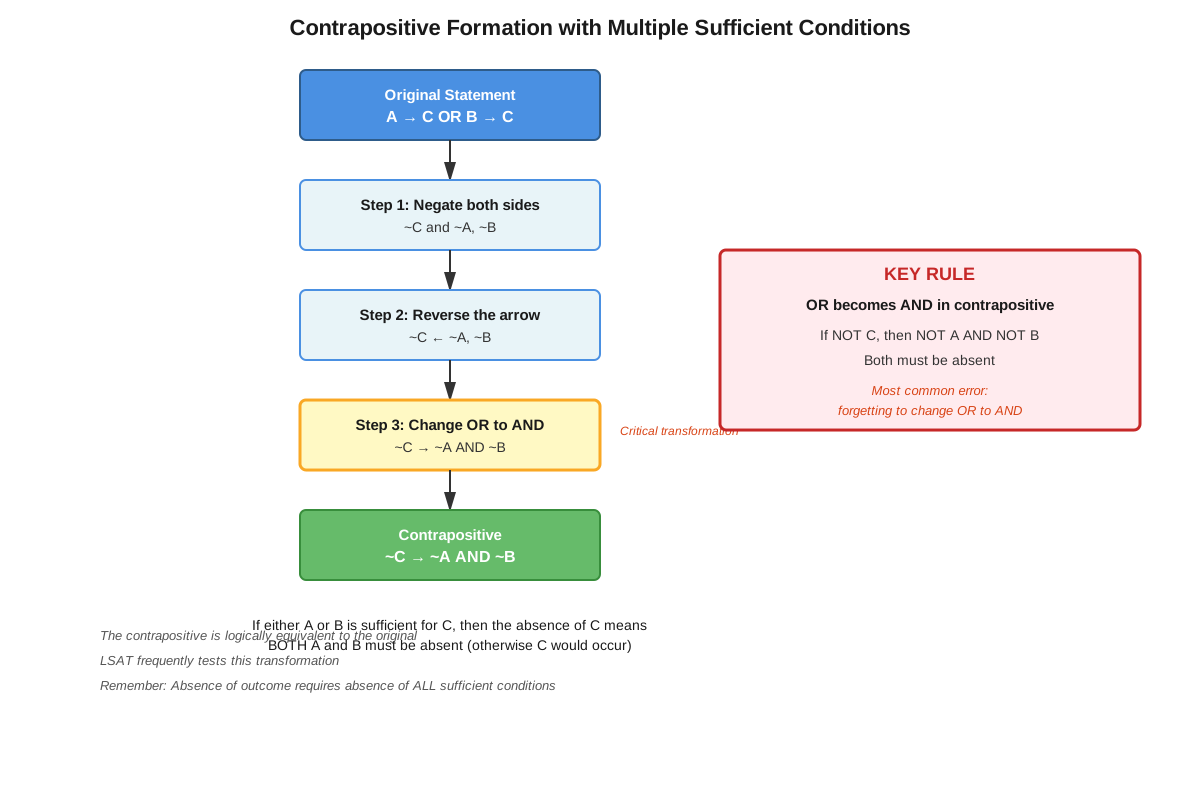
The contrapositive of multiple sufficient conditions follows a specific pattern that students must master. When you have "A or B → C," the contrapositive becomes "NOT C → NOT A and NOT B." This transformation is crucial: the "or" on the sufficient side becomes "and" on the necessary side when forming the contrapositive.
Original: "If you study hard OR have natural talent, you will succeed."
- Symbolic: Study Hard or Natural Talent → Success
- Contrapositive: NOT Success → NOT Study Hard AND NOT Natural Talent
- Translation: "If you don't succeed, then you didn't study hard AND you don't have natural talent."
This pattern reflects a fundamental logical principle: to prevent the outcome (C), you must prevent ALL of the sufficient conditions. Preventing just one sufficient condition is insufficient because the other(s) could still trigger the outcome.
Independence of Sufficient Conditions
Each sufficient condition operates independently—the occurrence of one does not affect whether another might also occur, and the presence of multiple sufficient conditions does not create any relationship between those conditions themselves. This independence is frequently tested on the LSAT through wrong answer choices that incorrectly suggest relationships between the sufficient conditions.
For example, if "A → C" and "B → C," we cannot conclude:
- That A and B are related to each other
- That if A occurs, B cannot occur
- That if B occurs, A must also occur
- That A and B together are necessary for C
Multiple Sufficient Conditions vs. Multiple Necessary Conditions
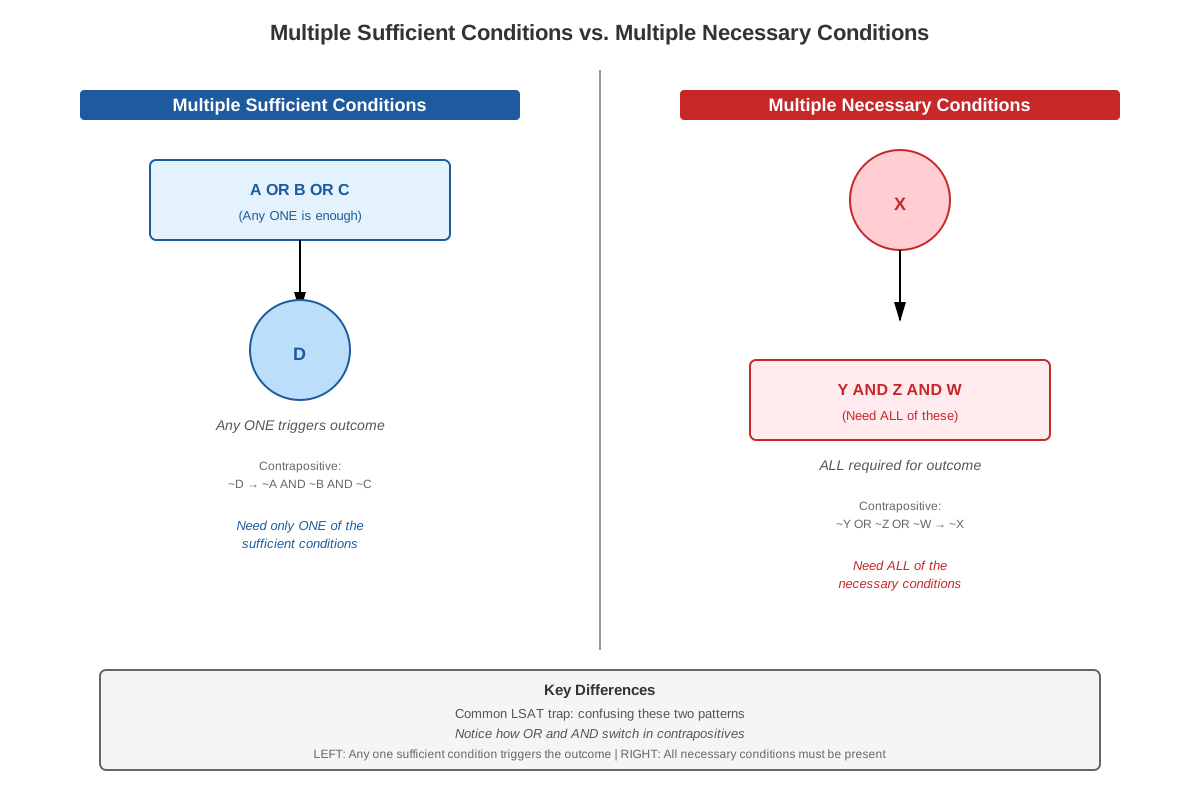
Students must distinguish between multiple sufficient conditions and multiple necessary conditions, as these create entirely different logical structures:
Multiple Sufficient Conditions: A or B → C (Either condition alone guarantees C)
Multiple Necessary Conditions: A → B and C (If A occurs, both B and C must occur)
The LSAT frequently tests this distinction by presenting arguments that confuse these patterns or by offering answer choices that misrepresent one as the other.
Combining with Conditional Chains
Multiple sufficient conditions often appear within longer conditional chains, creating complex logical structures. For example:
A or B → C → D
E → C → D
Here, A, B, and E are all sufficient conditions for C, which is itself a sufficient condition for D. This means A, B, and E are each sufficient for D as well (through the transitive property). Recognizing these extended relationships is essential for Must Be True questions.
Concept Relationships
Multiple sufficient conditions build directly upon basic conditional logic by adding complexity to the sufficient side of if-then relationships. The foundational concept of sufficient conditions (if A, then B) expands to accommodate multiple independent triggers (if A or B or C, then D), while the necessary condition remains singular. This expansion requires understanding how the logical operator "or" functions in conditional statements, connecting this topic to Boolean logic and set theory.
The relationship between multiple sufficient conditions and contrapositive reasoning is bidirectional and essential. Forming the contrapositive of multiple sufficient conditions requires transforming "or" to "and" (and vice versa), which connects to De Morgan's Laws from formal logic. This transformation pattern: (A or B → C) becomes (NOT C → NOT A and NOT B) represents a critical skill tested repeatedly on the LSAT.
Concept flow: Basic Conditionals → Multiple Sufficient Conditions → Contrapositive Formation → Complex Conditional Chains → Formal Logic Integration
Multiple sufficient conditions also relate to argument structure analysis. When an argument presents multiple independent reasons supporting a conclusion, this often reflects a multiple sufficient conditions structure where each premise independently suffices to establish the conclusion. This connects to question types like Sufficient Assumption (where the correct answer provides an additional sufficient condition) and Strengthen questions (where additional sufficient conditions can bolster an argument).
The distinction between multiple sufficient conditions and multiple necessary conditions connects to understanding logical operators and their positions within conditional statements. This distinction further relates to recognizing flawed reasoning patterns, particularly the common error of treating a sufficient condition as necessary—a flaw that becomes more complex when multiple sufficient conditions are involved.
High-Yield Facts
⭐ Multiple sufficient conditions means each condition independently guarantees the outcome—no combination is required.
⭐ The contrapositive of "A or B → C" is "NOT C → NOT A and NOT B" (or becomes and).
⭐ When "or" appears among sufficient conditions, each condition alone is sufficient; when "or" appears in the necessary condition, at least one must occur but we cannot determine which.
⭐ Multiple sufficient conditions do not create any logical relationship between the sufficient conditions themselves.
⭐ To prevent an outcome with multiple sufficient conditions, ALL sufficient conditions must be prevented.
- The presence of one sufficient condition does not preclude other sufficient conditions from also being present.
- "Any" typically introduces multiple sufficient conditions: "Any of these violations will result in termination."
- Multiple sufficient conditions can chain together: if A or B → C, and C → D, then A or B → D.
- The LSAT frequently tests whether students incorrectly assume a sufficient condition is also necessary.
- In Must Be True questions, if you know the necessary condition did NOT occur, you can conclude that NONE of the sufficient conditions occurred.
⭐ Wrong answers often suggest that because one sufficient condition occurred, another sufficient condition could not have occurred.
- Parallel Reasoning questions require matching the structure of multiple sufficient conditions exactly, including the number of conditions and their relationships.
- Sufficient Assumption questions often require adding a new sufficient condition that guarantees the conclusion.
Quick check — test yourself on Multiple sufficient conditions so far.
Try Flashcards →Common Misconceptions
Misconception: If multiple sufficient conditions exist for an outcome, all of them must occur for the outcome to happen.
Correction: Each sufficient condition independently guarantees the outcome. Only ONE needs to occur, though multiple can occur simultaneously. The defining feature of sufficient conditions is that each alone is enough.
Misconception: Multiple sufficient conditions create a relationship between those conditions themselves.
Correction: The sufficient conditions are logically independent of each other. Knowing that A and B are both sufficient for C tells you nothing about any relationship between A and B. They could be mutually exclusive, overlapping, or completely unrelated.
Misconception: The contrapositive of "A or B → C" is "NOT C → NOT A or NOT B."
Correction: The contrapositive is "NOT C → NOT A AND NOT B." The logical operator flips from "or" to "and" when forming the contrapositive. This is because to prevent C, you must prevent all possible sufficient conditions, not just one of them.
Misconception: If one sufficient condition occurs and the outcome doesn't happen, the conditional statement is violated.
Correction: If a sufficient condition occurs, the necessary condition MUST occur—this is the definition of a valid conditional. If the outcome doesn't happen when a sufficient condition occurs, the conditional statement itself is false or the sufficient condition didn't actually occur.
Misconception: Multiple sufficient conditions mean the same thing as multiple necessary conditions.
Correction: These are opposite structures. Multiple sufficient conditions (A or B → C) mean either condition alone guarantees C. Multiple necessary conditions (A → B and C) mean if A occurs, both B and C must occur. The position and logical operator completely change the meaning.
Misconception: In "A or B → C," if A occurs, then B cannot occur.
Correction: The "or" in logic is inclusive unless explicitly stated otherwise. Both A and B can occur simultaneously. The statement only requires that at least one occurs to trigger C, but both occurring is perfectly consistent with the logical structure.
Misconception: If you have multiple sufficient conditions for an outcome, and the outcome occurs, you can determine which sufficient condition caused it.
Correction: Knowing only that the necessary condition occurred tells you that at least one sufficient condition occurred, but you cannot determine which one(s) without additional information. This is the fallacy of affirming the consequent applied to multiple sufficient conditions.
Worked Examples
Example 1: Must Be True Question
Stimulus: "Any company that fails to meet safety standards or that receives three customer complaints will have its license suspended. TechCorp's license was not suspended this year."
Question: Which of the following must be true?
Analysis:
Step 1: Identify the conditional structure.
- Sufficient conditions: (1) fails to meet safety standards OR (2) receives three customer complaints
- Necessary condition: license suspended
- Symbolic form: Safety Failure or 3 Complaints → License Suspended
Step 2: Identify what we know.
- We know the necessary condition did NOT occur (license was NOT suspended)
Step 3: Apply the contrapositive.
- Original: Safety Failure or 3 Complaints → License Suspended
- Contrapositive: NOT License Suspended → NOT Safety Failure AND NOT 3 Complaints
- This means: TechCorp did NOT fail to meet safety standards AND did NOT receive three customer complaints
Step 4: Evaluate what must be true.
- TechCorp met safety standards (must be true)
- TechCorp did not receive three customer complaints (must be true)
- TechCorp received fewer than three customer complaints (must be true)
Correct answer would state: "TechCorp met safety standards" or "TechCorp received fewer than three customer complaints" or both.
Wrong answer traps to avoid:
- "TechCorp met safety standards OR received fewer than three complaints" (too weak—both must be true, not just one)
- "TechCorp received no customer complaints" (too strong—we only know it received fewer than three)
- "No company that met safety standards had its license suspended" (reverses the logic—meeting standards is not sufficient for keeping the license)
Example 2: Flaw Question
Stimulus: "The city council will approve the new development project if either the environmental impact study shows no significant harm or if the project creates at least 500 jobs. The environmental study showed significant harm. Therefore, the city council will not approve the project."
Question: The reasoning is flawed because it:
Analysis:
Step 1: Identify the conditional structure.
- Sufficient conditions: (1) no significant environmental harm OR (2) creates 500+ jobs
- Necessary condition: council approves project
- Symbolic: No Harm or 500+ Jobs → Approval
Step 2: Identify what the argument establishes.
- The argument tells us one sufficient condition did NOT occur (there WAS significant harm)
- The argument concludes the necessary condition will NOT occur (no approval)
Step 3: Identify the logical error.
- The argument eliminates only ONE of the multiple sufficient conditions
- The other sufficient condition (500+ jobs) could still trigger approval
- To conclude "no approval," the argument would need to show that BOTH sufficient conditions fail to occur
- This is the contrapositive error: the contrapositive requires NOT Approval → NOT (No Harm) AND NOT (500+ Jobs)
Step 4: Articulate the flaw.
The reasoning fails to consider that even though one sufficient condition is absent, another sufficient condition might still be present and could independently guarantee the outcome.
Correct answer would state: "The argument overlooks the possibility that the project might create at least 500 jobs, which would be sufficient for approval regardless of environmental harm."
Connection to learning objectives: This example demonstrates how multiple sufficient conditions appear in Flaw questions and requires explaining the reasoning pattern (each condition independently suffices) and applying it to identify the logical error.
Exam Strategy
Recognition Triggers
Watch for these linguistic markers that signal multiple sufficient conditions:
- "Either...or" before the consequence
- "Any" followed by a list
- Multiple "if" clauses leading to the same outcome
- "Whenever" with compound subjects
- Lists separated by commas or "or" before a consequence
- "Each," "all," or "any" introducing alternatives
Exam Tip: When you see "or" in a conditional statement, immediately identify whether it appears on the sufficient side (before the arrow) or necessary side (after the arrow). This determines whether you're dealing with multiple sufficient conditions or a disjunctive necessary condition.
Systematic Approach
- Diagram immediately: Convert complex language into symbolic form (A or B → C) to clarify the structure
- Form the contrapositive: Write out the contrapositive to have both directions available
- Check what you know: Identify whether the stimulus tells you about sufficient conditions occurring or the necessary condition occurring/not occurring
- Apply the appropriate inference: Use the original statement if a sufficient condition occurs; use the contrapositive if the necessary condition doesn't occur
Process of Elimination
Eliminate answers that:
- Suggest relationships between the sufficient conditions themselves (they're independent)
- Treat one sufficient condition as necessary when multiple exist
- Fail to recognize that eliminating one sufficient condition doesn't eliminate the outcome
- Incorrectly form the contrapositive (watch for "or" vs. "and" errors)
- Affirm the consequent (conclude which sufficient condition occurred just because the necessary condition occurred)
Keep answers that:
- Recognize each sufficient condition independently guarantees the outcome
- Correctly apply the contrapositive when the necessary condition doesn't occur
- Acknowledge that multiple pathways exist to the same result
- Properly distinguish between sufficient and necessary conditions
Time Management
Multiple sufficient conditions questions typically require 1:15-1:45 to solve accurately. Invest time upfront in careful diagramming (15-20 seconds) because this prevents errors that cost more time later. If a stimulus presents three or more sufficient conditions, the question is likely testing whether you can track all of them systematically—slow down slightly to ensure accuracy.
For Must Be True questions with multiple sufficient conditions, the correct answer often follows directly from the contrapositive. For Flaw questions, the error typically involves ignoring one of the sufficient conditions. Recognizing these patterns can accelerate your process.
Memory Techniques
Mnemonic for Contrapositive Formation: "Opposite And" (OA)
- When you take the Opposite (negate), "or" becomes "And"
- Original: A or B → C
- Contrapositive: NOT C → NOT A and NOT B
Visualization Strategy: Picture multiple roads leading to the same destination. Each road (sufficient condition) independently gets you there. You only need to travel one road, but multiple roads exist. If you didn't arrive at the destination, you must have traveled none of the roads.
The "ANY Rule": When you see "Any," think "Numerous Yields" (ANY)—numerous different conditions each yield the same result.
Independence Reminder: "Sufficient conditions are Separate" (SS)—multiple sufficient conditions don't create relationships with each other; they remain separate and independent.
Acronym for Common Errors: MIST
- Mixing sufficient and necessary
- Ignoring one sufficient condition
- Suggesting relationships between sufficient conditions
- Treating "or" as "and" (or vice versa) in contrapositives
Summary
Multiple sufficient conditions represent a fundamental pattern in LSAT logical reasoning where two or more distinct conditions each independently guarantee the same outcome. The core principle is independence: each sufficient condition alone is enough to trigger the necessary condition, and no combination is required. This structure appears in approximately 15-20% of Logical Reasoning questions across various question types, making it essential for LSAT success. The critical skills involve recognizing the pattern through linguistic indicators like "either...or," "any," and multiple "if" clauses; correctly diagramming the structure as "A or B → C"; forming the contrapositive by transforming "or" to "and" (NOT C → NOT A and NOT B); and avoiding common errors like assuming relationships between sufficient conditions or treating one sufficient condition as necessary. Students must understand that to prevent an outcome with multiple sufficient conditions, all sufficient conditions must be prevented, while the occurrence of the outcome tells us only that at least one sufficient condition occurred, not which one. Mastery requires distinguishing this pattern from multiple necessary conditions, recognizing how it appears in conditional chains, and applying it systematically to Must Be True, Flaw, Sufficient Assumption, and Parallel Reasoning questions.
Key Takeaways
- Multiple sufficient conditions means each condition independently guarantees the outcome—only one needs to occur, though multiple can occur simultaneously
- The contrapositive transforms "or" to "and": (A or B → C) becomes (NOT C → NOT A AND NOT B)
- Sufficient conditions are logically independent of each other—no relationships exist between them based solely on being sufficient for the same outcome
- To prevent an outcome with multiple sufficient conditions, ALL sufficient conditions must be prevented; preventing just one is insufficient
- The position of "or" matters critically: "or" among sufficient conditions means each independently suffices; "or" in the necessary condition means at least one must occur
- Common LSAT traps include ignoring one sufficient condition, incorrectly forming contrapositives, and treating sufficient conditions as necessary
- Systematic diagramming and contrapositive formation are essential strategies for accuracy and speed on test day
Related Topics
Conditional Chains: Building on multiple sufficient conditions, conditional chains connect multiple conditional statements in sequence, where the necessary condition of one statement becomes the sufficient condition of another. Mastering multiple sufficient conditions enables understanding how these chains can have multiple entry points.
Formal Logic: Advanced LSAT questions combine multiple sufficient conditions with quantifiers (all, some, most, none) and complex logical structures. Strong understanding of multiple sufficient conditions provides the foundation for these more sophisticated reasoning patterns.
Necessary vs. Sufficient Conditions: While this guide assumes basic understanding, deeper exploration of the distinction between necessary and sufficient conditions, particularly in complex arguments, builds directly on multiple sufficient conditions concepts.
Argument Structure and Reasoning Patterns: Multiple sufficient conditions frequently appear in arguments where multiple independent premises each support the conclusion. Understanding this logical structure enhances ability to analyze argument construction across all Logical Reasoning question types.
Diagramming Techniques: Advanced diagramming methods for complex conditional logic, including hybrid diagrams and formal logic notation, extend the basic diagramming skills used for multiple sufficient conditions.
Practice CTA
Now that you've mastered the core concepts of multiple sufficient conditions, it's time to cement your understanding through active practice. Attempt the practice questions designed specifically for this topic, focusing on recognizing the pattern in various linguistic formulations, correctly forming contrapositives, and avoiding common traps. Use flashcards to drill the contrapositive transformation pattern until it becomes automatic—this single skill will save you valuable time on test day. Remember that multiple sufficient conditions appears in 15-20% of Logical Reasoning questions, making your investment in this topic one of the highest-yield uses of your study time. Each practice question you complete strengthens your pattern recognition and builds the confidence needed to tackle these questions quickly and accurately under timed conditions. You've built the foundation—now apply it!
Sign up free to keep reading
Create a free AnvayaPrep account to finish this LSAT guide on Multiple sufficient conditions — plus flashcards and practice questions.