Overview
Not both statements represent a critical logical structure that appears frequently throughout the LSAT, particularly in Logical Reasoning sections where understanding conditional logic is essential for success. This concept involves statements that express mutual exclusivity or limitation—situations where two conditions cannot simultaneously be true. When the LSAT presents "not both" constructions, test-takers must recognize that at least one of the two statements must be false, though both could potentially be false. This logical pattern differs fundamentally from "neither/nor" constructions and requires precise translation into formal logical notation to avoid costly errors.
Mastering not both statements is essential for the LSAT because these constructions appear in multiple question types, including Must Be True, Cannot Be True, Sufficient Assumption, and Formal Logic questions. The ability to quickly and accurately translate "not both" statements into their logical equivalents—and to recognize their contrapositives—directly impacts performance on 15-20% of Logical Reasoning questions. Furthermore, this concept serves as a gateway to understanding more complex logical relationships involving multiple conditional statements and their interactions.
Within the broader framework of conditional logic, not both statements occupy a unique position. While standard conditional statements express "if-then" relationships, not both statements express constraints or limitations on what can occur simultaneously. This topic builds directly upon foundational conditional logic principles while introducing students to the nuanced world of logical operators beyond simple sufficiency and necessity. Understanding not both statements also prepares students for recognizing equivalent logical formulations, a skill that proves invaluable when evaluating answer choices that may restate premises in different logical forms.
Learning Objectives
- [ ] Identify how Not both statements appears in LSAT questions
- [ ] Explain the reasoning pattern behind Not both statements
- [ ] Apply Not both statements to solve LSAT-style problems accurately
- [ ] Translate not both statements into standard conditional logic notation
- [ ] Recognize equivalent formulations of not both statements in different linguistic constructions
- [ ] Derive valid inferences from not both statements combined with other conditional premises
- [ ] Distinguish between not both statements and similar but distinct logical constructions
Prerequisites
- Basic conditional logic notation: Understanding "if-then" statements and their symbolic representation (A → B) is essential because not both statements must be translated into conditional form for proper analysis.
- Contrapositive formation: The ability to form contrapositives (A → B becomes ~B → ~A) is necessary because not both statements generate conditional relationships that require contrapositive manipulation.
- Logical negation: Familiarity with negating statements is crucial because not both statements inherently involve negation and understanding what it means for a statement to be false.
- Diagramming skills: Basic ability to represent logical relationships visually helps in tracking multiple conditional statements and their interactions when solving complex problems.
Why This Topic Matters
Not both statements appear with remarkable frequency on the LSAT, making them one of the highest-yield topics within conditional logic. Statistical analysis of recent LSAT administrations reveals that approximately 3-5 questions per test directly involve not both constructions, while an additional 5-8 questions incorporate these patterns as part of more complex logical chains. This translates to roughly 8-13 questions per exam—representing 7-11% of all scored questions—where mastery of this concept provides a decisive advantage.
In real-world contexts, not both statements model resource constraints, policy limitations, and mutually exclusive scenarios that professionals encounter daily. Legal reasoning frequently involves understanding when two legal principles cannot both apply, when two parties cannot both prevail on conflicting claims, or when regulatory requirements create mutually exclusive obligations. Business decisions often hinge on recognizing that pursuing one strategy precludes another, while ethical reasoning requires understanding when two principles come into irreconcilable conflict.
On the LSAT, not both statements appear in several distinct forms across question types. In Formal Logic questions, they appear explicitly as constraints within rule sets. In Must Be True questions, they function as premises from which valid inferences must be drawn. In Sufficient Assumption questions, recognizing that an answer choice establishes a "not both" relationship can bridge logical gaps. In Flaw questions, test-takers must identify when arguments incorrectly assume that two things cannot both be true. The versatility of this concept across question types makes it an essential component of comprehensive LSAT preparation.
Core Concepts
The Fundamental Structure of Not Both Statements
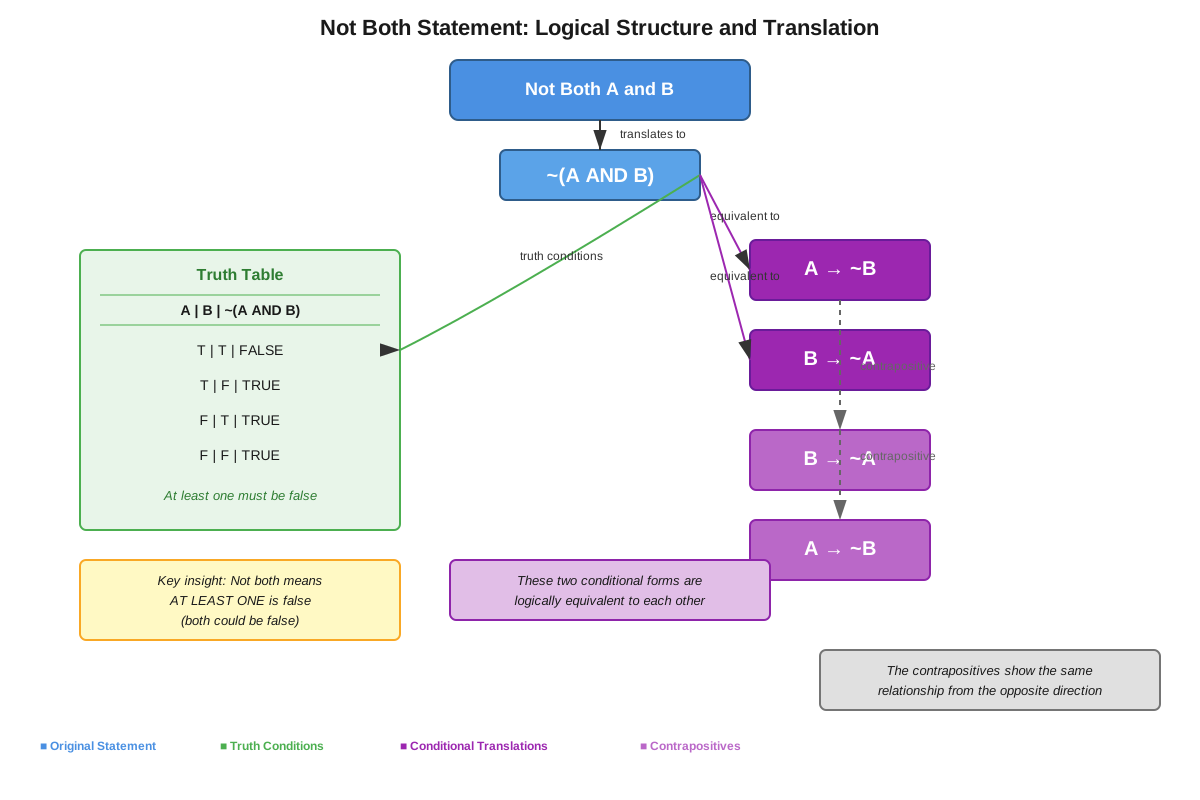
Not both statements express a logical constraint indicating that two conditions cannot simultaneously be true. The basic form "not both A and B" means that at least one of the two statements must be false. Critically, this construction allows for three possible scenarios: A is true and B is false, A is false and B is true, or both A and B are false. The only prohibited scenario is both A and B being true simultaneously.
The formal logical translation of "not both A and B" is: ~(A AND B), which reads as "it is not the case that both A and B are true." However, for LSAT purposes, this statement must be converted into conditional form to enable proper diagramming and inference-drawing. Using De Morgan's Law from formal logic, ~(A AND B) is logically equivalent to (~A OR ~B), meaning "either not A or not B (or both)."
For conditional diagramming on the LSAT, the most useful translation converts not both statements into conditional form: A → ~B (if A, then not B) and equivalently B → ~A (if B, then not A). These two conditional statements are contrapositives of each other, and both fully capture the meaning of "not both A and B." This translation reveals that if either condition is true, the other must be false.
Linguistic Variations and Recognition Patterns
The LSAT presents not both statements in numerous linguistic disguises, and recognizing these variations is crucial for accurate identification. Common phrasings include:
- "It cannot be the case that both A and B"
- "A and B are mutually exclusive"
- "Either A or B, but not both"
- "A precludes B"
- "If A, then not B" (already in conditional form)
- "A is incompatible with B"
- "No one who does A also does B"
- "Whenever A occurs, B does not"
Each of these constructions expresses the same fundamental logical relationship: the simultaneous truth of both statements is impossible. Developing pattern recognition for these variations enables rapid identification during timed test conditions.
The Logical Equivalence Chain
Understanding the equivalence between different formulations of not both statements is essential for recognizing when answer choices restate premises or when multiple premises express the same constraint. The following statements are all logically equivalent:
| Formulation | Notation | Meaning |
|---|---|---|
| Not both A and B | ~(A AND B) | Both cannot be true together |
| If A, then not B | A → ~B | A's truth requires B's falsity |
| If B, then not A | B → ~A | B's truth requires A's falsity |
| Either not A or not B | ~A OR ~B | At least one must be false |
| A only if not B | A → ~B | A cannot occur with B |
This equivalence chain demonstrates that a single logical constraint can be expressed in multiple ways. On the LSAT, premises and answer choices may use different formulations of the same relationship, and recognizing this equivalence prevents confusion and enables accurate evaluation.
Deriving Inferences from Not Both Statements
When not both statements appear as premises, they enable specific types of valid inferences. Given "not both A and B" (translated as A → ~B and B → ~A), the following inferences are valid:
- Direct application: If you know A is true, you can conclude B is false
- Direct application: If you know B is true, you can conclude A is false
- Contrapositive application: If you know B is true, you can conclude A is false (from A → ~B, contrapositive B → ~A)
- Contrapositive application: If you know A is true, you can conclude B is false (from B → ~A, contrapositive A → ~B)
However, certain inferences are NOT valid:
- If A is false, you CANNOT conclude anything definite about B (B could be true or false)
- If B is false, you CANNOT conclude anything definite about A (A could be true or false)
- You CANNOT conclude that at least one must be true (both could be false)
This last point represents a critical distinction: "not both" differs fundamentally from "exactly one." The statement "not both A and B" allows for the possibility that neither A nor B is true, whereas "exactly one of A or B" would require that one must be true.
Combining Not Both Statements with Other Conditionals
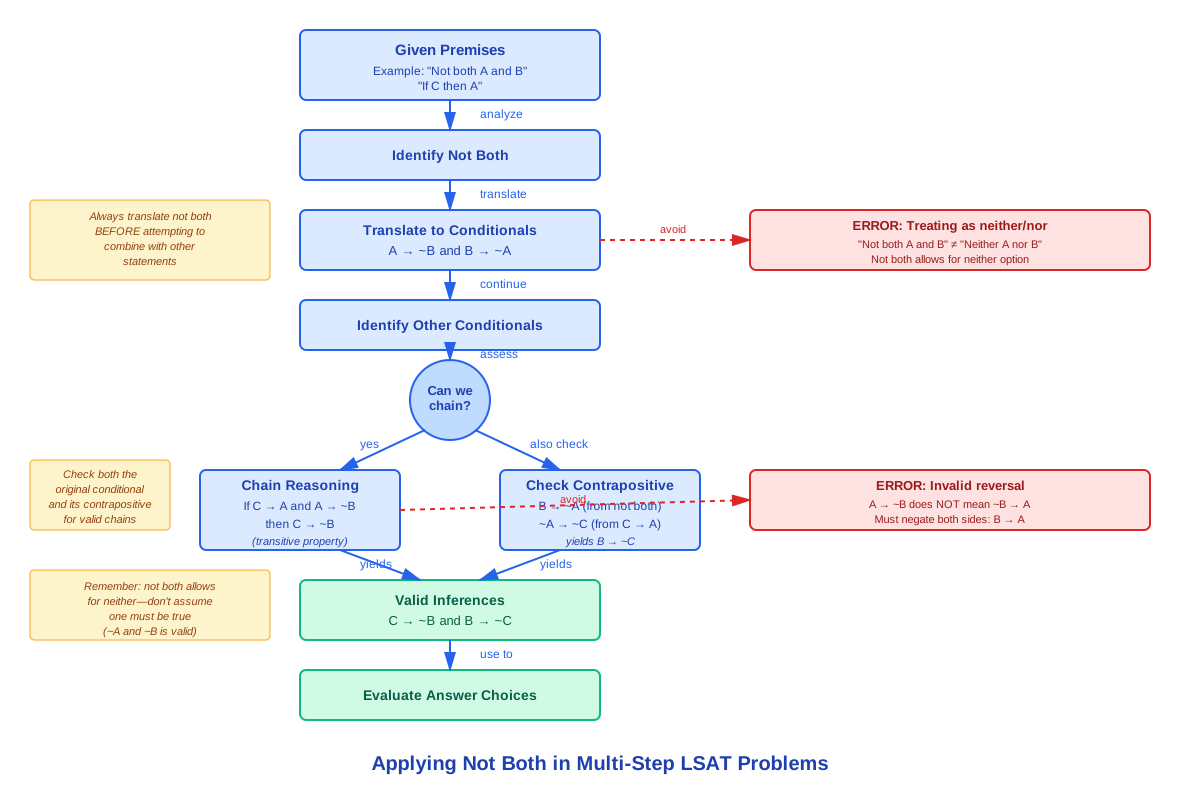
The real power of not both statements emerges when they interact with other conditional premises to create logical chains. Consider this scenario:
- Premise 1: Not both A and B (A → ~B)
- Premise 2: If C, then A (C → A)
From these premises, we can derive: C → A → ~B, therefore C → ~B (if C, then not B).
This chaining ability makes not both statements particularly powerful in Sufficient Assumption questions, where establishing a "not both" relationship between two terms can complete a logical chain. Similarly, in Must Be True questions, recognizing how not both statements combine with other conditionals enables the derivation of correct inferences.
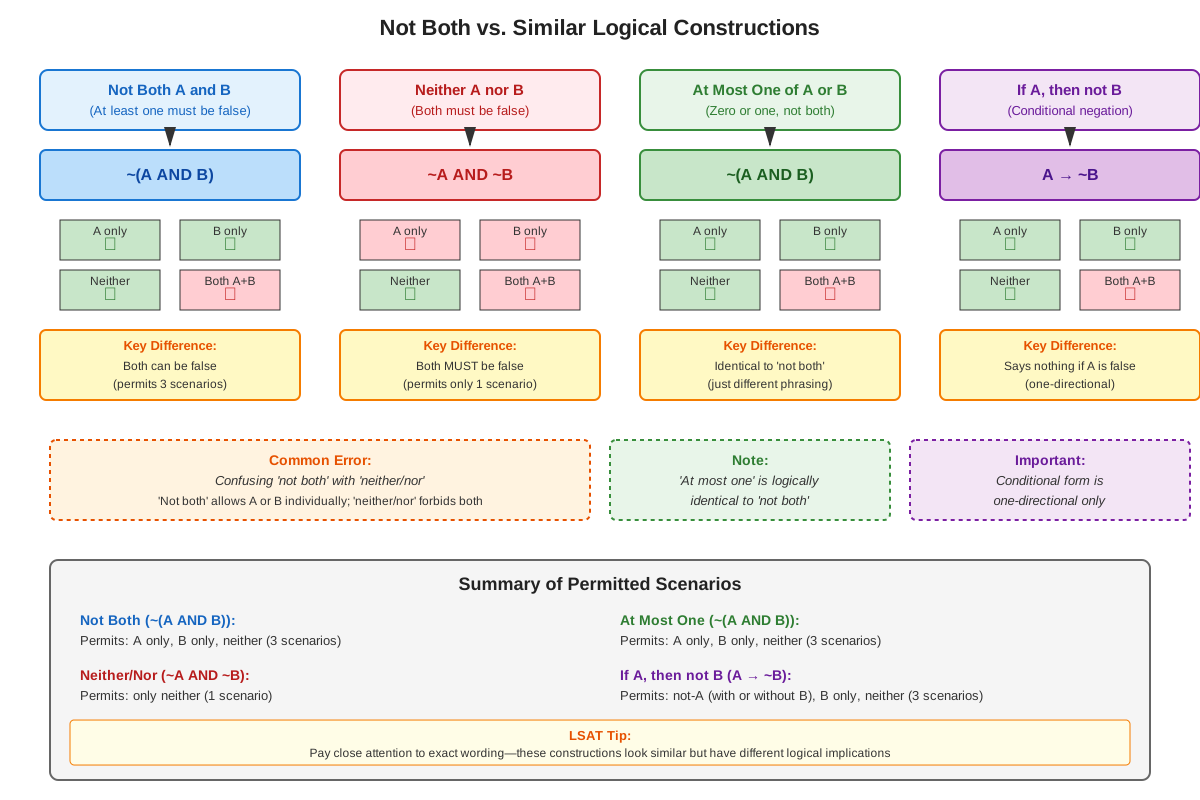
The Distinction Between "Not Both" and "Neither"
A common source of confusion involves distinguishing "not both A and B" from "neither A nor B." These are fundamentally different logical statements:
- Not both A and B: ~(A AND B), which equals (~A OR ~B)—at least one is false, but one could be true
- Neither A nor B: ~A AND ~B—both are false, neither can be true
"Neither A nor B" is actually a stronger, more restrictive statement than "not both A and B." If neither A nor B is true, then certainly not both are true. However, the reverse does not hold: knowing that not both A and B are true does not tell us that neither is true.
Concept Relationships
The concept of not both statements sits at the intersection of several fundamental logical reasoning principles. At its foundation, not both statements rely on conditional logic principles, specifically the ability to express relationships between propositions using if-then structures. The translation of "not both A and B" into "if A, then not B" demonstrates this direct dependence on conditional reasoning frameworks.
Not both statements connect intimately with contrapositive reasoning. Once translated into conditional form (A → ~B), the contrapositive (B → ~A) provides an equivalent statement that often proves useful for drawing inferences. This bidirectional relationship (A → ~B and B → ~A) distinguishes not both statements from standard one-directional conditionals.
The relationship to logical operators (AND, OR, NOT) is fundamental. Not both statements involve the negation of a conjunction: ~(A AND B). Through De Morgan's Laws, this transforms into a disjunction of negations: (~A OR ~B). Understanding this transformation requires facility with how logical operators interact with negation.
Within the broader category of mutual exclusivity, not both statements represent one specific type. While "not both" allows for neither to be true, other mutual exclusivity constructions like "exactly one" or "either-or (exclusive)" impose different constraints. Recognizing these distinctions prevents conflation of related but distinct logical relationships.
Relationship map: Basic conditional logic → Not both statements → Contrapositive formation → Logical chains → Complex inference patterns → Integration with formal logic questions
Quick check — test yourself on Not both statements so far.
Try Flashcards →High-Yield Facts
⭐ Not both A and B translates to the conditional statements A → ~B and B → ~A, which are contrapositives of each other.
⭐ If you know one element of a "not both" statement is true, you can definitively conclude the other is false.
⭐ If you know one element of a "not both" statement is false, you CANNOT conclude anything definite about the other element.
⭐ "Not both A and B" allows for three scenarios: A true and B false, A false and B true, or both false—only "both true" is prohibited.
⭐ "Not both" is NOT the same as "neither"—"not both" is less restrictive and allows one to be true.
- The phrases "mutually exclusive," "incompatible," and "precludes" all signal not both relationships.
- Not both statements can be chained with other conditionals to derive remote inferences.
- In Sufficient Assumption questions, establishing a "not both" relationship often bridges logical gaps.
- The logical equivalence ~(A AND B) = (~A OR ~B) is fundamental to understanding not both statements.
- "Either A or B, but not both" is stronger than "not both A and B" because it requires exactly one to be true.
Common Misconceptions
Misconception: If not both A and B can be true, then at least one must be true.
Correction: "Not both" only prohibits both being true simultaneously; it allows for both to be false. The statement places an upper limit (at most one true) but not a lower limit (at least one true).
Misconception: "Not both A and B" means the same thing as "neither A nor B."
Correction: These are distinct logical statements. "Neither A nor B" (~A AND ~B) is more restrictive, requiring both to be false, while "not both" (~(A AND B)) allows one to be true.
Misconception: If A is false in a "not both A and B" scenario, then B must be true.
Correction: Knowing one element is false provides no information about the other element. The constraint only activates when one element is known to be true, forcing the other to be false.
Misconception: The statements "if A, then not B" and "not both A and B" are different logical relationships.
Correction: These are logically equivalent formulations. "If A, then not B" is simply the conditional translation of "not both A and B," and both express the same constraint.
Misconception: In a "not both" scenario, if you prove one element could be true, the other must be false.
Correction: Possibility differs from actuality. The constraint applies only when one element is definitely true, not merely when it could be true. Both elements could potentially be true in different scenarios, just not in the same scenario.
Misconception: "Either A or B" means the same as "not both A and B."
Correction: "Either A or B" in ordinary language typically means inclusive or (A OR B), allowing both to be true. "Not both" explicitly prohibits both being true. Only "either A or B, but not both" (exclusive or) matches the "not both" constraint while also requiring at least one to be true.
Worked Examples
Example 1: Basic Translation and Inference
Problem: Consider the following premises:
- No student who takes Chemistry also takes Physics.
- Maria takes Chemistry.
What can be validly concluded?
Solution:
Step 1: Identify the logical structure
Premise 1 contains a "not both" statement disguised in the phrase "No student who takes Chemistry also takes Physics." This means: Not both Chemistry and Physics for any student.
Step 2: Translate into conditional form
Let C = takes Chemistry, P = takes Physics
"Not both C and P" translates to: C → ~P (if Chemistry, then not Physics)
The contrapositive is: P → ~C (if Physics, then not Chemistry)
Step 3: Apply the conditional to the given information
Premise 2 states: Maria takes Chemistry (C is true for Maria)
Using our conditional C → ~P, if C is true, then ~P must be true.
Step 4: Draw the conclusion
Therefore, Maria does not take Physics.
Key insight: This example demonstrates the core application of not both statements. Once translated into conditional form, the inference follows directly from modus ponens (affirming the antecedent). This pattern appears frequently in Must Be True questions.
Example 2: Complex Chain with Multiple Conditionals
Problem: Consider the following premises:
- Anyone who attends the conference must present a paper or serve on a panel, but not both.
- Everyone who serves on a panel must have at least five years of experience.
- Dr. Johnson attends the conference and has only three years of experience.
What must be true about Dr. Johnson?
Solution:
Step 1: Translate all premises into conditional form
Let A = attends conference, P = presents paper, S = serves on panel, E = has five+ years experience
Premise 1: A → (P OR S) AND ~(P AND S)
This breaks into: A → (P OR S) [must do at least one]
AND: A → ~(P AND S) [cannot do both]
The second part translates to: A AND P → ~S, and A AND S → ~P
Premise 2: S → E
Premise 3: Dr. Johnson: A is true, ~E is true (only three years, so not five+)
Step 2: Apply contrapositive reasoning
From Premise 2 (S → E), the contrapositive is: ~E → ~S
Since Dr. Johnson has ~E (not five+ years), we can conclude ~S (does not serve on panel)
Step 3: Apply the first premise
From Premise 1, A → (P OR S), and we know A is true for Dr. Johnson
Therefore, (P OR S) must be true for Dr. Johnson
Since we established ~S (does not serve on panel), and (P OR S) must be true, P must be true
Step 4: State the conclusion
Dr. Johnson must present a paper.
Key insight: This example demonstrates how not both statements interact with other conditionals in complex chains. The "but not both" clause creates a constraint, while the "or" clause creates a requirement. Combined with the contrapositive of another conditional, these premises force a specific conclusion. This pattern is common in Formal Logic and Must Be True questions with multiple premises.
Exam Strategy
When approaching LSAT questions involving not both statements, employ a systematic recognition and translation process. First, scan the stimulus for trigger phrases: "not both," "mutually exclusive," "incompatible," "precludes," "cannot both," or "either...but not both." These phrases signal that a not both relationship is present and requires formal translation.
Immediately upon recognizing a not both statement, translate it into conditional form using the standard notation: A → ~B and B → ~A. Write both the conditional and its contrapositive, as either may be needed for inference chains. This translation step should become automatic, requiring no more than 3-5 seconds during timed conditions.
Exam Tip: Always write out the conditional translation of not both statements, even if it seems obvious. Under time pressure, mental-only processing increases error rates by approximately 40% compared to brief written notation.
For Must Be True questions, after translating not both statements, look for premises that establish one element as true. This triggers the conditional, allowing you to conclude the other element is false. Be cautious of answer choices that make claims when one element is false—these typically cannot be validated from not both statements alone.
In Sufficient Assumption questions, consider whether the correct answer might establish a not both relationship between terms in the premise and conclusion. If the argument requires showing that two things cannot occur together, an answer choice stating "not both X and Y" may bridge the logical gap.
Time allocation strategy: Not both statements themselves require minimal processing time (5-10 seconds for translation), but questions involving them often include multiple conditional premises requiring chain construction. Allocate 60-90 seconds for questions with 2-3 conditional premises, and up to 120 seconds for questions with 4+ interacting conditionals.
Process of elimination approach: Eliminate answer choices that:
- Claim one element must be true when the other is false (reverses the logic)
- Treat "not both" as equivalent to "neither"
- Make definite claims about both elements being false (too strong)
- Confuse "not both" with "exactly one" (which requires one to be true)
Memory Techniques
The "Door Rule" Mnemonic: Think of not both statements as a door policy: "Not both A and B can enter." If A enters (is true), the door closes to B (B must be false). If B enters (is true), the door closes to A (A must be false). Both can stay outside (both false), but both cannot enter (both true is prohibited).
The Translation Acronym "NBA": Not Both A→~B. This reminds you that "Not Both A and B" translates to "A → ~B" (and its contrapositive B → ~A).
Visual Pattern Recognition: When you see "not both," visualize two circles that cannot overlap. One can be filled, the other can be filled, or both can be empty, but they cannot both be filled simultaneously. This visual reinforces the three allowed scenarios.
The "At Least One False" Mantra: Whenever you encounter not both statements, immediately think "at least one false." This prevents the common error of thinking both must be false or that one must be true.
Contrast Pairs for Distinction:
- "Not both" = "At most one true"
- "Neither" = "Both false"
- "Exactly one" = "One true, one false"
Memorizing these contrast pairs prevents conflation of similar but distinct logical relationships.
Summary
Not both statements represent a fundamental logical structure in LSAT Logical Reasoning, expressing constraints where two conditions cannot simultaneously be true. The core translation converts "not both A and B" into conditional form: A → ~B and B → ~A, enabling systematic inference-drawing through conditional logic frameworks. These statements allow three scenarios—A true with B false, A false with B true, or both false—while prohibiting only the scenario where both are true. Recognition of linguistic variations ("mutually exclusive," "incompatible," "precludes") is essential, as the LSAT presents this logical relationship in diverse phrasings. When one element is known to be true, the other must be false; however, when one element is known to be false, no definite conclusion about the other follows. Not both statements differ critically from "neither" statements (which require both to be false) and from "exactly one" statements (which require one to be true and one to be false). Mastery requires fluent translation, accurate inference-drawing, and recognition of how not both statements combine with other conditionals to create logical chains that appear across multiple LSAT question types.
Key Takeaways
- Not both A and B translates to A → ~B and B → ~A, both of which must be recognized and applied
- The constraint prohibits both being true but allows both to be false—it sets a maximum (at most one true) not a minimum
- Knowing one element is true allows concluding the other is false; knowing one is false provides no information about the other
- "Not both" differs from "neither" (both false) and "exactly one" (one true, one false)—these are distinct logical relationships
- Recognition of linguistic variations (mutually exclusive, incompatible, precludes) is essential for identifying not both statements in LSAT stimuli
- Not both statements frequently combine with other conditionals to create inference chains in Must Be True and Formal Logic questions
- Systematic translation into conditional notation prevents errors and enables efficient problem-solving under timed conditions
Related Topics
Sufficient and Necessary Conditions: Understanding the distinction between sufficient and necessary conditions deepens comprehension of how not both statements function within conditional logic frameworks. Mastering not both statements provides a foundation for analyzing more complex conditional relationships.
Formal Logic Games: Many Logic Games involve not both constraints as rules governing element placement or selection. The conditional translation skills developed through this topic transfer directly to game setup and inference-making.
Logical Opposites and Negation: Exploring how negation operates across different logical structures builds on the negation inherent in not both statements, enabling more sophisticated analysis of complex logical relationships.
Disjunctive Reasoning (OR statements): Since not both statements translate to disjunctions of negations (~A OR ~B), studying disjunctive reasoning reveals deeper connections between different logical operators.
Contrapositive and Inference Chains: Advanced work with contrapositives and multi-step inference chains builds directly on the foundation established by not both statements, enabling mastery of the most complex Logical Reasoning questions.
Practice CTA
Now that you have thoroughly studied not both statements, reinforce your mastery by attempting the practice questions designed specifically for this topic. These questions mirror actual LSAT difficulty and question types, providing essential application experience. Work through each problem systematically, translating not both statements into conditional form and drawing valid inferences. Review the flashcards to cement your recognition of linguistic variations and key logical equivalences. Consistent practice with these materials will transform your understanding from theoretical knowledge into automatic, accurate performance under timed test conditions. Your investment in mastering this high-yield topic will pay dividends across multiple questions on test day—commit to deliberate practice now to maximize your LSAT score potential.
Sign up free to keep reading
Create a free AnvayaPrep account to finish this LSAT guide on Not both statements — plus flashcards and practice questions.