Overview
Sufficient assumption conditionals represent one of the most powerful and frequently tested question types in LSAT logical reasoning. These questions ask test-takers to identify a statement that, when added to an argument, guarantees the conclusion follows logically from the premises. Unlike necessary assumption questions that ask for minimally required conditions, sufficient assumption questions demand an answer choice that completely bridges any logical gap in the argument—often through the strategic use of conditional logic.
The relationship between sufficient assumptions and conditional statements is fundamental to LSAT success. Most sufficient assumption questions can be solved by recognizing that the correct answer will establish a conditional relationship that connects the argument's evidence to its conclusion. When an argument moves from discussing one concept in the premises to a different concept in the conclusion, the sufficient assumption typically provides a conditional "bridge" linking these ideas. Understanding how to construct and recognize these conditional bridges separates high-scoring test-takers from those who struggle with logical reasoning sections.
Mastering lsat sufficient assumption conditionals builds directly upon foundational knowledge of conditional logic, including understanding "if-then" relationships, contrapositive reasoning, and formal logic notation. This topic integrates seamlessly with other logical reasoning skills such as identifying argument structure, recognizing logical gaps, and evaluating the strength of inferences. Students who excel at sufficient assumption questions typically demonstrate strong performance across multiple question types, as the analytical skills required—identifying premises and conclusions, spotting logical leaps, and understanding conditional relationships—transfer broadly throughout the LSAT.
Learning Objectives
- [ ] Identify how sufficient assumption conditionals appears in LSAT questions
- [ ] Explain the reasoning pattern behind sufficient assumption conditionals
- [ ] Apply sufficient assumption conditionals to solve LSAT-style problems accurately
- [ ] Construct conditional statements that bridge logical gaps between premises and conclusions
- [ ] Distinguish between sufficient and necessary assumptions in conditional contexts
- [ ] Evaluate answer choices by testing whether they guarantee the argument's conclusion
- [ ] Recognize common conditional patterns in sufficient assumption questions (transitive chains, contrapositive applications)
Prerequisites
- Basic conditional logic: Understanding "if-then" statements, antecedents, and consequents is essential because sufficient assumptions frequently take conditional form
- Contrapositive reasoning: The ability to form and recognize contrapositives enables recognition of equivalent conditional statements in answer choices
- Argument structure identification: Recognizing premises and conclusions allows students to identify what logical gap needs bridging
- Formal logic notation: Familiarity with symbolic representation (A → B) facilitates quick diagramming of complex conditional relationships
- Necessary vs. sufficient conditions: Understanding this distinction prevents confusion between sufficient assumption and necessary assumption question types
Why This Topic Matters
Sufficient assumption questions appear with remarkable consistency on every LSAT administration, typically comprising 3-5 questions per test across both logical reasoning sections. This frequency, combined with the predictable nature of correct answers, makes sufficient assumption conditionals one of the highest-yield topics for focused study. Students who master this question type can reliably secure these points, significantly boosting their overall logical reasoning performance.
Beyond exam strategy, sufficient assumption questions test core analytical reasoning skills that extend far beyond standardized testing. The ability to identify what additional information would make an argument airtight mirrors the reasoning required in legal analysis, where attorneys must determine what facts or legal principles would guarantee a particular outcome. Law school casework constantly demands this type of conditional thinking: "If we can establish X, then Y necessarily follows."
On the LSAT, sufficient assumption questions appear in several predictable patterns. Most commonly, arguments present evidence about one category or concept and draw a conclusion about a different category. The sufficient assumption bridges this gap by establishing a conditional relationship between the two concepts. These questions also frequently involve conditional chains where the argument provides some links but leaves a critical connection unstated. Additionally, sufficient assumption questions often test understanding of formal logic principles, requiring test-takers to recognize when a conditional statement or its contrapositive would complete an argument's logical structure.
Core Concepts
Understanding Sufficient Assumptions
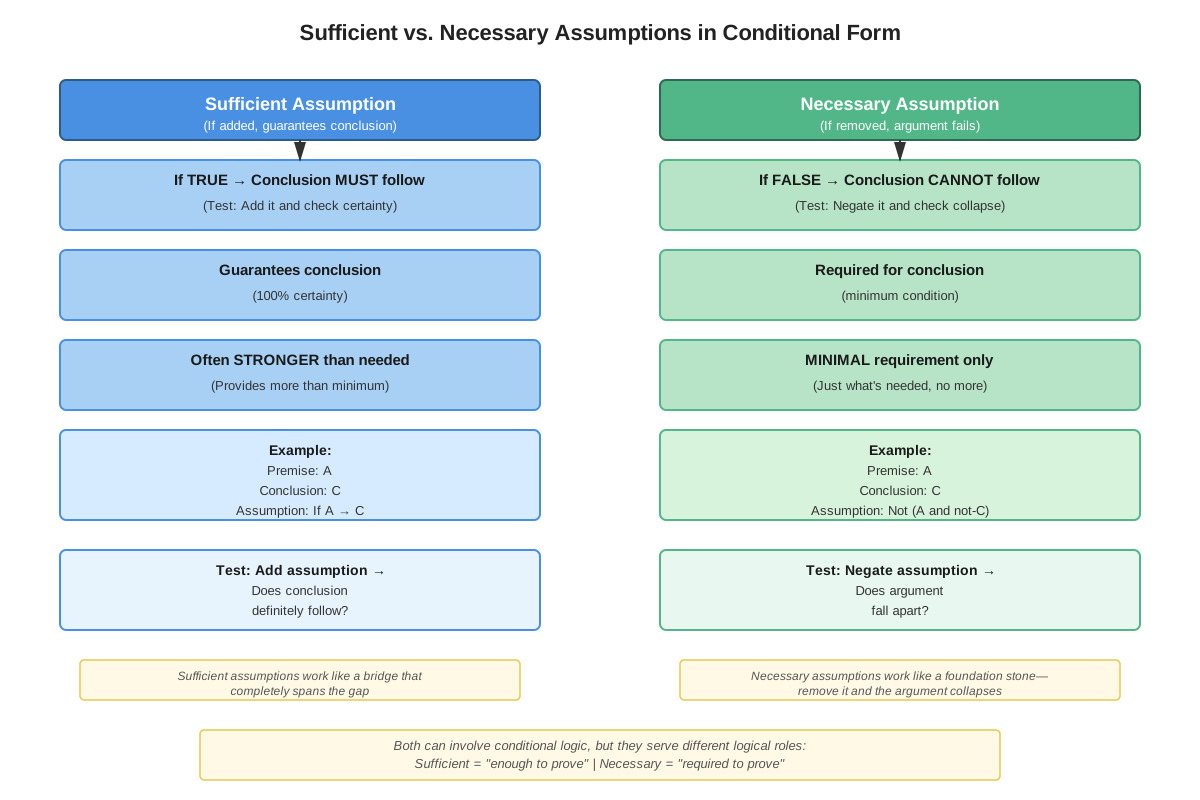
A sufficient assumption is a statement that, if true, guarantees an argument's conclusion follows logically from its premises. The term "sufficient" means "enough"—the assumption is enough, by itself, to make the argument valid. This differs fundamentally from necessary assumptions, which are required for an argument to work but don't necessarily guarantee the conclusion.
When evaluating whether an answer choice is a sufficient assumption, apply this test: If you add the answer choice to the argument as an additional premise, does the conclusion become unavoidable? If yes, you've found the sufficient assumption. If the conclusion merely becomes more likely or better supported, the answer choice strengthens the argument but isn't sufficient.
The Conditional Bridge Pattern
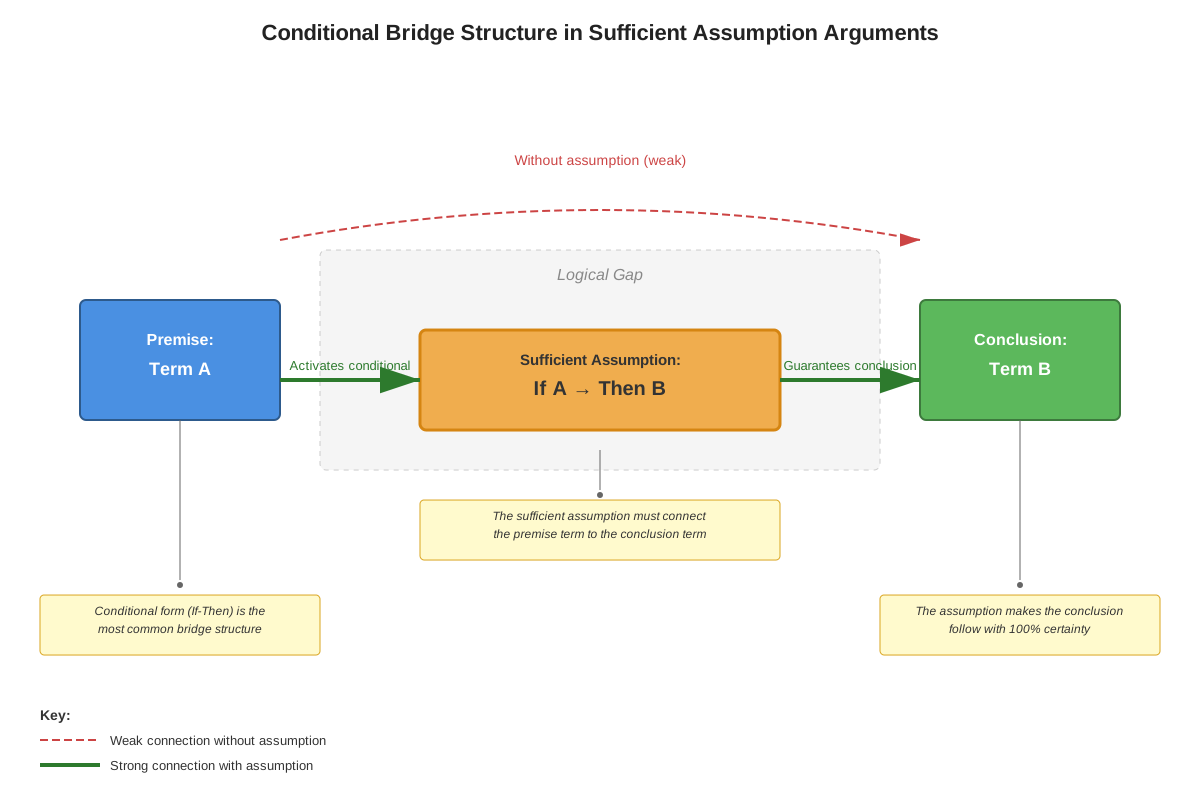
The most common pattern in sufficient assumption questions involves conditional bridges. When an argument discusses concept A in the premises and concept B in the conclusion, the sufficient assumption typically establishes: A → B. This conditional statement creates a logical pathway from the evidence to the conclusion.
Consider this structure:
- Premise: X has characteristic A
- Conclusion: Therefore, X has characteristic B
- Sufficient Assumption Needed: A → B
By establishing that having characteristic A is sufficient for having characteristic B, the assumption guarantees that if the premise is true (X has A), the conclusion must follow (X has B).
Conditional Chains and Transitive Property
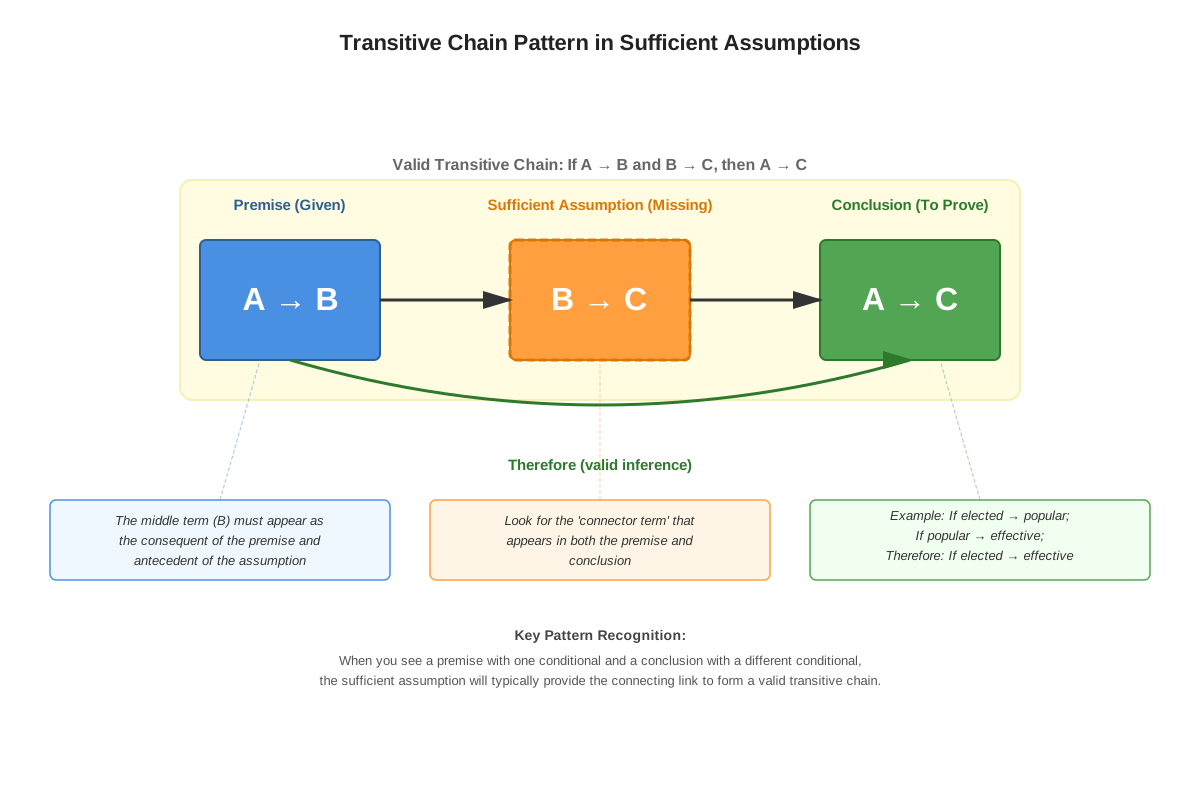
Many sufficient assumption questions involve conditional chains where multiple conditional statements link together through the transitive property. If A → B and B → C, then A → C. Sufficient assumption questions often provide some links in this chain while leaving one connection unstated.
Example structure:
- Premise 1: A → B
- Premise 2: C → D
- Conclusion: A → D
- Missing Link: B → C
The sufficient assumption must provide the missing conditional link that completes the chain. Recognizing these chain patterns allows test-takers to predict the correct answer before reviewing answer choices.
Formal Logic in Sufficient Assumptions
Sufficient assumption questions frequently incorporate formal logic principles, particularly involving quantifiers (all, some, none) and their conditional equivalents:
| Statement Type | Conditional Form | Contrapositive |
|---|---|---|
| All A are B | A → B | ~B → ~A |
| No A are B | A → ~B | B → ~A |
| Some A are B | Cannot be expressed as simple conditional | N/A |
Understanding these equivalences enables recognition of sufficient assumptions presented in various linguistic forms. An answer stating "All members of category A possess property B" provides the same logical function as "If something is A, then it is B."
The Mechanistic Approach to Sufficient Assumptions
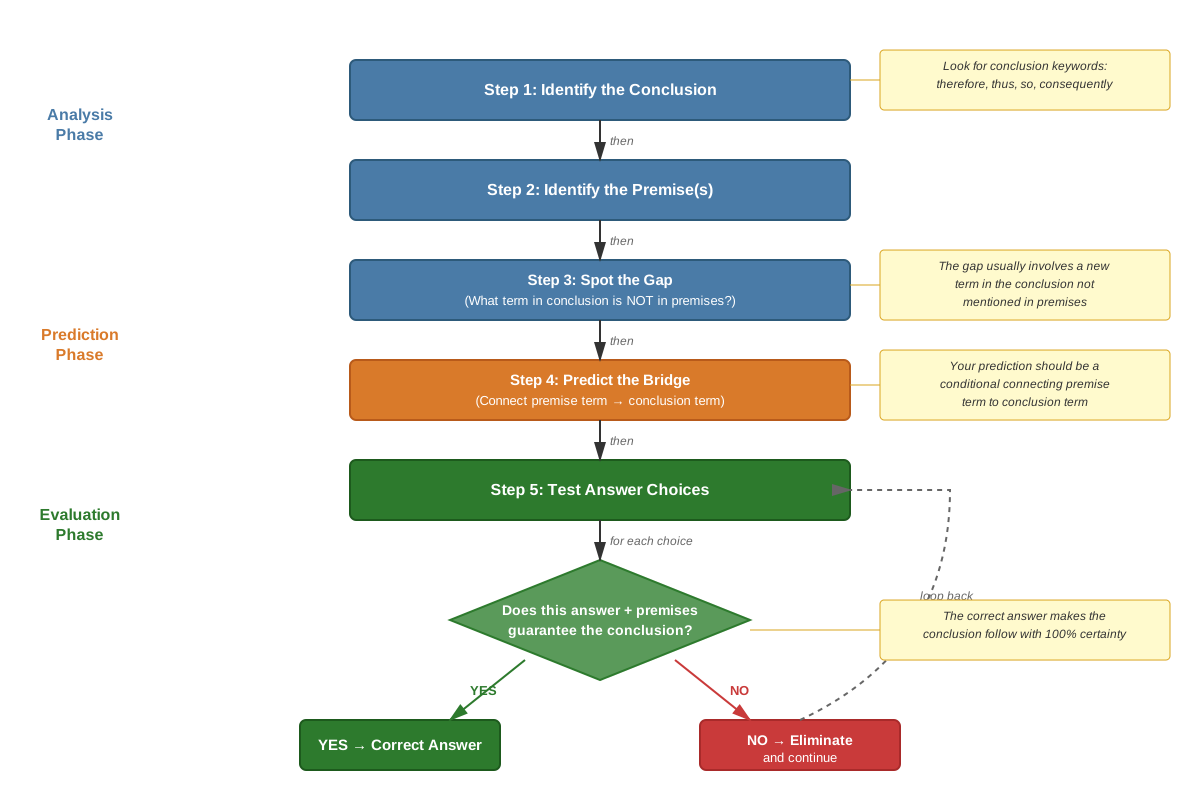
A systematic approach to sufficient assumption questions involves five steps:
- Identify the conclusion: Determine precisely what the argument is trying to prove
- Identify the premises: Catalog all evidence provided
- Spot the gap: Recognize what logical leap occurs between premises and conclusion
- Predict the bridge: Formulate what conditional statement would connect premises to conclusion
- Match and verify: Find the answer choice matching your prediction and verify it guarantees the conclusion
This mechanistic approach transforms sufficient assumption questions from abstract reasoning exercises into predictable, solvable problems.
Contrapositive Applications
The contrapositive plays a crucial role in sufficient assumption questions. Since a conditional statement and its contrapositive are logically equivalent, an answer choice might provide the contrapositive of the needed bridge rather than the bridge itself. Both forms are equally correct.
If an argument needs A → B to be valid, an answer stating ~B → ~A serves as an equally sufficient assumption. Test-takers must recognize both forms to avoid eliminating correct answers that appear in contrapositive form.
Quantifier Scope and Sufficient Assumptions
Many sufficient assumption questions involve careful attention to quantifier scope—the range of things to which a statement applies. An argument might provide evidence about "some" members of a category but draw a conclusion about "all" members. The sufficient assumption must bridge this quantifier gap, often by establishing a universal conditional that applies to all relevant cases.
Critical distinction:
- Premise: Some A are B
- Conclusion: All A are C
- Insufficient bridge: Some B are C (doesn't guarantee all A are C)
- Sufficient bridge: All A are C (directly establishes the conclusion) OR All B are C combined with All A are B
Common Conditional Patterns
Several conditional patterns appear repeatedly in sufficient assumption questions:
Pattern 1: Category Membership
- Premise: X is a member of category A
- Conclusion: X has property P
- Needed: A → P (All members of A have property P)
Pattern 2: Causal Conditionals
- Premise: Event E occurred
- Conclusion: Event E caused outcome O
- Needed: E → caused O (Whenever E occurs, it causes O)
Pattern 3: Definitional Conditionals
- Premise: X meets criteria C
- Conclusion: X qualifies as type T
- Needed: C → T (Meeting criteria C is sufficient for being type T)
Concept Relationships
The concepts within sufficient assumption conditionals form an interconnected logical framework. At the foundation lies basic conditional logic (if-then relationships), which enables understanding of how premises and conclusions can be linked through conditional bridges. This foundational understanding leads directly to recognizing conditional chains, where multiple conditional statements connect through transitive reasoning.
The contrapositive concept operates parallel to basic conditionals, providing an alternative form for expressing the same logical relationship. Both the standard conditional and its contrapositive can serve as sufficient assumptions, making contrapositive recognition essential for identifying correct answers.
Formal logic principles integrate with conditional reasoning by providing standardized ways to express categorical statements as conditionals. This connection allows test-takers to translate between everyday language ("All lawyers are professionals") and conditional form (Lawyer → Professional), facilitating the identification of logical gaps and necessary bridges.
The mechanistic approach serves as the procedural framework that organizes all other concepts, providing a step-by-step method for applying conditional logic principles to actual LSAT questions. This approach incorporates gap identification, which depends on understanding argument structure, and bridge prediction, which requires facility with conditional patterns.
Relationship map:
Basic Conditional Logic → Conditional Bridges → Conditional Chains → Transitive Property Application
↓
Contrapositive Reasoning → Alternative Forms of Sufficient Assumptions
↓
Formal Logic Principles → Translation Between Language and Logic
↓
Mechanistic Approach → Systematic Problem Solving → Correct Answer Selection
High-Yield Facts
⭐ A sufficient assumption, when added to an argument, guarantees the conclusion follows logically from the premises
⭐ The most common sufficient assumption pattern establishes a conditional bridge connecting a concept in the premises to a different concept in the conclusion
⭐ Sufficient assumption questions can be identified by question stems asking what "if assumed, allows the conclusion to be properly drawn" or what "enables the conclusion to be properly inferred"
⭐ The correct answer to a sufficient assumption question often takes the form of a conditional statement (if-then) or its logical equivalent
⭐ A conditional statement and its contrapositive are logically equivalent, so either form can serve as a sufficient assumption
- Sufficient assumptions differ from necessary assumptions: sufficient assumptions guarantee the conclusion, while necessary assumptions are merely required for the argument to work
- When an argument involves a conditional chain with a missing link, the sufficient assumption provides that missing conditional connection
- Formal logic statements using quantifiers (all, none, some) can be translated into conditional form to identify needed assumptions
- The transitive property of conditionals (if A → B and B → C, then A → C) frequently appears in sufficient assumption questions
- Sufficient assumptions often involve strengthening an argument from "some" to "all" or from "possible" to "certain"
- Answer choices that merely strengthen an argument without guaranteeing the conclusion are incorrect for sufficient assumption questions
- Diagramming conditional relationships using arrows (→) and negation symbols (~) helps visualize logical gaps and predict correct answers
- Sufficient assumption questions reward pre-phrasing: predicting the answer before reviewing choices increases accuracy and speed
- The correct sufficient assumption may appear more extreme or absolute than seems necessary, but this strength is required to guarantee the conclusion
- Wrong answers in sufficient assumption questions often provide necessary but not sufficient conditions, or strengthen without guaranteeing
Quick check — test yourself on Sufficient assumption conditionals so far.
Try Flashcards →Common Misconceptions
Misconception: A sufficient assumption must be realistic or likely to be true in the real world.
Correction: Sufficient assumptions need only be logically adequate to guarantee the conclusion. The LSAT tests logical validity, not factual plausibility. An assumption can be wildly unrealistic yet still be the correct answer if it makes the argument logically airtight.
Misconception: The correct answer will be the most moderate or reasonable-sounding option.
Correction: Sufficient assumptions often appear extreme or absolute because they must guarantee the conclusion. Statements using "all," "every," "always," or "only" frequently serve as correct sufficient assumptions, while more moderate language may indicate an answer that strengthens but doesn't suffice.
Misconception: If an answer choice makes the conclusion more likely, it's a sufficient assumption.
Correction: Sufficient assumptions must make the conclusion certain, not merely more probable. An answer that increases the likelihood of the conclusion from 30% to 80% strengthens the argument but isn't sufficient. The conclusion must become unavoidable when the assumption is added.
Misconception: Sufficient and necessary assumptions are interchangeable terms.
Correction: These are fundamentally different logical concepts. A necessary assumption is required for an argument to work (without it, the argument fails), while a sufficient assumption guarantees the conclusion (with it, the argument must succeed). The same statement is rarely both necessary and sufficient for a given argument.
Misconception: The sufficient assumption must directly restate or paraphrase the conclusion.
Correction: While the sufficient assumption must guarantee the conclusion, it typically does so by establishing a conditional relationship between premises and conclusion, not by repeating the conclusion. An answer that merely restates the conclusion is circular and doesn't bridge any logical gap.
Misconception: Complex conditional chains require complex sufficient assumptions.
Correction: Often, a single missing link in a conditional chain serves as the sufficient assumption. The correct answer may be simpler than expected, providing just one conditional connection that completes an otherwise valid chain of reasoning.
Misconception: The contrapositive of the needed assumption is incorrect because it's "backwards."
Correction: A conditional statement and its contrapositive are logically equivalent. If the argument needs A → B, then ~B → ~A is equally correct as a sufficient assumption. Recognizing contrapositives prevents eliminating correct answers.
Worked Examples
Example 1: Basic Conditional Bridge
Argument:
"All members of the city council voted for the new ordinance. Therefore, the new ordinance will benefit local businesses."
Question: Which one of the following, if assumed, allows the conclusion to be properly drawn?
Analysis:
Step 1 - Identify the conclusion: The new ordinance will benefit local businesses.
Step 2 - Identify the premises: All city council members voted for the ordinance.
Step 3 - Spot the gap: The premise discusses voting behavior; the conclusion discusses business benefits. There's no logical connection between council members voting for something and that thing benefiting businesses.
Step 4 - Predict the bridge: We need a conditional connecting "voted for by all council members" to "benefits local businesses." In conditional form: Voted for by all council members → Benefits local businesses.
Step 5 - Evaluate answer choices:
(A) Most ordinances benefit local businesses. [Incorrect - "most" doesn't guarantee this particular ordinance benefits businesses]
(B) The city council only votes for ordinances that will benefit local businesses. [Correct - This establishes: Voted for by council → Benefits businesses. Since all council members voted for this ordinance, it must benefit businesses]
(C) Local businesses support the city council. [Incorrect - This reverses the relationship and doesn't connect voting to benefits]
(D) Some ordinances that benefit businesses receive unanimous council support. [Incorrect - "Some" doesn't guarantee this particular ordinance benefits businesses]
(E) The city council carefully considers all ordinances. [Incorrect - Careful consideration doesn't guarantee beneficial outcomes]
Answer: (B) - This answer establishes the necessary conditional bridge. If the council only votes for ordinances benefiting businesses (Council votes for X → X benefits businesses), and they voted for this ordinance, then this ordinance must benefit businesses.
Example 2: Conditional Chain with Missing Link
Argument:
"Every plant in the botanical garden is properly labeled. Any plant that is properly labeled can be easily identified by visitors. Therefore, every plant in the botanical garden is suitable for educational tours."
Question: The conclusion follows logically if which one of the following is assumed?
Analysis:
Step 1 - Identify the conclusion: Every plant in the botanical garden is suitable for educational tours.
Step 2 - Identify the premises:
- Premise 1: Every plant in botanical garden is properly labeled (Garden plant → Labeled)
- Premise 2: Any properly labeled plant can be easily identified (Labeled → Easily identified)
Step 3 - Spot the gap: We have a conditional chain: Garden plant → Labeled → Easily identified. But the conclusion is about being "suitable for educational tours." The chain doesn't connect to this conclusion.
Step 4 - Predict the bridge: We need to connect "easily identified" to "suitable for educational tours." The missing link: Easily identified → Suitable for educational tours.
Step 5 - Evaluate answer choices:
(A) Educational tours require plants that are properly labeled. [Incorrect - This gives us: Educational tours → Labeled, which doesn't help us conclude that these plants are suitable for tours]
(B) Plants that can be easily identified by visitors are suitable for educational tours. [Correct - This provides: Easily identified → Suitable for tours. Combined with our chain (Garden plant → Labeled → Easily identified), we get: Garden plant → Suitable for tours]
(C) Most botanical gardens use their plants for educational tours. [Incorrect - "Most gardens" doesn't tell us about this particular garden's plants]
(D) Visitors prefer educational tours that feature easily identified plants. [Incorrect - Visitor preference doesn't establish suitability]
(E) Some plants suitable for educational tours are in the botanical garden. [Incorrect - "Some" doesn't establish that all garden plants are suitable]
Answer: (B) - This completes the conditional chain. The full chain becomes: Garden plant → Labeled → Easily identified → Suitable for educational tours. Since every plant in the garden is at the start of this chain, every plant must have all subsequent properties, including being suitable for educational tours.
Exam Strategy
Recognizing Sufficient Assumption Questions
Sufficient assumption questions use distinctive language in their question stems. Watch for these trigger phrases:
- "Which one of the following, if assumed, allows the conclusion to be properly drawn?"
- "The conclusion follows logically if which one of the following is assumed?"
- "Which one of the following, if assumed, enables the conclusion to be properly inferred?"
- "The argument's conclusion can be properly inferred if which one of the following is assumed?"
Any question asking what assumption would make the conclusion "follow logically," "be properly drawn," or "be properly inferred" is testing sufficient assumptions.
The Pre-Phrasing Advantage
Before reviewing answer choices, invest 15-20 seconds predicting the sufficient assumption. This pre-phrasing dramatically improves accuracy:
- Identify the exact gap between premises and conclusion
- Formulate a conditional statement bridging this gap
- Keep your prediction flexible (the answer may use different wording or provide the contrapositive)
- Scan answer choices for your predicted relationship
Pre-phrasing prevents the LSAT from controlling your thinking through attractive wrong answers.
The Negation Test Doesn't Apply
Unlike necessary assumption questions, the negation test (negating the answer and seeing if the argument falls apart) doesn't work for sufficient assumptions. Instead, use the addition test: Add the answer choice to the argument as a new premise. Does the conclusion now follow with certainty? If yes, you've found the sufficient assumption.
Dealing with Formal Logic
When an argument uses formal logic language (all, some, none, only), immediately translate into conditional form:
- "All A are B" = A → B
- "Only A are B" = B → A
- "No A are B" = A → ~B
This translation reveals the logical structure and makes gaps obvious.
Time Management
Sufficient assumption questions typically require 1:15 to 1:45 to solve accurately. They're worth the time investment because:
- The correct answer is definitively right (no ambiguity)
- Pre-phrasing makes answer selection quick
- These questions reward systematic analysis
If you're struggling after 2 minutes, mark your best guess and move on. Return if time permits.
Process of Elimination Strategies
Eliminate answer choices that:
- Introduce new concepts unrelated to the premises or conclusion
- Provide necessary but not sufficient conditions (they're required but don't guarantee the conclusion)
- Merely strengthen the argument without making the conclusion certain
- Reverse the needed conditional relationship
- Use "some" or "most" when "all" or "every" is needed to guarantee the conclusion
Common Trap Patterns
Be alert for these wrong answer types:
- The Reversal: Provides B → A when you need A → B
- The Strengthener: Makes the conclusion more likely but not certain
- The Necessary Assumption: Required for the argument but doesn't guarantee the conclusion
- The Irrelevant Conditional: Establishes a conditional relationship between concepts not in the argument
- The Partial Bridge: Connects some but not all elements needed
Memory Techniques
The BRIDGE Acronym
Remember the systematic approach with BRIDGE:
- Break down the argument (identify premises and conclusion)
- Recognize the gap (spot the logical leap)
- Identify needed connection (predict the conditional bridge)
- Diagram if helpful (use arrows for complex chains)
- Guarantee test (does the answer make the conclusion certain?)
- Eliminate and select (remove wrong answers, choose the bridge)
The Guarantee Mantra
When evaluating answer choices, repeat: "Does this GUARANTEE the conclusion?" This single question prevents selecting strengtheners or necessary assumptions instead of sufficient assumptions.
Visualizing Conditional Bridges
Picture conditional relationships as physical bridges spanning a gap:
- The left bank represents the premises (what you know)
- The right bank represents the conclusion (where you need to go)
- The bridge is the conditional statement connecting them
- A sufficient assumption builds a bridge strong enough to guarantee safe passage
The Contrapositive Flip
Remember contrapositives with "flip and negate":
- Flip the order of the terms
- Negate both terms
- A → B becomes ~B → ~A
Visualize flipping a card over and seeing the negative image on the back—same information, different presentation.
Quantifier Translation Rhyme
"All means arrow, none means not,
Some means nothing can be caught.
Only flips the arrow's way,
These translations save the day."
This rhyme encodes the formal logic translations essential for sufficient assumption questions.
Summary
Sufficient assumption conditionals represent a high-yield, predictable question type on the LSAT that rewards systematic analysis and conditional reasoning skills. These questions ask test-takers to identify a statement that, when added to an argument, guarantees the conclusion follows logically from the premises. The correct answer typically establishes a conditional bridge connecting concepts in the premises to concepts in the conclusion, often taking the form "if A, then B" or its logical equivalent. Mastering sufficient assumptions requires understanding conditional logic, recognizing logical gaps in arguments, predicting needed bridges, and distinguishing sufficient assumptions from necessary assumptions or mere strengtheners. The mechanistic approach—identifying the conclusion, cataloging premises, spotting the gap, predicting the bridge, and verifying the answer—transforms these questions from abstract reasoning challenges into solvable problems. Success requires recognizing that sufficient assumptions must guarantee conclusions with certainty, not merely make them more likely, and that correct answers often appear in conditional form or as contrapositives of needed relationships.
Key Takeaways
- Sufficient assumptions guarantee conclusions: The correct answer makes the conclusion logically unavoidable, not merely more probable or better supported
- Conditional bridges are the most common pattern: When premises discuss concept A and conclusions discuss concept B, the sufficient assumption typically establishes A → B
- Pre-phrase before reviewing answer choices: Predicting the needed assumption before seeing options dramatically improves accuracy and speed
- Contrapositives are logically equivalent: If an argument needs A → B, then ~B → ~A serves equally well as a sufficient assumption
- Use the addition test, not the negation test: Add the answer choice to the argument and verify the conclusion becomes certain; negation tests apply to necessary assumptions only
- Extreme language often signals correct answers: Words like "all," "every," "only," and "always" frequently appear in sufficient assumptions because guaranteeing conclusions requires strong conditional statements
- Distinguish sufficient from necessary assumptions: Sufficient assumptions guarantee conclusions; necessary assumptions are merely required for arguments to work—these are fundamentally different logical concepts
Related Topics
Necessary Assumption Questions: Understanding the distinction between sufficient and necessary assumptions is crucial. While sufficient assumptions guarantee conclusions, necessary assumptions identify minimally required conditions. Mastering both question types provides comprehensive coverage of assumption-based logical reasoning.
Conditional Logic Fundamentals: Deeper study of conditional reasoning, including complex conditional chains, multiple sufficient or necessary conditions, and unless/until/without constructions, builds upon the conditional bridge concepts central to sufficient assumptions.
Formal Logic and Quantifiers: Advanced work with categorical statements, quantifier relationships, and translating between natural language and logical notation enhances the ability to recognize and construct sufficient assumptions in formal logic contexts.
Argument Structure and Diagramming: Developing sophisticated argument mapping skills enables faster identification of logical gaps and more accurate prediction of needed assumptions across all logical reasoning question types.
Strengthen and Weaken Questions: Understanding how sufficient assumptions relate to strengthening arguments clarifies the distinction between making conclusions certain (sufficient assumptions) versus making them more likely (strengtheners), improving performance on both question types.
Practice CTA
Now that you've mastered the core concepts of sufficient assumption conditionals, it's time to cement your understanding through active practice. Work through the practice questions associated with this topic, applying the BRIDGE approach systematically to each problem. As you practice, focus on pre-phrasing your answers before reviewing choices—this skill separates top scorers from average performers. Use the flashcards to reinforce your recognition of conditional patterns and common sufficient assumption structures. Remember, sufficient assumption questions are among the most predictable and high-yield on the LSAT. Every minute you invest in mastering this question type pays dividends in points on test day. You've built the foundation; now apply it with confidence!
Sign up free to keep reading
Create a free AnvayaPrep account to finish this LSAT guide on Sufficient assumption conditionals — plus flashcards and practice questions.