Overview
Sufficient condition indicators are linguistic markers that signal the presence of a sufficient condition in conditional statements—one of the most fundamental building blocks of logical reasoning on the LSAT. These indicators are words or phrases that tell you "if this happens, then that follows." Understanding how to identify and interpret these indicators is absolutely critical for success on the LSAT, as conditional logic appears in approximately 25-30% of all Logical Reasoning questions and forms the backbone of many Logic Games scenarios.
Mastering lsat sufficient condition indicators enables students to quickly translate complex English sentences into clear logical relationships, which is essential for evaluating arguments, identifying flaws, making valid inferences, and solving formal logic problems. These indicators function as signposts that reveal the logical structure underlying an argument, allowing test-takers to diagram relationships accurately and predict what must, might, or cannot be true based on given information.
Within the broader framework of Logical Reasoning, sufficient condition indicators work in tandem with necessary condition indicators to create the complete picture of conditional relationships. While sufficient conditions tell us what is enough to guarantee an outcome, they form only one half of the conditional logic equation. The ability to recognize these indicators instantly and translate them correctly separates high-scoring test-takers from those who struggle with the logical reasoning section. This skill becomes particularly crucial in Must Be True questions, Sufficient Assumption questions, and Parallel Reasoning questions, where precise logical translation determines success.
Learning Objectives
- [ ] Identify how sufficient condition indicators appear in LSAT questions across different question types
- [ ] Explain the reasoning pattern behind sufficient condition indicators and their role in conditional statements
- [ ] Apply sufficient condition indicators to solve LSAT-style problems accurately and efficiently
- [ ] Translate complex sentences containing sufficient condition indicators into standard conditional notation
- [ ] Distinguish between sufficient and necessary condition indicators in mixed or ambiguous contexts
- [ ] Recognize non-standard or disguised sufficient condition indicators that appear in formal LSAT language
- [ ] Diagram chains of conditional logic by correctly identifying multiple sufficient condition indicators in a single argument
Prerequisites
- Basic understanding of conditional statements: Familiarity with "if-then" logic is essential because sufficient condition indicators signal the "if" portion of these relationships
- Ability to identify premises and conclusions: This skill helps distinguish between conditional relationships and other argument structures that may use similar language
- Understanding of logical necessity vs. sufficiency: Knowing the difference between "enough to guarantee" (sufficient) and "required for" (necessary) prevents fundamental translation errors
- Comfort with symbolic notation: Basic ability to work with arrows (→) and letters representing propositions makes diagramming efficient and accurate
Why This Topic Matters
Sufficient condition indicators represent one of the highest-yield topics for LSAT preparation because they appear consistently across multiple question types and sections of the exam. In Logical Reasoning alone, these indicators show up in Must Be True questions, Sufficient Assumption questions, Necessary Assumption questions (where recognizing the sufficient condition helps identify what's missing), Strengthen/Weaken questions, Flaw questions, and Parallel Reasoning questions. In the Logic Games section, conditional rules form the backbone of many game setups, and recognizing sufficient conditions quickly can mean the difference between finishing a game and running out of time.
Statistical analysis of recent LSATs reveals that approximately 8-12 questions per exam directly test the ability to work with conditional logic, and many more questions involve conditional reasoning as a secondary component. Questions involving sufficient condition indicators tend to have lower accuracy rates among test-takers (averaging 45-60% correct for medium difficulty questions), making this a high-impact area for score improvement. Students who master this topic typically see score increases of 3-5 points on the Logical Reasoning sections alone.
In real-world applications, the ability to recognize sufficient conditions underlies legal reasoning, contract interpretation, policy analysis, and logical argumentation—all core skills for law school and legal practice. On the LSAT, sufficient condition indicators most commonly appear in: (1) rule-based Logic Games where conditional relationships govern piece placement, (2) Must Be True questions requiring valid inferences from conditional premises, (3) Sufficient Assumption questions where the correct answer provides a sufficient condition to make an argument valid, and (4) Flaw questions where confusing sufficient and necessary conditions represents a common logical error.
Core Concepts
Definition of Sufficient Conditions
A sufficient condition is a condition that, when satisfied, guarantees or ensures that another condition is also satisfied. In logical terms, if A is sufficient for B, then whenever A occurs, B must also occur. The sufficient condition is the "trigger" or "guarantee" in a conditional relationship. In the standard conditional statement "If A, then B," A represents the sufficient condition—it is sufficient (enough) to guarantee that B follows.
The formal logical structure can be represented as: A → B, where the arrow means "if... then..." and A is the sufficient condition while B is the necessary condition. It's crucial to understand that a sufficient condition does not mean "only if" or "required"—it means "if this happens, that definitely follows." Multiple different conditions can be sufficient for the same outcome, and a sufficient condition may occur without being necessary.
Standard Sufficient Condition Indicators
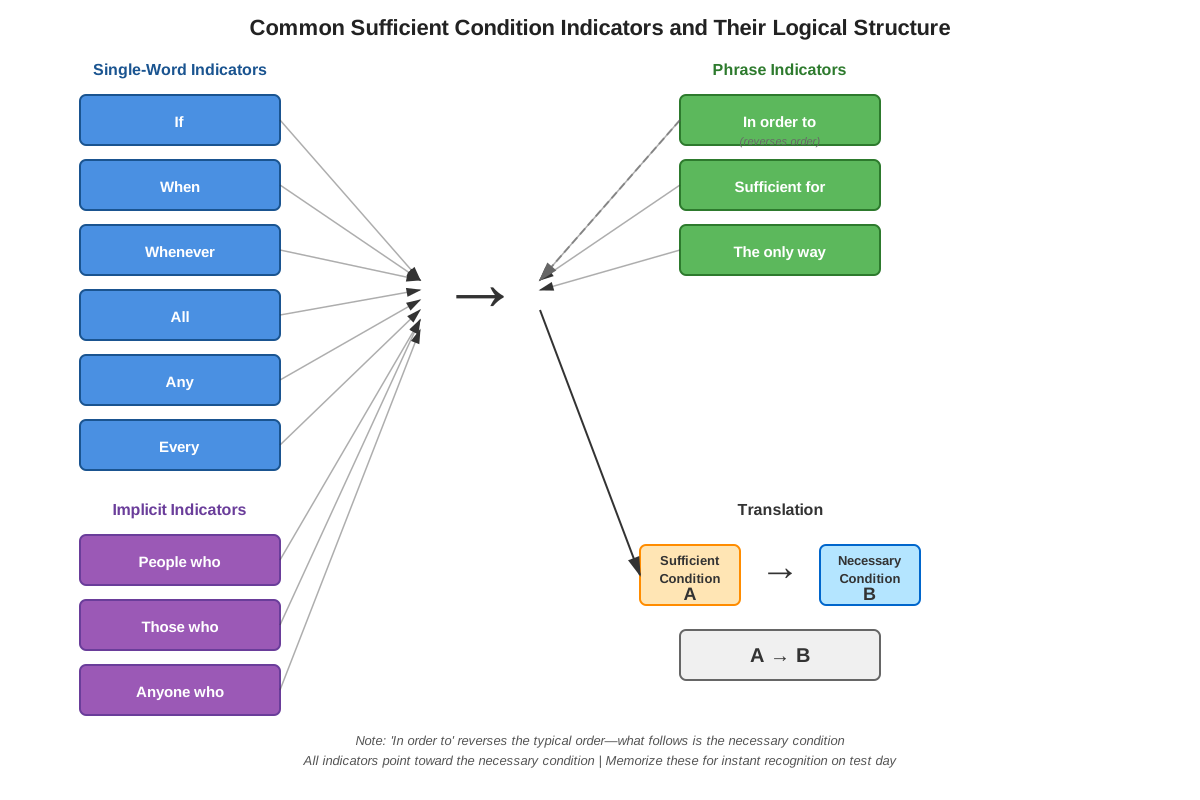
The most common sufficient condition indicators that appear on the LSAT include:
| Indicator | Example | Logical Translation |
|---|---|---|
| If | If it rains, the game is cancelled | Rain → Cancelled |
| When | When temperatures drop, pipes freeze | Drop → Freeze |
| Whenever | Whenever John studies, he passes | Studies → Passes |
| All | All lawyers are college graduates | Lawyer → Graduate |
| Any | Any student who cheats will be expelled | Cheats → Expelled |
| Each | Each participant must sign a waiver | Participant → Sign |
| Every | Every mammal has a backbone | Mammal → Backbone |
| The only | The only way to win is to practice | Win → Practice |
Each of these indicators signals that what follows (or precedes, depending on sentence structure) is the sufficient condition that triggers or guarantees the other part of the statement. The word "if" is the most straightforward indicator, but words like "all," "any," and "every" function identically in logical structure—they introduce a sufficient condition even though they don't use "if-then" language explicitly.
Sufficient Condition Indicator Variations
Beyond the standard indicators, the LSAT frequently employs more sophisticated or disguised sufficient condition indicators that test deeper understanding:
Conditional phrases:
- "Provided that" (Provided that you arrive early, you'll get a seat → Arrive early → Get seat)
- "Given that" (Given that the law passes, taxes will increase → Law passes → Taxes increase)
- "Assuming that" (Assuming the weather holds, we'll hike → Weather holds → Hike)
- "On the condition that" (You may enter on the condition that you're invited → Enter → Invited)
Categorical statements:
- "People who..." (People who exercise regularly live longer → Exercise regularly → Live longer)
- "Those who..." (Those who fail to register cannot vote → Fail to register → Cannot vote)
- "Anyone who..." (Anyone who wants success must work hard → Wants success → Work hard)
Temporal indicators:
- "Each time" (Each time the alarm sounds, evacuate → Alarm sounds → Evacuate)
- "Every time" (Every time prices rise, demand falls → Prices rise → Demand falls)
Sentence Structure and Sufficient Conditions
Understanding sentence structure is critical because sufficient condition indicators don't always appear at the beginning of a sentence. The LSAT deliberately varies sentence structure to test whether students truly understand logical relationships or merely memorize patterns.
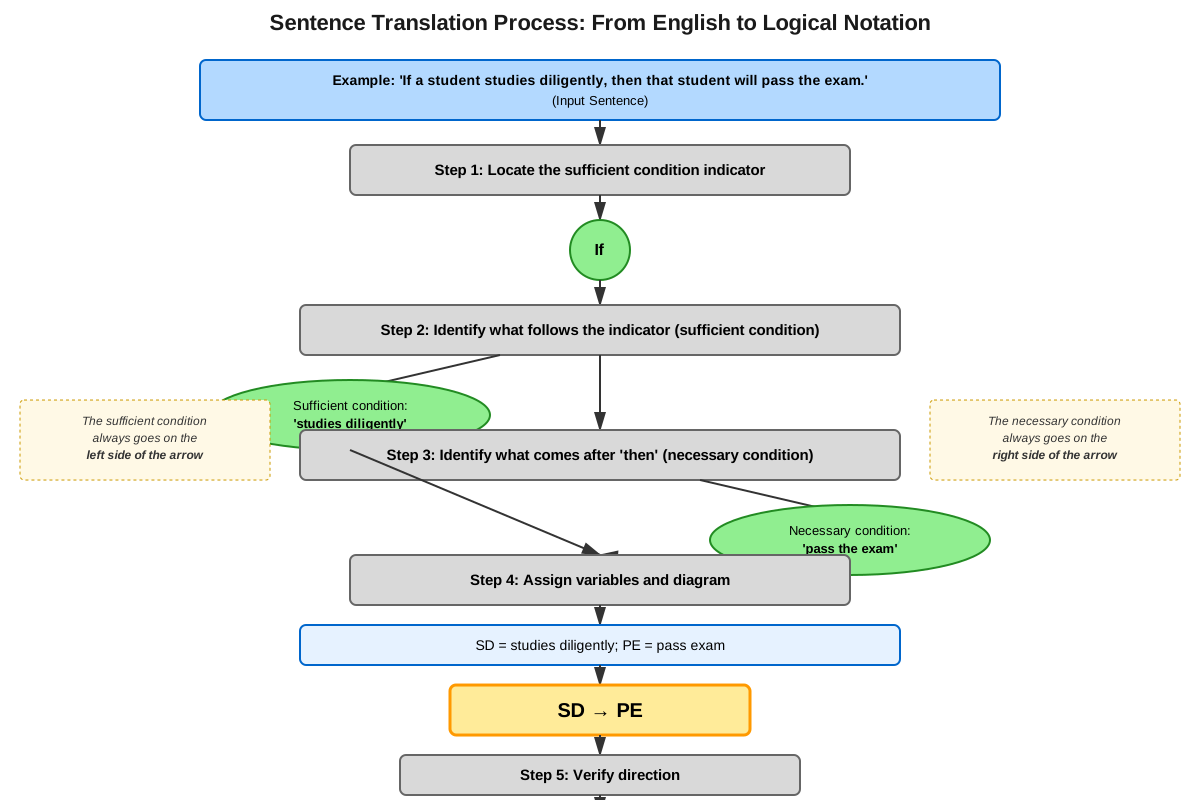
Standard structure: "If A, then B" → A → B
The sufficient condition (A) appears first, followed by the necessary condition (B).
Reversed structure: "B if A" → A → B
Despite B appearing first in the sentence, A remains the sufficient condition. Example: "The plant will die if you don't water it" translates to: Don't water → Die (not Die → Don't water).
Embedded structure: "All A are B" → A → B
The sufficient condition follows "all." Example: "All doctors are professionals" means Doctor → Professional.
"The only" structure: "The only A is B" or "A only if B"
This is particularly tricky. "The only way to pass is to study" means Pass → Study (passing is sufficient for knowing you studied), not Study → Pass. The word "only" typically introduces a necessary condition, but "the only" in this construction creates a sufficient condition for what comes before it.
Recognizing Sufficient Conditions in Complex Sentences
LSAT questions often present conditional logic within complex sentences containing multiple clauses, qualifiers, or embedded conditions. The key is to identify the logical structure beneath the grammatical complexity:
Multiple sufficient conditions for one outcome:
"If you study hard or if you're naturally gifted, you'll succeed."
Translation: Study hard → Succeed; Naturally gifted → Succeed
Compound sufficient conditions:
"If you study hard and attend every class, you'll pass."
Translation: (Study hard AND Attend class) → Pass
Both conditions must be met to trigger the outcome.
Negated sufficient conditions:
"If the defendant is not guilty, then the evidence was fabricated."
Translation: NOT guilty → Evidence fabricated
Negations can appear in either position and must be carefully tracked.
Sufficient vs. Necessary Condition Indicators
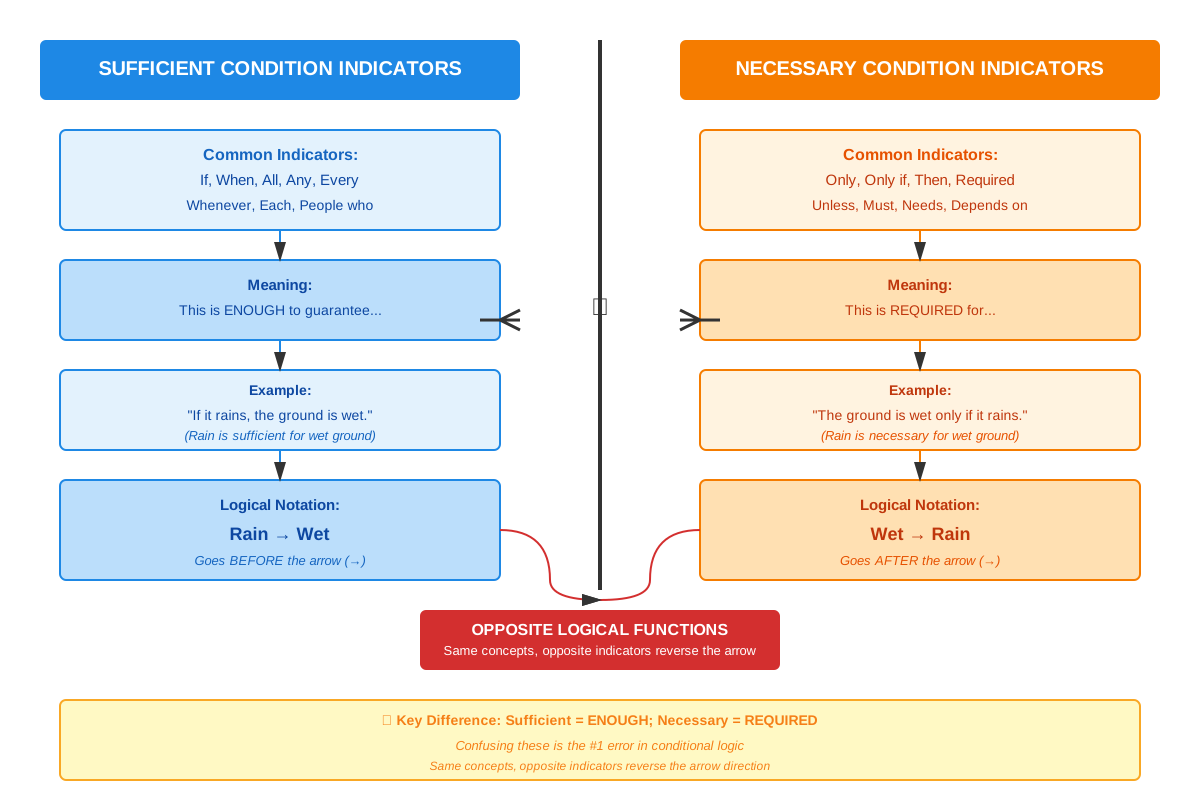
A critical skill is distinguishing sufficient condition indicators from necessary condition indicators, as confusing these represents one of the most common errors on the LSAT:
Sufficient indicators (introduce the "if" part): if, when, whenever, all, any, every, each
Necessary indicators (introduce the "then" part): then, only, only if, must, required, unless, until, without
The sentence "You can vote only if you're registered" means: Vote → Registered (being registered is necessary for voting, but voting is sufficient for knowing you're registered). This is the opposite of "If you're registered, you can vote," which would mean: Registered → Vote.
Concept Relationships
Sufficient condition indicators form the entry point into the broader system of conditional logic. The relationship flow works as follows:
Sufficient Condition Indicators → Conditional Statements → Contrapositives → Logical Chains → Valid Inferences
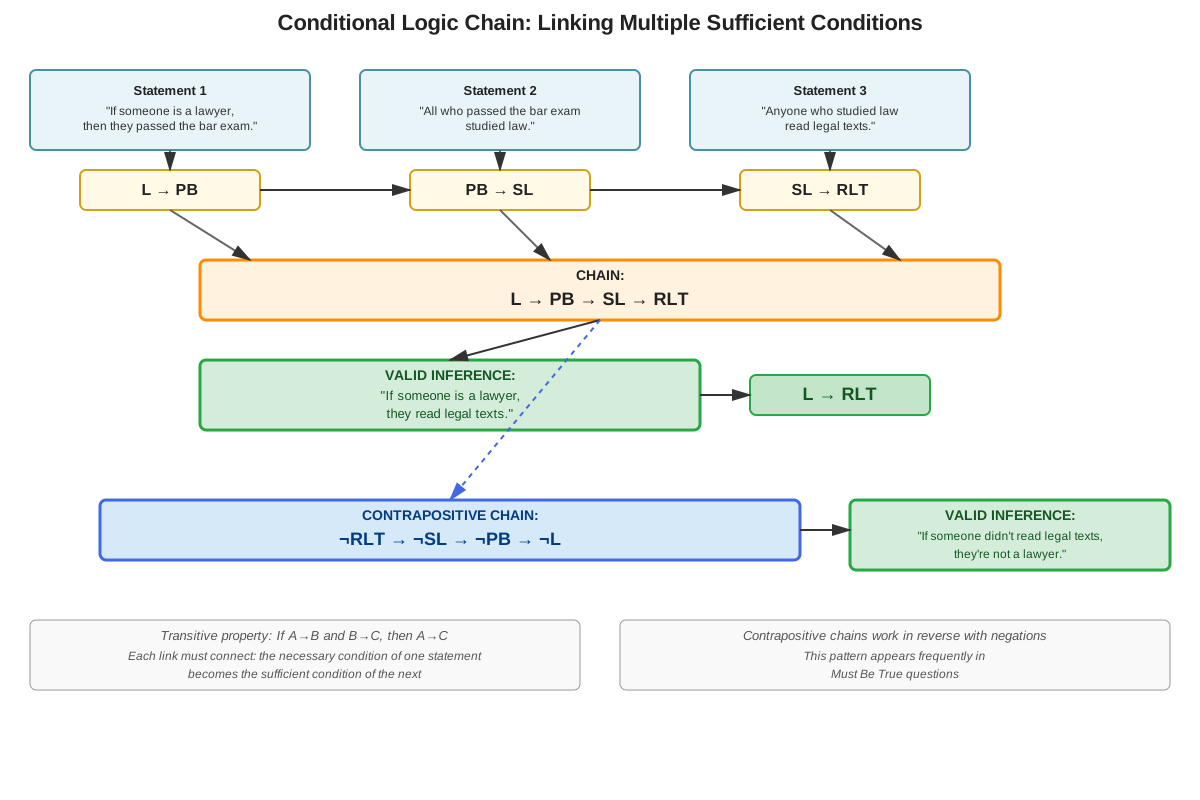
Recognizing sufficient condition indicators enables accurate translation of English sentences into conditional statements (A → B). Once a conditional statement is properly diagrammed, it can be converted to its contrapositive (NOT B → NOT A), which is logically equivalent and often necessary for making valid inferences. Multiple conditional statements can be chained together when the necessary condition of one statement matches the sufficient condition of another (A → B, B → C, therefore A → C).
The relationship to necessary condition indicators is complementary and interdependent—every conditional statement contains both a sufficient and necessary condition, and correctly identifying which is which determines whether the translation is accurate. Sufficient condition indicators also connect to formal logic operations including conjunction (AND), disjunction (OR), and negation (NOT), as these can modify or combine sufficient conditions.
Within question types, sufficient condition indicators relate most directly to: Must Be True questions (where recognizing sufficient conditions allows valid deductions), Sufficient Assumption questions (where the correct answer provides a sufficient condition to validate the argument), and Parallel Reasoning questions (where matching the conditional structure requires identifying corresponding sufficient conditions).
Quick check — test yourself on Sufficient condition indicators so far.
Try Flashcards →High-Yield Facts
⭐ The word "if" always introduces a sufficient condition, regardless of where it appears in the sentence.
⭐ "All," "any," "every," and "each" are sufficient condition indicators that mean the same thing logically, despite different grammatical forms.
⭐ In the construction "B if A," A is the sufficient condition even though it appears second in the sentence.
⭐ "The only" in phrases like "the only way" creates a sufficient condition for what precedes it, not what follows it.
⭐ A sufficient condition guarantees its necessary condition, but the necessary condition does not guarantee the sufficient condition (affirming the consequent is a logical flaw).
- Sufficient conditions can be negated: "If NOT A, then B" is a valid conditional structure.
- Multiple different conditions can each be sufficient for the same outcome without being necessary.
- Compound sufficient conditions require ALL components to be satisfied: "If A AND B, then C" means both A and B must occur.
- Temporal indicators like "when," "whenever," and "each time" function identically to "if" in logical structure.
- The absence of explicit sufficient condition indicators doesn't mean no conditional relationship exists—context and meaning matter.
- Sufficient condition indicators can appear in both premises and conclusions of arguments.
- Recognizing sufficient conditions is essential for identifying the logical flaw of confusing sufficient and necessary conditions.
- In Logic Games, sufficient conditions often appear as conditional rules that trigger specific outcomes or restrictions.
Common Misconceptions
Misconception: "If A, then B" means that A is the only way to get B.
Correction: A sufficient condition guarantees the outcome but is not necessarily the only way to achieve it. "If you study, you'll pass" doesn't mean studying is the only way to pass—natural talent might also be sufficient. Sufficient conditions guarantee but don't exclude other paths.
Misconception: "All A are B" means the same as "All B are A."
Correction: These are completely different statements. "All lawyers are college graduates" (Lawyer → Graduate) does not mean "All college graduates are lawyers" (Graduate → Lawyer). The sufficient condition indicator "all" only works in one direction and cannot be reversed without committing a logical error.
Misconception: In "B if A," B is the sufficient condition because it comes first.
Correction: The word "if" always introduces the sufficient condition regardless of sentence position. "The plant dies if you don't water it" means NOT water → Die, not Die → NOT water. Sentence order doesn't determine logical structure—the indicator words do.
Misconception: "The only" is a sufficient condition indicator like "only."
Correction: These function differently. "Only if" introduces a necessary condition (Vote only if registered → Vote → Registered), but "the only" creates a sufficient condition for what precedes it (The only way to win is practice → Win → Practice). The addition of "the" completely changes the logical function.
Misconception: When a sufficient condition occurs, the necessary condition must have already occurred.
Correction: Conditional logic describes what follows, not what preceded. If A → B, when A occurs, B will occur or is occurring—but B didn't necessarily happen before A. The arrow indicates forward logical flow, not temporal sequence.
Misconception: Sufficient conditions are more important than necessary conditions in conditional logic.
Correction: Both are equally important and provide different information. Sufficient conditions tell you what guarantees an outcome; necessary conditions tell you what's required. The contrapositive (which swaps and negates both) is logically equivalent to the original statement, showing that both conditions carry equal logical weight.
Worked Examples
Example 1: Translating Multiple Sufficient Condition Indicators
Question: "All students who complete the assignment on time will receive full credit. Any student who receives full credit will be eligible for honors. Each student eligible for honors must maintain a B average."
Step 1: Identify the sufficient condition indicators
- "All students who..." (first sentence)
- "Any student who..." (second sentence)
- "Each student..." (third sentence)
Step 2: Translate each sentence
- Sentence 1: Complete on time → Full credit
- Sentence 2: Full credit → Eligible for honors
- Sentence 3: Eligible for honors → B average
Step 3: Create the logical chain
Complete on time → Full credit → Eligible for honors → B average
Step 4: Derive valid inferences
From this chain, we can validly conclude:
- If a student completes the assignment on time, they must maintain a B average (following the full chain)
- If a student doesn't maintain a B average, they didn't complete the assignment on time (contrapositive of the full chain)
Invalid inference (common trap): If a student maintains a B average, they completed the assignment on time. This reverses the logic and is invalid—the B average is necessary but not sufficient for completing on time.
Connection to learning objectives: This example demonstrates how to identify sufficient condition indicators in multiple sentences, translate them accurately, and chain them together to make valid inferences—core skills for Must Be True and Inference questions.
Example 2: Complex Sentence with Embedded Sufficient Condition
Question: "The company will expand into new markets only if profits increase, and profits will increase if the new product succeeds. The new product will succeed provided that the marketing campaign is effective."
Step 1: Identify and classify each indicator
- "only if" → necessary condition indicator (not sufficient!)
- "if" (second instance) → sufficient condition indicator
- "provided that" → sufficient condition indicator
Step 2: Translate each component carefully
- "expand only if profits increase" → Expand → Profits increase (only if introduces necessary condition)
- "profits will increase if product succeeds" → Product succeeds → Profits increase
- "product will succeed provided that marketing effective" → Marketing effective → Product succeeds
Step 3: Build the complete chain
Marketing effective → Product succeeds → Profits increase → (necessary for) Expand
Note: The first relationship is necessary, not sufficient, so we can't conclude that increased profits guarantee expansion. However, we can use the contrapositive: NOT profits increase → NOT expand.
Step 4: Valid conclusions
- If the marketing campaign is effective, profits will increase (following the chain through the sufficient conditions)
- If the company expands, the marketing campaign must have been effective (contrapositive reasoning)
- If profits don't increase, the marketing campaign wasn't effective (contrapositive)
Invalid conclusion: If profits increase, the company will expand. This treats a necessary condition as if it were sufficient—a classic LSAT trap.
Connection to learning objectives: This example shows how to distinguish sufficient condition indicators from necessary condition indicators in complex sentences, avoid common traps, and apply conditional logic to reach valid conclusions while avoiding invalid ones.
Exam Strategy
Primary Strategy: When you encounter any sufficient condition indicator, immediately identify what it's introducing and mark it as the "trigger" or "if" part of the relationship, regardless of where it appears in the sentence.
Step-by-step approach for LSAT questions:
- Scan for indicator words first: Before reading for content, quickly identify any sufficient condition indicators (if, when, all, any, every, etc.). This primes your brain for logical structure.
- Diagram immediately: Don't try to hold conditional logic in your head. Write down the translation using arrows (A → B) as soon as you identify a conditional relationship. This prevents errors and saves time.
- Watch for reversed sentence structures: When you see "B if A," pause and consciously note that A is still the sufficient condition. Circle the "if" and draw your arrow from A to B.
- Identify compound conditions: If you see "and" connecting conditions after a sufficient indicator, both must be satisfied. Use parentheses: (A AND B) → C.
- Check for contrapositives: Many correct answers require contrapositive reasoning. Once you diagram A → B, immediately note that NOT B → NOT A is also true.
Trigger words to watch for:
- High-frequency: if, when, all, any, every
- Medium-frequency: whenever, each, provided that, given that
- Tricky constructions: "the only," "people who," "those who"
- Disguised indicators: categorical statements without explicit "if" language
Process of elimination tips:
- Eliminate any answer choice that reverses a sufficient and necessary condition
- Eliminate choices that treat a sufficient condition as if it were necessary (or vice versa)
- Eliminate choices that affirm the consequent (if A → B, and B is true, concluding A is true)
- Keep choices that properly apply contrapositives or chain conditional statements
Time allocation:
- Spend 10-15 seconds identifying and diagramming conditional relationships upfront
- This investment saves 30-45 seconds during answer choice evaluation
- For questions with multiple conditional statements, spend up to 30 seconds creating a complete diagram before looking at answers
Memory Techniques
Mnemonic for standard sufficient condition indicators: "IF WAWA EAT"
- IF = If
- W = When
- A = All
- W = Whenever
- A = Any
- E = Every/Each
- A = (The only)
- T = (Temporal indicators)
Visualization strategy: Picture sufficient conditions as "light switches" that turn on the necessary condition. When you flip the switch (sufficient condition occurs), the light must come on (necessary condition follows). The light being on doesn't tell you whether the switch was flipped—there might be other switches.
Acronym for sentence structure check: "FLIP"
- Find the indicator word
- Locate what it introduces
- Identify the sufficient condition
- Place the arrow correctly
Memory aid for "the only" vs. "only": "THE ONLY flips the script"—when you see "the only," the sufficient condition is what comes BEFORE it in meaning, not after. "Only" (without "the") introduces what comes after as necessary.
Spatial memory technique: Always write sufficient conditions on the LEFT side of your arrow and necessary conditions on the RIGHT. This consistent spatial arrangement helps prevent reversal errors and makes contrapositives easier to visualize.
Summary
Sufficient condition indicators are linguistic markers that identify the "trigger" or "guarantee" portion of conditional statements, representing one of the most critical skills for LSAT success. These indicators—including "if," "when," "all," "any," "every," and more sophisticated variations like "provided that" and "the only"—signal that when the condition they introduce is satisfied, another condition must follow. Mastering these indicators requires understanding that they function identically regardless of sentence structure, that they can be distinguished from necessary condition indicators by their logical function rather than their position, and that they enable the construction of logical chains and contrapositives essential for valid reasoning. The LSAT tests this concept across multiple question types, particularly in Must Be True, Sufficient Assumption, and Parallel Reasoning questions, making accurate identification and translation of sufficient conditions a high-yield skill. Students must avoid common errors such as reversing conditional relationships, confusing sufficient and necessary conditions, or assuming that sufficient conditions are the only way to achieve an outcome. Success requires immediate recognition of indicator words, consistent diagramming practices, and careful attention to sentence structure variations that the LSAT uses to test deeper understanding.
Key Takeaways
- Sufficient condition indicators introduce the "if" part of conditional statements and guarantee that the necessary condition follows when satisfied
- The most common indicators—if, when, all, any, every—function identically in logical structure despite different grammatical forms
- Sentence position doesn't determine logical structure; "B if A" still means A → B because "if" always introduces the sufficient condition
- Distinguishing sufficient from necessary condition indicators is critical; confusing them leads to reversed translations and wrong answers
- Sufficient conditions can be chained together (A → B, B → C, therefore A → C) and converted to contrapositives (A → B equals NOT B → NOT A)
- The LSAT deliberately varies sentence structure and uses sophisticated indicators to test true understanding beyond pattern recognition
- Immediate diagramming of conditional relationships saves time and prevents errors in complex questions with multiple conditional statements
Related Topics
Necessary Condition Indicators: The complementary skill to sufficient condition indicators, covering words like "only if," "must," "required," and "unless" that introduce necessary conditions. Mastering sufficient conditions provides the foundation for understanding how necessary conditions complete the conditional relationship.
Contrapositives: The logical equivalent of a conditional statement formed by negating and reversing both conditions. Understanding sufficient conditions is prerequisite to working with contrapositives, which are essential for making valid inferences.
Conditional Logic Chains: The process of linking multiple conditional statements together when the necessary condition of one matches the sufficient condition of another. Proficiency with sufficient condition indicators enables efficient chain construction.
Formal Logic in Logic Games: Application of conditional reasoning to game rules and constraints. The sufficient condition skills learned here transfer directly to interpreting and diagramming Logic Games rules.
Logical Reasoning Question Types: Specific question formats including Must Be True, Sufficient Assumption, Necessary Assumption, and Flaw questions that heavily feature conditional logic and require mastery of sufficient condition indicators.
Practice CTA
Now that you've mastered the fundamentals of sufficient condition indicators, it's time to put your knowledge into practice. Work through the practice questions to test your ability to identify indicators in various sentence structures, translate complex conditional statements accurately, and avoid common traps. Use the flashcards to drill recognition of indicator words until identification becomes automatic—speed and accuracy with these indicators will directly translate to points on test day. Remember, conditional logic is one of the most learnable and high-yield topics on the LSAT; consistent practice with sufficient condition indicators will build the foundation for success across multiple question types and sections. You've got this!
Sign up free to keep reading
Create a free AnvayaPrep account to finish this LSAT guide on Sufficient condition indicators — plus flashcards and practice questions.