Overview
Necessary condition indicators are linguistic markers that signal the necessary condition in a conditional statement—one of the most fundamental building blocks of logical reasoning on the LSAT. Understanding these indicators is essential because conditional logic appears in approximately 25-30% of all Logical Reasoning questions and forms the backbone of many complex argument structures tested throughout the exam. When a statement contains a necessary condition indicator, it tells you what must be true if something else is true, establishing a logical relationship that flows in a specific direction.
Mastering necessary condition indicators enables students to correctly diagram conditional statements, identify logical flaws in arguments, and predict valid inferences. The LSAT frequently tests whether students can distinguish between necessary and sufficient conditions, recognize when an argument confuses the two, or identify what must follow from a given set of premises. Questions involving Must Be True, Sufficient Assumption, Necessary Assumption, Flaw, and Parallel Reasoning all regularly incorporate conditional logic with necessary condition indicators as central elements.
Within the broader framework of Logical Reasoning, necessary condition indicators work in tandem with sufficient condition indicators to create the complete conditional relationship. While sufficient conditions trigger or guarantee an outcome, necessary conditions represent requirements that must be met. This topic connects directly to formal logic notation, contrapositive reasoning, and argument structure analysis—all critical skills for achieving a competitive LSAT score. Students who can instantly recognize and correctly interpret necessary condition indicators gain a significant strategic advantage in both speed and accuracy.
Learning Objectives
- [ ] Identify how necessary condition indicators appear in LSAT questions
- [ ] Explain the reasoning pattern behind necessary condition indicators
- [ ] Apply necessary condition indicators to solve LSAT-style problems accurately
- [ ] Distinguish between necessary and sufficient condition indicators in complex sentences
- [ ] Diagram conditional statements correctly when necessary condition indicators are present
- [ ] Recognize when LSAT arguments illegally reverse or negate conditional relationships involving necessary conditions
Prerequisites
- Basic understanding of conditional statements: Familiarity with "if...then" logic is essential because necessary conditions form one half of every conditional relationship
- Ability to identify premises and conclusions: Necessary condition indicators often appear in both premises and conclusions, requiring students to parse argument structure
- Comfort with logical notation: Diagramming conditional statements using arrows (→) helps visualize the relationship between sufficient and necessary conditions
- Recognition of argument components: Understanding how claims relate to one another enables proper identification of which element serves as the necessary condition
Why This Topic Matters
In legal reasoning—the foundation of the LSAT—conditional logic mirrors the structure of legal rules, contractual obligations, and statutory requirements. Attorneys must constantly identify what conditions are necessary for legal outcomes, making this skill directly applicable to law school and legal practice. The ability to parse necessary conditions from complex language is fundamental to case analysis, statutory interpretation, and logical argumentation.
On the LSAT itself, necessary condition indicators appear with remarkable frequency. Research on recent LSAT administrations shows that conditional logic appears in approximately 8-12 questions per Logical Reasoning section, with necessary condition indicators present in the majority of these questions. They appear across multiple question types: Must Be True questions require identifying what necessarily follows from premises; Necessary Assumption questions explicitly ask what must be true for an argument to work; Sufficient Assumption questions require understanding what's needed to guarantee a conclusion; and Flaw questions often test whether arguments confuse necessary and sufficient conditions.
Common manifestations include arguments that assume something necessary is also sufficient (a classic logical flaw), questions asking what must be true given certain conditions, and complex conditional chains where multiple necessary conditions link together. The LSAT also frequently embeds necessary condition indicators in dense, formal language or uses less common indicators to test whether students truly understand the logical relationship rather than simply memorizing "if" and "then." Missing or misinterpreting these indicators typically results in selecting trap answers specifically designed to exploit conditional logic errors.
Core Concepts
Definition of Necessary Conditions
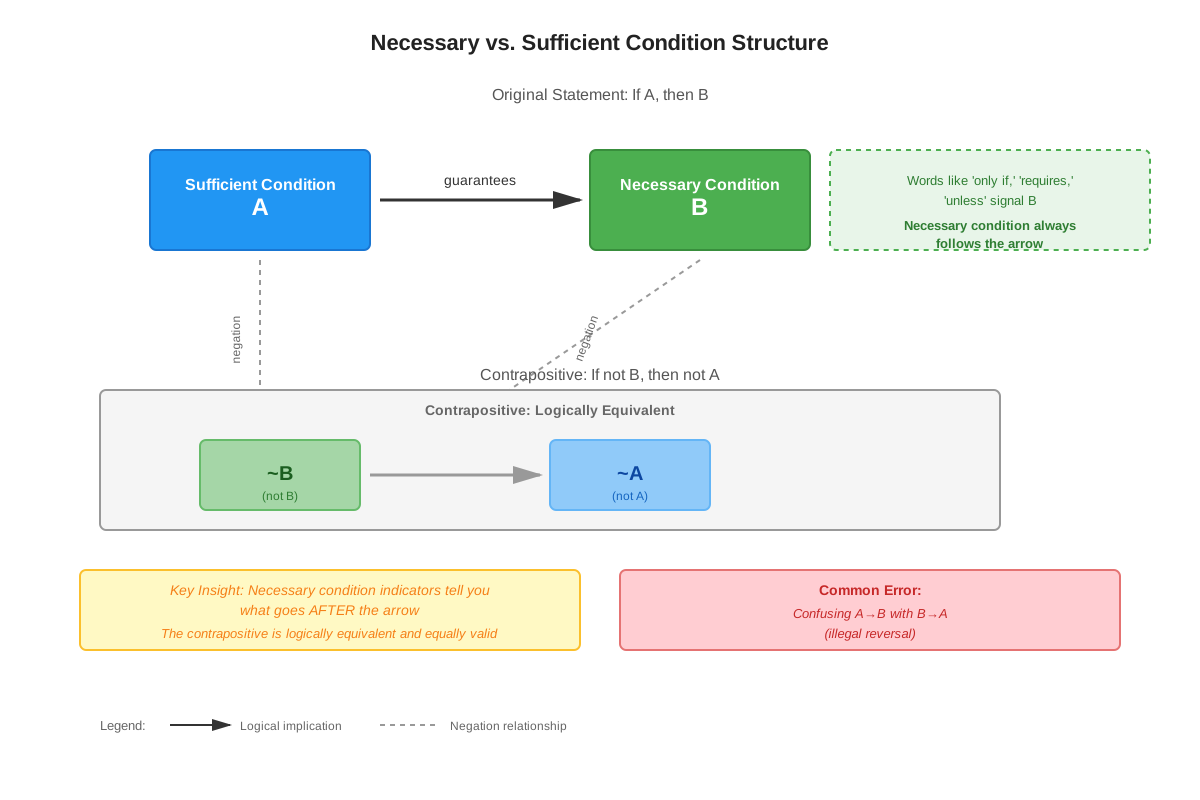
A necessary condition is something that must be true in order for something else to be true. It represents a requirement, prerequisite, or essential element. If the necessary condition is absent, the other condition cannot occur. In the conditional statement "If A, then B," B is the necessary condition—B must be true whenever A is true. However, B can be true without A being true; the relationship only guarantees that A requires B, not that B requires A.
The logical structure flows from sufficient to necessary: the sufficient condition (A) is enough to guarantee the necessary condition (B), but the necessary condition alone doesn't guarantee the sufficient condition. This unidirectional relationship is crucial for LSAT success because many wrong answers exploit reversals of this logic.
Common Necessary Condition Indicators
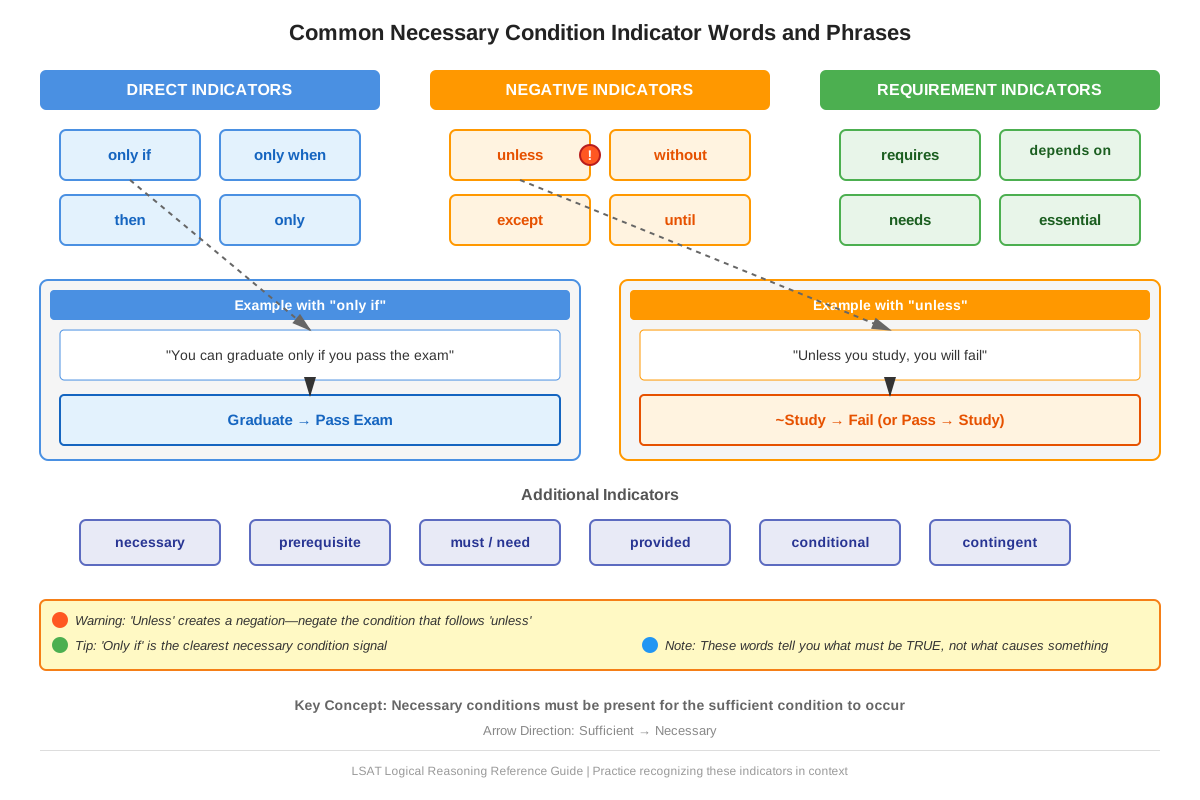
LSAT necessary condition indicators are words and phrases that signal which element in a statement serves as the necessary condition. The most important indicators include:
| Indicator | Example | Diagram |
|---|---|---|
| then | If you study, then you will improve | Study → Improve |
| only if | You will succeed only if you work hard | Succeed → Work Hard |
| requires | Admission requires a high score | Admission → High Score |
| necessary | Exercise is necessary for health | Health → Exercise |
| must | To qualify, you must apply | Qualify → Apply |
| depends on | Success depends on preparation | Success → Preparation |
| unless | You fail unless you study | ~Study → Fail (or Study ← ~Fail) |
| without | Without water, plants die | Plants Alive → Water |
| only | Only members can enter | Enter → Member |
| no...unless | No entry unless you're a member | Entry → Member |
The "Only If" Indicator
The phrase "only if" is particularly high-yield because it's frequently misinterpreted. "A only if B" means that B is necessary for A—you cannot have A without B. This translates to: A → B. Many students incorrectly reverse this, thinking "only if" introduces the sufficient condition.
Example: "You can vote only if you are registered." This means: Vote → Registered. Being registered is necessary for voting. Notice that being registered doesn't guarantee you will vote (you might be registered but choose not to vote), but voting requires registration.
The "Unless" Indicator
"Unless" creates a necessary condition through negation. The standard translation is: "A unless B" means "If not B, then A" (or equivalently, "If not A, then B"). The element following "unless" becomes the necessary condition when negated.
Example: "The plant will die unless you water it." This translates to: ~Water → Die, which is logically equivalent to ~Die → Water. The contrapositive reveals that if the plant doesn't die, you must have watered it.
Necessary vs. Sufficient Conditions
Understanding the distinction between necessary and sufficient conditions is fundamental to conditional logic:
- Sufficient condition: Enough to guarantee the result; if present, the necessary condition must follow
- Necessary condition: Required for the result; if absent, the sufficient condition cannot occur
The sufficient condition appears before the arrow (→) in standard notation, while the necessary condition appears after the arrow. On the LSAT, arguments frequently commit the flaw of treating a necessary condition as if it were sufficient—assuming that because something is required, its presence alone guarantees the outcome.
Diagramming with Necessary Condition Indicators
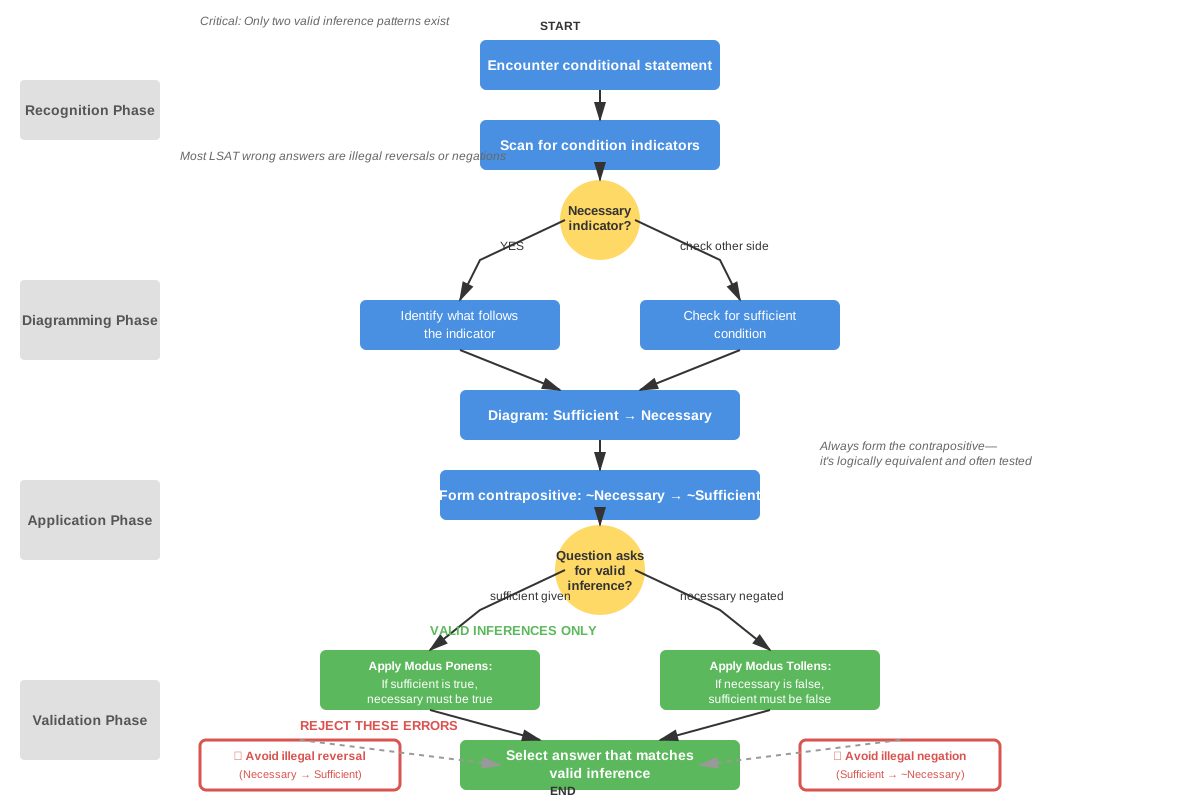
When diagramming conditional statements containing necessary condition indicators, follow these steps:
- Identify the indicator word or phrase (then, only if, requires, must, etc.)
- Determine which element is the necessary condition (the element that must be true)
- Identify the sufficient condition (the element that guarantees the necessary condition)
- Write the diagram: Sufficient → Necessary
- Form the contrapositive: ~Necessary → ~Sufficient
Example: "Success requires dedication."
- Indicator: "requires"
- Necessary condition: dedication
- Sufficient condition: success
- Diagram: Success → Dedication
- Contrapositive: ~Dedication → ~Success
Multiple Necessary Conditions
Some statements contain multiple necessary conditions for a single sufficient condition. These appear as: "If A, then B and C" or "A requires both B and C."
Diagram: A → B AND C
This means that if A occurs, both B and C must occur. The contrapositive becomes: ~B OR ~C → ~A (if either necessary condition is absent, the sufficient condition cannot occur).
Necessary Conditions in Complex Sentences
The LSAT often embeds necessary condition indicators in complex sentence structures with multiple clauses, negations, or formal language. Students must parse these carefully:
Example: "No candidate will be considered unless they possess both experience and credentials."
- "Unless" signals necessary condition
- "No...unless" structure
- Translation: Considered → (Experience AND Credentials)
Concept Relationships
Necessary condition indicators form the foundation for understanding conditional logic, which connects to virtually every aspect of Logical Reasoning. The relationship flows as follows:
Necessary Condition Indicators → enable correct Conditional Statement Diagramming → which allows formation of Contrapositives → leading to Valid Inferences → supporting Argument Analysis
Within conditional logic itself, necessary condition indicators work in complementary opposition to sufficient condition indicators. Together, they define the complete conditional relationship. When students master necessary condition indicators, they can immediately identify the direction of logical flow, which is essential for:
- Contrapositive formation: The contrapositive negates and reverses both conditions, so knowing which is necessary determines the correct reversal
- Conditional chains: Multiple conditional statements link together when the necessary condition of one statement matches the sufficient condition of another
- Flaw identification: Many logical flaws involve treating necessary conditions as sufficient or vice versa
The connection to prerequisite knowledge is direct: basic conditional statement understanding provides the framework, while necessary condition indicators add the linguistic component that allows students to extract conditional logic from natural language. This topic also connects forward to advanced concepts like formal logic, sufficient assumption questions, and necessary assumption questions—each requiring precise understanding of what conditions are required versus what conditions guarantee outcomes.
High-Yield Facts
⭐ The element following "only if" is always the necessary condition, not the sufficient condition (A only if B = A → B)
⭐ "Unless" introduces a necessary condition through negation: "A unless B" = ~B → A = ~A → B
⭐ Necessary conditions appear after the arrow (→) in standard logical notation
⭐ A necessary condition can be true without the sufficient condition being true, but not vice versa
⭐ The contrapositive of a conditional statement negates and reverses both conditions, making the negation of the necessary condition sufficient for the negation of the original sufficient condition
- "Requires," "necessary," "must," "depends on," and "prerequisite" all introduce necessary conditions
- Multiple necessary conditions for one sufficient condition are connected by "AND" in the diagram
- "Only" (without "if") typically introduces a necessary condition: "Only members may enter" = Enter → Member
- "Without" signals a necessary condition: "Without A, not B" = B → A
- The absence of a necessary condition guarantees the absence of the sufficient condition (via contrapositive)
- Necessary conditions can appear in both premises and conclusions of arguments
- "No...unless" structures always make the element after "unless" a necessary condition
- Treating a necessary condition as sufficient is one of the most common logical flaws on the LSAT
- Conditional statements can be expressed without explicit indicators through context and logical structure
- Necessary condition indicators can be combined with negations, requiring careful parsing of what must be true
Quick check — test yourself on Necessary condition indicators so far.
Try Flashcards →Common Misconceptions
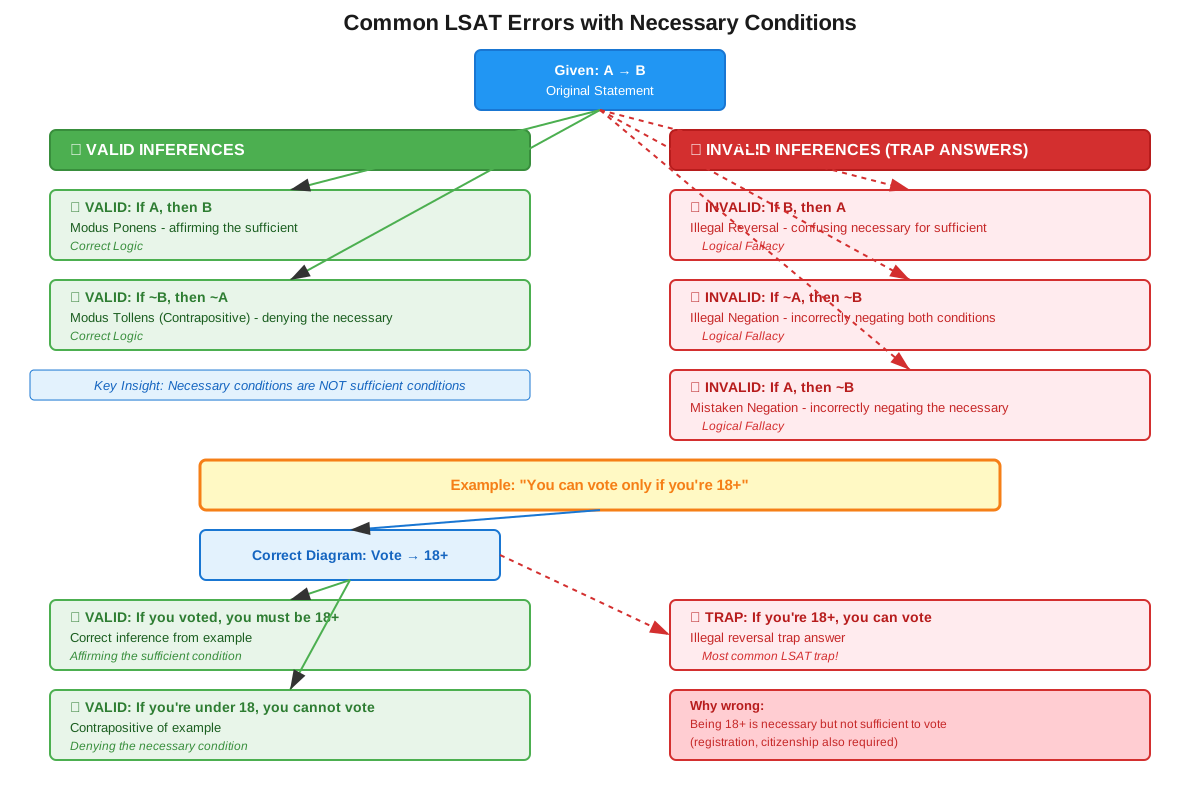
Misconception: "Only if" introduces the sufficient condition because "if" typically does so.
Correction: "Only if" introduces the necessary condition. The word "only" restricts when the first condition can occur, making the second condition necessary. "A only if B" means A → B, not B → A.
Misconception: If a necessary condition is present, the sufficient condition must also be present.
Correction: Necessary conditions can exist without sufficient conditions. The relationship only guarantees that sufficient conditions require necessary conditions, not that necessary conditions produce sufficient conditions. If you have a high LSAT score (necessary for admission to top schools), you're not automatically admitted—the necessary condition alone isn't sufficient.
Misconception: "Unless" means "if" and can be translated the same way.
Correction: "Unless" introduces a necessary condition through negation and requires special translation. "A unless B" means "if not B, then A" (~B → A), which is equivalent to "if not A, then B" (~A → B). This is different from "if B, then A."
Misconception: All necessary condition indicators are equally obvious and easy to spot.
Correction: The LSAT deliberately uses less common indicators and embeds them in complex sentence structures. Phrases like "depends on," "prerequisite for," "without," and "no...unless" are all necessary condition indicators that students often miss if they only look for "then" and "only if."
Misconception: When a statement has multiple necessary conditions, satisfying one of them is enough.
Correction: When multiple necessary conditions exist (A → B AND C), all necessary conditions must be satisfied for the sufficient condition to occur. If even one necessary condition is absent, the sufficient condition cannot occur. The contrapositive reflects this: ~B OR ~C → ~A.
Misconception: Necessary condition indicators always appear in the same position within a sentence.
Correction: Necessary condition indicators can appear at the beginning, middle, or end of sentences, and the grammatical structure doesn't always match the logical structure. "You must study to succeed" and "To succeed, you must study" both mean Succeed → Study, despite different word orders.
Worked Examples
Example 1: Identifying and Diagramming Necessary Conditions
Problem: Diagram the following statement and form its contrapositive: "A student will be admitted to the program only if they have completed the prerequisite courses and maintained a minimum GPA of 3.0."
Solution:
Step 1: Identify the necessary condition indicator.
- The phrase "only if" signals that what follows is the necessary condition.
Step 2: Identify all necessary conditions.
- Completed prerequisite courses (let's call this P)
- Maintained minimum GPA of 3.0 (let's call this G)
- Note the "and" connecting them—both are necessary
Step 3: Identify the sufficient condition.
- Being admitted to the program (let's call this A)
Step 4: Diagram the statement.
- A → (P AND G)
- Translation: If admitted, then the student must have completed prerequisites AND maintained the GPA
Step 5: Form the contrapositive.
- Negate both sides and reverse: ~(P AND G) → ~A
- Using De Morgan's Law: (~P OR ~G) → ~A
- Translation: If the student either hasn't completed prerequisites OR hasn't maintained the GPA (or both), then they will not be admitted
Key Insight: This example demonstrates how "only if" introduces necessary conditions and how multiple necessary conditions connected by "and" become "or" when negated in the contrapositive. This is a high-yield pattern on the LSAT.
Example 2: Analyzing an Argument with Necessary Condition Indicators
Problem: Evaluate the following argument:
"To be a successful entrepreneur, one must be willing to take risks. Jennifer is willing to take risks. Therefore, Jennifer will be a successful entrepreneur."
Identify the flaw and explain how it relates to necessary condition indicators.
Solution:
Step 1: Identify the conditional statement in the premise.
- "To be a successful entrepreneur, one must be willing to take risks"
- "Must" is a necessary condition indicator
- Diagram: Successful Entrepreneur → Willing to Take Risks (SE → R)
Step 2: Identify what the argument tells us about Jennifer.
- Jennifer is willing to take risks (R is true)
Step 3: Identify what the argument concludes.
- Jennifer will be a successful entrepreneur (SE is true)
Step 4: Analyze the logical structure.
- The argument has: SE → R (premise)
- The argument observes: R (premise)
- The argument concludes: SE (conclusion)
- This is an illegal reversal of the conditional statement
Step 5: Explain the flaw.
The argument treats a necessary condition (willingness to take risks) as if it were a sufficient condition. The premise establishes that being willing to take risks is necessary for entrepreneurial success—you can't be successful without it. However, being willing to take risks doesn't guarantee success; it's merely one requirement among potentially many others (capital, business acumen, market timing, etc.).
The valid inference from "Jennifer is willing to take risks" would be the contrapositive: if Jennifer were NOT a successful entrepreneur, we could conclude she is NOT willing to take risks (~SE → ~R, contrapositive of SE → R). But we cannot conclude that having the necessary condition means the sufficient condition must be present.
Key Insight: This is one of the most common flaws on the LSAT—confusing necessary and sufficient conditions. Recognizing necessary condition indicators helps identify when arguments make this error.
Exam Strategy
When approaching LSAT questions involving necessary condition indicators, implement this systematic strategy:
Step 1: Scan for indicator words immediately. Train your eye to spot "only if," "unless," "requires," "must," "necessary," "depends on," and "without" as you read. Underline or circle these indicators to ensure you don't miss them in complex passages.
Step 2: Diagram as you read. Don't wait until you've read the entire stimulus. As soon as you encounter a conditional statement with a necessary condition indicator, quickly diagram it in the margin using arrow notation. This prevents misinterpretation and provides a visual reference.
Step 3: Form contrapositives immediately. After diagramming the original conditional, write the contrapositive directly below it. Many correct answers require contrapositive reasoning, and having it pre-written saves time and reduces errors.
Step 4: Watch for illegal reversals in answer choices. When eliminating answers, be especially suspicious of choices that reverse the conditional relationship. If the stimulus says A → B, wrong answers often present B → A as if it were valid.
Step 5: Pay special attention to "only if" and "unless." These are the most commonly misinterpreted indicators. If you see them, slow down slightly and double-check your diagram. Many trap answers exploit common misinterpretations of these phrases.
Exam Tip: In Necessary Assumption questions, the correct answer will be something that, if negated, destroys the argument. This is literally testing whether you understand what's necessary for the conclusion. Use the negation test: negate each answer choice and see which one makes the argument fall apart.
Time allocation: Spend an extra 5-10 seconds carefully diagramming conditional statements with necessary condition indicators. This upfront investment typically saves 20-30 seconds during answer choice evaluation because you can quickly eliminate reversals and identify valid inferences.
Process of elimination tips:
- Eliminate any answer that reverses the conditional relationship
- Eliminate answers that treat necessary conditions as sufficient
- Eliminate answers that confuse "and" with "or" in multiple necessary conditions
- Keep answers that properly apply the contrapositive
- Keep answers that correctly identify what must be true given the necessary conditions
Memory Techniques
Mnemonic for common necessary condition indicators: "TURN ROWD"
- Then
- Unless
- Requires
- Necessary
- Relies on
- Only if
- Without
- Depends on
Visualization for "only if": Picture a door with a sign saying "ONLY IF you have a key." The key is necessary to enter—you can't get in without it. This reinforces that "only if" introduces what's necessary, not what's sufficient.
Acronym for "unless" translation: "NUN" = Negate, Unless becomes if, Necessary condition
- When you see "unless," negate the condition that follows it
- Replace "unless" with "if not"
- What followed "unless" becomes the necessary condition when negated
Arrow direction memory aid: "Necessary comes NEXT"—the necessary condition comes after (next to) the arrow. The arrow points toward what's necessary.
Contrapositive memory technique: "Flip and Nip"—Flip the arrow direction and Nip (negate) both conditions.
Summary
Necessary condition indicators are linguistic markers that identify which element in a conditional statement must be true for another element to be true. These indicators—including "only if," "unless," "requires," "must," "necessary," and "depends on"—appear frequently throughout LSAT Logical Reasoning questions and are essential for correctly interpreting conditional logic. The necessary condition appears after the arrow in standard notation (A → B, where B is necessary), and understanding this relationship enables students to form valid contrapositives, identify logical flaws, and make correct inferences. The most commonly tested indicators are "only if" (which introduces the necessary condition despite containing "if") and "unless" (which introduces a necessary condition through negation). Students must distinguish between necessary and sufficient conditions because many LSAT arguments commit the flaw of treating necessary conditions as if they were sufficient—assuming that having a requirement guarantees an outcome. Mastering necessary condition indicators requires recognizing them in various sentence structures, correctly diagramming the relationships they create, and applying contrapositive reasoning to derive valid conclusions.
Key Takeaways
- Necessary condition indicators signal what must be true for something else to be true; they include "only if," "unless," "requires," "must," "necessary," and "depends on"
- The necessary condition appears after the arrow (→) in logical notation, while the sufficient condition appears before it
- "Only if" introduces the necessary condition (A only if B = A → B), not the sufficient condition, despite containing the word "if"
- "Unless" creates a necessary condition through negation: "A unless B" translates to ~B → A or equivalently ~A → B
- A necessary condition can exist without the sufficient condition, but the sufficient condition cannot exist without the necessary condition
- The contrapositive negates and reverses both conditions, making it a valid inference that's frequently tested on the LSAT
- Treating a necessary condition as sufficient is one of the most common logical flaws on the LSAT and appears across multiple question types
Related Topics
Sufficient Condition Indicators: Understanding sufficient condition indicators ("if," "when," "whenever," "all") complements necessary condition knowledge and completes the conditional logic framework. Mastering both types of indicators enables full comprehension of conditional relationships.
Contrapositive Reasoning: Building directly on necessary condition indicators, contrapositive reasoning involves negating and reversing conditional statements to derive valid inferences—a skill tested extensively in Must Be True and Inference questions.
Conditional Chains: Once students master individual conditional statements with necessary condition indicators, they can link multiple conditionals together to form chains (A → B, B → C, therefore A → C), which appear in complex Logical Reasoning stimuli.
Formal Logic: Advanced formal logic questions combine necessary condition indicators with quantifiers ("all," "some," "none") to create complex logical relationships that require precise diagramming and inference skills.
Necessary Assumption Questions: This question type explicitly tests understanding of necessary conditions by asking what must be true for an argument to work, making mastery of necessary condition indicators directly applicable.
Practice CTA
Now that you understand necessary condition indicators and their critical role in LSAT Logical Reasoning, it's time to reinforce this knowledge through active practice. Complete the practice questions to test your ability to identify necessary condition indicators in various contexts, diagram conditional statements correctly, and apply contrapositive reasoning. Use the flashcards to drill the most common indicators until recognition becomes automatic—speed and accuracy with these indicators will significantly improve your performance across multiple question types. Remember, conditional logic mastery is one of the highest-yield investments you can make in your LSAT preparation, and necessary condition indicators are the foundation of that mastery. You've built the knowledge; now build the skill through deliberate practice!
Sign up free to keep reading
Create a free AnvayaPrep account to finish this LSAT guide on Necessary condition indicators — plus flashcards and practice questions.