Overview
The sufficient condition is one of the most fundamental building blocks of conditional logic on the LSAT, appearing in approximately 25-30% of Logical Reasoning questions and forming the backbone of many complex arguments. Understanding sufficient conditions is essential for success on the LSAT because they establish the "trigger" in if-then relationships that pervade legal reasoning and formal logic. When a sufficient condition is satisfied, it guarantees that another event, state, or condition (the necessary condition) must occur. This relationship forms the basis for valid deductive reasoning, which the LSAT tests extensively.
Mastering sufficient conditions enables test-takers to diagram arguments accurately, identify logical flaws, evaluate the strength of reasoning, and predict valid inferences. The concept appears across multiple question types, including Must Be True, Sufficient Assumption, Strengthen/Weaken, Flaw, and Parallel Reasoning questions. Without a solid grasp of sufficient conditions, students struggle to navigate the formal logic that underlies many LSAT arguments, particularly those involving rules, policies, legal principles, and causal relationships.
Within the broader framework of Logical Reasoning, sufficient conditions work in tandem with necessary conditions to create conditional statements that can be chained together, contraposed, and manipulated according to strict logical rules. This topic serves as the gateway to understanding more complex logical structures, including conditional chains, bi-conditionals, and formal logic games that appear in both Logical Reasoning and Logic Games sections. The ability to quickly identify and correctly interpret sufficient conditions separates high-scoring test-takers from those who struggle with the exam's most challenging questions.
Learning Objectives
- [ ] Identify how sufficient condition appears in LSAT questions
- [ ] Explain the reasoning pattern behind sufficient condition
- [ ] Apply sufficient condition to solve LSAT-style problems accurately
- [ ] Distinguish between sufficient and necessary conditions in complex statements
- [ ] Diagram conditional statements using standard LSAT notation
- [ ] Recognize and avoid common logical fallacies involving sufficient conditions
- [ ] Apply the contrapositive correctly to sufficient condition statements
Prerequisites
- Basic propositional logic: Understanding of statements that can be true or false is essential because conditional logic builds on the ability to evaluate truth values
- If-then statement structure: Familiarity with basic conditional statements provides the foundation for identifying sufficient and necessary conditions
- Logical connectors: Knowledge of words like "and," "or," "not," and "if" enables accurate translation of English sentences into logical notation
- Argument structure: Recognition of premises and conclusions helps identify where conditional logic functions within LSAT arguments
Why This Topic Matters
Sufficient conditions represent a cornerstone of legal reasoning and appear throughout law school and legal practice. Attorneys must constantly evaluate whether certain conditions trigger legal consequences, whether contractual obligations have been met, and whether precedents apply to current cases. The LSAT tests this skill extensively because it predicts success in legal education and practice.
On the LSAT, sufficient conditions appear in approximately 8-12 questions per test across both Logical Reasoning sections. They manifest in various question types: Sufficient Assumption questions explicitly ask test-takers to identify what condition would guarantee a conclusion; Must Be True questions often require recognizing when a sufficient condition has been triggered; Flaw questions frequently involve misunderstanding or misapplying sufficient conditions; and Parallel Reasoning questions test whether students can match conditional structures across different contexts.
Common manifestations include policy statements ("Anyone who scores above 170 will be admitted"), scientific principles ("Whenever temperature exceeds 100°C at sea level, water boils"), legal rules ("If a contract lacks consideration, it is unenforceable"), and causal claims ("Exposure to sunlight causes vitamin D production"). The LSAT also tests sufficient conditions through more subtle language, using words like "any," "all," "every," "when," and "requires" that signal conditional relationships. Recognizing these patterns quickly and accurately is essential for efficient test-taking and score maximization.
Core Concepts
Definition of Sufficient Condition
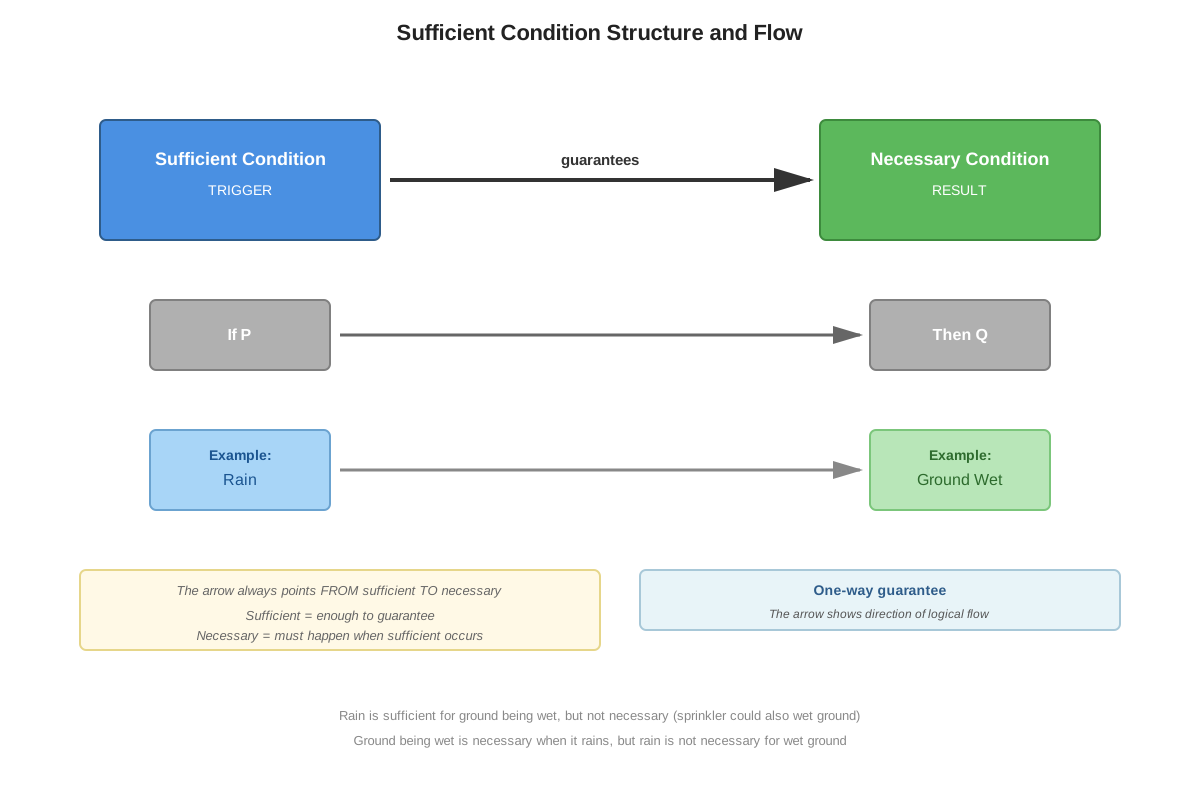
A sufficient condition is a circumstance, event, or state that, when present, guarantees or ensures that another condition will also be present. In formal logic notation, if we have "If A, then B," A is the sufficient condition. The presence of A is sufficient (enough) to guarantee B. The sufficient condition appears in the "if" clause of a conditional statement and represents the trigger or antecedent that activates the logical relationship.
The key characteristic of a sufficient condition is its guarantee function: whenever the sufficient condition occurs, the necessary condition must follow. However, the sufficient condition is not the only way to achieve the necessary condition—other paths may exist. For example, "If it is raining, then the ground is wet" establishes rain as sufficient for wet ground, but sprinklers, flooding, or snow melt could also make the ground wet.
Standard Conditional Form
LSAT sufficient condition statements follow a standard logical structure that can be represented as:
If [Sufficient Condition] → Then [Necessary Condition]Or in symbolic notation commonly used for LSAT preparation:
SC → NCWhere the arrow (→) means "if...then" or "implies." The condition before the arrow is sufficient; the condition after the arrow is necessary. This notation allows test-takers to quickly diagram complex arguments and track logical relationships.
Indicator Words for Sufficient Conditions
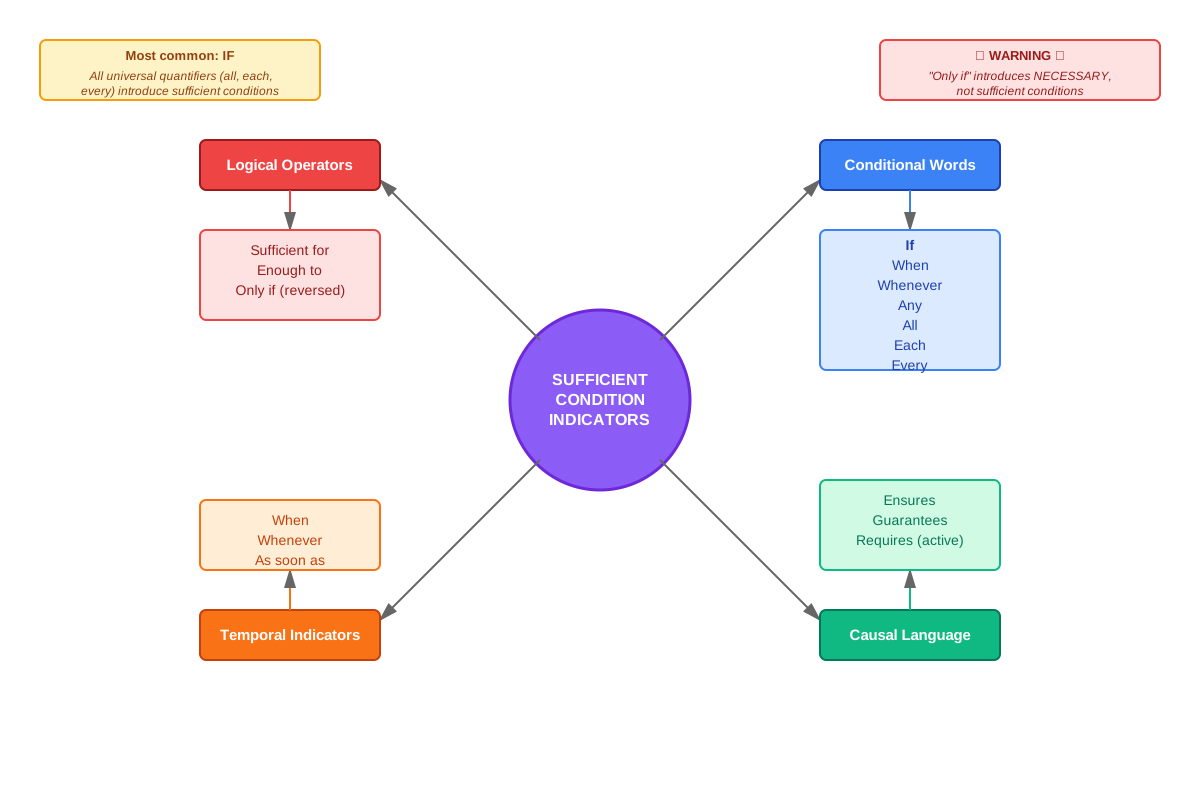
The LSAT uses diverse language to express sufficient conditions, and recognizing these indicators is crucial for accurate diagramming:
| Sufficient Condition Indicators | Example |
|---|---|
| If | If you study, you will improve |
| When/Whenever | When it rains, the game is cancelled |
| All/Every/Any | All lawyers passed the bar exam |
| Anyone who/Everyone who | Anyone who applies will be considered |
| The only way | The only way to win is to practice |
| Requires (subject position) | Admission requires a high score |
| In order to | In order to graduate, you must pass |
Each of these phrases signals that what follows (or precedes, depending on sentence structure) is the sufficient condition that triggers a necessary consequence.
Sufficient vs. Necessary Conditions
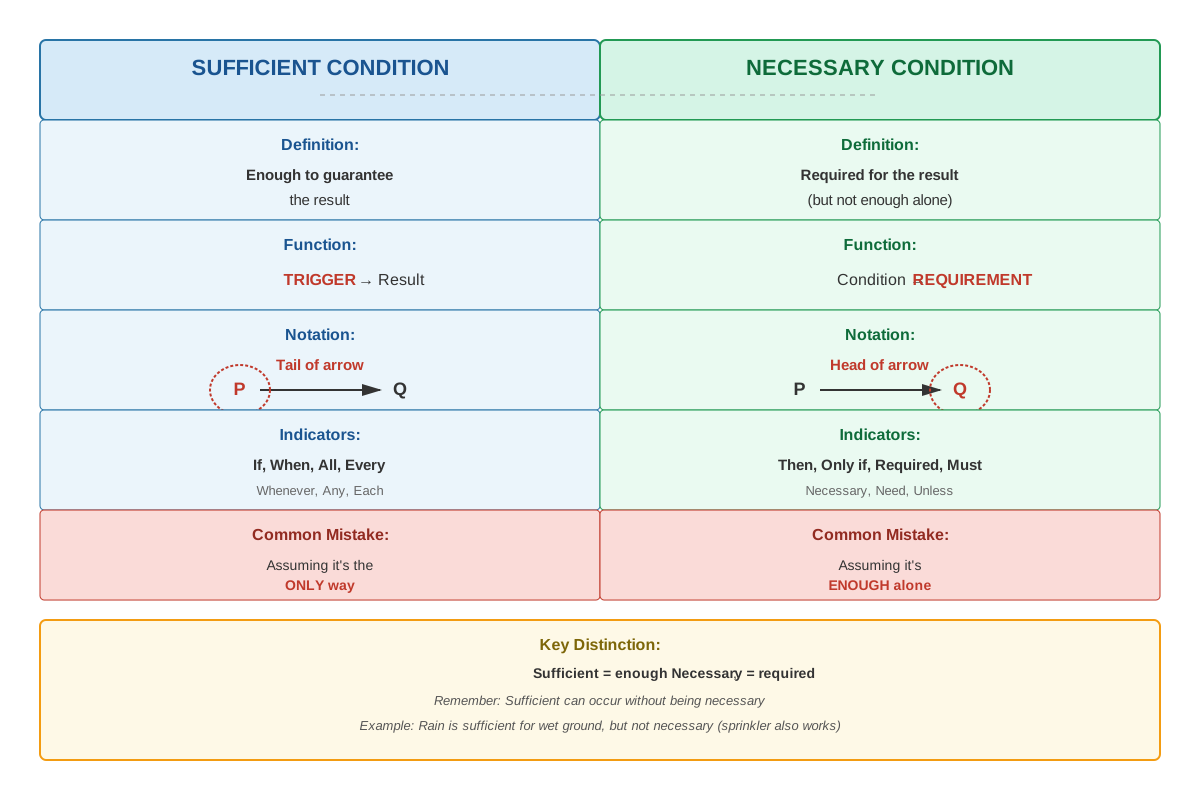
Understanding the distinction between sufficient and necessary conditions is fundamental to conditional logic:
Sufficient Condition: What is enough to guarantee an outcome. It triggers or causes the necessary condition. Think of it as the "if" part—if this happens, something else must follow.
Necessary Condition: What must be present for something else to occur, but alone doesn't guarantee it. It's the required element, the "then" part—this must be true if the sufficient condition is met.
Consider: "If you are in Boston, then you are in Massachusetts."
- Being in Boston (sufficient) guarantees you're in Massachusetts (necessary)
- Being in Massachusetts (necessary) does NOT guarantee you're in Boston (you could be in Cambridge, Worcester, etc.)
- Boston is sufficient for Massachusetts; Massachusetts is necessary for Boston
The Contrapositive
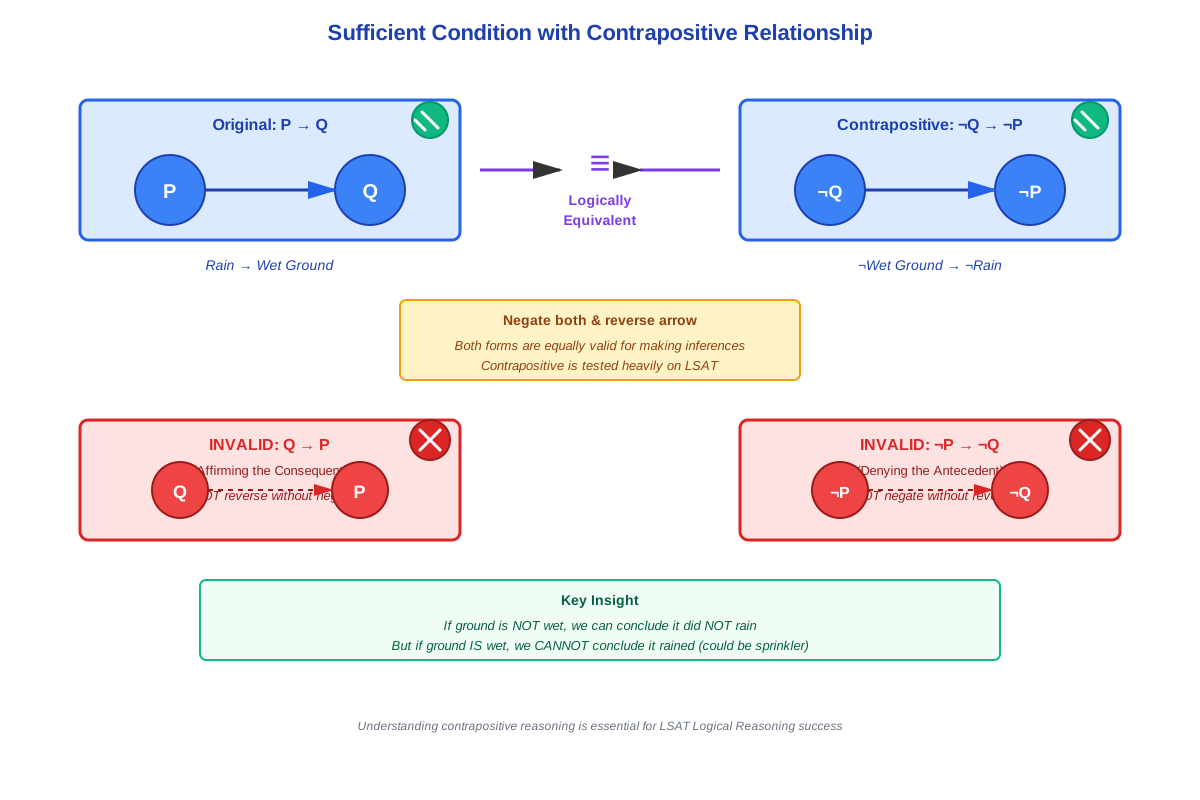
Every conditional statement has a logically equivalent contrapositive formed by negating both conditions and reversing their order:
Original: A → B
Contrapositive: NOT B → NOT A
The contrapositive is always valid and represents the same logical relationship as the original statement. For example:
- Original: "If it is raining → then the ground is wet"
- Contrapositive: "If the ground is NOT wet → then it is NOT raining"
Both statements are logically equivalent and equally valid. The LSAT frequently tests whether students can correctly form and apply contrapositives, particularly in Must Be True and Inference questions.
Invalid Logical Operations
Understanding what you CANNOT validly conclude from a sufficient condition is as important as knowing what you can conclude:
Affirming the Consequent (INVALID):
If A → B
B is true
Therefore, A is true (WRONG!)
Denying the Antecedent (INVALID):
If A → B
A is false
Therefore, B is false (WRONG!)
These represent the most common logical fallacies involving sufficient conditions on the LSAT. Test-takers must recognize that just because a necessary condition is present doesn't mean the sufficient condition occurred, and just because a sufficient condition is absent doesn't mean the necessary condition won't occur through other means.
Multiple Sufficient Conditions
Arguments can present multiple sufficient conditions for the same necessary condition:
A → C
B → C
This means either A or B is sufficient to guarantee C. If either occurs, C must occur. However, C can occur without either A or B (other sufficient conditions might exist). The LSAT tests this through questions asking what must be true or what could be true given certain conditions.
Conditional Chains
Sufficient conditions can link together to form logical chains:
A → B → C → DIf A occurs, then B must occur; if B occurs, then C must occur; if C occurs, then D must occur. Therefore, if A occurs, D must ultimately occur. The contrapositive of the entire chain is:
NOT D → NOT C → NOT B → NOT AThese chains appear frequently in complex LSAT arguments and require careful diagramming to track all implications.
Concept Relationships
The sufficient condition concept connects intimately with its logical partner, the necessary condition—they are two sides of the same conditional relationship. Every conditional statement contains both: the sufficient condition triggers the relationship, while the necessary condition represents the guaranteed outcome. Understanding one requires understanding the other, as they define each other through their logical roles.
The contrapositive relationship flows directly from the sufficient condition concept. Once a sufficient condition is identified, the contrapositive can be formed by negating and reversing, creating a logically equivalent statement that often reveals hidden implications in LSAT arguments. This relationship is bidirectional: Sufficient Condition → Necessary Condition ↔ NOT Necessary Condition → NOT Sufficient Condition.
Conditional chains extend the sufficient condition concept by linking multiple conditional statements: when the necessary condition of one statement becomes the sufficient condition of another, a chain forms that allows for extended inference. This relationship enables test-takers to derive conclusions that span multiple logical steps, a skill tested heavily in complex Logical Reasoning questions.
The relationship to logical fallacies is oppositional: understanding what sufficient conditions validly prove helps identify what they do NOT prove. Affirming the consequent and denying the antecedent represent misapplications of sufficient condition logic, and recognizing these invalid patterns is essential for Flaw questions.
Within the broader LSAT curriculum, sufficient conditions connect to formal logic in Logic Games (where rules often establish sufficient conditions for placement or ordering), to argument structure (where conditional premises support conditional conclusions), and to assumption questions (where missing sufficient conditions often represent gaps in reasoning).
High-Yield Facts
⭐ A sufficient condition guarantees its necessary condition but is not the only way to achieve it
⭐ The contrapositive of any conditional statement is always logically valid and equivalent to the original
⭐ "If A then B" does NOT mean "If B then A"—reversing a conditional creates an invalid statement
⭐ Words like "all," "every," "any," and "when" typically introduce sufficient conditions
⭐ Just because a sufficient condition is absent does NOT mean the necessary condition won't occur
- The sufficient condition appears in the "if" clause or before the arrow in standard notation
- Multiple different sufficient conditions can lead to the same necessary condition
- Conditional chains allow transitive inference: if A→B and B→C, then A→C
- The presence of a necessary condition does NOT prove its sufficient condition occurred
- "Only if" introduces a necessary condition, not a sufficient condition (common trap!)
- Sufficient conditions can be compound, requiring multiple elements to trigger the necessary condition
- The LSAT tests sufficient conditions across all Logical Reasoning question types
- Diagramming conditional statements prevents errors in complex arguments
- Sufficient Assumption questions ask what condition would guarantee the conclusion
- Recognizing sufficient condition indicators saves valuable time on test day
Quick check — test yourself on Sufficient condition so far.
Try Flashcards →Common Misconceptions
Misconception: If the necessary condition is present, the sufficient condition must have occurred.
Correction: The necessary condition can be present without the sufficient condition occurring. Multiple paths can lead to the same necessary condition. For example, if "rain → wet ground," finding wet ground doesn't prove it rained—sprinklers could have caused it.
Misconception: If the sufficient condition is absent, the necessary condition cannot occur.
Correction: The absence of one sufficient condition doesn't prevent the necessary condition from occurring through other means. The sufficient condition is enough to guarantee the outcome, but not required for it.
Misconception: "Only if" introduces a sufficient condition.
Correction: "Only if" actually introduces a necessary condition. "You can graduate only if you pass" means passing is necessary for graduation, not sufficient. The statement translates to: Graduate → Pass.
Misconception: Reversing a conditional statement (If A→B, then B→A) is valid.
Correction: Reversing creates an invalid statement called the converse. Only the contrapositive (NOT B → NOT A) is logically valid. The LSAT frequently includes reversed conditionals as trap answers.
Misconception: A sufficient condition must be the cause of the necessary condition.
Correction: Sufficient conditions establish logical relationships, not necessarily causal ones. While some sufficient conditions are causes, others are merely correlated indicators or definitional relationships. "If someone is a bachelor, then they are unmarried" is definitional, not causal.
Misconception: Compound sufficient conditions mean either element alone is sufficient.
Correction: When a sufficient condition requires multiple elements (A AND B → C), both must be present to trigger the necessary condition. Neither A alone nor B alone is sufficient; only their combination guarantees C.
Misconception: "Unless" means "if."
Correction: "Unless" introduces a necessary condition and translates to "if not." "You will fail unless you study" means "If you do NOT study → you will fail," making studying necessary to avoid failure.
Worked Examples
Example 1: Basic Sufficient Condition Identification and Application
Argument: "All students who score above 170 on the LSAT will receive scholarship offers from at least one top-tier law school. Jennifer scored 172 on the LSAT."
Question: What must be true?
Step 1 - Identify the conditional statement: The first sentence contains a sufficient condition indicator ("All students who"). This establishes: Score above 170 → Receive scholarship offer from top-tier school.
Step 2 - Diagram the relationship:
Score > 170 → Scholarship offerStep 3 - Identify what we know: Jennifer scored 172, which is above 170. This means the sufficient condition has been triggered.
Step 4 - Apply the logic: When a sufficient condition is met, the necessary condition MUST follow. Therefore, Jennifer must receive a scholarship offer from at least one top-tier law school.
Step 5 - Consider what we CANNOT conclude: We cannot conclude that Jennifer will attend a top-tier school (she might decline), that she scored exactly 172 on every section (we only know her total), or that everyone who receives scholarship offers scored above 170 (other sufficient conditions might exist).
Answer: Jennifer will receive a scholarship offer from at least one top-tier law school.
Connection to Learning Objectives: This example demonstrates identifying sufficient conditions in LSAT questions, explaining the reasoning pattern (sufficient condition triggers necessary condition), and applying the logic to reach a valid conclusion.
Example 2: Complex Conditional Chain with Contrapositive
Argument: "Any lawyer who specializes in patent law must have a technical background. Everyone with a technical background has completed advanced mathematics courses. No one who has completed advanced mathematics courses struggles with logical reasoning. Marcus is a patent lawyer."
Question: What can we validly conclude about Marcus?
Step 1 - Identify and diagram all conditional statements:
- Statement 1: Patent lawyer → Technical background
- Statement 2: Technical background → Advanced math courses
- Statement 3: Advanced math courses → NOT struggle with logical reasoning
Step 2 - Create the conditional chain:
Patent lawyer → Technical background → Advanced math → NOT struggle with logicStep 3 - Apply what we know: Marcus is a patent lawyer, which triggers the sufficient condition of the first statement.
Step 4 - Follow the chain: Since Marcus is a patent lawyer, he must have a technical background. Since he has a technical background, he must have completed advanced mathematics courses. Since he completed advanced mathematics courses, he must NOT struggle with logical reasoning.
Step 5 - Form the contrapositive: The contrapositive of the entire chain is:
Struggle with logic → NOT advanced math → NOT technical background → NOT patent lawyerThis means if someone struggles with logical reasoning, they cannot be a patent lawyer.
Step 6 - Evaluate answer choices (hypothetical):
- "Marcus has a technical background" - MUST BE TRUE (follows from first link)
- "Marcus completed advanced mathematics courses" - MUST BE TRUE (follows from chain)
- "Marcus does not struggle with logical reasoning" - MUST BE TRUE (follows from complete chain)
- "Marcus is the only patent lawyer with a technical background" - CANNOT BE CONCLUDED (no information about other patent lawyers)
- "If Marcus struggled with logic, he could still be a patent lawyer" - MUST BE FALSE (contradicts contrapositive)
Answer: We can validly conclude that Marcus has a technical background, completed advanced mathematics courses, and does not struggle with logical reasoning.
Connection to Learning Objectives: This example demonstrates identifying sufficient conditions in complex arguments, explaining the reasoning pattern through conditional chains, applying the logic to solve problems, and using the contrapositive to identify invalid conclusions.
Exam Strategy
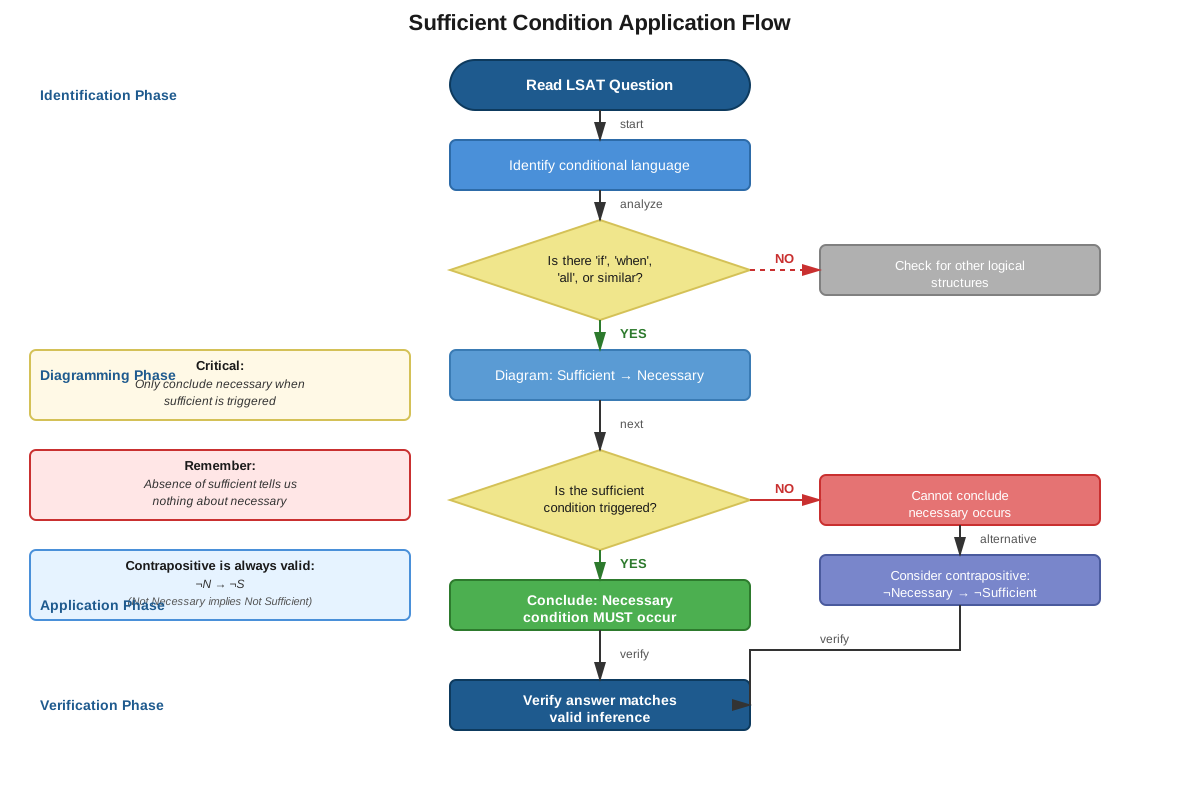
When approaching LSAT questions involving sufficient conditions, begin by scanning for indicator words: "if," "when," "all," "every," "any," and "requires." These signal that conditional logic is in play and that careful diagramming will likely be necessary. Immediately translate these statements into standard notation (SC → NC) to avoid confusion as the argument becomes more complex.
For Must Be True questions: Look for whether a sufficient condition has been triggered in the stimulus. If it has, the necessary condition must be true in the correct answer. Also check whether the contrapositive has been triggered (necessary condition is absent), which means the sufficient condition must be absent.
For Sufficient Assumption questions: The correct answer will provide a sufficient condition that, when combined with the premises, guarantees the conclusion. Diagram the gap between premises and conclusion, then look for an answer that bridges this gap with a conditional statement.
For Flaw questions: Watch for arguments that commit the fallacies of affirming the consequent (assuming that because the necessary condition is present, the sufficient condition must have occurred) or denying the antecedent (assuming that because the sufficient condition is absent, the necessary condition cannot occur).
Process of elimination tips: Eliminate answers that reverse the conditional (converse), that assume a necessary condition is sufficient, or that claim a sufficient condition is necessary. Also eliminate answers that ignore the possibility of multiple sufficient conditions leading to the same necessary condition.
Time-saving tip: Don't diagram every conditional statement in every question. Only diagram when the argument involves multiple conditional statements, conditional chains, or when the question explicitly asks about what must or could be true. For simpler arguments, mentally tracking the sufficient-necessary relationship is faster.
Trigger phrases to watch for: "The only way" (often misinterpreted), "unless" (translates to "if not"), "without" (similar to unless), and "requires" (direction matters—subject requires object means subject → object). These frequently appear in wrong answers designed to trap students who haven't mastered sufficient condition logic.
Allocate approximately 1:20-1:30 for straightforward sufficient condition questions, but budget up to 2:00 for complex conditional chains or Parallel Reasoning questions involving multiple conditional statements. The time invested in accurate diagramming prevents costly errors and often makes the correct answer obvious.
Memory Techniques
Mnemonic for Sufficient vs. Necessary: "Sufficient Starts the Statement" - The sufficient condition typically appears first in standard if-then form and starts the logical chain.
Visualization strategy: Picture the sufficient condition as a "trigger" or "switch" that, when activated, automatically turns on the necessary condition. The necessary condition is like a light that can be turned on by multiple switches (multiple sufficient conditions), but the sufficient condition switch always turns it on.
Acronym for Invalid Operations: RADA - Reversing is Always Definitely Awrong. This reminds you that reversing a conditional (creating the converse) is never valid on the LSAT.
Contrapositive Memory Device: "Negate and Reverse" - To form the contrapositive, Negate both conditions and Reverse their order. The acronym NR can stand for "Necessarily Right" because the contrapositive is always valid.
Indicator Word Grouping: Create mental categories:
- Time triggers: when, whenever, while
- Universal triggers: all, every, any, each
- Conditional triggers: if, provided that, given that
- Requirement triggers: requires, needs, demands
Chain Visualization: Picture conditional chains as dominoes—when the first domino (sufficient condition) falls, it knocks down the next (necessary condition becomes sufficient for the next), creating a cascade effect that reaches the final conclusion.
Summary
Sufficient conditions form the foundation of conditional logic on the LSAT, representing the "trigger" in if-then relationships that guarantee a necessary condition will follow. Mastering sufficient conditions requires recognizing indicator words like "if," "when," "all," and "every," accurately diagramming conditional statements using standard notation (SC → NC), and understanding that while a sufficient condition guarantees its necessary condition, it is not the only way to achieve that outcome. The contrapositive—formed by negating and reversing both conditions—is always logically valid and frequently tested. Students must avoid common fallacies such as affirming the consequent (assuming the necessary condition proves the sufficient condition occurred) and denying the antecedent (assuming the absence of a sufficient condition prevents the necessary condition). Sufficient conditions appear across all Logical Reasoning question types and in approximately 25-30% of questions, making them essential for LSAT success. The ability to quickly identify, diagram, and apply sufficient condition logic, combined with recognizing invalid operations, enables test-takers to navigate complex arguments efficiently and accurately, ultimately leading to higher scores on this critical section of the exam.
Key Takeaways
- A sufficient condition guarantees its necessary condition but is not required for it—multiple paths can lead to the same outcome
- The contrapositive (NOT necessary → NOT sufficient) is always valid and logically equivalent to the original statement
- Reversing a conditional statement creates an invalid argument; only negating and reversing (contrapositive) is valid
- Indicator words like "if," "when," "all," "every," and "any" signal sufficient conditions and require immediate recognition
- The absence of a sufficient condition does NOT prevent the necessary condition from occurring through other means
- Conditional chains allow transitive inference but require careful diagramming to track all implications
- Sufficient conditions appear in approximately 25-30% of LSAT Logical Reasoning questions across multiple question types
Related Topics
Necessary Conditions: The logical complement to sufficient conditions, representing what must be present for something else to occur. Mastering sufficient conditions naturally leads to understanding necessary conditions, as they are two sides of the same conditional relationship.
Formal Logic and Quantifiers: Builds on sufficient condition logic by introducing universal and existential quantifiers ("all," "some," "most," "none") that create more complex logical relationships tested in both Logical Reasoning and Logic Games.
Conditional Chains and Transitive Inference: Extends sufficient condition mastery by linking multiple conditional statements together, enabling multi-step logical reasoning essential for complex LSAT arguments.
Logical Fallacies: Understanding sufficient conditions enables recognition of common fallacies like affirming the consequent, denying the antecedent, and confusing correlation with causation—all frequently tested in Flaw questions.
Sufficient Assumption Questions: A specific question type that directly applies sufficient condition logic by asking test-takers to identify what condition would guarantee a conclusion, representing one of the highest-yield applications of this concept.
Practice CTA
Now that you have mastered the core concepts of sufficient conditions, it's time to cement your understanding through active practice. Attempt the practice questions and flashcards designed specifically for this topic—they will challenge you to apply sufficient condition logic in realistic LSAT contexts and help you identify any remaining gaps in your understanding. Remember, recognizing sufficient conditions quickly and accurately is a skill that improves dramatically with deliberate practice. Each question you work through strengthens your pattern recognition and builds the automaticity you need to excel on test day. You've built a strong foundation—now transform that knowledge into points through consistent, focused practice!
Sign up free to keep reading
Create a free AnvayaPrep account to finish this LSAT guide on Sufficient condition — plus flashcards and practice questions.