Overview
The unless equation is one of the most powerful and frequently tested tools in LSAT Logical Reasoning. This translation rule provides a systematic method for converting "unless" statements into standard conditional logic format, enabling test-takers to analyze arguments with precision and speed. Understanding the unless equation is not merely helpful—it is essential for achieving a competitive score on the LSAT, as "unless" appears regularly across Logical Reasoning questions, particularly in Must Be True, Sufficient Assumption, and Necessary Assumption question types.
The unless equation operates on a fundamental principle: the word "unless" introduces a necessary condition while simultaneously negating the sufficient condition. This creates a specific logical relationship that, once mastered, can be translated mechanically and reliably. Many students initially struggle with "unless" statements because everyday language usage doesn't always align with formal logical structure. However, the LSAT unless equation provides a formulaic approach that eliminates ambiguity and ensures consistent accuracy.
Within the broader framework of conditional logic, the unless equation serves as a bridge between natural language and formal logical notation. It connects directly to core concepts like sufficient and necessary conditions, contrapositive formation, and logical equivalence. Mastering this topic strengthens overall conditional reasoning skills and provides a foundation for tackling complex argument structures that combine multiple conditional relationships. The unless equation exemplifies how the LSAT tests not just reasoning ability, but also the capacity to translate complex linguistic structures into analyzable logical forms.
Learning Objectives
- [ ] Identify how Unless equation appears in LSAT questions
- [ ] Explain the reasoning pattern behind Unless equation
- [ ] Apply Unless equation to solve LSAT-style problems accurately
- [ ] Translate "unless" statements into standard conditional notation within 10 seconds
- [ ] Recognize equivalent formulations of "unless" statements (e.g., "except if," "without")
- [ ] Combine unless equations with other conditional statements to form logical chains
- [ ] Identify when answer choices contain disguised "unless" relationships
Prerequisites
- Basic conditional logic structure (If A, then B): The unless equation builds directly on understanding sufficient and necessary conditions, as it creates a specific type of conditional relationship.
- Negation principles: Translating "unless" requires negating one component of the statement, making comfort with logical negation essential.
- Contrapositive formation: The unless equation often requires forming contrapositives to connect with other conditional statements in arguments.
- Symbolic notation for logic: Familiarity with representing statements as variables (A, B, C) and using arrows (→) or other notation systems accelerates translation speed.
Why This Topic Matters
The unless equation appears with remarkable frequency on the LSAT, showing up in approximately 15-20% of all Logical Reasoning questions across both sections. This high appearance rate makes it one of the most valuable single skills a test-taker can develop. Questions featuring "unless" span virtually every Logical Reasoning question type, though they appear most commonly in Must Be True, Sufficient Assumption, Necessary Assumption, and Parallel Reasoning questions. The ability to quickly and accurately translate "unless" statements often determines whether a student can complete Logical Reasoning sections within the time limit while maintaining accuracy.
Beyond exam performance, understanding the unless equation develops critical thinking skills applicable to legal reasoning, contract interpretation, and policy analysis—all central to law school and legal practice. Legal documents frequently employ "unless" to establish exceptions, conditions, and limitations. The precision required to correctly interpret these statements mirrors the analytical rigor expected in legal education and professional practice.
On the LSAT specifically, "unless" statements appear in several distinct contexts: as premises within stimulus arguments, as components of answer choices in assumption questions, and as structural elements in formal logic games (though less frequently in recent LSAT administrations). The test writers deliberately use "unless" because it creates cognitive load—students who haven't mastered the mechanical translation process waste precious time and mental energy parsing these statements, while prepared students translate them instantly and move forward with confidence.
Core Concepts
The Unless Equation Formula
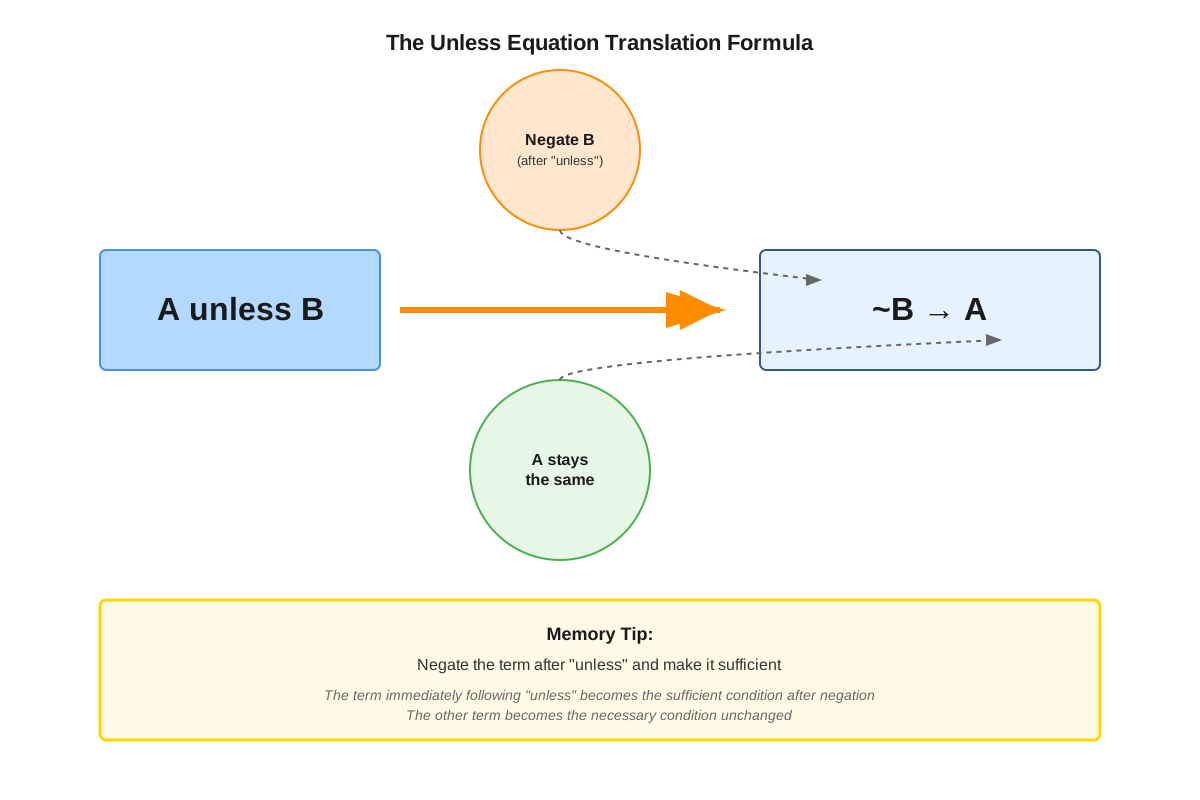
The unless equation follows a precise, mechanical formula that works in every instance. The standard form is:
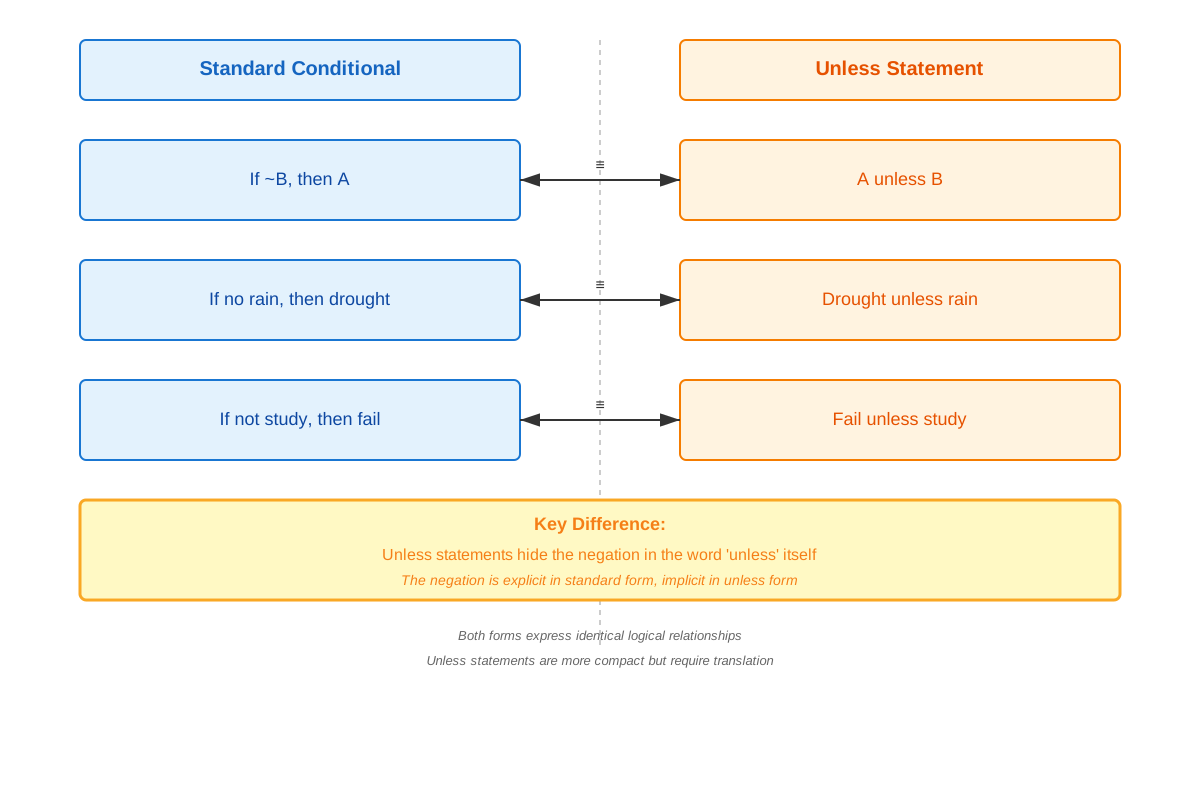
A unless B = If not B, then A (symbolically: ~B → A)
Alternatively stated: A unless B = If not A, then B (symbolically: ~A → B)
Both formulations are logically equivalent through contrapositive relationships. The key insight is that "unless" introduces a necessary condition (B) while the other component (A) becomes the necessary condition when we negate what follows "unless."
The most reliable translation method follows these steps:
- Identify the two components of the statement (what comes before "unless" and what comes after)
- Negate the component that follows "unless"
- Make the negated component the sufficient condition (the "if" part)
- Make the component before "unless" the necessary condition (the "then" part)
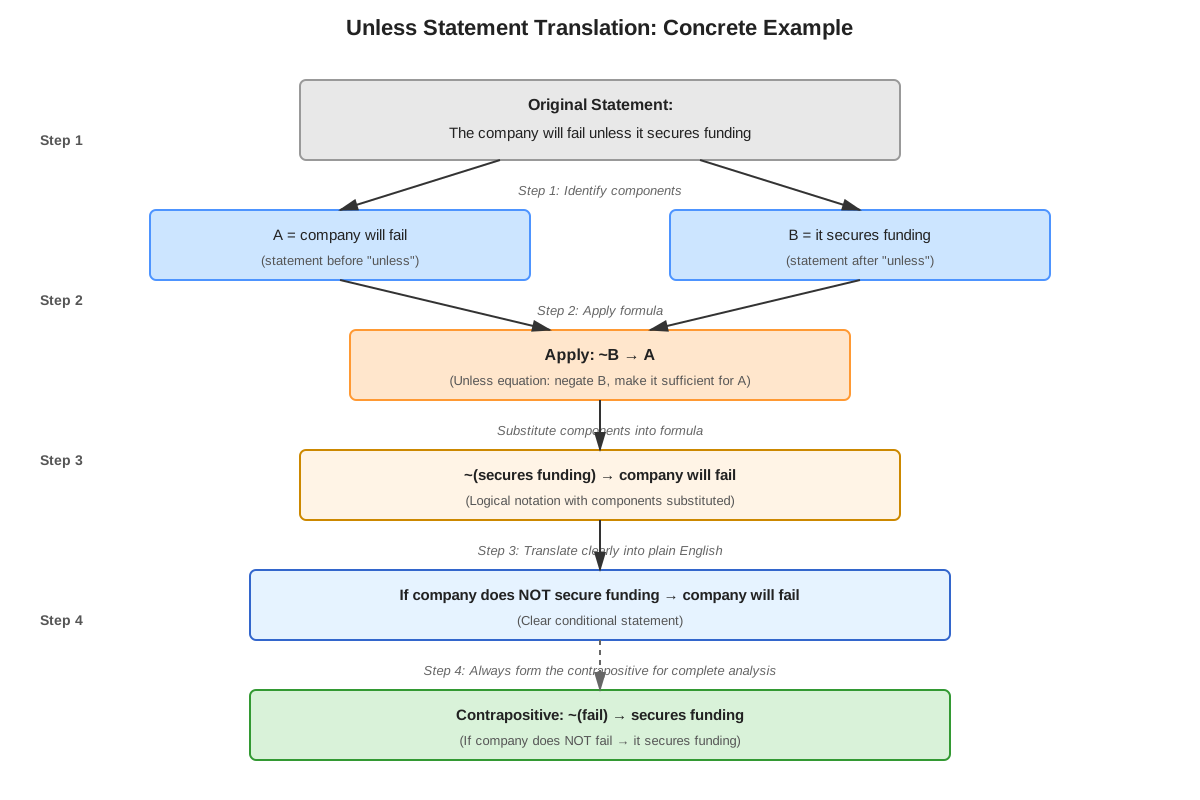
For example: "The company will fail unless it secures funding."
- Component before "unless": The company will fail (F)
- Component after "unless": It secures funding (S)
- Negate what follows "unless": NOT secure funding (~S)
- Translation: If the company does NOT secure funding, then it will fail (~S → F)
- Contrapositive: If the company does NOT fail, then it secured funding (~F → S)
Why the Unless Equation Works
The logical foundation of the unless equation rests on the concept of necessary conditions. When we say "A unless B," we're establishing that B is necessary to prevent A. In other words, B is the only thing that can stop A from occurring. This creates a logical relationship where the absence of B guarantees A will occur.
Consider the statement: "The plant will die unless you water it." This means watering is necessary to prevent death. If you don't water it (the necessary condition is absent), death is guaranteed. This translates to: If you don't water it, then it will die (~W → D).
The unless equation captures this relationship by recognizing that "unless" functions as a conditional indicator with built-in negation. Unlike straightforward "if...then" statements, "unless" simultaneously establishes a conditional relationship AND negates one component.
Common Unless Variations
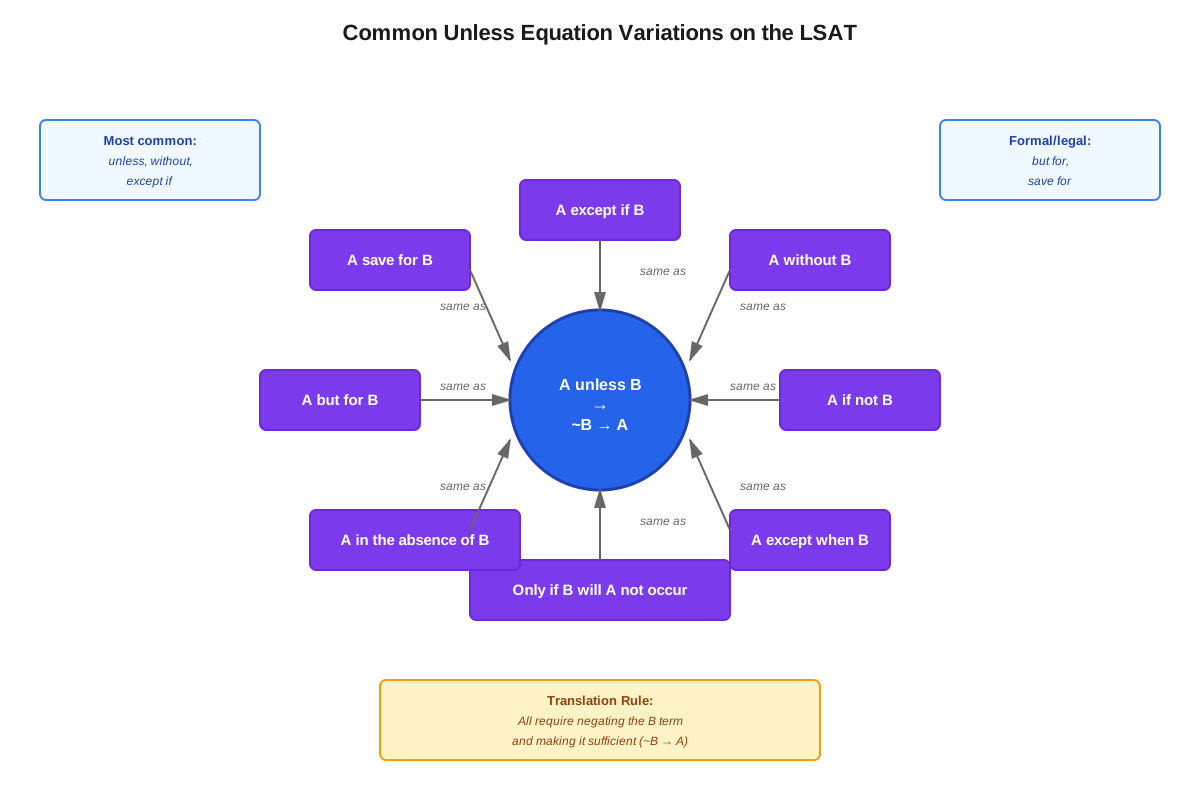
The LSAT presents "unless" in various linguistic forms, all of which follow the same translation pattern:
| Phrase | Example | Translation |
|---|---|---|
| Unless | "A unless B" | ~B → A |
| Without | "A without B" | ~B → A |
| Except if | "A except if B" | ~B → A |
| Until | "A until B" | ~B → A |
| Except when | "A except when B" | ~B → A |
Each variation means the same thing logically: the component following the indicator word is necessary to prevent the first component from occurring.
Negation in Unless Statements
Proper negation is critical for accurate unless equation translation. When negating components, remember:
- "All" becomes "not all" or "some are not"
- "Some" becomes "none"
- "None" becomes "at least one" or "some"
- "Always" becomes "not always" or "sometimes not"
- "Never" becomes "at least once" or "sometimes"
For complex statements, negate the entire proposition, not just individual words. "The committee will approve the proposal unless it violates regulations" translates to: If it does NOT violate regulations is false (meaning it DOES violate regulations), then the committee will NOT approve it. Wait—this requires careful attention. Let's reconsider: "The committee will approve unless it violates" means approval happens except when violations occur. So: If it violates regulations, then the committee will NOT approve (~V → ~A is incorrect).
Actually: "Approve unless violates" = If NOT violates, then... No. Let's use the formula precisely:
- Before "unless": approve (A)
- After "unless": violates (V)
- Negate after: NOT violates (~V)
- Formula: ~V → A (If it doesn't violate, then approve)
- Contrapositive: ~A → V (If not approved, then it violated)
This demonstrates why mechanical application of the formula prevents errors.
Combining Unless Equations with Other Conditionals
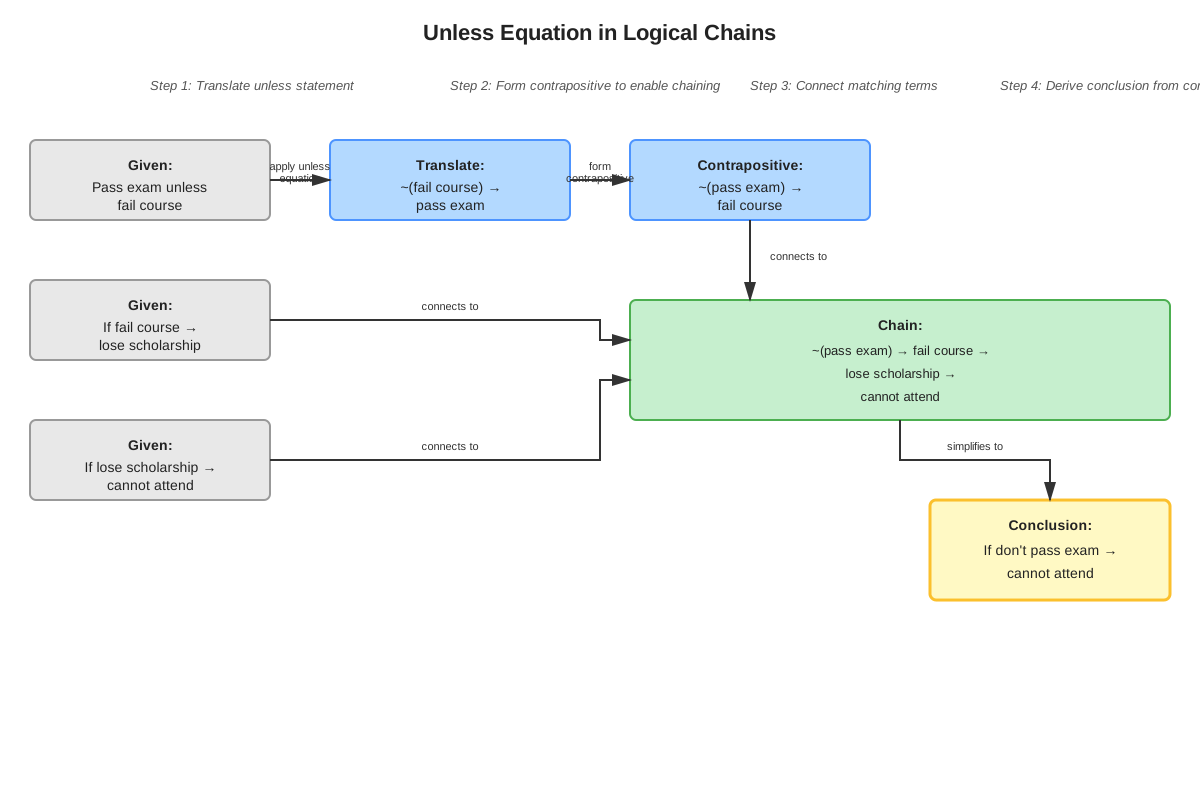
LSAT questions frequently require connecting unless equations with other conditional statements to form logical chains. Consider:
"The project succeeds unless funding is cut. If the project succeeds, the company expands."
Translation:
- "Succeeds unless funding cut": ~Cut → Succeed (If funding NOT cut, then succeed)
- "If succeed, then expand": Succeed → Expand
Chain: ~Cut → Succeed → Expand
Therefore: If funding is not cut, the company expands (~Cut → Expand)
Contrapositive: If company doesn't expand, funding was cut (~Expand → Cut)
This chaining ability makes unless equations particularly powerful in Sufficient Assumption questions, where the correct answer often provides a conditional link that completes a logical chain.
Concept Relationships
The unless equation sits at the intersection of several fundamental logical reasoning concepts. It directly applies conditional logic principles, specifically the relationship between sufficient and necessary conditions. Every unless statement creates a conditional relationship, making it a specialized application of broader conditional reasoning skills.
The unless equation connects to contrapositive formation because every translated unless statement has a contrapositive that's equally valid and often more useful for solving problems. When an unless equation is translated (~B → A), its contrapositive (~A → B) provides an alternative pathway for logical reasoning.
Negation is embedded within the unless equation, as the translation process requires negating the component following "unless." This makes unless statements more complex than simple "if...then" constructions and explains why they create cognitive difficulty for unprepared test-takers.
The relationship map flows as follows:
Basic Conditional Logic → Unless Equation → Contrapositive Formation → Logical Chains → Complex Argument Analysis
Additionally, unless equations connect to formal logic concepts tested in some Logical Reasoning questions and historically in Logic Games. They also relate to necessary assumption identification, as recognizing necessary conditions is central to both unless translation and necessary assumption questions.
High-Yield Facts
⭐ The unless equation formula is: A unless B = ~B → A (If not B, then A)
⭐ "Unless" always introduces a necessary condition—the thing that prevents the other component from occurring
⭐ The component following "unless" must be negated when translating to standard conditional form
⭐ "Without," "except if," "except when," and "until" all translate identically to "unless"
⭐ Every unless equation has a contrapositive: ~B → A becomes ~A → B
- Unless statements appear in approximately 15-20% of Logical Reasoning questions across both sections
- The unless equation works mechanically in 100% of cases—no exceptions or special circumstances
- Translating "unless" incorrectly is one of the top five most common errors on LSAT Logical Reasoning sections
- Unless equations frequently appear in Sufficient Assumption questions as part of the correct answer
- The negation step is where most translation errors occur—always negate the component after "unless"
- Unless statements can be chained with other conditionals to form extended logical sequences
- Answer choices may contain unless relationships even when the stimulus doesn't, and vice versa
- Time spent mastering unless translation reduces overall Logical Reasoning section time by 2-3 minutes on average
- Unless equations appear more frequently in recent LSAT administrations than in tests from before 2015
- Recognizing unless equivalents ("without," "except if") requires the same translation process
Quick check — test yourself on Unless equation so far.
Try Flashcards →Common Misconceptions
Misconception: "Unless" means the same as "if."
Correction: "Unless" is not equivalent to "if." While both create conditional relationships, "unless" includes built-in negation. "A unless B" means "If NOT B, then A," not "If B, then A." The negation is essential and non-negotiable.
Misconception: You should negate the component that comes before "unless."
Correction: Always negate the component that follows "unless," not what comes before it. The formula is A unless B = ~B → A. The component after "unless" (B) gets negated to become the sufficient condition (~B).
Misconception: "Unless" and "until" mean different things logically.
Correction: For LSAT purposes, "unless" and "until" translate identically. "The alarm sounds until you enter the code" means the same as "The alarm sounds unless you enter the code"—both translate to: If you don't enter the code, the alarm sounds.
Misconception: You can choose which component to negate based on what makes intuitive sense.
Correction: The translation is mechanical and invariable. You must negate the component following "unless" regardless of whether the result seems intuitive. Intuition often misleads with unless statements, which is precisely why the LSAT tests them.
Misconception: If a statement contains "not" or "never," you don't need to negate it further when it follows "unless."
Correction: You must still apply the negation step even when the component following "unless" is already negative. "A unless not B" translates to "If NOT (not B), then A," which simplifies to "If B, then A." The double negative resolves to a positive, but you must work through the negation step.
Misconception: The unless equation only matters for formal logic questions.
Correction: Unless statements appear across all Logical Reasoning question types, including Strengthen, Weaken, Flaw, Paradox, and Main Point questions. The translation skill applies universally, not just to formal logic contexts.
Misconception: You need to memorize different formulas for "unless," "without," "except if," etc.
Correction: All unless equivalents use the identical translation formula. Memorize one formula and apply it to all variations. This reduces cognitive load and prevents confusion.
Worked Examples
Example 1: Must Be True Question
Stimulus: "The museum will acquire the painting unless another institution outbids them. If the museum acquires the painting, it will feature it in next year's exhibition. The museum will not feature the painting in next year's exhibition."
Question: Which of the following must be true?
Step 1: Translate the unless statement.
- "Acquire unless outbid"
- Component before "unless": acquire (A)
- Component after "unless": outbid (O)
- Translation: ~O → A (If not outbid, then acquire)
- Contrapositive: ~A → O (If not acquire, then outbid)
Step 2: Identify other conditionals.
- "If acquire, then feature": A → F
- Given fact: "Not feature": ~F
Step 3: Work backwards from the given fact.
- We know: ~F
- From A → F, the contrapositive is ~F → ~A
- Therefore: ~A (the museum did not acquire)
Step 4: Apply the unless equation contrapositive.
- We established: ~A
- From ~A → O (contrapositive of our unless translation)
- Therefore: O (another institution outbid them)
Answer: Another institution outbid the museum. This must be true based on the logical chain: ~F → ~A → O.
Connection to Learning Objectives: This example demonstrates identifying unless equations in LSAT questions, explaining the reasoning pattern (working through contrapositives and chains), and applying the equation to solve problems accurately.
Example 2: Sufficient Assumption Question
Stimulus: "The company will expand into international markets unless regulatory barriers prove insurmountable. Therefore, the company will hire multilingual staff."
Question: Which of the following, if assumed, allows the conclusion to be properly drawn?
Step 1: Translate the unless statement.
- "Expand unless barriers insurmountable"
- Translation: ~Insurmountable → Expand (~I → E)
- Contrapositive: ~E → I
Step 2: Identify the gap.
- Premise gives us: ~I → E
- Conclusion states: Hire multilingual staff (H)
- Gap: We need to connect E to H
Step 3: Determine the sufficient assumption.
- We need: E → H (If expand, then hire multilingual staff)
- This would create the chain: ~I → E → H
- Therefore: ~I → H (If barriers not insurmountable, then hire multilingual staff)
Step 4: Evaluate answer choices.
- Correct answer will state: "If the company expands into international markets, it will hire multilingual staff" or an equivalent formulation.
Answer: The correct answer provides E → H, completing the logical chain from the unless equation to the conclusion.
Connection to Learning Objectives: This example shows how unless equations appear in assumption questions, demonstrates the reasoning pattern of identifying logical gaps, and applies the translation to determine what assumption makes the argument valid.
Exam Strategy
When approaching LSAT questions containing "unless" statements, follow this systematic process:
Immediate Recognition: Train yourself to immediately flag "unless" and its equivalents ("without," "except if," "until") when reading stimuli. These words should trigger automatic translation mode. Underline or circle them during your first read-through.
Mechanical Translation: Apply the formula without trying to "understand" the statement intuitively first. Write out the translation in shorthand: identify components, negate what follows "unless," construct the conditional. This takes 5-10 seconds and prevents errors that cost 30+ seconds to untangle later.
Contrapositive Awareness: Immediately note the contrapositive of your translation. Often, the contrapositive is more useful than the original translation for connecting with other statements or evaluating answer choices. Write both forms: ~B → A and ~A → B.
Integration with Other Statements: Look for opportunities to chain the unless equation with other conditionals in the stimulus. The LSAT frequently tests whether you can connect multiple conditional statements, and unless equations are often one link in a longer chain.
Answer Choice Evaluation: In Must Be True questions, the correct answer often follows from the contrapositive of an unless equation rather than the direct translation. In Assumption questions, look for answer choices that complete a chain involving the unless equation. In Parallel Reasoning questions, ensure the answer choice contains the same logical structure, not just the word "unless."
Time Management: Spend the time to translate unless statements correctly on your first pass. Attempting to work with untranslated unless statements leads to confusion, re-reading, and errors. The 10 seconds spent on proper translation saves 30-60 seconds of confusion and prevents wrong answers.
Trigger Phrases to Watch:
- "The only way to prevent X is Y" (translates similarly to unless)
- "X cannot occur if Y" (related conditional structure)
- "X will happen except when Y" (unless equivalent)
- "Without Y, X occurs" (unless equivalent)
Process of Elimination: Eliminate answer choices that reverse the conditional relationship or fail to negate properly. If the stimulus says "A unless B" (~B → A), eliminate answers suggesting B → A or ~A → ~B, as these represent common translation errors.
Memory Techniques
The "Negate and Flip" Mnemonic: Remember "unless" as "Negate what follows, Flip to the front." The component after "unless" gets negated and becomes the sufficient condition (the "if" part), while the component before "unless" becomes the necessary condition (the "then" part).
The Prevention Principle: Think of "unless" as introducing "the thing that prevents." "A unless B" means B prevents A. If B doesn't happen (prevention fails), then A occurs. This conceptual understanding reinforces the mechanical translation.
The UNLESS Acronym:
- Underline the word "unless"
- Negate what follows it
- Link it as the sufficient condition
- Establish the other component as necessary
- State the contrapositive
- Solve using the complete conditional
Visual Representation: Picture "unless" as a gate. The component after "unless" is the gate that, when closed (negated/absent), allows the first component to flow through. This visualization helps remember that negating what follows "unless" triggers the other component.
The "Without" Substitution: When you see "unless," mentally substitute "without" to check your translation. "A unless B" = "A without B" = "If without B (not B), then A." This substitution often makes the logical relationship clearer.
Finger Counting Method: Use your fingers to track the translation steps: (1) identify components, (2) negate what follows "unless," (3) make negated component sufficient, (4) make other component necessary, (5) state contrapositive. This kinesthetic reinforcement helps during high-pressure testing.
Summary
The unless equation is a high-yield, mechanical translation tool that converts "unless" statements into standard conditional logic format. The formula—A unless B = ~B → A—works invariably and must be applied precisely, with particular attention to negating the component that follows "unless." This translation skill appears across 15-20% of Logical Reasoning questions and is essential for competitive LSAT performance. The unless equation connects directly to broader conditional logic concepts, including contrapositive formation and logical chaining. Mastery requires understanding both the mechanical translation process and the underlying logical principle: "unless" introduces a necessary condition that prevents the other component from occurring. Students who master this topic gain significant advantages in speed, accuracy, and confidence across multiple Logical Reasoning question types, particularly Must Be True, Sufficient Assumption, and Necessary Assumption questions.
Key Takeaways
- The unless equation formula is invariable: A unless B = ~B → A (if not B, then A)
- Always negate the component following "unless" when translating to conditional form
- "Unless," "without," "except if," "until," and "except when" all translate identically
- Every unless equation has a contrapositive that's equally valid and often more useful for problem-solving
- Unless statements frequently chain with other conditionals to form extended logical sequences
- Mechanical application of the formula prevents errors and saves time under test conditions
- Unless equations appear in approximately 15-20% of Logical Reasoning questions across all question types
Related Topics
Sufficient and Necessary Conditions: Understanding the distinction between sufficient and necessary conditions deepens comprehension of why the unless equation works and how to apply it in complex scenarios. This foundational topic enables more sophisticated conditional reasoning.
Contrapositive Formation: Mastering contrapositives allows test-takers to recognize equivalent logical statements and find alternative solution pathways. The unless equation always generates a contrapositive that may be more useful than the direct translation.
Conditional Logic Chains: Building on unless equation mastery, students can learn to connect multiple conditional statements into extended logical sequences, a skill tested heavily in complex Logical Reasoning questions and Logic Games.
Formal Logic in Logical Reasoning: Some Logical Reasoning questions present formal logic scenarios with multiple conditional statements, quantifiers, and complex relationships. The unless equation is one tool within this broader analytical framework.
Necessary Assumption Questions: These questions require identifying what must be true for an argument to work, closely paralleling the necessary condition identification inherent in unless equation translation.
Practice CTA
Now that you've mastered the unless equation, it's time to cement your understanding through active practice. Attempt the practice questions associated with this topic, focusing on applying the mechanical translation process under timed conditions. Use the flashcards to drill the formula until translation becomes automatic—aim for consistent accuracy within 10 seconds per statement. Remember, the unless equation is one of the highest-yield skills you can develop for LSAT Logical Reasoning. Every minute spent practicing this translation pays dividends across multiple question types and significantly improves your overall section performance. You've learned the system; now make it automatic through deliberate practice.
Sign up free to keep reading
Create a free AnvayaPrep account to finish this LSAT guide on Unless equation — plus flashcards and practice questions.