Overview
Unless statements represent one of the most frequently tested and strategically important elements of conditional logic on the LSAT. These statements appear throughout the Logical Reasoning section and occasionally in Logic Games, making them essential for achieving a competitive score. An "unless" statement creates a conditional relationship between two propositions, but in a way that often confuses test-takers because the logical structure differs from more straightforward "if-then" conditionals.
Understanding LSAT unless statements requires recognizing that "unless" functions as a logical operator that establishes a necessary condition while simultaneously negating the sufficient condition. This dual operation makes unless statements particularly challenging: they simultaneously tell you what must happen to prevent something else from occurring. For example, "You will fail unless you study" doesn't simply mean "if you don't study, you'll fail"—it establishes studying as the necessary condition that prevents failure. Mastering this translation process is crucial because the LSAT deliberately uses unless statements to test whether students can accurately identify logical relationships under time pressure.
Within the broader framework of logical reasoning, unless statements connect directly to the fundamental architecture of conditional logic that underlies many LSAT question types. They appear in Sufficient Assumption questions, Necessary Assumption questions, Must Be True questions, Flaw questions, and Parallel Reasoning questions. The ability to quickly and accurately translate unless statements into standard conditional form (if-then statements) serves as a foundational skill that supports performance across multiple question types. This topic bridges basic conditional logic understanding with more complex logical operations, making it a critical stepping stone toward LSAT mastery.
Learning Objectives
- [ ] Identify how Unless statements appears in LSAT questions
- [ ] Explain the reasoning pattern behind Unless statements
- [ ] Apply Unless statements to solve LSAT-style problems accurately
- [ ] Translate unless statements into standard conditional notation within 10 seconds
- [ ] Recognize disguised unless statements using equivalent language (e.g., "without," "except," "until")
- [ ] Construct valid contrapositives from unless statements without error
- [ ] Distinguish between unless statements and other conditional indicators in complex passages
Prerequisites
- Basic conditional logic (if-then statements): Understanding standard conditional relationships is essential because unless statements are translated into if-then form for analysis.
- Contrapositive formation: The ability to form contrapositives is necessary because unless statements often require contrapositive reasoning to reach correct answers.
- Logical negation: Recognizing how to properly negate statements is critical since unless statements inherently involve negation in their translation.
- Sufficient and necessary conditions: Distinguishing between these condition types is fundamental because unless statements specifically create necessary conditions.
Why This Topic Matters
Unless statements appear with remarkable frequency on the LSAT, showing up in approximately 15-20% of all Logical Reasoning questions across both sections. This high frequency makes them one of the most valuable patterns to master for score improvement. Test-takers who struggle with unless statements often miss multiple questions per exam, while those who master them gain a significant competitive advantage.
In real-world contexts, unless statements mirror the conditional reasoning used in legal analysis, contract interpretation, and policy evaluation. Attorneys regularly encounter language like "The contract is void unless payment is received within 30 days" or "The defendant is liable unless they can demonstrate reasonable care." The LSAT tests this pattern because it reflects the type of logical reasoning essential to legal practice.
On the exam, unless statements appear in several distinct ways. They may form the core logical structure of a stimulus in Sufficient Assumption questions, where recognizing the unless relationship helps identify the missing logical link. In Necessary Assumption questions, unless statements often appear in answer choices, requiring test-takers to evaluate whether the stated condition is truly necessary. Flaw questions may present arguments that misinterpret unless statements, testing whether students can identify the logical error. Must Be True questions frequently include unless statements in the stimulus, with correct answers following logically from proper translation. The versatility of unless statements across question types makes them a high-yield study focus.
Core Concepts
The Basic Translation Rule
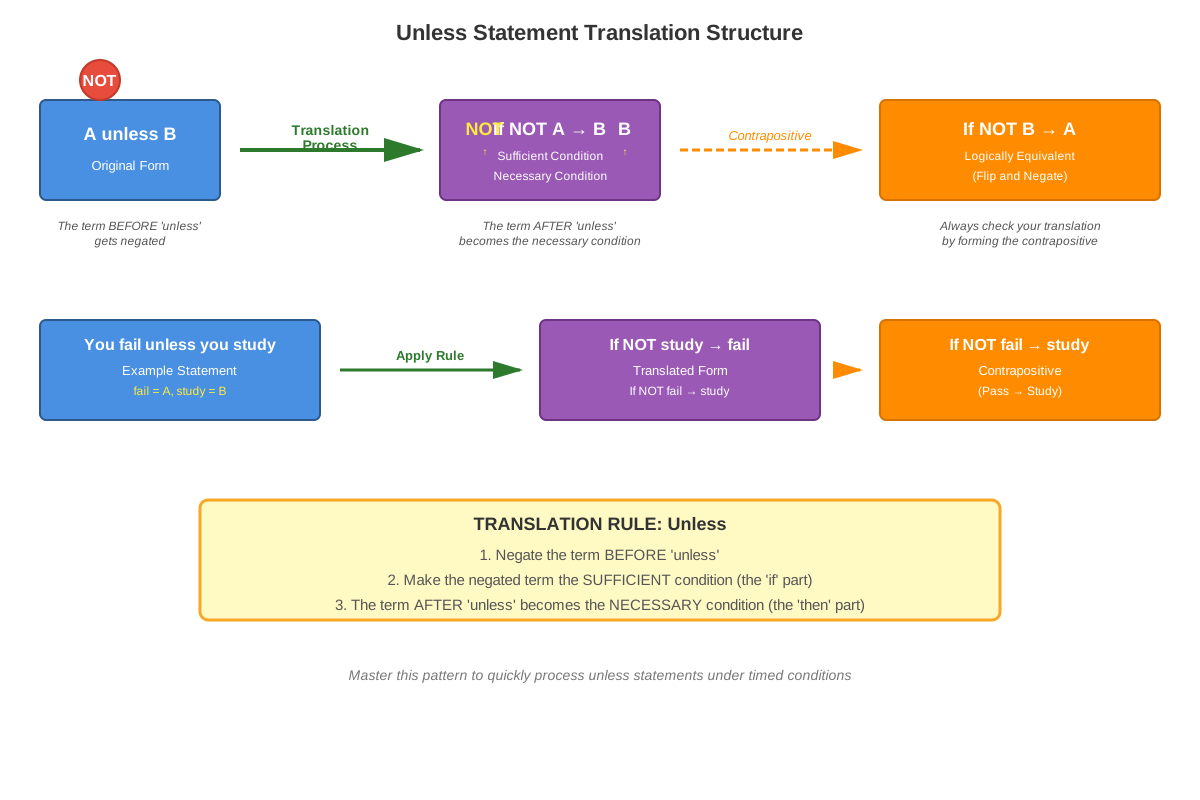
The fundamental principle for handling unless statements is the translation rule: "A unless B" translates to "If not B, then A." This rule has two critical components that must be applied simultaneously. First, the statement following "unless" (B) becomes the sufficient condition in its negated form. Second, the other statement (A) becomes the necessary condition in its original, non-negated form.
Consider the statement: "The company will fail unless it secures funding." Using the translation rule:
- A = "The company will fail"
- B = "It secures funding"
- Translation: "If the company does not secure funding, then it will fail"
- Symbolic notation: ~Funding → Fail
This translation reveals the logical structure: securing funding is the necessary condition that prevents failure. The unless statement establishes what must happen to avoid the negative outcome.
The Necessary Condition Principle
Unless statements always identify necessary conditions—conditions that must be present to prevent something from occurring. This is why the statement following "unless" becomes the necessary condition when translated into standard form. Understanding this principle helps test-takers quickly identify the logical role each component plays.
The necessary condition principle can be visualized through the contrapositive. If "A unless B" means "~B → A," then the contrapositive is "~A → B." This contrapositive reveals that B is necessary for not-A. In our funding example:
- Original: ~Funding → Fail
- Contrapositive: ~Fail → Funding
The contrapositive shows that if the company doesn't fail, it must have secured funding—confirming that funding is necessary to avoid failure.
Alternative Phrasings
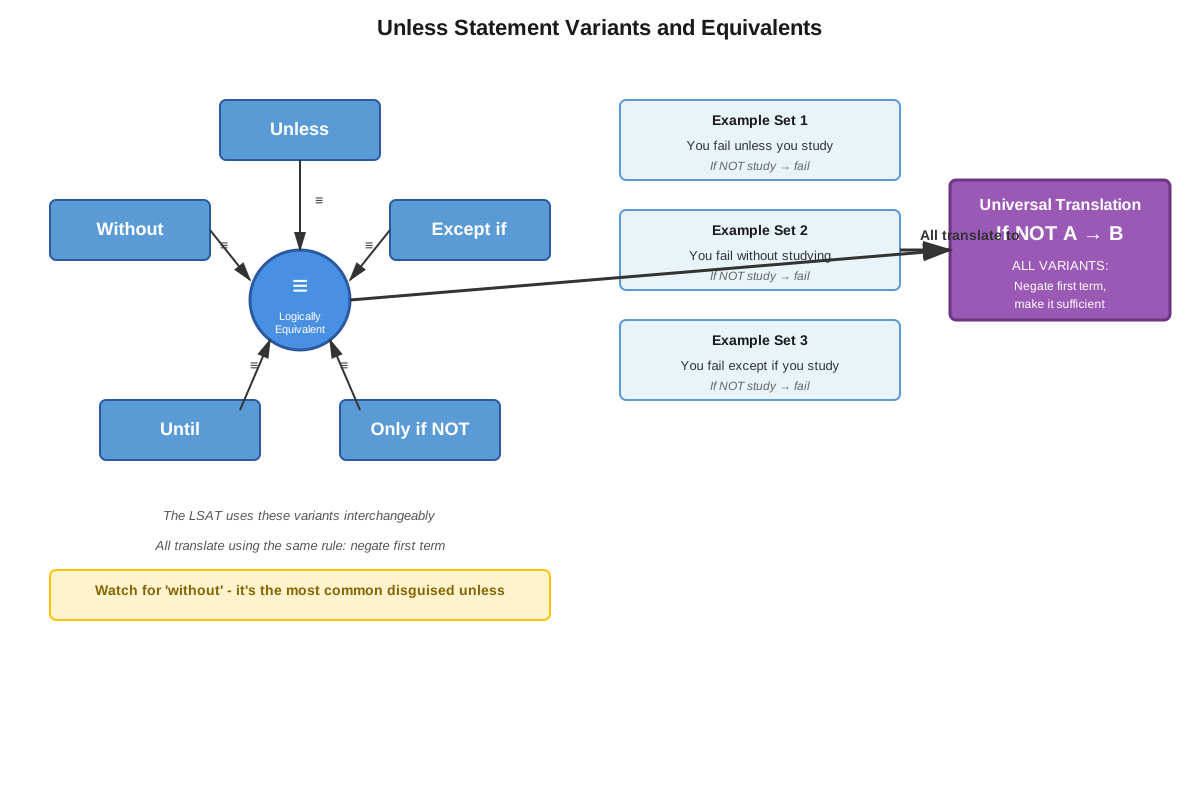
The LSAT frequently disguises unless statements using equivalent language. Recognizing these variations is essential for comprehensive mastery:
| Unless Equivalent | Example | Translation |
|---|---|---|
| Without | "Without rain, crops will die" | ~Rain → Crops die |
| Except if | "The law applies except if consent is given" | ~Consent → Law applies |
| Until | "Stay here until I return" | ~I return → Stay here |
| Only if not | "Succeed only if not distracted" | Distracted → ~Succeed |
Each of these phrasings creates the same logical structure as "unless," though they may appear more natural in certain contexts. The LSAT uses this variety to test whether students truly understand the underlying logical relationship rather than simply memorizing a single keyword.
The Negation Component
A critical aspect of unless statements is understanding what gets negated and what doesn't. The negation component operates according to a strict rule: only the statement following "unless" gets negated when it becomes the sufficient condition. The other statement remains in its original form as the necessary condition.
Common negation errors include:
- Negating both statements
- Negating neither statement
- Negating the wrong statement
- Failing to recognize implicit negations
Consider: "You cannot enter unless you have a ticket." Here, "cannot enter" already contains a negation. The proper translation requires careful attention:
- A = "You cannot enter" (which means ~Enter)
- B = "You have a ticket"
- Translation: "If you do not have a ticket, then you cannot enter"
- Symbolic: ~Ticket → ~Enter
- Contrapositive: Enter → Ticket
Complex Unless Statements
Advanced LSAT questions often embed unless statements within more complex logical structures. These may include:
Multiple unless statements: "The project will fail unless we hire experts, unless we extend the deadline." These require careful parsing to determine whether the conditions are alternatives or sequential requirements.
Unless with compound conditions: "The defendant is guilty unless both witnesses recant and new evidence emerges." Here, the condition following "unless" is compound (both witnesses recant AND new evidence emerges), and this entire compound condition must be negated as a unit.
Nested conditionals with unless: "If the economy improves, unemployment will decrease unless inflation rises." These statements combine standard if-then conditionals with unless statements, requiring multi-step translation.
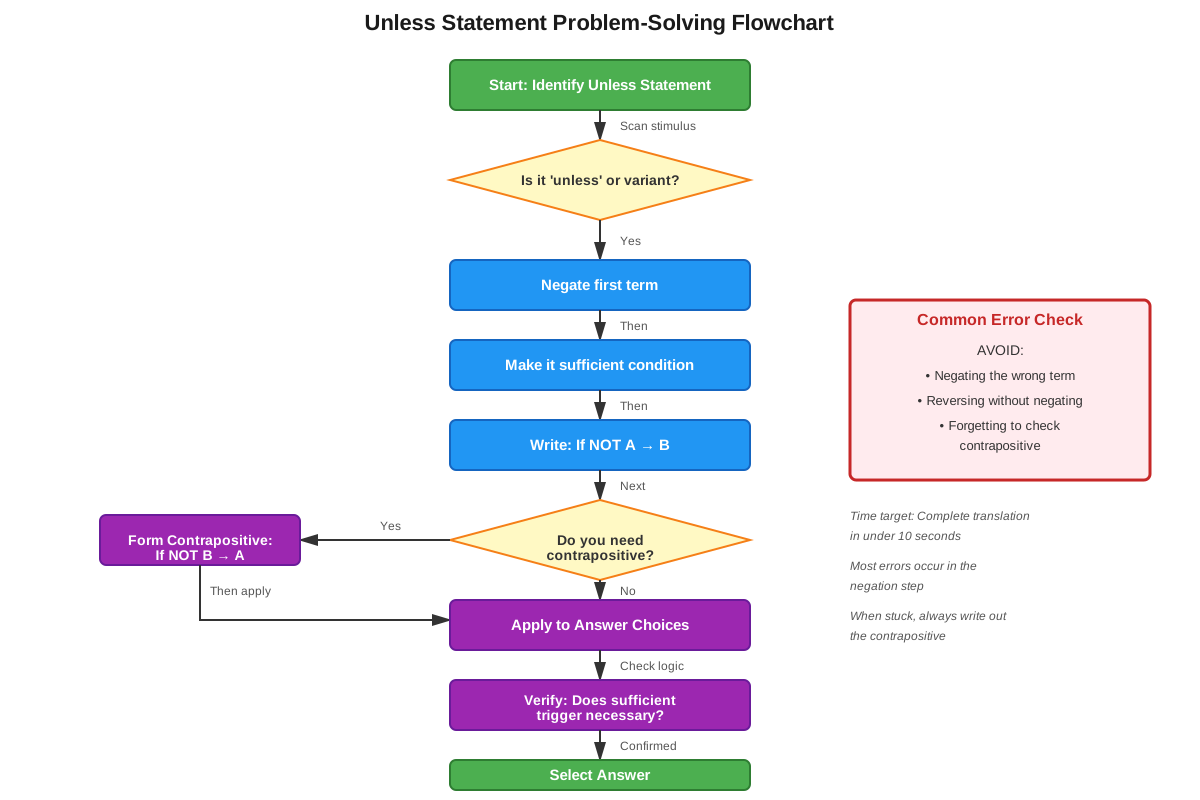
Strategic Translation Process
Mastering unless statements requires a systematic approach:
- Identify the unless statement: Locate "unless" or its equivalents
- Isolate the two propositions: Determine what comes before and after "unless"
- Apply the translation rule: "A unless B" → "If not B, then A"
- Write in symbolic notation: Use arrows and negation symbols for clarity
- Form the contrapositive: This often reveals the answer more directly
- Check your work: Verify that the necessary condition makes logical sense
This process should become automatic with practice, taking no more than 10-15 seconds per statement during the actual exam.
Concept Relationships
Unless statements exist within a hierarchical relationship to broader conditional logic concepts. At the foundation lies basic conditional reasoning (if-then statements), which provides the framework into which unless statements are translated. The translation process connects unless statements directly to standard conditionals, making them essentially a variant expression of the same underlying logical relationship.
The relationship map flows as follows:
Basic Conditional Logic → provides foundation for → Unless Statements → which require → Negation Skills → to properly translate into → Standard If-Then Form → which enables → Contrapositive Formation → leading to → Answer Selection
Unless statements also connect laterally to other conditional indicators like "only if," "provided that," and "when." Understanding how unless differs from these related concepts prevents confusion when multiple conditional indicators appear in the same stimulus. Specifically, "unless" creates a necessary condition from the statement that follows it, while "only if" also creates a necessary condition but without the negation component in the sufficient condition.
The connection to necessary and sufficient conditions is bidirectional. Understanding these concepts helps translate unless statements correctly, while practicing unless statements reinforces the distinction between necessary and sufficient conditions. This reciprocal relationship makes unless statements an excellent vehicle for deepening overall conditional logic mastery.
High-Yield Facts
⭐ "A unless B" always translates to "If not B, then A" — this is the single most important translation rule for the LSAT.
⭐ The statement following "unless" becomes the necessary condition when translated into standard form.
⭐ The statement following "unless" must be negated when it becomes the sufficient condition in the translation.
⭐ Unless statements appear in 15-20% of Logical Reasoning questions, making them one of the highest-yield patterns to master.
⭐ The contrapositive of an unless statement often leads more directly to the correct answer than the original translation.
- "Without," "except if," and "until" function identically to "unless" in logical structure.
- Unless statements can never be translated as "If B, then A" — this reverses the logic entirely.
- Multiple unless statements in a single sentence require separate translation of each conditional relationship.
- The LSAT frequently places unless statements in answer choices for Necessary Assumption questions.
- Misinterpreting unless statements is one of the top three reasons test-takers miss Logical Reasoning questions.
- Unless statements in the contrapositive form reveal what is necessary for the opposite outcome.
- Time pressure causes more errors with unless statements than with any other conditional indicator.
- Unless statements can appear in both the stimulus and answer choices within the same question.
Quick check — test yourself on Unless statements so far.
Try Flashcards →Common Misconceptions
Misconception: "Unless" means the same as "if."
Correction: Unless creates a different logical structure than "if." While "if" directly introduces a sufficient condition, "unless" introduces a necessary condition and requires negating the sufficient condition. "A if B" means "B → A," but "A unless B" means "~B → A."
Misconception: Both parts of an unless statement should be negated in translation.
Correction: Only the statement following "unless" gets negated when it becomes the sufficient condition. The other statement remains in its original form as the necessary condition. Negating both statements creates an entirely different logical relationship.
Misconception: "A unless B" and "B unless A" mean the same thing.
Correction: These statements create opposite logical relationships. "A unless B" translates to "~B → A," while "B unless A" translates to "~A → B." The order matters critically because it determines which statement becomes the necessary condition.
Misconception: Unless statements are rare on the LSAT, so they're not worth extensive study.
Correction: Unless statements appear in approximately 15-20% of Logical Reasoning questions and are tested across multiple question types. They represent one of the highest-yield study topics for score improvement.
Misconception: If you understand the unless statement intuitively, you don't need to translate it formally.
Correction: Under time pressure, intuitive understanding often leads to errors. The LSAT deliberately constructs unless statements to exploit common intuitive misinterpretations. Formal translation using the standard rule provides accuracy and consistency, especially in complex or nested conditional structures.
Misconception: The contrapositive of an unless statement is unnecessary since you already translated the original.
Correction: The contrapositive often reveals the logical relationship more clearly and may match the correct answer choice more directly. Many LSAT questions are designed so that the contrapositive leads to the answer more efficiently than the original translation.
Worked Examples
Example 1: Basic Unless Statement in a Must Be True Question
Stimulus: "The museum will close its Renaissance wing unless it receives a substantial donation within the next month. The museum did not close its Renaissance wing."
Question: Which of the following must be true?
Step 1 - Identify the unless statement: "The museum will close its Renaissance wing unless it receives a substantial donation within the next month."
Step 2 - Translate using the rule:
- A = "The museum will close its Renaissance wing"
- B = "It receives a substantial donation within the next month"
- Translation: "If the museum does not receive a substantial donation within the next month, then it will close its Renaissance wing"
- Symbolic: ~Donation → Close wing
Step 3 - Form the contrapositive:
- Contrapositive: ~Close wing → Donation
- In words: "If the museum does not close its Renaissance wing, then it received a substantial donation within the next month"
Step 4 - Apply to the given information: We're told "The museum did not close its Renaissance wing" (~Close wing).
Step 5 - Draw the conclusion: Using the contrapositive, if ~Close wing, then Donation must have occurred.
Answer: The museum must have received a substantial donation within the next month.
Connection to Learning Objectives: This example demonstrates identifying unless statements in LSAT questions, explaining the reasoning pattern (contrapositive application), and applying the translation to reach the correct answer.
Example 2: Complex Unless Statement in a Sufficient Assumption Question
Stimulus: "The new policy will reduce crime only if it is enforced consistently. However, the policy will not be enforced consistently unless additional officers are hired. Therefore, the new policy will reduce crime."
Question: Which of the following, if assumed, allows the conclusion to be properly drawn?
Step 1 - Identify all conditional statements:
- Statement 1: "The new policy will reduce crime only if it is enforced consistently"
- Translation: Reduce crime → Enforced consistently
- Statement 2: "The policy will not be enforced consistently unless additional officers are hired"
- This is an unless statement with a negation already present
- A = "The policy will not be enforced consistently" (~Enforced consistently)
- B = "Additional officers are hired"
- Translation: ~Hired → ~Enforced consistently
- Contrapositive: Enforced consistently → Hired
Step 2 - Map the logical chain:
- From Statement 1: Reduce crime → Enforced consistently
- From Statement 2 (contrapositive): Enforced consistently → Hired
- Chain: Reduce crime → Enforced consistently → Hired
Step 3 - Identify the gap: The conclusion states "The new policy will reduce crime," but we have no statement that establishes the sufficient condition for this outcome. We need to connect back to "Reduce crime."
Step 4 - Determine the sufficient assumption: To make the conclusion valid, we need: "Additional officers are hired" (Hired) to lead to "The new policy will reduce crime" (Reduce crime).
- Required assumption: Hired → Reduce crime
Step 5 - Verify the complete chain:
- With the assumption: Hired → Reduce crime → Enforced consistently → Hired
- This creates a valid logical chain if we're given that officers are hired
Answer: The correct answer will state that additional officers are hired, or that hiring additional officers will lead to crime reduction.
Connection to Learning Objectives: This example shows how unless statements interact with other conditional logic, requires explaining the complex reasoning pattern involving chains of conditionals, and demonstrates applying unless statement translation to solve a challenging LSAT problem.
Exam Strategy
When approaching LSAT questions involving unless statements, implement this systematic strategy:
Trigger Word Recognition: Immediately flag "unless," "without," "except if," "until," and "only if not" as conditional indicators requiring translation. Circle or underline these words during your first read-through to ensure you don't miss them in complex stimuli.
Immediate Translation Protocol: As soon as you identify an unless statement, translate it into standard if-then form before proceeding. Write the symbolic notation in the margin: "~B → A." This prevents errors that occur when trying to work with the unless statement in its original form. The 10-15 seconds spent on translation saves time by preventing confusion later.
Contrapositive Formation: Always form the contrapositive immediately after translation. Write both the original translation and the contrapositive in your notation. Many LSAT questions are designed so that the contrapositive leads to the answer more directly. Having both forms visible prevents the need to re-derive the contrapositive under time pressure.
Process of Elimination Approach: In answer choices, eliminate any option that:
- Reverses the sufficient and necessary conditions
- Fails to negate the statement following "unless"
- Treats "unless" as equivalent to "if"
- Confuses the unless statement with its contrapositive
Question Type Specific Strategies:
For Sufficient Assumption questions: Look for answer choices that complete a conditional chain involving the unless statement. The correct answer often provides the missing link between the unless statement and the conclusion.
For Necessary Assumption questions: Test answer choices using the negation technique. The correct answer, when negated, should break the logical connection established by the unless statement.
For Must Be True questions: Apply the contrapositive of the unless statement to any additional information provided. The correct answer typically follows from this application.
For Flaw questions: Watch for arguments that misinterpret unless statements by treating them as "if" statements or by failing to recognize the necessary condition.
Time Management: Allocate 30-45 seconds for questions with straightforward unless statements, and up to 90 seconds for questions with multiple or nested unless statements. If a question involves complex unless statements and you're behind on time, mark it for review and move on—these questions reward accuracy over speed.
Common Trap Patterns: The LSAT frequently includes wrong answer choices that:
- Present the correct translation but in reverse (making the necessary condition sufficient)
- Provide the original statement without the required negation
- Offer the contrapositive when the original translation is needed (or vice versa)
- Include the correct elements but with incorrect logical connectors
Memory Techniques
The "UN-LESS" Mnemonic: Remember that "unless" means "if UN-" (if not). The "UN" prefix signals negation. "A unless B" = "If UN-B (not B), then A."
The Rescue Visualization: Picture "unless" as a rescue scenario. "The ship will sink unless help arrives" means help arriving is the rescue that prevents sinking. The thing after "unless" is always the rescue (necessary condition) that prevents the negative outcome. Visualize the rescue arriving just in time—that's your necessary condition.
The NUNS Acronym:
- Negate the statement following unless
- Use it as the sufficient condition
- Necessary condition is the other statement
- Symbolic notation: ~B → A
The Translation Chant: Create a rhythmic pattern: "Unless means if not, then the other part. What follows unless gets the not, what comes before stays as it starts." Repeat this pattern while practicing until it becomes automatic.
The Finger Method: Use your fingers to track the translation physically:
- Left hand = statement before "unless"
- Right hand = statement after "unless"
- When translating, flip your right hand over (representing negation) and point it at your left hand (representing the arrow)
- This kinesthetic method helps cement the translation pattern
The Contrapositive Flip: Visualize the contrapositive as a mirror image. If the original translation is "~B → A," imagine flipping it horizontally in a mirror: "~A → B." The negations switch sides, and the arrow reverses direction.
Summary
Unless statements represent a critical pattern in LSAT conditional logic, appearing in approximately 15-20% of Logical Reasoning questions across multiple question types. The fundamental translation rule—"A unless B" means "If not B, then A"—must become automatic for test-day success. This translation involves two simultaneous operations: negating the statement following "unless" to create the sufficient condition, and using the other statement as the necessary condition in its original form. The statement following "unless" always identifies what is necessary to prevent the other outcome from occurring. Mastery requires recognizing not only "unless" itself but also equivalent phrasings like "without," "except if," and "until." The contrapositive of an unless statement often provides the most direct path to the correct answer, making contrapositive formation an essential companion skill. Common errors include treating "unless" as equivalent to "if," negating both statements or neither statement, and reversing the sufficient and necessary conditions. Success with unless statements demands systematic translation, symbolic notation, and consistent practice until the pattern becomes reflexive. This skill serves as a foundation for handling complex conditional logic throughout the LSAT and represents one of the highest-yield areas for score improvement.
Key Takeaways
- "A unless B" always translates to "If not B, then A" — memorize and apply this rule without exception
- The statement following "unless" becomes the necessary condition and must be negated when forming the sufficient condition
- Always form the contrapositive (~A → B) immediately after translation, as it often leads directly to the correct answer
- Unless statements appear in 15-20% of Logical Reasoning questions, making them essential for competitive scoring
- Equivalent phrasings like "without," "except if," and "until" function identically to "unless" in logical structure
- Systematic translation prevents errors under time pressure—never rely on intuitive interpretation alone
- Practice until translation becomes automatic, taking no more than 10-15 seconds per unless statement
Related Topics
Sufficient and Necessary Conditions: Deepening understanding of the distinction between sufficient and necessary conditions enhances unless statement mastery and supports analysis of all conditional logic on the LSAT.
Conditional Chains: Learning to connect multiple conditional statements in sequence builds on unless statement skills and is essential for complex Logical Reasoning questions.
Formal Logic in Logic Games: Unless statements appear in Logic Games rule sets, and mastering them in Logical Reasoning transfers directly to improved Logic Games performance.
Negation Techniques: Advanced negation skills, including negating compound statements and quantified statements, extend the foundation built through unless statement practice.
Argument Structure Analysis: Understanding how unless statements function within complete arguments prepares students for Strengthen, Weaken, and Assumption question families.
Practice CTA
Now that you've mastered the core concepts of unless statements, it's time to cement your understanding through active practice. Attempt the practice questions associated with this topic, focusing on applying the systematic translation process under timed conditions. Use the flashcards to drill the translation rule until it becomes reflexive—your goal is to translate any unless statement accurately within 10 seconds. Remember that unless statements represent one of the highest-yield study areas on the LSAT: mastering this single pattern can directly improve your score on 3-4 questions per exam. Every practice question you complete builds the automaticity that will serve you under test-day pressure. You've learned the system—now make it yours through deliberate practice.
Sign up free to keep reading
Create a free AnvayaPrep account to finish this LSAT guide on Unless statements — plus flashcards and practice questions.