Overview
Fill in the blank questions represent a distinctive and high-stakes question type within the LSAT's Logical Reasoning sections. These questions present an argument with a missing component—typically the conclusion, but occasionally a premise—and ask test-takers to identify which answer choice best completes the logical structure. Unlike other question types that ask you to evaluate, strengthen, or weaken an existing complete argument, fill in the blank questions require you to actively construct the logical endpoint or missing link of the reasoning chain.
These questions test your ability to recognize logical patterns, understand argument structure, and predict conclusions based on given premises. They appear frequently enough on the LSAT (typically 2-4 questions per test) to warrant dedicated preparation, and they offer a unique advantage: when approached systematically, they can be among the most predictable question types. The correct answer must flow inevitably from the premises provided, creating a tight logical fit that leaves little room for ambiguity. This makes them particularly valuable for score improvement, as mastering the technique yields consistent results.
Within the broader framework of Logical Reasoning, fill in the blank questions bridge multiple skill sets. They require the structural analysis skills used in identifying conclusions, the pattern recognition abilities needed for parallel reasoning questions, and the precision demanded by must-be-true questions. Understanding how to evaluate and complete the argument in these questions strengthens your overall ability to dissect arguments, recognize logical relationships, and distinguish between what an argument actually establishes versus what it merely suggests. This foundational skill transfers directly to nearly every other Logical Reasoning question type you'll encounter.
Learning Objectives
- [ ] Identify how fill in the blank questions appears in LSAT questions by recognizing the characteristic blank line and question stem formats
- [ ] Explain the reasoning pattern behind fill in the blank questions, including how premises constrain and determine the missing component
- [ ] Apply fill in the blank questions to solve LSAT-style problems accurately by predicting the answer before reviewing choices
- [ ] Distinguish between conclusion-completion and premise-completion variants of fill in the blank questions
- [ ] Evaluate answer choices based on logical necessity rather than mere plausibility or topical relevance
- [ ] Recognize common logical structures (conditional reasoning, causal claims, analogies) that appear in fill in the blank formats
Prerequisites
- Basic argument structure: Understanding the distinction between premises and conclusions is essential because fill in the blank questions require identifying which component is missing and how it relates to the provided elements
- Conditional logic fundamentals: Many fill in the blank questions involve conditional statements, so recognizing "if-then" relationships and their contrapositives enables accurate prediction of the missing component
- Logical indicators: Familiarity with conclusion indicators (therefore, thus, so) and premise indicators (because, since, given that) helps determine whether the blank represents a conclusion or supporting statement
- Scope and degree: Understanding how to match the strength and breadth of claims ensures the selected answer doesn't overreach or understate what the premises establish
Why This Topic Matters
Fill in the blank questions matter because they test pure logical reasoning in its most distilled form. In real-world contexts, professionals constantly complete logical chains: attorneys must anticipate the conclusions their evidence supports, policy analysts must determine what recommendations their data justifies, and business leaders must identify what actions their market analysis indicates. The skill of recognizing what logically must follow from given information is fundamental to critical thinking across all domains.
On the LSAT specifically, fill in the blank questions typically appear 2-4 times per test, representing approximately 4-8% of all Logical Reasoning questions. This frequency, combined with their predictability when approached correctly, makes them high-value targets for score improvement. The LSAT tests these questions because law school and legal practice constantly require completing logical arguments: determining what verdict the evidence supports, what legal principle a precedent establishes, or what conclusion a statute's language necessitates.
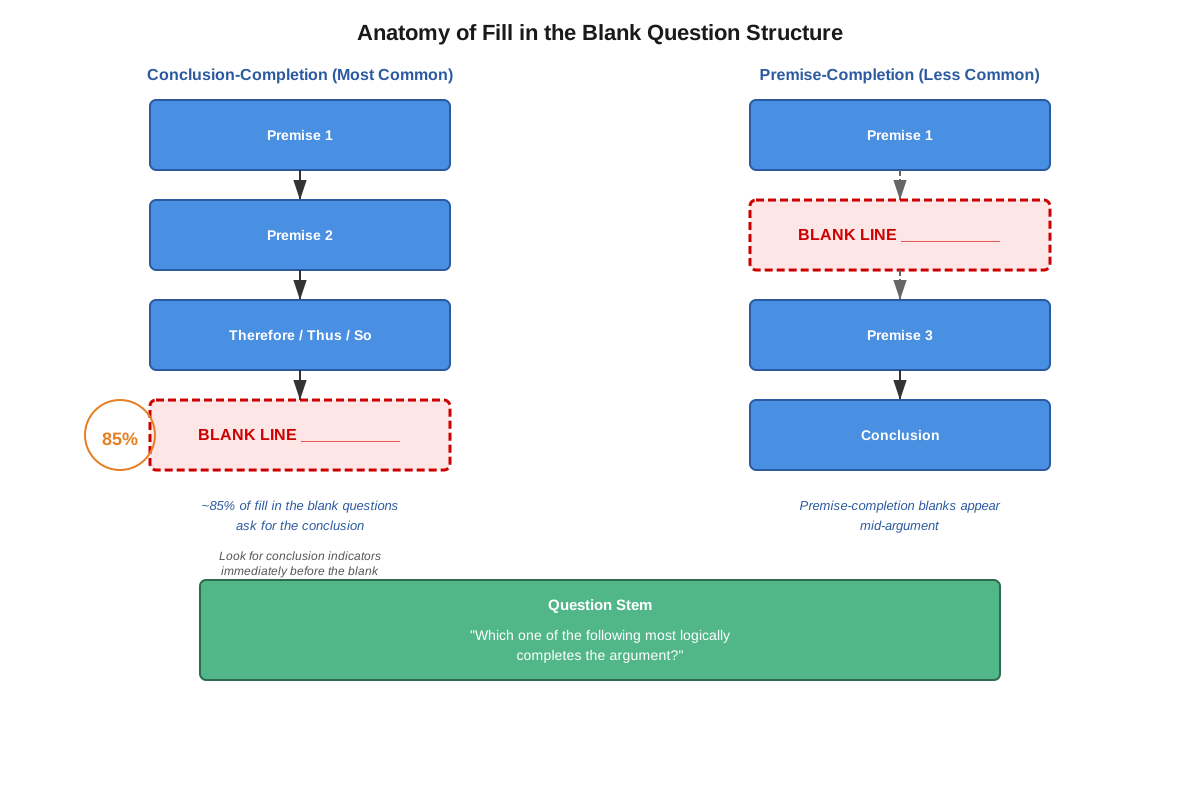
These questions most commonly appear in two formats: conclusion-completion (approximately 75% of fill in the blank questions) where the blank appears at the end of the argument, and premise-completion (approximately 25%) where the blank appears mid-argument. Both formats test your ability to recognize logical necessity—what must be true given the information provided, not merely what could be true or what sounds reasonable. The LSAT also occasionally embeds fill in the blank structures within principle questions or method of reasoning questions, making this skill broadly applicable across question types.
Core Concepts
Structure of Fill in the Blank Questions
LSAT fill in the blank questions are immediately recognizable by their format: the stimulus contains a blank line (often represented by underlining or explicit notation) where a sentence or phrase should appear, and the question stem asks which answer choice "most logically completes the argument." The physical blank creates a visual cue that distinguishes these from other question types. The blank's position within the argument determines the question's difficulty and approach: blanks at the end typically represent conclusions, while blanks in the middle usually represent premises or intermediate conclusions.
The question stems for these questions follow predictable patterns:
- "Which one of the following most logically completes the argument?"
- "Which one of the following best completes the passage?"
- "The conclusion of the argument is most strongly supported if which one of the following completes the passage?"
These stems signal that you must find the answer that creates the tightest logical fit—not the most interesting claim, not the most comprehensive statement, but the one that follows necessarily from what precedes it.
Logical Necessity vs. Plausibility
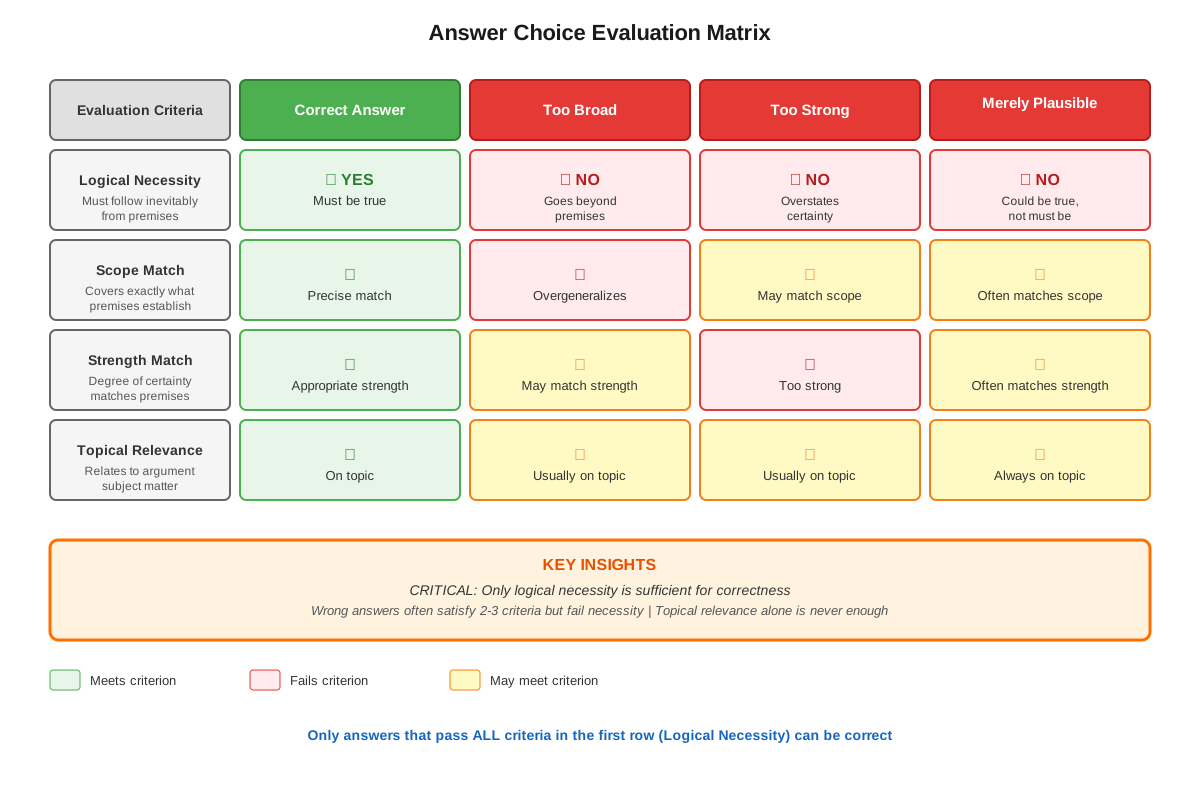
The fundamental principle underlying fill in the blank questions is logical necessity. The correct answer must be what the argument's logic requires, not merely what seems reasonable or topically related. This distinction separates correct answers from attractive wrong answers. Consider this framework:
| Characteristic | Logically Necessary Answer | Merely Plausible Answer |
|---|---|---|
| Relationship to premises | Directly supported by explicit statements | Consistent with topic but not proven |
| Scope | Matches the precise scope of premises | Often broader or narrower than justified |
| Strength | Matches the degree of certainty established | Often stronger or weaker than warranted |
| Content | Contains only elements introduced in premises | May introduce new concepts or assumptions |
Wrong answers in fill in the blank questions often sound good because they're topically relevant or make true statements about the subject matter. However, they fail the necessity test: the premises don't actually establish them. Training yourself to distinguish "this could be true" from "this must be true given the premises" is the core skill for these questions.
Conclusion-Completion Questions
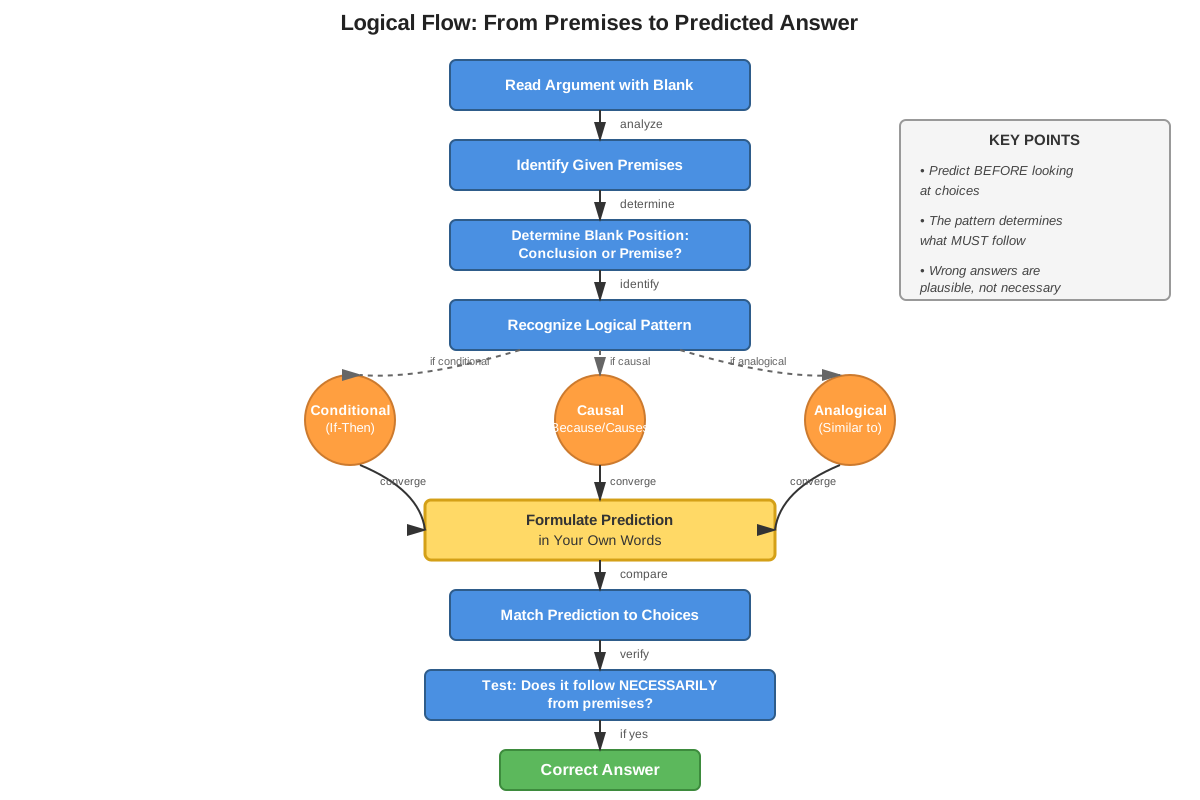
Conclusion-completion questions represent the majority of fill in the blank questions. In these, the blank appears at the end of the argument, and you must identify what conclusion the premises support. The approach follows these steps:
- Read the premises carefully: Identify each factual claim or piece of evidence provided
- Note logical indicators: Look for words like "therefore," "thus," or "so" immediately before the blank
- Identify the logical structure: Determine whether the argument uses conditional logic, causal reasoning, analogy, or another pattern
- Predict the conclusion: Before looking at answers, articulate what must follow from the premises
- Match your prediction: Select the answer that best matches your predicted conclusion
The key insight is that in well-constructed LSAT arguments, the conclusion is determined by the premises. If the premises establish that "All A are B" and "All B are C," the conclusion must involve the relationship between A and C. Any answer discussing D, no matter how interesting, cannot be correct.
Premise-Completion Questions
Premise-completion questions place the blank earlier in the argument, requiring you to identify what missing premise would make the stated conclusion follow logically. These questions test your ability to recognize logical gaps and determine what assumption or additional fact would bridge them. The approach differs slightly:
- Identify the conclusion first: Determine what the argument is trying to prove
- Examine the existing premises: Note what evidence is already provided
- Identify the logical gap: Determine what connection is missing between the premises and conclusion
- Predict the missing link: Articulate what statement would bridge this gap
- Verify sufficiency: Ensure your selected answer, combined with the existing premises, actually establishes the conclusion
For example, if an argument concludes "Therefore, the policy will reduce crime" and provides premises about the policy's effects on employment, the missing premise likely connects employment to crime rates. The correct answer must establish this connection with appropriate scope and strength.
Common Logical Patterns
Fill in the blank questions frequently employ recognizable logical structures. Identifying these patterns accelerates your prediction process:
Conditional chains: Arguments presenting a series of conditional relationships (if A then B, if B then C) typically conclude with the transitive relationship (if A then C).
Causal reasoning: Arguments establishing that X causes Y and Y causes Z typically conclude that X causes Z, or that preventing X prevents Z.
Analogical reasoning: Arguments comparing two situations typically conclude that what's true in one situation is true in the other, or that the same principle applies to both.
Elimination reasoning: Arguments ruling out all alternatives except one typically conclude that the remaining alternative must be true.
Quantitative reasoning: Arguments about proportions, percentages, or quantities typically conclude with a claim that follows mathematically from the given numbers.
Recognizing these patterns allows you to anticipate the logical structure of the correct answer even before reading the choices.
Scope and Degree Matching
The correct answer to a fill in the blank question must match both the scope (breadth of the claim) and degree (strength of the claim) established by the premises. Scope refers to what the claim is about—which categories, time periods, or contexts it covers. Degree refers to how certain or strong the claim is—whether it's absolute, probable, possible, or merely suggested.
Common scope mismatches include:
- Premises discuss "some companies" but answer discusses "all companies"
- Premises discuss "economic factors" but answer discusses "all factors"
- Premises discuss a specific time period but answer makes a timeless claim
Common degree mismatches include:
- Premises establish possibility but answer claims certainty
- Premises establish correlation but answer claims causation
- Premises establish a tendency but answer claims an absolute rule
The correct answer precisely matches what the premises establish—no more, no less.
Concept Relationships
The concepts within fill in the blank questions form a hierarchical relationship: Logical necessity serves as the overarching principle that governs all aspects of these questions. This principle determines both scope and degree matching (the correct answer must match what the premises establish) and the distinction between conclusion-completion and premise-completion variants (both require identifying what logically must fit the gap).
Common logical patterns (conditional chains, causal reasoning, analogies) represent specific implementations of logical necessity—they're the recurring structures through which logical necessity manifests in LSAT arguments. Recognizing these patterns enables faster prediction because you can anticipate the form the necessary conclusion will take.
The relationship flows: Logical Necessity → Scope/Degree Matching → Pattern Recognition → Accurate Prediction → Correct Answer Selection.
This topic connects to prerequisite knowledge of argument structure (you must identify whether the blank represents a premise or conclusion) and conditional logic (many fill in the blank questions employ conditional reasoning). It also connects forward to assumption questions (premise-completion questions essentially ask you to identify a necessary assumption) and inference questions (both require determining what must be true based on given information).
Understanding fill in the blank questions strengthens your ability to evaluate argument completeness across all Logical Reasoning question types, as you develop sensitivity to logical gaps and the specific claims needed to bridge them.
Quick check — test yourself on Fill in the blank questions so far.
Try Flashcards →High-Yield Facts
⭐ Fill in the blank questions appear 2-4 times per LSAT, making them a consistent score opportunity when mastered
⭐ The correct answer must be logically necessary given the premises, not merely plausible or topically relevant
⭐ Approximately 75% of fill in the blank questions involve conclusion-completion, while 25% involve premise-completion
⭐ Predicting the answer before reviewing choices dramatically increases accuracy and speed on these questions
⭐ The correct answer matches both the scope (breadth) and degree (strength) of what the premises establish
- Question stems typically include phrases like "most logically completes" or "best completes the passage"
- Wrong answers often introduce new concepts not mentioned in the premises or make claims broader than the premises support
- Conditional reasoning patterns (if-then chains) appear in approximately 30% of fill in the blank questions
- The blank's position in the argument (end vs. middle) indicates whether you're completing a conclusion or premise
- Logical indicator words (therefore, thus, because, since) immediately adjacent to the blank provide crucial structural clues
- Causal reasoning patterns frequently appear, with conclusions claiming that one factor causes or prevents another
- Elimination reasoning (ruling out alternatives) often leads to conclusions that the remaining option must be true
- The correct answer never requires outside knowledge—it must be fully supported by the stimulus alone
- Time pressure makes fill in the blank questions vulnerable to hasty selection of topically-related wrong answers
- Premise-completion questions often test your ability to identify unstated assumptions that bridge logical gaps
Common Misconceptions
Misconception: The correct answer is whichever choice sounds most intelligent or comprehensive → Correction: The correct answer is determined solely by logical necessity; a simple, narrow claim that follows necessarily from the premises beats a sophisticated claim that goes beyond what's established
Misconception: If an answer choice makes a true statement about the topic, it's likely correct → Correction: Real-world truth is irrelevant; the correct answer must be supported by the specific premises in the stimulus, regardless of whether it's true in reality
Misconception: Fill in the blank questions are essentially asking for your opinion about what should come next → Correction: These questions have objectively correct answers determined by logical structure; there's no subjective judgment involved in identifying what must follow from the premises
Misconception: The longest or most detailed answer choice is usually correct because it's most complete → Correction: Length is irrelevant to correctness; the correct answer is often concise because it states precisely what the premises establish without adding unnecessary elements
Misconception: You should read all answer choices before attempting to predict the answer → Correction: Predicting before reading choices prevents wrong answers from influencing your thinking and makes the correct answer more recognizable when you encounter it
Misconception: If the blank is in the middle of the argument, you should read to the end before determining what fits → Correction: While you should read the entire stimulus, the content after a mid-argument blank often provides crucial context for determining what the blank must contain
Misconception: Premise-completion and conclusion-completion questions require fundamentally different approaches → Correction: Both require identifying logical necessity; the only difference is whether you're determining what conclusion the premises support or what premise the conclusion requires
Worked Examples
Example 1: Conclusion-Completion with Conditional Logic
Stimulus: "All successful entrepreneurs take calculated risks. Maria has never taken a calculated risk in her business ventures. Therefore, _____________."
Analysis Process:
Step 1: Identify the logical structure. This argument uses conditional reasoning:
- Premise 1: Successful entrepreneur → Takes calculated risks
- Premise 2: Maria → Does NOT take calculated risks
Step 2: Recognize the pattern. We have the contrapositive situation: if someone doesn't take calculated risks, they cannot be a successful entrepreneur.
- Contrapositive: Does NOT take calculated risks → NOT a successful entrepreneur
Step 3: Apply to Maria. Since Maria doesn't take calculated risks, she cannot be a successful entrepreneur.
Step 4: Predict the answer. The conclusion must state that Maria is not a successful entrepreneur. The scope must be limited to Maria, and the degree must be definite (not "probably" or "might").
Step 5: Evaluate answer choices:
- (A) "Maria should reconsider her business strategy" - Introduces a recommendation not supported by premises; INCORRECT
- (B) "Maria is not a successful entrepreneur" - Matches prediction exactly; CORRECT
- (C) "Most entrepreneurs who avoid risks fail" - Discusses "most entrepreneurs" when premises only establish information about Maria; scope mismatch; INCORRECT
- (D) "Maria's business ventures have all failed" - Goes beyond what's established; not being successful doesn't necessarily mean complete failure; degree mismatch; INCORRECT
- (E) "Taking calculated risks guarantees entrepreneurial success" - Reverses the conditional logic; the original states success requires risk-taking, not that risk-taking guarantees success; INCORRECT
Connection to Learning Objectives: This example demonstrates how to identify the fill in the blank format, recognize the conditional reasoning pattern, and apply logical necessity to predict and select the correct answer.
Example 2: Premise-Completion with Causal Reasoning
Stimulus: "Studies show that cities with extensive public transportation systems have lower rates of traffic congestion than cities without such systems. _____________. Therefore, investing in public transportation is an effective way to reduce traffic congestion."
Analysis Process:
Step 1: Identify the conclusion. The argument concludes that investing in public transportation effectively reduces traffic congestion.
Step 2: Examine existing premises. We know there's a correlation: cities with public transit have less congestion.
Step 3: Identify the logical gap. The correlation doesn't establish causation. The missing premise must establish that public transportation actually causes the reduction in congestion, rather than both being effects of some other factor (like city planning philosophy or population density).
Step 4: Consider alternative explanations that would undermine the causal claim:
- Maybe cities that build public transit also implement other congestion-reducing policies
- Maybe less congested cities find it easier to build public transit
- Maybe wealthy cities both build transit and have less congestion for unrelated reasons
Step 5: Predict the missing premise. It must rule out these alternatives and establish that the public transportation itself causes the congestion reduction.
Step 6: Evaluate answer choices:
- (A) "Public transportation is more environmentally friendly than private vehicles" - Addresses a different benefit; doesn't establish the causal connection needed; INCORRECT
- (B) "The reduction in congestion occurs specifically because public transportation removes private vehicles from roads" - Establishes the causal mechanism; CORRECT
- (C) "Cities with public transportation are generally more prosperous" - Introduces a potential confounding variable rather than eliminating it; INCORRECT
- (D) "Traffic congestion has significant economic costs" - Provides motivation for the policy but doesn't establish that public transit causes congestion reduction; INCORRECT
- (E) "Most residents of cities with public transportation use it regularly" - Provides supporting detail but doesn't establish the causal link; INCORRECT
Connection to Learning Objectives: This example illustrates premise-completion questions, demonstrates how to identify logical gaps, and shows how the correct answer must provide exactly what's needed to make the conclusion follow logically.
Exam Strategy
Pre-Reading Strategy
Before reading the stimulus, quickly scan for the blank line and note its position. If it's at the end, prepare to identify the conclusion the premises support. If it's in the middle, prepare to identify what premise would make the conclusion (which comes after the blank) follow logically. This pre-reading orientation saves time and focuses your attention appropriately.
Reading Strategy
Read actively with your pencil, marking:
- Logical indicators (therefore, thus, because, since)
- Conditional statements (if, then, all, only)
- Quantifiers (some, most, all, none)
- Causal language (causes, leads to, results in)
These markers reveal the argument's logical structure and help you predict what must fill the blank.
Prediction Strategy
Always predict before reading answer choices. This is the single most important strategy for fill in the blank questions. Your prediction doesn't need to match the correct answer word-for-word, but it should capture the logical content. Ask yourself:
- What must be true given these premises?
- What scope and degree do the premises establish?
- What logical pattern is operating here?
Write a brief prediction in the margin. This prediction serves as your anchor when evaluating choices.
Answer Choice Evaluation
Evaluate choices systematically:
- Eliminate scope mismatches first: Remove any answer that discusses categories, time periods, or contexts not established in the premises
- Eliminate degree mismatches: Remove any answer that's stronger or weaker than what the premises establish
- Eliminate new concept introductions: Remove any answer that brings in ideas not mentioned in the stimulus
- Verify logical necessity: For remaining choices, confirm that the premises actually establish the claim
Trigger Words and Phrases
Watch for these question stem variations:
- "Most logically completes" - Standard phrasing
- "Best completes" - Identical to "most logically completes"
- "Most strongly supported if which one completes" - Emphasizes that premises must support the conclusion
In the stimulus, watch for:
- "Therefore" or "Thus" immediately before the blank - Signals conclusion-completion
- "Because" or "Since" immediately before the blank - May signal premise-completion
- Conditional indicators throughout - Suggests the answer will involve conditional logic
- Causal language - Suggests the answer will involve a causal claim
Time Allocation
Spend approximately 1:15-1:30 on fill in the blank questions:
- 30-40 seconds reading and analyzing the stimulus
- 15-20 seconds formulating your prediction
- 30-40 seconds evaluating answer choices
These questions reward careful prediction time. Don't rush the analysis phase to get to the answers faster—the prediction makes answer evaluation much quicker and more accurate.
Process of Elimination Tips
Wrong answers in fill in the blank questions typically fall into these categories:
- Scope creep: Discusses "all" when premises discuss "some," or vice versa
- Degree inflation: Claims certainty when premises establish probability
- Reverse logic: States the opposite of what the logical structure requires
- Premise repetition: Simply restates a premise rather than drawing a conclusion
- Topic drift: Sounds related but introduces concepts not in the stimulus
Actively categorize wrong answers as you eliminate them. This practice trains your recognition of these patterns.
Memory Techniques
The BLANK Acronym
Use BLANK to remember the systematic approach:
- Blank location (end = conclusion, middle = premise)
- Logical structure (conditional, causal, analogical, etc.)
- Anticipate the answer (predict before reading choices)
- Necessity test (must be true, not merely could be true)
- Keep scope and degree matched (no broader, stronger, or weaker than premises establish)
The Necessity Test Visualization
Visualize the premises as puzzle pieces that fit together in only one way. The blank is the missing piece. The correct answer is the piece that fits perfectly—not a piece from a different puzzle (even if it's interesting), not a piece that's too large or too small, but the exact piece that completes the picture the premises create.
The "Therefore Test"
For conclusion-completion questions, mentally insert "therefore" before your predicted answer. If it sounds awkward or doesn't follow naturally from the premises, revise your prediction. The correct answer should sound inevitable when preceded by "therefore."
The Scope-Degree Matrix
Memorize this quick check:
Scope: Does the answer discuss the same categories/subjects as the premises?
Degree: Does the answer claim the same level of certainty as the premises establish?
If either answer is "no," eliminate the choice immediately.
Summary
Fill in the blank questions test your ability to recognize logical necessity and complete arguments by identifying what must follow from given premises. These questions appear 2-4 times per LSAT and offer significant score improvement opportunities because they follow predictable patterns and reward systematic approaches. The fundamental principle is that the correct answer must be logically necessary—not merely plausible, interesting, or topically relevant. Success requires distinguishing between conclusion-completion questions (where the blank appears at the end) and premise-completion questions (where the blank appears mid-argument), though both demand the same core skill: identifying what the argument's logic requires. The most effective strategy involves predicting the answer before reading choices, ensuring your prediction matches both the scope and degree of what the premises establish, and recognizing common logical patterns like conditional chains, causal reasoning, and analogical arguments. Wrong answers typically fail by introducing new concepts, mismatching scope or degree, or stating what could be true rather than what must be true. Mastering these questions strengthens your overall logical reasoning abilities and transfers directly to other question types requiring precise argument analysis.
Key Takeaways
- Fill in the blank questions require identifying what logically must complete an argument, not what merely could or should complete it
- Always predict the answer before reading choices to avoid being influenced by attractive wrong answers
- The correct answer matches both the scope (breadth) and degree (strength) of what the premises establish—no more, no less
- Approximately 75% of these questions involve conclusion-completion (blank at end), while 25% involve premise-completion (blank in middle)
- Common logical patterns include conditional chains, causal reasoning, analogical arguments, and elimination reasoning
- Wrong answers typically introduce new concepts, mismatch scope or degree, or state premises rather than conclusions
- These questions appear consistently on every LSAT and offer high-value score improvement opportunities when approached systematically
Related Topics
Assumption Questions: Understanding fill in the blank questions, especially premise-completion variants, directly prepares you for assumption questions, which ask you to identify unstated premises that arguments require. The skill of recognizing logical gaps transfers directly.
Inference/Must Be True Questions: Both question types require determining what must be true based on given information, though inference questions provide complete arguments while fill in the blank questions require you to complete them.
Parallel Reasoning Questions: Recognizing the logical patterns in fill in the blank questions (conditional chains, causal structures, analogies) strengthens your ability to identify parallel logical structures in different contexts.
Strengthen/Weaken Questions: Understanding what premises would complete an argument (premise-completion questions) helps you identify what additional information would strengthen or weaken arguments in other question types.
Mastering fill in the blank questions builds foundational skills in logical necessity, scope matching, and pattern recognition that enhance performance across all Logical Reasoning question types.
Practice CTA
Now that you understand the principles and strategies for fill in the blank questions, it's time to apply this knowledge. Attempt the practice questions to reinforce these concepts and develop your prediction skills. Work through the flashcards to memorize key patterns and common wrong answer types. Remember: these questions reward systematic approaches and careful prediction. With practice, you'll find them among the most reliable question types for consistent correct answers. Each practice question you complete strengthens your pattern recognition and builds the confidence needed for test day success. Start practicing now to transform this knowledge into measurable score improvement!
Sign up free to keep reading
Create a free AnvayaPrep account to finish this LSAT guide on Fill in the blank questions — plus flashcards and practice questions.