Overview
Prephrasing completions is a critical strategic skill in LSAT Logical Reasoning that involves predicting the missing piece of an argument before examining the answer choices. This technique is particularly valuable for "Complete the Argument" questions, where test-takers must identify the conclusion that logically follows from the given premises. Rather than passively reading through all five answer choices and hoping to recognize the correct one, skilled test-takers actively engage with the stimulus by formulating their own completion based on the logical structure and content of the argument.
The ability to prephrase effectively transforms the test-taking experience from a potentially confusing evaluation of similar-sounding options into a targeted search for a specific logical element. When students master lsat prephrasing completions, they develop a proactive mindset that reduces susceptibility to trap answers and significantly improves accuracy. This approach leverages the predictable patterns in LSAT arguments: premises establish relationships, introduce constraints, or set up contrasts that point toward specific types of conclusions. By recognizing these patterns, test-takers can anticipate what must come next with remarkable precision.
Within the broader landscape of Logical Reasoning, prephrasing completions connects intimately with argument structure analysis, conditional reasoning, and pattern recognition. It represents the practical application of understanding how arguments are constructed—taking theoretical knowledge about premises, conclusions, and logical relationships and using it to generate predictions in real time. This skill also reinforces critical reading abilities essential for other question types, including Assumption, Strengthen, and Weaken questions, making it a foundational competency that enhances overall LSAT performance.
Learning Objectives
- [ ] Identify how Prephrasing completions appears in LSAT questions
- [ ] Explain the reasoning pattern behind Prephrasing completions
- [ ] Apply Prephrasing completions to solve LSAT-style problems accurately
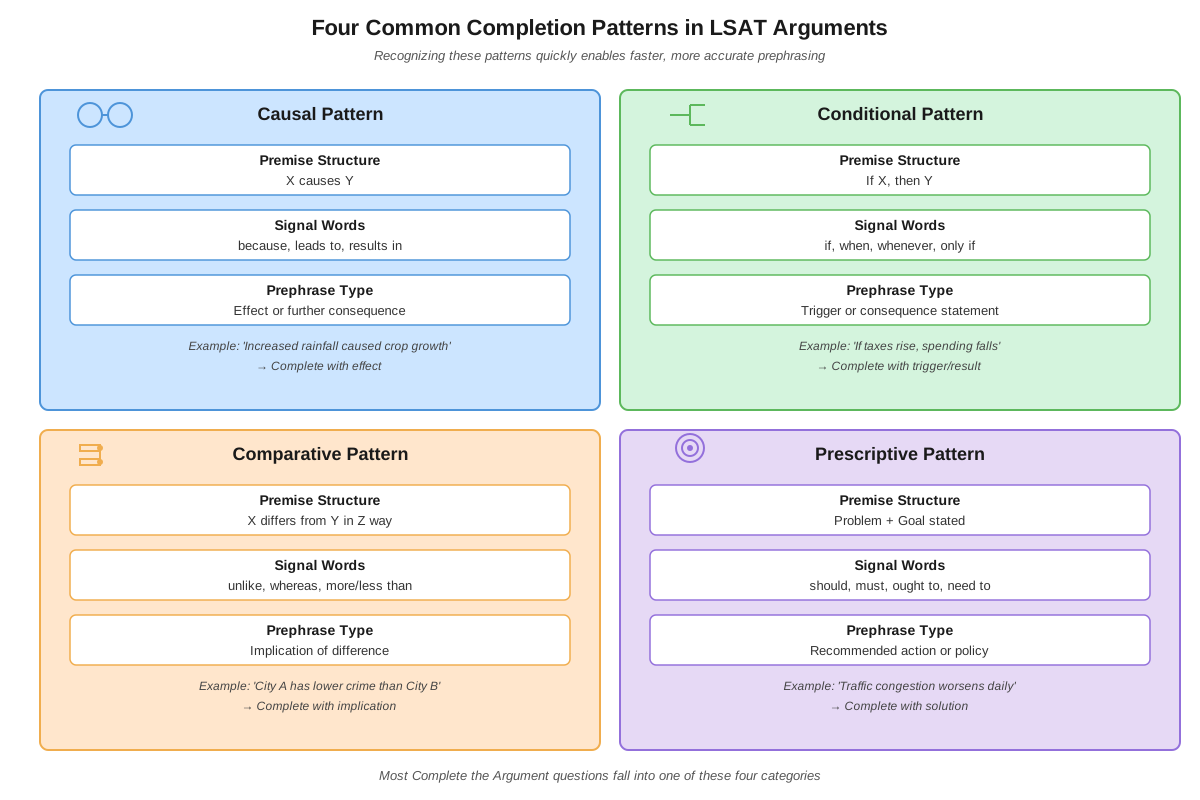
- [ ] Distinguish between different types of completion patterns (causal, conditional, comparative, prescriptive)
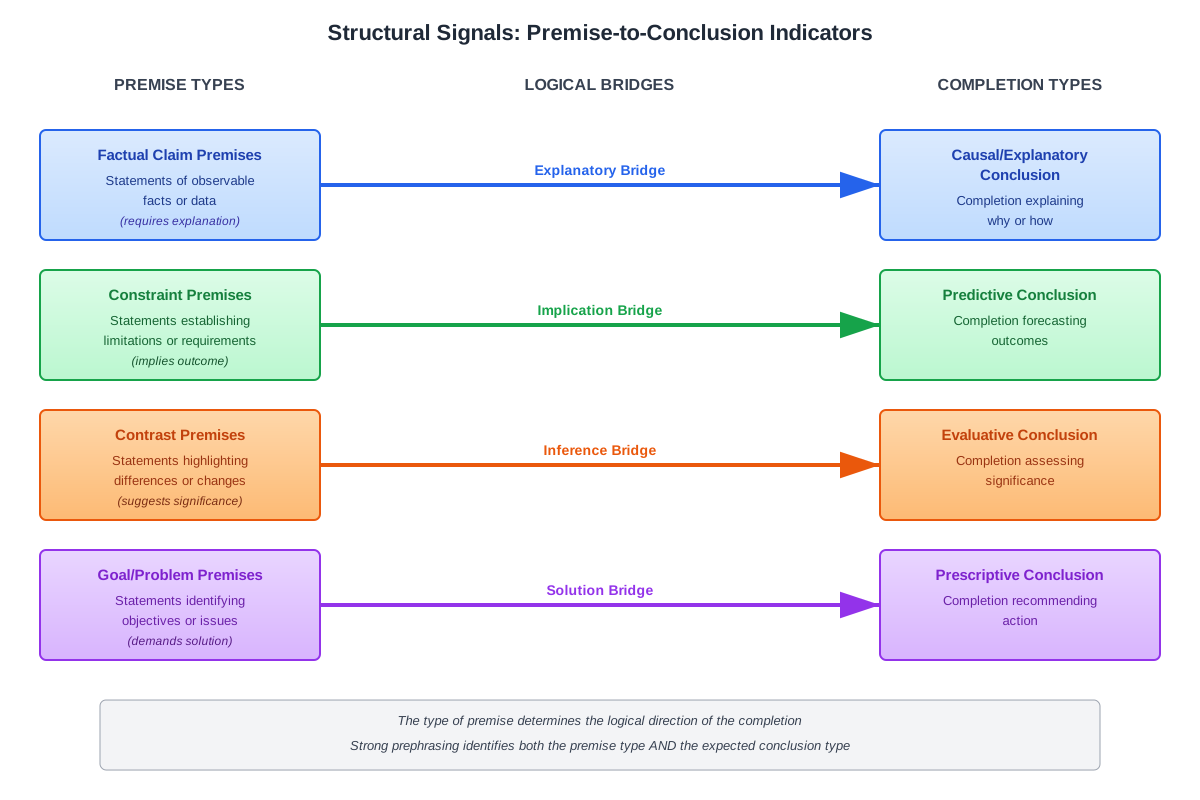
- [ ] Recognize structural signals that indicate the direction of a completion
- [ ] Evaluate answer choices efficiently by comparing them against a prephrased prediction
- [ ] Adapt prephrasing strategies when initial predictions don't match available answers
Prerequisites
- Basic argument structure: Understanding the distinction between premises and conclusions is essential because prephrasing requires identifying what information serves as support versus what needs to be supported.
- Conditional reasoning fundamentals: Recognizing "if-then" relationships helps predict completions that follow logically from conditional premises.
- Common argument patterns: Familiarity with causal reasoning, analogical reasoning, and comparative structures enables faster pattern recognition when prephrasing.
- Active reading skills: The ability to engage critically with text rather than passively absorbing information is necessary for generating predictions before seeing answer choices.
Why This Topic Matters
Prephrasing completions represents one of the highest-yield strategies for improving LSAT Logical Reasoning performance. This skill matters because it fundamentally changes the relationship between test-taker and test material—from reactive to proactive, from uncertain to confident. In real-world contexts, the ability to anticipate logical conclusions is essential for legal reasoning, where attorneys must predict how arguments will develop, what conclusions opposing counsel might draw, and what logical steps are necessary to complete a persuasive case.
On the LSAT, "Complete the Argument" questions appear with notable frequency, typically comprising 2-4 questions per Logical Reasoning section. These questions are explicitly identified by question stems such as "Which one of the following most logically completes the argument?" or "The conclusion of the argument is most strongly supported if which one of the following is assumed?" Beyond these explicit completion questions, the prephrasing skill enhances performance on virtually all Logical Reasoning question types because it trains students to think ahead of the test rather than merely responding to it.
Common manifestations in exam passages include arguments that establish a problem and require a solution, arguments that present evidence and need a conclusion, arguments that introduce a principle and require an application, and arguments that set up a contrast and need a resolution. The LSAT consistently rewards test-takers who can recognize these patterns and generate accurate predictions, making prephrasing completions a skill that directly translates to score improvements.
Core Concepts
Understanding Prephrasing Completions
Prephrasing completions is the strategic process of formulating a prediction for the missing element of an argument before evaluating the answer choices. This technique leverages the logical structure and content of the stimulus to generate an expectation about what must come next. The fundamental principle underlying this approach is that LSAT arguments follow predictable logical patterns—they are not random collections of statements but carefully constructed sequences where premises point toward specific types of conclusions.
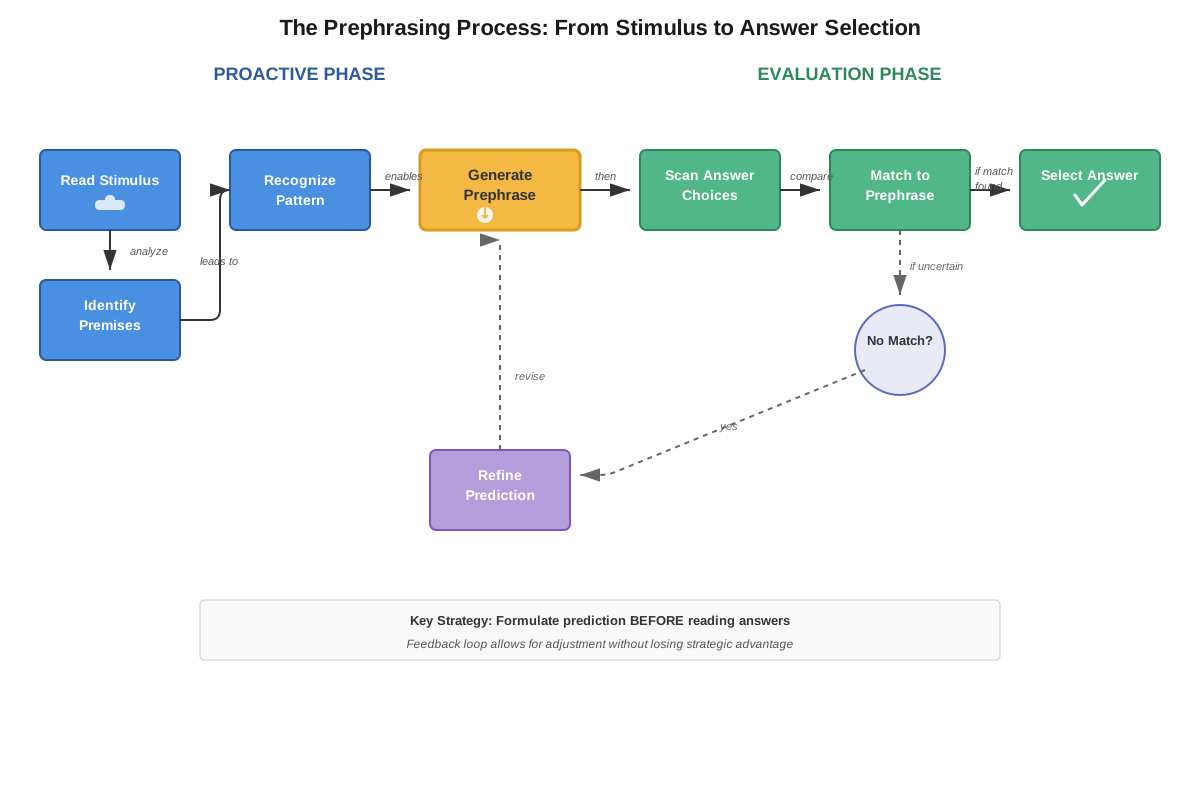
The prephrasing process involves three essential components: (1) identifying the logical structure of the given premises, (2) recognizing the pattern or relationship those premises establish, and (3) predicting the type of statement that would logically complete that pattern. This is not about guessing the exact wording of the correct answer but rather about understanding the logical role and general content that the completion must fulfill.
The Mechanics of Effective Prephrasing
To evaluate and complete the argument successfully, test-takers must first read the stimulus actively, noting key logical indicators such as contrast words ("however," "but," "although"), causal language ("because," "therefore," "as a result"), and conditional structures ("if," "only if," "unless"). These indicators signal the type of logical relationship being established and therefore the type of completion required.
The second mechanical step involves identifying what information is present and what is conspicuously absent. Complete the Argument questions deliberately withhold a crucial piece—typically the main conclusion—that would make the argument whole. By noting what the premises establish but don't yet conclude, test-takers can pinpoint the logical gap that needs filling.
The third step is articulating a prediction in simple terms. This prediction need not match the correct answer word-for-word; rather, it should capture the essential logical content. For example, if premises establish that "All effective policies require public support" and "This policy lacks public support," a prephrased completion might be "This policy won't be effective"—capturing the logical consequence without predicting exact phrasing.
Common Completion Patterns
| Pattern Type | Premise Structure | Expected Completion |
|---|---|---|
| Causal | X causes Y; X is present | Y will occur / Y is occurring |
| Conditional | If A then B; A is true | B must be true |
| Comparative | X has property P; Y lacks P | X is superior/different from Y in relevant way |
| Problem-Solution | Problem described; Solution proposed | Solution will address problem / Solution is necessary |
| Evidence-Conclusion | Multiple facts presented | General principle or specific inference from facts |
| Principle-Application | General rule stated; Specific case described | Rule applies to case / Case exemplifies rule |
Structural Signals for Prephrasing
Certain structural elements serve as powerful signals for what type of completion is needed. Contrast indicators ("however," "on the other hand," "despite") suggest that the completion will present an opposing viewpoint or unexpected outcome. Causal indicators ("because," "since," "due to") signal that the completion may draw a causal conclusion from the presented evidence.
Conditional structures are particularly important for prephrasing. When premises establish conditional relationships, the completion often involves applying those conditions to a specific case or drawing a logical consequence. For example: "Only candidates with extensive experience are considered for the position. Martinez has extensive experience." The completion must logically follow: Martinez will be considered (or at least meets that criterion).
Quantifiers ("all," "some," "most," "none") also guide prephrasing by establishing the scope of the completion. If premises use universal quantifiers ("all," "every"), the completion typically maintains that universal scope or applies it to a specific instance.
The Role of Context and Content
Beyond pure logical structure, the content and context of the argument provide crucial guidance for prephrasing. LSAT arguments often draw from recognizable domains—business, science, law, public policy—and understanding the practical context helps predict reasonable completions. If an argument discusses a company's financial difficulties and cost-cutting measures, the completion likely addresses the company's future viability or the effectiveness of those measures.
However, test-takers must balance contextual reasoning with strict logical analysis. The LSAT rewards conclusions that follow logically from premises, not merely conclusions that seem plausible in the real world. Effective prephrasing therefore combines content awareness with rigorous attention to what the premises actually establish versus what they merely suggest.
Adapting When Predictions Don't Match
A sophisticated understanding of prephrasing includes knowing what to do when the prephrased prediction doesn't appear among the answer choices. This situation occurs occasionally and requires flexibility. Rather than abandoning the prephrasing approach, test-takers should ask: "Which answer choice is most similar in logical function to my prediction?" or "Did I misidentify the argument's structure?"
Sometimes the correct answer expresses the prephrased idea using different terminology or from a different angle. Other times, the prephrasing reveals that the argument's structure is more complex than initially recognized, prompting a second, more careful analysis. The key is maintaining the proactive mindset while remaining open to refining the prediction based on available options.
Concept Relationships
The concepts within prephrasing completions form an interconnected system where each element reinforces the others. Structural analysis (identifying premises, conclusions, and logical indicators) serves as the foundation that enables pattern recognition (categorizing the argument as causal, conditional, comparative, etc.). Pattern recognition, in turn, guides prediction generation (formulating the expected completion), which then informs answer evaluation (efficiently identifying the correct choice).
This topic connects directly to prerequisite knowledge of argument structure—without understanding what makes a premise versus a conclusion, prephrasing becomes impossible. It also relates closely to conditional reasoning: many completion questions involve applying conditional rules, making facility with sufficient and necessary conditions essential for accurate prephrasing.
The relationship map flows as follows: Active Reading → Structural Analysis → Pattern Recognition → Prediction Generation → Answer Evaluation → Verification. Each stage depends on the previous one, creating a systematic approach that transforms a potentially overwhelming task into a manageable sequence of steps.
Prephrasing completions also connects forward to more advanced Logical Reasoning skills. The pattern recognition developed through prephrasing enhances performance on Parallel Reasoning questions, where identifying argument structure is paramount. The prediction-generation skill transfers to Assumption questions, where test-takers must anticipate what unstated premise the argument requires. Thus, prephrasing serves as both a specific technique for completion questions and a general skill that elevates overall Logical Reasoning performance.
Quick check — test yourself on Prephrasing completions so far.
Try Flashcards →High-Yield Facts
⭐ Complete the Argument questions explicitly ask test-takers to identify the statement that logically completes the stimulus, making prephrasing the most direct and efficient approach.
⭐ The correct completion must be supported by the premises without requiring additional assumptions beyond what's explicitly stated or clearly implied.
⭐ Structural indicators (contrast words, causal language, conditional structures) are the most reliable signals for predicting the type of completion needed.
⭐ Prephrasing reduces susceptibility to trap answers by establishing clear criteria before exposure to potentially misleading options.
⭐ The prephrased prediction need not match the correct answer's exact wording but must capture the essential logical content and function.
- Completion questions typically appear 2-4 times per Logical Reasoning section, making this a high-frequency question type.
- Arguments with conditional premises almost always require completions that apply those conditions or draw logical consequences from them.
- When premises establish a problem, the completion frequently presents a solution, consequence, or evaluation of proposed solutions.
- Comparative arguments (X versus Y) typically require completions that draw conclusions about the superiority, difference, or relationship between the compared elements.
- Evidence-based arguments that present multiple facts usually require completions that synthesize those facts into a general principle or specific inference.
- The LSAT favors completions that are conservative—drawing only what the premises strictly support rather than making broader claims.
- Temporal indicators ("first," "then," "subsequently") often signal that the completion will describe a next step or future consequence.
Common Misconceptions
Misconception: Prephrasing means predicting the exact wording of the correct answer.
Correction: Prephrasing involves predicting the logical content and function of the completion, not its precise language. The correct answer may express the prephrased idea using different words, sentence structure, or emphasis while maintaining the same logical meaning.
Misconception: If the prephrased prediction doesn't appear among the answers, the prephrasing approach has failed.
Correction: When the exact prediction isn't available, the prephrasing still provides valuable guidance by establishing what logical role the completion must fulfill. Test-takers should look for the answer that best approximates the prephrased idea or reconsider whether they correctly identified the argument's structure.
Misconception: Prephrasing takes too much time and slows down test performance.
Correction: While prephrasing requires an initial investment of 10-15 seconds, it dramatically accelerates answer evaluation by providing clear criteria for elimination. Test-takers who prephrase typically spend less total time per question because they avoid repeatedly re-reading the stimulus while evaluating each answer choice.
Misconception: Prephrasing only works for straightforward arguments with obvious patterns.
Correction: Prephrasing is actually most valuable for complex arguments where answer choices are designed to be confusing. Even when the pattern isn't immediately obvious, the process of attempting to prephrase forces deeper engagement with the argument's structure, leading to better comprehension and more accurate answers.
Misconception: The completion must introduce new information not mentioned in the premises.
Correction: While completions sometimes introduce new elements, they more commonly synthesize, apply, or draw logical consequences from information already present in the premises. The LSAT tests logical reasoning, not creativity or outside knowledge, so completions must be grounded in what the premises establish.
Misconception: All completion questions follow the same pattern and require the same approach.
Correction: Completion questions vary significantly in structure—some require causal conclusions, others conditional applications, still others comparative judgments or prescriptive recommendations. Effective prephrasing requires identifying which pattern applies to each specific argument rather than applying a one-size-fits-all approach.
Worked Examples
Example 1: Conditional Completion
Stimulus: "City council members are required to disclose any financial interests that might create conflicts of interest. Council member Johnson owns stock in a company that is bidding for a city contract. Therefore, ___________."
Step 1 - Identify Structure: This argument presents a conditional rule (requirement for disclosure) and a specific case (Johnson's stock ownership). The structure is: General rule + Specific case that meets the rule's condition.
Step 2 - Recognize Pattern: This is a conditional application pattern. The first sentence establishes: If council member has financial interest that might create conflict → must disclose. The second sentence establishes that Johnson has such a financial interest (stock in company bidding for contract).
Step 3 - Prephrase Completion: The completion must apply the conditional rule to Johnson's specific case. Prediction: "Johnson must disclose this financial interest" or "Johnson is required to disclose her stock ownership."
Step 4 - Evaluate Answer Choices: The correct answer will state that Johnson must disclose or is required to disclose. Incorrect answers might suggest Johnson should resign (goes beyond what premises support), that the company shouldn't get the contract (irrelevant to the disclosure requirement), or that Johnson has a conflict of interest (already implied; doesn't complete the logical sequence).
Connection to Learning Objectives: This example demonstrates how identifying the conditional structure (Objective 2: explain reasoning pattern) enables accurate prephrasing (Objective 3: apply to solve problems).
Example 2: Causal-Comparative Completion
Stimulus: "Studies show that students who take handwritten notes retain information better than those who type notes on laptops. This difference persists even when students are tested weeks after the initial learning. Researchers attribute this retention advantage to the fact that handwriting requires more cognitive processing than typing. However, ___________."
Step 1 - Identify Structure: The argument presents evidence for a causal claim (handwriting → better retention due to more cognitive processing). The "However" signals that the completion will present a contrast, limitation, or complicating factor.
Step 2 - Recognize Pattern: This is a contrast pattern following a causal explanation. The premises establish a phenomenon and its cause; the "however" indicates the completion will qualify, limit, or present an alternative perspective on this causal relationship.
Step 3 - Prephrase Completion: The completion should introduce a limitation or counterpoint to the handwriting advantage. Possible predictions: "typing allows students to capture more information," "the advantage disappears for certain types of material," "other factors also influence retention," or "handwriting is impractical in some educational settings."
Step 4 - Evaluate Answer Choices: The correct answer will present a genuine contrast or limitation that's relevant to the handwriting-typing comparison. Incorrect answers might strengthen the original claim (opposite of what "however" signals), introduce irrelevant information (about different study methods entirely), or make claims unsupported by the premises.
Connection to Learning Objectives: This example shows how structural signals like "however" guide prephrasing (Objective 4: distinguish completion patterns) and how understanding the argument's direction enables efficient answer evaluation (Objective 6: evaluate choices against prediction).
Exam Strategy
When approaching Complete the Argument questions on the LSAT, begin by reading the question stem first to confirm that you're dealing with a completion question. Question stems typically include phrases like "most logically completes," "conclusion is most strongly supported if," or "argument is most strengthened if which one of the following is assumed to be true."
Trigger words and phrases to watch for in the stimulus include:
- Contrast indicators: "however," "but," "yet," "although," "despite," "on the other hand"
- Causal language: "because," "since," "therefore," "thus," "as a result," "consequently"
- Conditional structures: "if," "only if," "unless," "whenever," "all," "any," "no"
- Evidence markers: "studies show," "research indicates," "data reveal," "experts agree"
- Conclusion indicators: "therefore," "thus," "hence," "so," "it follows that"
Process-of-elimination strategy: After prephrasing, evaluate answer choices by asking:
- Does this choice fulfill the logical role I predicted? (Eliminate if no)
- Is this choice supported by the premises without requiring additional assumptions? (Eliminate if no)
- Does this choice go beyond what the premises establish? (Eliminate if yes)
- Does this choice address the right scope (universal vs. particular, present vs. future)? (Eliminate if no)
Time allocation: Spend 10-15 seconds reading and prephrasing, then 20-30 seconds evaluating answer choices. If you find yourself spending more than 45 seconds total, you may be over-analyzing. Trust your prephrased prediction and look for the closest match rather than seeking perfection.
Exam Tip: If two answer choices both seem to match your prephrased prediction, re-read the stimulus to identify subtle differences in scope, strength, or logical relationship. The LSAT often includes one answer that's close but makes a slightly stronger claim than the premises support.
Common trap patterns: Watch for answers that (1) reverse the logical relationship established in the premises, (2) introduce new causal claims not supported by the evidence, (3) use extreme language ("always," "never," "only") when premises support more moderate claims, or (4) address a related but distinct issue from what the premises actually establish.
Memory Techniques
SCOPE Mnemonic for evaluating completions:
- Structure: Does it fit the argument's logical structure?
- Content: Does it address the right subject matter?
- Outcome: Does it draw the right type of conclusion (causal, conditional, comparative)?
- Premises: Is it fully supported by what's stated?
- Extreme: Does it avoid unsupported extreme claims?
The "Therefore Test": When prephrasing, mentally insert "therefore" before your predicted completion. If the resulting statement sounds like a logical conclusion from the premises, your prephrasing is on track. If it sounds like a non sequitur, reconsider the argument's structure.
Pattern Recognition Acronym - CCCP:
- Causal: Cause → Effect completions
- Conditional: If-then applications
- Comparative: X vs. Y judgments
- Prescriptive: Should/must recommendations
Visualization Strategy: Picture the argument as a bridge with the premises as the starting point and the completion as the destination. Your prephrasing identifies where the bridge must lead based on its starting direction and structure. Answer choices are different potential destinations—choose the one that aligns with the bridge's trajectory.
The "Blank Space" Technique: When reading the stimulus, literally visualize a blank space where the completion belongs. As you read the premises, actively think "this blank space must contain..." and fill it in mentally before looking at answer choices.
Summary
Prephrasing completions is a proactive strategic approach to Complete the Argument questions that involves predicting the missing element before evaluating answer choices. This technique leverages the predictable logical patterns in LSAT arguments—causal, conditional, comparative, and prescriptive structures—to generate accurate predictions about what must logically follow from given premises. Effective prephrasing requires identifying structural signals (contrast words, causal language, conditional indicators), recognizing the argument pattern, and articulating a prediction that captures the essential logical content needed to complete the argument. While the prephrased prediction need not match the correct answer's exact wording, it provides crucial criteria for efficiently evaluating options and avoiding trap answers. This skill enhances performance not only on explicit completion questions but across all Logical Reasoning question types by training test-takers to think ahead of the test material rather than merely reacting to it.
Key Takeaways
- Prephrasing transforms test-taking from reactive to proactive by establishing clear expectations before seeing answer choices
- Structural indicators (contrast words, causal language, conditional structures) are the most reliable signals for predicting completion type
- The prephrased prediction should capture logical content and function, not necessarily exact wording
- Common completion patterns include causal, conditional, comparative, problem-solution, and principle-application structures
- Effective prephrasing reduces time spent per question by enabling rapid elimination of answers that don't match the prediction
- When the exact prediction doesn't appear, look for the answer that best fulfills the same logical role
- The correct completion must be supported by the premises without requiring substantial additional assumptions
Related Topics
Assumption Questions: Mastering prephrasing completions provides a foundation for identifying unstated premises in arguments, as both skills require understanding what's missing from an argument's logical structure.
Strengthen and Weaken Questions: The ability to predict what would complete an argument naturally extends to predicting what information would support or undermine it.
Parallel Reasoning: Pattern recognition skills developed through prephrasing transfer directly to identifying structurally similar arguments.
Conditional Logic Advanced Applications: Many completion questions involve complex conditional structures, making deeper study of sufficient/necessary conditions valuable for improving prephrasing accuracy.
Argument Structure Mapping: Developing more sophisticated techniques for diagramming argument structure enhances the ability to identify what's missing and needs to be completed.
Practice CTA
Now that you understand the principles and strategies behind prephrasing completions, it's time to put this knowledge into action. Attempt the practice questions designed for this topic, focusing on articulating your prephrased prediction before looking at answer choices. Use the flashcards to reinforce pattern recognition and structural signals. Remember: prephrasing is a skill that improves dramatically with deliberate practice. Each question you work through strengthens your ability to recognize patterns and predict completions accurately. Your investment in mastering this technique will pay dividends not just on completion questions but across the entire Logical Reasoning section. Start practicing now, and watch your confidence and accuracy soar!
Sign up free to keep reading
Create a free AnvayaPrep account to finish this LSAT guide on Prephrasing completions — plus flashcards and practice questions.