Overview
All statements represent one of the most fundamental building blocks of formal logic and quantifiers tested on the LSAT. These universal quantifier statements assert that every member of a particular category possesses a certain characteristic or relationship. On the LSAT, all statements appear with remarkable frequency across Logical Reasoning sections, forming the backbone of conditional reasoning, argument structure analysis, and inference questions. Understanding how to properly interpret, diagram, and manipulate these statements is essential for achieving a competitive score, as they appear in approximately 40-50% of Logical Reasoning questions either directly or as components of more complex logical structures.
The power of all statements lies in their absolute nature—they make sweeping claims about entire categories without exception. When an LSAT stimulus states "All lawyers are college graduates," it establishes a universal relationship that applies to every single member of the lawyer category. This universality creates specific logical implications, contrapositive relationships, and inference patterns that the LSAT tests repeatedly. Mastering all statements enables students to quickly identify valid and invalid inferences, recognize flawed reasoning patterns, and eliminate incorrect answer choices with confidence.
Within the broader landscape of logical reasoning, all statements connect intimately with conditional logic, necessary and sufficient conditions, contrapositive reasoning, and categorical syllogisms. They serve as the foundation upon which more complex logical structures are built, including chains of conditional reasoning, formal logic games, and multi-layered argument analysis. Students who develop fluency with all statements gain a significant strategic advantage, as this knowledge transfers directly to understanding "if-then" statements, recognizing hidden quantifiers, and evaluating the logical force of conclusions drawn from categorical premises.
Learning Objectives
- [ ] Identify how All statements appears in LSAT questions
- [ ] Explain the reasoning pattern behind All statements
- [ ] Apply All statements to solve LSAT-style problems accurately
- [ ] Translate various linguistic formulations into standardized all statement notation
- [ ] Construct valid contrapositives from all statements with perfect accuracy
- [ ] Distinguish between valid and invalid inferences drawn from all statements
- [ ] Recognize disguised or implicit all statements in complex argument structures
Prerequisites
- Basic conditional logic: Understanding "if-then" relationships provides the foundation for recognizing how all statements function as universal conditionals
- Categorical reasoning: Familiarity with categories, classes, and membership relationships enables proper interpretation of the scope of all statements
- Logical operators: Knowledge of negation, conjunction, and disjunction helps in forming contrapositives and understanding logical relationships
- Argument structure: Recognizing premises and conclusions allows students to identify where all statements function within larger argumentative contexts
Why This Topic Matters
All statements appear in virtually every LSAT administration across multiple question types, making them one of the highest-yield topics for focused study. Research on LSAT question patterns reveals that all statements feature prominently in Must Be True questions (approximately 35% of such questions), Sufficient Assumption questions (45%), Necessary Assumption questions (25%), and Flaw questions (30%). The ability to rapidly process all statements and their logical implications directly correlates with improved accuracy and reduced time per question—two critical factors for achieving top-percentile scores.
Beyond the exam context, all statements represent fundamental patterns of human reasoning used in legal analysis, policy evaluation, and logical argumentation. Legal reasoning frequently employs universal rules ("All contracts require consideration") that function identically to LSAT all statements. Understanding these patterns develops critical thinking skills applicable to law school case analysis, statutory interpretation, and logical brief writing.
On the LSAT, all statements commonly appear in several disguised forms: explicit universal quantifiers ("all," "every," "any"), implicit universals ("Dogs are mammals" means "All dogs are mammals"), conditional statements ("If X, then Y" translates to "All X are Y"), and categorical assertions. Question stems that ask about what "must be true," what can be "properly inferred," or what "follows logically" frequently test whether students can correctly manipulate all statements through contrapositive reasoning or recognize invalid inference patterns like illicit conversion or affirming the consequent.
Core Concepts
The Structure of All Statements
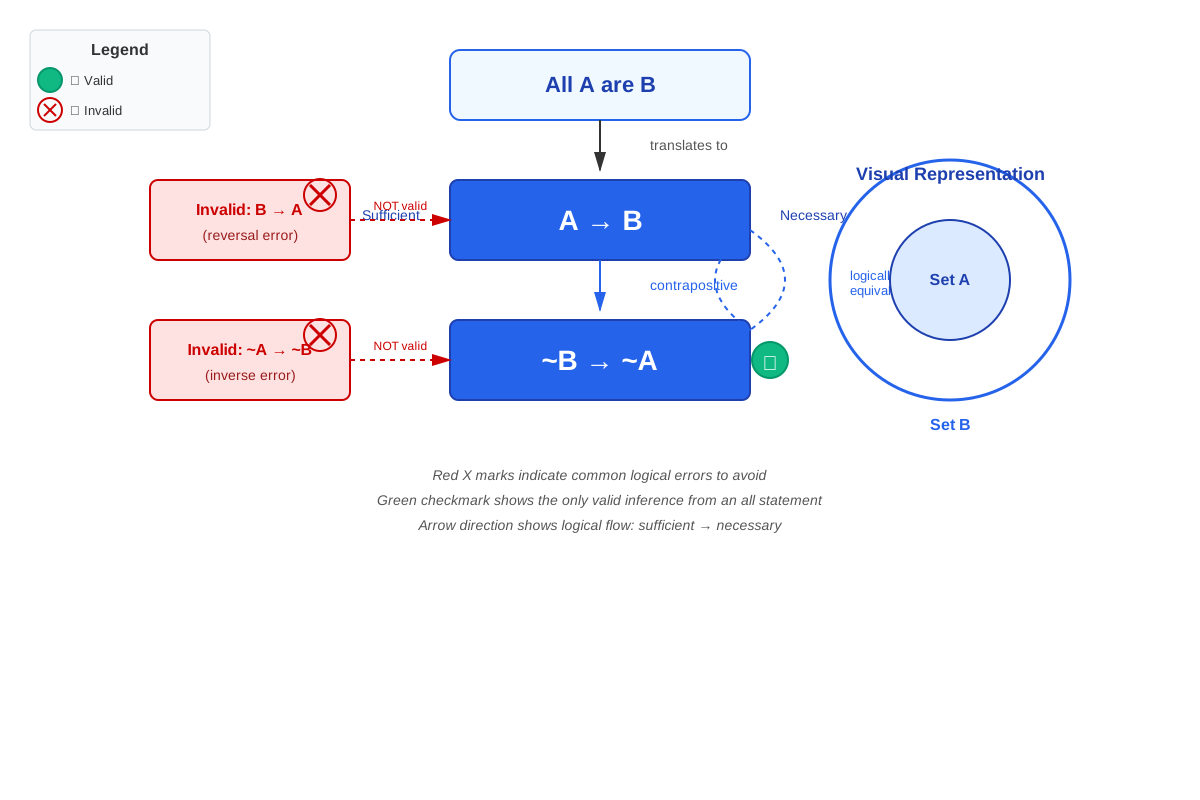
An all statement establishes a universal relationship between two categories or properties, asserting that every member of the first category (the sufficient condition) is also a member of the second category (the necessary condition). The standard form follows the pattern: "All A are B," which can be diagrammed as A → B. This notation captures the conditional nature of the relationship—being an A is sufficient to guarantee being a B, while being a B is necessary for being an A.
The logical structure contains three essential components: the universal quantifier (all, every, each, any), the subject term (the category being described), and the predicate term (the characteristic or category attributed to the subject). Understanding each component's role prevents common interpretation errors and enables accurate translation of complex statements into workable logical notation.
Standard Notation and Diagramming
LSAT all statements can be represented using arrow notation that makes their conditional structure explicit:
All A are B → A → BThis notation reveals that A is the sufficient condition (if something is A, that's enough to know it's B) and B is the necessary condition (being B is required for being A). The arrow always points from sufficient to necessary, creating a visual representation that facilitates rapid logical processing during timed exam conditions.
Consider the statement "All physicians are college graduates." This translates to:
Physician → College GraduateThis diagram immediately reveals several logical facts: being a physician guarantees college graduation, college graduation is required for being a physician (though not sufficient), and we can identify the contrapositive relationship.
The Contrapositive Relationship
Every all statement generates a logically equivalent contrapositive statement formed by negating both terms and reversing their order. The contrapositive of "All A are B" (A → B) is "All non-B are non-A" (~B → ~A). This relationship is absolutely critical for LSAT success, as correct answer choices frequently require contrapositive reasoning.
| Original Statement | Contrapositive |
|---|---|
| All A are B (A → B) | All non-B are non-A (~B → ~A) |
| All lawyers are college graduates | All non-college graduates are non-lawyers |
| All mammals are warm-blooded | All non-warm-blooded creatures are non-mammals |
The contrapositive preserves logical truth—if the original statement is true, the contrapositive must also be true, and vice versa. This equivalence enables powerful inference-making and answer choice elimination. Students must develop automatic fluency with contrapositive formation, as LSAT questions frequently present information in one direction while asking about the contrapositive direction.
Linguistic Variations of All Statements
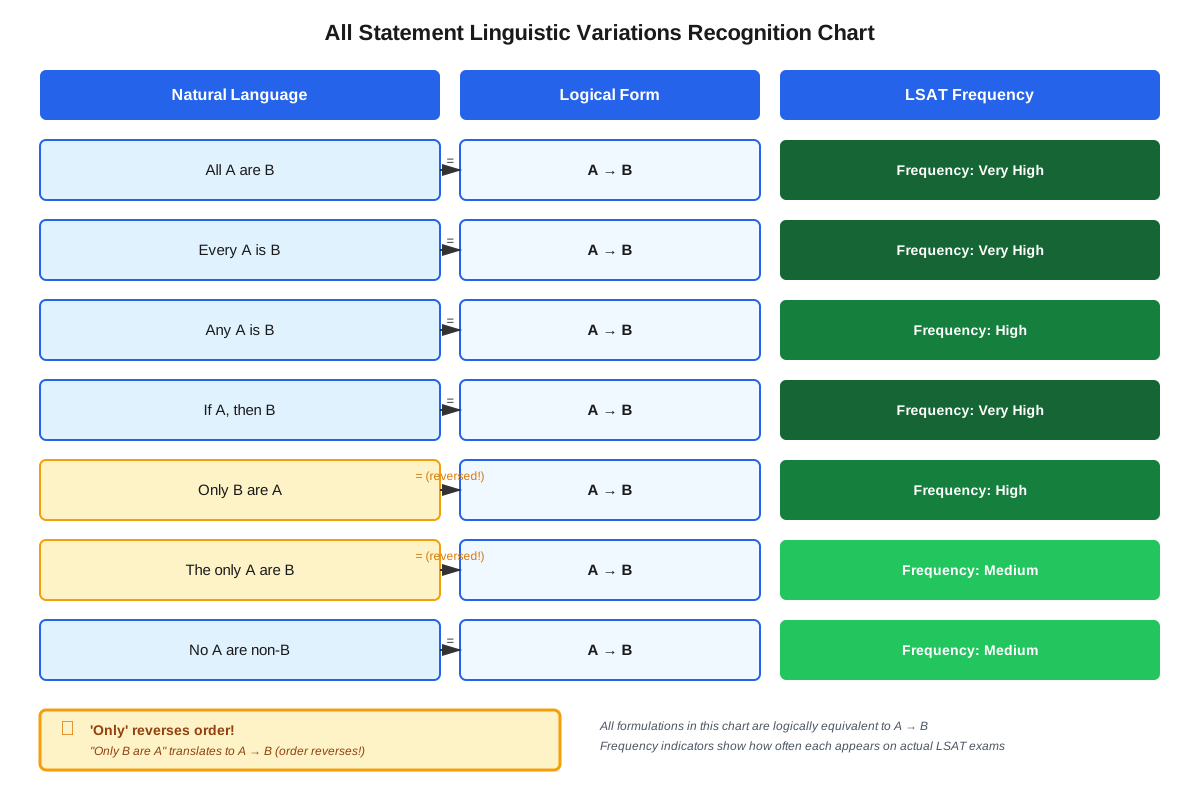
The LSAT presents all statements in numerous linguistic disguises, requiring students to recognize the underlying universal quantifier structure regardless of surface grammar. Common formulations include:
- Explicit universals: "All X are Y," "Every X is Y," "Each X is Y," "Any X is Y"
- Implicit universals: "Dogs are mammals" (means "All dogs are mammals")
- Conditional formulations: "If X, then Y" (equivalent to "All X are Y")
- Only statements: "Only Y are X" (means "All X are Y"—note the reversal)
- Categorical assertions: "Physicians must complete medical school" (means "All physicians are medical school completers")
Recognizing these variations prevents misinterpretation and enables consistent translation into standard notation. The statement "Anyone who votes must be registered" translates to "All voters are registered people" or Voter → Registered, demonstrating how conditional language masks universal quantifier structure.
Valid and Invalid Inferences
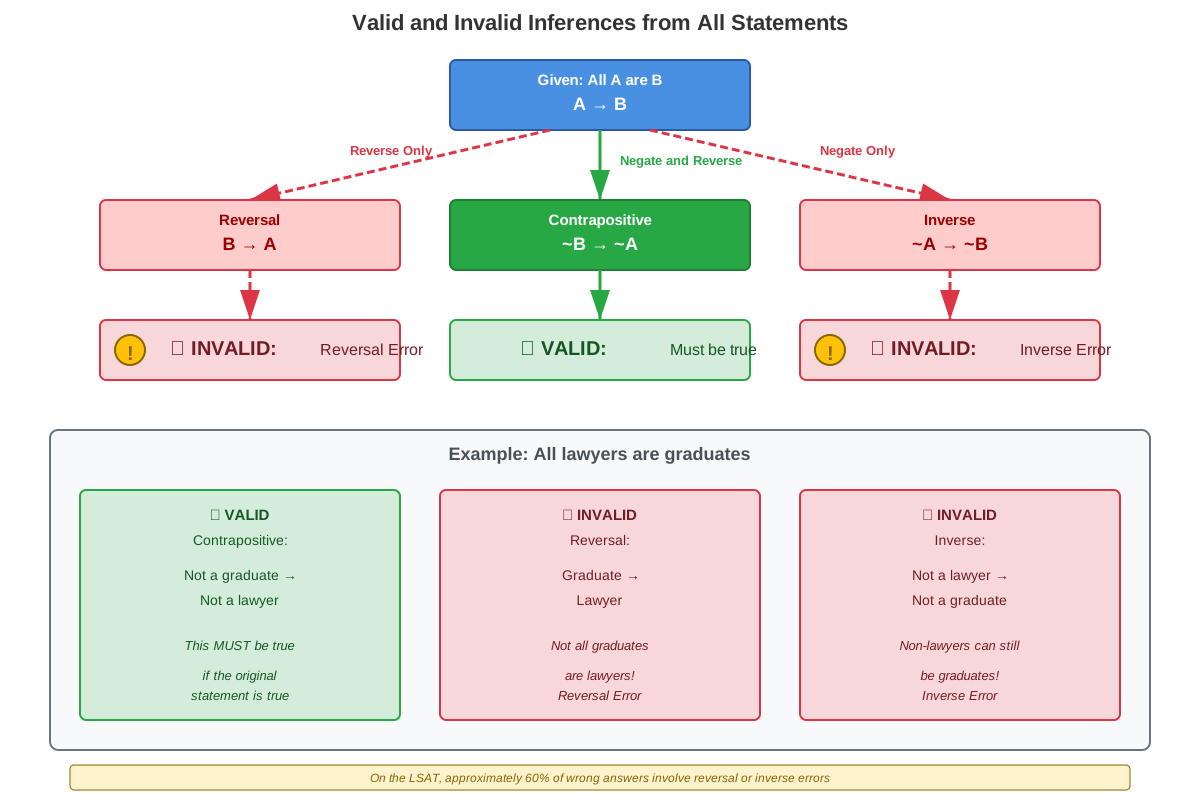
All statements support specific valid inference patterns while prohibiting others. Understanding these patterns prevents logical errors and enables confident answer choice evaluation.
Valid inferences from "All A are B" (A → B):
- Modus Ponens: If something is A, it must be B
- Contrapositive: If something is not B, it cannot be A (~B → ~A)
- Subset relationship: The category A is entirely contained within category B
Invalid inferences (common traps):
- Illicit conversion: "All A are B" does NOT mean "All B are A" (B → A is invalid)
- Affirming the consequent: Knowing something is B tells us nothing definite about whether it's A
- Denying the antecedent: Knowing something is not A tells us nothing definite about whether it's B
The LSAT frequently tests whether students can distinguish valid from invalid inferences. An incorrect answer choice might state "Some B are A" as if it must be true from "All A are B," when in fact we cannot determine whether any, some, or all B are A based solely on the original statement.
Combining Multiple All Statements
When multiple all statements share common terms, they can be chained together to generate new valid inferences through transitive reasoning. If "All A are B" and "All B are C," then "All A are C" follows necessarily:
A → B
B → C
Therefore: A → C
This chaining principle appears frequently in LSAT questions requiring multi-step reasoning. Consider:
- All senators are politicians
- All politicians are public speakers
These statements chain together: Senator → Politician → Public Speaker, yielding the valid inference "All senators are public speakers."
The LSAT tests whether students can correctly chain statements while avoiding invalid combinations. Statements must share a common term in the correct logical position (the necessary condition of one statement must match the sufficient condition of another) for valid chaining to occur.
Quantifier Scope and Exceptions
All statements admit no exceptions—they make absolute universal claims. This absoluteness distinguishes them from "most" statements, "some" statements, and probabilistic claims. A single counterexample definitively refutes an all statement, making them vulnerable to refutation but powerful when established as true.
Understanding quantifier scope prevents misinterpretation of complex statements. In "All students who study diligently pass the exam," the universal quantifier applies only to the subset "students who study diligently," not to all students generally. Proper scope identification ensures accurate translation and inference-making.
Concept Relationships
All statements function as the foundational element within formal logic and quantifiers, connecting directly to conditional logic through their if-then structure. The relationship flows as follows:
All Statements → Conditional Logic → Contrapositive Reasoning → Valid Inference Patterns
Each all statement generates a contrapositive, which itself is an all statement running in the opposite direction with negated terms. This bidirectional relationship creates a closed logical system where information flows both forward (through the original statement) and backward (through the contrapositive).
All statements also connect to categorical syllogisms, where two all statements sharing a common term generate a conclusion through the middle term. This relationship enables multi-step reasoning chains essential for complex LSAT questions.
The connection to necessary and sufficient conditions is direct and fundamental: all statements define sufficient conditions (the subject term) and necessary conditions (the predicate term). Understanding this connection enables students to translate between different logical vocabularies and recognize equivalent formulations.
Within argument structure analysis, all statements frequently serve as major premises in deductive arguments, providing universal rules from which specific conclusions are drawn. Recognizing this role helps students identify assumption gaps, evaluate argument validity, and predict answer choices in assumption-family questions.
Quick check — test yourself on All statements so far.
Try Flashcards →High-Yield Facts
⭐ All statements establish sufficient and necessary conditions: The subject term is sufficient for the predicate term; the predicate term is necessary for the subject term.
⭐ Every all statement has a logically equivalent contrapositive: Negate both terms and reverse their order to form the contrapositive.
⭐ "All A are B" does NOT mean "All B are A": Illicit conversion is the most common error tested on the LSAT regarding all statements.
⭐ All statements can be chained transitively: If A → B and B → C, then A → C follows necessarily.
⭐ A single counterexample refutes an all statement: All statements make absolute universal claims admitting no exceptions.
- "Only B are A" translates to "All A are B" (the terms reverse in only-statements)
- Implicit all statements ("Dogs are mammals") function identically to explicit ones ("All dogs are mammals")
- All statements support modus ponens reasoning: if the sufficient condition is met, the necessary condition must follow
- The contrapositive is the only logically equivalent transformation of an all statement
- All statements appear in approximately 40-50% of Logical Reasoning questions either directly or as components
- Conditional statements ("If X, then Y") are functionally equivalent to all statements ("All X are Y")
- Multiple all statements can combine to create inference chains, but only when terms align correctly
- "Any" functions as a universal quantifier equivalent to "all" in LSAT contexts
Common Misconceptions
Misconception: "All A are B" means the same as "All B are A" (assuming symmetry)
Correction: All statements are directional and non-symmetric. "All lawyers are college graduates" does not mean "All college graduates are lawyers." Only the contrapositive (~B → ~A) is logically equivalent to the original statement.
Misconception: If something is not A, then it cannot be B (denying the antecedent)
Correction: From "All A are B," knowing something is not A tells us nothing definite about whether it's B. Non-A things might be B or might not be B—both possibilities remain open.
Misconception: "All A are B" means that some B must be A
Correction: All statements make no claims about the reverse relationship. It's possible that all A are B while no B are A (if A is an empty set) or while only some B are A. The original statement simply doesn't address this question.
Misconception: "Most A are B" can be treated like "All A are B" for inference purposes
Correction: "Most" statements have entirely different logical properties than all statements. They cannot be diagrammed with arrows, do not generate contrapositives in the same way, and support different inference patterns. The LSAT frequently tests whether students inappropriately treat "most" as "all."
Misconception: All statements with complex subjects apply universally to everything mentioned
Correction: The universal quantifier applies only to the complete subject term. "All students who study pass" applies only to students-who-study, not to all students generally. Proper scope identification is essential for accurate interpretation.
Misconception: The contrapositive changes the meaning of the original statement
Correction: The contrapositive is logically equivalent to the original statement—they have identical truth values and convey the same logical relationship from different perspectives. If one is true, the other must be true; if one is false, the other must be false.
Worked Examples
Example 1: Basic All Statement with Contrapositive
Question: Consider the following statement: "All members of the debate team are honor students." Which of the following must be true?
(A) All honor students are members of the debate team
(B) Some honor students are members of the debate team
(C) Anyone who is not an honor student is not a member of the debate team
(D) Most members of the debate team are honor students
(E) Some members of the debate team are not honor students
Solution:
First, translate the original statement into standard notation:
- "All members of the debate team are honor students"
- Debate Team Member → Honor Student
Next, form the contrapositive by negating both terms and reversing order:
- ~Honor Student → ~Debate Team Member
- Translation: "All non-honor students are non-debate team members" or "Anyone who is not an honor student is not a member of the debate team"
Now evaluate each answer choice:
(A) This commits illicit conversion—reversing the terms without negating them. Invalid.
(B) This might be true, but doesn't MUST be true. If the debate team has zero members (empty set), this would be false. Invalid.
(C) This is the contrapositive of the original statement, which must be true. Correct answer.
(D) This weakens the claim from "all" to "most," which doesn't follow necessarily. Invalid.
(E) This directly contradicts the original all statement. Invalid.
Key takeaway: This question tests whether students can recognize the contrapositive as the only statement that must be true from an all statement. The correct answer (C) demonstrates mastery of contrapositive formation and recognition.
Example 2: Chaining Multiple All Statements
Question: A law firm operates under the following policies:
- All partners attend the annual retreat
- Everyone who attends the annual retreat receives the strategic planning document
- All recipients of the strategic planning document are informed about merger discussions
Based on these policies, which of the following must be true?
(A) All people informed about merger discussions are partners
(B) All partners are informed about merger discussions
(C) Some people who attend the annual retreat are not partners
(D) Most partners receive the strategic planning document
(E) Anyone not informed about merger discussions does not attend the annual retreat
Solution:
First, translate each statement into notation:
- All partners attend annual retreat: Partner → Attend Retreat
- Everyone who attends receives document: Attend Retreat → Receive Document
- All document recipients are informed: Receive Document → Informed
Next, chain these statements together:
Partner → Attend Retreat → Receive Document → Informed
This creates a complete chain: Partner → Informed
The contrapositive of this chain is: ~Informed → ~Partner
Now evaluate answer choices:
(A) This reverses the chain without negating (illicit conversion). Invalid.
(B) This correctly follows the chain from Partner to Informed. Correct answer.
(C) This might be true but doesn't must be true from the given statements. Invalid.
(D) This weakens "all" to "most" without justification. Invalid.
(E) This is the contrapositive of statement 2 only, not the complete chain. While true, it's not as complete as answer (B). However, let's verify: ~Informed → ~Receive Document → ~Attend Retreat. This is actually valid through the contrapositive chain. But (B) more directly answers what must be true about partners specifically.
Key takeaway: This question tests transitive reasoning with multiple all statements. Success requires systematically chaining statements and recognizing that information flows through the entire chain, allowing valid inferences from the first term to the last term.
Exam Strategy
When approaching LSAT questions involving all statements, implement this systematic process:
Step 1: Identify and translate - Scan the stimulus for universal quantifiers (all, every, each, any) and implicit universals. Immediately translate these into arrow notation, clearly identifying sufficient and necessary conditions.
Step 2: Form contrapositives - For each all statement identified, mentally or physically write out the contrapositive. Many correct answers require contrapositive reasoning, so having these ready accelerates answer choice evaluation.
Step 3: Look for chains - When multiple all statements appear, check whether they can be chained by identifying shared terms. Draw out the complete chain to visualize all valid inferences.
Step 4: Predict the answer - Before reading answer choices, predict what must be true, could be true, or cannot be true based on the logical relationships established. This prediction prevents distraction from attractive wrong answers.
Exam Tip: Trigger words for all statements include "all," "every," "each," "any," "only" (reversed), "must," and categorical assertions without qualifiers. Train yourself to automatically translate these into arrow notation.
Time allocation: Spend 15-20 seconds translating and diagramming all statements before evaluating answer choices. This upfront investment saves 30-45 seconds during answer choice evaluation by enabling rapid elimination of invalid inferences.
Process of elimination strategies:
- Immediately eliminate answer choices that commit illicit conversion (reversing without negating)
- Eliminate choices that deny the antecedent or affirm the consequent
- Eliminate choices that weaken "all" to "some" or "most" without justification
- Eliminate choices that claim exceptions to properly established all statements
- Prioritize answer choices that match contrapositives or valid chains
Common trap patterns: The LSAT frequently includes wrong answer choices that reverse all statements (illicit conversion), make claims about the reverse direction that don't follow, or treat "some" and "most" as equivalent to "all." Developing automatic recognition of these patterns enables rapid elimination.
Memory Techniques
Mnemonic for contrapositive formation: "NERD" - Negate Everything, Reverse Direction
Visualization strategy: Picture all statements as one-way streets with arrows. The arrow shows the direction of logical flow (sufficient to necessary). The contrapositive is the same street viewed from the opposite end—you're still on the same street (logically equivalent), just looking the other direction.
Acronym for valid inferences: "MTC" - Modus Ponens (if A, then B), Transitive Chaining (A→B, B→C, therefore A→C), Contrapositive (if not B, then not A)
Memory device for "only" statements: "Only reverses" - When you see "only," reverse the terms before diagramming. "Only B are A" becomes "All A are B" (A → B).
Rhyme for illicit conversion: "Don't reverse without negation, that's a logical violation" - This reminds students that reversing terms without negating them creates an invalid inference.
Physical gesture technique: When forming contrapositives, physically gesture reversing your hands while saying "negate and reverse." This kinesthetic reinforcement strengthens memory through multi-modal learning.
Summary
All statements represent universal quantifier claims asserting that every member of one category possesses a particular characteristic or belongs to another category. These statements form the foundation of formal logic on the LSAT, appearing in approximately 40-50% of Logical Reasoning questions. Mastery requires fluency in translating various linguistic formulations into standard notation (A → B), forming contrapositives by negating both terms and reversing their order (~B → ~A), and recognizing valid versus invalid inference patterns. The most critical skills include avoiding illicit conversion (the invalid reversal of terms without negation), correctly chaining multiple all statements through shared terms, and distinguishing between what must be true versus what could be true from given premises. All statements establish sufficient conditions (the subject term) and necessary conditions (the predicate term), creating directional logical relationships that support modus ponens reasoning and contrapositive equivalence. Students must develop automatic recognition of disguised all statements, including conditional formulations, implicit universals, and "only" statements, while maintaining awareness that all statements admit no exceptions and can be definitively refuted by a single counterexample.
Key Takeaways
- All statements create sufficient-to-necessary conditional relationships that can be diagrammed with arrow notation (A → B)
- The contrapositive (negate both terms, reverse direction) is the only logically equivalent transformation and must be true whenever the original statement is true
- Illicit conversion—reversing terms without negating—is the most frequently tested invalid inference pattern on the LSAT
- Multiple all statements can be chained transitively when they share common terms in the correct logical positions
- All statements appear in numerous linguistic disguises, including "if-then" conditionals, "only" statements, and implicit categorical assertions
- Valid inferences from all statements include modus ponens, contrapositive reasoning, and transitive chaining, while invalid inferences include affirming the consequent and denying the antecedent
- Mastering all statements provides the foundation for understanding complex formal logic, assumption questions, and inference-based question types across the LSAT
Related Topics
Conditional Logic: Building directly on all statements, conditional logic explores the full range of if-then relationships, including those with complex sufficient or necessary conditions. Mastering all statements provides the essential foundation for this more advanced topic.
Some and Most Statements: These quantifier statements have different logical properties than all statements, supporting different inference patterns and requiring distinct diagramming approaches. Understanding all statements first creates a clear contrast for learning these alternative quantifiers.
Necessary and Sufficient Conditions: This topic deepens the understanding of the two components of all statements, exploring how to identify these conditions in complex arguments and how they function in assumption questions.
Formal Logic Chains: Advanced applications of all statement chaining, including complex multi-step inferences, conditional chains with multiple branches, and integration with other logical operators.
Categorical Syllogisms: Classical logical argument forms that combine two all statements (or other categorical statements) to generate conclusions, representing a direct application of all statement reasoning.
Practice CTA
Now that you've mastered the core concepts of all statements, it's time to cement your understanding through active practice. Complete the practice questions associated with this topic, focusing on translating statements into notation, forming contrapositives, and identifying valid inferences. Use the flashcards to drill automatic recognition of all statement variations and contrapositive formation until these skills become second nature. Remember: fluency with all statements unlocks success across the entire Logical Reasoning section, making this practice time one of your highest-yield investments in LSAT preparation. Approach each practice question systematically, diagram clearly, and review both correct and incorrect answers to understand the logical principles at work. Your growing mastery of this foundational topic will pay dividends throughout your LSAT journey!
Sign up free to keep reading
Create a free AnvayaPrep account to finish this LSAT guide on All statements — plus flashcards and practice questions.