Overview
Most statements represent one of the most frequently tested quantifier types in LSAT logical reasoning questions. Unlike absolute quantifiers such as "all" or "none," the quantifier "most" indicates that more than half of a given category possesses a particular characteristic. Understanding how to manipulate, combine, and draw valid inferences from most statements is essential for success on the LSAT, particularly in questions involving formal logic and quantifiers.
The LSAT tests most statements across multiple question types, including Must Be True, Sufficient Assumption, Necessary Assumption, and Parallel Reasoning questions. These statements appear both explicitly (using the word "most") and implicitly (through synonymous expressions like "majority," "more than half," or "usually"). The ability to recognize most statements and understand their logical properties distinguishes high-scoring test-takers from average performers, as these questions often serve as difficulty differentiators in the Logical Reasoning sections.
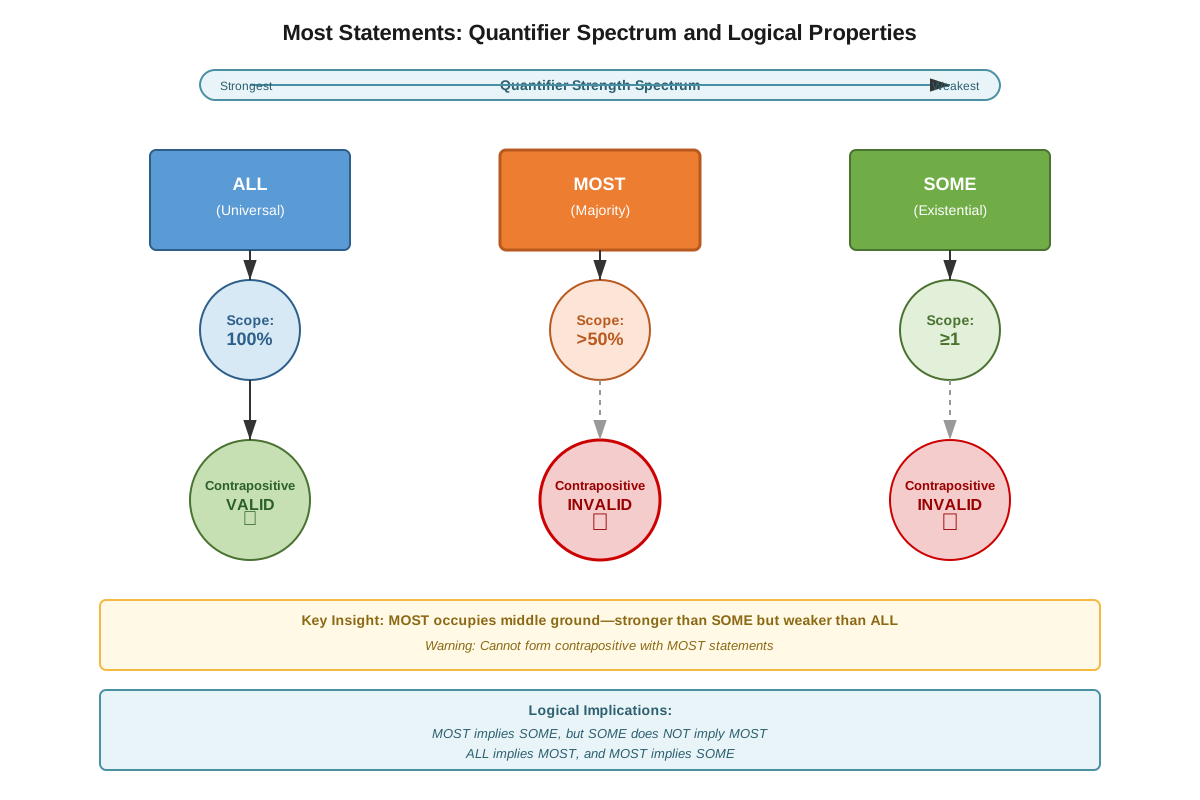
Within the broader landscape of formal logic, most statements occupy a middle ground between universal quantifiers (all/none) and existential quantifiers (some). They share certain properties with each category while maintaining unique characteristics that govern how they can be validly combined and manipulated. Mastering most statements requires understanding not only what they assert but also what they do not assert, what inferences they permit, and what logical operations remain invalid when working with this quantifier type.
Learning Objectives
- [ ] Identify how Most statements appears in LSAT questions
- [ ] Explain the reasoning pattern behind Most statements
- [ ] Apply Most statements to solve LSAT-style problems accurately
- [ ] Distinguish between valid and invalid inferences from most statements
- [ ] Combine multiple most statements to derive logically necessary conclusions
- [ ] Recognize synonymous expressions that function as most statements
- [ ] Diagram most statements using standard formal logic notation
Prerequisites
- Basic quantifier logic: Understanding of "all," "some," and "none" statements provides the foundation for comprehending how "most" functions as a quantifier with distinct logical properties
- Conditional reasoning: Familiarity with sufficient and necessary conditions helps distinguish between the absolute nature of conditional statements and the probabilistic nature of most statements
- Categorical relationships: Knowledge of how categories relate (subset, overlap, disjoint) enables proper interpretation of most statements across multiple categories
- Contrapositive formation: Understanding logical equivalence and negation assists in recognizing what most statements do and do not imply about their negations
Why This Topic Matters
Most statements appear in approximately 15-20% of all Logical Reasoning questions on the LSAT, making them one of the highest-yield topics for focused study. They frequently appear in Must Be True questions, where test-takers must identify what necessarily follows from a set of premises, and in Assumption questions, where understanding the gap between most statements becomes critical.
In real-world contexts, most statements reflect the probabilistic reasoning that dominates legal analysis, policy evaluation, and everyday decision-making. Attorneys regularly work with statistical evidence, majority opinions, and probabilistic claims about outcomes. The LSAT tests whether prospective law students can reason accurately with these non-absolute claims without falling into common logical fallacies.
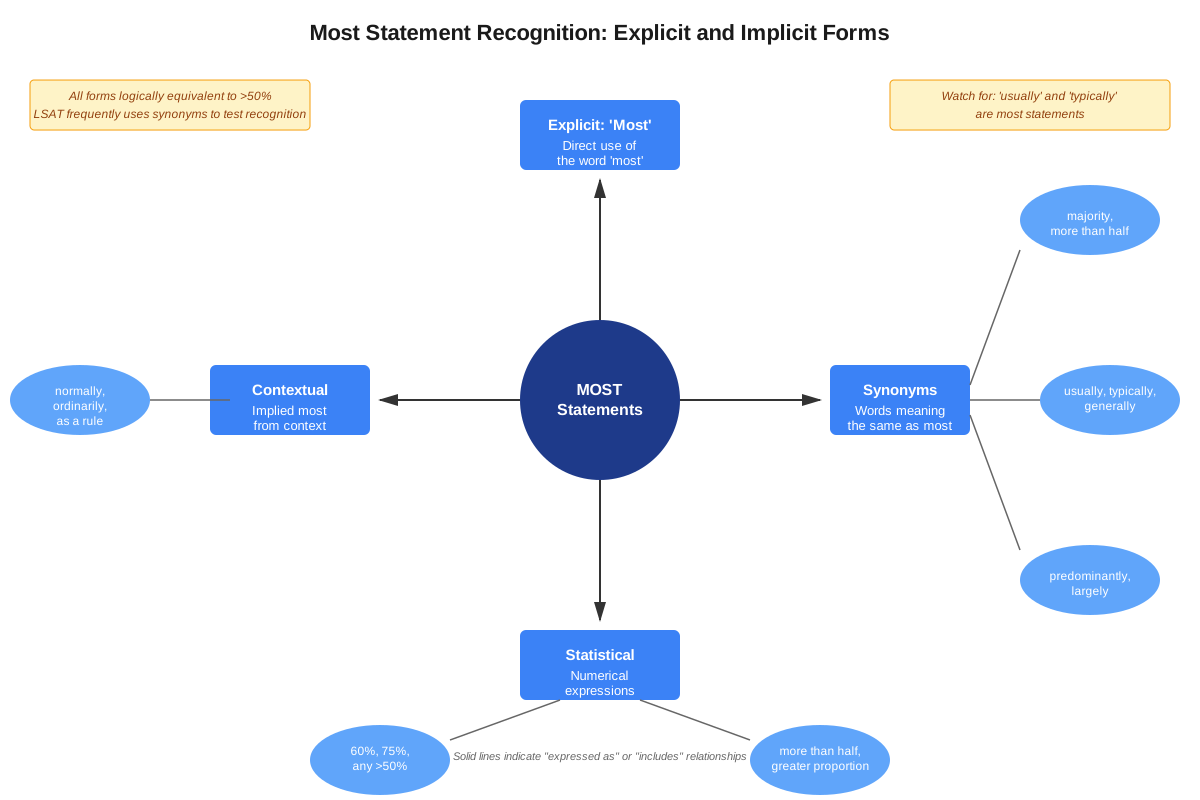
The LSAT presents most statements in several characteristic ways: directly through the word "most," indirectly through synonyms like "majority," "usually," "typically," "generally," or "more than half," and implicitly through statistical claims (e.g., "60% of lawyers"). Questions may provide a single most statement and ask what must be true, present multiple most statements requiring combination, or include most statements within complex argument structures where recognizing their limitations becomes essential for identifying flaws or necessary assumptions.
Core Concepts
Definition and Logical Properties
A most statement asserts that more than 50% of one category possesses a particular characteristic or belongs to another category. The standard form can be expressed as "Most A are B," which means that the majority of things in category A also belong to category B. Mathematically, this requires that the overlap between A and B contains more than half of all A's.
The logical properties of most statements differ significantly from universal quantifiers:
- Most statements are not reversible: "Most A are B" does NOT imply "Most B are A"
- Most statements do not contrapose: "Most A are B" does NOT imply "Most not-B are not-A"
- Most statements guarantee at least one: If most A are B, then at least some A are B
- Most statements guarantee not all of the opposite: If most A are B, then it is not the case that all A are not-B
Diagramming Most Statements
Standard notation for most statements uses an arrow with "M" or "most" above it:
A —most→ BThis diagram reads as "Most A are B." The arrow direction matters critically—reversing it changes the meaning entirely. Some test-takers prefer the notation:
A >50% BThis emphasizes the mathematical reality that more than half of A's are B's. Regardless of notation preference, consistency in diagramming prevents errors when working with multiple statements.
Combining Most Statements
The most powerful—and most tested—aspect of most statements involves combining multiple statements to derive necessary conclusions. The fundamental rule for combination is:
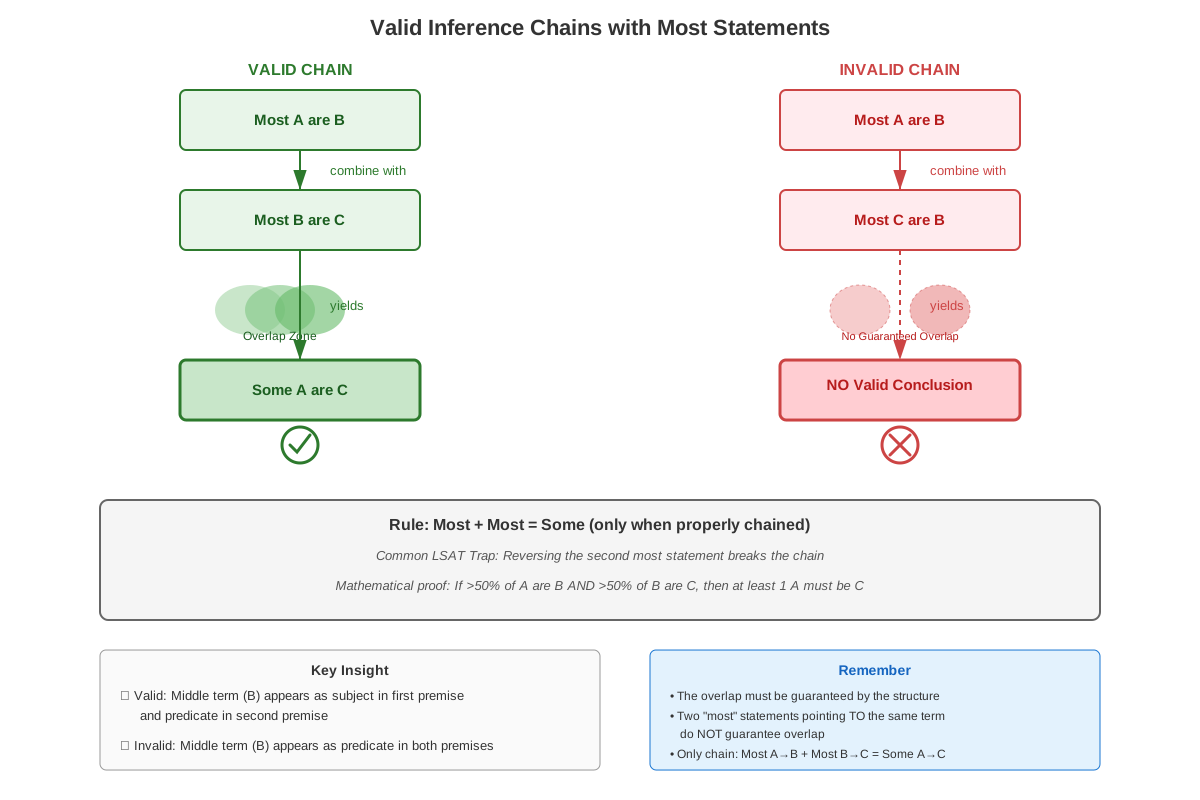
When two most statements share a common middle term, and that term appears in the same position (either as the subject or predicate) in both statements, a valid inference can be drawn.
The valid combination pattern:
Most A are B
Most B are C
Therefore: At least some A are C
This works because if more than 50% of A's are B's, and more than 50% of B's are C's, there must be overlap—some A's must also be C's. However, we cannot conclude "Most A are C" from these premises alone.
The invalid combination pattern:
Most A are B
Most C are B
Therefore: ??? (No valid inference about A and C)
When two most statements both point TO the same category (B in this case), no necessary inference about the relationship between A and C can be drawn. They might overlap completely, partially, or not at all.
Quantitative Reasoning with Most
Understanding most statements numerically helps avoid logical errors. Consider a group of 100 items:
| Statement | Minimum Required | Maximum Possible |
|---|---|---|
| Most A are B | 51 A's are B | 100 A's are B |
| Most A are not-B | 51 A's are not-B | 100 A's are not-B |
| Most A are B AND Most A are C | 2 A's are both B and C | 100 A's are both B and C |
The table reveals that "most" establishes a floor (more than 50%) but no ceiling. This asymmetry creates logical space that the LSAT exploits in wrong answer choices.
Most Statements vs. Conditional Statements
A critical distinction for LSAT success involves recognizing that most statements are NOT conditional statements:
Conditional Statement: All A are B (If A, then B)
- Applies to 100% of cases
- Contraposes validly
- Provides certainty about individual cases
Most Statement: Most A are B
- Applies to >50% of cases
- Does NOT contrapose
- Provides NO certainty about individual cases
This distinction becomes crucial in Flaw questions, where arguments illegitimately treat most statements as if they were conditional statements, and in Sufficient Assumption questions, where strengthening a most statement to a conditional statement may be necessary to make an argument valid.
Synonymous Expressions
The LSAT rarely makes recognition straightforward by always using the word "most." Test-takers must recognize these equivalent expressions:
- Majority
- More than half
- Usually
- Typically
- Generally
- In most cases
- More often than not
- The greater part
- Predominantly
- Primarily (context-dependent)
Additionally, any percentage above 50% (e.g., "60% of lawyers," "three-quarters of students") functions as a most statement.
Negating Most Statements
The negation of "Most A are B" is NOT "Most A are not-B." Instead, the negation is "It is not the case that most A are B," which means "50% or fewer A's are B." This could mean:
- Exactly half of A's are B
- Fewer than half of A's are B
- No A's are B
Understanding proper negation prevents errors in Necessary Assumption questions, where the negation technique requires accurate understanding of what would make a most statement false.
Concept Relationships
Most statements exist within a hierarchy of quantifiers in formal logic. At the strongest level, universal quantifiers ("all" and "none") make claims about 100% of a category. Most statements occupy the middle tier, making claims about more than 50% but less than 100%. Existential quantifiers ("some") represent the weakest claims, asserting only that at least one member exists.
The relationship flows as follows:
All A are B → Most A are B → Some A are BEach arrow represents a valid inference: if all A's are B, then certainly most A's are B, and if most A's are B, then certainly some A's are B. However, these inferences do not reverse—knowing that some A's are B tells us nothing about whether most or all A's are B.
Within the topic itself, the core concepts connect through a logical progression:
Definition and Properties → Diagramming → Combining Statements → Drawing Valid Inferences
Understanding what most statements assert enables proper diagramming, which facilitates recognizing when multiple statements can be combined, which ultimately determines what conclusions can be validly drawn. The quantitative reasoning component supports all other concepts by providing the mathematical foundation that explains why certain inferences work while others fail.
Most statements also connect to conditional reasoning through contrast. Many LSAT questions test whether students understand that most statements lack the certainty and contrapositive properties of conditional statements. This connection appears frequently in Flaw questions and Parallel Reasoning questions.
High-Yield Facts
⭐ Most statements assert that more than 50% of one category belongs to another category
⭐ Most statements do NOT reverse: "Most A are B" does not imply "Most B are A"
⭐ Most statements do NOT contrapose: "Most A are B" does not imply "Most not-B are not-A"
⭐ Two most statements can be validly combined only when they share a common term in the same position
⭐ From "Most A are B" and "Most B are C," you can conclude "At least some A are C" but NOT "Most A are C"
- If most A are B, then at least some A are B (most guarantees some)
- The negation of "Most A are B" is "50% or fewer A's are B," not "Most A are not-B"
- "Usually," "typically," "generally," and "majority" all function as most statements
- Most statements provide no certainty about individual cases, unlike conditional statements
- Three most statements in a chain (Most A→B, Most B→C, Most C→D) guarantee only that some A are D, not that most A are D
Quick check — test yourself on Most statements so far.
Try Flashcards →Common Misconceptions
Misconception: Most statements can be reversed like "some" statements.
Correction: While "Some A are B" does imply "Some B are A," most statements do not reverse. "Most lawyers are wealthy" does NOT mean "Most wealthy people are lawyers." The majority of a smaller group may constitute only a tiny fraction of a larger group.
Misconception: Most statements contrapose like conditional statements.
Correction: "Most A are B" tells us nothing definitive about not-B. Even if most dogs are friendly, we cannot conclude that most unfriendly animals are not dogs. The contrapositive operation, which works for "all" statements, fails for "most" statements.
Misconception: If most A are B and most A are C, then most B are C.
Correction: Two most statements about the same subject category tell us nothing definitive about the relationship between the two predicate categories. Most students might study math AND most students might study English, but this tells us nothing about the relationship between math-studiers and English-studiers.
Misconception: Most statements provide certainty about individual cases.
Correction: Even if most lawyers are wealthy, knowing that Sarah is a lawyer provides no certainty about whether Sarah is wealthy. Most statements describe group properties, not individual certainties. This distinguishes them fundamentally from conditional statements.
Misconception: "Most A are B" means "All A are probably B."
Correction: These statements differ logically. "Most A are B" is a definitive claim about a group (more than 50% definitely are B), while "All A are probably B" makes a probabilistic claim about each individual. The LSAT treats these as distinct logical structures.
Misconception: Combining any two most statements yields a valid conclusion.
Correction: Only specific configurations of most statements combine validly. "Most A are B" and "Most C are B" cannot be combined to reach any conclusion about the relationship between A and C, because both statements point TO B rather than creating a chain through B.
Worked Examples
Example 1: Identifying Valid Inferences
Stimulus: Most corporate attorneys work more than 60 hours per week. Most people who work more than 60 hours per week experience high stress levels.
Question: Which of the following must be true?
Analysis:
Step 1: Diagram the statements
Corporate attorneys —most→ Work >60 hrs/week
Work >60 hrs/week —most→ High stress
Step 2: Identify the pattern
These statements form a valid chain: both most statements point in the same direction, with the predicate of the first statement matching the subject of the second statement.
Step 3: Apply the combination rule
When two most statements chain together (Most A→B, Most B→C), we can validly conclude that at least some A are C. We CANNOT conclude that most A are C.
Step 4: Evaluate answer choices
- ✓ "At least some corporate attorneys experience high stress levels" — VALID (guaranteed by the combination rule)
- ✗ "Most corporate attorneys experience high stress levels" — INVALID (goes beyond what the premises guarantee)
- ✗ "Most people with high stress work more than 60 hours per week" — INVALID (reverses the second statement)
- ✗ "Most people who experience high stress are corporate attorneys" — INVALID (reverses both statements)
Correct Answer: At least some corporate attorneys experience high stress levels.
Connection to Learning Objectives: This example demonstrates how to identify most statements in LSAT questions, apply the reasoning pattern for combining most statements, and distinguish between valid and invalid inferences.
Example 2: Recognizing Invalid Combinations
Stimulus: Most philosophy majors read extensively. Most mathematics majors read extensively.
Question: What can be properly concluded?
Analysis:
Step 1: Diagram the statements
Philosophy majors —most→ Read extensively
Mathematics majors —most→ Read extensively
Step 2: Identify the pattern
Both statements point TO the same category (reading extensively). This is the invalid combination pattern—no middle term connects the two subject categories.
Step 3: Consider the logical space
Imagine 100 people who read extensively. Perhaps 51 are philosophy majors and 51 are mathematics majors. These groups might overlap completely (all 51 philosophy majors are also math majors), partially (some overlap), or not at all (51 philosophy majors + 51 mathematics majors + others = 100+ extensive readers). The premises don't determine which scenario holds.
Step 4: Evaluate what must be true
The only valid conclusion is that at least some people who read extensively are philosophy majors AND at least some people who read extensively are mathematics majors. We cannot conclude anything about the relationship between philosophy majors and mathematics majors themselves.
Valid Conclusions:
- At least some extensive readers are philosophy majors
- At least some extensive readers are mathematics majors
Invalid Conclusions:
- Most philosophy majors are mathematics majors
- Most mathematics majors are philosophy majors
- At least some philosophy majors are mathematics majors (not guaranteed)
Connection to Learning Objectives: This example illustrates the critical distinction between valid and invalid combination patterns, helping students avoid a common trap in LSAT logical reasoning questions.
Exam Strategy
Recognition Phase
When approaching any Logical Reasoning question, scan for trigger words that indicate most statements: "most," "majority," "usually," "typically," "generally," "more than half," or any percentage above 50%. Immediately mark these in your scratch work, as they signal that formal logic rules for most statements will apply.
Exam Tip: The LSAT often disguises most statements. "The majority of cases" and "in most instances" function identically to "most" but may be overlooked by test-takers scanning only for the word "most."
Diagramming Strategy
For questions involving multiple most statements, always diagram before attempting to draw conclusions. Use consistent notation:
- Identify each most statement
- Diagram with arrows showing direction
- Look for valid combination patterns (chains where statements connect)
- Mark invalid patterns (multiple statements pointing to the same term)
Allocate 15-20 seconds for diagramming in complex most statement questions—this investment prevents costly errors and often makes the correct answer immediately apparent.
Process of Elimination
When evaluating answer choices involving most statements:
Eliminate immediately:
- Any answer that reverses a most statement
- Any answer that contraposes a most statement
- Any answer claiming "most" when only "some" is guaranteed
- Any answer treating a most statement as providing certainty about an individual case
Consider carefully:
- Answers using "some" or "at least one" (often correct when most statements combine validly)
- Answers using "could be true" rather than "must be true" (most statements leave logical space for possibilities)
Time Allocation
Most statement questions typically require 1:15 to 1:45 to complete accurately. Questions involving a single most statement should take closer to 1:15, while questions requiring combination of multiple most statements may require up to 1:45. If a question involves three or more most statements, consider flagging it for review if time becomes tight—these questions often serve as difficulty differentiators and may not be worth the time investment if other questions remain.
Common Question Stems
Most statements appear most frequently with these question stems:
- "Which one of the following must be true?"
- "Which one of the following can be properly inferred?"
- "If the statements above are true, which one of the following must also be true?"
- "The statements above, if true, best support which one of the following?"
Memory Techniques
The "More Than Half" Mantra
Whenever encountering a most statement, mentally translate it to "more than half" to maintain mathematical precision. This prevents the common error of treating "most" as "nearly all" or "almost every."
The CHAIN Acronym for Valid Combinations
Common term
Heading in same direction
At least some (conclusion strength)
Inference valid
Not reversible
Visualization: The Venn Diagram Test
When uncertain whether an inference is valid, visualize Venn diagrams:
- Draw circles representing each category
- Shade the region representing "more than half"
- Check whether the conclusion MUST be true in all possible configurations
If you can draw a valid Venn diagram where the conclusion is false, the inference is invalid.
The "Point TO vs. Point THROUGH" Rule
Valid combinations occur when most statements "point through" a common term (A→B→C). Invalid combinations occur when most statements "point to" the same term (A→B, C→B). Visualizing arrows helps distinguish these patterns quickly.
Summary
Most statements represent a critical quantifier type on the LSAT, asserting that more than 50% of one category belongs to another. Unlike universal quantifiers, most statements do not reverse, do not contrapose, and provide no certainty about individual cases. The key to mastering most statements lies in understanding valid combination patterns: when two most statements chain together (Most A→B, Most B→C), at least some A must be C, though we cannot conclude that most A are C. Invalid combinations occur when multiple most statements point to the same category without creating a chain. Success with most statements requires recognizing synonymous expressions (majority, usually, typically), accurately diagramming relationships, distinguishing valid from invalid inferences, and avoiding the temptation to treat most statements as conditional statements. These skills apply across multiple question types, particularly Must Be True and Assumption questions, making most statements one of the highest-yield topics for LSAT preparation.
Key Takeaways
- Most statements assert that more than 50% of one category belongs to another, but they do not reverse or contrapose
- Valid combination requires two most statements to chain together (A→B→C), yielding the conclusion that at least some A are C
- The conclusion from combining two most statements is "at least some," never "most"
- Most statements differ fundamentally from conditional statements—they provide no certainty about individual cases
- Recognition of synonymous expressions (majority, usually, typically, generally) is essential for identifying most statements
- Diagramming prevents errors and reveals valid combination patterns quickly
- The LSAT frequently tests whether students incorrectly reverse or contrapose most statements
Related Topics
Conditional Logic: Understanding how conditional statements (if-then) differ from most statements helps avoid treating probabilistic claims as certainties. Mastering most statements provides foundation for recognizing when arguments illegitimately strengthen most statements to conditional statements.
Some Statements and Existential Quantifiers: Most statements guarantee that "some" relationship exists, making understanding of existential quantifiers essential for drawing valid inferences from most statements.
Formal Logic Chains: Complex arguments often combine multiple quantifier types (all, most, some). Mastering most statements enables accurate analysis of these mixed-quantifier chains.
Necessary vs. Sufficient Assumptions: Many Assumption questions require recognizing that most statements create logical gaps that need strengthening. Understanding most statements enables identification of what additional premises would make arguments valid.
Flaw Questions: Common flaws involve treating most statements as conditional statements or illegitimately reversing most statements. Mastery of most statements enables rapid identification of these logical errors.
Practice CTA
Now that you understand the logical properties and combination rules for most statements, apply this knowledge to practice questions. Focus particularly on questions requiring combination of multiple most statements, as these represent the highest-difficulty applications of this concept. Work through practice sets systematically, diagramming each most statement before attempting to draw conclusions. Review flashcards covering valid and invalid inference patterns until recognition becomes automatic. Remember: most statements appear in 15-20% of Logical Reasoning questions, making this one of the highest-yield topics for your LSAT preparation. Consistent practice with these concepts will translate directly into points on test day.
Sign up free to keep reading
Create a free AnvayaPrep account to finish this LSAT guide on Most statements — plus flashcards and practice questions.