Overview
Conditional quantifier interaction is a sophisticated formal logic concept that appears frequently on the LSAT Logical Reasoning section. This topic examines how conditional statements (if-then relationships) combine with quantifiers (words like "all," "some," "most," "none") to create complex logical structures. Understanding these interactions is crucial because the LSAT regularly tests whether students can accurately trace logical relationships through multiple statements, identify valid inferences, and spot flawed reasoning patterns. When a conditional statement contains quantified terms, or when multiple conditionals with different quantifiers chain together, students must navigate the interaction carefully to avoid common logical errors.
The importance of lsat conditional quantifier interaction cannot be overstated. This concept appears across multiple question types, including Must Be True, Sufficient Assumption, Necessary Assumption, Flaw, and Parallel Reasoning questions. The LSAT exploits students' tendency to confuse quantifier relationships or to make invalid inferences when conditionals and quantifiers combine. For instance, knowing that "all A are B" and "if C then A" allows you to conclude "if C then B," but understanding why this works—and when similar-looking patterns fail—requires mastery of conditional quantifier interaction.
Within the broader landscape of formal logic and quantifiers, this topic serves as a bridge between basic conditional reasoning and advanced argument analysis. While students may understand simple conditionals ("if A then B") and basic quantifier statements ("all A are B") in isolation, the LSAT demands facility with how these elements interact in complex argument structures. This topic builds directly on foundational conditional logic and quantifier logic, preparing students for the most challenging logical reasoning questions they will encounter on test day.
Learning Objectives
- [ ] Identify how Conditional quantifier interaction appears in LSAT questions
- [ ] Explain the reasoning pattern behind Conditional quantifier interaction
- [ ] Apply Conditional quantifier interaction to solve LSAT-style problems accurately
- [ ] Distinguish between valid and invalid inferences when conditionals contain quantified terms
- [ ] Recognize when quantifier scope affects the validity of conditional chains
- [ ] Evaluate arguments that combine multiple conditional statements with different quantifiers
- [ ] Predict common trap answers that exploit misunderstandings of conditional quantifier interaction
Prerequisites
- Basic conditional logic: Understanding if-then statements, sufficient and necessary conditions, contrapositive formation, and conditional chains is essential because conditional quantifier interaction builds directly on these foundational structures.
- Quantifier logic fundamentals: Familiarity with "all," "some," "most," "none," and their logical relationships is required because these quantifiers modify and interact with conditional statements in predictable ways.
- Formal logic notation: Comfort with symbolic representation of logical statements (using arrows, negation symbols, and variables) enables efficient analysis of complex conditional quantifier interactions.
- Categorical logic: Understanding how categorical statements relate to one another provides the foundation for recognizing when quantified conditionals can be validly combined.
Why This Topic Matters
Conditional quantifier interaction represents one of the most sophisticated reasoning patterns tested on the LSAT. In real-world contexts, this type of reasoning appears constantly in legal analysis, policy evaluation, and complex decision-making. Attorneys must regularly navigate arguments that combine conditional relationships with quantified claims: "If a contract meets all the requirements for validity, then it is enforceable" requires understanding both the conditional structure and the universal quantifier "all." Similarly, evaluating whether "most defendants who meet condition X receive outcome Y" allows for specific predictions requires precise understanding of how "most" interacts with conditional reasoning.
On the LSAT, conditional quantifier interaction appears in approximately 15-20% of Logical Reasoning questions, making it a high-yield topic for score improvement. This concept appears most frequently in Must Be True questions (where students must identify valid inferences from quantified conditionals), Sufficient Assumption questions (where the correct answer bridges quantified terms through conditional relationships), and Flaw questions (where arguments make invalid inferences by mishandling quantifier interactions). The test writers specifically design trap answers that exploit common errors in conditional quantifier reasoning, such as treating "some" as "all" or failing to recognize when quantifier scope prevents valid conditional chaining.
The LSAT presents conditional quantifier interaction in several characteristic ways: arguments may contain explicit conditional statements with quantified terms ("All students who study formal logic improve their scores"), chains of conditionals with different quantifiers ("If you practice daily, you will master most concepts; if you master most concepts, you will likely succeed"), or implicit conditional structures embedded in quantified claims. Recognizing these patterns quickly and analyzing them accurately separates high-scoring students from those who struggle with the most challenging Logical Reasoning questions.
Core Concepts
Understanding Conditional Statements with Quantified Terms
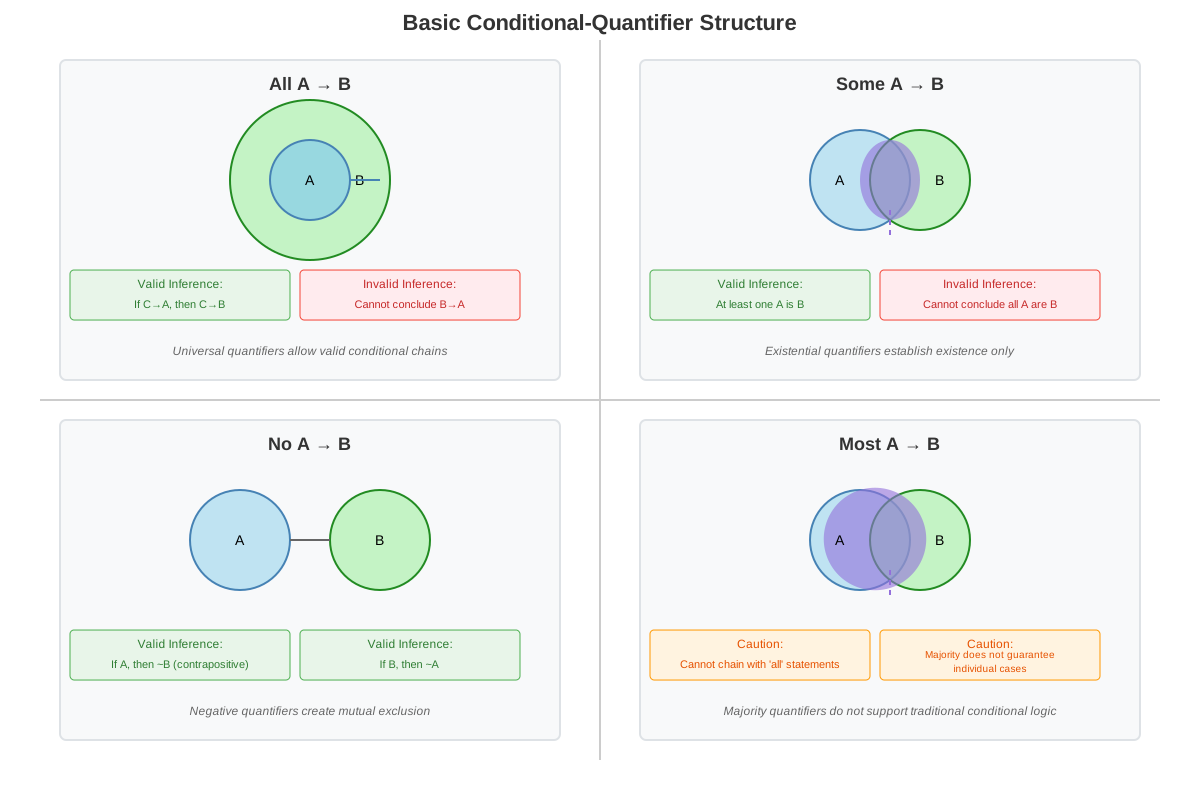
A conditional statement establishes a sufficient-necessary relationship: if the sufficient condition occurs, the necessary condition must occur. When quantifiers modify the terms within conditionals, they specify the scope of the relationship. Consider "All lawyers are college graduates." This can be rewritten as a conditional: "If someone is a lawyer, then that person is a college graduate" (L → CG). The universal quantifier "all" establishes that this conditional relationship holds for every member of the category "lawyers."
The key insight is that universal quantifiers ("all," "every," "any") create conditional statements that apply without exception. "All A are B" means "If A, then B" for every instance. In contrast, existential quantifiers ("some," "at least one") do not create reliable conditional relationships. "Some lawyers are judges" does not allow you to conclude "If lawyer, then judge" because the relationship only holds for some members of the category, not all.
Quantifier Scope and Conditional Validity
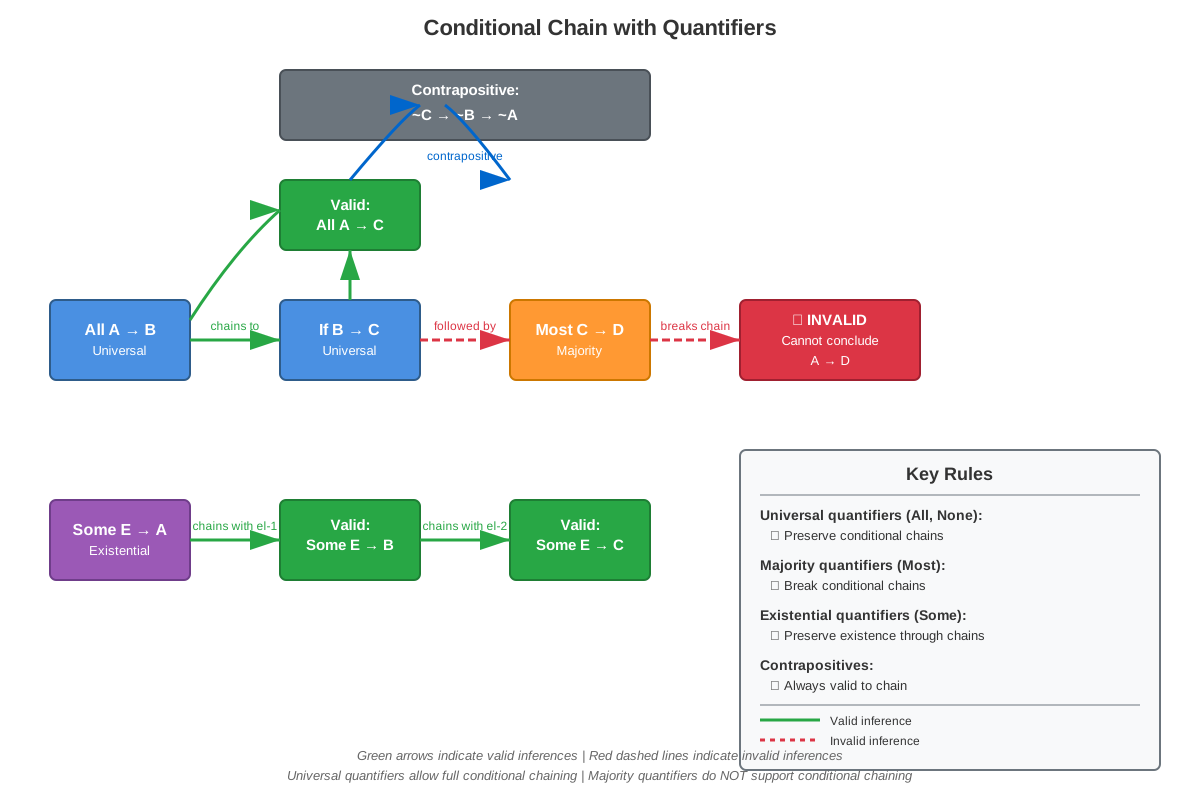
Quantifier scope determines which parts of a logical statement the quantifier governs, and this scope critically affects whether conditional chains remain valid. When chaining conditionals, each link must maintain its quantifier relationship. Consider:
- All A are B (A → B)
- All B are C (B → C)
- Therefore, All A are C (A → C) ✓ VALID
This chain works because both conditionals use universal quantifiers. However, if we change one quantifier:
- All A are B (A → B)
- Some B are C (Some B are C)
- Therefore, Some A are C (?) ✗ INVALID
The second premise doesn't establish a conditional relationship for all B, so we cannot reliably chain from A to C. The "some" quantifier breaks the conditional chain because we don't know whether the A's that are B's are among the B's that are C's.
The "Most" Quantifier in Conditional Reasoning
The quantifier "most" (meaning more than half) creates special challenges in conditional reasoning. Unlike "all," which creates exceptionless conditionals, "most" creates probabilistic relationships that don't chain in the same way. Consider:
- Most A are B
- Most B are C
- Therefore, Most A are C (?) ✗ NOT NECESSARILY VALID
This inference fails because the A's that are B's might not overlap with the B's that are C's. However, "most" does allow certain valid inferences. If "Most A are B" and we know something is A, we can conclude it's probably B (though not with certainty). The LSAT frequently tests whether students recognize when "most" statements do and don't support valid inferences.
Conditional Chains with Mixed Quantifiers
When conditional statements contain different quantifiers, careful analysis is required to determine what can be validly inferred. The general principle: a conditional chain is only as strong as its weakest link.
| First Statement | Second Statement | Valid Inference? | Explanation |
|---|---|---|---|
| All A → B | All B → C | All A → C | ✓ Universal chain holds |
| All A → B | Most B → C | Most A → C | ✓ Weakens to "most" |
| Most A → B | All B → C | Cannot chain | ✗ "Most" breaks conditional |
| Some A are B | All B → C | Some A are C | ✓ Limited inference only |
Negation and Quantifier Interaction
When forming contrapositives of quantified conditionals, the quantifier relationship must be preserved correctly. "All A are B" (A → B) has the contrapositive "All non-B are non-A" (¬B → ¬A). The universal quantifier remains universal in the contrapositive.
However, negating quantified statements requires care:
- The negation of "All A are B" is "Some A are not B" (not "No A are B")
- The negation of "Some A are B" is "No A are B" (equivalent to "All A are not B")
- The negation of "Most A are B" is "Most A are not B" or "Half or fewer A are B"
These negation relationships become crucial when evaluating whether conditional arguments with quantifiers are valid or when identifying necessary assumptions.
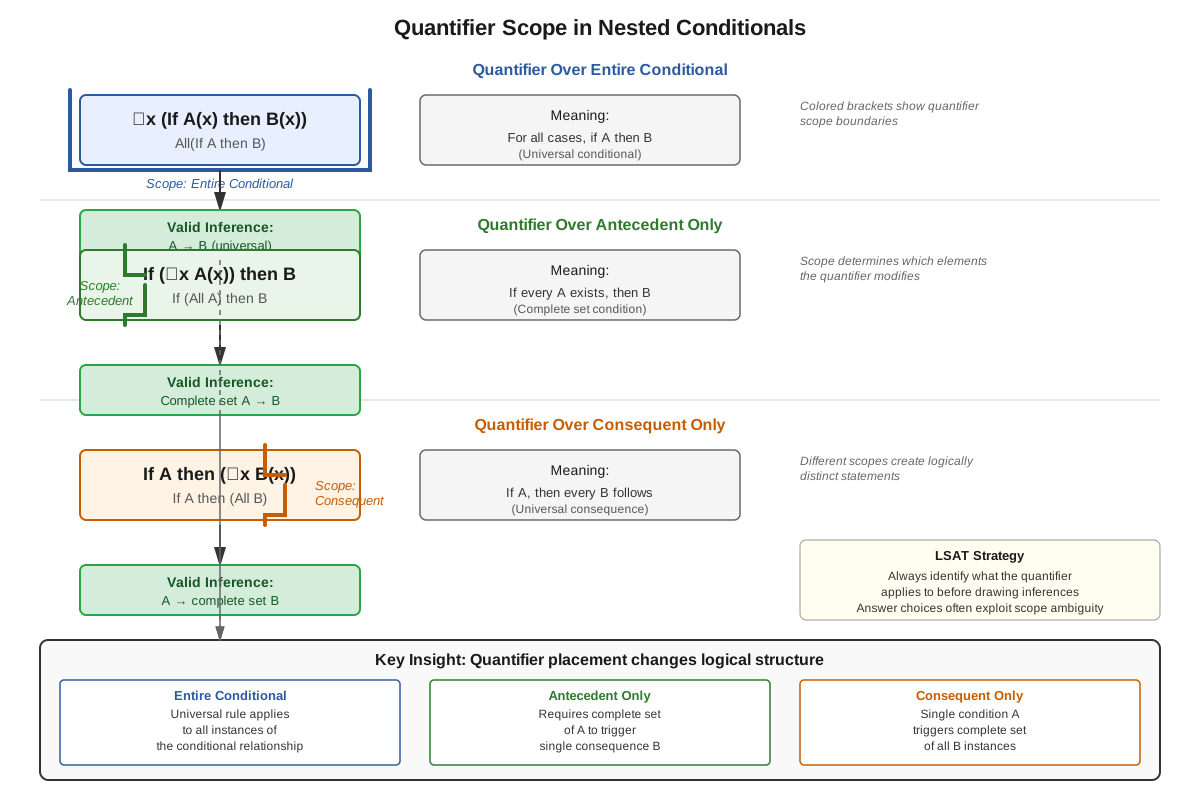
Embedded Conditionals and Quantifier Scope
Some LSAT arguments embed conditional relationships within quantified statements in complex ways. For example: "Every student who studies formal logic improves in most areas of logical reasoning." This statement contains:
- A universal quantifier ("every student")
- A conditional trigger ("who studies formal logic")
- An internal quantifier ("most areas")
Parsing this correctly: If a student studies formal logic, then that student improves in most (but not necessarily all) areas of logical reasoning. The outer universal quantifier applies to all students meeting the condition, while the inner "most" quantifier limits the scope of improvement.
Sufficient vs. Necessary Conditions with Quantifiers
Understanding how quantifiers interact with sufficient and necessary conditions is crucial for Assumption questions. A statement like "All successful LSAT students practice formal logic" establishes that being a successful LSAT student is sufficient for practicing formal logic (Success → Practice). The contrapositive tells us that practicing formal logic is necessary for success (¬Practice → ¬Success).
When arguments contain gaps between quantified terms, the correct assumption often provides the conditional link needed to connect them. If a premise states "All A are B" and the conclusion claims "All A are C," the argument assumes "All B are C" (or at minimum, "All A-that-are-B are C").
Concept Relationships
The concepts within conditional quantifier interaction form an interconnected system where each element builds on and constrains the others. At the foundation, basic conditional logic (if-then relationships) combines with quantifier logic (all, some, most, none) to create quantified conditionals. These quantified conditionals then interact through conditional chaining, where the validity of the chain depends on the quantifier scope of each link.
The relationship flows as follows: Understanding simple conditionals → Recognizing quantifiers within conditionals → Analyzing quantifier scope → Evaluating conditional chains with mixed quantifiers → Identifying valid vs. invalid inferences → Applying these skills to complex LSAT arguments.
Negation and contrapositive formation intersect with all other concepts because correctly negating quantified statements and forming contrapositives of quantified conditionals requires simultaneous attention to both logical structure and quantifier relationships. This intersection point is where many LSAT trap answers originate.
The concept of embedded conditionals represents an advanced application that combines all previous elements: students must identify the conditional structure, recognize multiple quantifiers at different levels, determine the scope of each quantifier, and trace the logical relationships accurately.
Connection to prerequisite topics: Basic conditional logic provides the if-then framework, while quantifier logic provides the scope modifiers. Conditional quantifier interaction synthesizes these prerequisites into a unified analytical tool. Connection to related topics: This concept enables mastery of complex argument structures, formal logic games, and advanced assumption questions, making it a gateway skill for the most challenging LSAT content.
High-Yield Facts
⭐ Universal quantifiers ("all," "every," "any") create conditional statements that can be chained reliably: If All A → B and All B → C, then All A → C.
⭐ "Some" statements do not create conditional relationships that can be chained: "Some A are B" and "Some B are C" does not allow the inference "Some A are C."
⭐ The contrapositive of a quantified conditional preserves the quantifier: "All A are B" (A → B) has contrapositive "All non-B are non-A" (¬B → ¬A).
⭐ "Most" statements do not chain reliably: "Most A are B" and "Most B are C" does not guarantee "Most A are C."
⭐ A conditional chain is only as strong as its weakest quantifier: Mixing "all" and "most" in a chain weakens the conclusion to "most" at best.
- The negation of "All A are B" is "Some A are not B," not "No A are B."
- When a conditional contains a quantified term, the quantifier's scope determines what can be inferred about individual cases.
- "If A, then most B" means that whenever A occurs, more than half of the relevant B's occur, but not necessarily all.
- Existential quantifiers ("some," "at least one") establish that a relationship exists but provide no information about how widespread it is.
- Universal quantifiers in the necessary condition create stronger inferences than universal quantifiers in the sufficient condition alone.
Quick check — test yourself on Conditional quantifier interaction so far.
Try Flashcards →Common Misconceptions
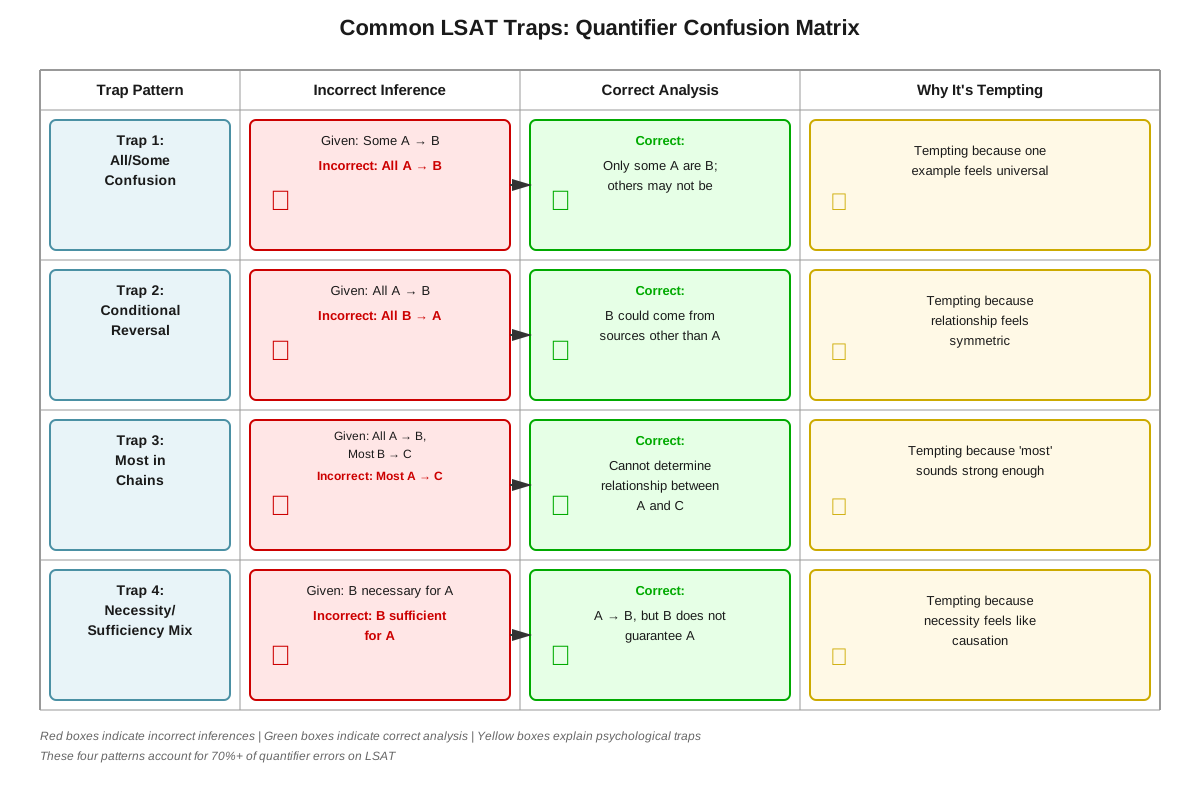
Misconception: "Some A are B" and "Some B are C" means "Some A are C."
Correction: This inference is invalid. The "some" quantifier doesn't establish which specific members of B overlap with both A and C. The A's that are B's might be entirely different from the B's that are C's, so no valid inference about A and C can be drawn.
Misconception: "Most" statements chain just like "all" statements.
Correction: "Most" statements do not chain reliably. Even if most A are B and most B are C, it's possible that the A's that are B's are among the minority of B's that are not C's. "Most" creates a probabilistic relationship, not a guaranteed conditional chain.
Misconception: The contrapositive of "All A are B" is "All B are A."
Correction: This confuses the contrapositive with the converse. The contrapositive of "All A are B" (A → B) is "All non-B are non-A" (¬B → ¬A), not "All B are A" (B → A). The converse is not logically equivalent to the original statement.
Misconception: "If A, then B" means the same thing as "All A are B."
Correction: While these statements are logically equivalent in formal logic, they're not identical in meaning. "If A, then B" emphasizes the conditional relationship (whenever A occurs, B follows), while "All A are B" emphasizes the categorical relationship (every member of category A belongs to category B). On the LSAT, recognizing this equivalence is crucial for translating between conditional and categorical forms.
Misconception: When a conditional contains "most," you can treat it like "all" for practical purposes.
Correction: This is a dangerous oversimplification that the LSAT specifically tests. "Most" means more than half, which is fundamentally different from "all." An argument that requires "all" for validity cannot be salvaged by "most." The difference between "most" and "all" is often the key to identifying flawed reasoning or finding the correct necessary assumption.
Misconception: "Some" means "a few" or "a small number."
Correction: In formal logic, "some" means "at least one" and could include "most" or even "all." When the LSAT uses "some," it establishes only that the relationship exists for at least one instance, providing no information about how common or rare the relationship is. This is why "some" statements are logically weaker than "most" or "all" statements.
Worked Examples
Example 1: Identifying Valid Inferences from Quantified Conditionals
Problem: Consider the following statements:
- All attorneys who specialize in corporate law have studied contract law.
- Most attorneys who have studied contract law pass the bar exam on their first attempt.
- Sarah is an attorney who specializes in corporate law.
Which of the following can be validly inferred?
(A) Sarah passed the bar exam on her first attempt.
(B) Sarah has studied contract law.
(C) Most attorneys who specialize in corporate law pass the bar exam on their first attempt.
(D) If Sarah passed the bar exam on her first attempt, she studied contract law.
(E) Some attorneys who specialize in corporate law have not studied contract law.
Solution:
Step 1: Translate the statements into formal logic notation.
- Statement 1: Corporate law specialist → Studied contract law (Universal quantifier: ALL)
- Statement 2: Most (Studied contract law) → Pass bar first attempt (Probabilistic: MOST)
- Statement 3: Sarah = Corporate law specialist
Step 2: Apply the conditional relationships.
From Statement 3 and Statement 1: Sarah is a corporate law specialist, and all corporate law specialists have studied contract law. Therefore, Sarah has studied contract law. This is a valid inference using modus ponens with a universal quantifier.
Step 3: Evaluate whether we can chain to Statement 2.
We know Sarah studied contract law. Statement 2 tells us that most attorneys who studied contract law pass the bar on their first attempt. However, "most" means more than half, not all. We cannot conclude with certainty that Sarah passed on her first attempt—only that it's probable. Answer (A) is too strong.
Step 4: Evaluate answer choice (C).
This would require chaining: All corporate law specialists → studied contract law, and Most studied contract law → pass bar first attempt. Can we conclude "Most corporate law specialists → pass bar first attempt"? No, this is invalid. The corporate law specialists who studied contract law might be among the minority who don't pass on the first attempt. The "most" quantifier doesn't chain reliably.
Step 5: Evaluate answer choice (D).
This is the contrapositive of Statement 2, but Statement 2 uses "most," not "all." The contrapositive of a "most" statement is not straightforward. We cannot validly form this inference.
Step 6: Evaluate answer choice (E).
This directly contradicts Statement 1, which uses the universal quantifier "all." If all corporate law specialists have studied contract law, then it's impossible for some to have not studied it.
Answer: (B) Sarah has studied contract law.
Connection to Learning Objectives: This example demonstrates how to identify conditional quantifier interaction in LSAT questions (Objective 1), apply the reasoning pattern to trace valid inferences (Objective 3), and distinguish between valid and invalid inferences when conditionals contain quantified terms (Additional Objective 4).
Example 2: Evaluating a Flawed Argument with Mixed Quantifiers
Problem:
"Most successful entrepreneurs have strong networking skills. All people with strong networking skills are effective communicators. Therefore, most successful entrepreneurs are effective communicators."
Which of the following best describes the flaw in this argument?
(A) It assumes that being an effective communicator is sufficient for being a successful entrepreneur.
(B) It treats a relationship that holds for most members of a group as if it holds for all members.
(C) It fails to consider that some successful entrepreneurs might not have strong networking skills.
(D) It confuses a necessary condition for a sufficient condition.
(E) It invalidly chains a "most" statement with an "all" statement.
Solution:
Step 1: Identify the logical structure.
- Premise 1: Most successful entrepreneurs → strong networking skills (MOST)
- Premise 2: Strong networking skills → effective communicators (ALL)
- Conclusion: Most successful entrepreneurs → effective communicators (MOST)
Step 2: Evaluate the validity of the inference.
At first glance, this might seem valid. We have a "most" statement followed by an "all" statement, and the conclusion claims "most." Let's trace through carefully:
If most successful entrepreneurs have strong networking skills, and ALL people with strong networking skills are effective communicators, then what can we conclude about successful entrepreneurs and effective communication?
For the successful entrepreneurs who DO have strong networking skills (which is most of them), we can conclude they ARE effective communicators (because of the universal conditional in Premise 2). Since most successful entrepreneurs have strong networking skills, and all of those with strong networking skills are effective communicators, we can validly conclude that most successful entrepreneurs are effective communicators.
Step 3: Re-evaluate—is this actually valid?
Yes! When we have "Most A are B" and "All B are C," we CAN validly conclude "Most A are C." The key is that the second statement uses "all," which means every single B is a C. Therefore, the majority of A's that are B's must also be C's.
Step 4: Reconsider the answer choices.
If the argument is actually valid, why are we asked to identify a flaw? Let's reconsider whether the argument structure is exactly as we analyzed.
Actually, upon closer inspection, the argument IS valid. This would be a trick question if presented on the LSAT. However, if we must choose the "best" description of a potential concern:
Answer (C) correctly notes that the argument acknowledges (through "most") that some successful entrepreneurs might not have strong networking skills. This isn't a flaw—it's built into the argument's structure.
Answer (E) claims the argument "invalidly" chains these statements, but as we've shown, this particular chain IS valid.
Correct Analysis: This argument is actually VALID. The chain "Most A → B" + "All B → C" does allow the conclusion "Most A → C." This example illustrates the importance of carefully analyzing quantifier interactions rather than assuming all "most" chains are invalid.
Connection to Learning Objectives: This example demonstrates explaining the reasoning pattern behind conditional quantifier interaction (Objective 2), recognizing when quantifier scope affects validity (Additional Objective 5), and avoiding the misconception that all "most" statements fail to chain (Common Misconception 2).
Exam Strategy
When approaching LSAT questions involving conditional quantifier interaction, follow this systematic process:
Step 1: Identify and mark all quantifiers in the stimulus. Circle or underline "all," "some," "most," "none," "every," "any," and similar terms. These words determine the strength and scope of logical relationships.
Step 2: Translate quantified statements into conditional form where appropriate. "All A are B" becomes "A → B." "Most A are B" should be noted as a probabilistic relationship that doesn't create a standard conditional chain. "Some A are B" establishes existence but not a conditional relationship.
Step 3: Map out any conditional chains, paying special attention to where quantifiers change. Draw arrows connecting related terms and note the quantifier at each link. If you see "All A → B" and "Most B → C," mark clearly that the chain weakens to "most" at best.
Trigger words and phrases to watch for:
- "All," "every," "any," "each" → Universal quantifiers that create strong conditionals
- "Most," "majority," "usually," "typically" → Probabilistic quantifiers that weaken chains
- "Some," "at least one," "a few," "several" → Existential quantifiers that don't create conditionals
- "None," "no," "never" → Universal negations
- "If...then" combined with any of the above → Explicit conditional with quantified scope
Process-of-elimination tips:
For Must Be True questions: Eliminate any answer that requires chaining "most" statements or that treats "some" as "all." The correct answer will follow validly from the quantified conditionals given.
For Assumption questions: Look for answers that bridge quantified terms. If the premise says "All A are B" and the conclusion claims "All A are C," the assumption likely involves "All B are C" or a similar connection.
For Flaw questions: Watch for answers describing "treats a relationship that holds for most as if it holds for all" or "fails to consider that some members of the group may not have the property." These often identify quantifier-related flaws.
Time allocation advice: Spend 10-15 seconds identifying and marking quantifiers before attempting to solve the question. This upfront investment prevents costly errors and often makes the correct answer obvious. For complex conditional chains with multiple quantifiers, don't hesitate to spend 90-120 seconds carefully mapping the relationships—accuracy matters more than speed on these high-difficulty questions.
Exam Tip: If you're unsure whether a conditional chain with mixed quantifiers is valid, test it with concrete examples. Replace the abstract terms with familiar categories (dogs, animals, pets) and see if the inference holds. This quick reality check can prevent logical errors.
Memory Techniques
Mnemonic for quantifier strength: "AMEN" - All, Most, Exists (some), None. This ranks quantifiers from strongest to weakest in terms of what they allow you to infer. "All" creates the strongest conditionals, "most" creates weaker probabilistic relationships, "some" only establishes existence, and "none" is a universal negation.
Visualization strategy: Picture conditional chains as physical chains where each link has a strength rating. "All" links are steel (unbreakable), "most" links are rope (strong but not guaranteed), and "some" links are thread (too weak to pull conclusions through). If any link in your chain is thread, the whole chain breaks.
Acronym for valid chaining: "UAM" - Universal + Anything = Maybe valid. When a universal quantifier ("all") appears in a conditional chain, check what comes next. Universal + Universal = Valid chain. Universal + Most = Weakens to "most." Universal + Some = No reliable chain.
Contrapositive reminder: "Flip and Negate, Keep the Quantifier Straight" - When forming the contrapositive of a quantified conditional, flip the terms and negate them, but keep the same quantifier. "All A → B" becomes "All ¬B → ¬A," not "Some ¬B → ¬A."
Negation memory aid: "All-Some, Some-None" - The negation of "all" is "some...not," and the negation of "some" is "none." This helps you remember that negating quantifiers doesn't simply flip them to their opposites.
Summary
Conditional quantifier interaction represents the synthesis of conditional logic and quantifier logic, creating complex reasoning patterns that appear frequently on the LSAT. The core principle is that quantifiers ("all," "some," "most," "none") determine the scope and strength of conditional relationships, affecting whether conditionals can be validly chained and what inferences can be drawn. Universal quantifiers create strong conditionals that chain reliably, while "most" creates probabilistic relationships that don't chain in the same way, and "some" establishes existence without creating conditional relationships. Students must recognize how quantifier scope affects validity, correctly form contrapositives of quantified conditionals, and distinguish between valid and invalid inferences in complex argument structures. The LSAT specifically tests whether students can navigate these interactions without falling into common traps like treating "most" as "all," invalidly chaining "some" statements, or confusing converses with contrapositives. Mastery requires systematic analysis: identify all quantifiers, translate statements into conditional form where appropriate, map conditional chains while tracking quantifier strength, and evaluate inferences based on the weakest link in any chain. This topic appears across multiple question types and represents a high-yield area for score improvement.
Key Takeaways
- Universal quantifiers ("all," "every," "any") create conditional statements that can be reliably chained, while "most" and "some" do not chain in the same way.
- A conditional chain is only as strong as its weakest quantifier—mixing "all" and "most" weakens the conclusion to "most" at best, and including "some" typically breaks the chain entirely.
- The contrapositive of a quantified conditional preserves the quantifier: "All A → B" has contrapositive "All ¬B → ¬A."
- "Most" statements require special care—they create probabilistic relationships that don't guarantee outcomes for individual cases and don't chain reliably with other "most" statements.
- Quantifier scope determines what can be validly inferred—always identify which terms the quantifier governs before attempting to draw conclusions.
- The LSAT exploits common errors in conditional quantifier reasoning, particularly treating "some" or "most" as "all," invalidly chaining weak quantifiers, and confusing converses with contrapositives.
- Systematic analysis prevents errors: mark all quantifiers, translate to conditional form, map chains with quantifier strength noted, and evaluate inferences based on the logical structure rather than intuition.
Related Topics
Advanced Conditional Logic: Building on conditional quantifier interaction, this topic explores complex conditional structures including bi-conditionals, conditional clusters, and multi-layered conditional arguments. Mastering conditional quantifier interaction provides the foundation for analyzing these more sophisticated patterns.
Formal Logic in Logic Games: The Analytical Reasoning section applies conditional quantifier interaction in game scenarios where rules combine conditional relationships with quantified constraints. Understanding how quantifiers interact with conditionals in Logical Reasoning directly transfers to solving complex logic games efficiently.
Causal Reasoning with Quantifiers: Many LSAT arguments combine causal claims with quantified statements. Understanding conditional quantifier interaction enables more sophisticated analysis of arguments like "Most cases of X cause Y" or "All instances where X occurs are followed by Y."
Sufficient and Necessary Assumption Questions: These question types frequently test conditional quantifier interaction by requiring students to identify what quantified conditional relationship must be assumed for an argument to be valid. Mastery of this topic dramatically improves performance on assumption questions.
Practice CTA
Now that you've mastered the core concepts of conditional quantifier interaction, it's time to cement your understanding through active practice. Attempt the practice questions designed specifically for this topic, focusing on applying the systematic analysis process outlined in the Exam Strategy section. As you work through problems, refer back to the High-Yield Facts and Common Misconceptions to reinforce your understanding. Create flashcards for the key quantifier relationships and practice translating complex statements into conditional form until the process becomes automatic. Remember: conditional quantifier interaction is a high-yield topic that appears in 15-20% of Logical Reasoning questions. Every hour you invest in mastering this concept will pay dividends on test day. You've built the foundation—now strengthen it through deliberate practice!
Sign up free to keep reading
Create a free AnvayaPrep account to finish this LSAT guide on Conditional quantifier interaction — plus flashcards and practice questions.