Overview
The contrapositive with all statements is a foundational concept in formal logic and quantifiers that appears frequently throughout the LSAT's Logical Reasoning sections. Understanding how to properly form and apply contrapositives when dealing with universal quantifiers ("all," "every," "any") is essential for success on Must Be True questions, Sufficient Assumption questions, and Parallel Reasoning questions. This skill enables test-takers to recognize logically equivalent statements and draw valid inferences from conditional relationships involving entire categories or groups.
The contrapositive represents one of the most powerful inference tools available on the LSAT because it allows students to derive new, guaranteed-true information from existing statements. When a statement begins with "all," it establishes a sufficient-necessary relationship between two categories. The contrapositive flips and negates both terms, creating a logically equivalent statement that must also be true. Mastering this transformation is non-negotiable for achieving a competitive LSAT score, as the test writers deliberately construct answer choices that test whether students can recognize valid contrapositives versus invalid converses or inverses.
Within the broader landscape of Logical Reasoning, contrapositive reasoning with universal statements connects directly to conditional logic, necessary and sufficient conditions, and formal logic translation. This topic serves as a bridge between basic conditional reasoning (if-then statements) and more complex quantified logic involving "some," "most," and "none." Students who master contrapositives with "all" statements develop the logical precision needed to navigate the LSAT's most challenging formal logic questions and can more easily identify flawed reasoning patterns that violate these logical principles.
Learning Objectives
- [ ] Identify how Contrapositive with all statements appears in LSAT questions
- [ ] Explain the reasoning pattern behind Contrapositive with all statements
- [ ] Apply Contrapositive with all statements to solve LSAT-style problems accurately
- [ ] Translate natural language "all" statements into formal logical notation
- [ ] Distinguish between valid contrapositives and invalid logical transformations (converse and inverse)
- [ ] Recognize disguised "all" statements using equivalent language ("every," "any," "only")
- [ ] Chain multiple contrapositive statements together to reach valid conclusions
Prerequisites
- Basic conditional logic (if-then statements): Understanding simple sufficient-necessary relationships provides the foundation for working with quantified conditionals
- Logical operators (negation, conjunction, disjunction): Knowing how to properly negate terms is essential for forming accurate contrapositives
- Categorical relationships: Familiarity with how groups and categories relate helps in understanding universal quantifiers
- Sufficient and necessary conditions: Recognizing which term is sufficient and which is necessary determines the correct direction of the logical relationship
Why This Topic Matters
In real-world reasoning, contrapositive logic with universal statements underlies legal reasoning, scientific hypothesis testing, and policy analysis. Attorneys regularly use contrapositive reasoning when interpreting statutes and regulations: if a law states "all vehicles must stop at red lights," the contrapositive tells us that anything not stopping at red lights is not following the law. Scientists use contrapositive reasoning to falsify hypotheses: if "all swans are white" were true, finding a non-white bird proves it cannot be a swan.
On the LSAT specifically, contrapositive reasoning with "all" statements appears in approximately 15-20% of Logical Reasoning questions across both sections. This topic is particularly prevalent in Must Be True questions (where the correct answer is often a contrapositive of a premise), Sufficient Assumption questions (where the correct answer completes a logical chain using contrapositive reasoning), and Parallel Reasoning questions (where matching the logical structure requires recognizing contrapositive equivalence). The LSAT also tests this concept in Flaw questions, where incorrect reasoning often involves confusing a statement with its converse rather than its contrapositive.
Exam Tip: The LSAT frequently disguises contrapositive relationships by using varied language. A premise might state "All lawyers are college graduates," while the correct answer expresses the contrapositive as "Anyone who didn't graduate from college is not a lawyer." Training yourself to recognize these equivalent formulations is crucial.
Common manifestations in LSAT passages include rule-based scenarios (where multiple "all" statements create a logical chain), principle application questions (where a general rule must be applied to specific cases), and formal logic games in the Analytical Reasoning section. The test writers deliberately create wrong answer choices that represent invalid transformations, testing whether students truly understand logical equivalence.
Core Concepts
The Structure of "All" Statements
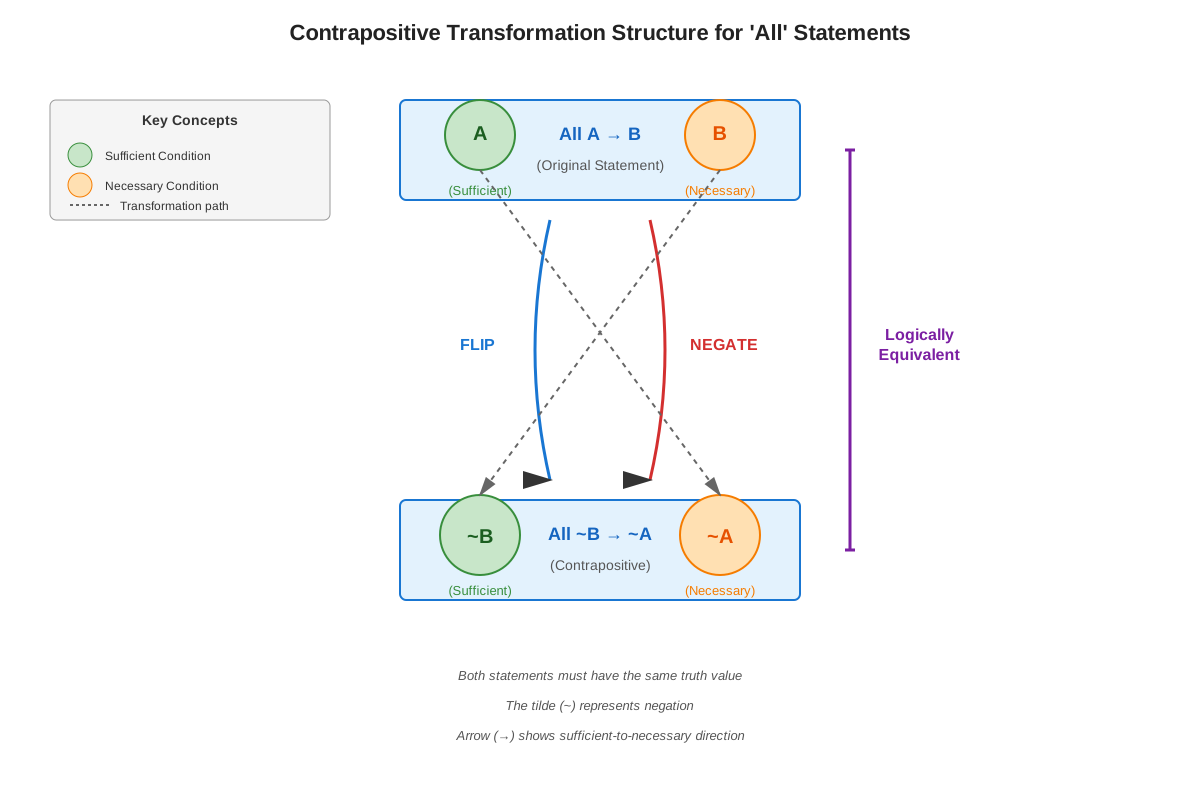
An "all" statement establishes a universal conditional relationship between two categories or properties. The basic form "All A are B" means that being an A is sufficient for being a B, while being a B is necessary for being an A. This creates a sufficient-necessary relationship that can be symbolized as: A → B (read as "if A, then B" or "A is sufficient for B").
The critical insight is that "all" statements are inherently conditional despite not always containing the word "if." When we say "All dogs are mammals," we're actually stating a conditional: "If something is a dog, then it is a mammal." This translation into conditional form makes the logical structure explicit and enables proper contrapositive formation.
Forming the Contrapositive
The contrapositive of any conditional statement is formed by two simultaneous operations: (1) reversing the order of the terms, and (2) negating both terms. For the statement A → B, the contrapositive is ~B → ~A (read as "if not B, then not A"). Crucially, the contrapositive is logically equivalent to the original statement—whenever one is true, the other must also be true.
For "all" statements specifically:
- Original: All A are B (A → B)
- Contrapositive: All non-B are non-A (~B → ~A)
In natural language, if "All lawyers are college graduates" (Lawyer → College Graduate), then the contrapositive is "All non-college graduates are non-lawyers" (~College Graduate → ~Lawyer), which can be expressed more naturally as "If someone is not a college graduate, then they are not a lawyer."
The Negation Component
Proper negation is essential for accurate contrapositive formation. The negation of a category or property is simply "not that category" or "lacking that property." For "All A are B," the negation of A is "non-A" or "not A," and the negation of B is "non-B" or "not B."
Common negation patterns include:
- "All doctors" → negation: "non-doctors" or "not doctors"
- "Honest" → negation: "not honest" or "dishonest"
- "Present" → negation: "absent" or "not present"
- "Legal" → negation: "illegal" or "not legal"
Important: Be careful with compound terms. The negation of "all tall buildings" is "not all tall buildings" (which includes short buildings and non-buildings), not "all short buildings."
Invalid Transformations: Converse and Inverse
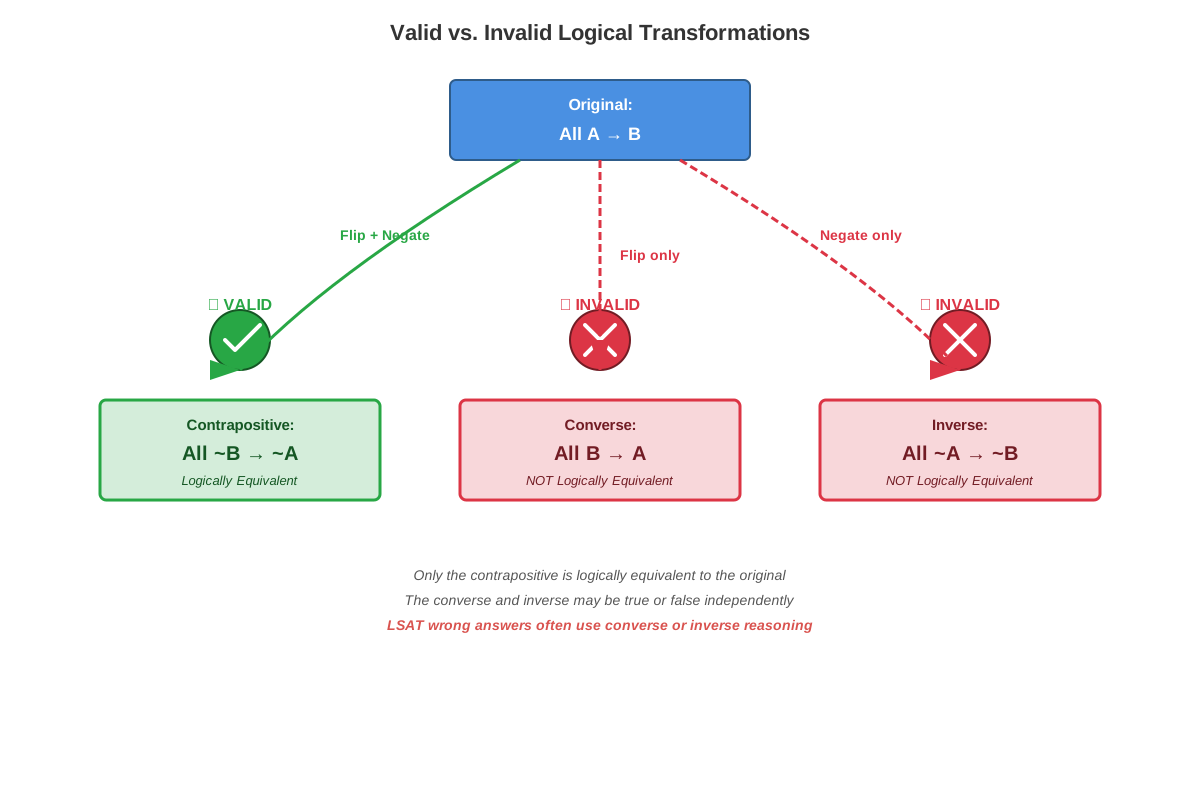
Students must distinguish the valid contrapositive from two invalid transformations that the LSAT frequently uses as trap answers:
| Transformation | Form | Validity | Example |
|---|---|---|---|
| Original | A → B | True (given) | All dogs are mammals |
| Contrapositive | ~B → ~A | Valid (logically equivalent) | All non-mammals are non-dogs |
| Converse | B → A | Invalid | All mammals are dogs ❌ |
| Inverse | ~A → ~B | Invalid | All non-dogs are non-mammals ❌ |
The converse simply reverses the terms without negating (B → A), while the inverse negates both terms without reversing (~A → ~B). Neither transformation is logically valid—they may be true or false independently of the original statement. The LSAT exploits this by offering answer choices that represent converses or inverses, testing whether students can identify the only logically guaranteed inference: the contrapositive.
Equivalent Formulations of "All" Statements
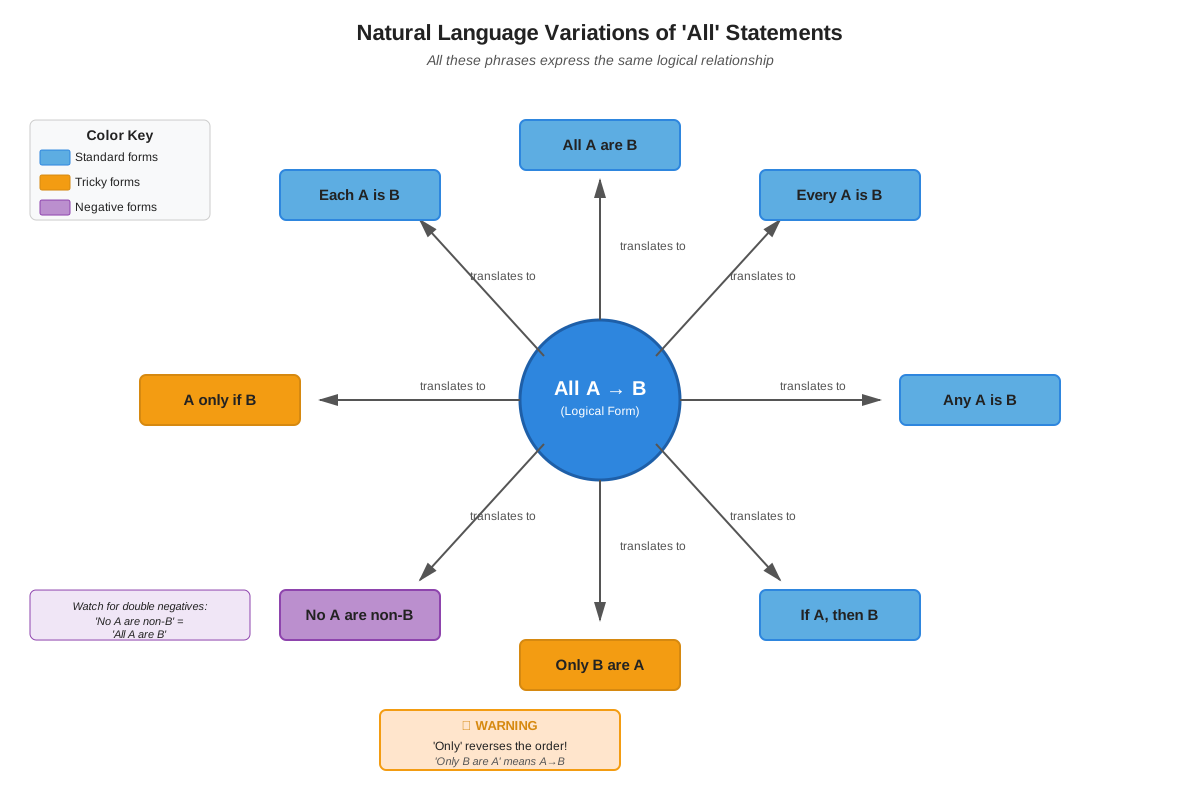
The LSAT expresses universal quantification in numerous ways beyond the word "all." Recognizing these equivalent formulations is essential:
- "Every A is B": Every politician is a public servant → Politician → Public Servant
- "Any A is B": Any student who studies will succeed → Studies → Succeeds
- "Each A is B": Each participant must register → Participant → Registered
- "A are B" (without quantifier): Dogs are animals → Dog → Animal
- "Only B are A": Only members can vote → Vote → Member (note the reversal!)
- "No A without B": No success without effort → Success → Effort
The "only" construction requires special attention because it reverses the order: "Only B are A" means A → B, not B → A. For example, "Only citizens can vote" means Vote → Citizen (if you vote, you must be a citizen), and its contrapositive is ~Citizen → ~Vote (if you're not a citizen, you cannot vote).
Chaining Contrapositive Statements
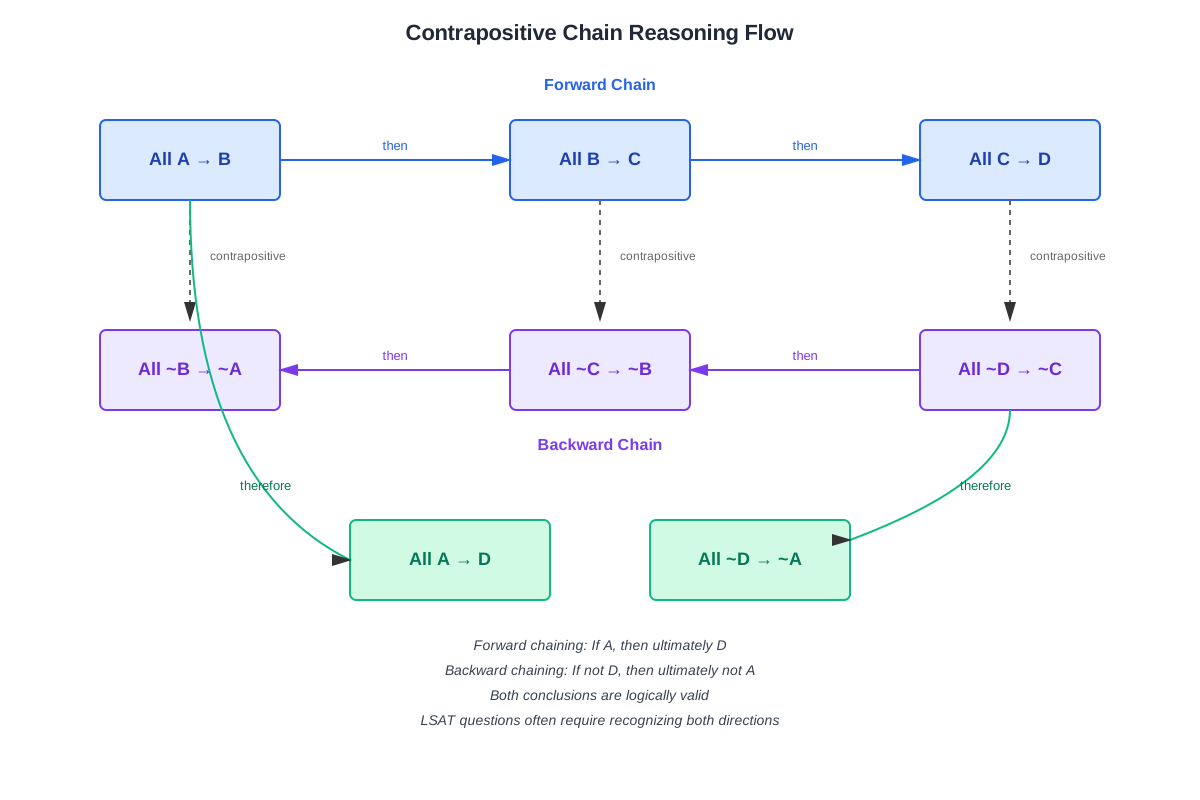
Multiple "all" statements can be chained together to derive new conclusions. When the consequent of one statement matches the antecedent of another, they can be linked:
- All A are B (A → B)
- All B are C (B → C)
- Conclusion: All A are C (A → C)
The contrapositives can also be chained in reverse:
- Contrapositive of statement 2: All non-C are non-B (~C → ~B)
- Contrapositive of statement 1: All non-B are non-A (~B → ~A)
- Conclusion: All non-C are non-A (~C → ~A)
This chaining ability makes contrapositive reasoning particularly powerful on the LSAT, as complex question stems often require linking multiple conditional statements to reach the credited response.
Concept Relationships
The contrapositive with all statements sits at the intersection of several logical reasoning concepts. At its foundation, it builds directly on basic conditional logic, extending simple if-then statements to encompass entire categories rather than individual instances. The sufficient-necessary relationship inherent in "all" statements (A → B) is identical in structure to basic conditionals, but the universal quantifier means the relationship applies to every member of category A without exception.
This topic connects forward to quantifier logic with "some" and "most" statements, though these quantifiers behave differently. While "all" statements have valid contrapositives, "some" statements do not—they only have valid converses. Understanding this distinction prevents logical errors when mixing quantifiers.
The relationship map flows as follows:
Basic Conditional Logic → enables → Sufficient-Necessary Relationships → extends to → Universal Quantifiers ("All") → produces → Contrapositive with All Statements → combines with → Logical Chaining → enables → Complex Formal Logic Reasoning
Additionally, contrapositive reasoning connects to argument structure analysis because recognizing unstated contrapositives helps identify assumptions and strengthen or weaken arguments. It also relates to flaw identification, as many LSAT arguments commit the error of treating a statement as equivalent to its converse or inverse rather than its contrapositive.
High-Yield Facts
⭐ The contrapositive of any "all" statement is formed by reversing the terms and negating both: All A are B becomes All non-B are non-A
⭐ The contrapositive is logically equivalent to the original statement—if one is true, the other must be true
⭐ The converse (B → A) and inverse (~A → ~B) are NOT logically valid transformations
⭐ "Only B are A" translates to A → B, not B → A, and its contrapositive is ~B → ~A
⭐ Multiple "all" statements can be chained together when the consequent of one matches the antecedent of another
- "All," "every," "any," and "each" are equivalent universal quantifiers that create the same logical structure
- The negation of a category is simply "not that category"—the negation of "lawyers" is "non-lawyers"
- On Must Be True questions, the correct answer is frequently a contrapositive of a premise
- Contrapositive reasoning applies identically whether dealing with categories (all dogs), properties (all honest people), or conditions (all who study)
- The LSAT often expresses contrapositives using different vocabulary than the original statement to test true comprehension
- When an argument assumes a converse is true, it commits a formal logical flaw
- Recognizing that a statement and its contrapositive are equivalent helps eliminate redundant answer choices
Quick check — test yourself on Contrapositive with all statements so far.
Try Flashcards →Common Misconceptions
Misconception: The converse of an "all" statement must be true if the original is true.
Correction: The converse (B → A) is not logically valid. "All dogs are mammals" does NOT mean "all mammals are dogs." Only the contrapositive is guaranteed to be true.
Misconception: "Only A are B" means the same as "All A are B."
Correction: "Only A are B" actually means B → A (the reverse). "Only citizens can vote" means Vote → Citizen, not Citizen → Vote. The word "only" modifies the sufficient condition, not the necessary condition.
Misconception: The contrapositive of "All A are B" is "All B are A."
Correction: This is the converse, not the contrapositive. The contrapositive requires both reversal AND negation: "All non-B are non-A." You must perform both operations, not just one.
Misconception: Negating "all" produces "none."
Correction: The negation of "all A are B" is "some A are not B" or "not all A are B," not "no A are B." However, when forming a contrapositive, you negate the individual terms (A and B), not the quantifier "all."
Misconception: If the original statement is false, the contrapositive must also be false.
Correction: While the contrapositive and original are logically equivalent (both true or both false together), this misconception confuses logical equivalence with truth value. If the original is false, the contrapositive is indeed also false, but students sometimes think they're independent.
Misconception: Contrapositive reasoning only applies to formal logic questions.
Correction: Contrapositive reasoning appears throughout Logical Reasoning, including in everyday arguments about policies, rules, and principles. Recognizing implicit contrapositives strengthens argument analysis across all question types.
Misconception: "Not all A are B" is the contrapositive of "All A are B."
Correction: "Not all A are B" is simply the negation of the entire statement, not its contrapositive. The contrapositive maintains the "all" quantifier but applies it to the negated terms: "All non-B are non-A."
Worked Examples
Example 1: Basic Contrapositive Formation
Question Stem: "All members of the debate team are honor students. Which one of the following must be true?"
Analysis:
First, identify the logical structure of the given statement:
- Original: All debate team members are honor students
- Formal notation: Debate Team → Honor Student
Next, form the contrapositive by reversing and negating both terms:
- Contrapositive: ~Honor Student → ~Debate Team
- Natural language: All non-honor students are not on the debate team
- Alternative phrasing: If someone is not an honor student, then they are not on the debate team
Answer choices (typical):
- (A) All honor students are on the debate team [This is the CONVERSE - invalid]
- (B) Some debate team members are not honor students [This CONTRADICTS the original - invalid]
- (C) If someone is not an honor student, they are not on the debate team [This is the CONTRAPOSITIVE - CORRECT]
- (D) No honor students are on the debate team [This CONTRADICTS the original - invalid]
- (E) Most people who are not on the debate team are not honor students [This introduces "most" which cannot be inferred from "all"]
Correct Answer: (C)
Reasoning: Only the contrapositive must be true given the original statement. Choice (A) is the converse, which is a classic trap. The original tells us that being on the debate team is sufficient for being an honor student, but it doesn't tell us that being an honor student is sufficient for being on the debate team. Choice (C) correctly expresses the contrapositive, even though it uses different wording than a mechanical translation might produce.
Example 2: Chaining with Contrapositives
Question Stem: "All successful entrepreneurs are risk-takers. All risk-takers are optimists. Therefore, which one of the following can be properly concluded?"
Analysis:
Identify both conditional statements:
- Successful Entrepreneur → Risk-Taker
- Risk-Taker → Optimist
Chain them together:
- Successful Entrepreneur → Risk-Taker → Optimist
- Simplified: Successful Entrepreneur → Optimist
Form the contrapositive of the chain:
- ~Optimist → ~Risk-Taker → ~Successful Entrepreneur
- Simplified: ~Optimist → ~Successful Entrepreneur
- Natural language: All non-optimists are not successful entrepreneurs
- Alternative: If someone is not an optimist, they are not a successful entrepreneur
Answer choices (typical):
- (A) All optimists are successful entrepreneurs [CONVERSE of the chain - invalid]
- (B) All successful entrepreneurs are optimists [Direct chain conclusion - CORRECT]
- (C) Some risk-takers are not successful entrepreneurs [Cannot be determined - may be true but not proven]
- (D) If someone is not an optimist, they are not a successful entrepreneur [Contrapositive of chain - ALSO CORRECT]
- (E) No pessimists are risk-takers [Too strong - we only know ~Optimist → ~Risk-Taker, but "pessimist" may not equal "non-optimist"]
Correct Answers: Both (B) and (D) must be true. (B) represents the direct chain, while (D) represents the contrapositive of that chain.
Reasoning: This example demonstrates how multiple "all" statements can be linked together and how both the resulting chain and its contrapositive are valid inferences. The LSAT frequently tests whether students can recognize both forward chains and contrapositive chains as equally valid. Notice that choice (E) is a trap that introduces a term ("pessimist") that may seem like the opposite of "optimist" but isn't necessarily logically equivalent to "non-optimist."
Exam Strategy
When approaching LSAT questions involving contrapositive with all statements, follow this systematic process:
Step 1: Identify Universal Quantifiers
Scan the stimulus for "all," "every," "any," "each," "only," and equivalent constructions. Underline or circle these trigger words immediately. Remember that "only" reverses the typical order.
Step 2: Translate to Formal Notation
Convert each "all" statement into arrow notation (A → B). This makes the logical structure explicit and prevents errors. Write this notation in the margin or in your scratch work.
Step 3: Form Contrapositives Immediately
For each conditional statement, write out its contrapositive (~B → ~A) before looking at answer choices. Having both the original and contrapositive visible prevents you from being fooled by converses or inverses.
Step 4: Chain When Possible
If multiple statements share terms, link them together. Look for patterns where the consequent of one statement matches the antecedent of another.
Step 5: Evaluate Answer Choices Systematically
Compare each answer choice against your formal notation. Ask: "Is this the original statement, its contrapositive, or an invalid transformation?"
Time-Saving Tip: On Must Be True questions, immediately eliminate any answer choice that represents a converse or inverse. These are never correct. Focus your time on distinguishing between the contrapositive and other valid inferences.
Trigger Words and Phrases to Watch For:
- "Must be true": Look for contrapositives of given statements
- "Properly inferred": Same as must be true—contrapositives are always properly inferred
- "If the statements above are true": Signals that you should form contrapositives and chains
- "Assumption required": May need to identify a missing link in a contrapositive chain
- "Flaw in reasoning": Often involves treating a converse or inverse as valid
Process of Elimination Tips:
- Eliminate any answer choice that represents the converse (B → A) unless the question specifically asks for what could be true
- Eliminate any answer choice that represents the inverse (~A → ~B)
- Eliminate answer choices that introduce new quantifiers ("some," "most") not supported by "all" statements
- Eliminate answer choices that weaken or contradict the original statement
- Keep answer choices that represent either the original statement, its contrapositive, or valid chains
Time Allocation:
Spend 15-20 seconds translating statements into formal notation, 10-15 seconds forming contrapositives, and 30-40 seconds evaluating answer choices. Don't rush the translation phase—accuracy here prevents time-consuming errors later.
Memory Techniques
Mnemonic for Contrapositive Formation: "FRAN"
- Flip the terms (reverse order)
- Remember to negate
- Apply to both terms
- Now you have the contrapositive
Visualization Strategy: The Arrow Reversal
Picture the arrow in A → B as a physical arrow. To form the contrapositive, imagine grabbing both ends of the arrow, flipping it completely around (so it points the opposite direction), and adding a "NOT" sign to each end. This visual reinforces both operations: reversal and negation.
Acronym for Invalid Transformations: "CI-TRAP"
- Converse
- Inverse
- TRAP answers on the LSAT
When you see an answer choice that looks too simple or obvious, check if it's a CI-TRAP.
The "Only" Rule Rhyme:
"When you see the word 'only,' flip it—don't be lonely!"
This reminds you that "Only B are A" means A → B (the reverse of what it might seem).
Chaining Visualization:
Think of conditional statements as train cars that can only connect when the back of one car (consequent) matches the front of the next car (antecedent). If they don't match, they can't connect.
Summary
Contrapositive reasoning with all statements represents a cornerstone of formal logic on the LSAT, appearing in approximately 15-20% of Logical Reasoning questions. The fundamental principle is straightforward: any statement of the form "All A are B" (A → B) has a logically equivalent contrapositive "All non-B are non-A" (~B → ~A), formed by reversing the terms and negating both. This equivalence is absolute—whenever the original statement is true, the contrapositive must also be true, and vice versa. Students must distinguish this valid transformation from two invalid ones: the converse (B → A) and the inverse (~A → ~B), which the LSAT frequently uses as trap answers. Mastery requires recognizing equivalent formulations of "all" statements (including "every," "any," "each," and the reversed "only"), properly negating terms, and chaining multiple conditional statements together. Success on contrapositive questions depends on systematic translation into formal notation, immediate formation of contrapositives, and careful evaluation of answer choices against these logical structures.
Key Takeaways
- The contrapositive of "All A are B" is "All non-B are non-A"—reverse the terms and negate both
- The contrapositive is logically equivalent to the original statement; the converse and inverse are not valid
- "Only B are A" translates to A → B (reversed), with contrapositive ~B → ~A
- Multiple "all" statements can be chained when the consequent of one matches the antecedent of another
- On Must Be True questions, the correct answer is frequently a contrapositive of a premise
- Always translate "all" statements into formal notation (A → B) before evaluating answer choices
- The LSAT tests whether you can recognize contrapositives expressed in varied natural language, not just mechanical translations
Related Topics
Conditional Logic with "Some" Statements: While "all" statements have valid contrapositives, "some" statements behave differently—they have valid converses but not contrapositives. Understanding this distinction prevents logical errors when mixing quantifiers.
Necessary vs. Sufficient Conditions: Deepening your understanding of which term in an "all" statement is necessary and which is sufficient enhances your ability to form accurate contrapositives and recognize the logical relationships.
Formal Logic Chains and Diagrams: Building on contrapositive reasoning, complex formal logic questions require diagramming multiple conditional relationships and identifying valid inference chains.
Argument Assumptions with Conditional Logic: Many assumption questions involve identifying missing links in conditional chains, often requiring recognition of unstated contrapositives.
Flaw Questions: Confusing Necessary and Sufficient: Understanding contrapositives helps identify when arguments illegitimately treat a statement as equivalent to its converse, a common logical flaw on the LSAT.
Mastering contrapositive reasoning with all statements provides the foundation for these advanced topics and significantly improves performance across all Logical Reasoning question types.
Practice CTA
Now that you've mastered the core concepts of contrapositive reasoning with all statements, it's time to reinforce your learning through active practice. Attempt the practice questions designed specifically for this topic, focusing on translating statements into formal notation, forming accurate contrapositives, and distinguishing valid inferences from trap answers. Use the flashcards to drill the key distinctions between contrapositives, converses, and inverses until recognizing these patterns becomes automatic. Remember: understanding the theory is only the first step—consistent practice transforms knowledge into the rapid, accurate reasoning skills that lead to LSAT success. You've built a strong foundation; now apply it with confidence!
Sign up free to keep reading
Create a free AnvayaPrep account to finish this LSAT guide on Contrapositive with all statements — plus flashcards and practice questions.