Overview
Confusing necessary and sufficient conditions is one of the most frequently tested logical flaws on the LSAT, appearing regularly in Flaw Questions within the Logical Reasoning section. This error occurs when an argument mistakenly treats a necessary condition as if it were sufficient, or vice versa. Understanding this distinction is fundamental to success on the LSAT because the exam writers deliberately craft arguments that exploit this confusion, testing whether students can identify when an argument has illegitimately reversed or confused the logical relationship between conditions.
The ability to spot this flaw is essential because it appears not only in dedicated flaw questions but also influences performance on Assumption, Strengthen/Weaken, and Parallel Reasoning questions. When test-takers fail to recognize this confusion, they often select trap answer choices that seem superficially correct but actually perpetuate the same logical error. Mastering this concept provides a significant competitive advantage, as it represents a pattern that, once recognized, becomes immediately identifiable across multiple question types.
Within the broader landscape of Logical Reasoning, lsat confusing necessary and sufficient conditions connects directly to conditional reasoning, formal logic, and argument structure analysis. This flaw represents a specific type of reasoning error where the logical architecture of an argument breaks down due to misunderstanding the directional nature of conditional relationships. Students who master this topic develop sharper analytical skills that transfer to recognizing other structural flaws and understanding how premises must properly support conclusions.
Learning Objectives
- [ ] Identify how Confusing necessary and sufficient appears in LSAT questions
- [ ] Explain the reasoning pattern behind Confusing necessary and sufficient
- [ ] Apply Confusing necessary and sufficient to solve LSAT-style problems accurately
- [ ] Distinguish between necessary and sufficient conditions in complex conditional statements
- [ ] Recognize the logical structure of arguments that commit this flaw
- [ ] Predict trap answer choices that exploit confusion about necessary and sufficient conditions
- [ ] Construct valid counterexamples that expose the flaw in arguments confusing these conditions
Prerequisites
- Basic conditional logic: Understanding "if-then" statements is essential because necessary and sufficient conditions are defined through conditional relationships
- Argument structure identification: Recognizing premises and conclusions allows students to see where the logical gap occurs when conditions are confused
- Formal logic notation: Familiarity with symbolic representation (A → B) helps visualize the directional nature of conditional relationships
- Contrapositive understanding: Knowing how to form valid contrapositives prevents confusion with invalid reversals
Why This Topic Matters
In real-world reasoning, confusing necessary and sufficient conditions leads to faulty decision-making across professional and personal contexts. A doctor who confuses a necessary symptom for a sufficient diagnosis might misdiagnose patients. A business analyst who treats a necessary condition for success as sufficient might recommend flawed strategies. Legal reasoning, which the LSAT is designed to test, constantly requires distinguishing between what must be present (necessary) and what guarantees an outcome (sufficient).
On the LSAT specifically, this flaw appears in approximately 10-15% of all Flaw Questions, making it one of the highest-yield patterns to master. The flaw also appears indirectly in Assumption questions (where the assumption bridges the gap created by the confusion), Strengthen/Weaken questions (where answer choices exploit the distinction), and Parallel Reasoning questions (where the logical structure must match). According to LSAT preparation data, students who master this distinction improve their Logical Reasoning scores by an average of 2-3 points.
This topic appears in exam passages through several common formats: arguments about qualifications or requirements (confusing what's needed to qualify with what guarantees qualification), causal reasoning (confusing necessary causes with sufficient causes), and conditional predictions (confusing necessary preconditions with sufficient guarantees). The LSAT writers particularly favor scenarios involving rules, regulations, policies, and scientific or social phenomena where the distinction between necessary and sufficient becomes crucial.
Core Concepts
Defining Necessary Conditions
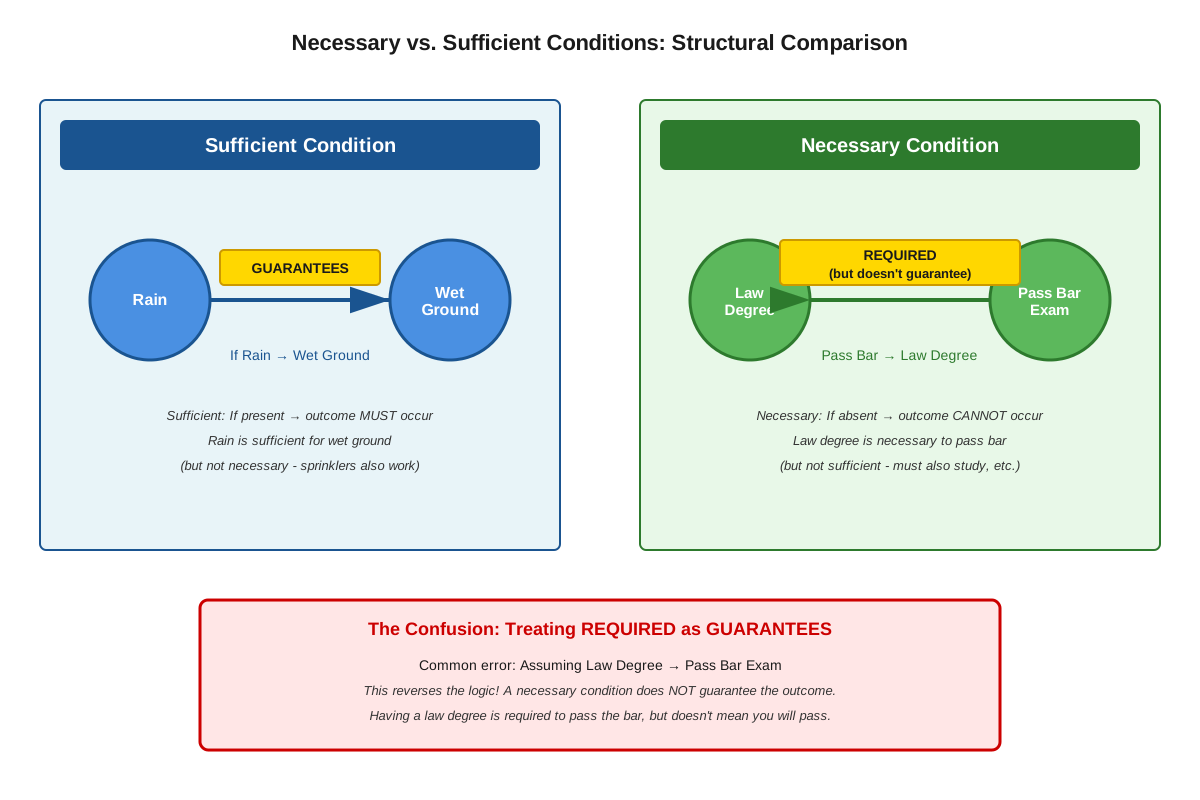
A necessary condition is something that must be present for a particular outcome to occur, but its presence alone does not guarantee that outcome. In conditional logic, if "A → B," then B is necessary for A. This means: you cannot have A without B, but you can have B without A.
Consider the statement: "If you are a lawyer, then you passed the bar exam." Passing the bar exam is necessary for being a lawyer—you cannot be a lawyer without having passed it. However, passing the bar exam is not sufficient to make you a lawyer; many people pass the bar but never practice law or let their licenses lapse.
The key insight is that necessary conditions set minimum requirements or prerequisites. They establish what must be true but don't tell us what's enough to guarantee an outcome. In everyday language, necessary conditions often appear with phrases like "only if," "requires," "depends on," "prerequisite," and "without which not."
Defining Sufficient Conditions
A sufficient condition is something that, when present, guarantees a particular outcome, but it is not the only way that outcome can occur. In conditional logic, if "A → B," then A is sufficient for B. This means: whenever you have A, you definitely have B, but B might occur through other means as well.
Using the same conditional: "If you are a lawyer, then you passed the bar exam." Being a lawyer is sufficient for having passed the bar exam—if someone is a lawyer, we can be certain they passed the bar. However, being a lawyer is not necessary for having passed the bar; as noted, many non-lawyers have passed it.
Sufficient conditions provide guarantees or automatic triggers. They establish what's enough to ensure an outcome, even if other paths to that outcome exist. In everyday language, sufficient conditions often appear with phrases like "if," "whenever," "guarantees," "ensures," and "is enough for."
The Logical Relationship
The relationship between necessary and sufficient conditions is directional and asymmetric. This table clarifies the distinction:
| Aspect | Necessary Condition | Sufficient Condition |
|---|---|---|
| Definition | Must be present for outcome | Guarantees the outcome |
| In A → B | B is necessary for A | A is sufficient for B |
| Logical meaning | Without this, outcome impossible | With this, outcome certain |
| Can occur without outcome? | Yes | No—outcome must follow |
| Multiple paths? | Only one necessary condition per simple conditional | Multiple sufficient conditions possible |
| Common phrases | "only if," "required," "depends on" | "if," "whenever," "guarantees" |
The Flaw Pattern
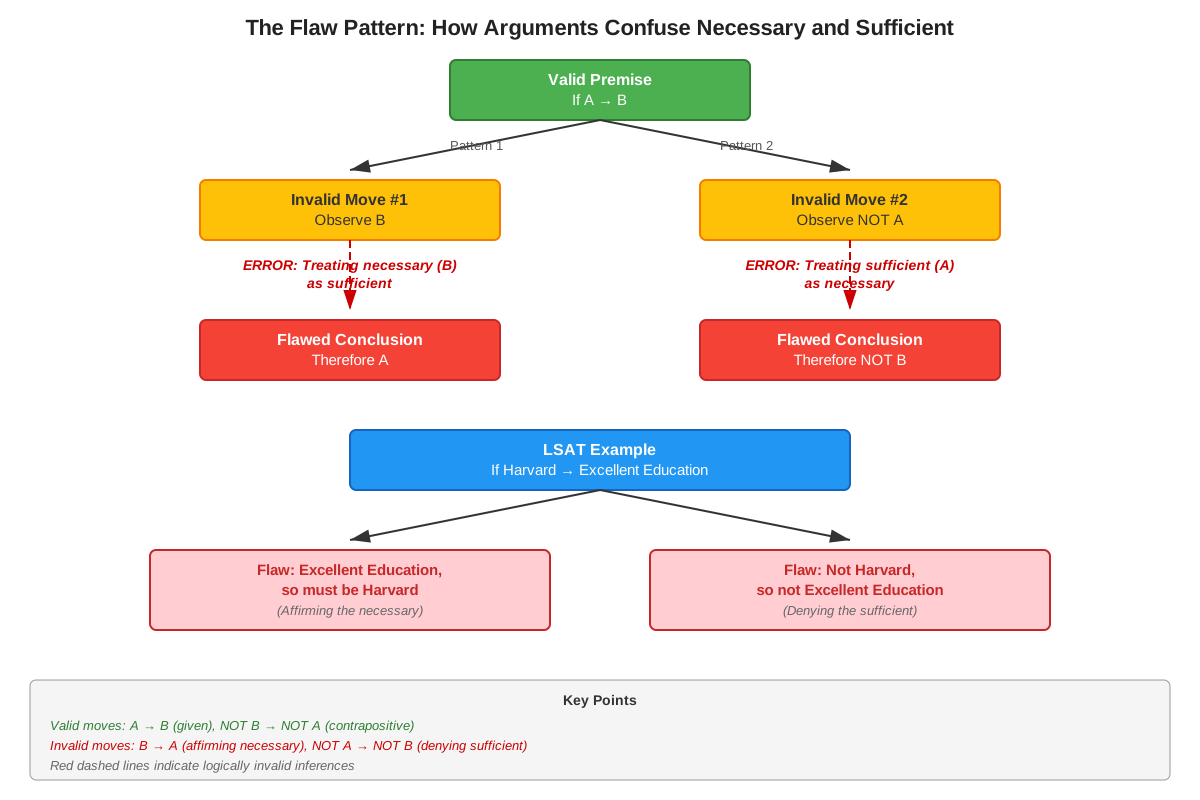
Confusing necessary and sufficient occurs when an argument commits one of these errors:
- Treating necessary as sufficient: The argument assumes that because something is required for an outcome, its presence guarantees that outcome. Example: "To get into medical school, you need a high MCAT score. Sarah has a high MCAT score, so she'll get into medical school." The flaw: a high MCAT score is necessary but not sufficient—many other factors matter.
- Treating sufficient as necessary: The argument assumes that because something guarantees an outcome, it's the only way to achieve that outcome. Example: "Winning the lottery would make you wealthy. You're not wealthy, so you must not have won the lottery." The flaw: winning the lottery is sufficient for wealth but not necessary—many paths to wealth exist.
- Reversing the conditional: The argument flips the direction of the conditional relationship without proper justification. Example: "All dogs are mammals. This animal is a mammal, so it must be a dog." The flaw: being a dog is sufficient for being a mammal, but being a mammal is not sufficient for being a dog.
Identifying the Flaw in Arguments
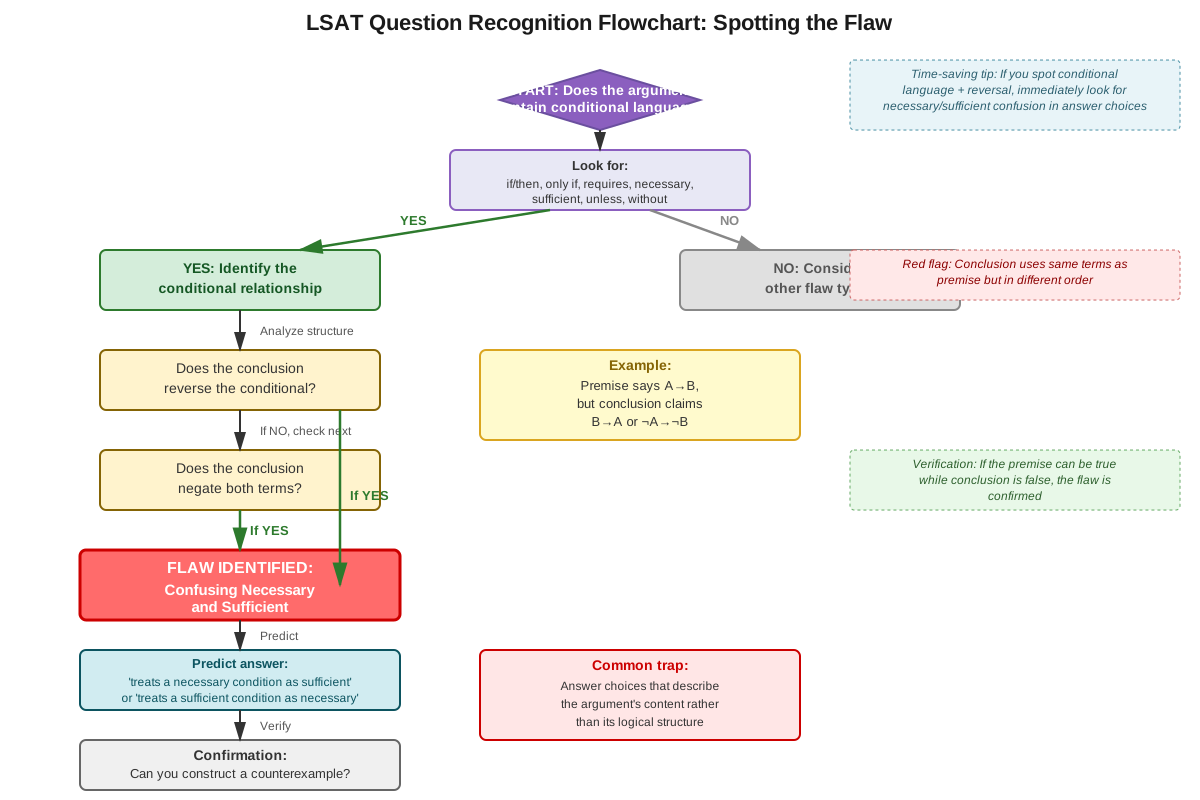
To identify this flaw systematically, follow these steps:
- Locate the conditional relationship: Find the "if-then" structure, whether explicit or implicit
- Identify what's sufficient and what's necessary: Determine the direction of the arrow
- Examine the conclusion: Check whether the argument claims something based on the presence of a necessary condition or the absence of a sufficient condition
- Spot the reversal or confusion: Determine if the argument has illegitimately flipped or confused the relationship
The most common manifestation on the LSAT involves arguments that observe a necessary condition is present and conclude the outcome must occur, or observe a sufficient condition is absent and conclude the outcome cannot occur. Both represent fundamental misunderstandings of conditional logic.
Valid vs. Invalid Inferences
Understanding what you CAN and CANNOT conclude from conditional statements is crucial:
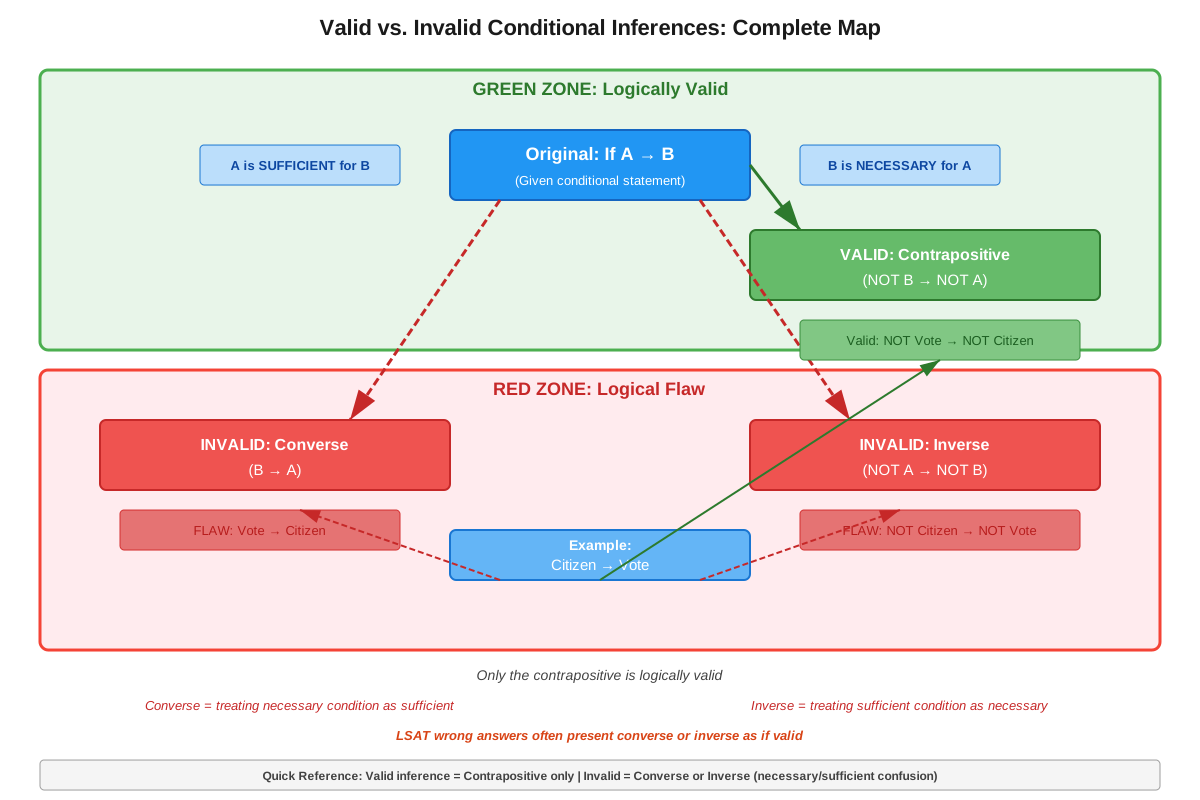
Valid inferences from "If A, then B" (A → B):
- If A is true, then B must be true (affirming the sufficient)
- If B is false, then A must be false (denying the necessary—the contrapositive)
Invalid inferences from "If A, then B":
- If B is true, then A must be true (affirming the necessary—the confusion)
- If A is false, then B must be false (denying the sufficient—another confusion)
The LSAT frequently tests whether students can distinguish valid from invalid inferences, particularly in the context of flaw identification.
Concept Relationships
The core concepts within this topic form a logical progression: understanding necessary conditions and sufficient conditions as distinct concepts → recognizing their directional relationship in conditional statements → identifying when arguments confuse or reverse these conditions → applying systematic identification steps to spot the flaw → distinguishing valid from invalid inferences.
This topic connects directly to prerequisite knowledge of conditional logic, as the entire framework depends on understanding "if-then" relationships. The ability to form contrapositives relates closely because the contrapositive represents the only valid reversal of a conditional, making it essential to distinguish legitimate reversals from illegitimate ones.
Within the broader Flaw Questions category, confusing necessary and sufficient represents one specific type of structural flaw—errors in how premises connect to conclusions. It relates to other flaws like circular reasoning (where the conclusion appears in the premises) and false dichotomy (where necessary conditions are treated as the only options), but maintains its distinct logical character.
The concept map flows as follows: Basic Conditional Logic → Necessary vs. Sufficient Distinction → Directional Relationships → Common Confusion Patterns → Flaw Identification → Application to LSAT Questions → Integration with Other Question Types (Assumptions, Strengthen/Weaken, Parallel Reasoning).
High-Yield Facts
⭐ In a conditional statement "If A, then B," A is sufficient for B and B is necessary for A—this is the foundational relationship that defines both concepts.
⭐ The most common flaw pattern is treating a necessary condition as if it were sufficient—observing that a requirement is met and concluding the outcome must occur.
⭐ Necessary conditions can be present without the outcome occurring—they set minimum requirements but don't guarantee results.
⭐ Sufficient conditions guarantee the outcome but are not the only way to achieve it—multiple sufficient conditions can lead to the same result.
⭐ The contrapositive is the only valid reversal of a conditional—if A → B, then ~B → ~A, but B → A is invalid.
- Phrases like "only if" introduce necessary conditions, while "if" introduces sufficient conditions—language cues help identify the relationship.
- Confusing necessary and sufficient appears in approximately 10-15% of Flaw Questions on the LSAT—making it one of the highest-yield patterns.
- The flaw can appear in reverse: treating sufficient as necessary by claiming that without a sufficient condition, the outcome cannot occur.
- Arguments about qualifications, requirements, and rules frequently commit this flaw—these contexts naturally involve necessary and sufficient conditions.
- Recognizing this flaw requires identifying the direction of the conditional relationship—the arrow direction determines which is which.
Quick check — test yourself on Confusing necessary and sufficient so far.
Try Flashcards →Common Misconceptions
Misconception: If something is necessary, it must also be important or significant, so it should be sufficient. → Correction: Necessity and sufficiency are logical relationships, not measures of importance. Something can be absolutely necessary yet completely insufficient (oxygen is necessary for human life but nowhere near sufficient).
Misconception: The contrapositive and the reverse are the same thing. → Correction: The contrapositive (~B → ~A) is logically valid and equivalent to the original (A → B), while the reverse (B → A) is invalid and represents the confusion of necessary and sufficient.
Misconception: If multiple conditions are necessary, having all of them must be sufficient. → Correction: Even when all known necessary conditions are met, sufficiency is not guaranteed unless explicitly stated. There might be additional unstated necessary conditions, or the combination might still not be sufficient.
Misconception: Sufficient conditions are always stronger or more important than necessary conditions. → Correction: Neither is inherently stronger; they serve different logical functions. Necessary conditions are indispensable (without them, the outcome is impossible), while sufficient conditions are guarantees (with them, the outcome is certain).
Misconception: In everyday language, "necessary" and "sufficient" mean roughly the same thing. → Correction: While colloquial usage sometimes blurs these terms, they represent fundamentally different logical relationships. On the LSAT, precision in distinguishing them is essential, as the exam deliberately exploits this confusion.
Misconception: If an argument says "X is required for Y," then having X means you'll get Y. → Correction: "Required" indicates a necessary condition—X must be present for Y, but X alone doesn't guarantee Y. This is precisely the confusion the LSAT tests.
Worked Examples
Example 1: Medical School Admission
Argument: "To gain admission to Prestigious Medical School, applicants must have completed organic chemistry. Jennifer has completed organic chemistry, so she will be admitted to Prestigious Medical School."
Analysis:
Step 1: Identify the conditional relationship. The first sentence establishes: "If admitted to Prestigious Medical School → completed organic chemistry." This can be written as: Admission → Organic Chemistry.
Step 2: Determine what's sufficient and what's necessary. In this conditional, admission is sufficient for having completed organic chemistry, and completing organic chemistry is necessary for admission.
Step 3: Examine the conclusion. The argument concludes that Jennifer will be admitted based on the fact that she completed organic chemistry.
Step 4: Spot the flaw. The argument observes that a necessary condition (organic chemistry) is present and concludes that the outcome (admission) must occur. This is the classic pattern of treating necessary as sufficient.
Why it's flawed: Completing organic chemistry is required for admission (necessary), but it doesn't guarantee admission (not sufficient). Many other factors—GPA, MCAT scores, letters of recommendation, interviews—also matter. The argument illegitimately reverses the conditional from "Admission → Organic Chemistry" to "Organic Chemistry → Admission."
Valid reasoning would be: "Jennifer was admitted to Prestigious Medical School, so she must have completed organic chemistry" (affirming the sufficient condition) or "Jennifer did not complete organic chemistry, so she will not be admitted" (denying the necessary condition via contrapositive).
Connection to learning objectives: This example demonstrates how to identify the flaw (Objective 1), explains the reasoning pattern of treating necessary as sufficient (Objective 2), and shows how to apply the concept to solve the problem (Objective 3).
Example 2: Economic Policy
Argument: "Economic growth is sufficient to reduce unemployment. The country experienced reduced unemployment last year, so it must have experienced economic growth."
Analysis:
Step 1: Identify the conditional. The first sentence states: "If economic growth → reduced unemployment." This is written as: Growth → Reduced Unemployment.
Step 2: Determine the relationship. Economic growth is sufficient for reduced unemployment, and reduced unemployment is necessary for economic growth (according to this conditional).
Step 3: Examine the conclusion. The argument observes that reduced unemployment occurred and concludes that economic growth must have occurred.
Step 4: Spot the flaw. The argument affirms the necessary condition (reduced unemployment) and concludes the sufficient condition (economic growth) must have occurred. This reverses the conditional.
Why it's flawed: Economic growth is sufficient to reduce unemployment—if you have growth, you'll get reduced unemployment. But economic growth is not necessary for reduced unemployment; other factors (government hiring programs, demographic shifts, changes in labor force participation) could reduce unemployment without economic growth. The argument treats a sufficient condition as if it were necessary.
Valid reasoning would be: "The country experienced economic growth, so it must have experienced reduced unemployment" (affirming the sufficient condition) or "The country did not experience reduced unemployment, so it must not have experienced economic growth" (contrapositive).
Additional insight: This example shows the reverse pattern—treating sufficient as necessary—which is less common but still appears on the LSAT. Recognizing both directions of the confusion is essential for comprehensive mastery.
Connection to learning objectives: This demonstrates identifying the flaw in a different context (Objective 1), explains the alternative pattern of treating sufficient as necessary (Objective 2), and applies the distinction to solve a different type of problem (Objective 3).
Exam Strategy
When approaching flaw questions involving necessary and sufficient conditions, follow this systematic process:
Step 1: Read for conditional language. Watch for trigger words: "if," "only if," "requires," "necessary," "sufficient," "depends on," "prerequisite," "guarantee," "ensure," "whenever," "must," and "without." These signal that conditional relationships are at play.
Step 2: Diagram the conditional. Even if you don't write it down, mentally map the relationship. Identify what's on the left side of the arrow (sufficient) and what's on the right side (necessary). For "only if" statements, remember the necessary condition comes after "only if."
Step 3: Check the conclusion against the premises. Ask: "Does the conclusion claim something based on observing a necessary condition?" or "Does it claim something cannot happen because a sufficient condition is absent?" Either pattern signals the flaw.
Step 4: Predict the answer. Before looking at choices, articulate the flaw: "The argument treats a necessary condition as sufficient" or "The argument treats a sufficient condition as necessary." This prediction prevents trap answers from seeming attractive.
Exam Tip: Answer choices describing this flaw often use phrases like "confuses a condition necessary for X with a condition sufficient for X," "mistakes something required for something that guarantees," or "treats a prerequisite as if it ensures the outcome."
Process of elimination tips:
- Eliminate answers that describe the conditional relationship correctly (e.g., if the argument does treat necessary as sufficient, eliminate any answer saying it treats sufficient as necessary)
- Eliminate answers about different flaws (causal reasoning, sampling errors, etc.) unless you've misidentified the flaw
- Be cautious of answers that use "necessary" and "sufficient" but describe a different error
- Watch for answers that correctly identify the conditional but incorrectly describe what the argument does with it
Time allocation: Spend 15-20 seconds diagramming the conditional relationship if needed. This upfront investment prevents 30+ seconds of confusion when evaluating answer choices. For most test-takers, this flaw type should take 60-75 seconds total once mastered.
Common trap patterns: The LSAT often includes wrong answers that reverse the flaw description (saying the argument treats sufficient as necessary when it actually treats necessary as sufficient). Read answer choices carefully and match them precisely to your prediction.
Memory Techniques
Mnemonic for the relationship: "Sufficient Starts the arrow; Necessary is Needed at the end." In A → B, A is Sufficient (starts), B is Necessary (needed).
Visualization strategy: Picture necessary conditions as gates you must pass through to reach a destination. You can pass through the gate without reaching the destination (necessary but not sufficient), but you cannot reach the destination without passing through the gate. Picture sufficient conditions as guaranteed tickets—if you have the ticket, you definitely get in, but other tickets might also work.
Acronym for identification: SCAN the argument:
- Spot the conditional language
- Chart the direction (what's sufficient, what's necessary)
- Analyze the conclusion
- Note any reversal or confusion
Memory phrase for the flaw: "Necessary Never Nails it down" (necessary conditions don't guarantee outcomes). "Sufficient Seals the deal" (sufficient conditions guarantee outcomes).
Contrast technique: When you see a conditional, immediately think of both valid inferences: "If A, then B means: A guarantees B (valid), and no-B guarantees no-A (valid). But B doesn't guarantee A (invalid), and no-A doesn't guarantee no-B (invalid)." Rehearsing both valid and invalid inferences builds recognition.
Summary
Confusing necessary and sufficient conditions represents one of the most testable logical flaws on the LSAT, appearing frequently in Flaw Questions and influencing performance across multiple Logical Reasoning question types. The core distinction is directional: necessary conditions must be present for an outcome but don't guarantee it, while sufficient conditions guarantee an outcome but aren't the only way to achieve it. In conditional logic notation (A → B), A is sufficient for B and B is necessary for A. The flaw occurs when arguments treat necessary conditions as if they were sufficient (observing a requirement is met and concluding the outcome must occur) or treat sufficient conditions as if they were necessary (claiming that without a particular guarantee, the outcome cannot occur). Mastering this distinction requires understanding the logical relationship, recognizing common language patterns that signal each type of condition, systematically analyzing arguments for reversals or confusions, and distinguishing valid inferences (affirming the sufficient, denying the necessary via contrapositive) from invalid ones (affirming the necessary, denying the sufficient). Success on LSAT questions testing this concept depends on diagramming conditional relationships, predicting the flaw before reviewing answer choices, and precisely matching answer language to the specific confusion present in the argument.
Key Takeaways
- Necessary conditions must be present but don't guarantee outcomes; sufficient conditions guarantee outcomes but aren't the only path—this fundamental distinction underlies all applications of this concept
- In "If A, then B," A is sufficient for B and B is necessary for A—memorizing this relationship in both directions prevents confusion
- The most common flaw pattern treats necessary as sufficient—observing a requirement is met and concluding the outcome must follow
- Only two valid inferences exist from any conditional: affirming the sufficient condition and the contrapositive (denying the necessary condition)
- Language cues signal the relationship: "if" introduces sufficient conditions, "only if" introduces necessary conditions, and "requires/depends on/prerequisite" indicate necessary conditions
- Systematic diagramming prevents errors—taking 15 seconds to map the conditional relationship saves time and improves accuracy
- This flaw appears in 10-15% of Flaw Questions—making it one of the highest-yield patterns to master for score improvement
Related Topics
Formal Logic and Conditional Reasoning: Deeper exploration of conditional statements, chains of conditionals, and complex logical relationships builds on the necessary/sufficient distinction and enables handling of more sophisticated LSAT arguments.
Contrapositive Formation: Mastering how to correctly form and apply contrapositives reinforces understanding of valid versus invalid reversals, directly supporting recognition of the necessary/sufficient confusion.
Assumption Questions: Many assumption questions require identifying unstated premises that bridge the gap between necessary conditions observed and conclusions about outcomes, making this topic's mastery essential for assumption question success.
Strengthen and Weaken Questions: Answer choices in these question types often exploit the necessary/sufficient distinction, either by providing additional sufficient conditions or by showing necessary conditions are absent.
Parallel Reasoning Questions: These questions require matching logical structure, including the specific pattern of confusing necessary and sufficient, making recognition of this flaw transferable to structural matching tasks.
Practice CTA
Now that you've mastered the conceptual framework for identifying and understanding how arguments confuse necessary and sufficient conditions, it's time to apply this knowledge to actual LSAT-style practice questions. The flashcards will help you internalize the key distinctions and language patterns, while the practice questions will develop your ability to spot this flaw under timed conditions. Remember: this is one of the most frequently tested patterns on the LSAT, and students who master it consistently see measurable score improvements. Every practice question you complete strengthens your pattern recognition and builds the confidence needed to quickly identify this flaw on test day. You've built the foundation—now reinforce it through deliberate practice!
Sign up free to keep reading
Create a free AnvayaPrep account to finish this LSAT guide on Confusing necessary and sufficient — plus flashcards and practice questions.