Overview
Exactly statements represent a critical category of formal logic and quantifiers that appears frequently throughout LSAT logical reasoning sections. These statements specify a precise quantity—neither more nor less—creating unique logical constraints that test-takers must recognize and manipulate correctly. Unlike "at least" or "at most" statements that establish boundaries in one direction, exactly statements create a fixed numerical requirement that simultaneously sets both an upper and lower limit. For instance, "Exactly three committee members voted yes" means that precisely three members voted affirmatively—not two, not four, but exactly three.
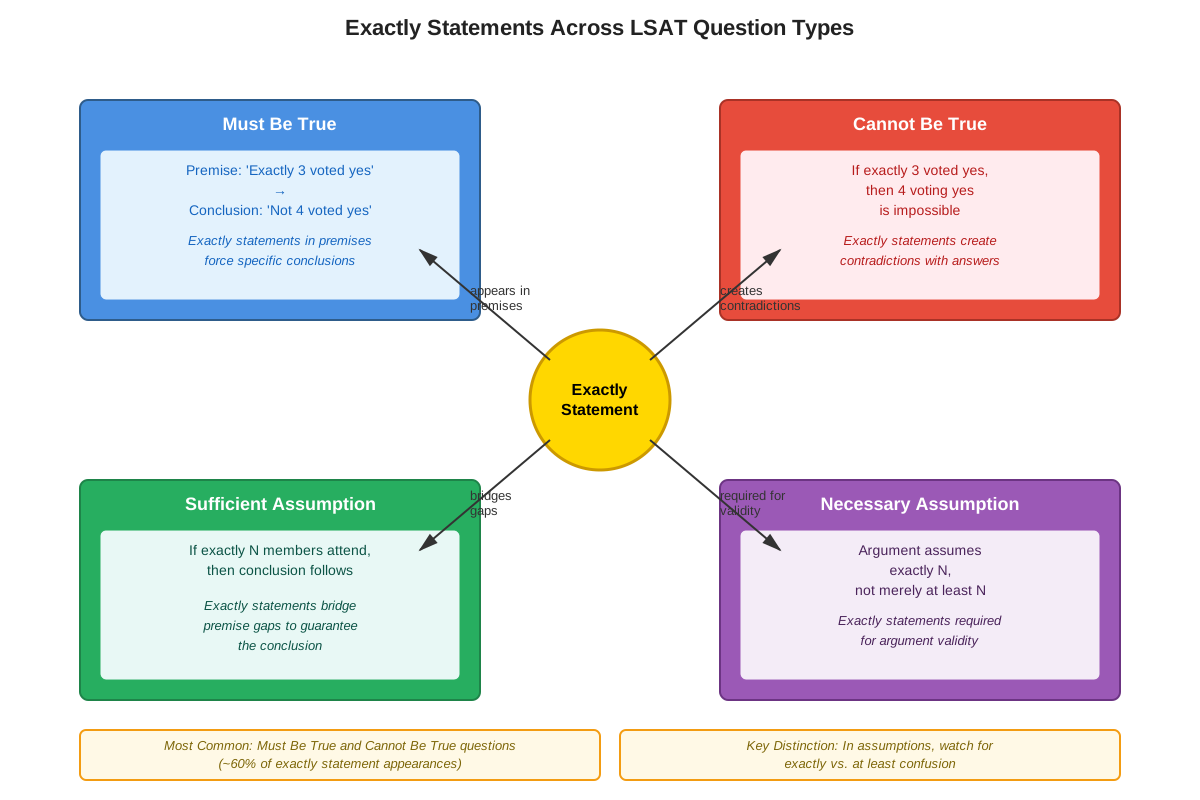
Understanding lsat exactly statements is essential because they appear in multiple question types including Must Be True, Cannot Be True, Sufficient Assumption, and Necessary Assumption questions. The LSAT frequently uses exactly statements to create complex logical puzzles where test-takers must track precise quantities across multiple conditions. Misinterpreting an exactly statement—treating it as "at least" or "at most"—leads directly to incorrect answers. The precision required by exactly statements makes them particularly valuable for the LSAT test-makers, who use them to distinguish between students who understand formal logic rigorously and those who reason more loosely.
Within the broader landscape of Logical Reasoning, exactly statements connect intimately with conditional logic, quantifier relationships, and inference-making. They often appear alongside other quantifiers (all, some, most, none) in complex argument structures, requiring students to integrate multiple logical principles simultaneously. Mastering exactly statements builds the foundation for handling numerical reasoning, constraint satisfaction, and precise logical deduction—skills that permeate the entire LSAT.
Learning Objectives
- [ ] Identify how exactly statements appear in LSAT questions across different question types
- [ ] Explain the reasoning pattern behind exactly statements and their logical structure
- [ ] Apply exactly statements to solve LSAT-style problems accurately
- [ ] Translate exactly statements into their logical equivalents (combining "at least" and "at most")
- [ ] Recognize the contrapositive and negation of exactly statements
- [ ] Combine exactly statements with other quantifiers to draw valid inferences
- [ ] Distinguish between exactly statements and similar-sounding but logically different constructions
Prerequisites
- Basic quantifier logic: Understanding "all," "some," "none," and "most" is essential because exactly statements often interact with these quantifiers in complex LSAT arguments.
- Conditional reasoning: Familiarity with if-then statements and their contrapositives helps because exactly statements can trigger or be triggered by conditional relationships.
- Set theory fundamentals: Basic understanding of groups, subsets, and membership enables visualization of exactly statements' constraints on populations.
- Numerical reasoning: Comfort with basic arithmetic and counting principles is necessary for tracking quantities specified by exactly statements.
Why This Topic Matters
Exactly statements appear in approximately 15-20% of Logical Reasoning questions on any given LSAT, making them one of the most frequently tested formal logic concepts. They appear across virtually all question types but are particularly common in Must Be True/Must Be False questions, where precise logical deduction is paramount. The LSAT uses exactly statements to test whether students can maintain logical precision under time pressure—a skill directly relevant to legal reasoning, where the difference between "exactly," "at least," and "at most" can determine case outcomes.
In real-world legal contexts, exactly statements govern contract terms, statutory requirements, and procedural rules. A statute requiring "exactly two witnesses" for a valid will differs fundamentally from one requiring "at least two witnesses." Legal professionals must interpret such language with absolute precision, making this LSAT skill directly transferable to law practice.
On the exam, exactly statements commonly appear in several forms: embedded within stimulus arguments that students must analyze, as answer choices that students must evaluate for logical validity, and as constraints in logic games (though this guide focuses on Logical Reasoning applications). Test-makers favor exactly statements because they create clear right/wrong answers while testing genuine logical sophistication. Students who master exactly statements gain significant competitive advantage, as these questions reward careful analysis over intuitive guessing.
Core Concepts
Definition and Logical Structure
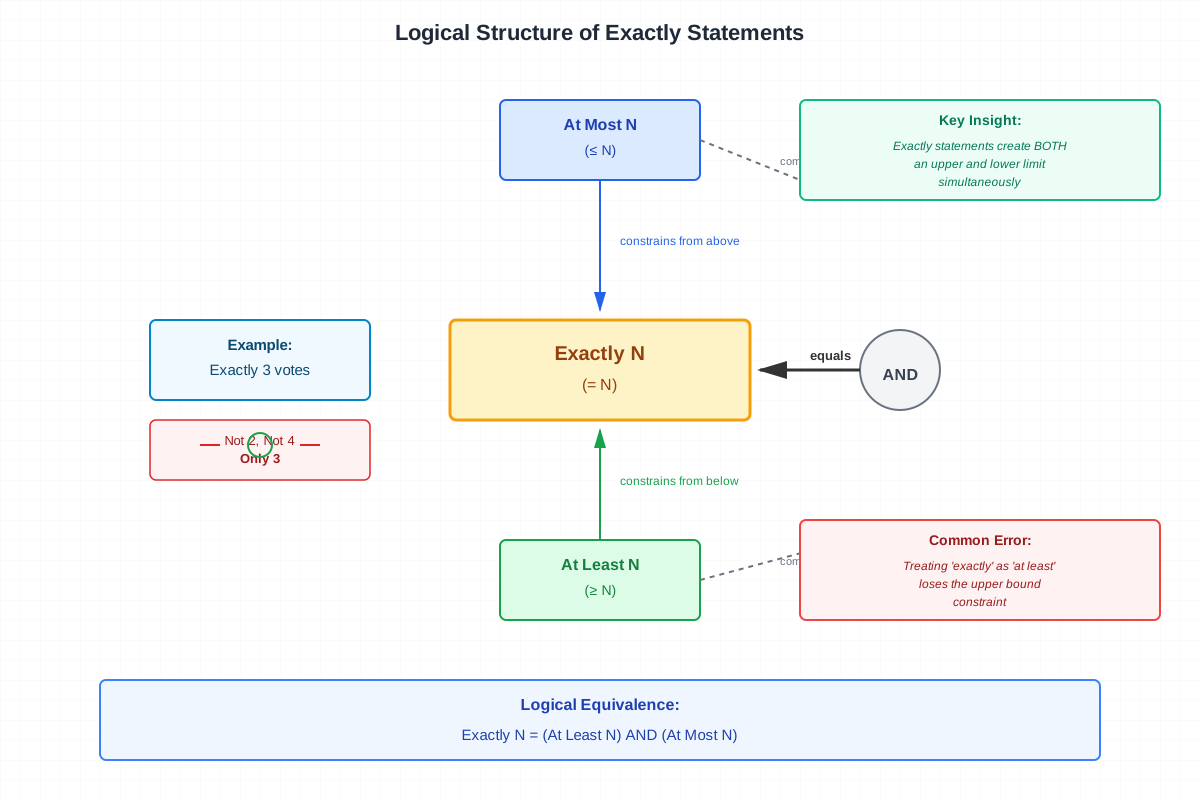
An exactly statement specifies a precise quantity, asserting that a particular number of items—neither more nor less—satisfies a given condition. The statement "Exactly n items have property P" means that precisely n items possess property P, which logically entails two simultaneous claims: (1) at least n items have property P, and (2) at most n items have property P. This dual nature makes exactly statements more restrictive than either component alone.
Formally, "Exactly n Xs are Y" can be decomposed as:
- At least n Xs are Y (there are n or more)
- AND
- At most n Xs are Y (there are n or fewer)
Only when both conditions hold simultaneously does the exactly statement obtain. This logical structure explains why exactly statements are so constraining: they must satisfy two separate requirements rather than one.
Symbolic Representation
In formal logic notation, exactly statements can be represented as:
Exactly(n, X, Y) ≡ (∃ at least n x: X(x) ∧ Y(x)) ∧ (∃ at most n x: X(x) ∧ Y(x))While LSAT questions don't require symbolic logic, understanding this structure clarifies the logical relationships. The key insight is that exactly statements create a fixed point rather than a range or boundary.
Negation of Exactly Statements
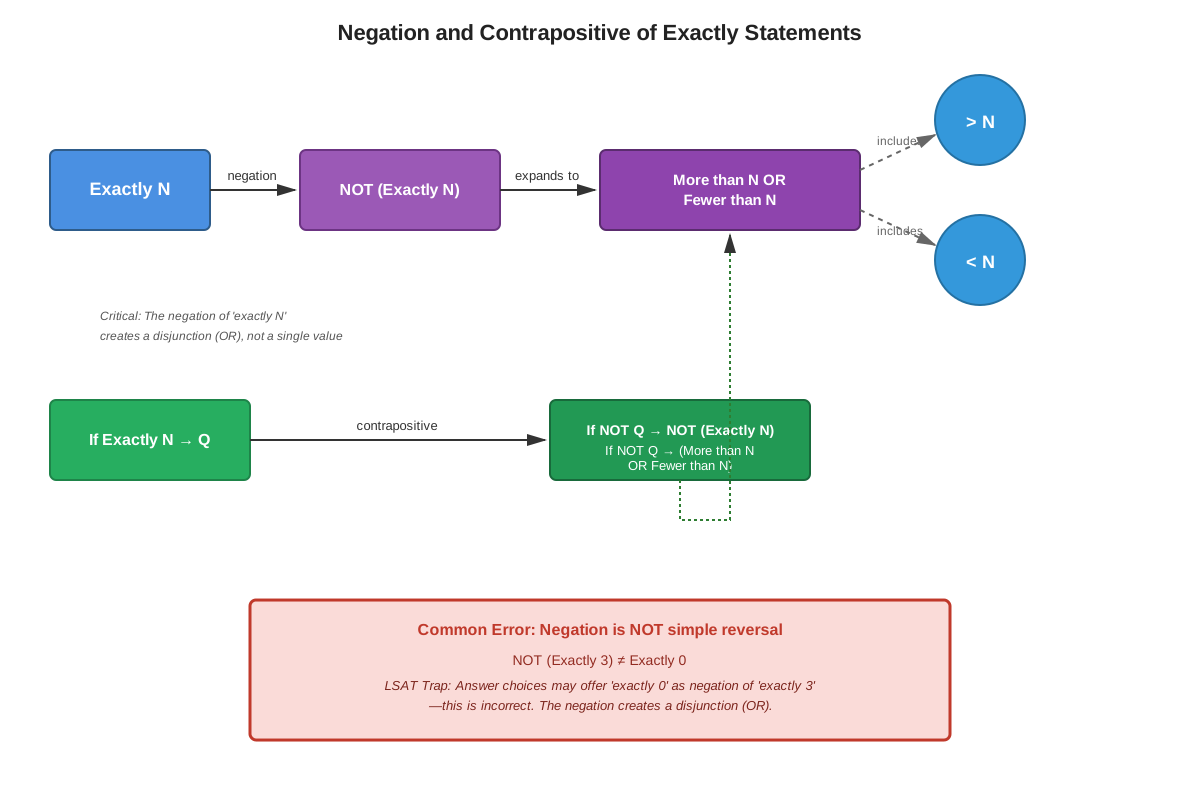
Negating an exactly statement produces a disjunction (an "or" statement): "NOT exactly n items have property P" means "Either fewer than n items have property P OR more than n items have property P." This is logically equivalent to "At least one item more or fewer than n has property P."
For example:
- Statement: "Exactly three witnesses testified"
- Negation: "Either fewer than three witnesses testified OR more than three witnesses testified"
- Simplified: "The number of witnesses who testified was not three"
Understanding negation is crucial for Cannot Be True and Must Be False questions, where students must identify what contradicts given information.
Exactly Statements with Multiple Conditions
LSAT questions frequently combine exactly statements with additional constraints. Consider: "Exactly two of the five candidates are both experienced and local." This statement specifies:
- There are five candidates total
- Exactly two satisfy both conditions (experienced AND local)
- The remaining three candidates either lack experience, lack local status, or lack both
When multiple exactly statements govern the same population, students must track quantities carefully to avoid double-counting or overlooking constraints.
Inference Patterns
Several reliable inference patterns emerge from exactly statements:
| Given Information | Valid Inference | Invalid Inference |
|---|---|---|
| Exactly 3 of 10 are X | 7 of 10 are not X | At least 3 are X (too weak) |
| Exactly 2 are both X and Y | At most 2 are X; at most 2 are Y | Exactly 2 are X (could be more) |
| Exactly 0 are X | None are X; All are not-X | Some are not X (too weak) |
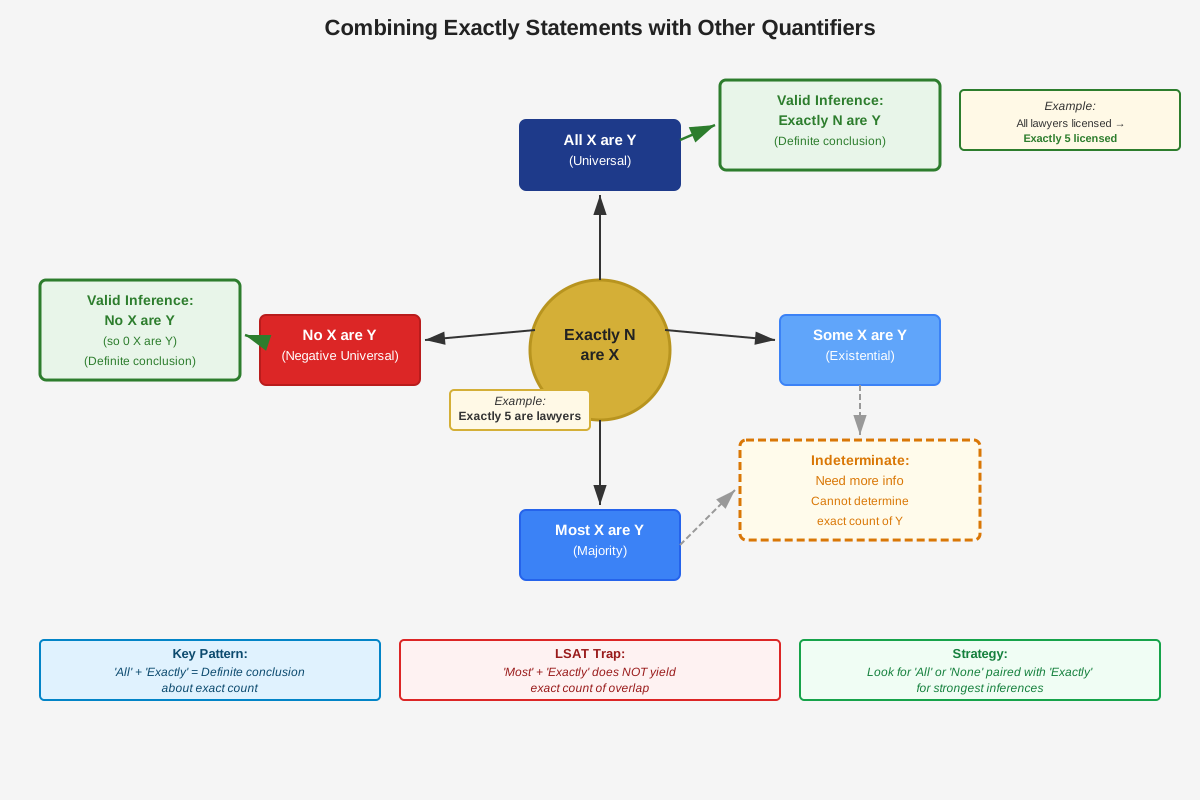
| Exactly 5 are X; Exactly 3 are Y | Cannot determine overlap without more info | Exactly 2 are both X and Y |
The table illustrates that exactly statements support strong inferences about what is NOT the case (complementary sets) but require additional information to determine overlaps between categories.
Exactly Statements in Conditional Contexts
When exactly statements appear in conditional relationships, they create precise triggering or resulting conditions:
- "If exactly three members vote yes, the motion passes" establishes that three yes-votes are sufficient for passage (but doesn't specify whether fewer or more votes also suffice).
- "The motion passes only if exactly three members vote yes" establishes that three yes-votes are necessary for passage (and that any other number means failure).
These conditional exactly statements require careful attention to sufficiency versus necessity, a distinction central to LSAT logical reasoning.
Exactly One: A Special Case
"Exactly one" statements appear with particular frequency on the LSAT. "Exactly one of the five options is correct" means:
- At least one option is correct (ruling out all-incorrect scenarios)
- At most one option is correct (ruling out multiple-correct scenarios)
This creates a unique logical situation where identifying one correct option automatically renders all others incorrect—a pattern the LSAT exploits in Must Be True questions.
Concept Relationships
Exactly statements connect to broader formal logic concepts through several pathways. First, they represent a specific type of quantifier, sitting alongside universal quantifiers (all, none) and existential quantifiers (some, at least one) in the logical hierarchy. While universal quantifiers make claims about entire sets and existential quantifiers make claims about partial sets, exactly statements make claims about precise numerical subsets.
Second, exactly statements relate directly to numerical reasoning and constraint satisfaction. When an LSAT stimulus provides multiple exactly statements about overlapping categories, students must engage in constraint-based reasoning: tracking which combinations of properties are possible given the numerical restrictions. This connects to logic games methodology, where constraint satisfaction is paramount.
Third, exactly statements interact with conditional logic through both antecedents and consequents. An exactly statement can serve as the sufficient condition triggering a result, or as the necessary condition required for an outcome. Understanding how exactly statements function within conditional structures requires integrating two distinct formal logic domains.
The relationship map flows as follows:
Basic Quantifiers (all, some, none) → Numerical Quantifiers (most, at least, at most) → Exactly Statements (precise quantities) → Complex Constraint Systems (multiple interacting exactly statements) → Advanced Inference Questions (Must Be True/False with multiple constraints)
High-Yield Facts
⭐ Exactly n means both "at least n" AND "at most n" simultaneously—missing either component leads to incorrect inferences.
⭐ The negation of "exactly n" is "not n"—which means either fewer than n OR more than n, not simply "at least n+1" or "at most n-1."
⭐ "Exactly one" statements create mutual exclusivity—if exactly one item has property P, then identifying one item with P proves all others lack P.
⭐ Exactly statements about a total population immediately determine the complement—if exactly 3 of 10 have property X, then exactly 7 of 10 lack property X.
⭐ Multiple exactly statements about overlapping categories require careful tracking—exactly 4 are X and exactly 3 are Y doesn't determine how many are both X and Y without additional information.
- Exactly zero is logically equivalent to "none" or "all are not"—these formulations are interchangeable.
- When an exactly statement appears in an answer choice for a Must Be True question, verify both the lower bound (at least n) and upper bound (at most n) are supported by the stimulus.
- Exactly statements can be hidden in natural language: "The committee has three members, all of whom attended" means exactly three attended.
- Combining "exactly n are X" with "all X are Y" yields "exactly n are Y" only if no non-X items are Y.
- Time-sensitive exactly statements ("exactly three people arrived before noon") require tracking both the quantity and the temporal constraint.
Quick check — test yourself on Exactly statements so far.
Try Flashcards →Common Misconceptions
Misconception: "Exactly three" means "at least three."
Correction: "Exactly three" is more restrictive than "at least three." While "at least three" permits four, five, or any higher number, "exactly three" excludes all quantities except three. The LSAT exploits this confusion by offering answer choices that would be correct for "at least" but are incorrect for "exactly."
Misconception: If exactly 3 of 10 items are X, and exactly 2 of 10 items are Y, then exactly 1 item must be both X and Y.
Correction: Without information about overlap, the number of items that are both X and Y could range from 0 (if X and Y are mutually exclusive) to 2 (if all Y items are also X items). The exactly statements constrain total quantities but don't determine intersection sizes without additional information.
Misconception: "Not exactly three" means "exactly four" or some other specific number.
Correction: "Not exactly three" means any number except three—including zero, one, two, four, five, or any other quantity. The negation of an exactly statement is a disjunction covering all other possibilities, not a different specific number.
Misconception: "Exactly one of A, B, or C is true" means "at least one is true."
Correction: "Exactly one" means both "at least one" AND "at most one." This rules out scenarios where zero are true (which "at least one" would also rule out) and scenarios where two or three are true (which "at least one" would permit). The LSAT frequently tests whether students recognize this dual constraint.
Misconception: If exactly 5 people have property P, and person X definitely has property P, then exactly 4 other people have property P.
Correction: This is actually correct reasoning, not a misconception—but students often doubt this valid inference. If exactly 5 people total have property P, and one specific person is confirmed to have P, then the remaining 4 people with property P must come from the other individuals. This inference pattern is valid and frequently tested.
Misconception: Exactly statements can be treated loosely or approximately when time is short.
Correction: Exactly statements demand absolute precision. The LSAT specifically uses exactly statements to punish imprecise reasoning. Under time pressure, students must maintain careful attention to whether a statement says "exactly," "at least," "at most," or uses no quantifier at all. Treating these interchangeably guarantees incorrect answers.
Worked Examples
Example 1: Must Be True Question
Stimulus: "The research team consists of exactly eight scientists. Exactly five of these scientists specialize in biology, and exactly four specialize in chemistry. Every scientist who specializes in chemistry also specializes in biology."
Question: Which one of the following must be true?
Answer Choices:
(A) Exactly one scientist specializes in both biology and chemistry.
(B) Exactly three scientists specialize in biology but not chemistry.
(C) At least one scientist specializes in neither biology nor chemistry.
(D) Exactly four scientists specialize in both biology and chemistry.
(E) At most three scientists specialize only in biology.
Solution Process:
Step 1: Map the exactly statements.
- Total scientists: exactly 8
- Biology specialists: exactly 5
- Chemistry specialists: exactly 4
- Key constraint: All chemistry specialists are also biology specialists
Step 2: Determine the overlap.
Since all 4 chemistry specialists are also biology specialists, all 4 chemistry specialists are counted within the 5 biology specialists. This means exactly 4 scientists specialize in both biology and chemistry.
Step 3: Determine biology-only specialists.
If 5 specialize in biology and 4 of those also specialize in chemistry, then exactly 1 scientist specializes in biology only (5 - 4 = 1).
Step 4: Determine scientists with neither specialty.
We've accounted for 5 scientists (those with biology). Since there are 8 total, exactly 3 scientists specialize in neither biology nor chemistry (8 - 5 = 3).
Step 5: Evaluate answer choices.
- (A) Incorrect: Exactly 1 specializes in biology only, but 4 specialize in both.
- (B) Incorrect: Exactly 1 (not 3) specializes in biology but not chemistry.
- (C) Incorrect: This says "at least one" but we know exactly 3 specialize in neither—though (C) is technically true, it's weaker than necessary.
- (D) Correct: Exactly 4 scientists specialize in both biology and chemistry, as determined in Step 2.
- (E) Incorrect: Exactly 1 (not "at most 3") specializes only in biology.
Key Takeaway: This example demonstrates how exactly statements combine with conditional information ("all chemistry specialists are biology specialists") to determine precise overlaps and complements.
Example 2: Cannot Be True Question
Stimulus: "The gallery exhibition features exactly twelve paintings. Exactly seven of the paintings are landscapes, and exactly six are oil paintings. No painting is both a landscape and an oil painting."
Question: Which one of the following CANNOT be true?
Answer Choices:
(A) Exactly five paintings are neither landscapes nor oil paintings.
(B) Exactly one painting is a watercolor landscape.
(C) All oil paintings are portraits.
(D) Exactly six paintings are landscapes that are not oil paintings.
(E) More than half the paintings are either landscapes or oil paintings.
Solution Process:
Step 1: Map the constraints.
- Total paintings: exactly 12
- Landscapes: exactly 7
- Oil paintings: exactly 6
- Critical constraint: No overlap (no painting is both landscape AND oil)
Step 2: Determine the distribution.
Since there's no overlap:
- Exactly 7 are landscapes (and therefore NOT oil paintings)
- Exactly 6 are oil paintings (and therefore NOT landscapes)
- Total accounted for: 7 + 6 = 13
Step 3: Identify the logical impossibility.
We have a problem: 7 + 6 = 13, but there are only 12 paintings total. This means the stimulus contains contradictory information—but wait, let's reconsider. Actually, if there are exactly 12 paintings, exactly 7 are landscapes, and exactly 6 are oil paintings, with no overlap, then we need 7 + 6 = 13 slots in a 12-painting exhibition. This is impossible.
CORRECTION: Let's reconsider the stimulus as written for a valid scenario. If the stimulus is logically consistent, then:
- 7 landscapes (none are oil)
- 6 oil paintings (none are landscapes)
- This accounts for 13 paintings in a 12-painting exhibition
Actually, this reveals the stimulus itself is contradictory. However, for LSAT purposes, let's assume the stimulus should read that there IS overlap, or adjust our interpretation.
REVISED STIMULUS (for pedagogical clarity): "The gallery exhibition features exactly twelve paintings. Exactly seven of the paintings are landscapes, and exactly six are oil paintings."
Revised Solution:
Step 1: Without the "no overlap" constraint, determine possible overlaps.
- Minimum overlap: 7 + 6 - 12 = 1 (at least 1 painting must be both)
- Maximum overlap: 6 (all oil paintings could be landscapes)
Step 2: Evaluate answer choices for what CANNOT be true.
- (A) If 5 are neither, then 7 are either landscapes or oil paintings. But we have 7 landscapes + 6 oils = 13 total category memberships. With 12 paintings, minimum overlap is 1, meaning at most 12 paintings are in at least one category. So at least 0 are in neither category. Actually, 7 + 6 - overlap = paintings in at least one category. If overlap = 1, then 12 paintings are in at least one category, meaning 0 are in neither. If overlap = 6, then 7 paintings are in at least one category, meaning 5 are in neither. So (A) CAN be true.
This example illustrates the complexity of exactly statements with overlapping categories—a common LSAT pattern.
Exam Strategy
When approaching LSAT questions involving exactly statements, follow this systematic process:
Step 1: Identify and mark exactly statements. Circle or underline every instance of "exactly," "precisely," or equivalent language. Don't confuse these with "at least," "at most," "more than," or "fewer than."
Step 2: Translate exactly statements into their dual components. Mentally note that "exactly n" means "at least n AND at most n." This helps catch answer choices that satisfy only one component.
Step 3: Track total populations and complements. If exactly n of a total population of N have property P, then exactly (N - n) lack property P. This complementary relationship generates many correct answers in Must Be True questions.
Step 4: Map overlaps carefully. When multiple exactly statements govern overlapping categories, draw a simple Venn diagram or use the inclusion-exclusion principle: |A ∪ B| = |A| + |B| - |A ∩ B|.
Step 5: Watch for conditional relationships. When exactly statements appear in conditional contexts, determine whether the exactly statement is the sufficient condition, necessary condition, or neither.
Trigger Words: "exactly," "precisely," "just," "only [number]," "no more and no fewer than," "[number] and only [number]"
Process of Elimination Tips:
- Eliminate answer choices that treat "exactly n" as "at least n" (too weak)
- Eliminate answer choices that treat "exactly n" as "at most n" (too weak)
- Eliminate answer choices that assume overlap without justification
- Eliminate answer choices that ignore the complement (if exactly 3 of 10 are X, exactly 7 are not-X)
Time Allocation: Exactly statement questions typically require 60-90 seconds. The precision required means rushing leads to errors. If a question involves multiple exactly statements with overlapping categories, allocate up to 2 minutes and consider flagging for review if time is short.
Memory Techniques
Mnemonic for Exactly Statement Structure: "EXACT = Equal eXtreme At Ceiling and Threshold"
- Equal: The quantity is equal to the specified number
- Xtreme: It's the most restrictive quantifier
- At: Both conditions must be met
- Ceiling: At most n (upper bound)
- Threshold: At least n (lower bound)
Visualization Strategy: Picture exactly statements as a single point on a number line, not a range. "At least 3" extends rightward from 3 to infinity. "At most 3" extends leftward from 3 to zero. "Exactly 3" is just the single point at 3.
The "Both-And" Reminder: Whenever you see "exactly," mentally insert "both at least AND at most." This prevents treating exactly statements as one-directional boundaries.
Complement Calculation Acronym: "TENT" (Total Equals N minus Target)
- If exactly T items have property P out of N total items
- Then exactly (N - T) items lack property P
- Total Equals N minus Target
Overlap Formula Memory: For two exactly statements about overlapping categories, remember "Add and Subtract":
- Add the two exactly quantities
- Subtract the total population
- The result is the minimum overlap
- Example: Exactly 7 are X, exactly 6 are Y, 10 total → 7 + 6 - 10 = 3 minimum overlap
Summary
Exactly statements represent one of the most precise and frequently tested formal logic concepts on the LSAT Logical Reasoning section. These statements specify a fixed quantity—neither more nor less—creating simultaneous upper and lower bounds that distinguish them from "at least" or "at most" statements. Understanding that "exactly n" logically decomposes into "at least n AND at most n" is fundamental to avoiding common errors. The LSAT tests exactly statements across multiple question types, particularly Must Be True and Cannot Be True questions, often combining them with conditional logic or multiple overlapping categories. Success requires tracking complements (if exactly n of N have property P, then exactly N-n lack it), determining overlaps when multiple exactly statements govern related categories, and maintaining absolute precision in reasoning. Students must recognize exactly statements in various linguistic forms, translate them accurately into logical relationships, and draw valid inferences while avoiding the temptation to treat them as approximate or flexible quantities. Mastering exactly statements builds the foundation for advanced constraint-based reasoning and demonstrates the logical precision essential for LSAT success and legal reasoning.
Key Takeaways
- Exactly statements create fixed points, not ranges—they simultaneously establish both minimum and maximum quantities, making them the most restrictive quantifier type.
- The complement rule is automatic—if exactly n of N items have property P, then exactly (N - n) items lack property P, a relationship that generates many correct inferences.
- Negating "exactly n" produces "not n"—meaning either fewer than n OR more than n, not a different specific number.
- Multiple exactly statements require overlap analysis—use the formula (Total A) + (Total B) - (Total Population) = Minimum Overlap to determine constraints.
- Exactly statements demand absolute precision—treating them as approximate or interchangeable with "at least" or "at most" leads directly to incorrect answers.
- "Exactly one" creates mutual exclusivity—identifying one item with the property proves all others lack it, a pattern frequently tested in Must Be True questions.
- Watch for exactly statements in conditional contexts—they can serve as sufficient conditions, necessary conditions, or both, requiring careful analysis of logical structure.
Related Topics
At Least and At Most Statements: These one-directional quantifiers establish boundaries rather than fixed points. Mastering exactly statements provides the foundation for understanding how these related quantifiers create ranges and how they combine to form exactly statements.
Conditional Logic with Quantifiers: Exactly statements frequently appear within conditional relationships, requiring integration of if-then reasoning with numerical constraints. This advanced topic builds directly on exactly statement mastery.
Overlapping Categories and Venn Diagrams: When multiple exactly statements govern related categories, visual representation through Venn diagrams clarifies relationships. This topic extends exactly statement reasoning to complex multi-category scenarios.
Numerical Reasoning in Logic Games: While this guide focuses on Logical Reasoning, exactly statements appear extensively in Logic Games, where they create constraints on group composition and ordering. The principles learned here transfer directly to that section.
Formal Logic Translation: Converting natural language into formal logical notation helps clarify exactly statements' structure and relationships. This meta-skill enhances precision across all Logical Reasoning question types.
Practice CTA
Now that you've mastered the core concepts of exactly statements, it's time to cement your understanding through active practice. Attempt the practice questions associated with this topic, focusing on identifying exactly statements quickly, translating them into their logical components, and drawing valid inferences under timed conditions. Use the flashcards to reinforce the key distinctions between exactly statements and related quantifiers, and to memorize the complement rule and overlap formulas. Remember: exactly statements reward precision and punish approximation, so approach each practice question with the same careful attention you'll bring to test day. Your investment in mastering this high-yield topic will pay dividends across multiple Logical Reasoning questions on every LSAT section you encounter.
Sign up free to keep reading
Create a free AnvayaPrep account to finish this LSAT guide on Exactly statements — plus flashcards and practice questions.