Overview
At most statements represent a critical category of quantified expressions in formal logic and quantifiers that appear frequently throughout LSAT logical reasoning sections. These statements establish an upper boundary or maximum limit on the quantity of elements that can possess a particular property or satisfy a specific condition. Understanding how to properly interpret and manipulate at most statements is essential for success on the LSAT, as they appear in sufficient assumption questions, must be true questions, parallel reasoning questions, and formal logic games.
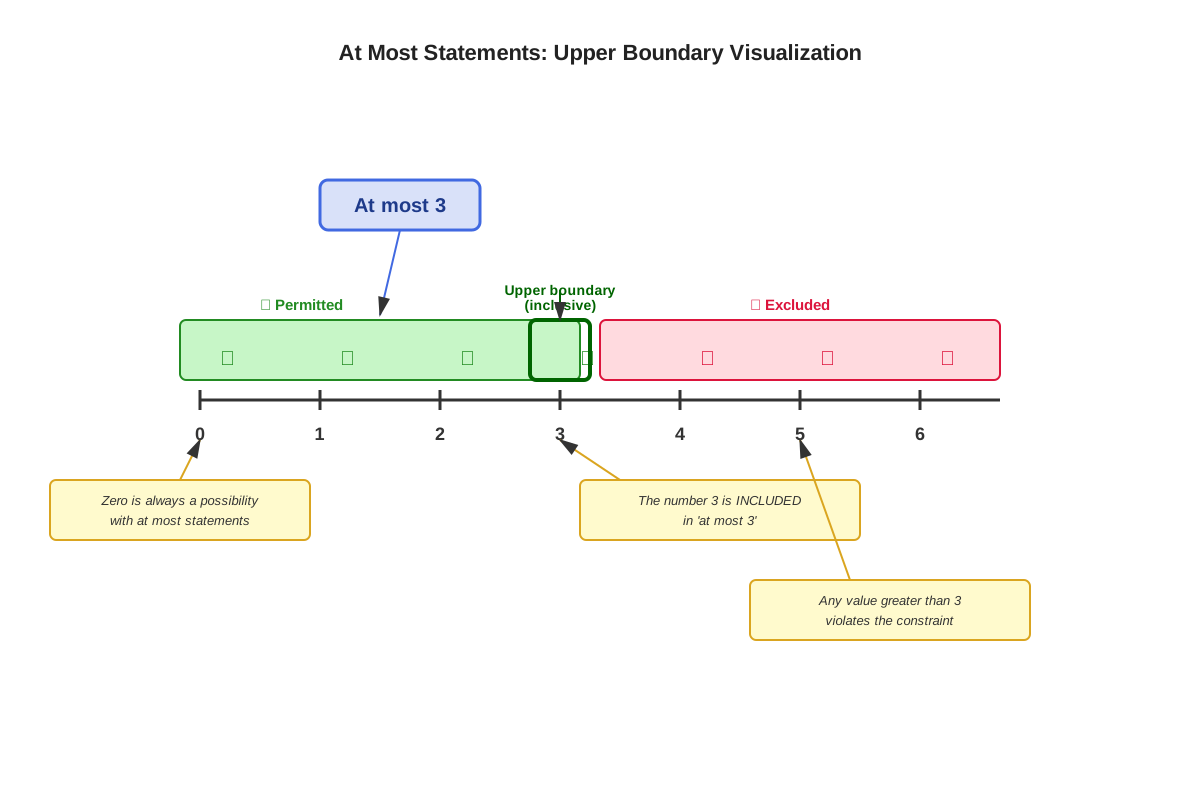
The logical structure of at most statements differs fundamentally from other quantifiers like "all," "some," or "none," making them particularly challenging for test-takers who haven't mastered their unique properties. When the LSAT presents a statement such as "at most three candidates will be selected," it establishes that the number of selected candidates cannot exceed three—meaning zero, one, two, or three candidates could be selected, but never four or more. This upper-bound constraint creates specific logical implications that the LSAT exploits in various question types, particularly when combined with other quantified statements or conditional logic.
Within the broader framework of LSAT logical reasoning, at most statements connect intimately with conditional logic, contrapositive reasoning, and quantifier negation. They frequently appear alongside other quantifiers in complex argument structures, requiring test-takers to translate natural language into precise logical notation, identify valid inferences, and recognize invalid reasoning patterns. Mastery of lsat at most statements enables students to navigate sophisticated formal logic questions with confidence and accuracy, directly impacting performance on some of the highest-difficulty questions that separate top scorers from average performers.
Learning Objectives
- [ ] Identify how at most statements appears in LSAT questions
- [ ] Explain the reasoning pattern behind at most statements
- [ ] Apply at most statements to solve LSAT-style problems accurately
- [ ] Translate at most statements into formal logical notation and equivalent expressions
- [ ] Recognize the contrapositive and negation of at most statements
- [ ] Combine at most statements with other quantifiers to derive valid inferences
- [ ] Distinguish between at most statements and similar-sounding quantifiers (at least, exactly, most)
Prerequisites
- Basic conditional logic: Understanding "if-then" statements and their contrapositives is essential because at most statements often appear within conditional structures
- Quantifier fundamentals: Familiarity with "all," "some," and "none" provides the foundation for understanding how at most statements function as bounded quantifiers
- Set theory basics: Recognizing how elements belong to or are excluded from sets helps visualize the constraints that at most statements impose
- Logical negation: Understanding how to negate statements correctly is crucial for working with the contrapositive and opposite of at most statements
Why This Topic Matters
At most statements appear with remarkable frequency on the LSAT, showing up in approximately 15-20% of formal logic questions and appearing across multiple question types including sufficient assumption, must be true/must be false, parallel reasoning, and logic games. The LSAT test-makers favor at most statements because they test a student's ability to think precisely about numerical constraints and upper boundaries—skills that directly correlate with the analytical reasoning required for legal practice.
In real-world legal contexts, attorneys constantly work with maximum limits: statutes of limitations establish at most timeframes for filing claims, sentencing guidelines specify at most penalties for offenses, and contractual provisions often include maximum liability clauses. The logical reasoning skills developed through mastering at most statements translate directly to interpreting legal language, identifying the boundaries of legal rules, and recognizing when arguments exceed their logical warrant.
On the LSAT specifically, at most statements commonly appear in several distinct patterns: (1) as premises in formal logic arguments where students must identify what can be validly concluded, (2) in answer choices for sufficient assumption questions where the correct answer must provide an upper-bound constraint, (3) in logic games where numerical constraints limit how many elements can possess certain properties, and (4) in must be true questions where combining an at most statement with other quantified premises yields a necessary inference. Questions involving at most statements tend to have higher difficulty ratings and lower accuracy rates among test-takers, making them high-value targets for focused study.
Core Concepts
Definition and Logical Structure
An at most statement establishes a maximum numerical limit on the quantity of elements that can satisfy a particular condition. The statement "at most n elements have property P" means that the number of elements with property P is less than or equal to n. Formally, this can be expressed as: the count of elements with property P ≤ n.
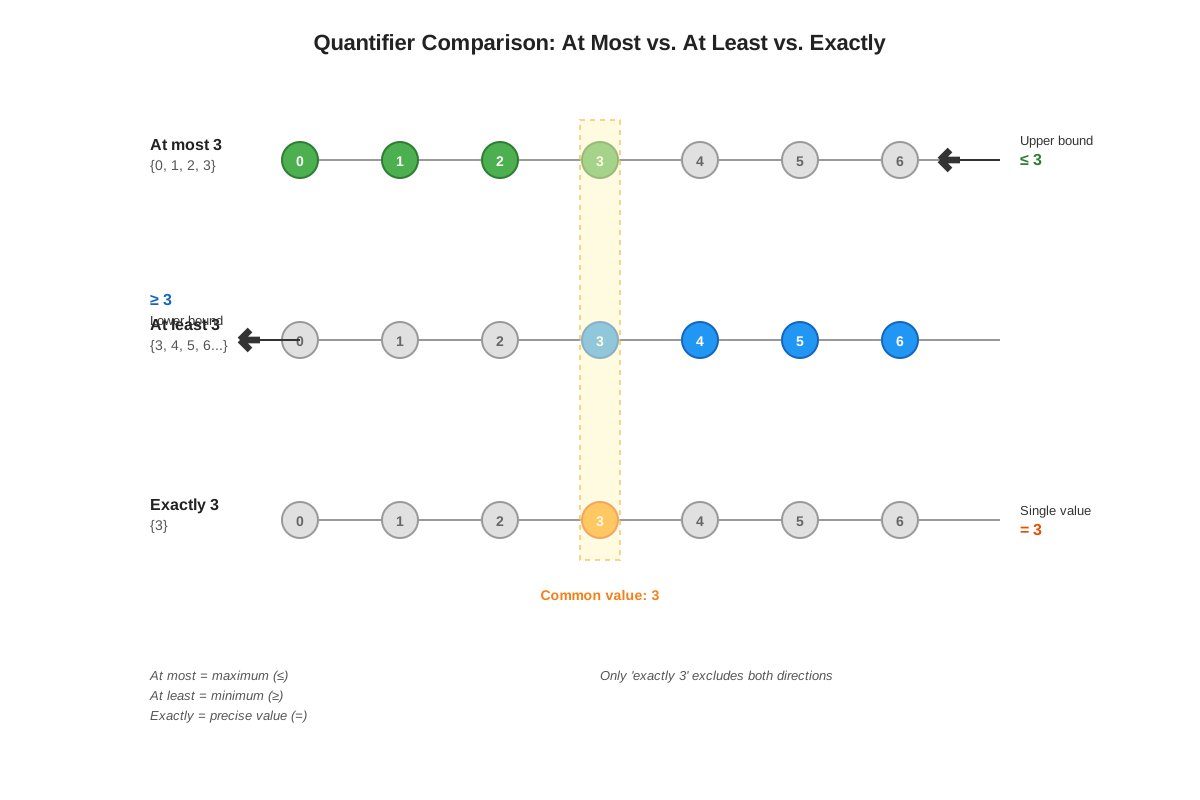
The critical insight is that at most statements specify an upper boundary while leaving all possibilities below that boundary open. If at most three students passed the exam, then exactly zero, one, two, or three students could have passed—but four or more students definitely did not pass. This differs fundamentally from "exactly" statements (which specify a precise number) and "at least" statements (which specify a lower boundary).
Formal Notation and Translation
When translating at most statements into formal logical notation, several equivalent expressions exist:
| Natural Language | Formal Expression | Meaning |
|---|---|---|
| At most 3 are P | Count(P) ≤ 3 | Zero, one, two, or three elements have property P |
| No more than 3 are P | Count(P) ≤ 3 | Identical to "at most 3" |
| 3 or fewer are P | Count(P) ≤ 3 | Identical to "at most 3" |
| Not more than 3 are P | Count(P) ≤ 3 | Identical to "at most 3" |
The LSAT frequently uses these equivalent phrasings interchangeably, testing whether students recognize that "no more than," "at most," and "or fewer" express identical logical constraints. Developing fluency in recognizing these equivalent expressions is essential for quickly processing LSAT questions.
Negation of At Most Statements
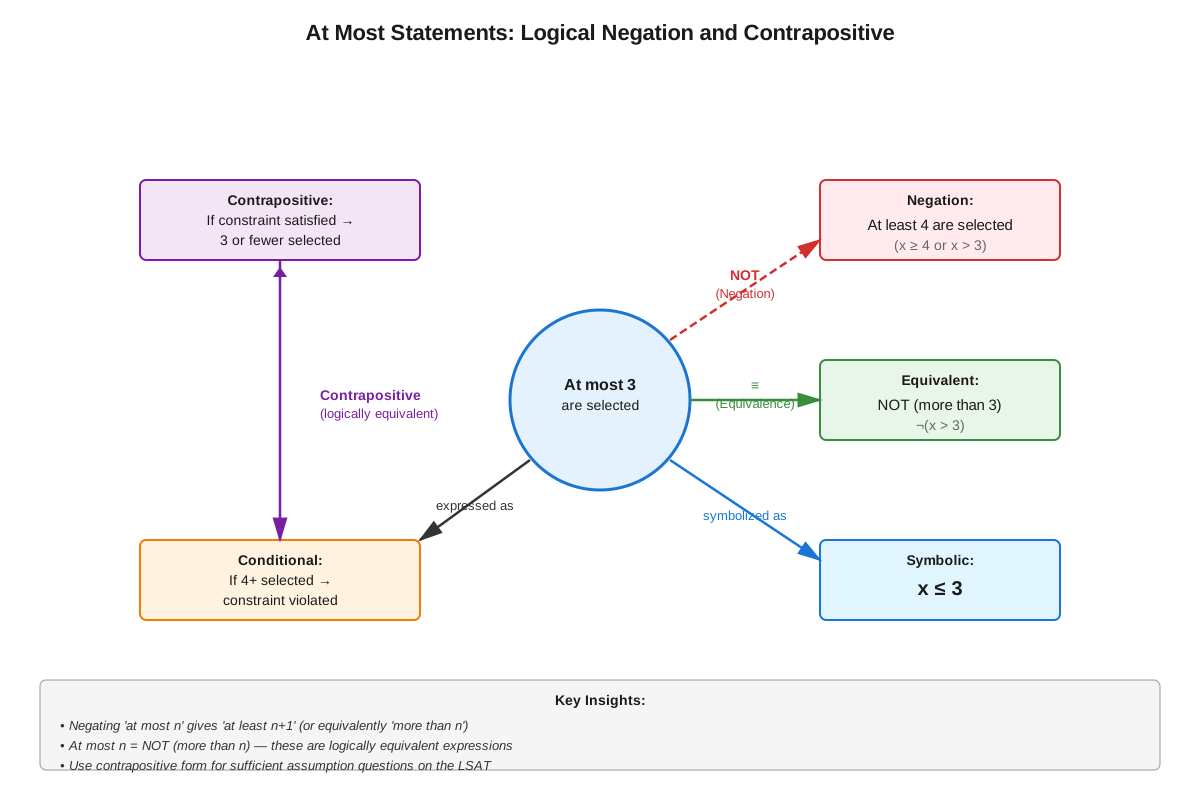
Understanding how to negate at most statements correctly is crucial for contrapositive reasoning and for evaluating answer choices in weaken/strengthen questions. The negation of "at most n elements have property P" is "at least (n+1) elements have property P."
For example:
- Statement: "At most 3 candidates will be hired"
- Negation: "At least 4 candidates will be hired"
This negation pattern follows from the logical principle that if it's not true that the count is ≤ n, then the count must be > n, which is equivalent to ≥ (n+1) for integer values. The LSAT exploits this relationship in questions requiring students to identify what would make an argument fail or what contradicts a given statement.
Combining At Most Statements with Other Quantifiers
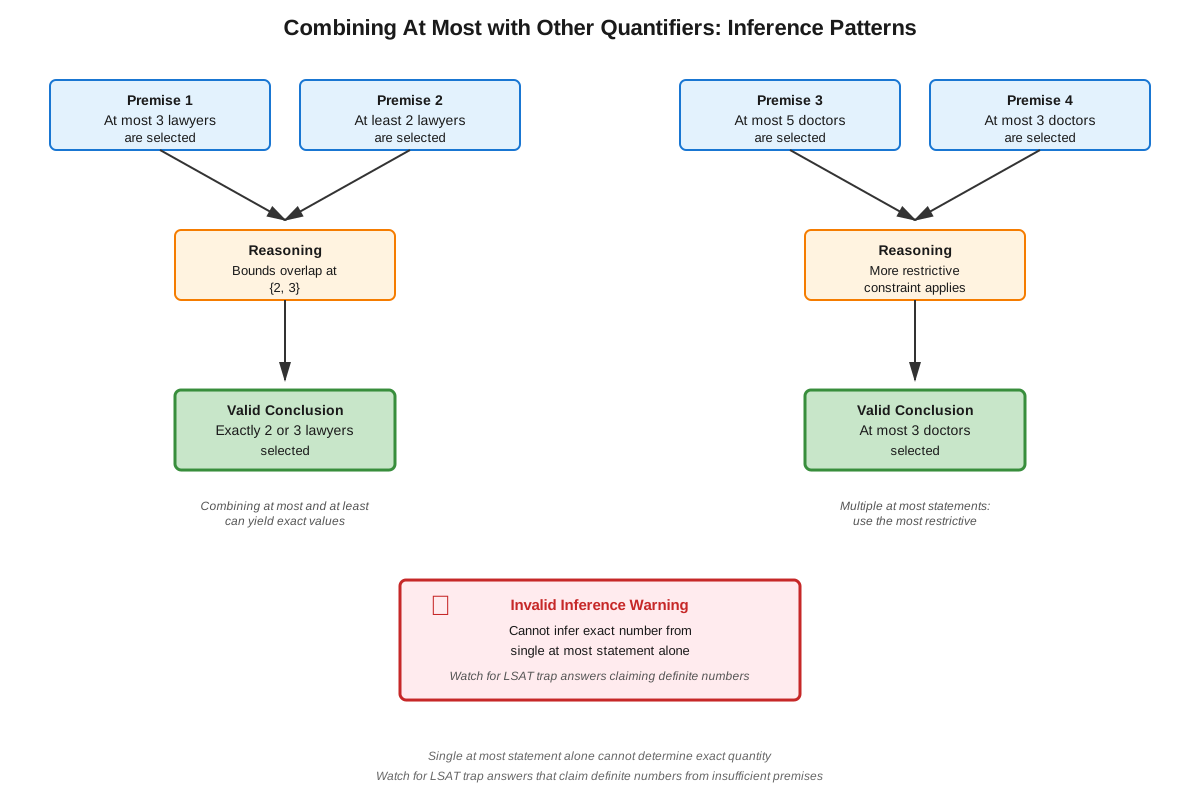
The LSAT frequently tests the ability to combine at most statements with other quantified premises to derive valid inferences. Consider these combination patterns:
- At Most + At Least = Exactly (when boundaries meet)
- Premise 1: At most 5 members voted yes
- Premise 2: At least 5 members voted yes
- Valid inference: Exactly 5 members voted yes
- Multiple At Most statements about overlapping sets
- Premise 1: At most 3 students study French
- Premise 2: At most 2 students study German
- Premise 3: Every student studies French or German
- Valid inference: At most 5 students total (if sets don't overlap)
- At Most + Universal statements
- Premise 1: All lawyers are professionals
- Premise 2: At most 4 lawyers attended the meeting
- Valid inference: At most 4 professionals who are lawyers attended the meeting
Distinguishing At Most from Similar Quantifiers
The LSAT deliberately creates confusion by using quantifiers that sound similar but have distinct logical meanings:
| Quantifier | Meaning | Example |
|---|---|---|
| At most n | ≤ n | At most 3 means 0, 1, 2, or 3 |
| At least n | ≥ n | At least 3 means 3, 4, 5, ... |
| Exactly n | = n | Exactly 3 means only 3 |
| Most | > 50% | Most means more than half |
| More than n | > n | More than 3 means 4, 5, 6, ... |
| Fewer than n | < n | Fewer than 3 means 0, 1, or 2 |
Note particularly that "at most n" includes n itself (≤), while "fewer than n" excludes n (<). This distinction appears in trap answer choices designed to catch students who conflate these similar-sounding expressions.
At Most Statements in Conditional Logic
At most statements frequently appear within conditional structures, creating compound logical relationships:
- "If a candidate is selected, then at most 2 others from the same department are selected"
- "At most 3 witnesses will testify only if the trial lasts fewer than 5 days"
When at most statements appear in conditional contexts, students must carefully track both the conditional relationship and the numerical constraint. The contrapositive of a conditional containing an at most statement requires negating the at most statement (converting it to at least):
- Original: If P → at most 3 are Q
- Contrapositive: If at least 4 are Q → not P
Boundary Cases and Edge Scenarios
The LSAT tests understanding of boundary cases where at most statements reach their limits:
- Zero as a possibility: "At most 3" includes the possibility that zero elements satisfy the condition
- Maximum saturation: When an at most statement reaches its upper bound, no additional elements can satisfy the condition
- Overlapping constraints: When multiple at most statements apply to overlapping sets, the most restrictive constraint governs
Concept Relationships
At most statements exist within a hierarchical relationship structure in formal logic. They represent a specific type of quantified statement (alongside universal, existential, and other numerical quantifiers), which in turn forms part of the broader domain of formal logic and quantifiers. Understanding this hierarchy helps students recognize when at most reasoning applies.
The relationship flow operates as follows: Basic conditional logic (if-then statements) → Quantifier introduction (all, some, none) → Numerical quantifiers (at least, at most, exactly) → Complex quantified arguments (combining multiple quantifiers with conditionals). At most statements represent an intermediate-to-advanced concept that builds on simpler quantifiers while enabling more sophisticated logical reasoning.
Within the topic itself, the core concepts connect through these relationships:
- Definition and structure → establishes the foundation → Formal notation → enables precise manipulation → Negation rules → supports contrapositive reasoning → Combination patterns → allows inference derivation → Conditional integration → creates complex argument structures
At most statements also connect laterally to at least statements (as logical complements), exactly statements (as a special case where upper and lower bounds coincide), and most statements (which establish proportional rather than absolute constraints). Mastering these relationships enables students to quickly identify which logical tools apply to any given LSAT question.
High-Yield Facts
⭐ At most n means the count is less than or equal to n (includes zero through n as possibilities)
⭐ The negation of "at most n" is "at least (n+1)" (not "at least n")
⭐ "At most," "no more than," and "n or fewer" are logically equivalent expressions that the LSAT uses interchangeably
⭐ When "at most n" and "at least n" both apply, the count must be exactly n (boundaries meeting)
⭐ At most statements establish upper bounds but do not guarantee any elements satisfy the condition (zero is always possible)
- At most n is symbolized as ≤ n, while fewer than n is symbolized as < n (the difference matters)
- Multiple at most statements about non-overlapping sets can be added to determine an overall maximum
- At most statements in conditional antecedents create constraints that apply only when the condition is met
- The contrapositive of a conditional with "at most" in the consequent requires negating to "at least (n+1)"
- At most 1 is logically equivalent to "zero or one" (not "at least one")
- When an at most statement appears in an LSAT stimulus, look for other quantified statements that might combine to yield valid inferences
- At most statements cannot be converted or inverted like simple conditional statements (they are not biconditionals)
- "Most" (meaning more than half) is fundamentally different from "at most" and should never be confused
Quick check — test yourself on At most statements so far.
Try Flashcards →Common Misconceptions
Misconception: "At most 3" means "exactly 3" or "probably 3"
Correction: At most 3 means anywhere from zero to three, inclusive. It establishes only an upper limit, not a specific value or likely value. All possibilities from zero through three remain open.
Misconception: The negation of "at most 3" is "at least 3"
Correction: The negation of "at most 3" is "at least 4" (or equivalently, "more than 3"). The negation must exclude all possibilities allowed by the original statement, which includes 3 itself, so the negation must start at 4.
Misconception: "At most" and "most" are similar concepts
Correction: These are entirely different quantifiers. "Most" means more than half (a proportional claim), while "at most" establishes a maximum numerical limit. "Most students passed" means >50% passed, while "at most 3 students passed" means ≤3 passed regardless of the total number of students.
Misconception: If at most 3 people have property P, then at least one person must have property P
Correction: At most statements do not guarantee that any elements satisfy the condition. "At most 3" includes the possibility that zero elements have the property. To guarantee at least one, you need a separate "at least 1" statement.
Misconception: You can convert an at most statement like a conditional (if at most 3 are P, then at most 3 are Q)
Correction: At most statements are not conditional statements and cannot be converted, inverted, or manipulated like conditionals. They are numerical constraints that must be combined with other statements according to specific inference rules.
Misconception: "At most 3" and "fewer than 3" mean the same thing
Correction: "At most 3" includes 3 as a possibility (≤3), while "fewer than 3" excludes 3 (<3). The difference is whether the boundary value itself is included. On the LSAT, this distinction often appears in trap answer choices.
Misconception: When two at most statements overlap, you add them together
Correction: Whether you can add at most statements depends on whether the sets overlap. If the sets are completely separate, you can add the maximums. If they overlap, the combined maximum might be less than the sum. Always consider whether elements could belong to both categories.
Worked Examples
Example 1: Combining At Most with At Least
Question: A committee will select new members according to these rules:
- At most 4 members will be selected from the finance department
- At least 3 members will be selected from the finance department
- Every selected member is from either finance or marketing
- At most 6 members total will be selected
Which of the following must be true?
(A) Exactly 4 members from finance will be selected
(B) At least 2 members from marketing will be selected
(C) At most 3 members from marketing will be selected
(D) Exactly 3 or 4 members from finance will be selected
(E) At least 1 member from marketing will be selected
Solution:
Step 1: Identify the constraints
- Finance: at most 4 AND at least 3 (so exactly 3 or 4)
- Total: at most 6
- Every member is finance OR marketing
Step 2: Determine what must be true about finance
Since finance has both "at most 4" and "at least 3," the number from finance must be exactly 3 or exactly 4 (where the boundaries overlap). This makes (D) correct.
Step 3: Check why other answers fail
- (A) is too strong—could be 3 or 4, not necessarily 4
- (B) is not necessarily true—if 4 from finance and 0 from marketing, total is 4 (≤6)
- (C) is not necessarily true—if 3 from finance, could have 3 from marketing (total 6)
- (E) is not necessarily true—all 6 could be from finance... wait, no! Finance is at most 4, so if we select 6 total, at least 2 must be from marketing. But we're not required to select 6 total.
Step 4: Verify (D)
The combination of "at most 4" and "at least 3" for finance creates a bounded range: exactly 3 or exactly 4. This must be true regardless of other factors.
Answer: (D)
Key takeaway: When at most and at least statements apply to the same category with overlapping or adjacent boundaries, they create an "exactly" constraint or a narrow range. This is a high-yield inference pattern on the LSAT.
Example 2: Negating At Most in Conditional Logic
Question: A legal scholar argues: "If the court's interpretation is correct, then at most two of the five precedents cited remain valid. But we know that at least three of the five precedents remain valid. Therefore, the court's interpretation is incorrect."
Which of the following most accurately describes the reasoning pattern?
(A) Affirming the consequent
(B) Denying the antecedent
(C) Valid modus tollens
(D) Invalid contrapositive
(E) Circular reasoning
Solution:
Step 1: Identify the logical structure
- Conditional: If court correct → at most 2 precedents valid
- Fact: At least 3 precedents valid
- Conclusion: Court not correct
Step 2: Determine if this is valid reasoning
To use modus tollens (denying the consequent to deny the antecedent), we need:
- If P → Q
- Not Q
- Therefore, not P
Step 3: Check if "at least 3 valid" negates "at most 2 valid"
- "At most 2 valid" means ≤2 valid
- "At least 3 valid" means ≥3 valid
- These are contradictory (one must be false if the other is true)
- So "at least 3 valid" is indeed the negation of "at most 2 valid"
Step 4: Verify the reasoning pattern
- If court correct → at most 2 valid
- NOT (at most 2 valid) [because at least 3 valid]
- Therefore, NOT (court correct)
This is valid modus tollens—denying the consequent to deny the antecedent.
Answer: (C)
Key takeaway: Recognizing that "at least (n+1)" negates "at most n" is essential for evaluating arguments that use contrapositive reasoning with at most statements. The LSAT frequently tests whether students can identify valid modus tollens when the consequent contains an at most statement.
Exam Strategy
When approaching LSAT questions involving at most statements, implement this systematic process:
Step 1: Identify and translate - When you see "at most," "no more than," or "n or fewer," immediately recognize this as an upper-bound constraint and mentally translate it to "≤n" notation. Mark these statements in your scratch work as they're likely to be key premises.
Step 2: Watch for combination opportunities - Scan for other quantified statements (especially "at least" statements) that might combine with the at most statement. When at most and at least apply to the same category, check if they create an "exactly" constraint.
Step 3: Consider the zero case - Remember that at most statements always include zero as a possibility unless another statement rules it out. Many trap answers assume at least one element must satisfy the condition.
Step 4: Check boundary values carefully - Pay close attention to whether the boundary number itself is included. "At most 3" includes 3, while "fewer than 3" excludes 3. The LSAT uses this distinction in wrong answer choices.
Trigger words and phrases to watch for:
- "At most" (direct statement)
- "No more than" (equivalent to at most)
- "Or fewer" (equivalent to at most)
- "Not more than" (equivalent to at most)
- "Maximum" (indicates upper bound)
- "Cannot exceed" (indicates upper bound)
Process of elimination tips:
- Eliminate answers that treat "at most n" as "exactly n"
- Eliminate answers that confuse "at most n" with "at least n"
- Eliminate answers that assume at least one element must satisfy the condition when only an at most constraint exists
- Eliminate answers that add at most statements without considering whether sets overlap
Time allocation advice: At most questions typically require 60-90 seconds. If a question involves combining multiple quantified statements, allocate up to 2 minutes. Don't rush the translation phase—accurately converting natural language to logical notation prevents errors downstream. If you find yourself stuck, check whether you've correctly identified all at most statements and whether you've considered the zero case.
Memory Techniques
Mnemonic for At Most vs. At Least: "At MOST = Maximum = ≤" (all start with M). "At LEAST = Lower bound = ≥" (all start with L).
Visualization strategy: Picture a container with a maximum capacity. "At most 3" means the container can hold 0, 1, 2, or 3 items but cannot exceed 3. Visualize a line at the top representing the ceiling that cannot be crossed.
Acronym for negation: "NAMO" = Negation of At Most = One more than the stated number. If you see "at most 3," think "NAMO 4" (negation is at least 4).
Boundary memory device: "At most includes the most" (the boundary number is included). "Fewer than excludes the number" (the boundary is not included). This helps distinguish ≤ from <.
Combination rule: "When MOST meets LEAST, you get EXACTLY the feast" (when at most n and at least n apply to the same thing, the result is exactly n).
Zero reminder: "At most allows for ZERO" (always remember that zero is a possibility unless ruled out by another statement).
Summary
At most statements establish upper-bound numerical constraints that appear frequently throughout LSAT logical reasoning questions and logic games. These statements specify that the count of elements satisfying a condition is less than or equal to a specified number, leaving all possibilities from zero through that number open. Mastering at most statements requires understanding their formal logical structure (≤n), recognizing equivalent phrasings ("no more than," "or fewer"), correctly negating them (at most n negates to at least n+1), and combining them with other quantified statements to derive valid inferences. The LSAT exploits common misconceptions about at most statements, particularly the confusion between at most and at least, the assumption that at most guarantees at least one element, and the failure to recognize that at most n includes n itself as a possibility. Success with at most statements depends on careful translation from natural language to logical notation, systematic checking of boundary cases including zero, and recognition of high-yield combination patterns such as when at most and at least statements create exactly constraints. These skills directly impact performance on sufficient assumption questions, must be true questions, and formal logic games where numerical constraints determine valid inferences.
Key Takeaways
- At most n means ≤n: The count can be anywhere from zero to n, inclusive—it establishes only an upper boundary
- Negation adds one: The negation of "at most n" is "at least (n+1)," not "at least n"
- Equivalent expressions: "At most," "no more than," and "n or fewer" are logically identical and interchangeable
- Combination creates exactness: When "at most n" and "at least n" both apply, the count must be exactly n
- Zero is always possible: At most statements never guarantee that any elements satisfy the condition unless combined with an at least statement
- Boundary inclusion matters: "At most 3" includes 3 (≤), while "fewer than 3" excludes 3 (<)—this distinction appears in trap answers
- Watch for overlapping sets: When combining multiple at most statements, consider whether the categories overlap before adding the maximums
Related Topics
At Least Statements: The logical complement to at most statements, establishing lower bounds rather than upper bounds. Mastering both enables recognition of exactly constraints when boundaries meet.
Exactly Statements: Represent the special case where upper and lower bounds coincide. Understanding at most statements provides half the foundation for working with exactly statements.
Most vs. All Quantifiers: While at most deals with absolute numerical limits, most deals with proportional claims (>50%). Distinguishing these prevents common confusion on the LSAT.
Conditional Logic with Quantifiers: At most statements frequently appear within conditional structures, requiring integration of conditional reasoning rules with quantifier manipulation.
Logic Games Numerical Constraints: At most statements appear extensively in logic games where numerical distribution rules govern how elements can be assigned to categories.
Sufficient Assumption Questions: These questions often require identifying at most statements as the missing premise that makes an argument valid by establishing necessary upper bounds.
Practice CTA
Now that you've mastered the logical structure and application of at most statements, it's time to reinforce your understanding through active practice. Work through the practice questions to test your ability to identify, translate, and apply at most reasoning in realistic LSAT contexts. Use the flashcards to drill the key distinctions and combination patterns until they become automatic. Remember: at most statements appear in some of the highest-difficulty LSAT questions, so mastering this topic directly translates to score improvement. Every practice question you complete builds the pattern recognition and logical fluency that will serve you on test day. You've built the foundation—now strengthen it through deliberate practice!
Sign up free to keep reading
Create a free AnvayaPrep account to finish this LSAT guide on At most statements — plus flashcards and practice questions.