Overview
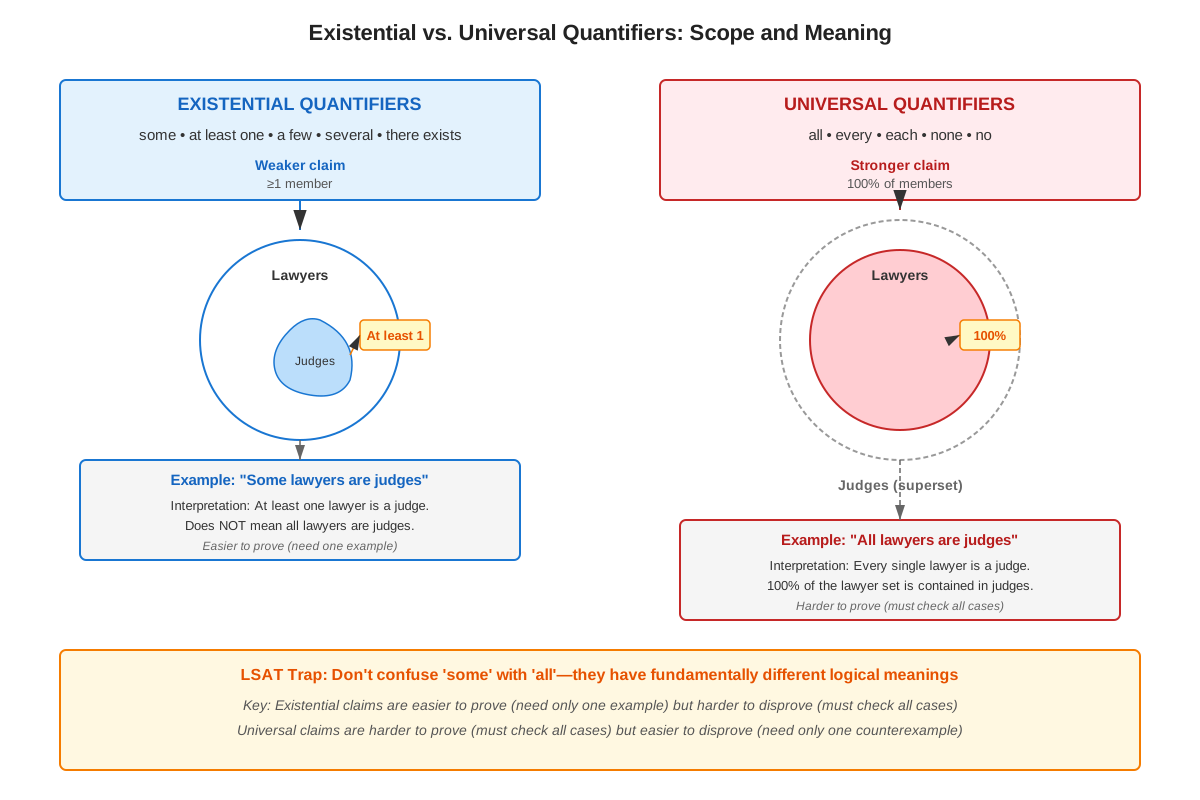
Existential quantifiers are fundamental building blocks of formal logic and quantifiers that appear frequently throughout the LSAT, particularly in logical reasoning sections. An existential quantifier is a logical operator that asserts the existence of at least one member of a specified group that satisfies a particular condition. In everyday language, existential quantifiers appear as words like "some," "at least one," "a few," "several," or "there exists." Understanding how these quantifiers function is critical for accurately interpreting LSAT arguments, identifying logical flaws, and recognizing valid inferences.
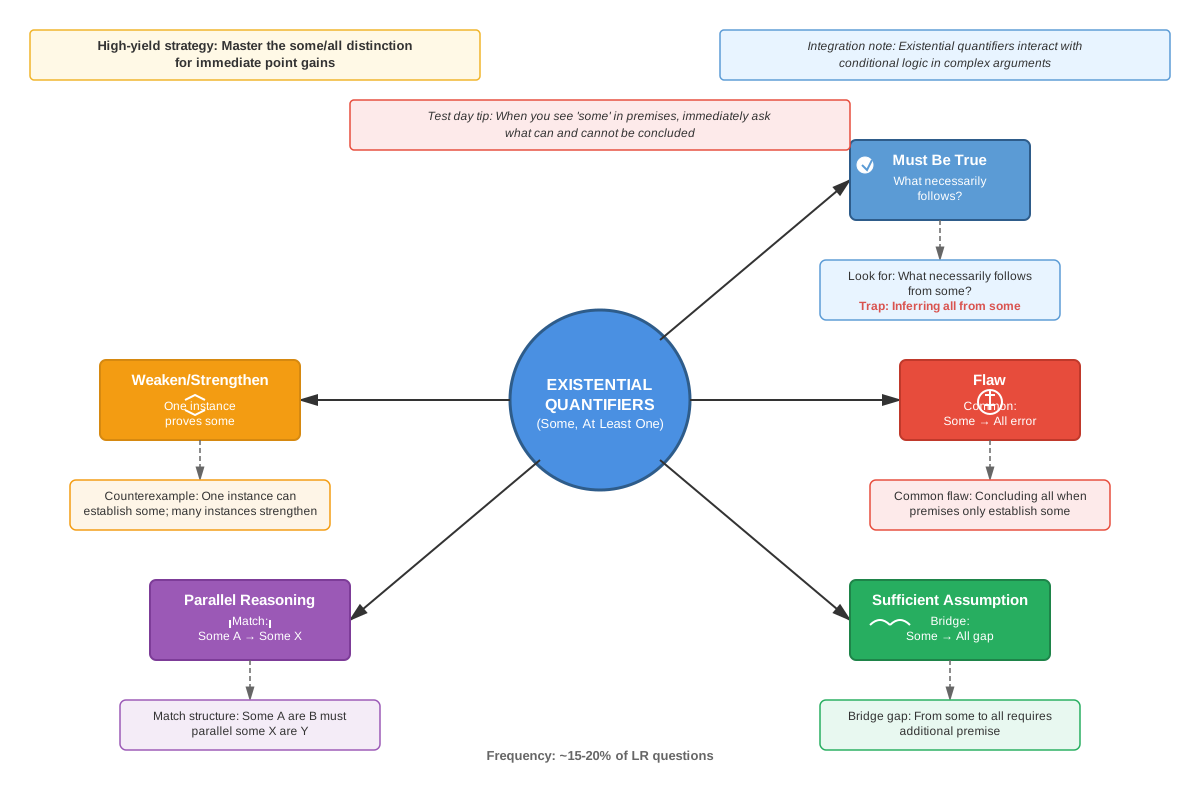
The LSAT tests existential quantifiers both explicitly and implicitly across multiple question types, including Must Be True, Flaw, Sufficient Assumption, and Parallel Reasoning questions. Test-makers frequently construct arguments that hinge on the precise meaning of "some" versus "all," or they create traps by exploiting common misunderstandings about what can and cannot be inferred from existential claims. Students who master existential quantifiers gain a significant advantage in quickly identifying valid versus invalid logical moves, which directly translates to improved accuracy and speed on test day.
Within the broader landscape of LSAT logical reasoning, existential quantifiers form one half of the quantifier system, with universal quantifiers ("all," "every," "none") forming the other half. These two types of quantifiers interact in complex ways throughout LSAT arguments, and understanding their relationship is essential for mastering conditional logic, recognizing necessary versus sufficient conditions, and evaluating argument strength. Existential quantifiers also play a crucial role in understanding the logical structure of counterexamples, which are frequently used to weaken arguments or demonstrate logical flaws.
Learning Objectives
- [ ] Identify how existential quantifiers appear in LSAT questions
- [ ] Explain the reasoning pattern behind existential quantifiers
- [ ] Apply existential quantifiers to solve LSAT-style problems accurately
- [ ] Distinguish between valid and invalid inferences involving existential quantifiers
- [ ] Recognize the relationship between existential and universal quantifiers in complex arguments
- [ ] Translate natural language statements containing existential quantifiers into formal logical notation
- [ ] Identify common LSAT traps that exploit misunderstandings of existential quantifiers
Prerequisites
- Basic conditional logic: Understanding "if-then" statements is essential because existential quantifiers often appear within conditional structures
- Categorical statements: Familiarity with statements about groups and categories provides the foundation for understanding quantified claims
- Logical negation: Knowing how to properly negate statements is crucial for understanding the relationship between existential and universal quantifiers
- Argument structure: Recognizing premises and conclusions helps identify where existential quantifiers function within LSAT arguments
Why This Topic Matters
Existential quantifiers appear in approximately 15-20% of all LSAT Logical Reasoning questions, making them one of the most frequently tested formal logic concepts on the exam. They are particularly prevalent in Must Be True questions, where test-takers must identify what necessarily follows from given premises, and in Flaw questions, where arguments often commit errors by making unjustified leaps from existential to universal claims or vice versa.
In real-world contexts, existential quantifiers are fundamental to legal reasoning, scientific claims, and policy arguments. Attorneys must understand the difference between proving that some instances of a phenomenon exist versus proving that all instances share a characteristic. Scientific research often begins with existential claims ("some patients respond to this treatment") before attempting to establish broader patterns. Policy debates frequently hinge on whether a problem affects some or all members of a population.
On the LSAT, existential quantifiers commonly appear in several distinct ways: as explicit quantified statements in stimulus passages, as implicit claims embedded in everyday language, as components of formal logic games, and as key elements in answer choices that must be evaluated for logical validity. The test frequently presents arguments that confuse "some" with "most" or "all," or that incorrectly assume that because something is true of some members of a group, it must be true of specific individuals or all members. Recognizing these patterns is essential for avoiding common traps and selecting correct answers efficiently.
Core Concepts
Definition and Basic Structure
Existential quantifiers are logical operators that assert the existence of at least one element in a domain that satisfies a given property or condition. In formal logic, the existential quantifier is typically symbolized as "∃" (read as "there exists"). When applied to a variable and a predicate, an existential quantifier creates a statement of the form "∃x P(x)," which translates to "there exists at least one x such that P(x) is true."
On the LSAT existential quantifiers appear primarily through natural language expressions rather than formal symbols. The most common linguistic markers include:
- "Some" (the most frequent and important)
- "At least one"
- "There is/are"
- "A few"
- "Several"
- "Many" (though this implies more than just "some")
- "Most" (technically stronger than basic existential quantification)
The critical feature of existential quantifiers is that they make minimal claims: they assert only that at least one instance exists, without specifying how many instances exist or providing information about all members of the category.
The Logical Meaning of "Some"
In formal logic and quantifiers, the word "some" has a precise technical meaning that differs from its everyday usage. Logically, "some" means "at least one, possibly all." This definition has several important implications:
- Minimum commitment: "Some X are Y" commits only to the existence of at least one X that is also Y
- No upper limit: "Some" does not exclude the possibility that all X are Y
- Bidirectionality: "Some X are Y" logically entails "Some Y are X" (the converse is always valid for existential statements)
- Non-zero assertion: "Some" always means at least one; it cannot mean zero
This technical definition often conflicts with conversational implicature, where "some" typically suggests "not all." On the LSAT, however, the logical definition always applies, and answer choices that rely on the conversational interpretation are incorrect.
Valid Inferences from Existential Statements
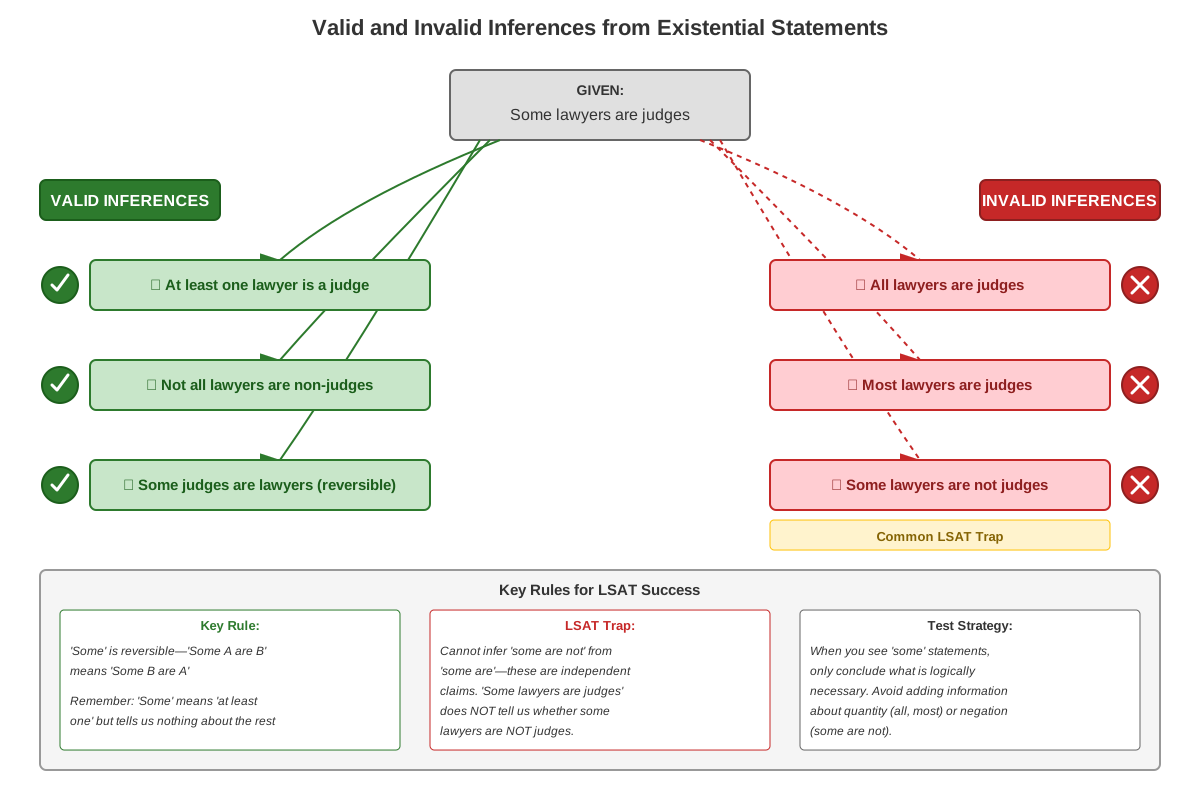
Understanding what can and cannot be validly inferred from existential quantifiers is crucial for LSAT success. Consider the statement "Some lawyers are poets":
Valid inferences:
- At least one lawyer is a poet
- At least one poet is a lawyer (conversion)
- Not all lawyers are non-poets (equivalent contrapositive form)
- It is not the case that no lawyers are poets
Invalid inferences:
- All lawyers are poets
- Most lawyers are poets
- This particular lawyer is a poet
- Some lawyers are not poets (though this may be true, it doesn't follow logically)
- Some poets are not lawyers
The LSAT frequently tests the distinction between these valid and invalid inferences, particularly in Must Be True and Parallel Reasoning questions.
Relationship to Universal Quantifiers
Existential and universal quantifiers form a complementary system in logic, and understanding their relationship is essential for logical reasoning on the LSAT. The universal quantifier "all" makes a claim about every member of a category, while the existential quantifier "some" makes a claim about at least one member.
| Quantifier Type | Common Forms | Logical Meaning | Negation |
|---|---|---|---|
| Existential | Some, at least one, there exists | ∃x P(x) | No, none, not any |
| Universal | All, every, each, any | ∀x P(x) | Some... not, not all |
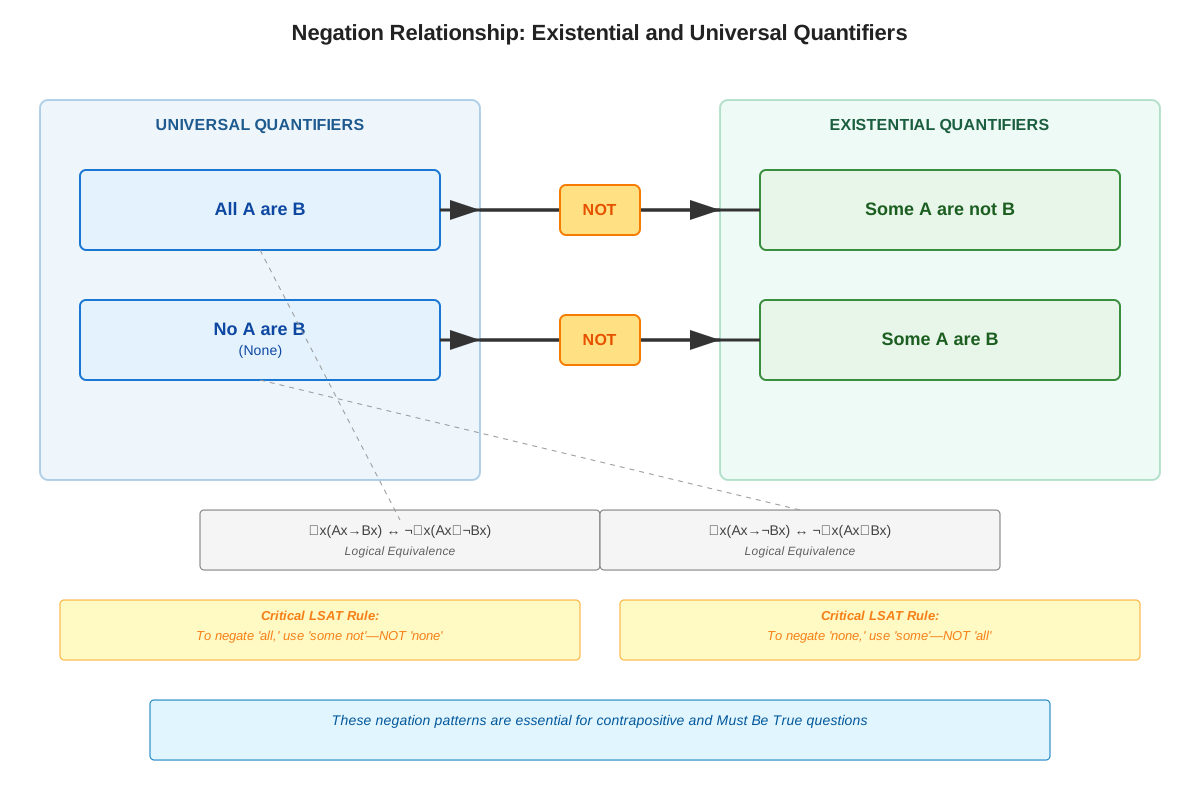
The negation relationship is particularly important: the negation of a universal statement is an existential statement, and vice versa. "All X are Y" negates to "Some X are not Y," while "Some X are Y" negates to "No X are Y" (or equivalently, "All X are not Y").
Existential Quantifiers in Conditional Statements
Existential quantifiers frequently appear within conditional (if-then) structures on the LSAT, creating complex logical relationships. Consider: "If some politicians are honest, then democracy can function."
This statement has the form: (∃x: Politician(x) ∧ Honest(x)) → Democracy-Functions
Key points about existential quantifiers in conditionals:
- The existential claim may appear in the sufficient condition (antecedent), necessary condition (consequent), or both
- The scope of the quantifier matters: "Some X, if Y, then Z" differs from "If some X are Y, then Z"
- Negating these statements requires careful attention to both the conditional structure and the quantifier
Existential Quantifiers and Counterexamples
A single counterexample is sufficient to disprove a universal claim, which is an application of existential quantification. If someone claims "All swans are white," finding just one black swan (asserting "Some swans are not white") completely refutes the universal claim. The LSAT frequently tests this principle in Weaken and Flaw questions, where arguments make universal claims that can be challenged by existential counterexamples.
Concept Relationships
The concepts within existential quantifiers form an interconnected logical system. The basic definition of existential quantifiers establishes the foundation, specifying that these operators assert the existence of at least one instance. This definition directly leads to understanding the precise logical meaning of "some", which is the most common linguistic expression of existential quantification on the LSAT.
Understanding "some" then enables recognition of valid versus invalid inferences, as students must know what logically follows from existential claims and what does not. This inference knowledge connects to the relationship between existential and universal quantifiers, since many LSAT questions test whether students can distinguish between "some" and "all" claims or recognize how these quantifiers negate each other.
The existential-universal relationship feeds into understanding existential quantifiers in conditional statements, where both types of quantifiers may appear in complex logical structures. All of these concepts converge in the practical application of identifying counterexamples, which uses existential quantification to challenge universal claims.
These internal relationships also connect to prerequisite knowledge: conditional logic provides the framework for understanding quantifiers in if-then statements, while logical negation is essential for understanding the existential-universal relationship. Looking forward, mastery of existential quantifiers enables progression to more advanced topics like quantifier scope, multiply quantified statements, and formal logic translations.
High-Yield Facts
⭐ "Some" in formal logic means "at least one, possibly all" – never interpret it as excluding the possibility of "all"
⭐ Existential statements are always convertible – "Some X are Y" always means "Some Y are X"
⭐ The negation of "all" is "some not" – "Not all X are Y" is logically equivalent to "Some X are not Y"
⭐ The negation of "some" is "none" – "Not some X are Y" is logically equivalent to "No X are Y"
⭐ A single counterexample disproves a universal claim – finding one instance of "not Y" refutes "All X are Y"
- "Some X are Y" does NOT allow you to conclude "Some X are not Y" (though both might be true)
- You cannot validly infer anything about a specific individual from "Some X are Y"
- "Some" makes no claim about quantity beyond "at least one" – it could be one, many, most, or all
- Existential claims in the conclusion of an argument are relatively easy to support (only need one example)
- Universal claims in the conclusion require much stronger support than existential claims
- "Most" is stronger than "some" but weaker than "all" – it implies more than half but not necessarily all
- Existential quantifiers can be hidden in phrases like "there are," "we find," or "occurs in"
- Two existential statements about overlapping categories do not allow you to infer a connection between the non-overlapping elements
Quick check — test yourself on Existential quantifiers so far.
Try Flashcards →Common Misconceptions
Misconception: "Some" means "some but not all" in formal logic.
Correction: In formal logic and on the LSAT, "some" means "at least one, possibly all." The conversational implicature that "some" excludes "all" does not apply to logical reasoning. If an LSAT question states "Some lawyers are wealthy," this is logically consistent with all lawyers being wealthy.
Misconception: From "Some X are Y" and "Some Y are Z," you can conclude "Some X are Z."
Correction: This inference is invalid. Existential statements do not chain together like conditional statements. For example, "Some dogs are brown" and "Some brown things are tables" does not allow you to conclude "Some dogs are tables." The overlapping category (brown things) might contain completely different members in each statement.
Misconception: "Some X are not Y" is the negation of "Some X are Y."
Correction: These two statements are not negations of each other; in fact, both can be true simultaneously. The actual negation of "Some X are Y" is "No X are Y" (or "All X are not Y"). If some politicians are honest, it can simultaneously be true that some politicians are not honest.
Misconception: If "Some X are Y" is true, then you can conclude something about any particular X.
Correction: Existential quantifiers make claims about the existence of at least one member but provide no information about specific individuals. Knowing "Some students passed the exam" tells you nothing about whether any particular student passed.
Misconception: "Many," "several," and "a few" are logically equivalent to "some."
Correction: While these terms all involve existential quantification, they carry different quantitative implications. "Many" suggests a larger number than "a few," though both guarantee at least one. On the LSAT, treat these terms according to their ordinary meaning unless the question explicitly defines them otherwise, but recognize that they all share the basic existential property of asserting at least one instance.
Misconception: Existential statements in premises strongly support existential statements in conclusions.
Correction: While existential claims are easier to support than universal claims, the support depends on the logical relationship between premises and conclusion. "Some birds fly" does not support "Some fish fly" even though both are existential claims. The content and logical structure matter more than the quantifier type alone.
Worked Examples
Example 1: Must Be True Question
Stimulus: "Some of the city's firefighters are also trained as paramedics. All paramedics in the city must complete a certification program. No one who has completed the certification program is unfamiliar with emergency medical procedures."
Question: If the statements above are true, which one of the following must also be true?
Answer Choices:
(A) All firefighters are familiar with emergency medical procedures
(B) Some firefighters are familiar with emergency medical procedures
(C) Most firefighters have completed a certification program
(D) Some people who are familiar with emergency medical procedures are firefighters
(E) All paramedics are firefighters
Solution:
Step 1: Identify and translate the existential and universal quantifiers.
- Premise 1: Some firefighters are paramedics (existential)
- Premise 2: All paramedics → completed certification (universal)
- Premise 3: All who completed certification → familiar with emergency procedures (universal)
Step 2: Chain the logical relationships.
From Premise 1, we know at least one firefighter is a paramedic. Let's call this person X.
From Premise 2, since X is a paramedic, X must have completed the certification program.
From Premise 3, since X completed the certification program, X is familiar with emergency medical procedures.
Step 3: Evaluate each answer choice.
(A) Invalid: We only know that SOME firefighters (those who are paramedics) are familiar with emergency procedures, not ALL firefighters.
(B) Valid: We've established that at least one firefighter (X) is familiar with emergency medical procedures. This is exactly what "some" means in formal logic.
(C) Invalid: We know some firefighters completed the program (those who are paramedics), but we have no information about whether this constitutes "most."
(D) Invalid: While this might be true, it's not what we can prove. We know some firefighters are familiar with emergency procedures, which means some people familiar with emergency procedures are firefighters. Wait—this IS valid by conversion! However, let's verify against (B) first.
(E) Invalid: The first premise tells us some firefighters are paramedics, not that all paramedics are firefighters.
Step 4: Choose between (B) and (D).
Both are actually valid inferences. However, (B) follows more directly from our chain of reasoning, while (D) requires the additional step of converting the existential statement. In a real LSAT question, only one would be offered, but this demonstrates that existential statements are convertible.
Correct Answer: (B)
Connection to Learning Objectives: This example demonstrates how to identify existential quantifiers in LSAT questions, chain them with universal quantifiers, and apply the reasoning pattern to determine what must be true.
Example 2: Flaw Question
Stimulus: "A recent study found that some people who drink green tea daily have lower cholesterol levels than the general population. Therefore, everyone who wants to lower their cholesterol should drink green tea daily."
Question: The reasoning in the argument is flawed because it:
Answer Choices:
(A) assumes that what is true of some members of a group is true of all members
(B) relies on a study that may not be representative
(C) fails to consider that correlation does not imply causation
(D) takes for granted that green tea has no negative side effects
(E) presumes that lowering cholesterol is desirable for everyone
Solution:
Step 1: Identify the quantifiers in the argument.
- Premise: Some green tea drinkers have lower cholesterol (existential quantifier)
- Conclusion: Everyone who wants lower cholesterol should drink green tea (universal recommendation)
Step 2: Identify the logical gap.
The argument moves from an existential claim ("some people") to a universal recommendation ("everyone should"). This is a classic quantifier shift error—one of the most common flaws involving existential quantifiers on the LSAT.
Step 3: Evaluate the answer choices.
(A) Strong candidate: This directly describes the quantifier shift from "some" to "all" (or in this case, "everyone").
(B) Possible but not the primary flaw: While representativeness is a concern, the more fundamental logical error is the quantifier shift.
(C) Also a flaw, but different: The argument does assume causation from correlation, but this doesn't capture the quantifier shift issue.
(D) Out of scope: The argument doesn't need to address side effects to commit the quantifier shift error.
(E) Out of scope: The argument is addressed to people who want to lower cholesterol, so this isn't the main flaw.
Step 4: Select the answer that best describes the quantifier-related flaw.
Correct Answer: (A)
Connection to Learning Objectives: This example shows how to identify the reasoning pattern behind existential quantifiers (specifically, the invalid shift from existential to universal claims) and apply this understanding to identify logical flaws in LSAT arguments.
Exam Strategy
When approaching LSAT questions involving existential quantifiers, follow this systematic process:
Step 1: Identify quantifier words immediately. As you read the stimulus, circle or mentally note words like "some," "all," "most," "none," "few," and "many." These are your logical signposts that indicate the strength and scope of claims being made.
Step 2: Translate to formal logic when helpful. For complex arguments, quickly translate statements into symbolic form: "Some X are Y" becomes "∃X→Y" or simply "S: X→Y" in your notation. This prevents misinterpretation and makes logical relationships clearer.
Step 3: Watch for quantifier shifts. The LSAT loves to present arguments that shift from "some" to "all" or vice versa. These shifts are almost always logical errors unless additional premises justify them. If you spot a quantifier shift, you've likely found the flaw or gap in the argument.
Step 4: Remember conversion rules. When you see "Some X are Y," immediately recognize that "Some Y are X" is also true. This conversion is valid ONLY for existential quantifiers, not for universal ones. Many correct answers in Must Be True questions rely on this conversion.
Step 5: Eliminate answers that overstate or understate. In Must Be True questions, wrong answers often make claims that are too strong (using "all" when only "some" is justified) or too weak (using "might" when "some" is actually proven). Match the quantifier strength in the answer to what the premises actually support.
Exam Tip: If you're stuck between two answer choices, check the quantifiers. The LSAT rarely makes the correct answer hinge on subtle content differences when a clear quantifier distinction is available.
Trigger words and phrases to watch for:
- "Some" (most important—appears in 70%+ of quantifier questions)
- "At least one" (explicit existential quantifier)
- "There are/is" (often introduces existential claims)
- "Not all" (equivalent to "some not")
- "A few," "several," "many" (existential with quantity implications)
Time allocation advice: Quantifier questions should be among your faster questions once you've mastered the patterns. Aim to spend 60-75 seconds on straightforward Must Be True questions with clear quantifier relationships. Allocate 90-120 seconds for complex Flaw or Sufficient Assumption questions involving multiple quantifiers. If you find yourself spending more than two minutes, you may be overthinking—return to the basic logical relationships.
Memory Techniques
SONIC Mnemonic for "Some":
- Some means
- One or more (at least)
- Not necessarily all, but
- Includes the possibility of all
- Convertible (Some X are Y = Some Y are X)
The "At Least One" Visualization: Whenever you see "some," visualize a Venn diagram with at least one dot in the overlapping region between two circles. This single dot represents the minimum commitment of an existential claim. You can add more dots (representing more instances), but you can never remove that one dot without making the statement false.
Negation Flip-Flop: Remember that existential and universal quantifiers flip when negated:
- "All" negates to "Some not"
- "Some" negates to "None"
- Think of it as a seesaw: when one side goes up (gets negated), it flips to the other type
The Counterexample Rule: "One Example Kills All" (OEKA). One counterexample is sufficient to disprove any universal claim. This reminds you that existential quantification (finding one instance) can defeat universal quantification.
Conversion Memory Aid: "Some Statements Switch Sides Safely" (5 S's). This reminds you that existential statements (some) can be converted (switch sides) without changing truth value, unlike universal statements.
Summary
Existential quantifiers are logical operators that assert the existence of at least one member of a category satisfying a specified condition, most commonly expressed through the word "some" on the LSAT. Understanding that "some" means "at least one, possibly all" in formal logic is fundamental to correctly interpreting LSAT arguments and avoiding common traps. Existential statements are always convertible (Some X are Y = Some Y are X), and they negate to universal negative statements (the negation of "Some X are Y" is "No X are Y"). The LSAT frequently tests the distinction between existential and universal quantifiers, particularly through invalid quantifier shifts where arguments move from "some" to "all" without justification. Mastering existential quantifiers requires recognizing their linguistic markers, understanding valid versus invalid inferences, and applying these principles to identify flaws, evaluate must-be-true statements, and assess argument strength across multiple question types.
Key Takeaways
- "Some" means "at least one, possibly all" in formal logic—never interpret it as excluding "all"
- Existential statements are always convertible: Some X are Y logically guarantees Some Y are X
- Quantifier shifts from "some" to "all" are invalid unless additional premises provide justification
- The negation of "some" is "none", and the negation of "all" is "some not"—existential and universal quantifiers flip when negated
- A single counterexample refutes a universal claim, which is an application of existential quantification
- You cannot infer information about specific individuals from existential claims about groups
- Watch for hidden existential quantifiers in phrases like "there are," "occurs," and "we find"
Related Topics
Universal Quantifiers: The complement to existential quantifiers, universal quantifiers ("all," "every," "none") make claims about entire categories. Mastering existential quantifiers provides the foundation for understanding how universal and existential claims interact and negate each other.
Conditional Logic: Existential and universal quantifiers frequently appear within conditional (if-then) statements, creating complex logical structures. Understanding existential quantifiers enables progression to analyzing how quantifiers function in sufficient and necessary conditions.
Formal Logic Translations: Converting natural language statements into formal logical notation requires precise understanding of quantifiers. Mastery of existential quantifiers is essential for accurate translation and manipulation of logical statements.
Argument Flaws: Many common LSAT argument flaws involve improper use of quantifiers, including hasty generalizations (moving from "some" to "all") and unwarranted assumptions about group membership. Understanding existential quantifiers enables quick identification of these flaws.
Sufficient Assumption Questions: These questions often require adding a premise that bridges a gap between existential and universal claims, or vice versa. Recognizing quantifier relationships is crucial for identifying correct sufficient assumptions.
Practice CTA
Now that you've mastered the core concepts of existential quantifiers, it's time to put your knowledge into practice. Work through the practice questions to reinforce your understanding of how "some," "at least one," and other existential expressions function in LSAT arguments. Pay special attention to questions involving quantifier shifts and conversion rules—these are high-yield patterns that appear repeatedly on test day. Use the flashcards to drill the key distinctions between valid and invalid inferences until they become automatic. Remember, recognizing existential quantifiers quickly and accurately will save you valuable time and boost your confidence across multiple question types. You've built a strong foundation—now strengthen it through deliberate practice!
Sign up free to keep reading
Create a free AnvayaPrep account to finish this LSAT guide on Existential quantifiers — plus flashcards and practice questions.