Overview
Minority reasoning is a critical pattern of logical inference that appears frequently on the LSAT Logical Reasoning section. This reasoning pattern involves drawing conclusions about a subset or minority of a group based on statements about the majority, or conversely, making inferences about the whole group when given information about a minority. Understanding this concept is essential because the LSAT regularly tests whether students can recognize valid and invalid inferences involving quantifiers like "most," "some," "few," and "many." Questions involving minority reasoning often appear deceptively simple but contain subtle logical traps that catch unprepared test-takers.
The fundamental principle underlying lsat minority reasoning is that when you know something about the majority of a group, you can make limited but definite inferences about the minority. For example, if most members of a group have property X, then some members must lack property X (assuming the group has more than one member). This seemingly straightforward relationship becomes complex when combined with conditional statements, overlapping groups, or multiple quantified statements. The LSAT exploits these complexities to create challenging questions that test precise logical thinking rather than intuitive reasoning.
Within the broader framework of formal logic and quantifiers, minority reasoning represents a crucial bridge between basic quantifier logic and more advanced inference patterns. It connects directly to concepts like "some" statements, "most" statements, and the logical relationships between different quantified claims. Mastering minority reasoning enhances performance not only on questions explicitly testing this pattern but also on complex logical reasoning questions involving multiple quantifiers, strengthening arguments, and identifying flaws in reasoning. This topic typically appears in 3-5 questions per LSAT exam, making it a high-yield area for focused study.
Learning Objectives
- [ ] Identify how Minority reasoning appears in LSAT questions
- [ ] Explain the reasoning pattern behind Minority reasoning
- [ ] Apply Minority reasoning to solve LSAT-style problems accurately
- [ ] Distinguish between valid and invalid inferences involving majority and minority statements
- [ ] Combine minority reasoning with conditional logic to solve complex problems
- [ ] Recognize common trap answers that exploit misunderstandings of minority reasoning
- [ ] Construct valid chains of reasoning using multiple quantified statements
Prerequisites
- Basic quantifier logic: Understanding terms like "all," "some," "most," and "none" is essential because minority reasoning builds directly on these foundational concepts
- Conditional reasoning: Familiarity with if-then statements helps recognize when minority reasoning combines with conditional logic
- Contrapositive formation: Knowing how to form contrapositives aids in understanding the logical relationships between majority and minority statements
- Set theory basics: Understanding groups, subsets, and overlapping categories provides the conceptual framework for minority reasoning
- Valid inference patterns: Recognizing what constitutes a valid logical inference prevents common errors in minority reasoning questions
Why This Topic Matters
Minority reasoning appears throughout everyday decision-making, policy analysis, and statistical interpretation. When a news report states that "most voters support a policy," understanding what can and cannot be inferred about the minority who don't support it becomes crucial for informed citizenship. In professional contexts, managers must reason correctly about team dynamics when they know that "most employees prefer remote work" or that "few clients complained about the new system." Medical professionals use minority reasoning when interpreting clinical trial data showing that "most patients improved" while considering what happened to those who didn't.
On the LSAT, minority reasoning appears in approximately 15-20% of Logical Reasoning questions, making it one of the most frequently tested formal logic concepts. This topic appears across multiple question types, including Must Be True questions, Sufficient Assumption questions, Flaw questions, and Strengthen/Weaken questions. The LSAT particularly favors minority reasoning in questions that combine multiple quantified statements, requiring students to track what can be definitively concluded about various subgroups.
Common manifestations in LSAT passages include arguments that move from "most X are Y" to conclusions about what "some X" must be, arguments that incorrectly assume minorities can be ignored, and complex scenarios involving overlapping groups where understanding the minority becomes essential. The test writers frequently create wrong answer choices that seem intuitively correct but violate the precise logical rules governing minority reasoning. Questions may present survey data, voting patterns, group preferences, or categorical statements about populations, all requiring careful application of minority reasoning principles.
Core Concepts
The Basic Minority Principle
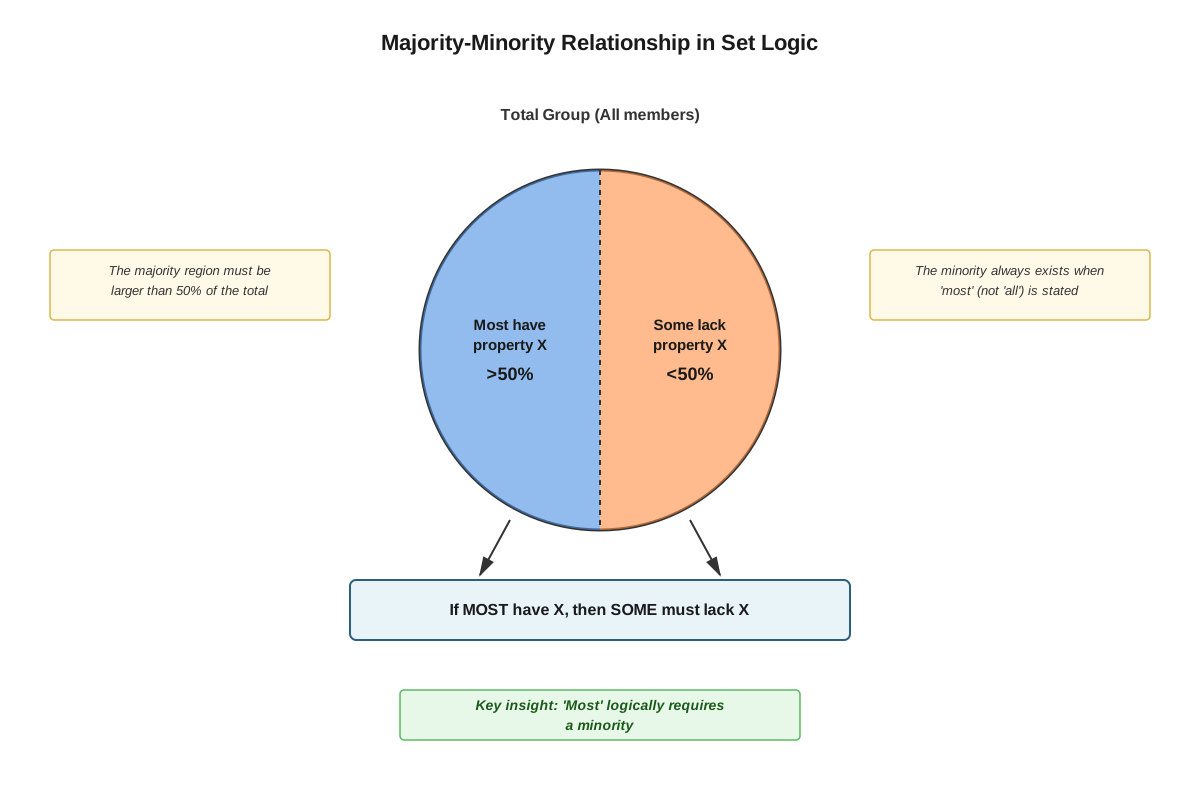
The foundation of minority reasoning rests on a simple but powerful logical relationship: when most members of a group have a certain property, at least some members must lack that property (assuming the group contains more than one member). This principle emerges from the definition of "most," which means "more than half." If more than half of a group has property X, then less than half must lack property X—and "less than half" always constitutes "some" members.
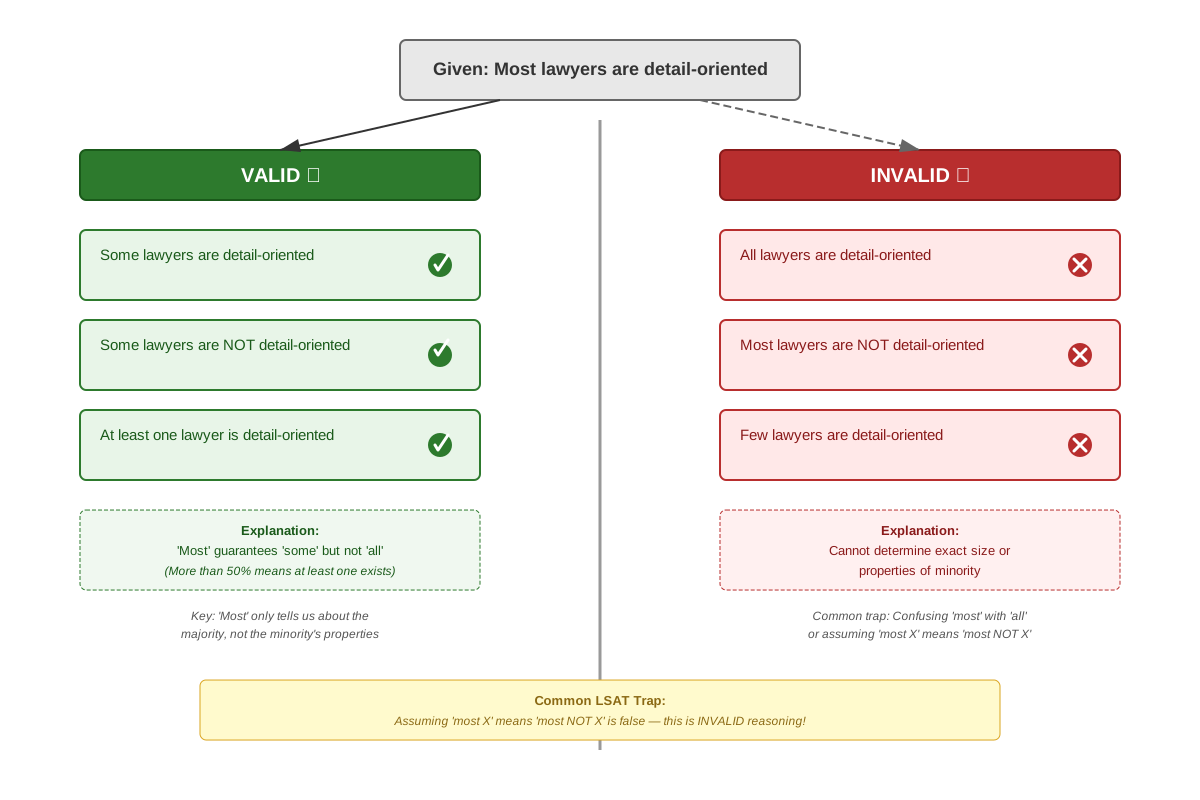
Consider a concrete example: If most lawyers in a firm specialize in corporate law, then some lawyers in that firm do not specialize in corporate law. This inference is logically necessary. The minority (those not specializing in corporate law) must exist for the majority statement to be true. However, the inference works in only one direction—knowing something about the minority does not allow you to draw conclusions about the majority.
Quantifier Hierarchy and Relationships
Understanding the precise meanings of quantifiers is essential for minority reasoning:
| Quantifier | Meaning | Percentage Range | Logical Symbol |
|---|---|---|---|
| All | Every single member | 100% | ∀ |
| Most | More than half | >50% to 100% | M |
| Many | A large number (ambiguous) | Unspecified | - |
| Some | At least one | ≥1 to 100% | ∃ |
| Few | A small number | <50% (typically) | - |
| None | Zero members | 0% | ¬∃ |
The relationship between "most" and "some" is particularly important: "Most X are Y" automatically means "Some X are Y" because "most" is a stronger claim that includes "some." However, "Some X are Y" does NOT mean "Most X are Y." This asymmetric relationship creates many trap answers on the LSAT.
Valid Minority Inferences
When given "Most X are Y," you can validly infer:
- Some X are Y (the majority includes at least one member)
- Some X are not Y (the minority must exist)
- Not all X are Y (if all were Y, we'd say "all," not "most")
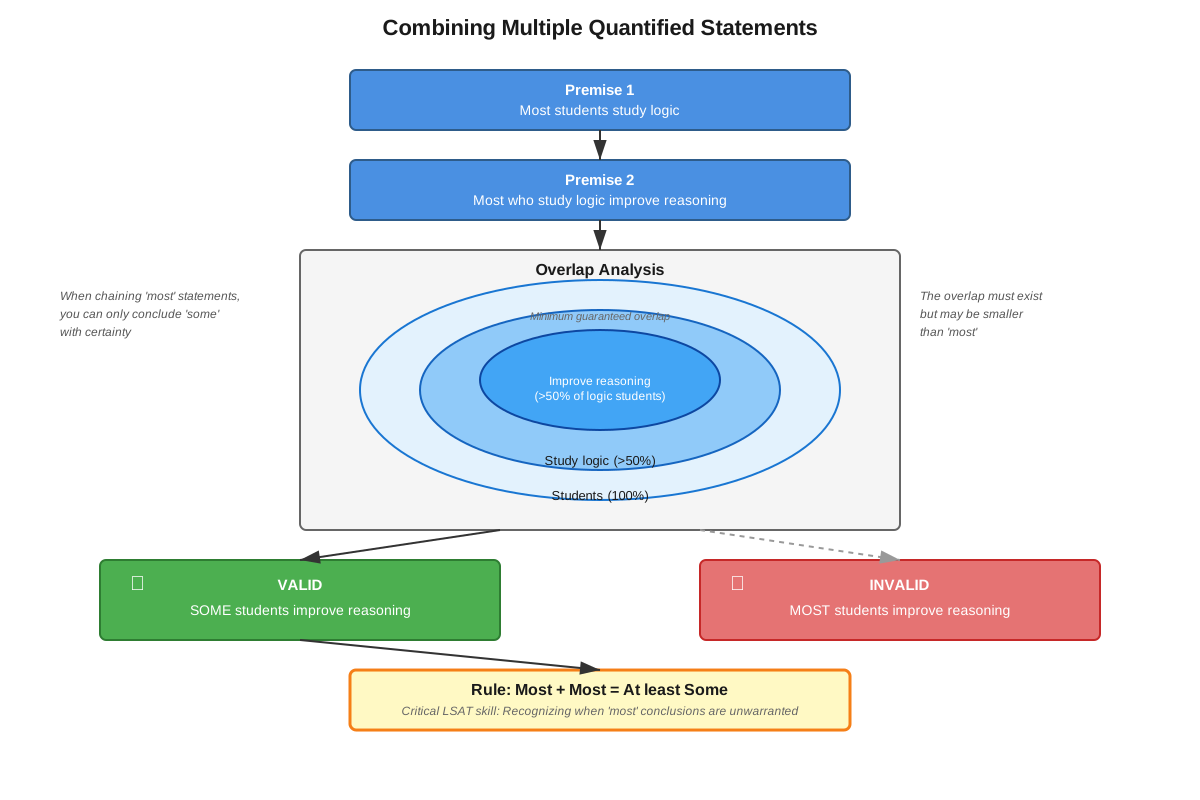
When given "Most X are Y" AND "Most X are Z," you can validly infer:
- Some X are both Y and Z (the overlap principle—when two majorities exist in the same group, they must overlap)
This overlap principle is crucial: if more than 50% are Y and more than 50% are Z, there must be at least some members in both categories. The minimum overlap can be calculated: if 60% are Y and 70% are Z, at least 30% must be both (60% + 70% = 130%, which exceeds 100% by 30%).
Invalid Minority Inferences
Common invalid inferences that the LSAT exploits include:
- From "Some X are Y" to "Most X are Y": "Some" could mean anywhere from one member to all members, so you cannot conclude "most"
- From "Most X are Y" to "Most Y are X": The majority relationship doesn't reverse (most dogs are mammals, but most mammals are not dogs)
- From "Few X are Y" to "Most X are not Y": "Few" is ambiguous and doesn't necessarily mean "less than half"
- From "Most X are Y" to any specific claim about the minority: Knowing the majority tells you the minority exists but nothing about its specific properties
Combining Minority Reasoning with Conditional Logic
Advanced LSAT questions combine minority reasoning with conditional statements. Consider: "Most lawyers are wealthy" and "If someone is wealthy, they are happy." Can we conclude "Most lawyers are happy"?
Yes! Here's why: Most lawyers are wealthy (majority), and ALL wealthy people are happy (conditional applying to 100%). Therefore, most lawyers fall into the wealthy category, and all of those wealthy lawyers must be happy, so most lawyers are happy.
The key principle: when a conditional statement (all/if-then) applies to a majority, the conclusion applies to that same majority. However, if the conditional applies to only some of the majority, you cannot draw a "most" conclusion about the final property.
The Minority Remainder Principle
When working with multiple overlapping groups, understanding what remains after accounting for the majority becomes crucial. If "Most X are Y" and you're told "All Y are Z," you know most X are Z. But what about the minority of X that are not Y? You know nothing definite about them—they might be Z or might not be Z.
This principle prevents overreaching conclusions. The LSAT frequently includes wrong answers that make unwarranted claims about the minority remainder—the portion of the group not included in the majority statement.
Concept Relationships
Minority reasoning connects intimately with several other logical reasoning concepts. At its foundation, it builds directly on quantifier logic, using the precise definitions of "most," "some," and "all" to generate valid inferences. The relationship flows: Basic Quantifiers → Minority Reasoning → Complex Multi-Quantifier Arguments.
The overlap principle in minority reasoning (when two "most" statements apply to the same group) connects to set theory and Venn diagram reasoning. Visualizing overlapping sets helps students understand why two majorities must share common members. This relationship can be expressed as: Set Theory Basics → Overlapping Majorities → Minimum Overlap Calculations.
When minority reasoning combines with conditional logic, it creates some of the most challenging LSAT questions. The connection works as follows: Conditional Statements (If-Then) + Majority Statements (Most) → Conclusions About Majorities. Understanding both components separately is necessary before tackling their combination.
Minority reasoning also relates to argument structure analysis. Many flawed arguments on the LSAT make invalid inferences from majority to minority or vice versa. Recognizing these flaws requires understanding: Valid Minority Inferences → Identifying Invalid Inferences → Recognizing Argument Flaws.
Finally, minority reasoning connects forward to statistical reasoning and causal reasoning on the LSAT. Arguments about correlations, surveys, and studies often involve majority/minority distinctions, creating the progression: Minority Reasoning → Statistical Claims → Causal Arguments.
Quick check — test yourself on Minority reasoning so far.
Try Flashcards →High-Yield Facts
⭐ Most X are Y logically guarantees that some X are not Y (the minority must exist)
⭐ When most X are Y AND most X are Z, then some X must be both Y and Z (overlap principle)
⭐ Most X are Y does NOT mean most Y are X (the relationship does not reverse)
⭐ Some X are Y can mean anywhere from one member to all members, so it never proves most X are Y
⭐ If most X are Y and all Y are Z, then most X are Z (conditional applies to the majority)
- Most means specifically "more than 50%" and can include up to 100%
- Few is logically ambiguous and does not have a precise quantifier meaning on the LSAT
- You cannot make specific claims about the minority based solely on information about the majority
- When calculating minimum overlap of two majorities, add the percentages and subtract 100%
- Not all X are Y is logically equivalent to some X are not Y
- Three "most" statements about the same group do NOT guarantee a three-way overlap
- Minority reasoning questions often appear in Must Be True and Sufficient Assumption question types
Common Misconceptions
Misconception: If most X are Y, then most Y are X. → Correction: The majority relationship is not reversible. Most dogs are friendly, but most friendly things are not dogs. The size and composition of the two groups matter, and the LSAT frequently exploits this confusion.
Misconception: If some X are Y, then we can conclude something definite about how many X are Y. → Correction: "Some" is logically weak, meaning only "at least one." It could be one member, half the members, or all members. You cannot conclude "most," "many," or "few" from "some" alone.
Misconception: If most X are Y, we know specific properties about the minority who are not Y. → Correction: Information about the majority tells you nothing specific about the minority except that it exists. The minority could have any properties not logically excluded by the given information.
Misconception: "Many" and "most" are logically equivalent. → Correction: "Many" is ambiguous and has no precise logical meaning on the LSAT, while "most" specifically means "more than half." Never treat these terms as interchangeable.
Misconception: If most X are Y and most Y are Z, then most X are Z. → Correction: This inference is invalid. Most students are hardworking, and most hardworking people in the world are not wealthy, but we cannot conclude most students are not wealthy. The second "most" applies to a different, larger group.
Misconception: Three "most" statements about the same group guarantee that some members have all three properties. → Correction: While two "most" statements guarantee overlap, three do not necessarily create a three-way overlap. If 60% are A, 60% are B, and 60% are C, the minimum three-way overlap could be 0%.
Worked Examples
Example 1: Basic Minority Inference
Question: Most members of the city council support the new zoning law. Which of the following must be true?
(A) Some members of the city council oppose the new zoning law
(B) Most residents of the city support the new zoning law
(C) The new zoning law will pass
(D) Few members of the city council oppose the new zoning law
(E) All members who oppose the law are in the minority
Solution:
Step 1: Identify the given information. We know "Most city council members support the new zoning law."
Step 2: Apply the basic minority principle. If most support it, then some must not support it (the minority must exist).
Step 3: Evaluate each answer:
- (A) CORRECT. This is a valid minority inference. If most support it, some must oppose or abstain.
- (B) Invalid. We know nothing about city residents, only council members.
- (C) Invalid. We don't know voting rules or whether "most" is enough to pass the law.
- (D) Invalid. "Few" is not a valid inference from "most support." The minority could be substantial (e.g., 49%).
- (E) Invalid. This is circular reasoning—by definition, those who oppose are in the minority, but this doesn't add information.
Answer: (A)
Connection to Learning Objectives: This example demonstrates identifying minority reasoning in LSAT questions and applying the basic principle that a majority statement guarantees a minority exists.
Example 2: Overlapping Majorities
Question: Most of the attorneys at the firm specialize in corporate law. Most of the attorneys at the firm have more than ten years of experience. If both statements are true, which of the following must also be true?
(A) Most attorneys who specialize in corporate law have more than ten years of experience
(B) Some attorneys at the firm both specialize in corporate law and have more than ten years of experience
(C) All experienced attorneys at the firm specialize in corporate law
(D) Most attorneys with more than ten years of experience specialize in corporate law
(E) Few attorneys at the firm lack both corporate law specialization and extensive experience
Solution:
Step 1: Identify the two majority statements about the same group (attorneys at the firm):
- Most attorneys → specialize in corporate law
- Most attorneys → have 10+ years experience
Step 2: Apply the overlap principle. When two majorities exist in the same group, they must overlap. If more than 50% are in category A and more than 50% are in category B, some must be in both categories.
Step 3: Evaluate each answer:
- (A) Invalid. This reverses the group. We know about attorneys at the firm, not about all corporate law specialists.
- (B) CORRECT. This is the necessary overlap. The two majorities must share some members.
- (C) Invalid. This claims "all," which is too strong. We only know "most."
- (D) Invalid. This reverses the relationship and makes an unwarranted claim about most.
- (E) Invalid. We cannot determine how many lack both properties; we only know some must have both.
Answer: (B)
Connection to Learning Objectives: This example shows how to apply minority reasoning to solve complex problems involving overlapping majorities, a high-yield LSAT pattern.
Exam Strategy
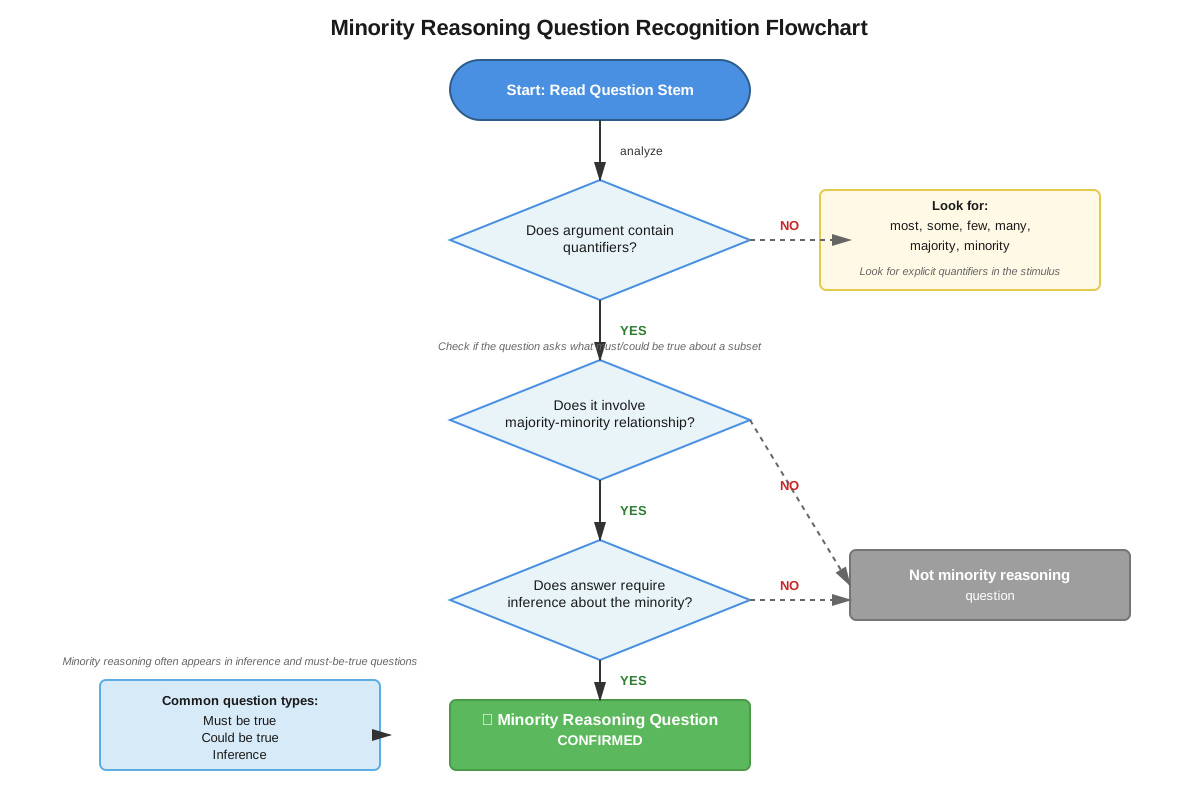
When approaching minority reasoning questions on the LSAT, begin by identifying trigger words that signal this reasoning pattern: "most," "majority," "more than half," "some," "few," "minority," and "not all." These quantifiers indicate that minority reasoning principles will likely apply.
Exam Tip: When you see "most" in the stimulus, immediately ask yourself: "What can I infer about the minority?" This proactive approach helps you anticipate correct answers and avoid traps.
Follow this systematic approach:
- Identify all quantified statements in the stimulus and note which groups they describe
- Determine whether statements apply to the same group (enabling overlap inferences) or different groups
- Apply valid inference rules before looking at answer choices
- Eliminate answers that make invalid inferences about minorities or majorities
- Watch for reversal errors where the answer choice flips the direction of the majority relationship
Time allocation: Minority reasoning questions should take 60-90 seconds once you've mastered the patterns. Spend 20-30 seconds analyzing the stimulus, 10-15 seconds predicting the answer type, and 30-45 seconds evaluating choices.
Process of elimination tips specific to minority reasoning:
- Eliminate any answer claiming "most" when you only know "some"
- Eliminate answers that reverse the majority relationship (most X are Y → most Y are X)
- Eliminate answers making specific claims about the minority when you only know the majority
- Eliminate answers using ambiguous quantifiers like "many" or "few" as if they were precise
- Keep answers that correctly apply the overlap principle to two majorities
Red flag phrases that often indicate wrong answers: "therefore, most," "it follows that all," "the majority of [reversed group]," "few members," and "many members" when these terms appear in conclusions not supported by the premises.
Memory Techniques
Mnemonic for valid inferences from "Most X are Y": SOS
- Some X are Y (the majority includes some)
- Opposite exists: Some X are not Y (the minority must exist)
- Some overlap when two "most" statements apply to the same group
Visualization strategy: Picture a circle representing the entire group. Shade more than half to represent "most." The shaded portion is the majority; the unshaded portion is the minority. When you have two "most" statements, draw two overlapping circles—the overlap must exist because each circle covers more than half the space.
Acronym for avoiding common errors: MARS
- Most does not reverse (most X are Y ≠ most Y are X)
- Ambiguous terms like "many" and "few" lack precision
- Remainder (minority) properties are unknown
- Some is weak (could be one or all members)
Memory device for overlap calculation: "Add and subtract the hundred" — Add the two percentages and subtract 100 to find minimum overlap. If 70% are A and 80% are B, then 70 + 80 - 100 = 50% minimum overlap.
Rhyme for the basic principle: "When most have a trait, some must lack it straight" — This helps remember that a majority statement guarantees a minority exists.
Summary
Minority reasoning is a high-yield LSAT topic that tests precise logical thinking about quantified statements. The core principle is straightforward: when most members of a group have a property, some members must lack it, and when two majorities exist in the same group, they must overlap. However, the LSAT creates complexity by combining minority reasoning with conditional logic, using ambiguous quantifiers, and creating trap answers that reverse relationships or make unwarranted inferences about minorities. Success requires understanding the precise meanings of quantifiers, recognizing valid inference patterns, and avoiding common logical errors. The most frequently tested concepts include the basic minority principle (most implies some don't), the overlap principle (two majorities must share members), and the non-reversibility of majority relationships. Students must also recognize that "some" is logically weak and that information about majorities reveals nothing specific about minority properties. Mastering these principles enables confident, accurate performance on the 15-20% of Logical Reasoning questions involving minority reasoning.
Key Takeaways
- Most X are Y automatically means some X are not Y — the minority must exist for the majority statement to be true
- When most X are Y AND most X are Z, then some X must be both Y and Z — two majorities in the same group must overlap
- Majority relationships never reverse: most X are Y does NOT mean most Y are X
- Some is the weakest quantifier, meaning "at least one," and never proves "most" or provides specific numbers
- Information about the majority tells you nothing specific about the minority's properties beyond its existence
- Combining "most" statements with "all" statements (conditionals) allows the conclusion to apply to the majority
- Ambiguous terms like "many" and "few" lack precise logical meaning and should not be treated as equivalent to "most" or "some"
Related Topics
Advanced Quantifier Logic: Building on minority reasoning, this topic explores complex chains of quantified statements and formal logic notation, enabling students to tackle the most difficult Logical Reasoning questions involving multiple quantifiers and nested relationships.
Conditional Logic Combinations: This advanced topic shows how minority reasoning integrates with sufficient and necessary conditions, creating sophisticated inference patterns that appear in high-difficulty LSAT questions.
Formal Logic Diagramming: Learning to diagram quantified statements visually helps solidify understanding of minority reasoning and provides a powerful tool for solving complex problems efficiently.
Statistical Reasoning on the LSAT: Minority reasoning provides the foundation for understanding arguments involving surveys, studies, and statistical claims, which frequently appear in Strengthen, Weaken, and Flaw questions.
Argument Structure and Flaws: Many flawed arguments make invalid inferences about minorities or majorities, and recognizing these flaws requires mastery of minority reasoning principles.
Practice CTA
Now that you understand the principles of minority reasoning, it's time to cement your knowledge through practice. Attempt the practice questions to test your ability to identify valid and invalid inferences, and use the flashcards to reinforce the key principles and common patterns. Remember, minority reasoning appears in approximately 15-20% of Logical Reasoning questions—mastering this topic will directly improve your LSAT score. Focus on recognizing the trigger words, applying the systematic approach outlined above, and avoiding the common misconceptions. With focused practice, these patterns will become second nature, allowing you to confidently tackle even the most complex minority reasoning questions on test day.
Sign up free to keep reading
Create a free AnvayaPrep account to finish this LSAT guide on Minority reasoning — plus flashcards and practice questions.