Overview
Statistical reasoning is one of the most frequently tested concepts in LSAT Logical Reasoning sections, appearing in approximately 15-20% of all questions. This topic examines how test-takers evaluate arguments that draw conclusions from numerical data, surveys, studies, and population samples. The LSAT tests whether students can identify flaws in statistical arguments, recognize when data has been misapplied, and understand the proper scope of statistical conclusions.
Mastering lsat statistical reasoning is essential because these questions appear across multiple question types, including Flaw, Strengthen, Weaken, Assumption, and Evaluate questions. Statistical arguments form a distinct pattern within argument fundamentals: they move from data about a sample or subset to conclusions about a larger group, or they compare statistical information across different populations or time periods. Understanding how statistics can be properly and improperly used provides a powerful framework for quickly identifying correct answers.
Within the broader context of Logical Reasoning, statistical reasoning connects directly to concepts of evidence evaluation, scope issues, and causal reasoning. Many statistical arguments also involve causal claims (correlation versus causation), representativeness concerns, and quantitative comparison errors. Students who master statistical reasoning develop a critical analytical skill that applies across nearly all argument types, making this one of the highest-yield topics for LSAT preparation.
Learning Objectives
- [ ] Identify how Statistical reasoning appears in LSAT questions
- [ ] Explain the reasoning pattern behind Statistical reasoning
- [ ] Apply Statistical reasoning to solve LSAT-style problems accurately
- [ ] Recognize the difference between sample and population in statistical arguments
- [ ] Evaluate whether statistical evidence adequately supports a given conclusion
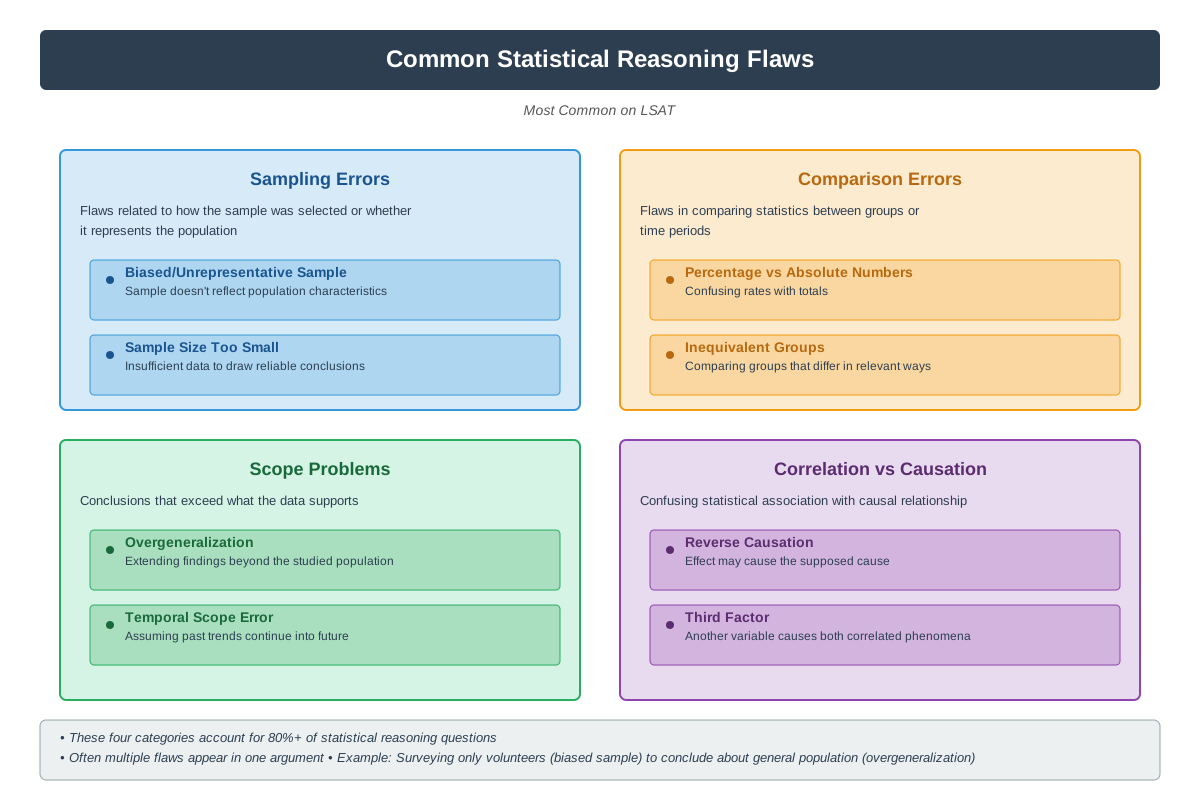
- [ ] Identify common statistical fallacies including sampling errors, comparison errors, and scope problems
- [ ] Distinguish between correlation and causation in statistical contexts
Prerequisites
- Basic argument structure: Understanding premises and conclusions is essential because statistical reasoning questions require identifying what data supports what claim
- Scope and degree concepts: Recognizing when conclusions go beyond their evidence is fundamental to spotting statistical reasoning errors
- Conditional reasoning basics: Many statistical arguments involve "most," "some," and other quantifiers that relate to conditional logic
- Causal reasoning fundamentals: Statistical arguments frequently make or imply causal claims that must be evaluated
Why This Topic Matters
Statistical reasoning pervades modern discourse, from medical studies and economic reports to political polling and social science research. The ability to critically evaluate statistical claims is essential for informed citizenship, professional decision-making, and academic success. The LSAT tests this skill because legal practice constantly requires attorneys to evaluate expert testimony, survey evidence, and statistical data presented in cases.
On the LSAT, statistical reasoning appears in 15-20% of Logical Reasoning questions, making it one of the most frequently tested topics. These questions appear across virtually all question types: Flaw questions often feature statistical reasoning errors; Strengthen and Weaken questions frequently involve statistical evidence; Assumption questions may require identifying unstated premises about sample representativeness; and Evaluate questions commonly ask what additional information would help assess a statistical argument.
Common manifestations include arguments about survey results, medical studies, demographic trends, comparative statistics between groups, and predictions based on historical data. The LSAT particularly favors questions involving sampling issues, comparison problems (comparing different groups or time periods), and the relationship between percentages and absolute numbers. Recognizing these patterns allows test-takers to quickly identify the logical structure and anticipate likely answer choices.
Core Concepts
Sample and Population Relationships
The foundation of statistical reasoning involves understanding the relationship between a sample (a subset of cases examined) and a population (the entire group about which a conclusion is drawn). Valid statistical reasoning requires that the sample adequately represents the population. The LSAT frequently tests whether arguments inappropriately generalize from unrepresentative samples.
A representative sample shares relevant characteristics with the population in appropriate proportions. For example, if a population is 60% urban and 40% rural, a representative sample should reflect similar proportions. The LSAT tests this by presenting arguments that draw conclusions about all members of a group based on evidence from an unrepresentative subset.
Key considerations for sample-to-population reasoning include:
- Sample size: Is the sample large enough to support the conclusion?
- Selection method: How were sample members chosen? Random selection typically produces more representative samples
- Relevant characteristics: Does the sample match the population on characteristics that matter for the conclusion?
- Response rate: In surveys, do non-respondents differ systematically from respondents?
Statistical Comparisons
Many LSAT statistical arguments involve comparing two or more groups, time periods, or conditions. Valid comparisons require that the groups be comparable in relevant respects and that the same measurement methods be applied consistently.
Common comparison errors include:
| Comparison Error | Description | Example |
|---|---|---|
| Baseline differences | Groups differ in ways that affect the outcome | Comparing crime rates between cities with different population densities |
| Measurement inconsistency | Different standards applied to different groups | Using different diagnostic criteria in two medical studies |
| Temporal changes | Conditions changed between time periods | Comparing prices without adjusting for inflation |
| Selection bias | Non-random factors determine group membership | Comparing volunteers to non-volunteers |
Percentages versus Absolute Numbers
A critical distinction in lsat statistical reasoning involves the relationship between percentages and absolute numbers. An increase in percentage does not necessarily mean an increase in absolute numbers, and vice versa. The LSAT frequently exploits this distinction.
Consider: "The percentage of students majoring in philosophy decreased from 5% to 3%, but the absolute number of philosophy majors increased from 100 to 150." This occurs when the total population grows substantially (from 2,000 to 5,000 students). Arguments that confuse these measures commit a quantitative reasoning error.
Correlation and Causation
Statistical arguments often present correlational data (two things occur together) and draw causal conclusions (one thing causes the other). Valid causal reasoning requires ruling out alternative explanations:
- Reverse causation: B might cause A rather than A causing B
- Common cause: C might cause both A and B
- Coincidence: The correlation might be accidental
- Confounding variables: Other factors might explain the relationship
The LSAT tests whether arguments adequately establish causation or merely demonstrate correlation.
Scope and Strength of Statistical Conclusions
Statistical evidence supports conclusions of varying strength. The LSAT tests whether conclusions appropriately match the strength of the evidence:
- "All" claims: Require evidence about every member (rarely supported by statistical data)
- "Most" claims: Require evidence that more than 50% have the characteristic
- "Many" or "some" claims: Require evidence of multiple instances
- "Likely" or "probably" claims: Require evidence of greater than 50% probability
Arguments that draw stronger conclusions than their statistical evidence supports commit a scope error.
Sampling Bias
Sampling bias occurs when the method of selecting sample members systematically excludes or overrepresents certain types of individuals. Common forms include:
- Self-selection bias: Volunteers differ from non-volunteers in relevant ways
- Survivorship bias: Only examining cases that "survived" some process
- Convenience sampling: Choosing easily accessible subjects rather than representative ones
- Non-response bias: Survey non-respondents differ systematically from respondents
Rate versus Number Confusion
Arguments sometimes confuse rates (proportions or percentages) with absolute numbers. An increase in the rate of something does not necessarily mean an increase in the total number, especially if the base population has changed. Similarly, a decrease in rate might accompany an increase in absolute numbers if the denominator has grown sufficiently.
Concept Relationships
Statistical reasoning concepts form an interconnected web within argument fundamentals. The sample-population relationship serves as the foundation: all statistical reasoning ultimately involves drawing conclusions about some group based on information about a subset or related group. This connects directly to scope issues—a core concept across all logical reasoning—because statistical arguments frequently draw conclusions that exceed what their evidence supports.
The relationship flows as follows: Sample selection methods → Sample representativeness → Validity of population conclusions. When samples are biased or unrepresentative, conclusions about populations become unreliable. This connects to the broader concept of evidence evaluation: assessing whether premises adequately support conclusions.
Statistical comparisons build upon sample-population reasoning by adding a second dimension: comparing two samples, two populations, or a population across time. Comparison validity requires both that each sample represents its population AND that the comparison itself is appropriate (similar measurement methods, comparable baseline conditions, etc.).
The percentage-versus-absolute-number distinction intersects with both comparison reasoning and scope issues. Many flawed comparisons involve comparing percentages when absolute numbers matter, or vice versa. This also relates to quantitative reasoning more broadly: understanding how numerical relationships work.
Correlation-causation issues connect statistical reasoning to causal reasoning, another major LSAT topic. Statistical evidence often demonstrates correlation, but causal conclusions require additional support. This relationship appears frequently in Strengthen and Weaken questions, where answer choices either provide or undermine support for causal interpretations of statistical data.
All these concepts ultimately relate to the fundamental logical reasoning skill of evaluating whether evidence supports conclusions, making statistical reasoning a specialized application of core argument analysis principles.
High-Yield Facts
⭐ Statistical arguments that generalize from a sample to a population assume the sample is representative of the population in relevant respects
⭐ An increase in percentage does not necessarily indicate an increase in absolute numbers, and vice versa
⭐ Correlation between two variables does not establish that one causes the other
⭐ Self-selected samples (volunteers, survey respondents) are often unrepresentative of the broader population
⭐ Valid statistical comparisons require that groups be measured using the same methods and standards
- Statistical conclusions should not be stronger than the evidence supports (data about "most" cannot support "all" claims)
- Comparing rates or percentages requires considering whether the base populations are similar in size and composition
- Non-response bias occurs when survey non-respondents differ systematically from respondents in relevant ways
- Temporal comparisons must account for changed conditions between time periods
- Small sample sizes may not reliably represent population characteristics, especially for rare attributes
- Survivorship bias occurs when analysis includes only cases that passed some selection filter, excluding relevant failures
- Arguments that shift between discussing a subset and the whole group often commit scope errors
- Statistical evidence about past occurrences does not automatically predict future occurrences unless conditions remain similar
- Comparing averages can mask important distributional differences between groups
- The absence of statistical evidence for a claim is not the same as statistical evidence against the claim
Quick check — test yourself on Statistical reasoning so far.
Try Flashcards →Common Misconceptions
Misconception: If a sample is large, it must be representative of the population.
Correction: Sample size alone does not ensure representativeness. A large sample can still be biased if the selection method systematically excludes or overrepresents certain groups. A sample of 10,000 volunteers may be less representative than a random sample of 500.
Misconception: Statistical correlation between two variables means one must cause the other.
Correction: Correlation can result from reverse causation, common causes, confounding variables, or coincidence. Establishing causation requires ruling out alternative explanations, not merely demonstrating that two things occur together.
Misconception: If the percentage of X increased, then the absolute number of X must have increased.
Correction: Percentages and absolute numbers can move in opposite directions when the base population changes. A percentage can increase while absolute numbers decrease if the total population shrinks, and vice versa.
Misconception: Comparing two groups' statistics is valid as long as the measurements are accurate.
Correction: Valid comparisons require not only accurate measurements but also that groups be comparable in relevant baseline characteristics, that the same measurement standards be applied, and that conditions be similar. Accurate measurements of incomparable groups yield misleading conclusions.
Misconception: Statistical evidence about "most" members of a group supports conclusions about "all" members.
Correction: Statistical evidence supports conclusions only as strong as the evidence itself. Evidence about "most" (more than 50%) cannot support universal claims about "all" (100%). This scope error appears frequently on the LSAT.
Misconception: If a survey shows a particular result, that result applies to everyone, including non-respondents.
Correction: Survey results apply only to respondents. Non-respondents may differ systematically from respondents in ways that affect the conclusion. High non-response rates undermine the representativeness of survey results.
Misconception: Statistical arguments are always about numbers, percentages, or mathematical calculations.
Correction: Statistical reasoning on the LSAT focuses on the logical structure of arguments involving data, samples, and populations, not mathematical computation. Questions test logical evaluation of statistical claims, not arithmetic ability.
Worked Examples
Example 1: Sample Representativeness
Argument: "A survey of 1,000 people who visited the city's new art museum found that 85% support increased government funding for the arts. Therefore, most city residents support increased arts funding."
Question Type: Flaw
Analysis:
- Identify the statistical reasoning pattern: This argument generalizes from a sample (museum visitors) to a population (all city residents)
- Evaluate sample representativeness: Museum visitors are self-selected individuals who chose to visit an art museum. They likely have greater interest in the arts than average city residents
- Identify the flaw: The sample is unrepresentative because museum visitors systematically differ from the general population in a characteristic (interest in arts) directly relevant to the conclusion
- Connect to learning objective: This demonstrates how statistical reasoning appears in LSAT questions—through arguments that generalize from samples to populations
Correct answer would state: The argument treats a sample that is likely unrepresentative of the population as though it were representative, or the argument overlooks that museum visitors may have different views on arts funding than city residents generally.
Example 2: Percentage versus Absolute Numbers
Argument: "Five years ago, 2% of the company's employees worked remotely. Today, 8% work remotely. However, the company's total workforce has decreased from 10,000 to 3,000 employees. Therefore, the company has expanded its remote work program."
Question Type: Flaw or Evaluate
Analysis:
- Identify the statistical reasoning pattern: This argument compares percentages across time periods and draws a conclusion about program expansion
- Calculate absolute numbers:
- Five years ago: 2% of 10,000 = 200 remote workers
- Today: 8% of 3,000 = 240 remote workers
- Evaluate the conclusion: While the percentage increased dramatically (from 2% to 8%), the absolute number increased only slightly (from 200 to 240). Whether this constitutes "expansion" is questionable
- Identify the reasoning issue: The argument focuses on percentage increase while the conclusion about "expansion" might more naturally refer to absolute numbers. Additionally, the increase might result from reducing in-office positions rather than adding remote positions
- Connect to learning objectives: This demonstrates applying statistical reasoning to solve LSAT problems by recognizing the percentage-versus-absolute-number distinction
Correct answer might state: The argument fails to consider that the percentage of remote workers could increase even if the absolute number of remote workers remained constant or decreased, or the argument overlooks that the increase in percentage might result from a decrease in total employees rather than an increase in remote positions.
Exam Strategy
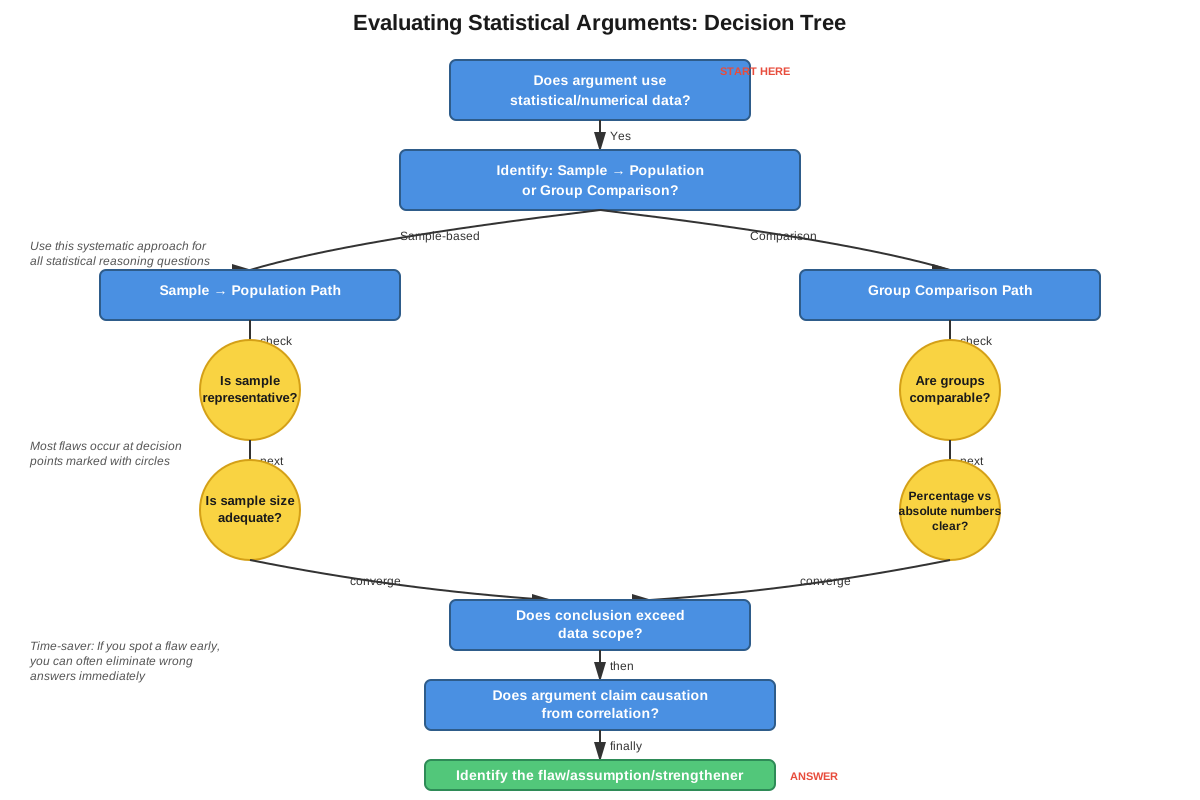
When approaching logical reasoning questions involving statistical reasoning, follow this systematic process:
Step 1: Identify statistical elements (5-10 seconds)
Look for trigger words and phrases: "survey," "study," "percentage," "most," "rate," "sample," "poll," "statistics," "data," "research," "majority," "increase/decrease," "compared to," "correlation," "trend"
Step 2: Map the statistical structure (10-15 seconds)
- What is the sample or data source?
- What is the population or group about which the conclusion is drawn?
- Is the argument making a comparison? Between what groups or time periods?
- Does the argument involve percentages, rates, or absolute numbers?
Step 3: Evaluate representativeness and comparability (10-15 seconds)
- Is the sample likely representative of the population?
- Are compared groups similar in relevant baseline characteristics?
- Are measurement methods consistent?
- Have conditions changed between time periods?
Step 4: Check for common statistical errors (10-15 seconds)
- Sample bias or self-selection
- Percentage-versus-absolute-number confusion
- Correlation-causation confusion
- Scope mismatch (conclusion stronger than evidence)
- Comparison problems (different baselines, measurement methods, or conditions)
Exam Tip: In Flaw questions, statistical reasoning flaws typically involve sample representativeness, inappropriate comparisons, or percentage-versus-number confusion. In Strengthen/Weaken questions, correct answers often address whether samples are representative or whether alternative explanations exist for statistical patterns.
Process of Elimination Strategy:
- Eliminate answers that address issues unrelated to the statistical reasoning (e.g., source credibility when the issue is sample bias)
- Eliminate answers that describe the argument's reasoning accurately when the question asks for a flaw
- Eliminate answers that would strengthen when you need to weaken, and vice versa
- Keep answers that address the specific statistical issue you identified (representativeness, comparison validity, etc.)
Time Allocation:
Statistical reasoning questions typically require 60-90 seconds. Spend slightly more time on the initial analysis (identifying the statistical structure) to avoid misunderstanding the argument, which leads to incorrect answers and wasted time reconsidering.
Memory Techniques
SCRAP Mnemonic for evaluating statistical arguments:
- Sample: Is the sample representative?
- Comparison: Are compared groups actually comparable?
- Rate vs. Number: Does the argument confuse percentages and absolute numbers?
- Alternatives: Are there alternative explanations (especially for correlations)?
- Population: Does the conclusion match the scope of the evidence?
Visualization Strategy: Picture statistical arguments as bridges. The sample is one side, the population is the other side, and the argument builds a bridge between them. Ask: Is the bridge strong enough? Are the two sides actually aligned? Does the bridge reach all the way across, or does it fall short (scope problem)?
The "Three C's" of Statistical Correlation:
- Correlation doesn't prove causation
- Common causes can explain correlations
- Coincidence is always possible
Percentage-Number Distinction: Remember "PERCENT = PART/TOTAL." When the total changes, percentages and absolute numbers can move in opposite directions. Visualize a pie that grows or shrinks—a slice can be a smaller percentage of a bigger pie but still be larger in absolute size.
Summary
Statistical reasoning is a high-yield LSAT topic that tests the ability to evaluate arguments involving numerical data, samples, populations, and comparisons. The core principle is that valid statistical reasoning requires representative samples, appropriate comparisons, and conclusions that match the scope and strength of the evidence. The LSAT primarily tests whether arguments inappropriately generalize from unrepresentative samples, make invalid comparisons between dissimilar groups or time periods, confuse percentages with absolute numbers, or draw causal conclusions from merely correlational data. Mastering statistical reasoning requires recognizing these common patterns and systematically evaluating whether samples represent populations, whether comparisons are valid, and whether conclusions exceed what the evidence supports. This skill applies across multiple question types—Flaw, Strengthen, Weaken, Assumption, and Evaluate—making it essential for LSAT success. The key is to quickly identify the statistical structure of arguments, evaluate representativeness and comparability, and match conclusions to evidence strength.
Key Takeaways
- Statistical arguments that generalize from samples to populations assume sample representativeness—this assumption is frequently flawed on the LSAT
- Percentages and absolute numbers are distinct; changes in one do not necessarily indicate changes in the other, especially when base populations change
- Correlation does not establish causation; alternative explanations including reverse causation, common causes, and confounding variables must be ruled out
- Valid statistical comparisons require comparable groups, consistent measurement methods, and similar conditions
- Self-selected samples (volunteers, survey respondents) are typically unrepresentative and cannot reliably support conclusions about broader populations
- Statistical conclusions should match the strength of the evidence—"most" evidence cannot support "all" conclusions
- Recognizing statistical reasoning patterns allows rapid identification of argument structure and likely flaws, improving both accuracy and speed
Related Topics
Causal Reasoning: Statistical reasoning frequently intersects with causal arguments, as statistical data often serves as evidence for causal claims. Mastering statistical reasoning provides the foundation for evaluating whether correlational data supports causal conclusions.
Scope and Degree: Statistical reasoning is a specialized application of scope issues—conclusions that exceed their evidence. Understanding statistical reasoning deepens comprehension of how conclusions can inappropriately exceed premises.
Necessary and Sufficient Assumptions: Many statistical arguments rely on unstated assumptions about sample representativeness or comparison validity. Mastering statistical reasoning enhances the ability to identify these assumptions.
Strengthen and Weaken Questions: Statistical reasoning appears frequently in these question types, where answer choices provide or undermine support for statistical arguments. Mastery of statistical reasoning dramatically improves performance on these common question types.
Formal Logic and Quantifiers: Statistical reasoning involves quantifiers like "most," "some," and "all," connecting to formal logic concepts. Understanding these relationships strengthens overall logical reasoning ability.
Practice CTA
Now that you understand the core principles of statistical reasoning, it's time to apply this knowledge to actual LSAT questions. Work through the practice questions systematically, using the SCRAP mnemonic and the strategic approach outlined above. Pay special attention to identifying the statistical structure before evaluating answer choices—this upfront investment saves time and improves accuracy. Review the flashcards to reinforce the common patterns and errors that appear repeatedly on the LSAT. Statistical reasoning is highly learnable and highly testable, making it one of the best investments of your study time. With focused practice, you'll quickly recognize these patterns and confidently tackle statistical reasoning questions on test day.
Sign up free to keep reading
Create a free AnvayaPrep account to finish this LSAT guide on Statistical reasoning — plus flashcards and practice questions.