Overview
Most plus all inference is a fundamental reasoning pattern in LSAT Logical Reasoning that combines two quantified statements to produce a valid conclusion. This inference type belongs to the broader domain of formal logic and quantifiers, where understanding how different quantifiers interact is essential for success on the exam. The pattern involves connecting a "most" statement with an "all" statement through a shared term, allowing test-takers to derive a new "most" conclusion.
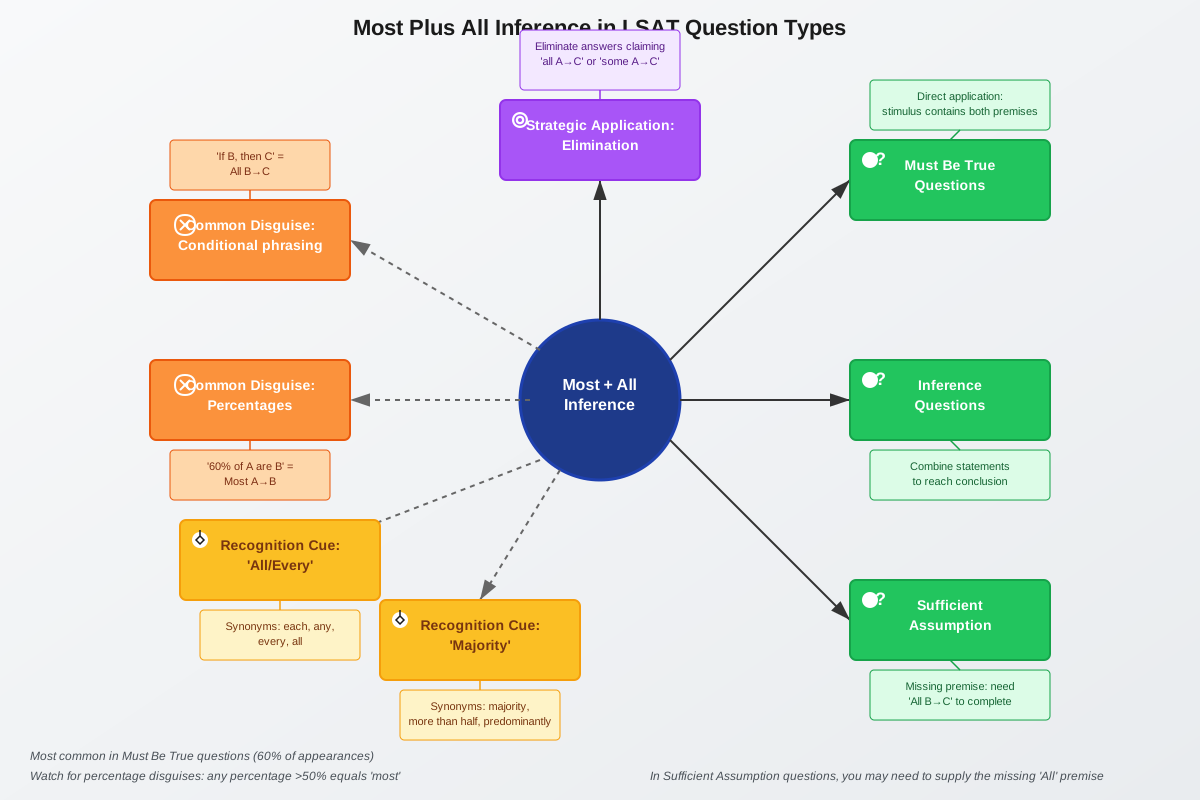
This topic represents one of the most frequently tested formal logic patterns on the LSAT because it appears in Must Be True questions, Inference questions, and occasionally in Sufficient Assumption questions. The LSAT tests this pattern both directly—where students must recognize the valid inference—and indirectly—where recognizing the pattern helps eliminate incorrect answer choices. Mastering most plus all inference provides a significant strategic advantage because it allows test-takers to move quickly and confidently through questions that might otherwise require time-consuming diagramming or uncertain reasoning.
Within the broader landscape of Logical Reasoning, most plus all inference sits at the intersection of quantifier logic and conditional reasoning. While conditional logic deals with "if-then" relationships and "all" statements, most plus all inference introduces the complexity of probabilistic quantifiers ("most" means "more than half"). Understanding this pattern requires comfort with both the certainty of universal quantifiers and the probabilistic nature of majority statements, making it a bridge concept that deepens overall logical reasoning skills.
Learning Objectives
- [ ] Identify how Most plus all inference appears in LSAT questions
- [ ] Explain the reasoning pattern behind Most plus all inference
- [ ] Apply Most plus all inference to solve LSAT-style problems accurately
- [ ] Diagram most plus all inference patterns using standard notation
- [ ] Distinguish valid most plus all inferences from invalid quantifier combinations
- [ ] Recognize when most plus all inference is the key to eliminating wrong answers
- [ ] Construct original examples demonstrating the most plus all inference pattern
Prerequisites
- Basic quantifier understanding: Familiarity with "all," "some," "most," and "none" is essential because most plus all inference builds on these foundational quantifiers
- Conditional reasoning fundamentals: Understanding sufficient and necessary conditions helps recognize how "all" statements function as conditional relationships
- Set theory basics: Recognizing overlapping groups and subsets aids in visualizing why the inference pattern works
- Formal logic notation: Ability to use arrows and symbols to represent logical relationships streamlines the diagramming process
Why This Topic Matters
Most plus all inference appears with remarkable frequency on the LSAT, showing up in approximately 15-20% of Logical Reasoning sections across recent exams. This pattern is particularly prevalent in Must Be True questions, where test-takers must identify what necessarily follows from the stimulus, and in Inference questions, where recognizing valid deductive patterns is crucial. The LSAT favors this inference type because it tests both formal logic skills and careful reading—students must identify the quantifiers correctly and apply the pattern accurately.
In real-world contexts, most plus all inference mirrors everyday reasoning about groups and categories. When a manager knows that most employees in Department A have advanced degrees, and all employees with advanced degrees receive higher salaries, the manager can validly conclude that most employees in Department A receive higher salaries. This type of reasoning appears in policy analysis, medical diagnosis, legal argumentation, and business strategy—all domains where law students and lawyers must think precisely about populations and their characteristics.
On the LSAT, this topic typically appears in several distinct ways: as the primary inference in a Must Be True question where the stimulus provides two premises and the correct answer states the valid conclusion; as a trap in Flaw questions where an argument incorrectly combines quantifiers; as the logical gap in Sufficient Assumption questions where the missing premise must complete the pattern; and as a tool for eliminating wrong answers in various question types by recognizing what cannot be validly inferred.
Core Concepts
The Basic Most Plus All Pattern
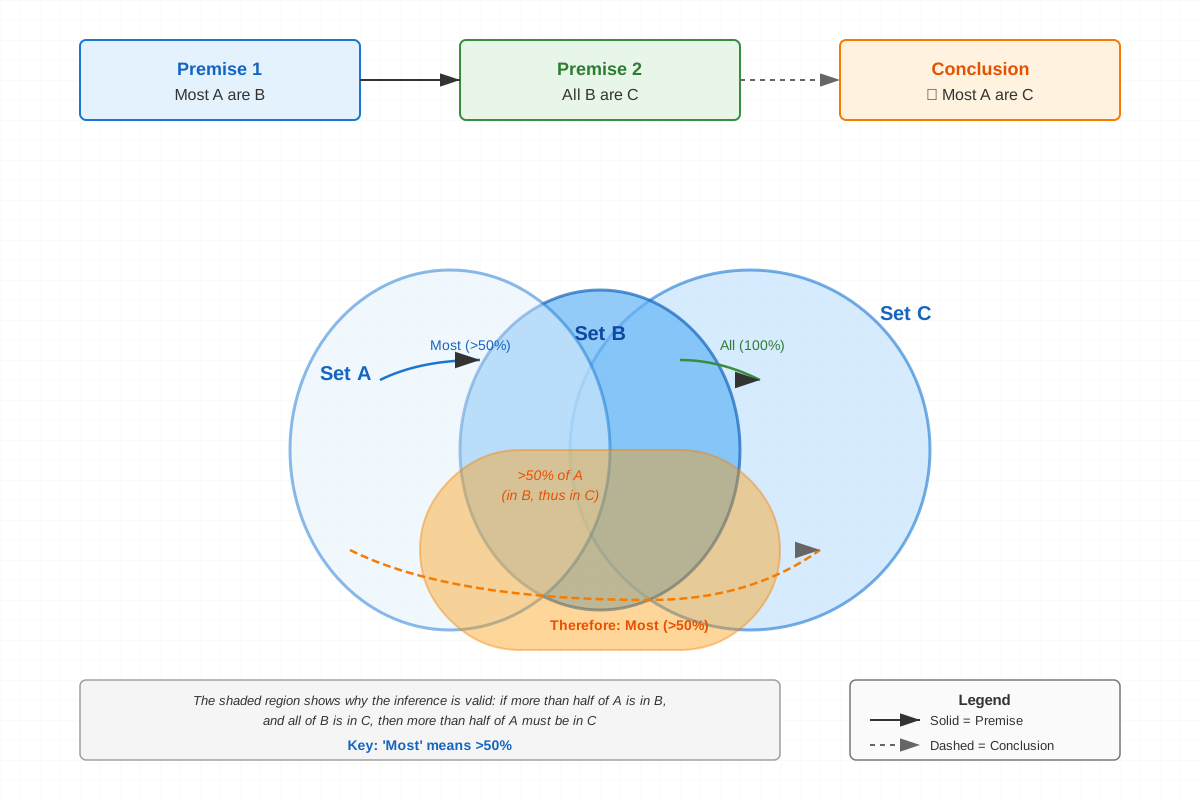
The lsat most plus all inference follows a specific structure that produces a guaranteed valid conclusion. When the premises state that "Most A are B" and "All B are C," the valid inference is "Most A are C." This pattern works because the "most" relationship (more than 50%) is preserved through the "all" relationship (100%).
The mathematical foundation is straightforward: if more than half of Group A belongs to Group B, and every member of Group B belongs to Group C, then more than half of Group A must belong to Group C. The "all" statement acts as a bridge, transferring the majority from the first group to the third group without loss.
Consider this concrete example:
- Premise 1: Most lawyers are detail-oriented
- Premise 2: All detail-oriented people are successful editors
- Valid Conclusion: Most lawyers are successful editors
The inference holds because the "all" statement guarantees that the detail-oriented lawyers (who constitute more than half of all lawyers) are transferred completely into the category of successful editors.
Formal Notation and Diagramming
Representing most plus all inference using formal notation clarifies the pattern and prevents errors. The standard notation uses:
- "Most A → B" to represent "Most A are B"
- "All B → C" or "B → C" to represent "All B are C"
- Therefore: "Most A → C" represents the conclusion "Most A are C"
The arrow in "Most A → B" should be understood differently from a conditional arrow. It indicates that more than 50% of A's are B's, not that being an A is sufficient for being a B. However, when combined with a true conditional "B → C," the pattern produces a valid "Most A → C" conclusion.
A visual representation helps:
Group A (100 members)
    ↓ (more than 50, say 60)
Group B (60 members from A, possibly others)
    ↓ (all 60)
Group C (includes all 60 from A)

Result: More than 50 of the 100 A's are C's → Most A are C
Direction Matters: Valid vs. Invalid Combinations
The order of premises in most plus all inference is crucial. The pattern only works in one direction:
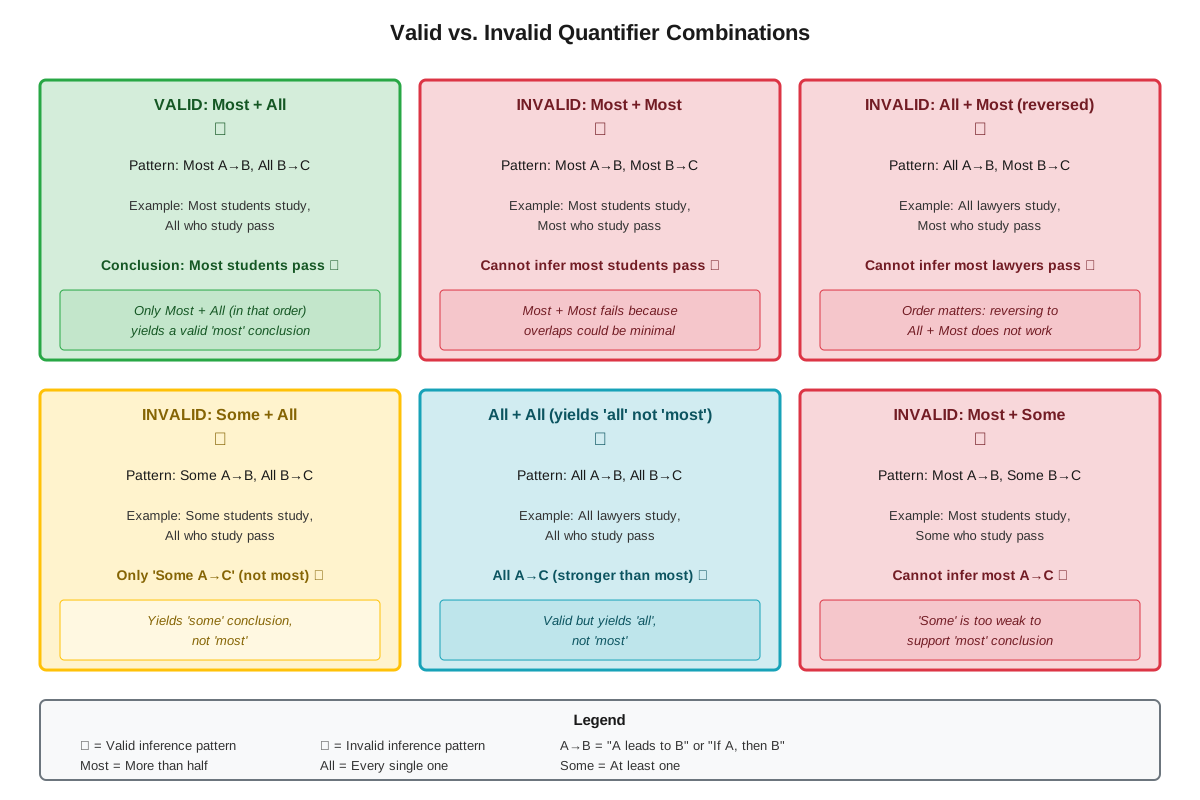
Valid Pattern: Most A → B + All B → C = Most A → C
Invalid Pattern: All A → B + Most B → C ≠ Most A → C
This second pattern fails because "all" followed by "most" doesn't preserve the majority relationship for the original group. If all members of Group A are in Group B, but only most members of Group B are in Group C, we cannot conclude anything definite about what portion of Group A is in Group C—it could be anywhere from 0% to 100%.
Example of the invalid pattern:
- All cats are mammals (All A → B)
- Most mammals are herbivores (Most B → C)
- Invalid conclusion: Most cats are herbivores
This fails because even though all cats are mammals, they might all fall into the minority of mammals that are not herbivores.
The "Most" Quantifier Defined
Understanding "most" precisely is essential for applying the inference pattern correctly. On the LSAT, "most" means "more than half" or "greater than 50%". This is a strict mathematical definition:
- "Most" = more than 50%
- "Most" does NOT mean "many," "a lot," or "the largest group"
- If exactly 50% of A are B, we cannot say "most A are B"
This precision matters because the inference pattern depends on maintaining a majority. If "most A are B" means 51% of A's are B's, and "all B are C" means 100% of those B's are C's, then 51% of A's are C's, which still qualifies as "most."
Multiple Most Plus All Chains
The pattern can extend beyond two premises. If "Most A → B," "All B → C," and "All C → D," then "Most A → D" is valid. Each "all" statement serves as a bridge, and the "most" relationship is preserved through multiple transfers:
- Most students are hardworking (Most S → H)
- All hardworking people are disciplined (All H → D)
- All disciplined people are successful (All D → Su)
- Valid conclusion: Most students are successful (Most S → Su)
However, introducing a second "most" statement breaks the chain. "Most A → B" + "Most B → C" does NOT yield "Most A → C" because two majorities don't guarantee overlap in the original group.
Contrapositive Considerations
The contrapositive of an "all" statement reverses and negates: "All B → C" becomes "Not C → Not B." However, "most" statements do not have standard contrapositives because "Most A are B" does not tell us anything definite about what most B's are or what most non-B's are.
When working with most plus all inference, the contrapositive only applies to the "all" portion:
- Most A → B
- All B → C (contrapositive: Not C → Not B)
We cannot validly conclude "Most Not C → Not A" because the contrapositive doesn't interact with "most" statements in a predictable way.
Concept Relationships
The most plus all inference pattern connects directly to several other logical reasoning concepts. It builds upon basic quantifier logic, where understanding "all," "some," "most," and "none" provides the foundation for recognizing how these quantifiers interact. The "all" component of the pattern is essentially conditional reasoning—"All B are C" is logically equivalent to "If B, then C"—so mastery of conditional logic strengthens most plus all inference skills.
The pattern relates inversely to invalid quantifier combinations. Understanding why "All A → B" plus "Most B → C" doesn't work (because the direction is reversed) or why "Most A → B" plus "Most B → C" doesn't work (because two majorities don't guarantee overlap) reinforces the validity of the correct pattern. This negative knowledge is as valuable as positive knowledge on the LSAT.
Within formal logic, most plus all inference represents a specific case of transitive reasoning—connecting A to C through B. However, unlike pure conditional transitivity (All A → B + All B → C = All A → C), the most plus all pattern introduces probabilistic elements while maintaining logical validity.
The relationship map flows as follows:
Quantifier Understanding → enables recognition of → Most vs. All Distinctions → which combine in → Most Plus All Pattern → which is one type of → Valid Inference → which appears in → Must Be True Questions → and helps eliminate wrong answers in → Various Question Types
High-Yield Facts
⭐ Most plus all inference requires the pattern: Most A → B + All B → C = Most A → C
⭐ The "most" statement must come first in the chain; reversing to "All then Most" produces no valid inference
⭐ "Most" on the LSAT means strictly more than 50%, not merely "many" or "a plurality"
⭐ The pattern can chain multiple "all" statements after the initial "most" statement while remaining valid
⭐ Two "most" statements cannot be combined to produce a valid inference (Most + Most ≠ Most)
- The "all" statement in the pattern functions as a conditional relationship (B → C)
- Most plus all inference appears most frequently in Must Be True and Inference questions
- The contrapositive applies only to the "all" portion of the pattern, not the "most" portion
- If the conclusion states "Most A are C," look for premises connecting A to C through an intermediate term
- Invalid answer choices often reverse the pattern or incorrectly combine two "most" statements
- The pattern works with any number of intermediate "all" statements: Most A → B, All B → C, All C → D yields Most A → D
- Recognizing when most plus all inference is NOT applicable is as important as recognizing when it is
- The pattern preserves the "more than 50%" relationship through guaranteed (100%) transfers
- Diagramming the pattern with arrows and clear notation prevents directional errors
- Most plus all inference can be disguised with synonyms like "majority," "more than half," or "the greater part"
Quick check — test yourself on Most plus all inference so far.
Try Flashcards →Common Misconceptions
Misconception: "Most" means the same as "many" or "a lot," so any large group qualifies as "most."
Correction: "Most" has a precise mathematical meaning on the LSAT—more than 50%. A group could be large in absolute numbers but still not constitute "most" if it's less than half of the total population.
Misconception: The pattern works in reverse: All A → B + Most B → C = Most A → C.
Correction: This reversal is invalid. When all A's are B's, but only most B's are C's, the A's might all fall into the minority of B's that are not C's. The "most" statement must come first for the inference to be valid.
Misconception: Two "most" statements can be combined: Most A → B + Most B → C = Most A → C.
Correction: Two majorities don't guarantee overlap in the original group. Even if 51% of A's are B's and 51% of B's are C's, it's possible that none of the A's that are B's are also C's, so we cannot conclude that most A's are C's.
Misconception: If most A are B and all B are C, then all A are C.
Correction: The conclusion can only be "most A are C," not "all A are C." The "most" quantifier in the premise limits the strength of the conclusion—we know nothing about the minority of A's that are not B's.
Misconception: The contrapositive of "Most A are B" is "Most not-B are not-A."
Correction: "Most" statements do not have standard contrapositives. Knowing that most A's are B's tells us nothing definite about what most B's are or what most non-B's are. Only "all" statements have reliable contrapositives.
Misconception: If the premises are "Most A are B" and "All C are B," then "Most A are C."
Correction: This pattern has the "all" statement pointing in the wrong direction. Both statements point toward B, but they don't connect A to C through B in a way that produces a valid inference. The "all" statement must continue the chain from the "most" statement's endpoint.
Worked Examples
Example 1: Classic Most Plus All Pattern
Stimulus: Most professional athletes follow strict training regimens. All people who follow strict training regimens are disciplined.
Question: Which one of the following can be properly inferred from the statements above?
Answer Choices:
(A) All professional athletes are disciplined
(B) Most professional athletes are disciplined
(C) Most disciplined people are professional athletes
(D) Some professional athletes are not disciplined
(E) All disciplined people follow strict training regimens
Solution Process:
Step 1: Identify and diagram the premises
- Premise 1: Most professional athletes → follow strict training regimens (Most PA → STR)
- Premise 2: All people who follow strict training regimens → disciplined (All STR → D)
Step 2: Recognize the pattern
This is a most plus all inference pattern: Most PA → STR + All STR → D
Step 3: Apply the inference rule
Valid conclusion: Most PA → D (Most professional athletes are disciplined)
Step 4: Evaluate answer choices
- (A) "All professional athletes are disciplined" - Too strong; we only know "most," not "all"
- (B) "Most professional athletes are disciplined" - CORRECT; this matches our valid inference
- (C) "Most disciplined people are professional athletes" - Reverses the relationship; invalid
- (D) "Some professional athletes are not disciplined" - Could be true (the minority who don't follow strict regimens), but isn't what must be true
- (E) "All disciplined people follow strict training regimens" - Reverses the second premise; invalid
Answer: (B)
Connection to Learning Objectives: This example demonstrates identifying the pattern in LSAT format, explaining the reasoning (most preserved through all), and applying it to select the correct answer.
Example 2: Recognizing an Invalid Pattern
Stimulus: All of the company's senior managers have MBA degrees. Most people with MBA degrees are analytical thinkers.
Question: Which one of the following can be properly concluded from the information above?
Answer Choices:
(A) Most of the company's senior managers are analytical thinkers
(B) All analytical thinkers have MBA degrees
(C) Most analytical thinkers are senior managers at the company
(D) Some of the company's senior managers are analytical thinkers
(E) None of the above can be properly concluded
Solution Process:
Step 1: Identify and diagram the premises
- Premise 1: All senior managers → MBA degrees (All SM → MBA)
- Premise 2: Most MBA degrees → analytical thinkers (Most MBA → AT)
Step 2: Recognize the pattern
This appears to be: All SM → MBA + Most MBA → AT
Step 3: Check if the pattern is valid
This is the INVALID pattern! The "all" statement comes first, followed by "most." This does not produce a valid inference about "most senior managers." The senior managers might all fall into the minority of MBA holders who are not analytical thinkers.
Step 4: Evaluate answer choices
- (A) "Most of the company's senior managers are analytical thinkers" - Invalid inference; this would require Most + All, not All + Most
- (B) "All analytical thinkers have MBA degrees" - Reverses the second premise; invalid
- (C) "Most analytical thinkers are senior managers" - Reverses both relationships; invalid
- (D) "Some of the company's senior managers are analytical thinkers" - This is actually valid! If all SM are MBA holders, and most MBA holders are AT, then there must be overlap. At least some SM must be AT, even if we can't say "most."
- (E) "None of the above can be properly concluded" - Incorrect because (D) is valid
Answer: (D)
Connection to Learning Objectives: This example demonstrates distinguishing valid from invalid patterns, recognizing that All + Most doesn't yield Most, but understanding that it can still yield "Some" through overlap reasoning.
Exam Strategy
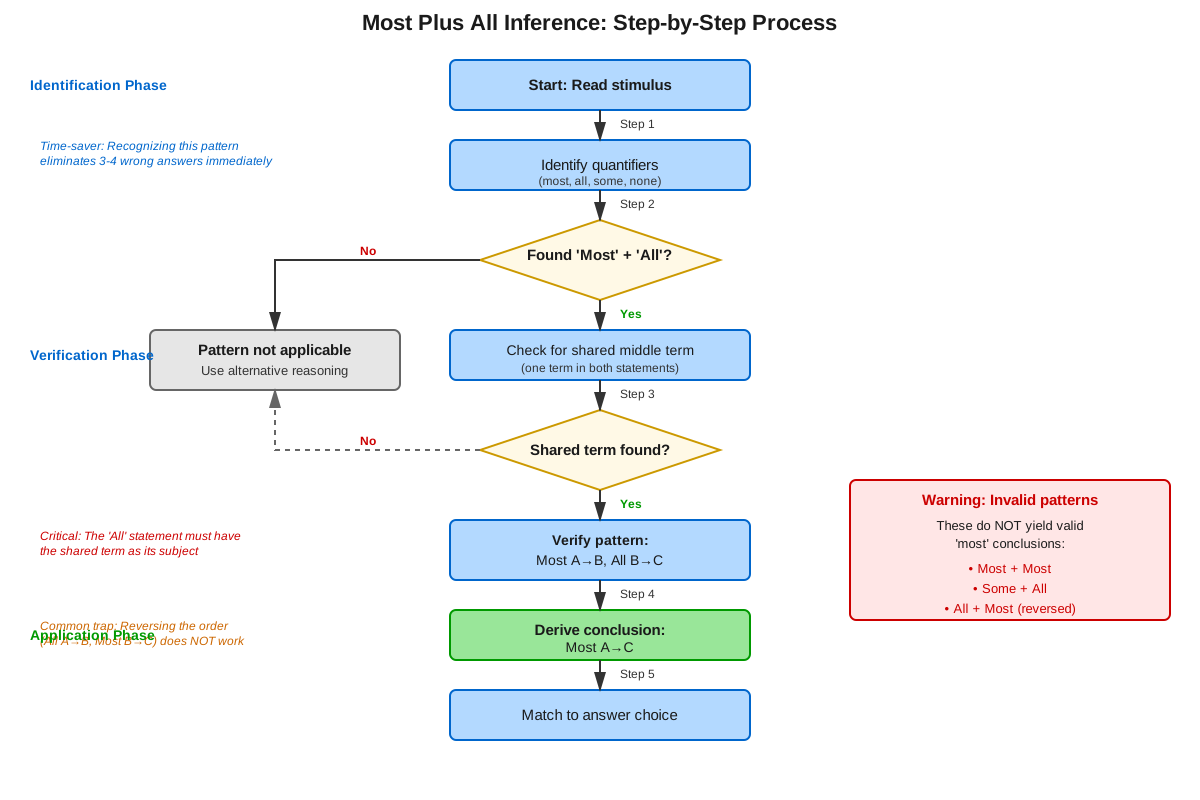
When approaching LSAT questions involving most plus all inference, begin by identifying all quantifiers in the stimulus. Circle or underline words like "most," "all," "every," "majority," and "each." This immediate recognition prevents misreading a "most" as "all" or vice versa, which would lead to incorrect inference application.
Trigger phrases that signal most plus all inference opportunities include:
- "Most [Group A] are [Group B]" followed by "All [Group B] are [Group C]"
- "The majority of [Group A]" combined with "Every [Group B]"
- "More than half" paired with "Each" or "All"
- Any combination where a majority statement precedes a universal statement with a shared term
When you identify the pattern, immediately diagram it using arrows: Most A → B + All B → C = Most A → C. This visual representation takes only seconds but dramatically reduces errors. If the pattern appears reversed (All then Most), note that no "most" conclusion is valid, though "some" might be.
For process of elimination, use these strategies:
- Eliminate any answer that claims "all" when the premises only support "most"
- Eliminate answers that reverse the direction of the inference (e.g., concluding "Most C are A" when the pattern yields "Most A are C")
- Eliminate answers that combine two "most" statements invalidly
- Keep answers that correctly state "most" with the proper direction
- Be cautious of "some" answers—they might be valid even when "most" isn't
Time allocation: Most plus all inference questions should take 45-60 seconds once you recognize the pattern. If you're spending more than 90 seconds, you may be overcomplicating the logic. Diagram quickly, apply the rule, and move to answer evaluation. These questions reward pattern recognition over deep analysis.
Exam Tip: If a Must Be True question presents exactly two premises with clear quantifiers and a shared term, most plus all inference is likely being tested. Don't overthink it—apply the pattern and select the answer that matches.
Memory Techniques
Mnemonic for the valid pattern: "Most Always Makes Another Most" - The first letters (M-A-M-A-M) remind you that Most + All = Most, and the pattern flows from the first group through to the third.
Directional memory device: Think of "most" as a starting point and "all" as a bridge. You start with a majority, cross a bridge that guarantees 100% transfer, and arrive with your majority intact. If you try to cross the bridge backward (starting with "all"), you can't guarantee where you'll end up.
Visual anchor: Picture a funnel system:
- Wide funnel opening = Group A (100 items)
- More than 50 items (most) flow into the narrow part = Group B
- All items in the narrow part (100% of those 50+) flow into the container = Group C
- Result: More than 50 items from A are now in C = Most A are C
Acronym for invalid patterns: "All Mess No Most" (AM-NM) - When you see All then Most, you get No Most conclusion.
Rhyme for the quantifier: "Most means more than half, not just a larger path" - Reminds you that "most" is mathematical (>50%), not just "more than other groups."
Summary
Most plus all inference is a high-yield formal logic pattern that combines a "most" statement with an "all" statement to produce a valid "most" conclusion. The pattern requires strict ordering: "Most A are B" plus "All B are C" yields "Most A are C," but reversing the order (All then Most) produces no valid "most" inference. Understanding that "most" means precisely "more than 50%" is essential, as is recognizing that the "all" statement acts as a guaranteed bridge that preserves the majority relationship. This pattern appears frequently in LSAT Logical Reasoning sections, particularly in Must Be True and Inference questions, making it one of the most valuable formal logic tools for test-takers. Success requires both pattern recognition—quickly identifying when premises fit the most plus all structure—and precise application—avoiding common errors like reversing the pattern or incorrectly combining two "most" statements. Mastery of this inference type provides a significant strategic advantage, allowing students to answer questions confidently and efficiently while eliminating wrong answers that violate the pattern's logical constraints.
Key Takeaways
- Most plus all inference follows the pattern: Most A → B + All B → C = Most A → C, where the "most" statement must come first
- "Most" means strictly more than 50% on the LSAT, not merely "many" or "the largest group"
- The pattern works because the "all" statement (100% transfer) preserves the majority (>50%) from the first group to the third
- Reversing the pattern to All + Most produces no valid "most" conclusion, though "some" may be inferable
- Multiple "all" statements can chain after the initial "most" statement while maintaining validity
- Two "most" statements cannot be combined to produce a valid inference
- Recognizing this pattern enables quick, confident answers on Must Be True and Inference questions, which frequently test this concept
Related Topics
Conditional Logic and Sufficient-Necessary Relationships: Understanding how "all" statements function as conditional relationships (If A, then B) deepens comprehension of why the "all" portion of most plus all inference acts as a guaranteed bridge. Mastering most plus all inference provides a foundation for more complex conditional chains.
Invalid Quantifier Combinations: Studying which quantifier combinations do NOT produce valid inferences (such as All + Most or Most + Most) reinforces understanding of why most plus all inference works and helps avoid logical errors on the LSAT.
Some Plus All Inference: A related pattern where "Some A are B" and "All B are C" yields "Some A are C." This simpler inference pattern shares structural similarities with most plus all inference and often appears alongside it in Logical Reasoning sections.
Formal Logic Diagramming Techniques: Advanced diagramming methods for complex logical relationships build on the basic arrow notation used in most plus all inference, enabling students to tackle multi-layered formal logic questions efficiently.
Must Be True Question Strategies: Since most plus all inference appears most frequently in Must Be True questions, studying broader strategies for this question type—including how to evaluate answer choices and avoid trap answers—complements mastery of this specific inference pattern.
Practice CTA
Now that you understand the most plus all inference pattern, it's time to cement your mastery through practice. Attempt the practice questions designed specifically for this topic, focusing on both recognizing the pattern quickly and applying it accurately. Use the flashcards to drill the key distinctions—particularly the difference between valid and invalid quantifier combinations—until pattern recognition becomes automatic. Remember, most plus all inference appears in 15-20% of Logical Reasoning sections, so every minute you invest in mastering this pattern directly translates to points on test day. You've learned the theory; now build the speed and confidence that will make these questions feel effortless when you encounter them under timed conditions. Your LSAT score will thank you!
Sign up free to keep reading
Create a free AnvayaPrep account to finish this LSAT guide on Most plus all inference — plus flashcards and practice questions.