Overview
Some plus all inference is a fundamental reasoning pattern in formal logic and quantifiers that appears frequently on the LSAT. This inference type involves combining two categorical statements—one containing a "some" quantifier and another containing an "all" quantifier—to derive a valid logical conclusion. When students encounter a statement like "Some A are B" paired with "All B are C," they must recognize that these premises necessarily lead to the conclusion "Some A are C." This deductive reasoning pattern represents one of the most testable formal logic relationships on the LSAT, appearing in Must Be True questions, Inference questions, and as part of more complex argument structures.
Understanding lsat some plus all inference is essential because it forms the backbone of categorical reasoning on the exam. The LSAT frequently tests whether students can recognize valid inferences from quantified statements, and the some-plus-all pattern is among the most common. Unlike informal reasoning that relies on context and probability, this formal logic pattern produces conclusions that must be true whenever the premises are true. Mastering this inference type enables students to move through certain question types with confidence and speed, as the logical relationship is mechanical and predictable once recognized.
Within the broader landscape of logical reasoning, some plus all inference connects directly to other quantifier relationships, conditional logic, and set theory concepts. It serves as a bridge between understanding basic categorical statements and tackling more complex formal logic chains that may involve multiple inference steps. Students who master this pattern develop stronger skills in diagramming arguments, recognizing valid versus invalid reasoning, and eliminating incorrect answer choices that violate formal logic principles.
Learning Objectives
- [ ] Identify how Some plus all inference appears in LSAT questions
- [ ] Explain the reasoning pattern behind Some plus all inference
- [ ] Apply Some plus all inference to solve LSAT-style problems accurately
- [ ] Diagram some plus all inference relationships using standard notation
- [ ] Distinguish valid some plus all inferences from invalid quantifier combinations
- [ ] Recognize when answer choices incorrectly reverse or negate some plus all relationships
- [ ] Chain multiple some plus all inferences together in complex argument structures
Prerequisites
- Basic categorical statements: Understanding "all," "some," and "no" quantifiers is essential because some plus all inference builds directly on these foundational terms
- Set theory fundamentals: Recognizing how groups overlap and relate to one another provides the conceptual framework for visualizing quantifier relationships
- Valid versus invalid inferences: Distinguishing between conclusions that must follow from premises versus those that might or might not follow is critical for applying formal logic rules correctly
- Conditional logic basics: Familiarity with sufficient and necessary conditions helps students understand the directional nature of "all" statements
Why This Topic Matters
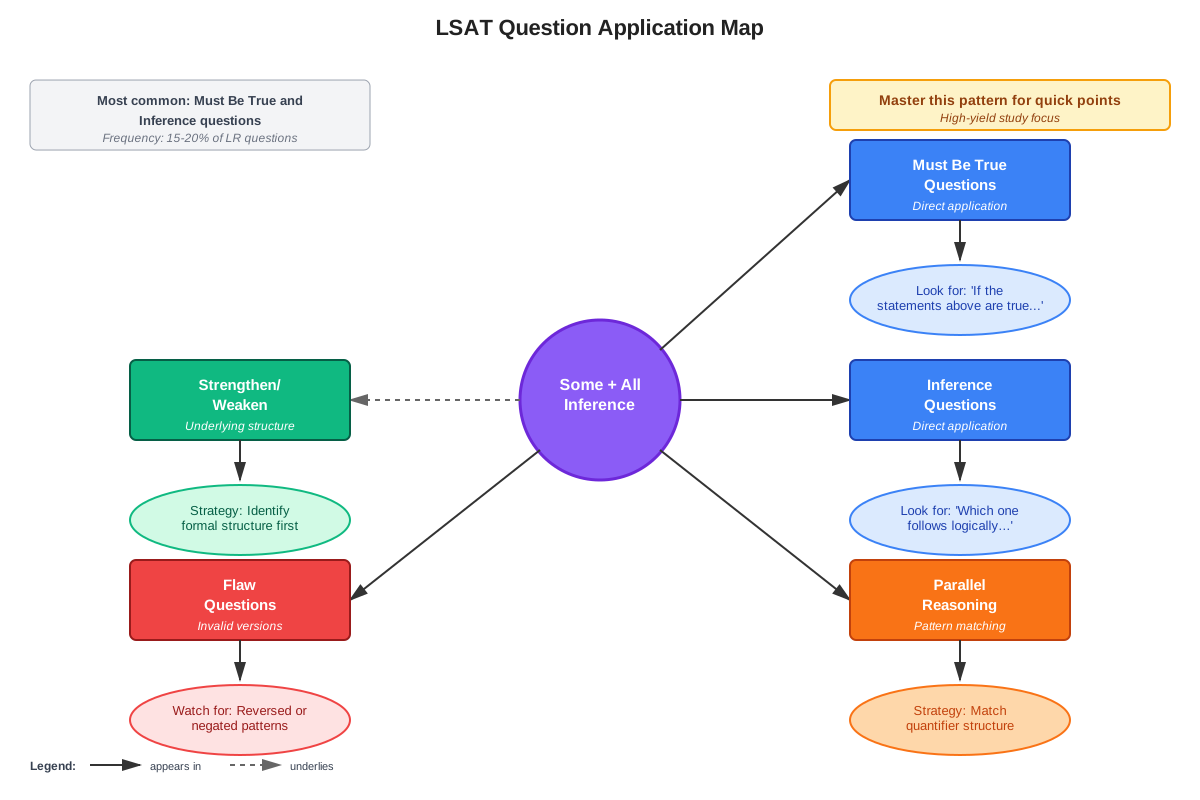
Some plus all inference represents one of the highest-yield formal logic patterns for LSAT success. This reasoning structure appears in approximately 15-20% of Logical Reasoning questions across typical LSAT administrations, making it one of the most frequently tested formal logic concepts. Beyond its direct appearance in Must Be True and Inference questions, understanding this pattern strengthens performance on Parallel Reasoning, Flaw, and even some Strengthen/Weaken questions where formal logic relationships underpin the argument structure.
In real-world applications, some plus all inference mirrors the categorical reasoning used in legal analysis, policy evaluation, and scientific classification. Attorneys regularly work with categorical rules ("All contracts require consideration") and specific instances ("Some agreements in this case are contracts") to reach necessary conclusions about legal obligations. The ability to recognize what must follow from categorical premises—and equally important, what does not follow—is fundamental to legal reasoning and critical thinking in professional contexts.
On the LSAT, this topic most commonly appears in several distinct formats: (1) Must Be True questions where the stimulus presents two categorical statements and the correct answer represents the valid inference; (2) Inference questions embedded within longer arguments where recognizing the some plus all pattern helps identify supporting conclusions; (3) Flaw questions where the argument incorrectly applies or reverses the inference pattern; and (4) Parallel Reasoning questions where matching the logical structure requires identifying the quantifier relationships. The pattern may appear with explicit quantifier language ("some," "all") or through equivalent expressions ("a few," "every," "certain," "any").
Core Concepts
The Basic Some Plus All Pattern
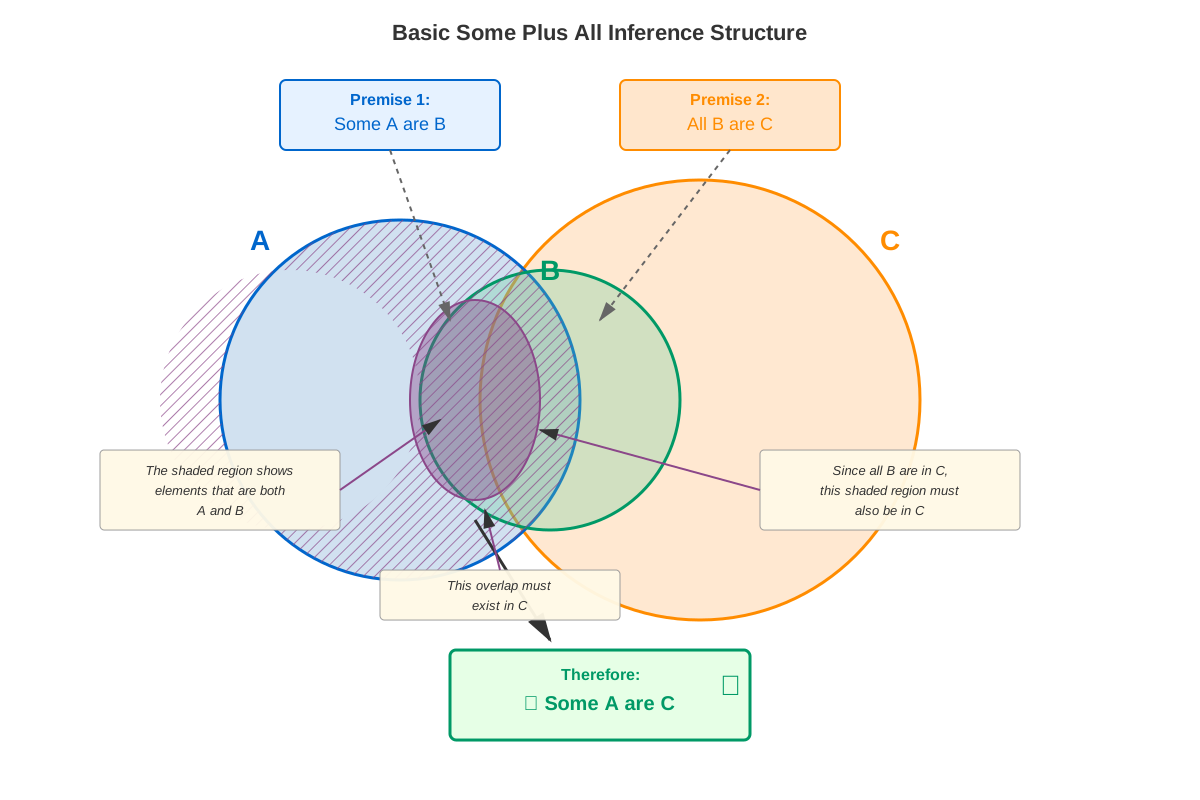
The some plus all inference follows a straightforward logical structure: when you know that some members of group A belong to group B, and you know that all members of group B belong to group C, you can validly conclude that some members of group A belong to group C. This inference is deductively valid—the conclusion must be true whenever both premises are true.
The formal structure can be represented as:
- Premise 1: Some A are B
- Premise 2: All B are C
- Valid Conclusion: Some A are C
The reasoning behind this pattern relies on the definitions of the quantifiers. "Some" means "at least one" in formal logic—it establishes that there exists at least one member in the overlap between two groups. "All" means "every single member without exception"—it establishes that one group is entirely contained within another. When we combine these statements, the member(s) that exist in both A and B must also be in C, because every B is in C.
Visualizing the Inference with Sets
Understanding some plus all inference becomes clearer through set visualization. Imagine three circles representing groups A, B, and C. The statement "Some A are B" means the circles for A and B overlap—there is at least one element in the intersection. The statement "All B are C" means circle B is entirely contained within circle C—every point in B is also in C.
Given this configuration, any element in the overlap between A and B must also be in C, because that element is in B, and everything in B is in C. Therefore, there must be at least one element that is both A and C—which is exactly what "Some A are C" means. This visual approach helps students recognize why the inference is necessary rather than merely probable.
The Directionality Principle
A critical aspect of some plus all inference is understanding directionality. The "all" statement creates a directional relationship—it tells us that one category is entirely contained in another. The inference only works when the "all" statement connects the second term of the "some" statement to a new category.
Consider these two scenarios:
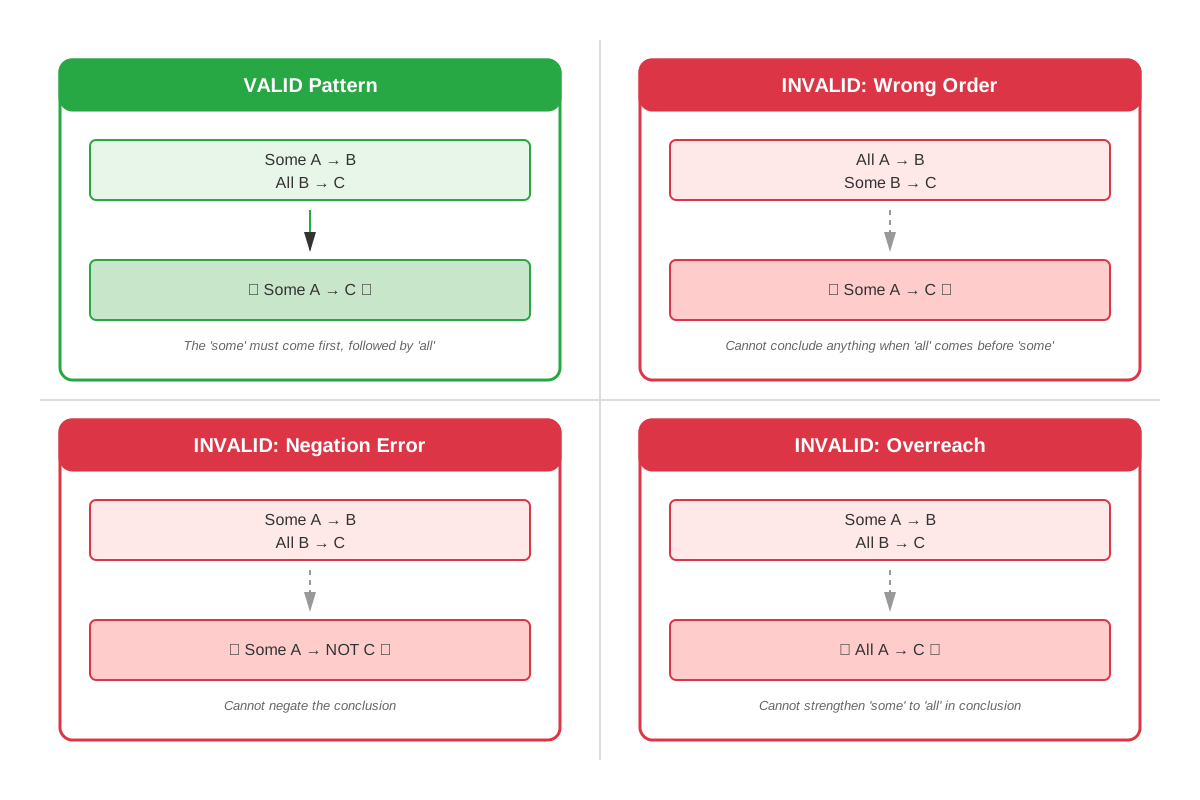
Valid Pattern:
- Some lawyers are professors (Some L are P)
- All professors are educators (All P are E)
- Conclusion: Some lawyers are educators (Some L are E) ✓
Invalid Pattern:
- Some lawyers are professors (Some L are P)
- All educators are professors (All E are P)
- Conclusion: Some lawyers are educators (Some L are E) ✗
In the invalid pattern, the "all" statement goes in the wrong direction—it doesn't tell us anything about what all professors are, only what all educators are. Since we only know that some lawyers are professors, and professors might include non-educators, we cannot conclude anything about the relationship between lawyers and educators.
Quantifier Definitions in Formal Logic
| Quantifier | Formal Meaning | Minimum Requirement | Maximum Allowance |
|---|---|---|---|
| All | Every member without exception | 100% of the category | 100% of the category |
| Some | At least one member | 1 member | All members (inclusive) |
| Most | More than half | 50% + 1 member | 100% of the category |
| No/None | Zero members | 0% of the category | 0% of the category |
Understanding that "some" means "at least one" is crucial for some plus all inference. The conclusion "Some A are C" is satisfied even if only a single member of A is also in C. Students often mistakenly think "some" implies "a significant portion" or "many," but formal logic uses the minimal interpretation.
The Reversibility Limitation
Some plus all inference has an important limitation: the conclusion is also a "some" statement, which means it cannot be reversed to create a new "all" statement. If we conclude "Some A are C," we cannot infer "Some C are A" automatically, though in this particular case it happens to be true due to the symmetric nature of "some" statements.
More importantly, we absolutely cannot conclude "All A are C" or "All C are A" from a some plus all inference. The original "some" statement in the premises limits our conclusion—we only know about at least one member of A, not all members of A.
Chaining Multiple Inferences
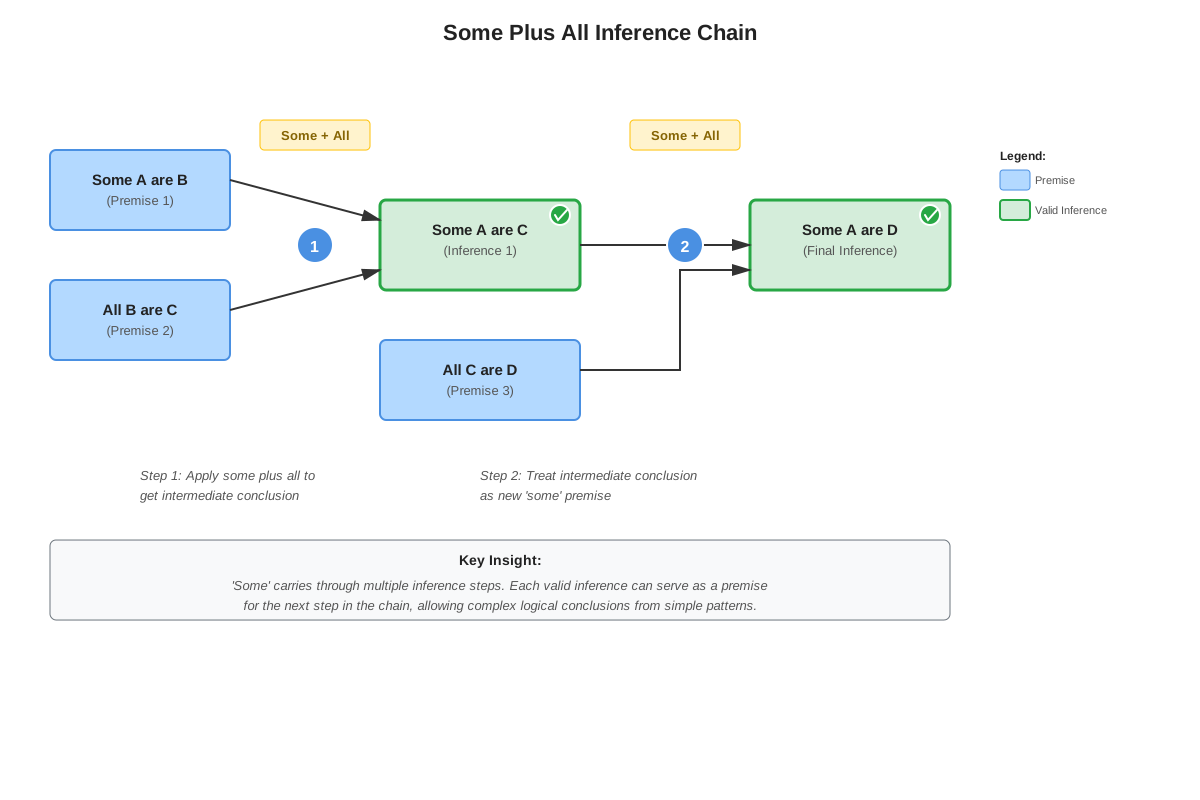
Some plus all inferences can be chained together to create longer logical sequences. If you have:
- Some A are B
- All B are C
- All C are D
You can first infer "Some A are C" (from the first two statements), then use this derived conclusion with the third statement to infer "Some A are D." This chaining ability makes the pattern particularly powerful in complex LSAT questions where multiple inference steps are required.
The key to successful chaining is ensuring that each step follows the valid pattern: you need the "all" statement to connect the second term of your "some" statement to a new category. Each intermediate conclusion becomes a new premise for the next inference step.
Concept Relationships
The some plus all inference pattern connects to several other formal logic concepts in a hierarchical relationship. At the foundation lies basic quantifier logic, which defines what "some," "all," "most," and "no" mean in formal reasoning. Some plus all inference builds directly on these definitions, particularly the understanding that "some" means "at least one" and "all" means "every member without exception."
This inference pattern relates closely to conditional logic because "all" statements can be translated into conditional form: "All B are C" is logically equivalent to "If B, then C." This connection means that some plus all inference can also be understood as: "Some A are B" + "If B, then C" → "Some A are C." Students who understand conditional logic can leverage that knowledge to reinforce their grasp of some plus all patterns.
The relationship map flows as follows:
Basic Quantifiers → Categorical Statements → Some Plus All Inference → Complex Inference Chains → Argument Analysis
Some plus all inference also contrasts with other quantifier combinations that do not produce valid inferences. For example, "Some A are B" + "Some B are C" does not allow any conclusion about the relationship between A and C—the two "some" statements might refer to entirely different subsets of B. Understanding what doesn't work helps students avoid invalid reasoning on the LSAT.
Within the broader context of formal logic and quantifiers, some plus all inference represents a specific application of syllogistic reasoning, where two premises containing a shared term lead to a conclusion about the relationship between the other two terms. This connects to the classical logic tradition and helps students recognize the LSAT's emphasis on deductive validity.
High-Yield Facts
⭐ Some plus all inference requires one "some" statement and one "all" statement with a shared middle term to produce a valid "some" conclusion
⭐ The "all" statement must connect the second term of the "some" statement to a new category for the inference to be valid
⭐ "Some" in formal logic means "at least one" and is satisfied even if only a single instance exists
⭐ The conclusion of a some plus all inference is always a "some" statement, never an "all" statement
⭐ Some plus all inferences can be chained together when multiple "all" statements connect sequentially
- The inference pattern works regardless of whether the statements appear in "Some A are B, All B are C" order or "All B are C, Some A are B" order
- Reversing the direction of the "all" statement invalidates the inference pattern
- "Some" statements are symmetric: "Some A are B" is logically equivalent to "Some B are A"
- The inference remains valid even when expressed with equivalent language like "certain," "a few," "several," or "at least one" instead of "some"
- Some plus all inference appears in both standalone inference questions and as part of larger argument structures in Logical Reasoning
- The pattern can be disguised with negative terms: "Some A are not B" + "All non-B are C" → "Some A are C"
- Multiple "all" statements can be chained without requiring additional "some" statements once the initial "some" is established
Quick check — test yourself on Some plus all inference so far.
Try Flashcards →Common Misconceptions
Misconception: If some A are B and all B are C, then all A are C.
Correction: The conclusion must be "some A are C," not "all A are C." The original "some" statement only guarantees at least one member of A is in B, so we can only conclude that at least one member of A is in C. We have no information about the other members of A.
Misconception: "Some A are B" plus "Some B are C" allows us to conclude "Some A are C."
Correction: Two "some" statements with a shared middle term do not produce a valid inference. The "some A are B" might refer to entirely different members of B than the "some B are C," leaving no guaranteed overlap between A and C.
Misconception: The order of the premises matters for validity—you must have the "some" statement first.
Correction: The order of premises does not affect logical validity. "All B are C" followed by "Some A are B" produces the same valid inference as "Some A are B" followed by "All B are C." What matters is the logical relationship between the terms, not the sequence of presentation.
Misconception: "Some" means "some but not all," excluding the possibility that all members are included.
Correction: In formal logic, "some" means "at least one" and is compatible with "all." If all A are B, then it is also true that some A are B. The LSAT uses the inclusive interpretation of "some" unless explicitly stated otherwise.
Misconception: If some A are B and all C are B, then some A are C.
Correction: This reverses the direction of the "all" statement. The "all" statement must start with the shared middle term (B in this case) and point to a new category. "All C are B" tells us that C is contained in B, but doesn't help us conclude anything about the relationship between A and C, since both might occupy completely different parts of B.
Misconception: Some plus all inference only works with the exact words "some" and "all."
Correction: The LSAT frequently uses equivalent expressions. "A few," "certain," "several," and "at least one" can all function as "some." Similarly, "every," "any," "each," and "only those who" can function as "all." Students must recognize the logical function of the quantifiers, not just the specific words used.
Worked Examples
Example 1: Basic Some Plus All Inference
Stimulus: Some philosophy majors are mathematics enthusiasts. All mathematics enthusiasts are logical thinkers.
Question: If the statements above are true, which one of the following must also be true?
Analysis:
Let's identify the components:
- Premise 1: Some philosophy majors are mathematics enthusiasts (Some P are M)
- Premise 2: All mathematics enthusiasts are logical thinkers (All M are L)
This is a classic some plus all inference pattern. We have a "some" statement connecting philosophy majors to mathematics enthusiasts, and an "all" statement connecting mathematics enthusiasts to logical thinkers. The shared middle term is "mathematics enthusiasts."
Following the inference pattern:
- Some P are M (given)
- All M are L (given)
- Therefore: Some P are L (valid conclusion)
Correct Answer: Some philosophy majors are logical thinkers.
Why this must be true: Since at least one philosophy major is a mathematics enthusiast (from premise 1), and every mathematics enthusiast is a logical thinker (from premise 2), that philosophy major who is a mathematics enthusiast must also be a logical thinker. Therefore, at least one philosophy major is a logical thinker, which is exactly what "some philosophy majors are logical thinkers" means.
Wrong answer types to avoid:
- "All philosophy majors are logical thinkers" - Too strong; we only know about some philosophy majors
- "Some logical thinkers are philosophy majors" - While this happens to be true due to the symmetry of "some," it's not the direct inference from the pattern
- "All mathematics enthusiasts are philosophy majors" - Reverses the first premise incorrectly
Example 2: Chained Some Plus All Inference
Stimulus: Certain members of the city council are former business owners. Every former business owner on the council supports the new tax incentive. Anyone who supports the new tax incentive will vote for the budget proposal.
Question: Which one of the following can be properly inferred from the statements above?
Analysis:
Let's translate the statements:
- Premise 1: Some city council members are former business owners (Some C are B)
- Premise 2: All former business owners [on the council] are tax incentive supporters (All B are T)
- Premise 3: All tax incentive supporters will vote for the budget proposal (All T are V)
This requires chaining two some plus all inferences:
First inference:
- Some C are B
- All B are T
- Conclusion: Some C are T (Some city council members support the tax incentive)
Second inference:
- Some C are T (from our first conclusion)
- All T are V
- Conclusion: Some C are V (Some city council members will vote for the budget proposal)
Correct Answer: At least one city council member will vote for the budget proposal.
Why this must be true: We can trace the logical chain: certain council members are former business owners → those former business owners support the tax incentive → those tax incentive supporters will vote for the budget proposal. Therefore, at least one council member (those who are former business owners) will vote for the budget proposal.
Key learning point: This example demonstrates how some plus all inferences can be chained through multiple steps. Each intermediate conclusion becomes a premise for the next inference. The pattern remains valid as long as each step follows the some plus all structure.
Exam Strategy
When approaching LSAT questions involving some plus all inference, follow this systematic process:
Step 1: Identify quantifier language
Scan the stimulus for quantifier words. Look for "some," "all," "certain," "every," "a few," "several," "any," and "each." Mark these terms and the categories they connect. The LSAT often disguises quantifiers with equivalent expressions, so train yourself to recognize functional equivalents.
Step 2: Diagram the relationships
Use simple notation to map the logical structure:
- Some A → B (for "Some A are B")
- All B → C (for "All B are C")
This visual representation helps you see whether the pattern is present and whether the terms connect properly. The shared middle term should appear as the second element in the "some" statement and the first element in the "all" statement.
Step 3: Check directionality
Verify that the "all" statement points in the correct direction. The "all" must start with the shared middle term and point to a new category. If the "all" statement points toward the middle term instead of away from it, the inference pattern doesn't work.
Step 4: Predict the conclusion
Before looking at answer choices, predict what must be true: "Some [first term] are [last term]." This prediction helps you move quickly to the correct answer and avoid attractive wrong answers.
Step 5: Eliminate systematically
Wrong answers typically fall into these categories:
- Too strong: Claims "all" instead of "some"
- Reversed direction: Switches the terms incorrectly
- Invalid combination: Tries to infer from two "some" statements or mismatched terms
- Possible but not necessary: Could be true but doesn't have to be true
Exam Tip: When you see "must be true" or "properly inferred" in the question stem, and the stimulus contains clear quantifier language, immediately check for some plus all inference patterns. These questions are designed to be solved quickly once you recognize the structure.
Time allocation: Some plus all inference questions should take 45-60 seconds once you've mastered the pattern. If you find yourself spending more than 90 seconds, you may be overcomplicating the logic. Return to the basic pattern and diagram the relationships simply.
Trigger phrases to watch for:
- "If the statements above are true, which one of the following must also be true?"
- "Which one of the following can be properly inferred?"
- "The statements above, if true, best support which one of the following?"
These question stems signal that you should look for formal logic relationships, including some plus all inference.
Memory Techniques
The "SAME" Acronym:
- Some statement first (identifies at least one overlap)
- All statement second (connects middle term to new category)
- Middle term shared (appears in both premises)
- Ends with some (conclusion is always "some," never "all")
The Chain Link Visualization:
Picture the inference as a chain: Some A are B [link] All B are C [link] = Some A are C. The "all" statement is the strong link that carries the "some" relationship forward. If the "all" link is broken or reversed, the chain doesn't connect.
The Container Method:
Visualize three containers (A, B, C). The "some" statement means you pour at least one marble from container A into the overlap with container B. The "all" statement means container B is entirely inside container C. Therefore, any marble in the A-B overlap must also be in C. This physical metaphor helps cement the logical relationship.
The Direction Arrow Rule:
Remember: "Some A → B" + "All B → C" = "Some A → C"
The arrows must flow in sequence. If the "all" arrow points backward (All C → B), the sequence breaks and no valid inference follows.
The "At Least One" Reminder:
Whenever you see "some" in a premise or need to state a conclusion, mentally replace it with "at least one." This prevents the common error of thinking "some" means "many" or "most," and reminds you that the conclusion is satisfied by even a single instance.
Summary
Some plus all inference represents a fundamental formal logic pattern that appears frequently on the LSAT Logical Reasoning section. The pattern combines a "some" statement (meaning "at least one") with an "all" statement (meaning "every member without exception") to produce a valid "some" conclusion. The inference works when the "all" statement connects the second term of the "some" statement to a new category, creating a logical chain: if some A are B, and all B are C, then some A must be C. This conclusion is deductively valid—it must be true whenever the premises are true. Students must recognize that the conclusion is always a "some" statement, never an "all" statement, and that the directionality of the "all" statement is crucial for validity. The pattern can be chained through multiple steps and appears in various question types, often disguised with equivalent quantifier language. Mastering this inference type enables quick, confident answers on high-yield LSAT questions and strengthens overall formal logic reasoning skills essential for test success.
Key Takeaways
- Some plus all inference combines "Some A are B" with "All B are C" to validly conclude "Some A are C"
- The "all" statement must connect the shared middle term to a new category for the inference to work
- "Some" means "at least one" in formal logic, and the conclusion is satisfied by even a single instance
- The conclusion is always a "some" statement, never an "all" statement, regardless of the premises
- Directionality matters: reversing the "all" statement invalidates the inference pattern
- The pattern can be chained through multiple steps when sequential "all" statements connect properly
- Recognizing equivalent quantifier language ("certain," "every," "a few") is essential for identifying the pattern on the LSAT
Related Topics
Most Plus All Inference: Similar to some plus all inference but uses "most" (more than half) as the initial quantifier, producing a "most" conclusion. Mastering some plus all inference provides the foundation for understanding this more complex pattern.
Conditional Logic Chains: The relationship between conditional statements (if-then) and quantifier logic, where "all" statements translate to conditionals. Understanding some plus all inference strengthens your ability to work with conditional chains.
Invalid Quantifier Combinations: Learning which quantifier combinations do not produce valid inferences (such as two "some" statements) helps you avoid logical errors and identify flawed reasoning in LSAT arguments.
Contrapositive Reasoning with Quantifiers: How to correctly form contrapositives of "all" statements and combine them with "some" statements, extending your formal logic toolkit beyond the basic some plus all pattern.
Formal Logic in Sufficient Assumption Questions: Applying some plus all inference to identify missing premises that would make arguments valid, a critical skill for Sufficient Assumption question types.
Practice CTA
Now that you understand the mechanics and application of some plus all inference, it's time to reinforce your learning through active practice. Attempt the practice questions designed for this topic, focusing on identifying the pattern quickly and predicting conclusions before reviewing answer choices. Use the flashcards to drill the key concepts until recognizing some plus all inference becomes automatic. Remember: formal logic patterns like this one are among the most learnable and predictable elements of the LSAT—consistent practice translates directly into points on test day. Every question you practice strengthens your pattern recognition and builds the confidence needed for peak performance.
Sign up free to keep reading
Create a free AnvayaPrep account to finish this LSAT guide on Some plus all inference — plus flashcards and practice questions.