Overview
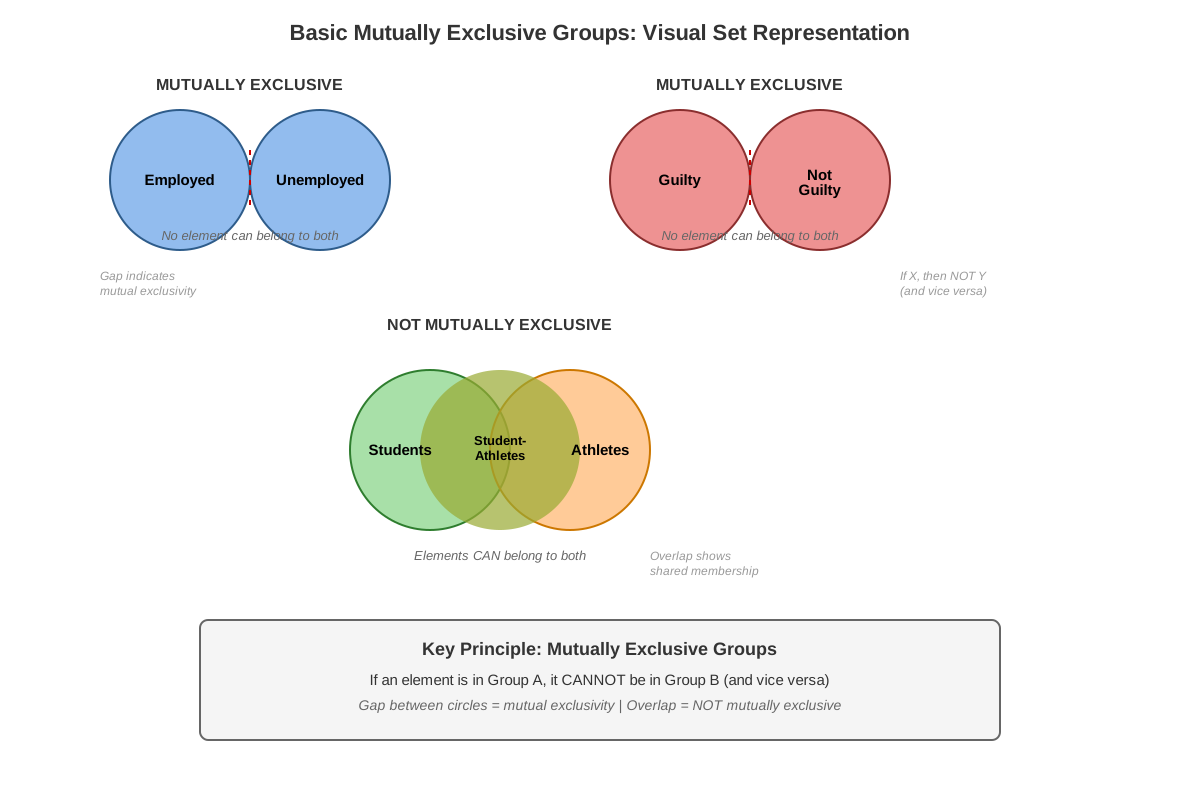
Mutually exclusive groups represent a fundamental concept in formal logic and quantifiers that appears frequently throughout the LSAT, particularly in logical reasoning sections. This concept describes a relationship between categories or sets where membership in one group automatically precludes membership in another group. When two or more groups are mutually exclusive, no element can belong to more than one group simultaneously. For example, if someone is classified as either "employed" or "unemployed," these categories are mutually exclusive—a person cannot be both at the same time.
Understanding mutually exclusive groups is essential for LSAT success because the exam regularly tests your ability to recognize when categories cannot overlap, to identify logical errors that arise from treating overlapping categories as mutually exclusive (or vice versa), and to draw valid inferences from statements involving exclusive classifications. This concept appears across multiple question types, including Must Be True, Flaw, Sufficient Assumption, and Parallel Reasoning questions. The LSAT frequently constructs arguments that either correctly apply the principle of mutual exclusivity or commit errors by failing to recognize when groups are or are not mutually exclusive.
The concept of lsat mutually exclusive groups connects directly to broader logical reasoning principles including conditional logic, categorical statements, and set theory. Mastering this topic provides the foundation for understanding more complex logical structures, such as exhaustive categorizations (where groups are both mutually exclusive and collectively exhaustive), and helps students avoid common logical fallacies that exploit confusion about category boundaries. This topic bridges basic formal logic with the practical application skills needed to dissect complex LSAT arguments efficiently.
Learning Objectives
- [ ] Identify how mutually exclusive groups appears in LSAT questions
- [ ] Explain the reasoning pattern behind mutually exclusive groups
- [ ] Apply mutually exclusive groups to solve LSAT-style problems accurately
- [ ] Distinguish between mutually exclusive groups and overlapping categories in argument structures
- [ ] Recognize logical flaws that arise from incorrectly assuming groups are or are not mutually exclusive
- [ ] Construct valid inferences from statements involving mutually exclusive classifications
- [ ] Evaluate whether a given categorization scheme creates mutually exclusive groups
Prerequisites
- Basic set theory and category logic: Understanding how elements can belong to sets and how sets can relate to one another provides the foundation for recognizing when categories exclude each other.
- Conditional logic fundamentals: Familiarity with "if-then" statements helps students understand how membership in one category can trigger exclusion from another.
- Categorical statements (All, Some, None): Knowledge of quantifiers enables proper interpretation of statements that establish mutually exclusive relationships.
- Logical operators (AND, OR, NOT): Understanding these operators is essential for translating mutually exclusive relationships into formal logical notation.
Why This Topic Matters
Mutually exclusive groups appear in real-world reasoning constantly, from legal classifications (guilty vs. not guilty), to medical diagnoses (where certain conditions cannot coexist), to policy decisions (where choosing one option precludes another). Legal reasoning—the foundation of the LSAT—frequently involves determining whether categories are properly exclusive, whether exceptions exist, and whether arguments improperly assume mutual exclusivity where none exists.
On the LSAT, questions involving mutually exclusive groups appear in approximately 15-20% of Logical Reasoning sections, making this a high-yield topic for score improvement. These questions appear most frequently as:
- Flaw questions where the argument incorrectly assumes two categories cannot overlap
- Must Be True questions where you must infer what cannot be true based on exclusive categories
- Sufficient Assumption questions where establishing mutual exclusivity closes a logical gap
- Parallel Reasoning questions where matching the exclusive/non-exclusive structure is essential
- Logic Games where rules establish mutually exclusive assignments
The LSAT particularly favors testing whether students can recognize when an argument treats overlapping categories as mutually exclusive (a common flaw) or when an argument fails to recognize that categories actually are mutually exclusive. Understanding this concept prevents costly errors and enables rapid elimination of incorrect answer choices.
Core Concepts
Definition of Mutually Exclusive Groups
Two or more groups are mutually exclusive when membership in one group automatically prevents membership in any other group within the same classification system. Formally, if groups A and B are mutually exclusive, then A ∩ B = ∅ (the intersection of A and B is the empty set). In practical terms, no element can possess the characteristics that would place it in both categories simultaneously.
The key characteristics of mutually exclusive groups include:
- Non-overlapping membership: No element belongs to more than one group
- Clear boundaries: The defining characteristics of each group are incompatible
- Binary or multiple divisions: Can involve two groups (binary) or more than two groups
- Context-dependent: Whether groups are mutually exclusive depends on how they are defined
Binary Mutually Exclusive Classifications
The simplest form involves exactly two categories that divide all possibilities. Common examples in LSAT arguments include:
| Category A | Category B | Relationship |
|---|---|---|
| Guilty | Not guilty | Legal status—mutually exclusive |
| Present | Absent | Physical location—mutually exclusive |
| Alive | Dead | Biological state—mutually exclusive |
| Passed | Failed | Test outcome—mutually exclusive |
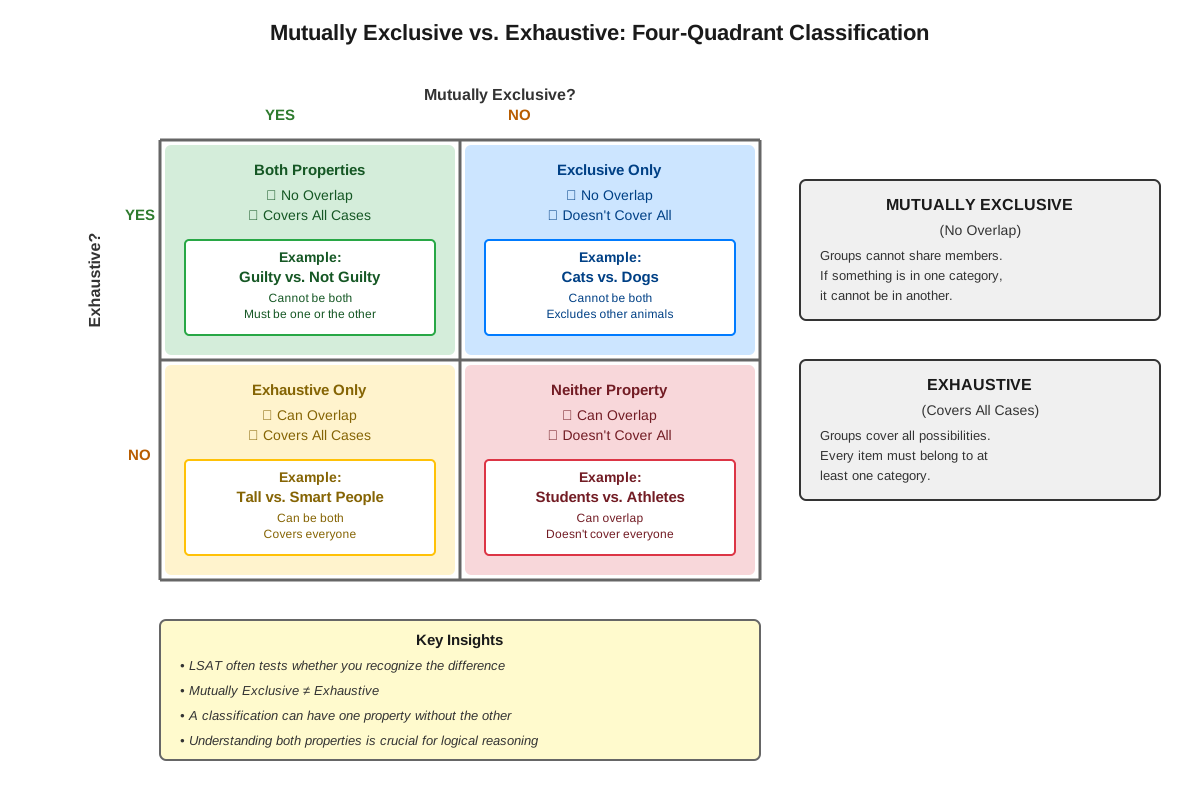
In binary classifications, if something is not in Category A, it must be in Category B (assuming the categories are also collectively exhaustive, meaning they cover all possibilities). However, mutual exclusivity alone does not guarantee collective exhaustiveness—two groups can be mutually exclusive without covering all possibilities.
Multiple Mutually Exclusive Groups
Classifications can involve three or more mutually exclusive categories. For example, a classification of "freshman, sophomore, junior, senior" for college students creates four mutually exclusive groups—a student cannot simultaneously be a freshman and a junior.
When dealing with multiple mutually exclusive groups:
- Each element belongs to exactly one group (if the classification is also exhaustive)
- Knowing an element is NOT in one group does not tell you which other group it belongs to
- The number of possible group memberships equals the number of groups
- Logical inferences require careful attention to which groups have been eliminated
Distinguishing Mutually Exclusive from Overlapping Categories
A critical LSAT skill involves recognizing when categories are NOT mutually exclusive, even when they might appear to be. Consider these examples:
Mutually Exclusive: "vegetarian" and "meat-eater" (defined by whether one eats meat)
NOT Mutually Exclusive: "vegetarian" and "athlete" (one can be both)
The LSAT frequently exploits confusion between these types by presenting arguments that:
- Assume two categories cannot overlap when they actually can
- Treat overlapping categories as mutually exclusive
- Fail to recognize that categories are mutually exclusive when they are
Formal Logic Representation
Mutually exclusive groups can be represented using formal logic notation:
If A and B are mutually exclusive:
A → ¬B (If A, then not B)
B → ¬A (If B, then not A)
¬(A ∧ B) (Not both A and B)
This representation shows that membership in one group triggers the negation of membership in the other group. Understanding this conditional relationship helps identify mutually exclusive structures in complex arguments.
Exhaustive vs. Non-Exhaustive Mutually Exclusive Groups
Groups can be mutually exclusive without being exhaustive. Consider:
Mutually Exclusive AND Exhaustive: "pass" and "fail" on a test (assuming no incomplete grades)
Mutually Exclusive but NOT Exhaustive: "red car" and "blue car" (mutually exclusive, but cars can be other colors)
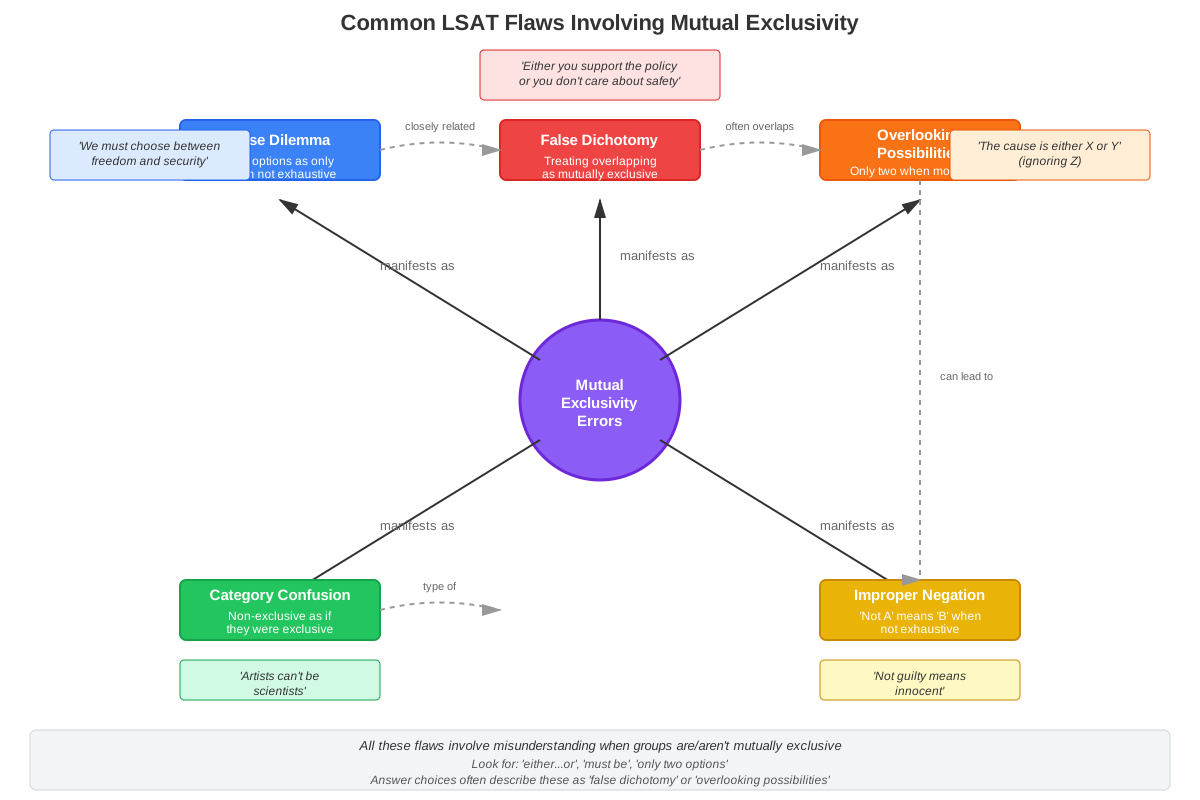
The LSAT tests whether students recognize this distinction. An argument might validly conclude that something is not in Group A, but then invalidly conclude it must be in Group B, forgetting that other options exist. This error occurs when treating non-exhaustive mutually exclusive groups as if they were exhaustive.
Common Logical Patterns Involving Mutually Exclusive Groups
Several reasoning patterns regularly appear on the LSAT:
- Disjunctive Syllogism: If groups A and B are mutually exclusive and exhaustive, and something is not A, then it must be B.
- Exclusion by Classification: If X belongs to Group A, and Groups A and B are mutually exclusive, then X does not belong to Group B.
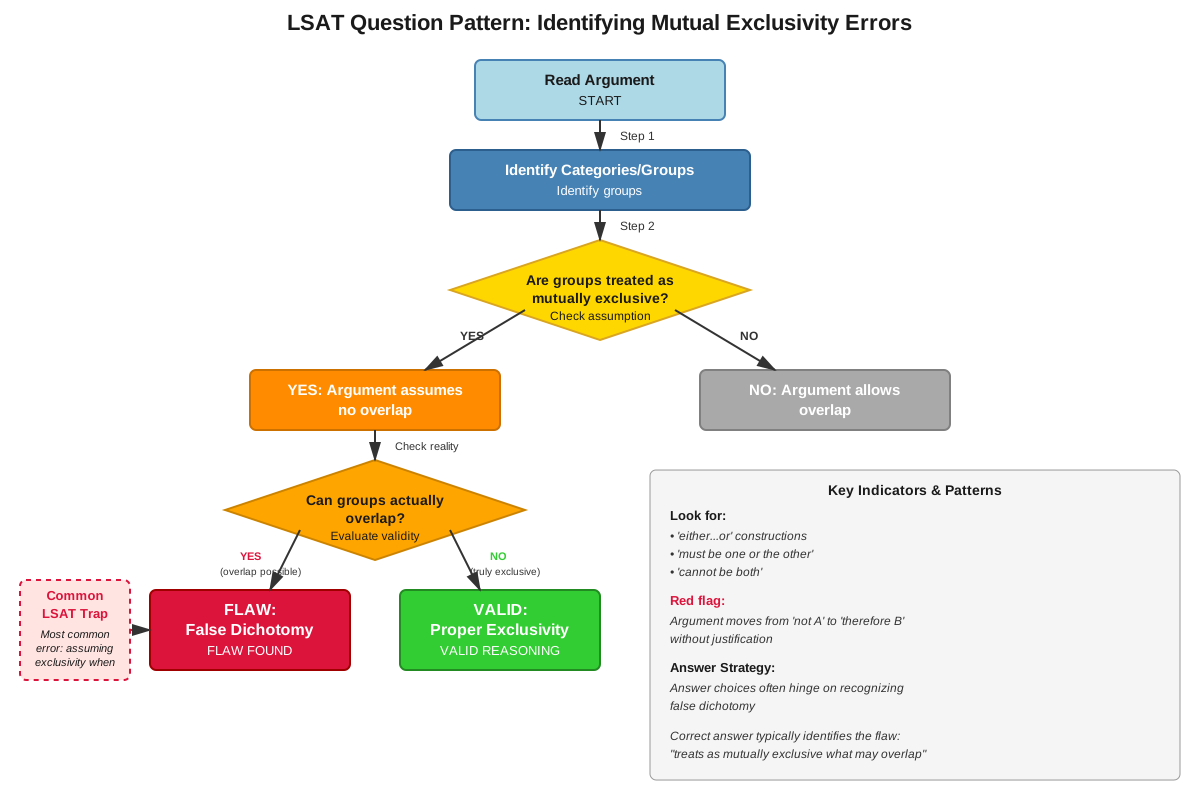
- False Dichotomy Flaw: Treating two non-exhaustive options as if they were the only possibilities (assuming exhaustiveness when it doesn't exist).
- False Mutual Exclusivity: Assuming two categories cannot overlap when they actually can.
Concept Relationships
The concept of mutually exclusive groups serves as a foundational element connecting multiple logical reasoning principles. Formal logic and quantifiers provide the language for expressing mutual exclusivity, while categorical statements establish the boundaries that make groups exclusive. The relationship flows as follows:
Set Theory → defines categories and membership → Mutually Exclusive Groups → enables valid inferences about non-membership → Conditional Logic → expresses exclusivity as conditional statements → Logical Reasoning Arguments
Within the topic itself, understanding binary classifications provides the foundation for grasping multiple mutually exclusive groups. Recognizing the difference between exhaustive and non-exhaustive classifications prevents the false dichotomy flaw. The ability to distinguish mutually exclusive from overlapping categories directly supports identifying logical flaws in LSAT arguments.
This topic connects forward to more advanced concepts including formal logic games (where mutually exclusive rules constrain assignments), sufficient and necessary conditions (where mutual exclusivity creates necessary conditions), and complex argument structures (where multiple layers of classification interact). Mastering mutually exclusive groups also enhances performance on strengthen/weaken questions where recognizing category boundaries helps evaluate evidence relevance.
High-Yield Facts
⭐ Two groups are mutually exclusive if and only if no element can belong to both groups simultaneously.
⭐ Mutually exclusive groups can be represented as: A → ¬B and B → ¬A.
⭐ A common LSAT flaw involves treating overlapping categories as mutually exclusive when they are not.
⭐ Mutually exclusive does not imply exhaustive—there may be additional options beyond the stated groups.
⭐ In binary mutually exclusive and exhaustive classifications, ¬A → B and ¬B → A are both valid.
- Multiple groups can all be mutually exclusive with each other (e.g., freshman, sophomore, junior, senior).
- The LSAT frequently tests whether students can identify when an argument incorrectly assumes mutual exclusivity.
- Knowing something is NOT in one mutually exclusive group only tells you which other group it belongs to if the classification is also exhaustive.
- Categories defined by contradictory properties are always mutually exclusive (e.g., "present" and "absent").
- The intersection of mutually exclusive sets is always the empty set (A ∩ B = ∅).
- Temporal states often create mutually exclusive categories (before/after, past/present/future).
- Legal and regulatory classifications frequently establish mutually exclusive categories by definition.
- An element can belong to mutually exclusive groups at different times, but not simultaneously.
Quick check — test yourself on Mutually exclusive groups so far.
Try Flashcards →Common Misconceptions
Misconception: If two categories are different, they must be mutually exclusive.
Correction: Different categories can overlap. "Doctor" and "parent" are different categories, but someone can be both. Mutual exclusivity requires that the defining characteristics of the categories are incompatible, not merely different.
Misconception: If groups are mutually exclusive, knowing something is not in Group A means it must be in Group B.
Correction: This is only true if the groups are also collectively exhaustive (covering all possibilities). Mutually exclusive groups can be non-exhaustive, meaning additional options exist beyond the stated groups.
Misconception: All binary classifications are mutually exclusive.
Correction: Some binary terms can overlap. For example, "tall" and "athletic" are two binary properties (you either have them or don't), but they are not mutually exclusive with each other—someone can be both tall and athletic.
Misconception: Mutually exclusive groups must be explicitly stated as such in the argument.
Correction: The LSAT often requires you to recognize mutual exclusivity from the definitions or context, even when not explicitly stated. For example, if an argument discusses "before the law was passed" and "after the law was passed," these are mutually exclusive time periods even without explicit statement.
Misconception: If an argument mentions two groups, they are probably mutually exclusive.
Correction: The LSAT frequently tests your ability to recognize when mentioned groups are NOT mutually exclusive. Always evaluate whether the defining characteristics actually prevent overlap rather than assuming exclusivity.
Misconception: Mutually exclusive relationships are always permanent.
Correction: An element can belong to different mutually exclusive groups at different times. A person can be "employed" at one time and "unemployed" at another time, even though these are mutually exclusive states at any given moment.
Worked Examples
Example 1: Identifying Mutual Exclusivity in a Must Be True Question
Stimulus: "Every member of the committee voted either for the proposal or against the proposal. Chen voted for the proposal. Therefore, Chen did not abstain from voting."
Question: Which of the following must be true?
Analysis:
Step 1: Identify the groups mentioned: "voted for," "voted against," and "abstained."
Step 2: Determine relationships: The first sentence establishes that every member voted either for or against—this creates a binary, exhaustive classification for committee members. This implicitly means no one abstained.
Step 3: Recognize mutual exclusivity: "Voted for" and "voted against" are mutually exclusive (cannot do both). The statement also makes these exhaustive for committee members, excluding "abstained" as an option.
Step 4: Apply to Chen: Since Chen voted for the proposal, and "voted for" is mutually exclusive with both "voted against" and "abstained," Chen definitely did not abstain.
Step 5: Evaluate what must be true: Chen voted for the proposal (stated), Chen did not vote against the proposal (mutually exclusive with voting for), and Chen did not abstain (excluded by the exhaustive classification).
Connection to Learning Objectives: This example demonstrates how to identify mutually exclusive groups in LSAT questions (the voting categories) and apply the concept to draw valid inferences (Chen's non-abstention).
Example 2: Recognizing a False Mutual Exclusivity Flaw
Stimulus: "All successful entrepreneurs are risk-takers. However, Maria is extremely cautious in her decision-making. Therefore, Maria cannot be a successful entrepreneur."
Question: The reasoning in the argument is flawed because it:
Analysis:
Step 1: Identify the categories: "successful entrepreneurs," "risk-takers," and "cautious decision-makers."
Step 2: Examine the stated relationship: The argument establishes that successful entrepreneurs → risk-takers (conditional relationship).
Step 3: Identify the assumption: The argument assumes that "risk-takers" and "cautious decision-makers" are mutually exclusive—that being cautious means you cannot be a risk-taker.
Step 4: Evaluate the assumption: Are these categories actually mutually exclusive? No. Someone can be a risk-taker in business ventures while being cautious in decision-making (carefully evaluating risks before taking them). These categories can overlap.
Step 5: Identify the flaw: The argument treats "risk-taker" and "cautious decision-maker" as mutually exclusive when they are not. This is a false mutual exclusivity flaw.
Step 6: Correct reasoning: Even if Maria is cautious, she could still be a risk-taker (taking calculated risks), and therefore could still be a successful entrepreneur. The argument's conclusion does not follow.
Connection to Learning Objectives: This example shows how to explain the reasoning pattern behind mutually exclusive groups (the flawed assumption that two overlapping categories are exclusive) and demonstrates a common LSAT trap involving false mutual exclusivity.
Exam Strategy
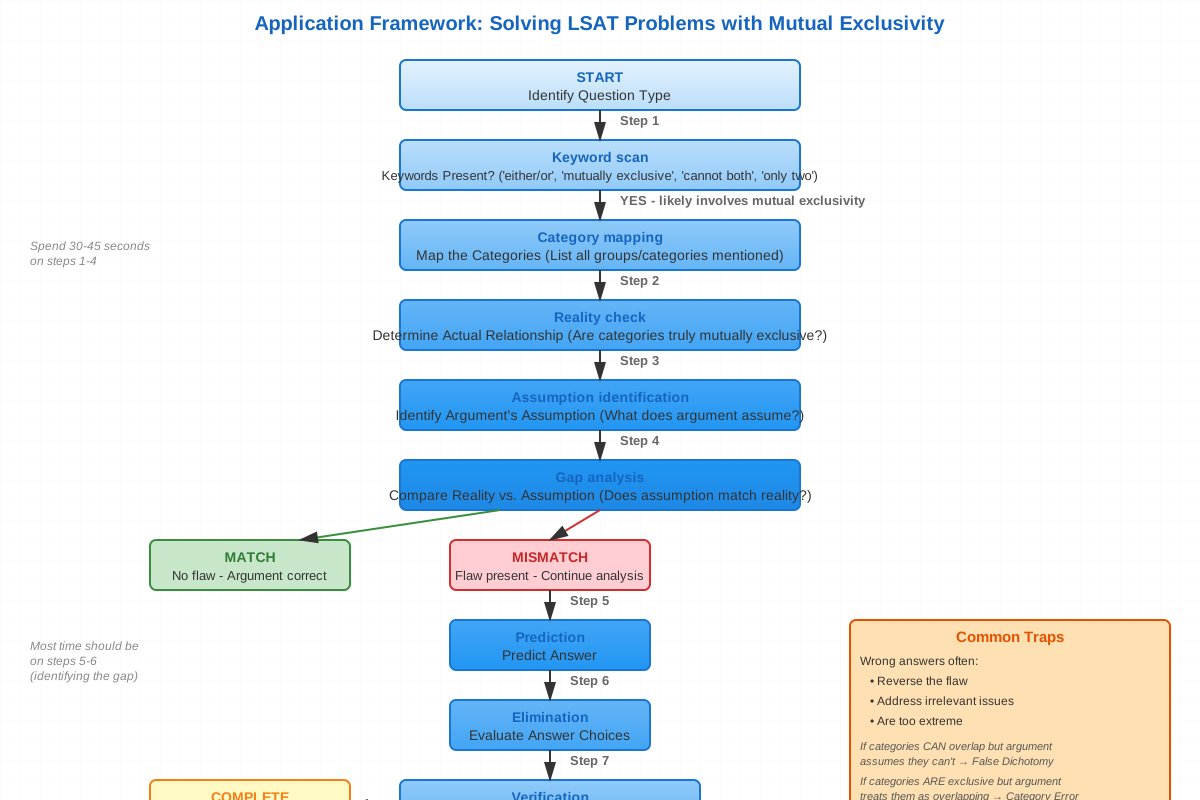
When approaching LSAT questions involving mutually exclusive groups, follow this systematic process:
Step 1: Identify all categories or groups mentioned in the stimulus. Create a mental or written list of each distinct category. Pay special attention to binary classifications (A vs. not-A) and multiple classifications (A, B, C, D).
Step 2: Determine whether the categories are mutually exclusive. Ask: "Can something belong to both categories simultaneously?" Look for explicit language ("either...or," "cannot be both") or implicit exclusivity based on definitions (before/after, alive/dead).
Step 3: Determine whether the categories are exhaustive. Ask: "Do these categories cover all possibilities, or could there be other options?" This distinction is crucial for valid inference-making.
Step 4: Watch for trigger words and phrases:
- "Either...or" (often signals mutual exclusivity, but check if "both" is excluded)
- "Cannot be both" (explicit mutual exclusivity)
- "Mutually exclusive" (direct statement)
- "Only one of" (mutual exclusivity with exhaustiveness)
- "Must be one or the other" (mutual exclusivity and exhaustiveness)
- "Distinct categories" (suggests but doesn't guarantee mutual exclusivity)
Step 5: Apply process of elimination for answer choices:
- Eliminate choices that assume mutual exclusivity when categories can overlap
- Eliminate choices that assume exhaustiveness when other options exist
- Eliminate choices that fail to recognize actual mutual exclusivity
- Keep choices that correctly apply the exclusive/non-exclusive relationship
Time allocation advice: Spend 10-15 seconds identifying category relationships before evaluating answer choices. This upfront investment prevents costly errors and speeds up answer choice evaluation. For complex stimuli with multiple classifications, quickly diagram the relationships using simple notation (A | B | C for mutually exclusive groups, A ∩ B for overlapping groups).
Exam Tip: When you see two categories mentioned in an argument, your default assumption should be that they CAN overlap unless you have explicit evidence they cannot. The LSAT more frequently tests false assumptions of mutual exclusivity than failures to recognize actual mutual exclusivity.
Memory Techniques
Mnemonic for Mutual Exclusivity: "ONE SPOT ONLY"
- One membership per element
- No overlap between groups
- Exclusive boundaries
Visualization Strategy: Picture mutually exclusive groups as separate rooms with locked doors between them. Once you enter one room (join one group), you cannot be in another room simultaneously. Non-mutually-exclusive groups are like overlapping circles (Venn diagrams) where the intersection area represents elements belonging to both.
Acronym for Checking Mutual Exclusivity: "DICE"
- Definitions: Do the definitions prevent overlap?
- Intersection: Can any element be in both groups?
- Context: Does the context establish exclusivity?
- Exhaustive: Do the groups cover all possibilities?
Memory Hook: Remember "ME groups" (Mutually Exclusive) by thinking "ME = only ME, not you"—emphasizing that membership in one group excludes membership in others.
Pattern Recognition: Create a mental list of inherently mutually exclusive pairs:
- Before/After (temporal)
- Alive/Dead (biological)
- Guilty/Not Guilty (legal)
- Present/Absent (spatial)
- Passed/Failed (outcome)
Summary
Mutually exclusive groups represent a fundamental logical relationship where membership in one category automatically prevents membership in another category within the same classification system. This concept appears frequently throughout LSAT Logical Reasoning sections, testing your ability to recognize when categories cannot overlap, identify logical errors involving false assumptions of mutual exclusivity, and draw valid inferences from exclusive classifications. The key distinction students must master is between mutually exclusive groups (which cannot overlap) and overlapping categories (which can share members), as well as between exhaustive classifications (which cover all possibilities) and non-exhaustive classifications (which leave room for additional options). The LSAT most commonly tests this concept through flaw questions where arguments incorrectly treat overlapping categories as mutually exclusive, and through must-be-true questions where exclusive classifications enable definitive inferences. Success requires systematic identification of all categories in an argument, careful evaluation of whether their defining characteristics prevent overlap, and recognition of whether the classification system is exhaustive. Understanding mutually exclusive groups provides essential foundation for more complex logical reasoning tasks and directly impacts performance across multiple question types.
Key Takeaways
- Mutually exclusive groups cannot share members—if something belongs to Group A, it cannot simultaneously belong to Group B when these groups are mutually exclusive.
- Mutual exclusivity does not imply exhaustiveness—two groups can be mutually exclusive without covering all possibilities; additional options may exist.
- The LSAT frequently tests false assumptions of mutual exclusivity—many arguments incorrectly treat overlapping categories as if they were mutually exclusive.
- Binary mutually exclusive and exhaustive classifications enable strong inferences—if only two options exist and they're mutually exclusive, knowing something is not A means it must be B.
- Context and definitions determine mutual exclusivity—evaluate whether the defining characteristics of categories actually prevent overlap rather than assuming exclusivity.
- Formal logic representation helps clarify relationships—expressing mutual exclusivity as A → ¬B makes the logical structure explicit and testable.
- Recognizing mutually exclusive groups enables rapid elimination of incorrect answer choices—understanding category boundaries helps identify logically impossible scenarios.
Related Topics
Conditional Logic and Contraposition: Mutually exclusive groups can be expressed as conditional statements (A → ¬B), connecting this topic to broader conditional reasoning skills. Mastering mutual exclusivity enhances your ability to work with complex conditional chains.
Categorical Logic and Venn Diagrams: Understanding how sets relate to each other through intersection and union provides visual tools for analyzing mutually exclusive and overlapping groups, particularly useful for complex classification problems.
Sufficient and Necessary Conditions: Mutual exclusivity creates necessary conditions (if A, then necessarily not B), connecting this topic to the broader framework of sufficient and necessary condition analysis.
Formal Logic Games: Many logic games establish mutually exclusive assignment rules (e.g., "If A is selected, B cannot be selected"), making this concept essential for games performance.
Logical Fallacies: False dichotomy and false mutual exclusivity represent common logical fallacies that build directly on understanding mutually exclusive groups, enabling recognition of flawed reasoning patterns.
Practice CTA
Now that you understand the concept of mutually exclusive groups and how it appears on the LSAT, it's time to reinforce your learning through active practice. Attempt the practice questions associated with this topic, focusing on identifying category relationships before evaluating answer choices. Use the flashcards to drill recognition of mutually exclusive versus overlapping categories until the distinction becomes automatic. Remember that mastery comes through application—each practice question you work through strengthens your ability to quickly and accurately analyze category relationships under timed conditions. Your investment in understanding this high-yield concept will pay dividends across multiple question types throughout the LSAT. Approach each practice problem systematically, and review both correct and incorrect answers to deepen your understanding of how the LSAT tests this concept.
Sign up free to keep reading
Create a free AnvayaPrep account to finish this LSAT guide on Mutually exclusive groups — plus flashcards and practice questions.