Overview
Percentages in logic represent one of the most frequently tested quantitative reasoning patterns on the LSAT Logical Reasoning section. Unlike pure mathematical percentage calculations, LSAT percentages in logic focus on the relationship between relative proportions (percentages) and absolute numbers, and how test-takers can be misled by confusing these two distinct concepts. This topic sits at the intersection of formal logic and quantifiers, requiring students to parse numerical claims with the same precision they apply to conditional statements and categorical reasoning. The LSAT exploits common cognitive biases about percentages to create trap answers that seem intuitively correct but are logically flawed.
Understanding percentages in logical reasoning is essential because these questions appear in multiple question types, including Strengthen, Weaken, Flaw, Assumption, and Paradox questions. The test-makers consistently design arguments that shift between discussing percentages and discussing raw numbers, or that compare percentages across different-sized populations without acknowledging the significance of base rates. Students who fail to recognize these shifts will systematically select incorrect answers that "feel right" but violate basic logical principles.
This topic connects directly to broader concepts in formal logic, particularly the proper interpretation of quantifiers (some, most, all) and the relationship between parts and wholes. Mastering percentage reasoning strengthens overall analytical skills by training students to distinguish between what an argument explicitly states versus what test-takers assume based on incomplete information. The precision required for percentage questions transfers directly to other high-difficulty LSAT content, making this a foundational skill for achieving elite scores.
Learning Objectives
- [ ] Identify how Percentages in logic appears in LSAT questions
- [ ] Explain the reasoning pattern behind Percentages in logic
- [ ] Apply Percentages in logic to solve LSAT-style problems accurately
- [ ] Distinguish between percentage changes and absolute number changes in arguments
- [ ] Recognize when an argument illegitimately shifts between discussing percentages and raw numbers
- [ ] Evaluate whether percentage comparisons account for differences in base population sizes
- [ ] Identify missing information about denominators that would be necessary to draw percentage-based conclusions
Prerequisites
- Basic arithmetic with percentages: Understanding how to calculate percentages and what they represent is necessary to recognize when arguments misuse these concepts
- Conditional logic fundamentals: The ability to track what information is given versus what is assumed helps identify gaps in percentage-based reasoning
- Argument structure analysis: Recognizing premises and conclusions allows students to pinpoint where percentage reasoning errors occur
- Quantifier interpretation: Understanding terms like "most," "some," and "all" provides context for how percentages function as specific quantifiers
Why This Topic Matters
Percentage reasoning appears in approximately 10-15% of all Logical Reasoning questions on the LSAT, making it one of the highest-yield quantitative patterns to master. These questions appear across nearly every question type, though they are particularly common in Flaw, Weaken, and Strengthen questions. The LSAT tests percentage reasoning because it reveals whether students can think precisely about numerical relationships—a skill essential for legal reasoning, where attorneys must evaluate statistical evidence, interpret survey data, and assess quantitative claims in contracts and regulations.
In real-world legal practice, attorneys regularly encounter percentage-based arguments in contexts ranging from employment discrimination cases (comparing hiring rates across demographic groups) to product liability litigation (evaluating defect rates) to policy analysis (assessing the impact of legislative changes). The ability to identify flawed percentage reasoning prevents costly errors in case strategy and argumentation.
On the LSAT, percentage questions typically appear in arguments about: comparative rates across different populations; changes over time in both percentages and raw numbers; survey or study results; economic or business trends; and public health or safety statistics. The test-makers exploit predictable reasoning errors, such as assuming that a higher percentage necessarily means a higher absolute number, or that an increase in percentage automatically indicates an increase in raw numbers. Students who master this topic gain a significant strategic advantage because these questions follow recognizable patterns once the underlying logical structure is understood.
Core Concepts
The Percentage-Number Distinction
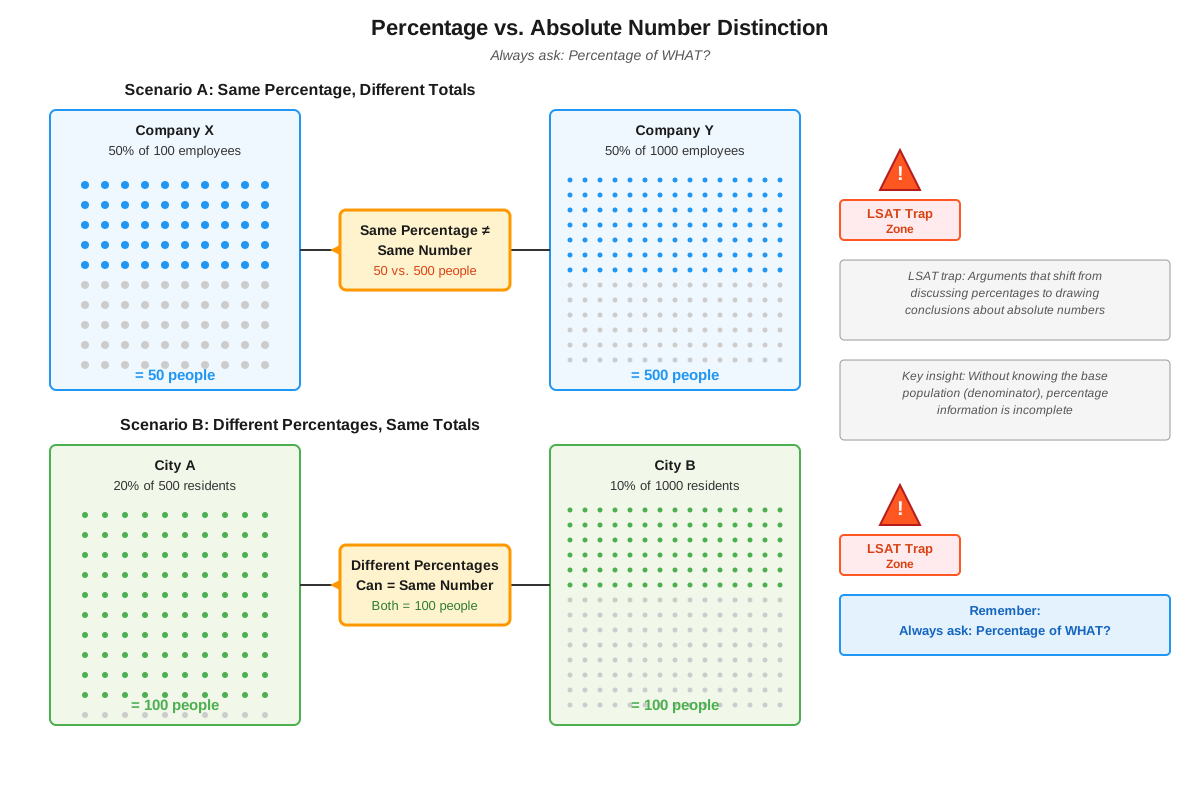
The fundamental concept underlying all LSAT percentage reasoning is the distinction between relative proportions (percentages) and absolute quantities (raw numbers). A percentage expresses a part-to-whole relationship, while an absolute number represents a specific quantity. The LSAT consistently creates arguments that confuse these two concepts or that provide information about one while drawing conclusions about the other.
Consider this relationship mathematically:
Percentage = (Part / Whole) × 100
Absolute Number = Part
An argument might state that "Company A has a higher percentage of female executives than Company B" and conclude that "Company A employs more female executives than Company B." This conclusion is invalid without knowing the total number of executives at each company. If Company A has 10 executives (50% female = 5 women) and Company B has 100 executives (30% female = 30 women), Company B actually employs more female executives despite the lower percentage.
Base Rate Neglect
Base rate neglect occurs when an argument compares percentages across populations of different sizes without accounting for how the size difference affects the interpretation. This is one of the most common flaws in LSAT percentage questions. The error involves treating percentage comparisons as meaningful without considering whether the underlying populations are comparable.
For example: "City X saw a 50% increase in traffic accidents this year, while City Y saw only a 10% increase. Therefore, City X's roads became much more dangerous than City Y's roads." This reasoning neglects that City X might have started with 10 accidents (increasing to 15) while City Y started with 1,000 accidents (increasing to 1,100). The absolute increase in City Y is far larger, and the roads might actually be more dangerous there despite the smaller percentage increase.
Percentage Change vs. Absolute Change
Arguments frequently shift between discussing percentage changes and absolute changes without acknowledging that these are distinct concepts. A percentage change describes how much a value has increased or decreased relative to its starting point, while an absolute change describes the raw numerical difference.
| Concept | Definition | Example |
|---|---|---|
| Percentage Change | (New Value - Old Value) / Old Value × 100 | Sales increased from 100 to 150 units = 50% increase |
| Absolute Change | New Value - Old Value | Sales increased by 50 units |
| Percentage Point Change | Difference between two percentages | Market share increased from 20% to 25% = 5 percentage point increase |
The LSAT exploits confusion between percentage changes and percentage point changes. If a company's market share increases from 20% to 25%, this is a 5 percentage point increase but a 25% relative increase (5/20 = 0.25). Arguments that conflate these concepts contain reasoning errors.
The Missing Denominator Problem
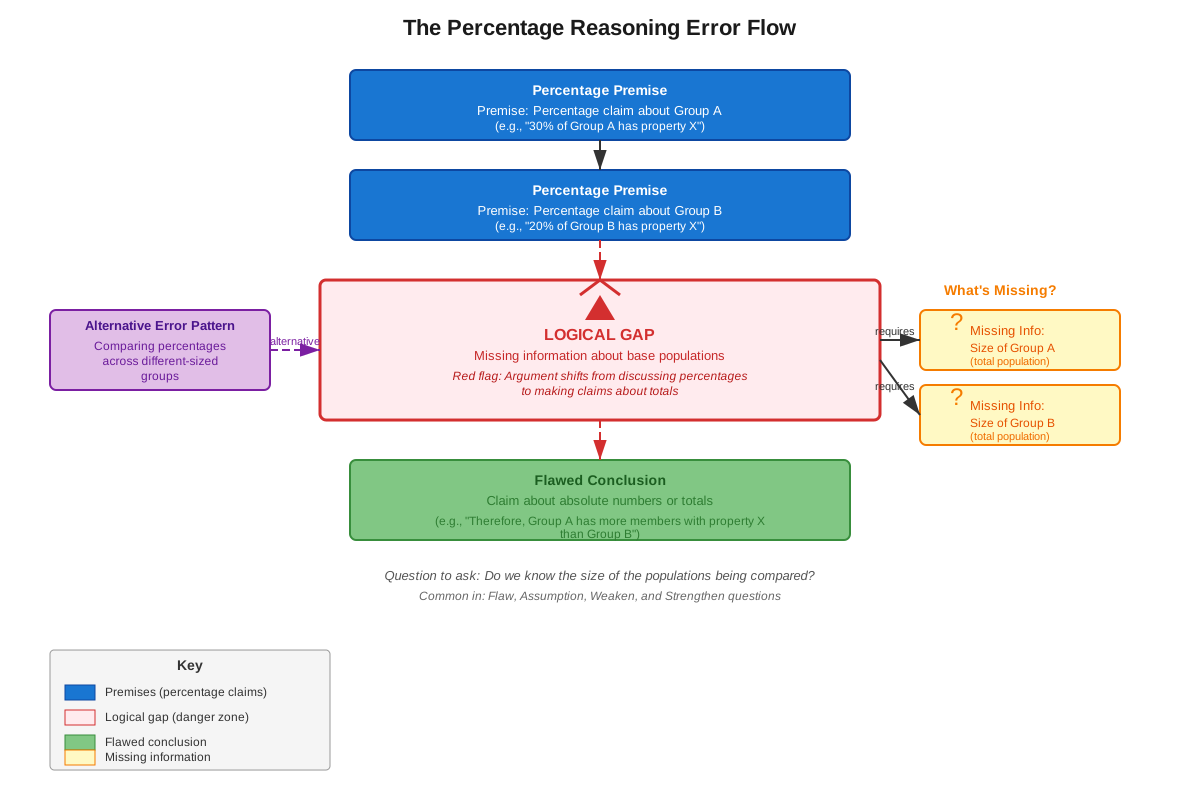
Many LSAT percentage arguments commit the missing denominator flaw by providing information about percentages without specifying the total population size (the denominator). Without knowing the denominator, it's impossible to calculate absolute numbers or make meaningful comparisons.
For instance: "In 2020, 60% of applicants were accepted to Program A, while only 40% were accepted to Program B. Therefore, Program A accepted more applicants than Program B." This conclusion requires knowing how many people applied to each program. If 100 people applied to Program A (60 accepted) and 500 applied to Program B (200 accepted), Program B actually accepted more applicants despite the lower acceptance rate.
Percentage of Different Wholes
A sophisticated percentage error involves comparing percentages that are calculated from different base populations (different "wholes"). The LSAT creates arguments that treat these percentages as directly comparable when they are not.
Example structure: "In 2010, 30% of Company X's revenue came from Product A. In 2020, only 20% of Company X's revenue came from Product A. Therefore, sales of Product A declined." This reasoning is flawed because if Company X's total revenue doubled between 2010 and 2020, Product A's absolute sales could have increased even as its percentage of total revenue decreased.
Survivor Bias in Percentages
Survivor bias occurs when percentage calculations are based on a subset of a population that has been filtered in some way, making the percentage unrepresentative of the original whole. LSAT arguments sometimes present percentages calculated from a surviving or selected group and draw conclusions about a broader population.
For example: "Among students who completed the advanced program, 80% passed the certification exam. Therefore, the program is highly effective at preparing students for certification." This reasoning fails to account for students who dropped out of the program. If only the most capable students completed the program, the 80% pass rate might not reflect the program's effectiveness for all students who enrolled.
Temporal Percentage Comparisons
Arguments comparing percentages across different time periods must account for changes in the underlying population. The LSAT frequently presents arguments that compare percentages from different years without acknowledging that the total population may have changed, making the comparison misleading.
Structure: "In 1990, 5% of residents owned electric cars. In 2020, 15% owned electric cars. Therefore, electric car ownership tripled." While the percentage tripled, if the total population also changed significantly, the absolute increase might be much larger or smaller than "tripling" suggests. Additionally, this confuses a percentage point increase (10 points) with a relative percentage increase (200% increase from the original 5%).
Concept Relationships
The core concepts in percentage reasoning form an interconnected logical framework. The percentage-number distinction serves as the foundation for all other concepts—every percentage error ultimately involves confusing relative proportions with absolute quantities or failing to account for the relationship between them.
Base rate neglect represents a specific application of the percentage-number distinction, occurring when arguments compare percentages without considering the different denominators (base populations) from which those percentages are calculated. This connects directly to the missing denominator problem, which identifies the specific information gap that makes percentage-based conclusions invalid.
The relationship flows as follows:
Percentage-Number Distinction → Missing Denominator Problem → Base Rate Neglect → Invalid Comparisons
Percentage change vs. absolute change represents a parallel application of the fundamental distinction, focusing on how values change over time rather than how they compare across populations. This concept connects to temporal percentage comparisons, which adds the complexity of changing base populations over time.
Percentage of different wholes synthesizes multiple concepts: it involves both the missing denominator problem (not knowing the size of each "whole") and base rate neglect (not accounting for different population sizes). Survivor bias adds a sampling dimension, introducing the idea that the denominator itself might be systematically biased.
All these concepts connect to the prerequisite knowledge of quantifiers from formal logic. Percentages are precise quantifiers (e.g., "60%" is more specific than "most"), and the same logical principles that govern quantifier interpretation apply to percentage reasoning. The connection to conditional logic appears when arguments make conditional claims based on percentage evidence (e.g., "If the percentage increased, then the absolute number increased"), which are often invalid without additional information.
High-Yield Facts
⭐ A higher percentage does not necessarily mean a higher absolute number—the total population size (denominator) determines the absolute quantity.
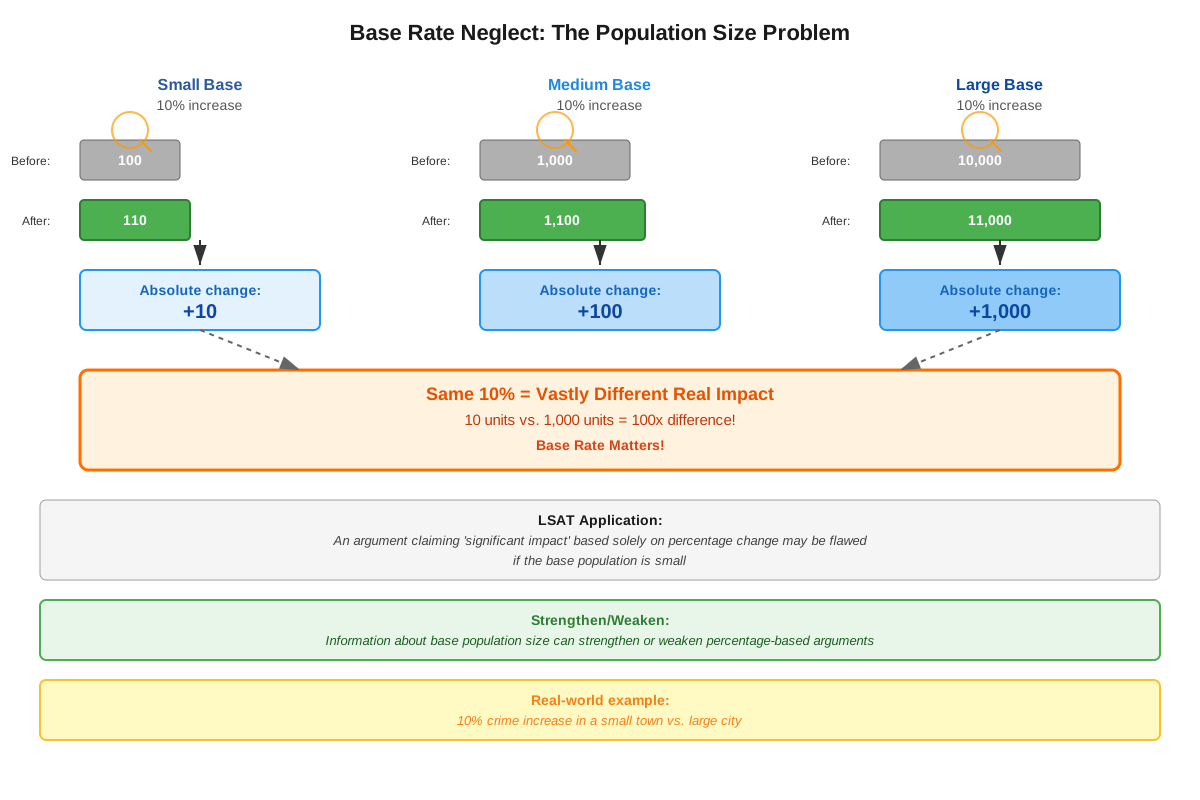
⭐ Percentage changes and absolute changes are distinct concepts—a large percentage change can represent a small absolute change if the starting value is small.
⭐ Comparing percentages across different-sized populations without accounting for the size difference is a logical flaw—this is base rate neglect.
⭐ A percentage increase in one category does not mean the absolute number in that category increased—the total population might have decreased.
⭐ Percentage point changes differ from relative percentage changes—an increase from 20% to 30% is a 10 percentage point increase but a 50% relative increase.
- When an argument provides only percentages without denominators, it cannot validly conclude anything about absolute numbers.
- If a percentage of total revenue/budget/population changes, this could result from changes in the numerator, denominator, or both.
- Survivor bias makes percentages calculated from filtered populations unrepresentative of the original whole.
- Temporal percentage comparisons require knowing whether the base population remained constant over time.
- An increase in percentage can coincide with a decrease in absolute numbers if the total population decreased substantially.
- Percentages from different wholes (e.g., 30% of Company A's revenue vs. 30% of Company B's revenue) cannot be directly compared without knowing the size of each whole.
- The same absolute change represents different percentage changes depending on the starting value (10 to 20 is 100% increase; 100 to 110 is 10% increase).
Quick check — test yourself on Percentages in logic so far.
Try Flashcards →Common Misconceptions
Misconception: If the percentage increased, the absolute number must have increased. → Correction: The absolute number depends on both the percentage and the total population size. If the total population decreased significantly, the absolute number could decrease even as the percentage increases. For example, if 10% of 1,000 people (100 people) becomes 20% of 400 people (80 people), the percentage doubled but the absolute number decreased.
Misconception: A larger percentage change always represents a more significant change than a smaller percentage change. → Correction: The significance of a percentage change depends on the starting value and context. A 100% increase from 2 to 4 is less significant in absolute terms than a 10% increase from 1,000 to 1,100, even though the percentage change is larger in the first case.
Misconception: If two groups have the same percentage, they have the same absolute number. → Correction: The same percentage of different-sized populations yields different absolute numbers. 50% of 100 (50) is very different from 50% of 1,000 (500), even though both are 50%.
Misconception: Percentage point changes and relative percentage changes are the same thing. → Correction: These are distinct concepts. An increase from 25% to 50% is a 25 percentage point increase but a 100% relative increase (the value doubled). The LSAT exploits this confusion by using language like "increased by 25%" when describing a change from 25% to 50%, which could mean either interpretation.
Misconception: If a percentage of a total decreases, the absolute amount in that category must have decreased. → Correction: The absolute amount could have increased, decreased, or stayed the same. If the total increased substantially, a category could grow in absolute terms while shrinking as a percentage of the larger total. For example, if Product A sales increase from 100 to 150 units, but total company sales increase from 500 to 1,000 units, Product A's percentage of sales decreased from 20% to 15% even though absolute sales increased.
Misconception: Comparing percentages across different populations is always valid. → Correction: Percentage comparisons are only meaningful when the populations are comparable in size or when the argument accounts for size differences. Comparing a 10% increase in a population of 10 to a 5% increase in a population of 10,000 without acknowledging the base rate difference is misleading.
Misconception: If most of Group A has property X and most of Group B has property X, then most of the combined group has property X. → Correction: This depends on the relative sizes of Groups A and B. If Group A is much smaller than Group B, and "most" means just over 50%, the combined percentage could be below 50%. For example, if 90% of 100 people (90 people) and 51% of 1,000 people (510 people) have property X, then 600 out of 1,100 total (54.5%) have property X—still "most," but the calculation depends on group sizes.
Worked Examples
Example 1: Percentage vs. Absolute Number Flaw
Argument: "Last year, 15% of Acme Corporation's employees worked in the research division. This year, 25% work in research. Therefore, Acme hired more research employees this year."
Question: Which of the following, if true, most weakens the argument?
Analysis:
Step 1: Identify the reasoning pattern. The argument moves from a premise about percentages (15% to 25%) to a conclusion about absolute numbers (more research employees were hired).
Step 2: Recognize the flaw. This is a classic percentage-number distinction error. The conclusion about absolute numbers requires knowing the total number of employees, which isn't provided. The percentage could increase while the absolute number decreases if total employment decreased.
Step 3: Determine what would weaken the argument. Information showing that the absolute number of research employees did not increase would weaken the conclusion. This could happen if total employment decreased substantially.
Step 4: Evaluate answer choices (hypothetical):
- (A) "Acme's total workforce decreased by 60% this year." ← CORRECT. If the workforce decreased by 60%, then even though the percentage in research increased from 15% to 25%, the absolute number likely decreased. For example: 15% of 1,000 = 150 employees; 25% of 400 = 100 employees. The percentage increased but absolute numbers decreased.
- (B) "Research employees received higher salaries this year." ← Irrelevant to whether more research employees were hired.
- (C) "Other divisions also expanded their workforce." ← This would strengthen the argument by suggesting overall growth.
- (D) "The research division became more important to company strategy." ← Explains why the percentage might have increased but doesn't address whether absolute numbers increased.
Connection to Learning Objectives: This example demonstrates how to identify percentage reasoning in LSAT questions (Objective 1), explains the percentage-number distinction pattern (Objective 2), and shows how to apply this knowledge to eliminate wrong answers and select the correct one (Objective 3).
Example 2: Base Rate Neglect
Argument: "City Hospital reported that 8% of its patients experienced post-surgical complications last year, while County Hospital reported a 12% complication rate. Therefore, patients are safer receiving surgery at City Hospital than at County Hospital."
Question: The reasoning in the argument is flawed because it fails to consider which of the following?
Analysis:
Step 1: Identify the reasoning structure. The argument compares complication rates (percentages) across two hospitals and concludes that one hospital is safer based solely on the lower percentage.
Step 2: Recognize the flaw. This involves base rate neglect and potentially survivor bias. The argument doesn't account for: (a) the total number of surgeries performed at each hospital, (b) the types of surgeries performed (more complex surgeries naturally have higher complication rates), or (c) the severity of patients' conditions before surgery.
Step 3: Identify missing information. To validly conclude that City Hospital is safer, we need to know that the hospitals perform comparable types of surgeries on comparable patient populations. The percentage alone is insufficient.
Step 4: Evaluate answer choices (hypothetical):
- (A) "County Hospital performs a higher proportion of high-risk surgeries than City Hospital." ← CORRECT. This identifies a crucial difference in the base populations being compared. If County Hospital takes on more difficult cases, its higher complication rate might reflect the patient population rather than inferior care. The hospitals aren't comparable, making the percentage comparison misleading.
- (B) "City Hospital has more experienced surgeons." ← This would explain the difference but doesn't identify the flaw in reasoning.
- (C) "Both hospitals have implemented new safety protocols." ← Irrelevant to the comparison between them.
- (D) "City Hospital performed fewer total surgeries than County Hospital." ← While this relates to base rates, the absolute number of surgeries doesn't necessarily affect the validity of comparing complication rates, unless it's connected to the types of surgeries or patient populations.
Connection to Learning Objectives: This example shows how base rate neglect appears in LSAT questions, demonstrates the reasoning pattern of invalid percentage comparisons across non-comparable populations, and illustrates how to identify the necessary missing information that would make the argument valid.
Exam Strategy
When approaching LSAT questions involving percentages, follow this systematic process:
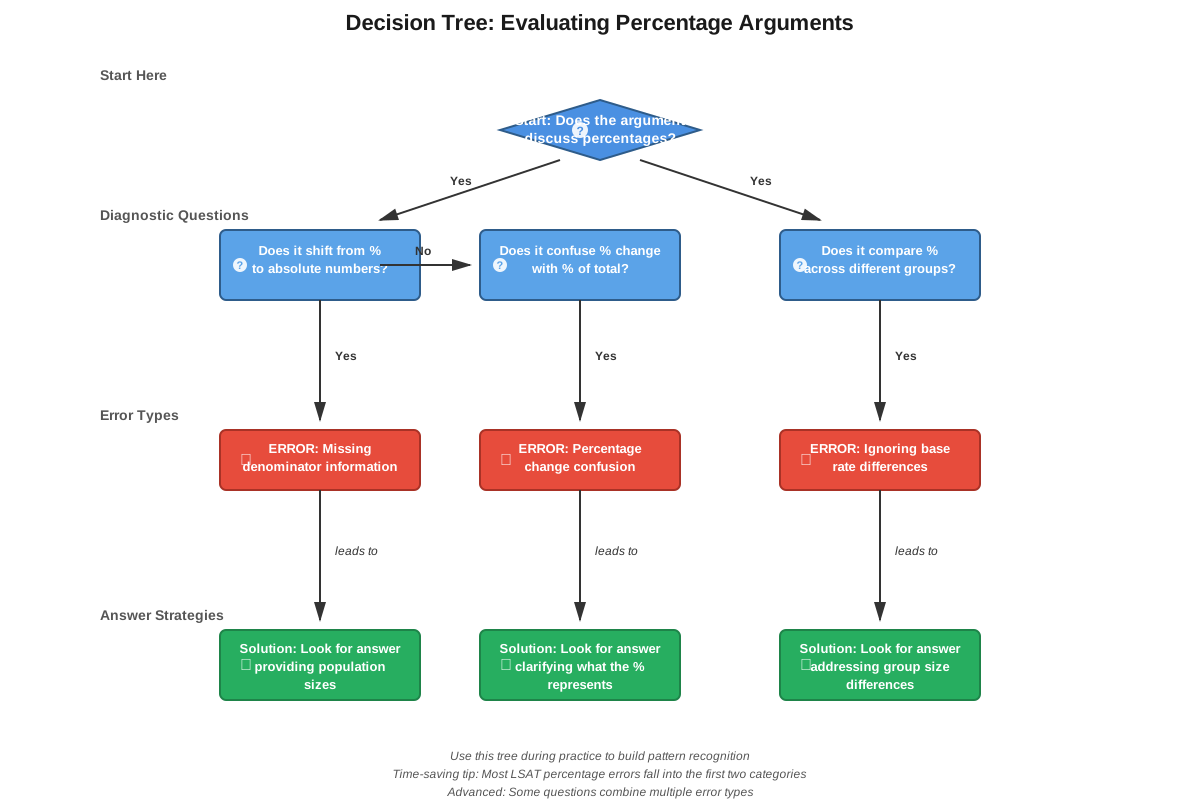
Step 1: Identify percentage language. Watch for trigger words and phrases: "percent," "percentage," "rate," "proportion," "ratio," "share of," "fraction of," or comparative terms like "higher rate," "increased from X% to Y%," or "twice as likely." These signal that percentage reasoning is central to the question.
Step 2: Distinguish percentages from absolute numbers. As you read the argument, mentally label each piece of information as either a percentage (relative proportion) or an absolute number (raw quantity). Note when the argument shifts between these concepts, especially when the conclusion discusses one type while the premises discuss the other.
Step 3: Identify the denominator. For every percentage mentioned, ask: "Percentage of what?" Identify the base population (denominator). If the argument compares percentages, check whether they're calculated from the same base population or different ones. If the denominator isn't specified, this is likely the key to the question.
Step 4: Check for temporal changes. If the argument compares percentages across time, determine whether the base population remained constant. A percentage increase could result from the numerator increasing, the denominator decreasing, or both changing.
Step 5: Evaluate the logical gap. Determine what additional information would be necessary to make the argument's conclusion valid. This often involves information about denominators, base population sizes, or the composition of the populations being compared.
Exam Tip: In Flaw questions, wrong answers often describe reasoning errors that aren't present in the argument. When you've identified a percentage-number distinction flaw, eliminate answers that describe other types of flaws (circular reasoning, ad hominem attacks, etc.).
Time allocation: Percentage questions typically require 1:15-1:30 to solve carefully. Don't rush—these questions reward methodical analysis. However, if you're stuck, eliminate answers that don't address the percentage-number relationship and make an educated guess.
Process of elimination strategy:
- Eliminate answers that address the wrong type of flaw (if it's a percentage question, the answer should relate to percentages, numbers, or rates)
- Eliminate answers that would strengthen rather than weaken (or vice versa, depending on the question type)
- Eliminate answers that are irrelevant to the numerical relationship in the argument
- Choose the answer that directly addresses the missing denominator or base rate issue
Memory Techniques
Mnemonic for percentage reasoning: "PANDA"
- Percentage vs. absolute number—are they different?
- Assume nothing about denominators
- Number the populations—are they the same size?
- Distinguish percentage change from absolute change
- Ask "percentage of what?"
Visualization strategy: When reading a percentage argument, visualize two circles of different sizes representing the two populations being compared. Draw mental pictures of the percentages as shaded portions of each circle. This makes it immediately obvious when the argument compares percentages from different-sized populations without accounting for the size difference.
The "Shrinking Company" scenario: Memorize this concrete example to anchor your understanding: A company goes from 1,000 employees (10% in management = 100 managers) to 500 employees (25% in management = 125 managers). The percentage of managers increased, the absolute number of managers increased, but total employment decreased. This shows that percentage and absolute changes can move in different directions depending on what happens to the denominator.
Acronym for common flaws: "BAMS"
- Base rate neglect
- Absolute vs. percentage confusion
- Missing denominator
- Survivor bias in samples
Summary
Percentages in logic represent a high-yield LSAT topic that tests whether students can distinguish between relative proportions (percentages) and absolute quantities (raw numbers). The fundamental principle is that percentages express part-to-whole relationships, and any conclusion about absolute numbers requires knowing the size of the whole (denominator). The LSAT systematically exploits common reasoning errors: assuming higher percentages mean higher absolute numbers, comparing percentages across different-sized populations without accounting for base rates, confusing percentage changes with absolute changes, and drawing conclusions from percentages without knowing the denominators. Mastering this topic requires recognizing when arguments shift between discussing percentages and numbers, identifying missing information about population sizes, and understanding that the same percentage of different wholes yields different absolute quantities. Success on percentage questions depends on methodically identifying what type of information is provided (percentage or number), what the conclusion claims, and what additional information would be necessary to bridge the logical gap. This precision in quantitative reasoning transfers to other LSAT content and reflects the analytical skills essential for legal practice.
Key Takeaways
- The percentage-number distinction is fundamental: percentages are relative proportions, while absolute numbers are specific quantities; confusing these is the most common percentage reasoning error on the LSAT
- Always identify the denominator (base population) for any percentage—without knowing "percentage of what," you cannot draw valid conclusions about absolute numbers
- Comparing percentages across different-sized populations without accounting for the size difference constitutes base rate neglect, a frequent LSAT flaw
- Percentage changes and absolute changes are distinct concepts that can move in opposite directions if the base population changes
- When an argument provides only percentages, it cannot validly conclude anything definitive about absolute numbers without additional information about denominators
- Watch for temporal comparisons that assume base populations remained constant over time—population changes can make percentage comparisons misleading
- Percentage point changes differ from relative percentage changes; the LSAT exploits confusion between these concepts in trap answers
Related Topics
Conditional Logic and Sufficient/Necessary Conditions: Percentage reasoning connects to conditional logic when arguments make conditional claims based on percentage evidence (e.g., "If most members support the policy, it will pass"). Understanding when percentages do and don't support conditional conclusions strengthens both skill areas.
Causal Reasoning: Many causal arguments incorporate percentage evidence (e.g., "The percentage of patients who recovered increased after the treatment was introduced, so the treatment caused the recovery"). Mastering percentage reasoning helps identify when percentage evidence does or doesn't support causal claims.
Survey and Study Arguments: LSAT questions about surveys and studies frequently involve percentage reasoning, particularly regarding whether sample percentages can be generalized to broader populations. This topic builds directly on percentage reasoning fundamentals.
Formal Logic Quantifiers: Percentages function as precise quantifiers (more specific than "some" or "most"). Understanding the relationship between percentage-based claims and other quantifiers deepens formal logic skills.
Practice CTA
Now that you've mastered the core concepts of percentage reasoning, it's time to apply this knowledge to actual LSAT questions. The practice questions and flashcards will reinforce your ability to quickly identify percentage reasoning patterns, spot common flaws, and select correct answers with confidence. Remember: percentage questions follow predictable patterns, and with practice, you'll recognize these patterns instantly on test day. Each practice question you complete strengthens your analytical skills and builds the automaticity needed for peak performance. Start practicing now to transform this high-yield topic into a consistent source of correct answers on your LSAT!
Sign up free to keep reading
Create a free AnvayaPrep account to finish this LSAT guide on Percentages in logic — plus flashcards and practice questions.