Overview
Proportional reasoning is a critical analytical skill tested extensively throughout the LSAT Logical Reasoning sections. This reasoning pattern involves understanding and evaluating arguments that make claims about relationships between parts and wholes, percentages and absolute numbers, or rates and totals. The LSAT frequently presents arguments that confuse these relationships, and test-takers must identify when an argument improperly shifts between proportional and absolute terms or fails to account for relevant baseline information.
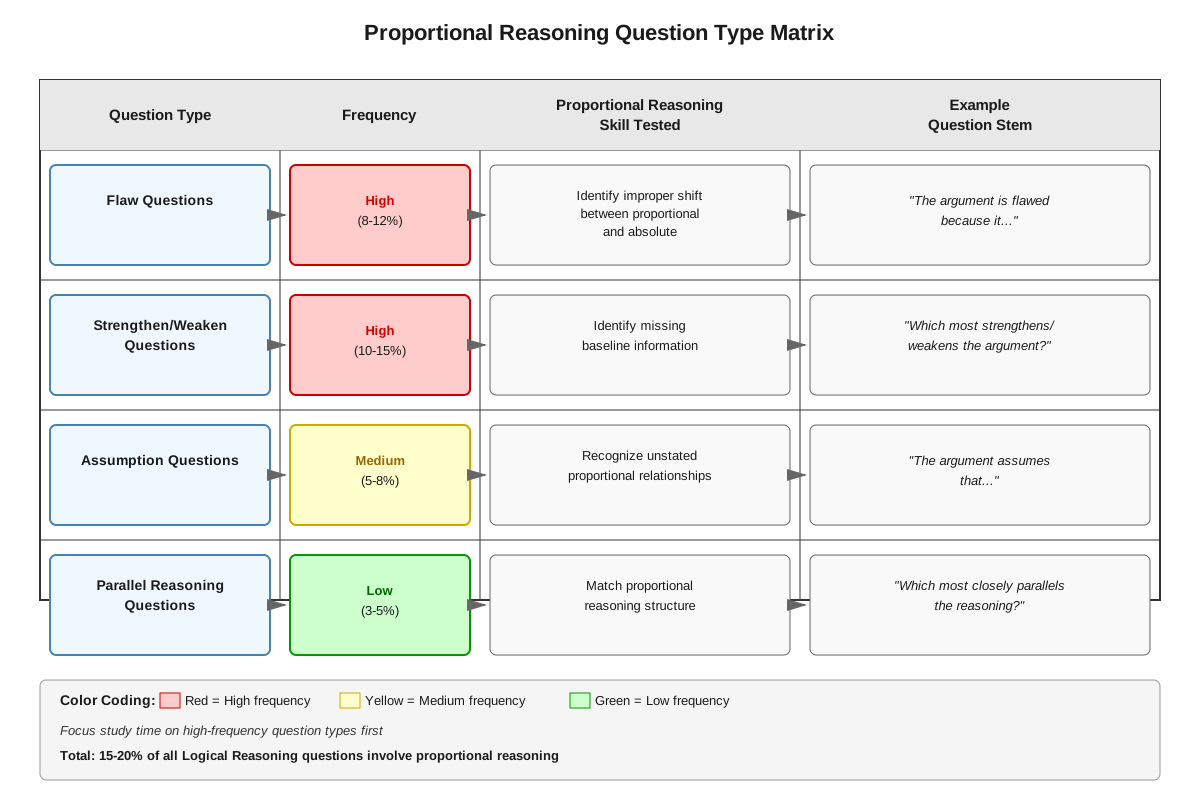
Mastering proportional reasoning is essential because it appears in approximately 15-20% of Logical Reasoning questions across both sections. These questions often involve statistical claims, survey results, comparative statements, or causal arguments where the relationship between percentages and raw numbers becomes crucial. Students who fail to recognize proportional reasoning errors consistently miss points on otherwise straightforward questions, making this topic a high-yield area for score improvement.
Within the broader framework of formal logic and quantifiers, proportional reasoning represents a specialized application of quantitative thinking. While formal logic deals with categorical statements (all, some, none), proportional reasoning extends this foundation to handle numerical relationships and comparative claims. Understanding this topic strengthens overall logical reasoning abilities and provides essential tools for evaluating the numerous LSAT arguments that rely on statistical or numerical evidence.
Learning Objectives
- [ ] Identify how Proportional reasoning appears in LSAT questions
- [ ] Explain the reasoning pattern behind Proportional reasoning
- [ ] Apply Proportional reasoning to solve LSAT-style problems accurately
- [ ] Distinguish between proportional (percentage/rate) and absolute (total number) claims in arguments
- [ ] Recognize when an argument improperly shifts between proportional and absolute terms
- [ ] Evaluate whether sufficient information exists to draw proportional conclusions from given premises
- [ ] Identify missing baseline information that would be necessary to assess proportional claims
Prerequisites
- Basic percentage and fraction concepts: Understanding how percentages relate to whole numbers is fundamental to recognizing when arguments confuse rates with totals
- Categorical logic (all, some, none statements): Proportional reasoning builds on quantifier logic by adding numerical precision to categorical claims
- Argument structure identification: Recognizing premises and conclusions is necessary before evaluating whether proportional reasoning is valid
- Basic statistical literacy: Familiarity with concepts like samples, populations, and rates helps identify when proportional claims are properly supported
Why This Topic Matters
Proportional reasoning appears throughout professional and academic contexts where data interpretation is essential. Medical professionals must understand disease prevalence rates versus absolute case numbers. Policy makers must distinguish between percentage increases in crime rates and actual crime totals. Business analysts must evaluate market share percentages against revenue figures. The LSAT tests this reasoning pattern because legal practice constantly requires attorneys to evaluate statistical evidence, interpret survey data, and assess numerical claims in arguments.
On the LSAT, proportional reasoning appears in multiple question types with significant frequency. Flaw questions commonly feature arguments that confuse percentages with absolute numbers (appearing in 8-12% of all flaw questions). Strengthen/Weaken questions often require identifying information about baseline rates or total populations (10-15% of these question types). Assumption questions may hinge on unstated premises about proportional relationships (5-8% frequency). Parallel Reasoning questions sometimes test whether students can recognize structurally similar proportional reasoning patterns across different contexts.
Common manifestations include: arguments comparing crime rates between cities without considering population differences; claims about product safety based on complaint percentages without knowing total sales; conclusions about group preferences drawn from survey percentages without considering sample sizes; and causal arguments that confuse correlation rates with absolute frequency of co-occurrence.
Core Concepts
The Proportion-Absolute Distinction
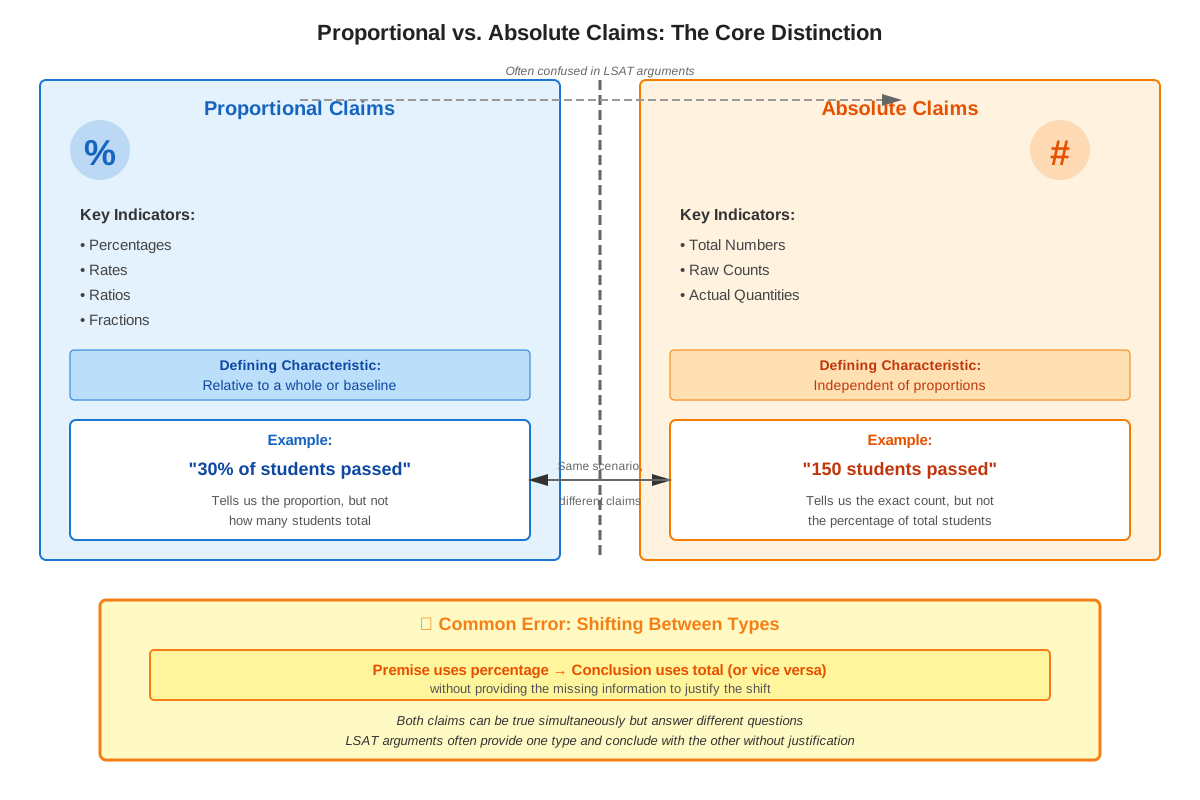
The fundamental concept in lsat proportional reasoning involves distinguishing between proportional measures (percentages, rates, ratios, fractions) and absolute measures (total numbers, raw counts, actual quantities). A proportional measure expresses a relationship between a part and a whole, while an absolute measure expresses a standalone quantity.
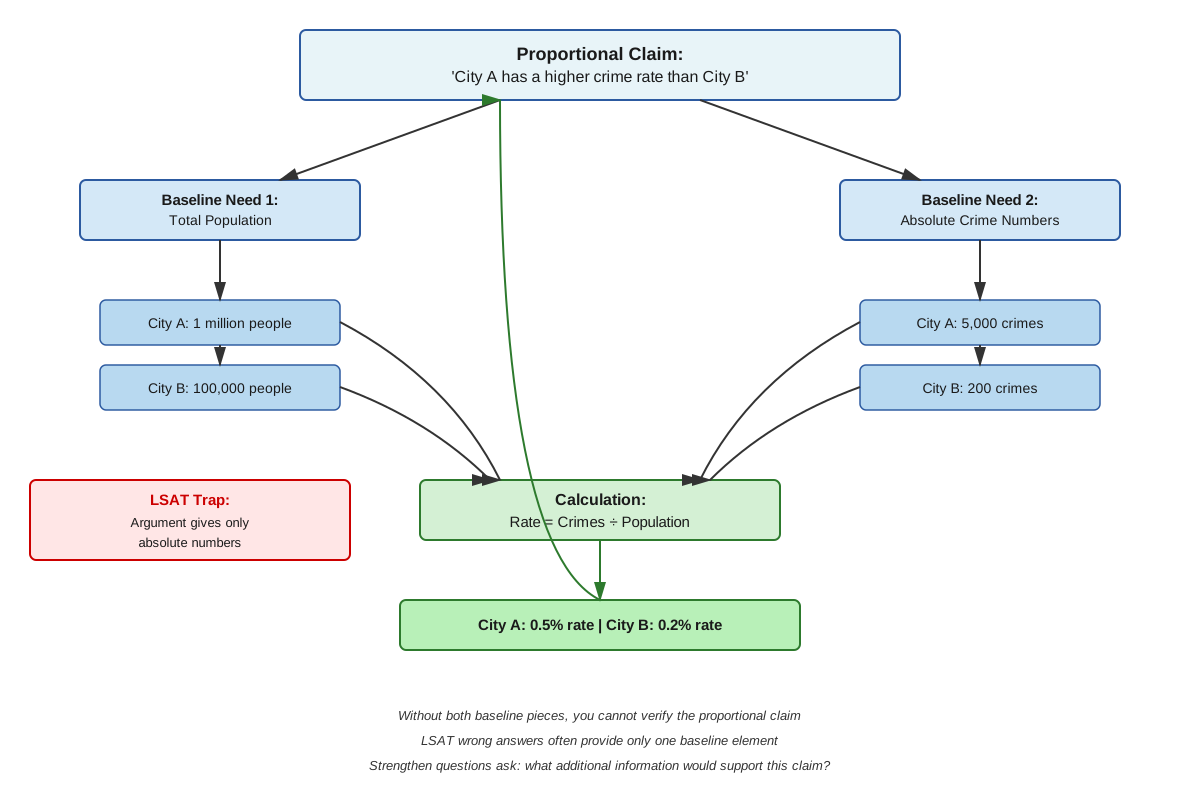
Consider this example: "City A has a higher crime rate than City B" (proportional claim) versus "City A has more crimes than City B" (absolute claim). These statements are not equivalent. City A could have a higher rate (crimes per capita) but fewer total crimes if its population is much smaller. The LSAT exploits this distinction relentlessly.
| Measure Type | Characteristics | Examples | What It Tells Us |
|---|---|---|---|
| Proportional | Relative to a whole; expressed as percentage, rate, or ratio | 15% unemployment rate; 3 accidents per 1000 drivers | Relationship between part and whole |
| Absolute | Standalone quantity; raw numbers | 500,000 unemployed people; 1,200 accidents | Total magnitude regardless of context |
The Missing Baseline Problem
Many LSAT arguments present proportional information but draw conclusions that require absolute information, or vice versa. The missing baseline represents the denominator information needed to convert between proportional and absolute measures.
For example: "Brand X toothpaste received 40% more customer complaints this year than last year. Therefore, Brand X has become less reliable." This argument assumes the baseline (total number of customers or units sold) remained constant. If Brand X doubled its market share, a 40% increase in complaints might actually represent improved reliability per unit sold.
The three critical baseline questions are:
- What is the total population or whole being measured?
- Has this total changed over time or between comparison groups?
- Is the proportional relationship being applied to comparable bases?
Proportional Shifts in Arguments
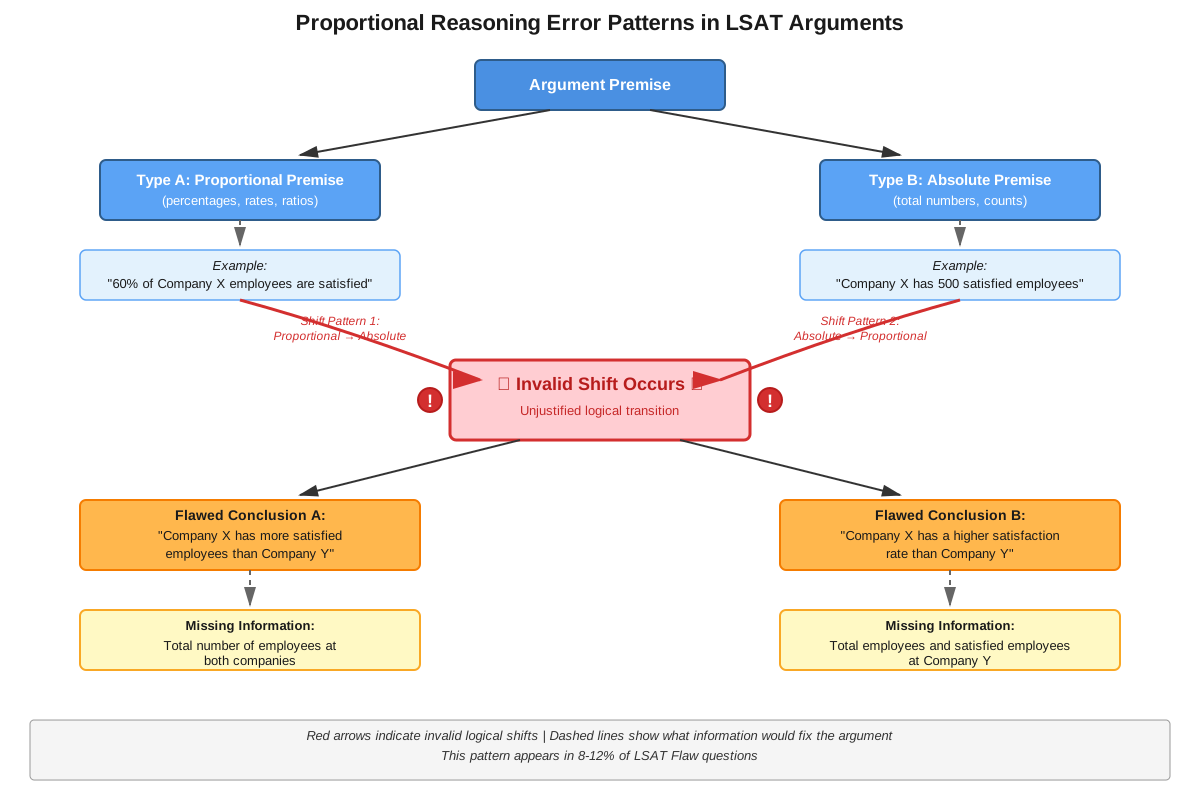
A proportional shift occurs when an argument's premises discuss one type of measure (proportional or absolute) but the conclusion relies on the other type. These shifts represent logical gaps that LSAT questions frequently exploit.
Common shift patterns:
- Percentage to absolute: "A higher percentage of Company A's employees received promotions than Company B's employees. Therefore, Company A promoted more employees." (Fails to account for company size differences)
- Absolute to percentage: "More people attended the concert this year than last year. Therefore, the concert was more popular this year." (Fails to account for population growth or ticket availability)
- Rate to total: "The accident rate on Highway 5 decreased. Therefore, fewer accidents occurred on Highway 5." (Fails to account for traffic volume changes)
- Comparison without common base: "Product A has a 2% defect rate while Product B has a 5% defect rate. Therefore, Product A has fewer defects." (Fails to account for production volume differences)
Sample Size and Representativeness
Proportional reasoning on the LSAT often involves survey data or sample-based claims. Understanding when proportions from a sample can legitimately support conclusions about a larger population is crucial.
Key considerations include:
- Sample size adequacy: A percentage from a tiny sample may not reliably predict population proportions
- Sample representativeness: The sample must reflect relevant characteristics of the target population
- Margin of error: Small percentage differences may not be meaningful given statistical uncertainty
Example: "In a survey of 10 doctors, 60% preferred Brand X. Therefore, most doctors prefer Brand X." The sample size is too small to support this generalization, even though the percentage seems substantial.
Temporal Proportional Reasoning
Many LSAT arguments involve proportional changes over time. Understanding whether percentage changes, absolute changes, or both are relevant to the conclusion is essential.
Percentage change formula context:
Percentage Change = ((New Value - Old Value) / Old Value) × 100%Critical distinction: A 50% increase from 100 to 150 requires adding 50 units. A 50% increase from 1,000 to 1,500 requires adding 500 units. The same proportional change represents vastly different absolute changes depending on the baseline.
LSAT arguments may present percentage increases while conclusions require absolute increases, or vice versa. For example: "Sales increased by 30% while costs increased by 20%. Therefore, profits increased." This conclusion is invalid without knowing the absolute values—if costs were initially much higher than sales, the company could still be losing money despite favorable percentage changes.
Comparative Proportional Claims
When arguments compare proportions between two or more groups, several logical requirements must be met for valid conclusions:
- Common measurement standard: Groups must be measured using the same criteria
- Comparable time frames: Comparisons should involve the same periods unless temporal differences are relevant
- Relevant denominators: The "whole" in each proportion must be appropriately defined
- Confounding variables: Other factors that might explain proportional differences must be considered
Example: "A higher percentage of students from School A were admitted to law school than students from School B. Therefore, School A provides better preparation for law school." This argument fails to consider that School A students might have been stronger candidates initially, regardless of the school's preparation quality.
Concept Relationships
The core concepts in proportional reasoning form an interconnected logical framework. The proportion-absolute distinction serves as the foundation, establishing the two fundamental categories of numerical claims. This distinction directly enables recognition of proportional shifts, which occur when arguments move between these categories without justification.
The missing baseline problem represents the specific information gap that makes proportional shifts invalid. When an argument shifts from percentage to absolute claims (or vice versa), the missing baseline is precisely what would be needed to make that shift legitimate. For example, knowing that "40% of students passed" (proportional) cannot tell us "how many students passed" (absolute) without the baseline of total students.
Sample size and representativeness concepts connect to the proportion-absolute distinction by addressing when proportions from a subset can validly represent proportions in a larger whole. This relationship extends proportional reasoning from simple part-whole relationships to statistical inference contexts.
Temporal proportional reasoning integrates all previous concepts by adding a time dimension. Temporal arguments may involve proportional shifts across time periods, missing baselines about how totals changed, or invalid comparisons between non-comparable time frames.
Comparative proportional claims synthesize these concepts by requiring simultaneous attention to multiple proportions, their respective baselines, and the validity of comparing them. Comparative arguments often combine proportional shifts with missing baseline problems.
Relationship map:
Proportion-Absolute Distinction → enables identification of → Proportional Shifts → which require → Missing Baseline Information → extends to → Sample-Population Relationships → adds dimension of → Temporal Changes → culminates in → Complex Comparative Claims
High-Yield Facts
⭐ A higher percentage does not necessarily mean a higher absolute number—the total population size determines the relationship between proportional and absolute measures.
⭐ When an argument shifts from discussing percentages to drawing conclusions about totals (or vice versa), look for the missing baseline information as the logical gap.
⭐ Percentage increases are calculated relative to the starting value—a 50% increase followed by a 50% decrease does not return to the original value.
⭐ Comparing rates or percentages between groups requires that the groups be measured using comparable standards and time frames.
⭐ A decrease in rate does not necessarily mean a decrease in absolute numbers if the total population or base increased sufficiently.
- Sample percentages only reliably represent population percentages when the sample is sufficiently large and representative of the population.
- Two groups can have the same percentage but vastly different absolute numbers if their total populations differ.
- An increase in both percentage and absolute numbers does not establish causation—both could result from a third factor.
- When evaluating proportional claims about subgroups, the composition and size of each subgroup matters for drawing valid conclusions.
- Arguments that compare "more" or "less" without specifying whether they mean proportionally or absolutely are ambiguous and potentially flawed.
- Proportional reasoning errors are especially common in arguments involving surveys, statistics, risk assessments, and comparative effectiveness claims.
Quick check — test yourself on Proportional reasoning so far.
Try Flashcards →Common Misconceptions
Misconception: If a percentage increased, the absolute number must have increased as well.
Correction: A percentage can increase while the absolute number decreases if the total population (denominator) decreased even more dramatically. For example, if a company had 100 employees with 10 managers (10%), then downsized to 20 employees with 5 managers (25%), the percentage of managers increased while the absolute number decreased.
Misconception: Comparing percentages between groups automatically tells you which group has more in absolute terms.
Correction: Percentages only indicate relative proportions within each group. Group A could have a lower percentage but a higher absolute number if Group A's total population is sufficiently larger. For instance, 30% of 1,000 (300) is more than 60% of 400 (240).
Misconception: If an argument mentions both percentages and numbers, it must be using proportional reasoning correctly.
Correction: Simply including both types of measures does not guarantee valid reasoning. The argument must properly connect the proportional and absolute claims with appropriate baseline information. Many flawed arguments mention both types of measures while still making invalid inferences.
Misconception: A small percentage always means a small absolute number.
Correction: A small percentage of a very large population can represent a substantial absolute number. For example, 0.1% of 10 million people is 10,000 people—a small proportion but a large absolute quantity.
Misconception: When two percentages are given, you can always calculate the relevant absolute numbers.
Correction: Without knowing at least one absolute number (baseline), you cannot convert percentages to absolute values. For example, knowing that "60% of Group A and 40% of Group B" support a policy tells you nothing about absolute numbers of supporters without knowing the sizes of Groups A and B.
Misconception: Proportional reasoning only matters in questions explicitly about statistics or mathematics.
Correction: Proportional reasoning appears in diverse LSAT contexts including causal arguments, policy recommendations, scientific reasoning, and comparative evaluations. Any argument involving "more," "less," "increased," "decreased," or comparative terms may involve proportional reasoning issues.
Worked Examples
Example 1: Identifying a Proportional Shift Flaw
Question Stem: "The reasoning in the argument is flawed in that it..."
Argument: "Last year, 15% of the cars sold by Dealer A were electric vehicles, while only 10% of the cars sold by Dealer B were electric vehicles. Therefore, Dealer A sold more electric vehicles than Dealer B last year."
Analysis:
Step 1: Identify the premise type—The premises provide proportional information (percentages of total sales).
Step 2: Identify the conclusion type—The conclusion makes an absolute claim (more electric vehicles in total).
Step 3: Recognize the shift—The argument shifts from proportional premises to an absolute conclusion.
Step 4: Identify the missing information—We need to know the total number of cars each dealer sold. If Dealer B sold vastly more cars overall, 10% of Dealer B's sales could exceed 15% of Dealer A's sales.
Step 5: Articulate the flaw—The argument fails to consider that Dealer B might have sold significantly more cars overall, which would mean that even a smaller percentage could represent a larger absolute number of electric vehicles.
Correct answer pattern: "fails to consider that a smaller proportion of a larger whole can be greater than a larger proportion of a smaller whole" or "treats evidence about the proportion of each dealer's sales as though it were evidence about the absolute number of sales."
Connection to learning objectives: This example demonstrates how to identify proportional reasoning in LSAT questions (Objective 1), explains the reasoning pattern of proportional shifts (Objective 2), and shows how to apply this understanding to identify flaws (Objective 3).
Example 2: Evaluating a Temporal Proportional Argument
Question Stem: "Which one of the following, if true, most strengthens the argument?"
Argument: "The percentage of traffic accidents involving teenage drivers decreased from 18% to 15% over the past five years. This shows that teenage driver safety programs have been effective."
Analysis:
Step 1: Identify what's given—We know the percentage of accidents involving teenagers decreased.
Step 2: Identify the conclusion—The programs were effective (implying teenage driving became safer).
Step 3: Identify potential gaps—The percentage could decrease for reasons unrelated to teenage driver safety:
- If total accidents increased dramatically while teenage accidents stayed constant
- If the teenage population decreased relative to the overall driving population
- If teenagers drove fewer miles
Step 4: Determine what would strengthen—Information showing that the decrease in percentage reflects actual improvement in teenage driving safety, not just demographic or other changes.
Step 5: Evaluate answer choices for baseline information:
Strong answer: "The total number of traffic accidents remained approximately constant over the five-year period." (This eliminates the possibility that the percentage decreased only because total accidents increased, confirming that teenage accidents actually decreased in absolute terms.)
Also strong: "The number of teenage drivers increased by 20% during the five-year period." (This shows that despite more teenage drivers, their accident percentage decreased, strongly suggesting improved safety.)
Weak answer: "Teenage drivers now receive more training than five years ago." (This might explain why safety improved but doesn't address whether the percentage decrease reflects actual safety improvement or just demographic changes.)
Connection to learning objectives: This example shows how proportional reasoning appears in strengthen questions (Objective 1), demonstrates the reasoning pattern of temporal proportional changes (Objective 2), and illustrates how to apply proportional reasoning to evaluate answer choices (Objective 3). It also addresses the learning objective about identifying missing baseline information (Objective 6).
Exam Strategy
Recognition Triggers
Watch for these trigger words and phrases that signal proportional reasoning issues:
- Percentage terms: "percent," "rate," "proportion," "ratio," "fraction"
- Comparative terms: "more," "less," "higher," "lower," "increased," "decreased"
- Statistical language: "survey," "study," "data show," "statistics indicate"
- Temporal comparisons: "this year compared to last year," "over time," "trend"
- Group comparisons: "Group A versus Group B," "compared to," "relative to"
Systematic Approach
When you identify a proportional reasoning question, follow this process:
- Categorize each claim (2-3 seconds): Mark whether each premise and the conclusion involves proportional or absolute measures.
- Check for shifts (3-5 seconds): Determine whether the argument moves from one type of measure to another.
- Identify the baseline (5-7 seconds): Ask "What total, population, or denominator information would I need to evaluate this argument?"
- Predict the answer (5-10 seconds): Before looking at choices, articulate the flaw or the type of information needed.
- Eliminate and confirm (10-15 seconds): Remove answers that don't address the proportional reasoning issue, then verify your selection addresses the specific gap you identified.
Process of Elimination Tips
Eliminate answers that:
- Discuss irrelevant proportional relationships (e.g., addressing percentages of a different group than the argument discusses)
- Provide absolute numbers when the gap requires proportional information, or vice versa
- Address the wrong baseline (e.g., providing information about Group A's total when the gap concerns Group B's total)
- Introduce new proportional comparisons without addressing the existing gap
Favor answers that:
- Explicitly address the relationship between proportional and absolute measures
- Provide the specific baseline information needed to evaluate the argument
- Use language like "proportion of a larger/smaller whole" or "percentage versus absolute number"
- Connect the proportional claim in the premises to the type of claim in the conclusion
Time Allocation
Proportional reasoning questions typically require 60-90 seconds:
- 15-20 seconds: Read and understand the argument
- 10-15 seconds: Identify the proportional reasoning pattern
- 10-15 seconds: Predict the answer or identify the gap
- 25-40 seconds: Evaluate answer choices
If you're spending more than 90 seconds, you may be overcomplicating the analysis. Proportional reasoning questions usually hinge on one clear shift or missing baseline—identify that single issue and move forward.
Exam Tip: In Flaw questions, wrong answers often describe real logical errors but not the specific error in the argument. An answer describing a proportional reasoning flaw is only correct if the argument actually commits that specific proportional reasoning error.
Memory Techniques
The "PART-WHOLE" Mnemonic
Percentages need Populations
Absolutes need Actual numbers
Rates require Reference to totals
Trends need Time-consistent baselines
Watch for shifts
Hunt the baseline
Observe what's missing
Link proportions to totals
Evaluate comparability
Visualization Strategy
Picture proportional reasoning as a fraction with two levels:
    PART (numerator) ← What the percentage describes
    ─────────────────
    WHOLE (denominator) ← The baseline/total
When an argument gives you only the top (percentage) but draws conclusions requiring the bottom (absolute numbers), visualize the missing denominator. When comparing two fractions, visualize whether the denominators are comparable.
The "Same Percentage, Different Story" Reminder
Memorize this concrete example to quickly recall the core concept:
- 10% of 100 = 10
- 10% of 1,000 = 100
Same percentage, ten-fold difference in absolute numbers. When you see percentage comparisons, mentally flash to this example to remember that percentages alone don't determine absolute quantities.
Acronym for Common Flaws: "SHIFT"
Sample size ignored
Higher percentage ≠ higher total
Increase in rate ≠ increase in number
Fails to consider baseline changes
Temporal changes in denominator overlooked
Summary
Proportional reasoning on the LSAT centers on the critical distinction between proportional measures (percentages, rates, ratios) and absolute measures (total numbers, raw quantities). The most common error pattern involves arguments that shift between these measure types without providing the necessary baseline information to justify the shift. A higher percentage does not guarantee a higher absolute number unless the totals being compared are equal or the relationship between totals is known. Similarly, changes in rates over time do not necessarily reflect changes in absolute numbers if the underlying population changed. LSAT questions exploit these gaps by presenting arguments with proportional premises and absolute conclusions (or vice versa), requiring test-takers to identify the missing baseline information or recognize the invalid shift. Mastering this topic requires developing the habit of immediately categorizing numerical claims as proportional or absolute, checking whether arguments shift between these categories, and identifying what baseline information would be necessary to evaluate the argument's validity.
Key Takeaways
- Proportional reasoning questions require distinguishing between percentages/rates (proportional) and total numbers (absolute)—these are not interchangeable without baseline information
- The most common flaw is the proportional shift: premises discuss one type of measure while the conclusion requires the other type
- Always ask "What is the total/baseline?" when evaluating proportional claims—missing denominator information is the typical logical gap
- A higher percentage in Group A versus Group B does not mean Group A has more in absolute terms unless both groups are the same size
- Temporal proportional arguments require checking whether the baseline (total population, denominator) remained constant over time
- Sample-based proportional claims require adequate sample size and representativeness to support conclusions about larger populations
- On the LSAT, proportional reasoning appears across multiple question types, especially Flaw, Strengthen/Weaken, and Assumption questions
Related Topics
Causal Reasoning: Proportional reasoning frequently intersects with causal arguments when statistical correlations are presented as evidence for causal relationships. Understanding proportional reasoning strengthens the ability to evaluate whether correlation data actually supports causal conclusions.
Necessary and Sufficient Conditions: While proportional reasoning deals with numerical relationships, necessary and sufficient conditions involve logical relationships. Both require precise thinking about what information is required to draw valid conclusions.
Survey and Study Reasoning: This advanced topic builds directly on proportional reasoning by adding layers of complexity about sampling methodology, study design, and statistical significance. Mastering proportional reasoning is essential before tackling these more complex statistical arguments.
Quantifier Logic: Understanding "all," "some," "most," and "none" provides the foundation for proportional reasoning, which adds numerical precision to these categorical quantifiers.
Comparison and Analogy: Many comparison arguments involve proportional reasoning when they compare rates, percentages, or relative measures between different contexts or time periods.
Practice CTA
Now that you understand the core principles of proportional reasoning, it's time to cement this knowledge through active practice. Attempt the practice questions associated with this topic, focusing on identifying proportional shifts and missing baseline information in each argument. Use the flashcards to reinforce the key distinctions between proportional and absolute measures until recognizing these patterns becomes automatic. Remember: proportional reasoning appears in 15-20% of Logical Reasoning questions, making this one of the highest-yield topics for score improvement. Every question you master in this area directly translates to points on test day. Approach each practice problem systematically using the strategies outlined above, and you'll develop the pattern recognition skills that separate top scorers from the rest.
Sign up free to keep reading
Create a free AnvayaPrep account to finish this LSAT guide on Proportional reasoning — plus flashcards and practice questions.