Overview
Quantifier diagrams are visual representations that help test-takers translate and analyze statements involving quantifiers—words like "all," "some," "none," and "most"—into clear, logical structures. These diagrams form a cornerstone of formal logic and quantifiers on the LSAT, particularly within the Logical Reasoning sections where understanding the precise relationships between categories is essential for success. By converting complex verbal statements into simple visual formats, quantifier diagrams enable students to quickly identify valid inferences, spot logical flaws, and eliminate incorrect answer choices with confidence.
The LSAT frequently tests the ability to recognize and manipulate quantified statements, making lsat quantifier diagrams an indispensable tool for achieving a competitive score. Questions involving formal logic appear not only in standalone Logical Reasoning questions but also underpin many argument structure, assumption, and inference questions. Without a systematic approach to diagramming quantifiers, students often fall prey to subtle logical traps, confuse sufficient and necessary conditions, or fail to recognize when an inference is invalid. Mastering quantifier diagrams transforms these challenging questions into straightforward, mechanical exercises.
Within the broader landscape of LSAT Logical Reasoning, quantifier diagrams connect directly to conditional reasoning, argument structure analysis, and inference questions. They provide the foundational framework for understanding how categories relate to one another and how information flows through logical chains. This topic serves as a bridge between basic conditional logic and more complex reasoning patterns, making it essential for students aiming to maximize their performance across all Logical Reasoning question types.
Learning Objectives
- [ ] Identify how quantifier diagrams appear in LSAT questions
- [ ] Explain the reasoning pattern behind quantifier diagrams
- [ ] Apply quantifier diagrams to solve LSAT-style problems accurately
- [ ] Translate verbal quantified statements into accurate visual diagrams within 30 seconds
- [ ] Recognize invalid inferences from quantified statements and explain why they fail
- [ ] Combine multiple quantified statements to derive valid conclusions through diagram chaining
Prerequisites
- Basic conditional logic notation: Understanding "if-then" statements and their contrapositives is essential because quantifier diagrams build upon conditional relationships between categories
- Set theory fundamentals: Familiarity with the concepts of sets, subsets, and overlapping categories enables visualization of how quantifiers describe relationships between groups
- Logical operators: Knowledge of negation, conjunction, and disjunction provides the foundation for understanding how quantifiers interact with logical statements
- LSAT question structure: General familiarity with Logical Reasoning question formats helps contextualize when and how to deploy quantifier diagrams strategically
Why This Topic Matters
Quantifier diagrams represent one of the highest-yield study investments for LSAT preparation. Research on LSAT question distribution indicates that approximately 15-20% of Logical Reasoning questions directly involve quantified statements, with many additional questions incorporating quantifier logic as a secondary component. Questions testing quantifier relationships appear consistently across Must Be True, Cannot Be True, Inference, Flaw, and Sufficient Assumption question types, making this skill applicable to nearly every Logical Reasoning section.
In real-world applications, quantifier logic underlies legal reasoning, policy analysis, and critical thinking in professional contexts. Attorneys regularly work with categorical statements in statutes, regulations, and case law, where precision about scope and applicability determines legal outcomes. The ability to quickly assess whether a general rule applies to a specific case, or whether exceptions invalidate a conclusion, mirrors the exact skills tested through quantifier diagrams on the LSAT.
On the exam itself, quantifier diagram questions typically appear in several distinct formats: pure inference questions that provide multiple quantified premises and ask what must be true; flaw questions where the error involves an invalid quantifier inference; and assumption questions where the correct answer bridges a gap between quantified categories. Students who master quantifier diagrams report significant time savings—often solving these questions in 60-90 seconds rather than the 90-120 seconds average—while simultaneously improving accuracy rates from approximately 60% to over 85% on quantifier-heavy questions.
Core Concepts
The Four Basic Quantifiers
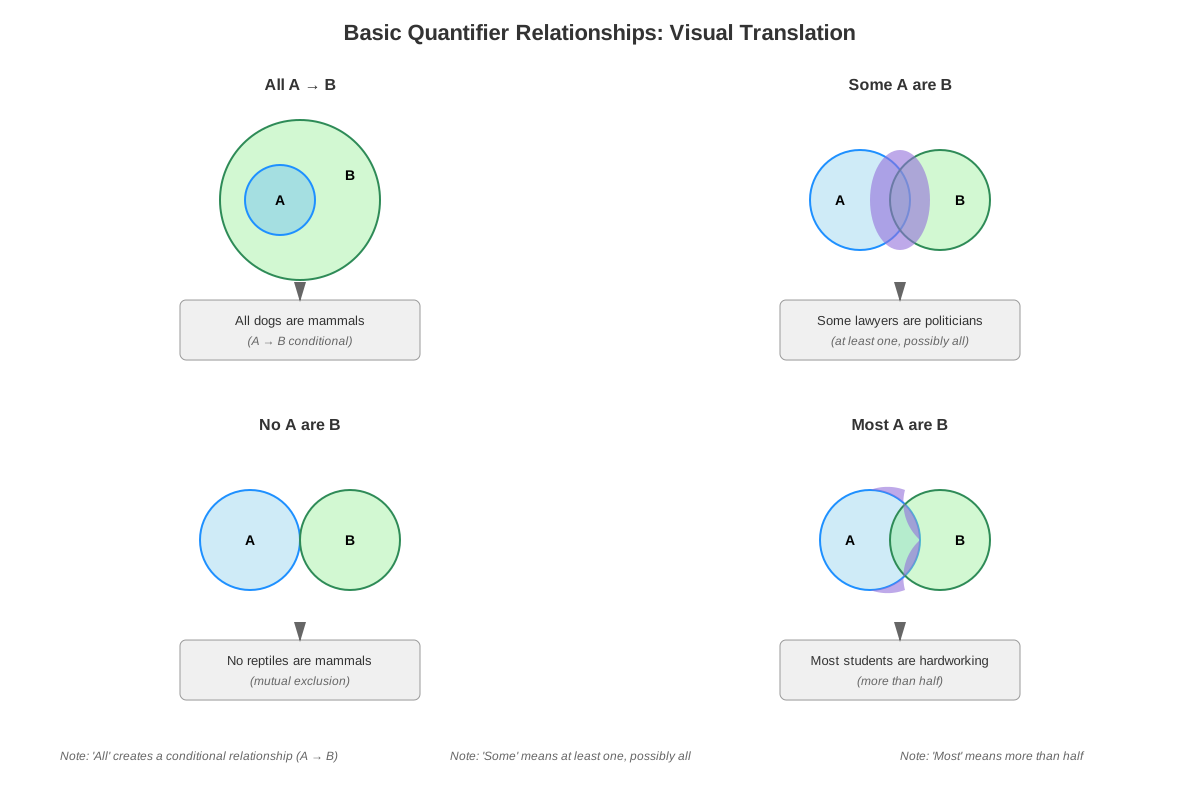
The LSAT employs four fundamental quantifiers that describe relationships between categories or sets. Each quantifier has a specific logical meaning and corresponding diagram structure:
All statements (universal affirmative) indicate that every member of one category is also a member of another category. The statement "All lawyers are professionals" means the entire set of lawyers is contained within the set of professionals. This is diagrammed as: Lawyer → Professional, showing a sufficient-necessary relationship where being a lawyer is sufficient to guarantee being a professional.
No/None statements (universal negative) indicate that two categories have no overlap whatsoever. "No reptiles are mammals" means these sets are completely separate. This is diagrammed as: Reptile → NOT Mammal, or alternatively shown as two non-overlapping circles in Venn diagram format.
Some statements (particular affirmative) indicate that at least one member exists in the overlap between two categories. "Some doctors are researchers" means at least one person is both a doctor and a researcher. This is diagrammed as overlapping circles with an "X" or shaded region indicating the confirmed overlap. Critically, "some" means "at least one" and could mean "all"—it establishes a minimum, not a maximum.
Most statements (majority quantifier) indicate that more than half of one category belongs to another category. "Most students are hardworking" means over 50% of students are hardworking. This is diagrammed similarly to "some" but with notation indicating the majority relationship, often shown as "Most S → H" with special notation to distinguish it from universal statements.
Diagram Notation Systems
Two primary notation systems exist for quantifier diagrams: arrow notation and Venn diagrams. Understanding both systems and when to deploy each is crucial for LSAT success.
Arrow notation (also called conditional notation) represents quantified statements as conditional relationships. This system excels at showing logical flow and enabling chain reasoning. The format follows: Category A → Category B, read as "if A, then B" or "all A are B." The contrapositive is automatically available: NOT B → NOT A. This notation integrates seamlessly with other conditional logic on the LSAT and allows for efficient combination of multiple statements.
Venn diagrams use overlapping circles to represent categories and their relationships. This system provides intuitive visualization of overlaps, separations, and subset relationships. For "all" statements, one circle is drawn entirely within another. For "no" statements, circles are completely separate. For "some" statements, circles overlap with an "X" marking the confirmed intersection. Venn diagrams excel at showing what must be true versus what could be true, making them particularly valuable for inference questions.
Valid Inferences from Quantified Statements
Understanding what can and cannot be validly inferred from quantified statements is the core skill tested on the LSAT. Each quantifier type permits specific inferences while prohibiting others.
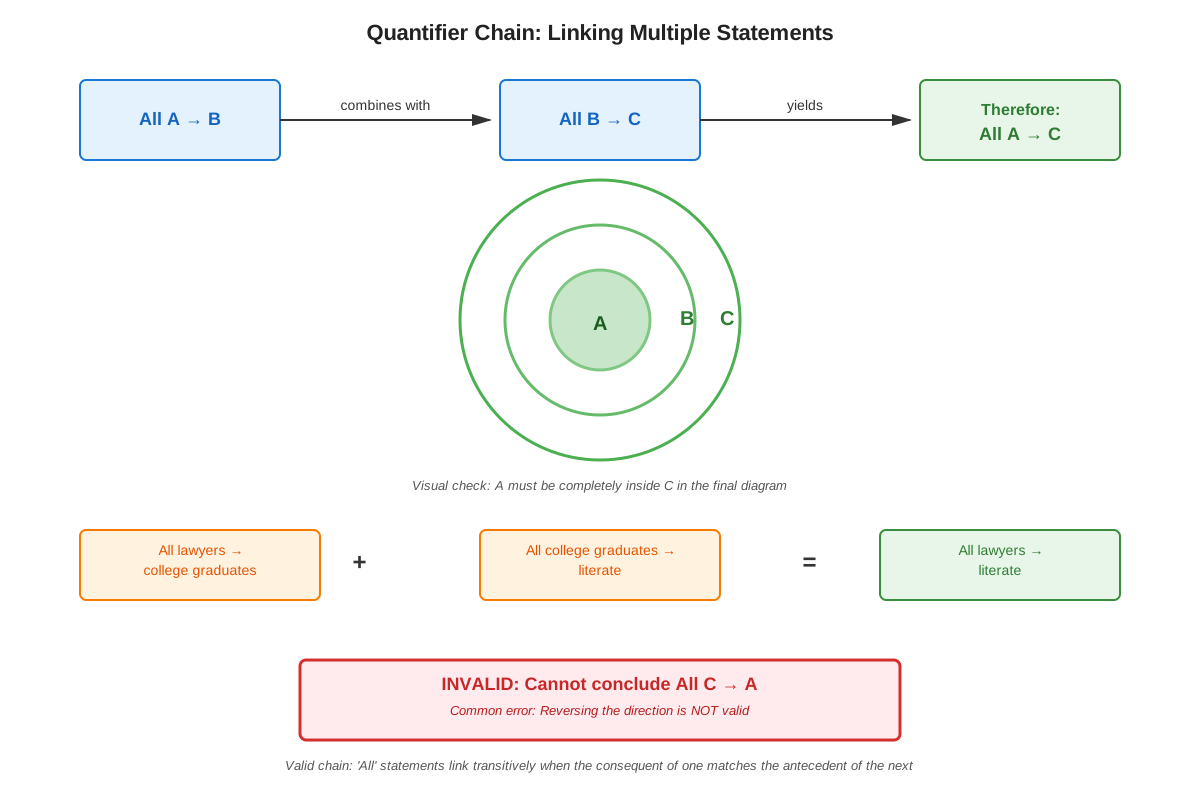
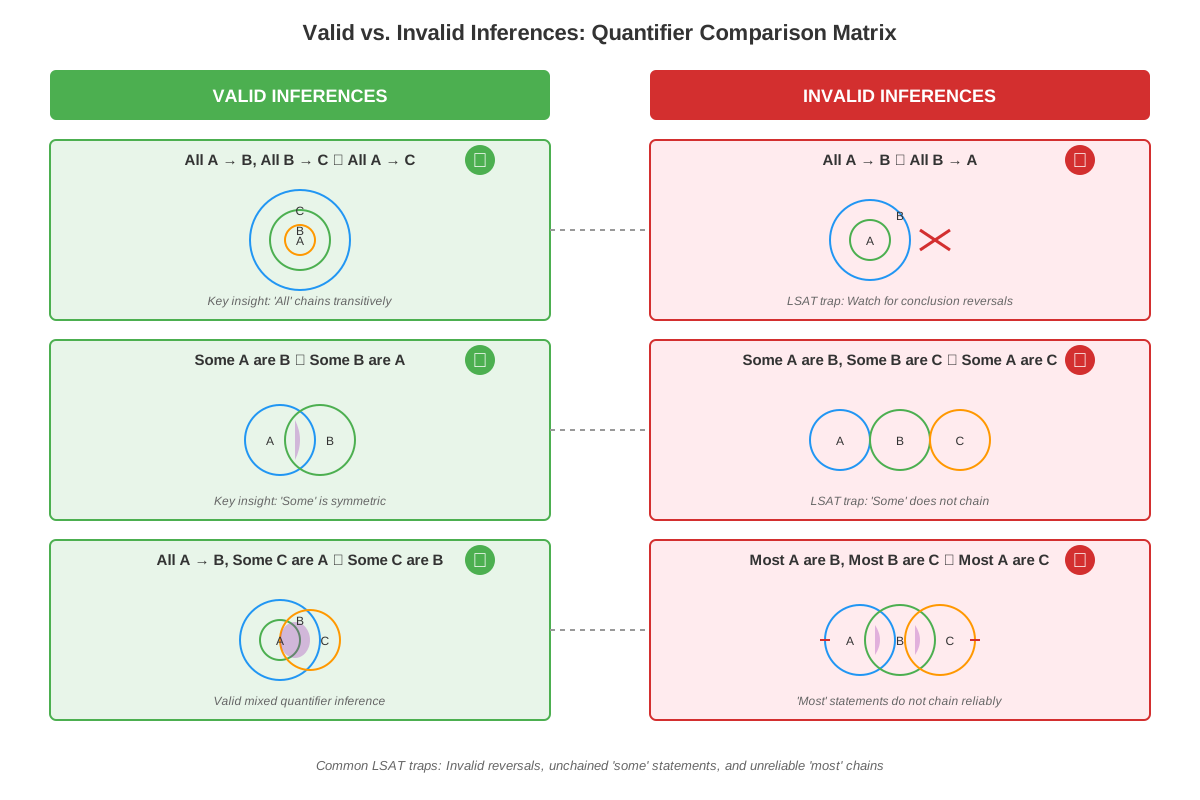
From "All A are B" you can validly infer: the contrapositive (all non-B are non-A), and that any specific instance of A is also B. You cannot infer the converse (all B are A), which is the most common logical error. You also cannot infer anything about the relative sizes of the categories or whether any A actually exists.
From "No A are B" you can validly infer: the symmetric statement (no B are A), that any specific A is not B, and that any specific B is not A. The contrapositive of "A → NOT B" is "B → NOT A," which is logically equivalent to the original statement.
From "Some A are B" you can validly infer: the symmetric statement (some B are A), that at least one thing is both A and B, and that both categories A and B contain at least one member. You cannot infer anything about the majority, about all members, or about specific individuals unless additional information is provided.
From "Most A are B" you can validly infer: that some A are B (since most implies at least one), and that the probability of a randomly selected A being B exceeds 50%. You cannot infer the converse (most B are A), cannot infer anything about all A, and cannot combine "most" statements through simple chaining (a critical LSAT trap).
Combining Quantified Statements
The LSAT frequently tests the ability to combine multiple quantified statements to reach valid conclusions. This process follows strict logical rules:
Chaining "All" statements: When you have "All A are B" and "All B are C," you can validly conclude "All A are C." This works because the conditional chain flows: A → B → C, therefore A → C. This is the most reliable form of quantifier combination.
Combining "All" and "Some": When you have "All A are B" and "Some C are A," you can validly conclude "Some C are B." The reasoning: since some C are A, and all A are B, those C that are A must also be B. This is diagrammed by following the "some" through the "all" chain.
The "Most" combination trap: You cannot chain "most" statements. "Most A are B" and "Most B are C" does NOT allow you to conclude "Most A are C" or even "Some A are C." This is because the overlaps might not align. This represents one of the highest-yield traps on the LSAT.
Combining "No" and "All": When you have "No A are B" and "All C are A," you can validly conclude "No C are B." The reasoning: since all C are A, and no A are B, then no C can be B either.
Quantifier Negations and Opposites
Understanding how to negate quantified statements is essential for contrapositive reasoning and flaw identification:
| Original Statement | Logical Negation | Common Incorrect Negation |
|---|---|---|
| All A are B | Some A are not B | No A are B |
| No A are B | Some A are B | All A are B |
| Some A are B | No A are B | Some A are not B |
| Most A are B | Most A are not B | Some A are not B |
The negation of "all" is "not all," which means "at least one is not," which translates to "some are not." This is not the same as "none," which is the opposite but not the logical negation. Understanding this distinction prevents errors in Must Be False and Cannot Be True questions.
Concept Relationships
Quantifier diagrams serve as the foundation for multiple interconnected logical reasoning skills. The relationship map flows as follows:
Basic Conditional Logic → leads to → Quantifier Diagrams → enables → Complex Inference Chains
Within quantifier diagrams themselves, the concepts build hierarchically: understanding individual quantifiers precedes combining quantifiers, which precedes recognizing invalid inferences. The four basic quantifiers (all, no, some, most) form the foundation, upon which diagram notation systems provide the tools for representation. These tools then enable the identification of valid inferences, which in turn allows for the combination of multiple statements.
Quantifier diagrams connect backward to prerequisite topics through their reliance on conditional logic notation and set theory. The arrow notation used in quantifier diagrams is identical to that used in basic conditional statements, making the transition seamless for students who have mastered "if-then" reasoning. The Venn diagram approach draws directly from set theory, visualizing categories as sets and relationships as intersections or containments.
Forward connections extend to argument structure analysis, where quantifier relationships often form the logical skeleton of complex arguments. Flaw questions frequently test whether an argument has made an invalid quantifier inference, such as confusing "all" with "some" or improperly chaining "most" statements. Assumption questions often require recognizing that a gap exists between quantified categories and identifying the statement that bridges that gap.
The relationship between arrow notation and Venn diagrams is complementary rather than hierarchical—each system has optimal use cases. Arrow notation excels in chain reasoning and integration with other conditional logic, while Venn diagrams excel in visualizing overlaps and quickly assessing what must versus could be true. Expert test-takers fluidly switch between systems based on question demands.
High-Yield Facts
⭐ The negation of "all A are B" is "some A are not B," not "no A are B"—this distinction appears in approximately 8-10 questions per LSAT
⭐ You cannot validly infer the converse from an "all" statement—"all A are B" does not mean "all B are A"
⭐ "Some" means "at least one" and could mean "all"—it establishes a minimum bound only
⭐ You cannot chain "most" statements to reach valid conclusions—"most A are B" and "most B are C" does not yield "most A are C"
⭐ "Some A are B" is logically equivalent to "some B are A"—"some" statements are symmetric
- The contrapositive of "all A are B" is "all non-B are non-A," which is logically equivalent to the original
- "No A are B" is logically equivalent to "no B are A"—universal negative statements are symmetric
- From "all A are B" and "some C are A," you can validly conclude "some C are B"
- "Most" means "more than half" (>50%), not merely "many" or "a lot"
- You cannot determine the size of category B from "all A are B"—B could be much larger than A
- "Some A are not B" is not the same as "some A are B"—these statements can both be true simultaneously
- The statement "all A are B" does not guarantee that any A actually exists—it's a conditional relationship
Quick check — test yourself on Quantifier diagrams so far.
Try Flashcards →Common Misconceptions
Misconception: "All A are B" means the same as "all B are A" (confusing a statement with its converse)
Correction: These are completely different statements. "All lawyers are professionals" does not mean "all professionals are lawyers." The converse is not logically equivalent to the original statement and cannot be inferred without additional information. Only the contrapositive ("all non-professionals are non-lawyers") is logically equivalent.
Misconception: "Some A are B" means "some A are not B" (assuming "some" means "only some")
Correction: "Some" means "at least one" and places no upper limit. "Some A are B" could mean all A are B. The statement only guarantees that at least one A is B; it says nothing about A that are not B. These are independent claims that could both be true, both be false, or have any combination of truth values.
Misconception: You can chain "most" statements just like "all" statements
Correction: "Most A are B" and "most B are C" does not allow any conclusion about the relationship between A and C. The overlaps might not align—it's possible that the majority of A that are B are entirely different from the majority of B that are C. This is one of the most frequently tested traps on the LSAT.
Misconception: The negation of "all A are B" is "no A are B"
Correction: The logical negation of "all A are B" is "not all A are B," which means "at least one A is not B," or "some A are not B." The statement "no A are B" is the opposite extreme, not the logical negation. To negate a universal statement, you need only one counterexample, not a complete reversal.
Misconception: "Some" statements allow you to make conclusions about specific individuals
Correction: "Some doctors are researchers" tells you that at least one person is both a doctor and a researcher, but it tells you nothing about any specific doctor. You cannot conclude that Dr. Smith is a researcher, nor can you conclude that Dr. Smith is not a researcher. "Some" statements establish existential claims about categories, not claims about individuals.
Misconception: If "most A are B" and "most A are C," then "most B are C"
Correction: This inference is invalid. While it's true that most A are B and most A are C, which means there must be some overlap between B and C (since together they account for more than 100% of A), you cannot conclude anything about the proportion of B that are C. The overlap could be minimal relative to the size of B.
Worked Examples
Example 1: Pure Inference Question
Stimulus: "All members of the debate team are honor students. Some honor students are varsity athletes. No varsity athletes are in the drama club."
Question: Which of the following must be true?
Step 1 - Diagram the statements:
- Statement 1: Debate Team → Honor Student (DT → HS)
- Statement 2: Some Honor Students are Varsity Athletes (HS ∩ VA ≠ ∅)
- Statement 3: Varsity Athlete → NOT Drama Club (VA → ¬DC)
Step 2 - Identify what can be combined:
Looking at the chain, we can potentially connect statements through shared categories. The shared category between statements 1 and 2 is "Honor Students." The shared category between statements 2 and 3 is "Varsity Athletes."
Step 3 - Test valid inferences:
- Can we conclude anything about debate team and varsity athletes? No—we know all debate team members are honor students, and some honor students are varsity athletes, but we don't know if the debate team members are among those honor students who are varsity athletes.
- Can we conclude anything about honor students and drama club? Yes—we know some honor students are varsity athletes (statement 2), and all varsity athletes are not in drama club (statement 3). Therefore, some honor students are not in drama club. This is valid because we're following the "some" through the "all" chain.
- Can we conclude anything about debate team and drama club? No—while all debate team members are honor students, we don't know if any debate team members are among the honor students who are varsity athletes, so we can't use statement 3.
Step 4 - Evaluate answer choices:
The answer that must be true is: "Some honor students are not in the drama club."
Connection to learning objectives: This example demonstrates identifying quantifier diagrams in LSAT questions (objective 1), explaining the reasoning pattern of combining "some" and "all" statements (objective 2), and applying diagrams to solve the problem accurately (objective 3).
Example 2: Flaw Question with Quantifiers
Stimulus: "Most successful entrepreneurs are risk-takers. Most risk-takers are optimistic about the future. Therefore, most successful entrepreneurs are optimistic about the future."
Question: The reasoning in the argument is flawed because it:
Step 1 - Identify the quantifier structure:
- Premise 1: Most Entrepreneurs → Risk-takers (Most E → R)
- Premise 2: Most Risk-takers → Optimistic (Most R → O)
- Conclusion: Most Entrepreneurs → Optimistic (Most E → O)
Step 2 - Recognize the pattern:
This is an attempt to chain two "most" statements. The argument assumes that because most E are R, and most R are O, then most E must be O.
Step 3 - Explain why this fails:
"Most" statements cannot be chained because the overlaps might not align. Consider: if there are 100 entrepreneurs, and 51 of them are risk-takers (satisfying "most"), and there are 1000 total risk-takers, and 501 of those risk-takers are optimistic (satisfying "most"), it's entirely possible that the 51 entrepreneurs who are risk-takers are among the 499 risk-takers who are NOT optimistic. In this scenario, both premises are true, but the conclusion is false.
Step 4 - Identify the flaw:
The correct answer would state something like: "The argument treats a characteristic of most members of a group as if it must be a characteristic of most members of a subset of that group" or "The argument improperly assumes that two overlapping majorities must have a specific relationship."
Connection to learning objectives: This example shows how quantifier diagram reasoning patterns appear in flaw questions (objective 1), explains the specific reasoning error of chaining "most" statements (objective 2), and demonstrates how to recognize and articulate invalid inferences (objective 5).
Exam Strategy
When approaching LSAT questions involving quantifier diagrams, follow this systematic process:
Trigger word identification: Immediately flag questions containing quantifier language. Watch for "all," "every," "any," "each," "no," "none," "some," "several," "many," "most," "majority," and "few." These words signal that formal diagramming will likely save time and improve accuracy. Also watch for equivalent phrasings: "only" (which reverses the conditional), "the only" (which indicates a necessary condition), and "unless" (which introduces a necessary condition).
Rapid diagramming protocol: Spend 15-20 seconds creating clear diagrams before evaluating answer choices. Use consistent notation—either commit to arrow notation or Venn diagrams for a given question. Write out contrapositives for "all" and "no" statements immediately. Mark "some" statements with an X or overlap notation. For "most" statements, use special notation (like "M>" or underlining) to distinguish them from universal quantifiers.
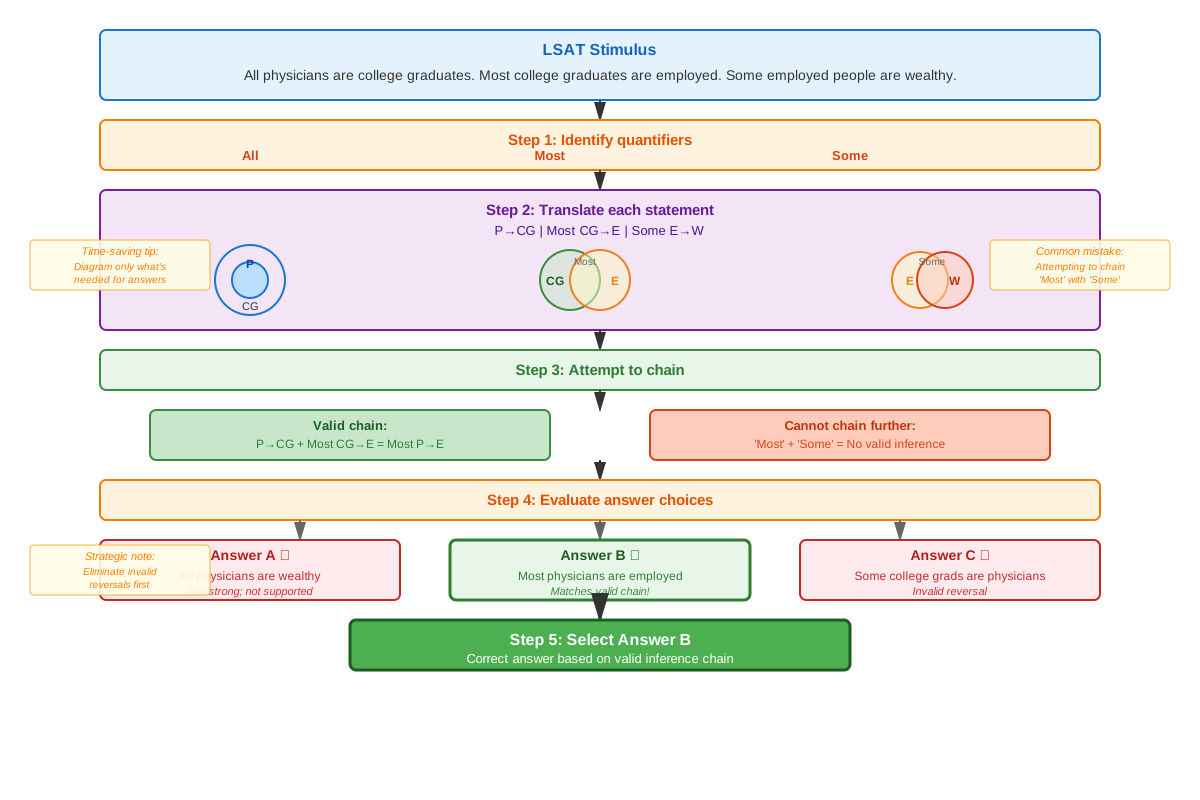
Chain analysis: After diagramming all statements, identify potential chains by looking for shared categories. Circle or highlight shared terms. Test whether chains are valid based on quantifier types—"all" chains work, "some" can flow through "all," but "most" cannot chain. This analysis should take 10-15 seconds and often reveals the answer directly.
Process of elimination tactics: For Must Be True questions, eliminate any answer choice that requires chaining "most" statements, assumes a converse, or makes claims about specific individuals from "some" statements. For Cannot Be True questions, look for answer choices that directly contradict valid inferences from your diagrams. For Sufficient Assumption questions, identify the gap between quantified categories and find the answer that bridges it with an "all" statement.
Time allocation: Allocate 60 seconds for diagramming and analysis, 30 seconds for answer choice evaluation. If you cannot diagram the statements clearly within 60 seconds, the question may not be a pure quantifier question—look for alternative approaches. Conversely, if your diagrams are clear, you should be able to eliminate wrong answers very quickly, often in 10-15 seconds total.
Common trap awareness: The LSAT repeatedly tests the same invalid inferences. Be hypervigilant for: converse confusion (switching the order of an "all" statement), "most" chaining, negation errors (confusing "not all" with "none"), and existential assumptions (assuming categories are non-empty). When you spot these patterns in answer choices, they are almost always incorrect.
Exam Tip: If a question provides three or more quantified statements, it is almost certainly testing your ability to combine them. Invest the time in careful diagramming—the answer will emerge mechanically from the diagrams.
Memory Techniques
SCAN mnemonic for quantifier types:
- Some = at least one (minimum bound)
- Converse doesn't work for "all"
- All = sufficient condition (arrow notation)
- No = complete separation (contrapositive equivalent)
"Most Chains Break" visualization: Picture a physical chain with "MOST" written on each link. Visualize the chain breaking in the middle, representing that you cannot connect "most" statements. This vivid image helps prevent the single most common quantifier error on the LSAT.
The "Flip Test" for converses: When you see an "all" statement, physically write it backward and ask "Does this make sense?" For example, "All lawyers are professionals" becomes "All professionals are lawyers?" The absurdity of the converse often becomes immediately apparent with this technique.
"Some Goes Both Ways" hand gesture: When you encounter a "some" statement, make a two-way gesture with your hand (pointing left, then right) to reinforce that "some A are B" equals "some B are A." This kinesthetic reinforcement helps internalize the symmetric property.
Negation Ladder: Visualize quantifiers on a ladder from strongest to weakest:
- Top rung: ALL
- Middle rung: MOST
- Lower rung: SOME
- Bottom rung: NONE
To negate, you only need to drop one rung: the negation of ALL is "not all" (which equals SOME...NOT), and the negation of NONE is SOME. This prevents over-negation errors.
Summary
Quantifier diagrams provide a systematic method for translating and analyzing statements involving "all," "no," "some," and "most" on the LSAT Logical Reasoning sections. By converting verbal statements into visual representations using either arrow notation or Venn diagrams, test-takers can quickly identify valid inferences, recognize logical flaws, and eliminate incorrect answer choices. The core skill involves understanding what each quantifier permits you to infer: "all" statements allow contrapositive reasoning and chain with other "all" statements; "no" statements indicate complete separation and are symmetric; "some" statements establish minimum overlap and are also symmetric; and "most" statements indicate majority relationships but cannot be chained. The highest-yield exam strategies involve recognizing that converses are invalid, that "most" statements cannot be combined through simple chaining, and that negations require precision—"not all" means "some are not," not "none." Mastery of quantifier diagrams transforms complex logical reasoning questions into mechanical exercises, typically reducing solution time by 30-40% while improving accuracy significantly. Students who internalize these patterns and practice rapid diagramming develop the ability to solve quantifier questions with near-perfect accuracy, making this topic one of the most valuable investments in LSAT preparation.
Key Takeaways
- Quantifier diagrams translate verbal statements into visual representations that make logical relationships explicit and enable systematic analysis
- The four basic quantifiers (all, no, some, most) each have specific inference rules that must be memorized and applied precisely
- "All" statements can be chained and allow contrapositive reasoning, but their converses are invalid—the most common trap on the LSAT
- "Most" statements cannot be chained together, and attempting to do so represents a fundamental logical error tested repeatedly
- "Some" statements are symmetric and establish minimum bounds (at least one), not maximum bounds
- Combining quantified statements requires following strict rules: "all" chains with "all," "some" flows through "all," but "most" cannot chain
- Rapid, consistent diagramming (15-20 seconds) followed by systematic chain analysis (10-15 seconds) enables high-accuracy solutions in under 60 seconds per question
Related Topics
Conditional Logic and Contrapositives: Quantifier diagrams build directly on conditional reasoning, with "all" statements functioning as conditional relationships. Mastering contrapositives enhances the ability to extract all valid inferences from quantified statements.
Formal Logic Games: Logic Games occasionally incorporate quantifier relationships in rule sets, particularly in grouping games. The diagramming skills developed for Logical Reasoning transfer directly to these game types.
Argument Structure and Assumptions: Many assumption questions involve gaps between quantified categories. Understanding quantifier diagrams enables rapid identification of these gaps and prediction of correct answers.
Sufficient and Necessary Conditions: The relationship between "all" statements and sufficient/necessary conditions deepens understanding of both topics. "All A are B" means A is sufficient for B, and B is necessary for A.
Flaw Question Types: Multiple flaw categories involve quantifier errors, including overgeneralization, improper reversal, and unwarranted assumptions about category relationships. Mastery of quantifier diagrams enables instant recognition of these flaws.
Practice CTA
Now that you have mastered the core concepts of quantifier diagrams, it's time to cement your understanding through active practice. Attempt the practice questions associated with this topic, focusing on rapid diagramming and systematic application of inference rules. Use flashcards to drill the valid and invalid inference patterns until they become automatic. Remember: quantifier diagram questions are among the most mechanical and predictable on the LSAT—with focused practice, you can achieve near-perfect accuracy on this high-yield question type. Every quantifier question you master is a guaranteed point on test day, so invest the time now to build unshakeable confidence in this essential skill.
Sign up free to keep reading
Create a free AnvayaPrep account to finish this LSAT guide on Quantifier diagrams — plus flashcards and practice questions.