Overview
Assumptions form the invisible backbone of every argument encountered in LSAT Logical Reasoning sections. An assumption is an unstated premise that must be true for an argument's conclusion to follow logically from its stated evidence. Understanding assumptions is not merely helpful for the LSAT—it is absolutely essential. Roughly 25-30% of all Logical Reasoning questions directly test the ability to identify, evaluate, or strengthen assumptions, making this one of the highest-yield topics in the entire exam. Beyond explicit assumption questions, recognizing unstated premises improves performance on strengthen, weaken, flaw, and evaluation questions as well.
The concept of assumptions bridges the gap between evidence and conclusion in argument fundamentals. Every LSAT argument contains premises (stated facts or evidence) and a conclusion (the claim the author wants to prove). However, arguments rarely state everything needed to make the logical connection complete. These unstated but necessary connections are assumptions. Mastering this topic requires developing the ability to see what an argument takes for granted—to identify the invisible logical leaps that authors make when constructing their reasoning.
Within the broader framework of Logical Reasoning, assumptions represent a foundational skill that supports nearly every other question type. Once students can reliably identify what an argument assumes, they gain the ability to attack arguments at their weakest points, recognize logical flaws, and understand how additional information might affect an argument's validity. This topic sits at the intersection of critical thinking and formal logic, requiring both analytical precision and intuitive pattern recognition.
Learning Objectives
- [ ] Identify how Assumptions appears in LSAT questions
- [ ] Explain the reasoning pattern behind Assumptions
- [ ] Apply Assumptions to solve LSAT-style problems accurately
- [ ] Distinguish between necessary assumptions and sufficient assumptions
- [ ] Recognize the gap between premises and conclusions that assumptions fill
- [ ] Evaluate whether a statement is assumed by using the negation test
- [ ] Identify common assumption patterns that recur across LSAT questions
Prerequisites
- Basic argument structure: Understanding the distinction between premises and conclusions is essential because assumptions connect these two elements
- Conditional reasoning fundamentals: Many assumptions involve conditional relationships, requiring familiarity with if-then logic
- Causal reasoning basics: Arguments often assume causal connections, so recognizing cause-and-effect claims helps identify unstated causal assumptions
- Reading comprehension skills: Identifying assumptions requires careful attention to what is stated versus what is merely implied
Why This Topic Matters
In real-world contexts, recognizing assumptions is fundamental to critical thinking across all professional and academic disciplines. Lawyers must identify unstated premises in opposing arguments to construct effective counterarguments. Business leaders must recognize the assumptions underlying strategic proposals to evaluate risk. Scientists must acknowledge the assumptions in their experimental designs to ensure valid conclusions. The LSAT tests this skill because legal reasoning constantly requires identifying what arguments take for granted.
On the LSAT itself, assumption-related questions appear with remarkable frequency and variety. Approximately 5-7 questions per Logical Reasoning section directly ask about assumptions, appearing as "Necessary Assumption," "Sufficient Assumption," and "Assumption" question types. Additionally, understanding assumptions is crucial for success on "Strengthen," "Weaken," "Flaw," "Evaluate," and "Principle" questions—collectively representing over 60% of all Logical Reasoning questions. This makes assumptions the single most important concept for maximizing Logical Reasoning scores.
LSAT assumptions appear in several distinct question formats. "Necessary Assumption" questions ask which statement the argument requires or depends upon. "Sufficient Assumption" questions ask which statement, if added, would make the argument logically complete. "Flaw" questions often describe arguments that fail because they make unwarranted assumptions. "Strengthen" and "Weaken" questions test whether students can identify which answer choices affect the argument by supporting or undermining its assumptions. Mastering this topic directly improves performance across all these question types.
Core Concepts
What Is an Assumption?
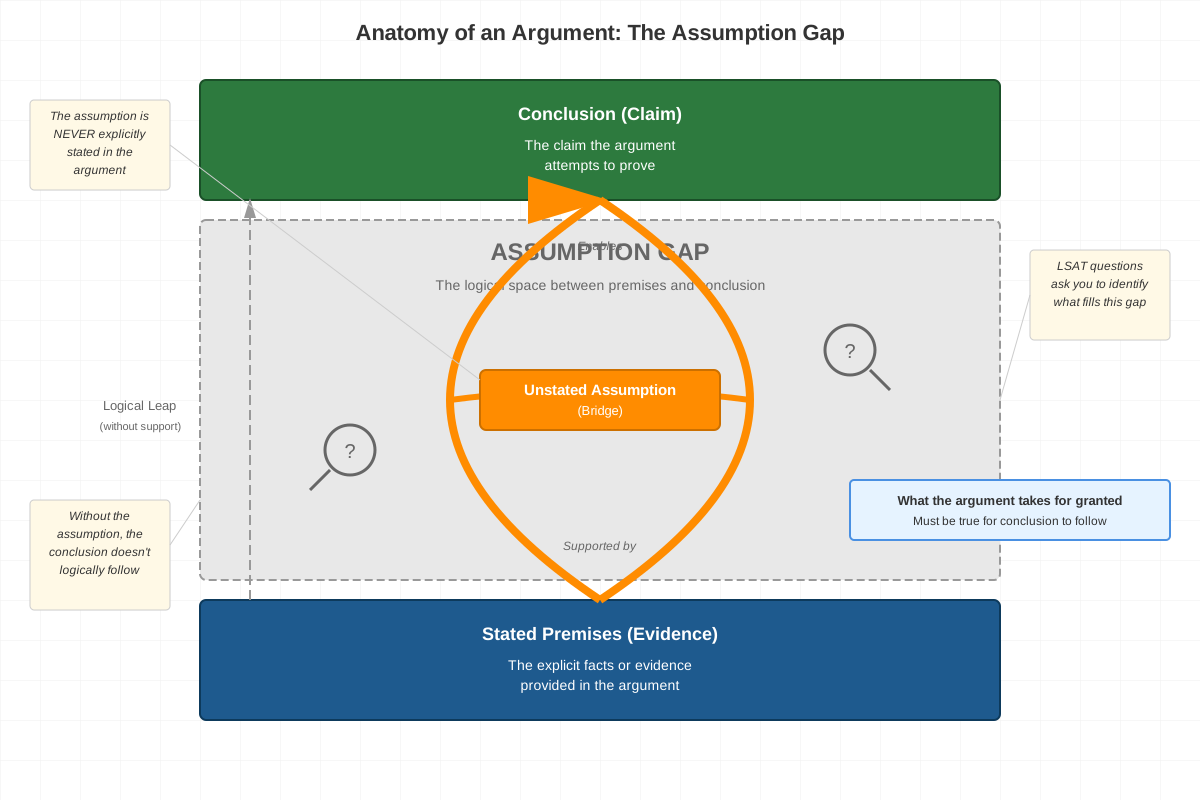
An assumption is an unstated premise that must be true for an argument's conclusion to follow logically from its stated premises. Assumptions are never explicitly mentioned in the argument text—if a statement appears in the stimulus, it is not an assumption but rather an explicit premise. The LSAT tests whether students can identify these invisible logical connections that authors rely upon but never articulate.
Every assumption fills a gap between evidence and conclusion. Consider this simple argument: "Sarah scored 170 on the LSAT. Therefore, she will be admitted to a top law school." The stated premise is Sarah's score. The conclusion is her admission. But what does this argument assume? It assumes that a 170 score is sufficient for admission, that Sarah will apply to top schools, that her application will be otherwise competitive, and numerous other unstated conditions. The argument cannot succeed unless these assumptions hold true.
Necessary vs. Sufficient Assumptions
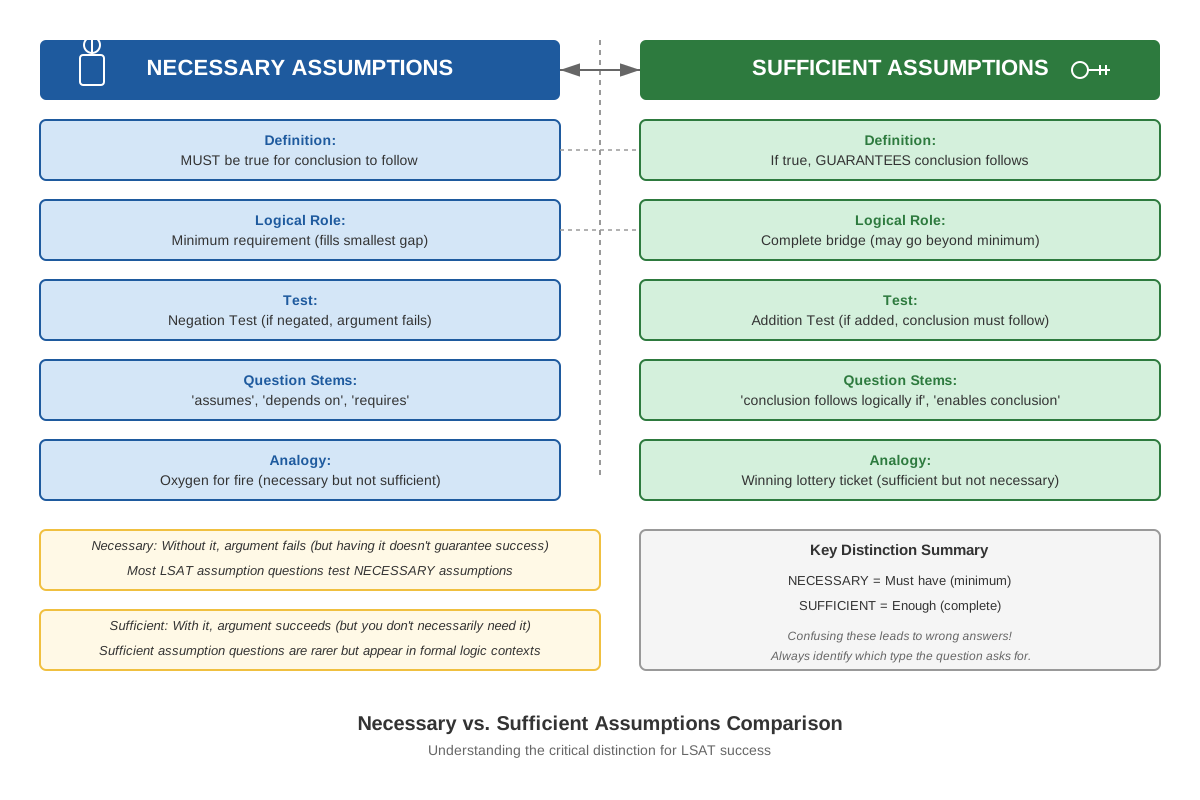
The LSAT distinguishes between two types of assumptions, each tested through different question types. Understanding this distinction is crucial for selecting correct answers.
Necessary assumptions are statements that must be true for the argument to work. If a necessary assumption is false, the argument completely falls apart. These are minimum requirements—the argument cannot succeed without them. Necessary assumption questions typically use language like "requires," "depends on," "assumes," or "presupposes." The correct answer to a necessary assumption question, when negated, will destroy the argument.
Sufficient assumptions are statements that, if true, guarantee the argument's conclusion follows from its premises. These assumptions are enough to make the argument work, though they may provide more than the minimum required. Sufficient assumptions often involve formal logical connections, particularly conditional statements that bridge premise and conclusion. Sufficient assumption questions use language like "allows the conclusion to be properly drawn" or "enables the conclusion to be logically inferred."
| Feature | Necessary Assumption | Sufficient Assumption |
|---|---|---|
| Definition | Must be true for argument to work | If true, guarantees conclusion |
| Strength | Minimum requirement | Often stronger than needed |
| Test method | Negation destroys argument | Addition completes argument |
| Question language | "requires," "depends on," "assumes" | "allows conclusion to be drawn" |
| Frequency | More common on LSAT | Less common, more formal |
The Assumption Gap
Every LSAT argument contains what can be called the "assumption gap"—the logical space between premises and conclusion that unstated assumptions must bridge. Identifying this gap is the key skill for assumption questions. The gap typically involves one of several common patterns:
Concept shifts occur when the premises discuss one concept but the conclusion discusses a different (though related) concept. For example: "This medication reduces blood pressure. Therefore, it will improve cardiovascular health." The premise is about blood pressure; the conclusion is about cardiovascular health. The assumption gap involves the unstated connection between these two concepts—that reducing blood pressure improves cardiovascular health.
Scope shifts happen when the conclusion makes a broader or narrower claim than the premises support. For instance: "In our study of 100 college students, meditation reduced stress. Therefore, meditation reduces stress in all adults." The premise covers college students; the conclusion covers all adults. The assumption bridges this scope gap—that what's true for college students applies to all adults.
Causal assumptions appear when arguments conclude that one thing causes another based on correlation or temporal sequence. The argument assumes no alternative explanations exist, that the causal direction is correct, and that the correlation isn't coincidental.
Comparison assumptions emerge when arguments compare two things without establishing that they're comparable. The argument assumes relevant similarities and no critical differences between the compared items.
The Negation Test
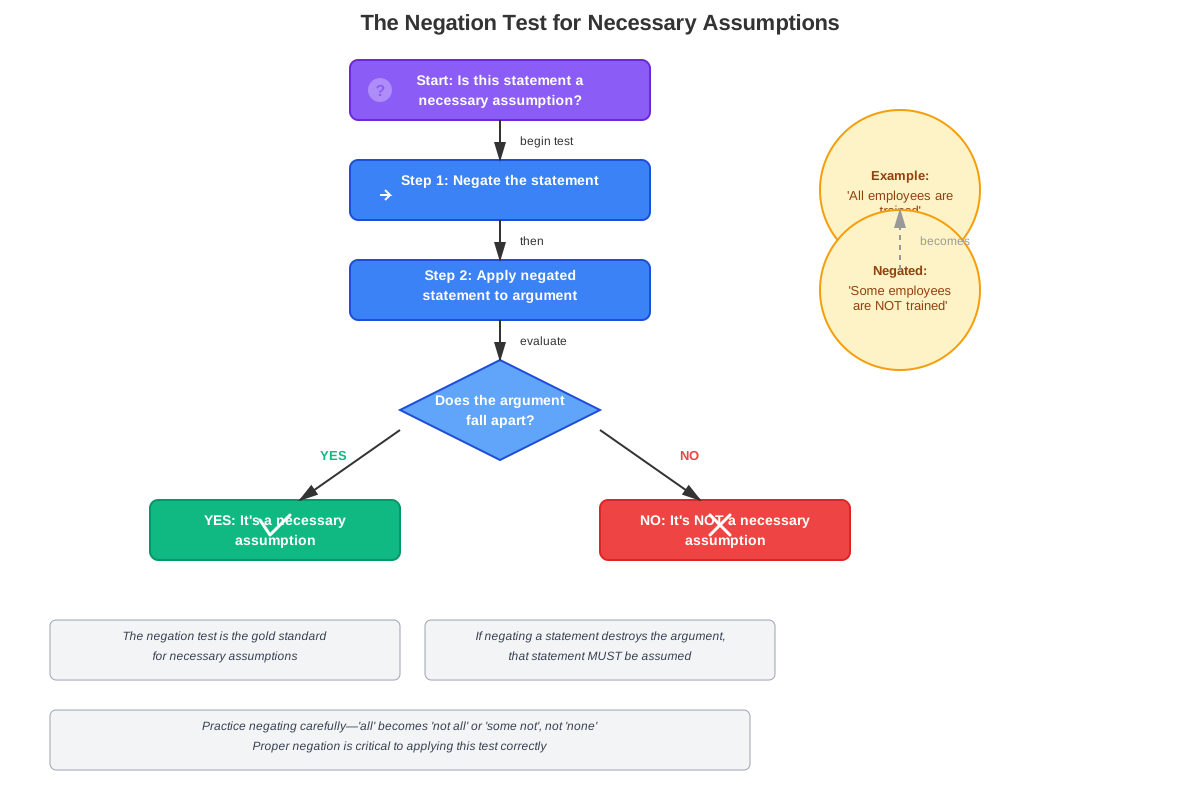
The negation test is the most powerful technique for evaluating necessary assumptions. This test works by negating (reversing the truth value of) an answer choice and asking whether the negated statement would destroy the argument. If negating an answer choice makes the argument fall apart, that choice states a necessary assumption. If the argument still could work after negation, the choice is not a necessary assumption.
To apply the negation test:
- Read the answer choice carefully
- Negate it (make it say the opposite)
- Ask: "If this negated statement were true, would the argument still work?"
- If the answer is "no, the argument fails," the original statement is a necessary assumption
- If the answer is "yes, the argument could still work," it's not a necessary assumption
For example, consider the argument: "The new policy increased productivity by 15%. Therefore, we should implement it company-wide." Test this answer choice: "The policy's benefits outweigh its costs." Negated: "The policy's benefits do NOT outweigh its costs." If this negation were true, would we still conclude the policy should be implemented company-wide? No—the argument collapses. Therefore, the original statement is a necessary assumption.
Common Assumption Patterns
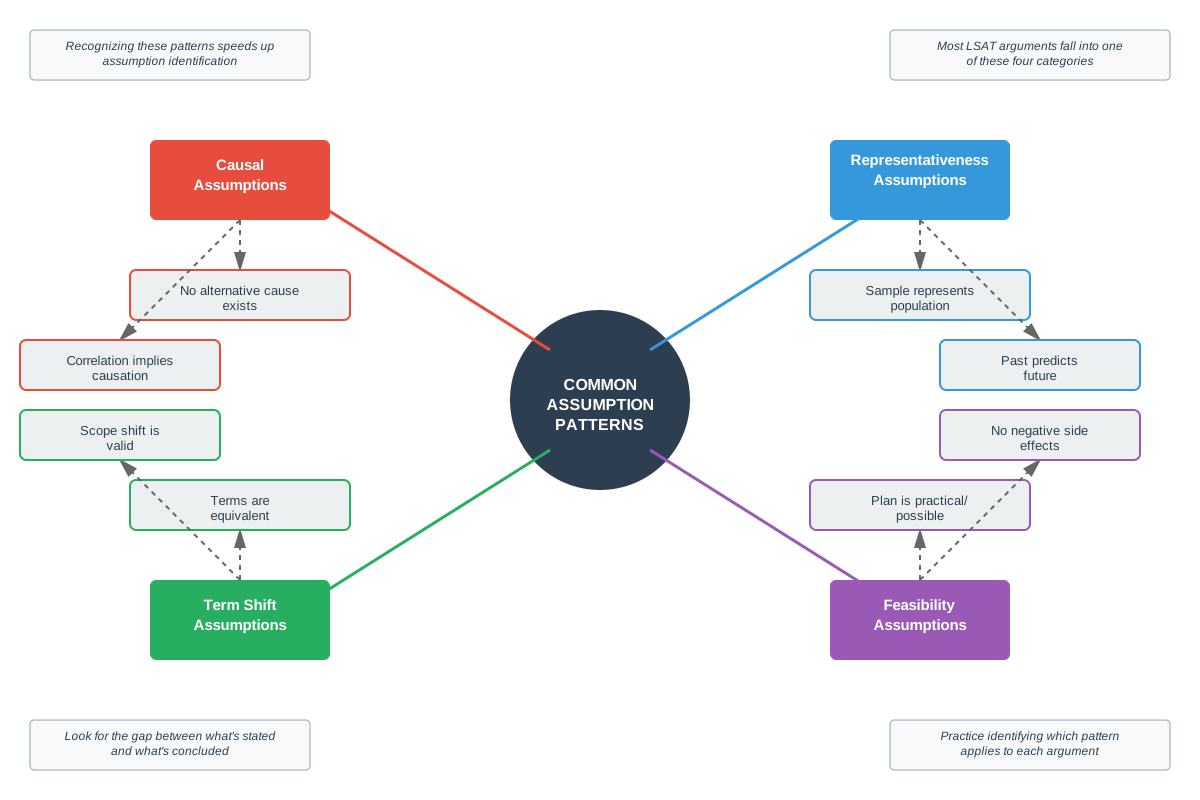
Certain assumption patterns recur frequently on the LSAT. Recognizing these patterns accelerates the process of identifying assumptions:
Representativeness assumptions: Arguments that generalize from a sample to a population assume the sample is representative. "In our survey of 50 customers, 80% were satisfied. Therefore, most of our customers are satisfied" assumes the 50 surveyed customers represent the broader customer base.
Feasibility assumptions: Arguments recommending action assume the action is possible to implement. "We should reduce carbon emissions by 50% to prevent climate change" assumes such a reduction is feasible.
No alternative cause assumptions: Causal arguments assume no other factors explain the observed effect. "After we hired a new manager, sales increased 20%. The new manager caused the sales increase" assumes nothing else explains the increase.
Term consistency assumptions: Arguments using the same term in premises and conclusion assume the term means the same thing throughout. "Studies show exercise improves health. Therefore, walking to the mailbox improves health" assumes "exercise" in the studies means the same as the minimal activity described.
Value assumptions: Arguments making recommendations assume certain values or priorities. "This policy will increase efficiency. Therefore, we should adopt it" assumes efficiency is desirable and outweighs other considerations.
Concept Relationships
The concept of assumptions connects intimately with every other element of argument fundamentals. Premises provide the stated evidence, conclusions present the claim to be proven, and assumptions form the unstated bridge between them. This three-part structure (premises + assumptions → conclusion) represents the complete logical architecture of every LSAT argument.
Assumptions relate directly to argument flaws because most flaws involve problematic assumptions. When an argument makes an unwarranted assumption, it commits a logical flaw. Understanding assumptions enables students to identify why flawed arguments fail—they assume something they shouldn't assume, or they fail to establish a necessary connection.
The relationship between assumptions and strengthen/weaken questions is particularly important. Strengthening an argument typically means supporting one of its assumptions, while weakening an argument means undermining an assumption. Students who can identify assumptions can predict what types of information would strengthen or weaken arguments before even reading the answer choices.
Conditional reasoning frequently appears in assumption questions, particularly sufficient assumption questions. These questions often require identifying a conditional statement that, when added to the premises, guarantees the conclusion through valid conditional logic (modus ponens, modus tollens, or contrapositive reasoning).
The conceptual flow follows this pattern: Argument Structure → Identify Conclusion → Identify Premises → Recognize the Gap → Determine What Assumption Fills the Gap → Apply Negation Test (for necessary assumptions) or Logical Completion Test (for sufficient assumptions) → Select Correct Answer.
Quick check — test yourself on Assumptions so far.
Try Flashcards →High-Yield Facts
⭐ An assumption is never stated in the argument text—if it appears explicitly, it's a premise, not an assumption
⭐ The negation test is the definitive method for confirming necessary assumptions: negate the answer choice, and if the argument falls apart, you've found a necessary assumption
⭐ Necessary assumptions are minimum requirements; sufficient assumptions guarantee the conclusion but often provide more than the minimum needed
⭐ Most LSAT arguments contain multiple assumptions, but questions ask for only one—select the assumption most critical to the argument's reasoning
⭐ Concept shifts between premises and conclusion signal assumption gaps—the argument assumes the connection between different concepts
- Scope shifts (from specific to general or vice versa) require assumptions about representativeness or universal applicability
- Causal arguments assume no alternative explanations, correct causal direction, and that correlation indicates causation
- Comparison arguments assume relevant similarities and no critical differences between compared items
- Necessary assumption answer choices often use moderate language ("some," "at least one") rather than extreme language ("all," "never")
- Sufficient assumption answer choices frequently contain formal conditional logic that completes the argument's reasoning chain
- Arguments recommending action assume the action is feasible, desirable, and will achieve its intended effect
- Statistical arguments assume representative samples, proper methodology, and that statistical relationships indicate real-world relationships
- The correct assumption answer directly addresses the specific gap in the specific argument—general truisms are usually incorrect
Common Misconceptions
Misconception: Assumptions are the same as inferences or conclusions → Correction: Assumptions are unstated premises that support the conclusion, while inferences are conclusions drawn from stated information. Assumptions are inputs to arguments; inferences are outputs.
Misconception: The correct assumption answer must be something the author consciously thought about → Correction: Assumptions are logical requirements of the argument's structure, regardless of whether the author deliberately considered them. The LSAT tests logical relationships, not authorial intent.
Misconception: Necessary assumptions must be sufficient to prove the conclusion → Correction: Necessary assumptions are minimum requirements only. An argument typically needs multiple necessary assumptions working together, plus its stated premises, to reach its conclusion. A single necessary assumption alone rarely proves anything.
Misconception: If an answer choice strengthens the argument, it must be an assumption → Correction: Many statements can strengthen an argument without being assumptions. Assumptions are specifically required for the argument to work—they're not merely helpful but essential. Use the negation test to distinguish assumptions from mere strengtheners.
Misconception: Extreme answer choices ("all," "every," "never") are always wrong on assumption questions → Correction: While necessary assumptions often use moderate language, some arguments genuinely require extreme assumptions. The negation test, not the presence of extreme language, determines whether something is a necessary assumption.
Misconception: Sufficient assumptions and necessary assumptions are interchangeable → Correction: These are distinct logical concepts tested through different question types. A sufficient assumption guarantees the conclusion but may be stronger than necessary. A necessary assumption is required but may not be sufficient alone. The question stem determines which type to identify.
Misconception: Background information or context stated in the argument can be assumptions → Correction: By definition, assumptions are unstated. Any information explicitly mentioned in the stimulus is a premise or background fact, not an assumption, regardless of how important it seems.
Worked Examples
Example 1: Necessary Assumption Question
Argument: "The city's new recycling program has increased the amount of material recycled by 30% over the past year. Therefore, the program has significantly reduced the amount of waste sent to landfills."
Question: Which of the following is an assumption required by the argument?
Analysis:
First, identify the conclusion: The program has significantly reduced waste sent to landfills.
Next, identify the premise: The program increased recycling by 30%.
Now, recognize the gap: The premise tells us recycling increased, but the conclusion is about landfill waste decreasing. What connects these? The argument assumes that the increased recycling actually represents material diverted from landfills, not just additional recycling of material that wouldn't have gone to landfills anyway.
The argument also assumes that "30% more recycling" translates to "significant reduction in landfill waste"—that the absolute amount is meaningful, not just the percentage.
Predicted assumption: The recycled material would otherwise have been sent to landfills.
Applying the negation test: If the recycled material would NOT have been sent to landfills (perhaps it would have been incinerated, or it's new material that wasn't previously generated), then increased recycling wouldn't reduce landfill waste. The argument falls apart. This confirms it's a necessary assumption.
Correct answer type: "The material recycled through the new program would otherwise have been disposed of in landfills."
Example 2: Sufficient Assumption Question
Argument: "All members of the debate team have strong analytical skills. Chen has strong analytical skills. Therefore, Chen is a member of the debate team."
Question: Which of the following, if assumed, allows the conclusion to be properly drawn?
Analysis:
This argument commits a formal logical flaw. The premise states: Debate team → Strong analytical skills. The conclusion attempts to reverse this: Strong analytical skills → Debate team. This is the fallacy of affirming the consequent.
For a sufficient assumption question, we need a statement that, when added, makes the conclusion follow logically. We need to establish that having strong analytical skills is sufficient for debate team membership.
Predicted assumption: "Only members of the debate team have strong analytical skills" or equivalently, "All people with strong analytical skills are debate team members."
This creates the conditional: Strong analytical skills → Debate team. Combined with the premise that Chen has strong analytical skills, we can validly conclude Chen is on the debate team.
Correct answer type: "Everyone with strong analytical skills is a member of the debate team."
Note: This sufficient assumption is much stronger than necessary. The argument doesn't require this to be true—it only needs it to be true to guarantee the conclusion. This illustrates the difference between necessary and sufficient assumptions.
Exam Strategy
Primary Strategy: Always identify the conclusion first, then the premises, then ask yourself: "What must be true for this conclusion to follow from these premises?"
When approaching assumption questions, follow this systematic process:
- Identify the question type: Look for keywords like "assumes," "requires," "depends on" (necessary assumption) or "allows the conclusion to be properly drawn" (sufficient assumption)
- Find the conclusion: Use conclusion indicators (therefore, thus, so, consequently) or ask "What is the author trying to prove?"
- Identify the premises: What evidence does the author provide?
- Spot the gap: What concept shift, scope shift, or logical leap occurs between premises and conclusion?
- Predict the assumption: Before reading answer choices, articulate what the argument must assume
- Evaluate answer choices: For necessary assumptions, use the negation test; for sufficient assumptions, test whether adding the statement completes the logic
Trigger words for assumption questions:
- "assumes," "presupposes," "takes for granted," "depends on," "requires," "relies on" → Necessary assumption
- "allows the conclusion to be properly drawn," "enables the conclusion to be logically inferred," "justifies the conclusion" → Sufficient assumption
Process of elimination tips:
- Eliminate answer choices that restate premises (assumptions are unstated)
- Eliminate choices that restate or paraphrase the conclusion (assumptions support the conclusion; they don't repeat it)
- Eliminate choices that address irrelevant concepts not mentioned in the argument
- Eliminate choices that go in the wrong direction (weakening rather than supporting)
- For necessary assumptions, eliminate choices that, when negated, leave the argument intact
Time allocation: Spend 1:00-1:15 on assumption questions. These questions reward careful analysis but don't require extensive reading. If you've correctly identified the gap, the right answer should be recognizable quickly. If you're struggling after 1:30, make your best guess and move on—assumption questions are high-yield but not worth sacrificing time needed for other questions.
Advanced Tip: On necessary assumption questions, the correct answer often uses surprisingly moderate language. If you're torn between a strong answer and a moderate answer, test both with negation—the necessary assumption is whichever one, when negated, destroys the argument.
Memory Techniques
GAPS - Remember that assumptions fill logical GAPS:
- Gap between premise and conclusion
- Always unstated
- Prove it with negation (for necessary assumptions)
- Support the reasoning
The Bridge Visualization: Picture the premise as one side of a canyon, the conclusion as the other side, and the assumption as the bridge connecting them. If the bridge (assumption) collapses, you can't get from premise to conclusion.
SCAN for common assumption patterns:
- Scope shifts (sample to population, specific to general)
- Causal claims (assuming causation from correlation)
- Alternative explanations (assuming none exist)
- New concepts (assuming connection between different terms)
The Negation Flip: For necessary assumptions, remember "Flip it and break it"—flip (negate) the answer choice, and it should break (destroy) the argument.
Sufficient = Complete: Remember that sufficient assumptions complete the argument—they're like the final puzzle piece that makes the picture whole. Necessary assumptions are more like the foundation—remove them and everything collapses.
Summary
Assumptions represent the unstated premises that arguments require to connect their evidence to their conclusions. Mastering assumptions is essential for LSAT success because assumption-related questions constitute approximately 25-30% of Logical Reasoning questions, and understanding assumptions improves performance across nearly all question types. The LSAT tests two types of assumptions: necessary assumptions (minimum requirements that, when negated, destroy the argument) and sufficient assumptions (statements that, when added, guarantee the conclusion). The key to identifying assumptions is recognizing the gap between premises and conclusions—typically involving concept shifts, scope shifts, causal leaps, or comparison issues. The negation test provides a reliable method for confirming necessary assumptions: negate the answer choice, and if the argument falls apart, you've identified a necessary assumption. Common assumption patterns include representativeness, feasibility, absence of alternative causes, term consistency, and value judgments. Success on assumption questions requires systematic analysis: identify the conclusion, locate the premises, recognize the gap, predict the assumption, and test answer choices methodically.
Key Takeaways
- Assumptions are unstated premises that must be true for an argument's conclusion to follow from its stated evidence—they never appear explicitly in the argument text
- The negation test definitively identifies necessary assumptions: negate the answer choice, and if the argument collapses, you've found a necessary assumption
- Necessary assumptions are minimum requirements; sufficient assumptions guarantee the conclusion but often provide more than minimally necessary
- Every assumption fills a gap between premises and conclusion, typically involving concept shifts, scope shifts, causal claims, or comparisons
- Approximately 25-30% of Logical Reasoning questions directly test assumptions, and understanding assumptions improves performance on strengthen, weaken, flaw, and evaluation questions
- Common assumption patterns include representativeness (sample to population), feasibility (recommended actions are possible), no alternative causes (in causal arguments), and term consistency (same words mean same things)
- Systematic analysis produces correct answers: identify conclusion → identify premises → recognize gap → predict assumption → test answer choices with negation or logical completion
Related Topics
Strengthen and Weaken Questions: These question types directly build on assumption knowledge. Strengthening an argument typically means supporting one of its assumptions, while weakening means undermining an assumption. Mastering assumptions enables students to predict strengthen and weaken answer choices before reading them.
Argument Flaws: Most logical flaws involve problematic assumptions—arguments that assume something unwarranted or fail to establish necessary connections. Understanding assumptions provides the foundation for identifying why flawed arguments fail.
Conditional Reasoning: Sufficient assumption questions frequently involve conditional logic, requiring students to identify conditional statements that complete an argument's reasoning chain. Advanced assumption work requires facility with conditional relationships.
Causal Reasoning: Causal arguments make specific types of assumptions (no alternative causes, correct causal direction, meaningful correlation). Deepening understanding of assumptions enhances ability to analyze causal claims.
Evaluation Questions: These questions ask what information would be most useful for evaluating an argument—essentially asking which assumption is most questionable or needs verification.
Practice CTA
Now that you understand the fundamental concepts and strategies for identifying and evaluating assumptions, it's time to apply this knowledge. Attempt the practice questions associated with this topic, focusing on systematically identifying the gap between premises and conclusions before reading answer choices. Use the negation test on necessary assumption questions, and verify that sufficient assumptions truly complete the logical chain. Review the flashcards to reinforce common assumption patterns and key distinctions. Remember: assumption questions are among the highest-yield questions on the LSAT—mastering this topic will directly improve your score. Every practice question you complete builds the pattern recognition and analytical skills that make assumption questions faster and more intuitive on test day. You've built the foundation; now strengthen it through deliberate practice.
Sign up free to keep reading
Create a free AnvayaPrep account to finish this LSAT guide on Assumptions — plus flashcards and practice questions.