Overview
The quantifier flaw represents one of the most frequently tested logical reasoning patterns on the LSAT. This flaw occurs when an argument improperly shifts between different quantifiers—words like "all," "some," "most," "none," and "many"—creating an invalid logical inference. Understanding this flaw is essential because it appears across multiple question types, including Flaw in the Reasoning, Necessary Assumption, Sufficient Assumption, and Strengthen/Weaken questions.
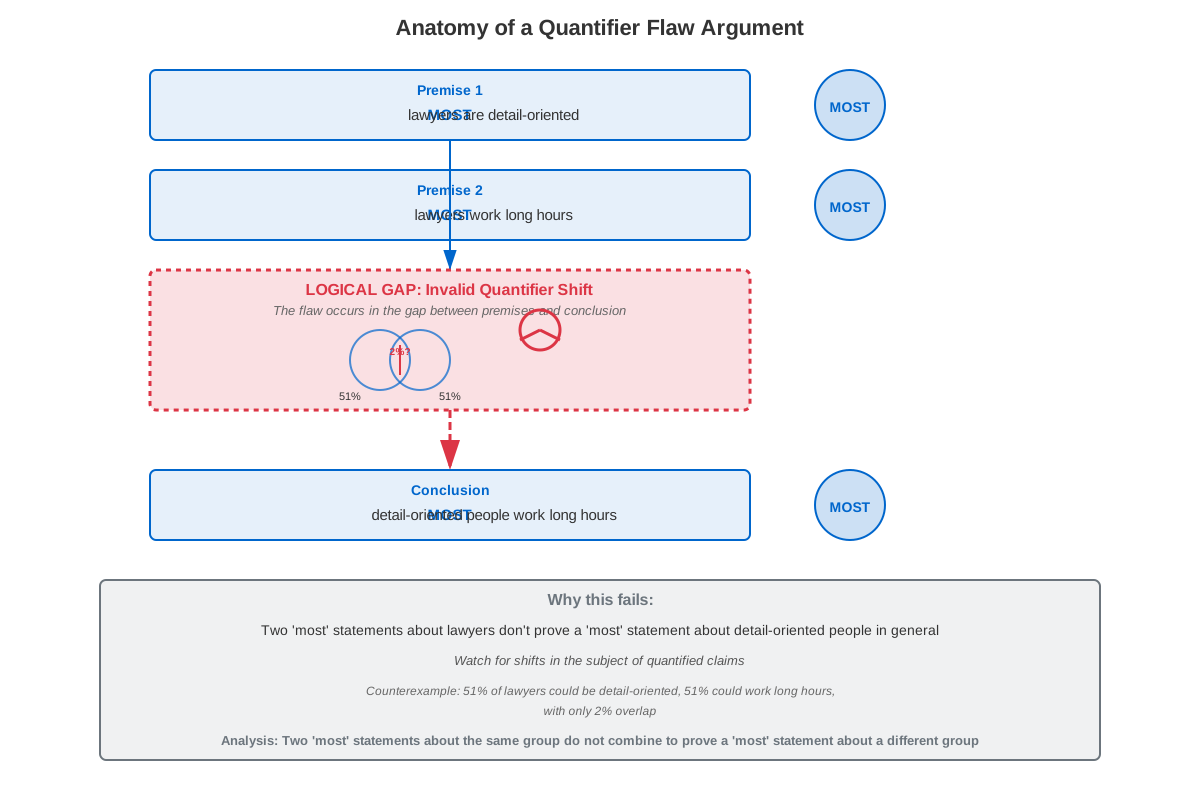
At its core, a lsat quantifier flaw involves treating statements with different quantitative scopes as if they were interchangeable. For example, an argument might conclude that "all X are Y" based solely on evidence that "some X are Y," or it might assume that because "most lawyers are detail-oriented" and "most lawyers work long hours," it follows that "most detail-oriented people work long hours." These shifts represent fundamental violations of logical reasoning principles that the LSAT tests rigorously.
Within the broader framework of formal logic and quantifiers, the quantifier flaw sits at the intersection of conditional reasoning and categorical logic. While conditional logic deals with "if-then" relationships, quantifier logic addresses the scope and distribution of claims across groups. Mastering quantifier flaws requires understanding not just what each quantifier means, but also what inferences are and are not valid when combining statements with different quantifiers. This topic connects directly to sufficient and necessary conditions, argument structure analysis, and the evaluation of evidence strength—all critical skills for achieving a competitive LSAT score.
Learning Objectives
- [ ] Identify how Quantifier flaw appears in LSAT questions
- [ ] Explain the reasoning pattern behind Quantifier flaw
- [ ] Apply Quantifier flaw to solve LSAT-style problems accurately
- [ ] Distinguish between valid and invalid quantifier inferences in complex arguments
- [ ] Recognize the specific language patterns that signal quantifier flaws
- [ ] Construct counterexamples that expose quantifier reasoning errors
- [ ] Evaluate answer choices by identifying which ones correctly describe quantifier shifts
Prerequisites
- Basic conditional logic: Understanding "if-then" statements is essential because quantifiers often interact with conditional relationships, and distinguishing between the two types of logical structures prevents confusion.
- Argument structure identification: Recognizing premises and conclusions allows students to pinpoint exactly where quantifier shifts occur within an argument's logical chain.
- Categorical statements: Familiarity with how statements make claims about groups (all members, some members, no members) provides the foundation for understanding how quantifiers function.
- Necessary vs. sufficient conditions: This distinction helps clarify why certain quantifier inferences fail—particularly when arguments confuse what's required with what's merely possible.
Why This Topic Matters
Quantifier flaws appear in approximately 15-20% of all Logical Reasoning questions on the LSAT, making them one of the highest-yield topics for test preparation. These flaws manifest across virtually every Logical Reasoning question type, though they appear most frequently in Flaw questions (where test-takers must identify the error), Assumption questions (where the correct answer bridges the quantifier gap), and Strengthen/Weaken questions (where answer choices exploit or repair quantifier relationships).
In real-world contexts, quantifier reasoning underlies critical thinking in law, policy analysis, scientific research, and everyday decision-making. Attorneys must distinguish between claims about all members of a class versus some members when interpreting statutes, contracts, and precedents. Policy makers must avoid overgeneralizing from limited data. The ability to recognize when someone has improperly shifted from "some" to "all" or from "most" to "every" represents a fundamental critical thinking skill that extends far beyond the LSAT.
On the exam, quantifier flaws typically appear in arguments that: (1) draw universal conclusions from limited evidence, (2) combine two "most" statements invalidly, (3) confuse "some" with "all" or "none," (4) treat the absence of evidence for "all" as evidence for "none," or (5) reverse the direction of a quantified relationship. Recognizing these patterns quickly allows test-takers to eliminate wrong answers efficiently and identify correct answers with confidence.
Core Concepts
Understanding Quantifiers and Their Logical Scope
Quantifiers are words or phrases that specify how many members of a group satisfy a particular condition. The primary quantifiers tested on the LSAT include:
| Quantifier | Meaning | Logical Scope | Example |
|---|---|---|---|
| All/Every/Each | 100% of the group | Universal affirmative | All lawyers passed the bar exam |
| No/None | 0% of the group | Universal negative | No cats are reptiles |
| Some/At least one | ≥1 member (could be all) | Particular affirmative | Some doctors specialize in cardiology |
| Most | >50% of the group | Majority | Most students study on weekends |
| Many/Several | Significant number (vague) | Indefinite | Many voters support the policy |
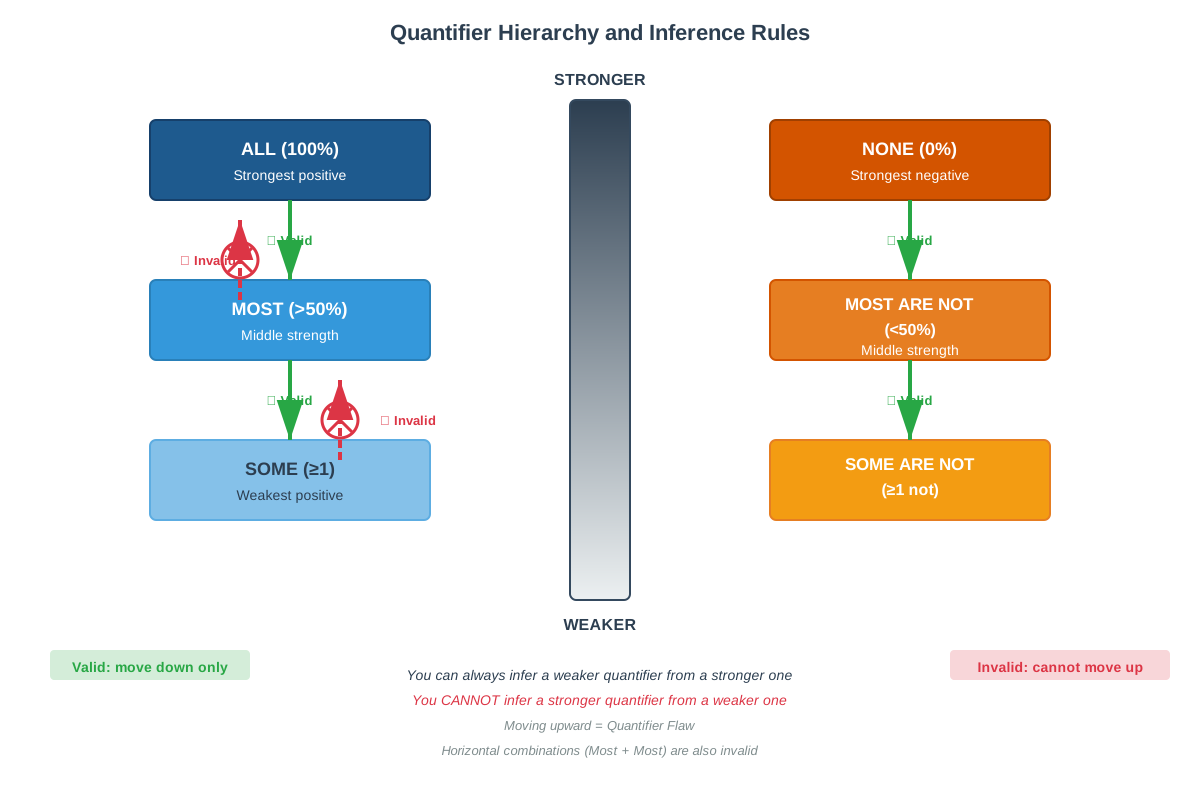
The logical scope of each quantifier determines what inferences are valid. "All" makes the strongest claim, applying to every single member without exception. "Some" makes the weakest claim, requiring only that at least one member satisfies the condition (though it doesn't exclude the possibility that all members do). "Most" occupies middle ground, requiring more than half but not necessarily all.
The Quantifier Flaw Pattern
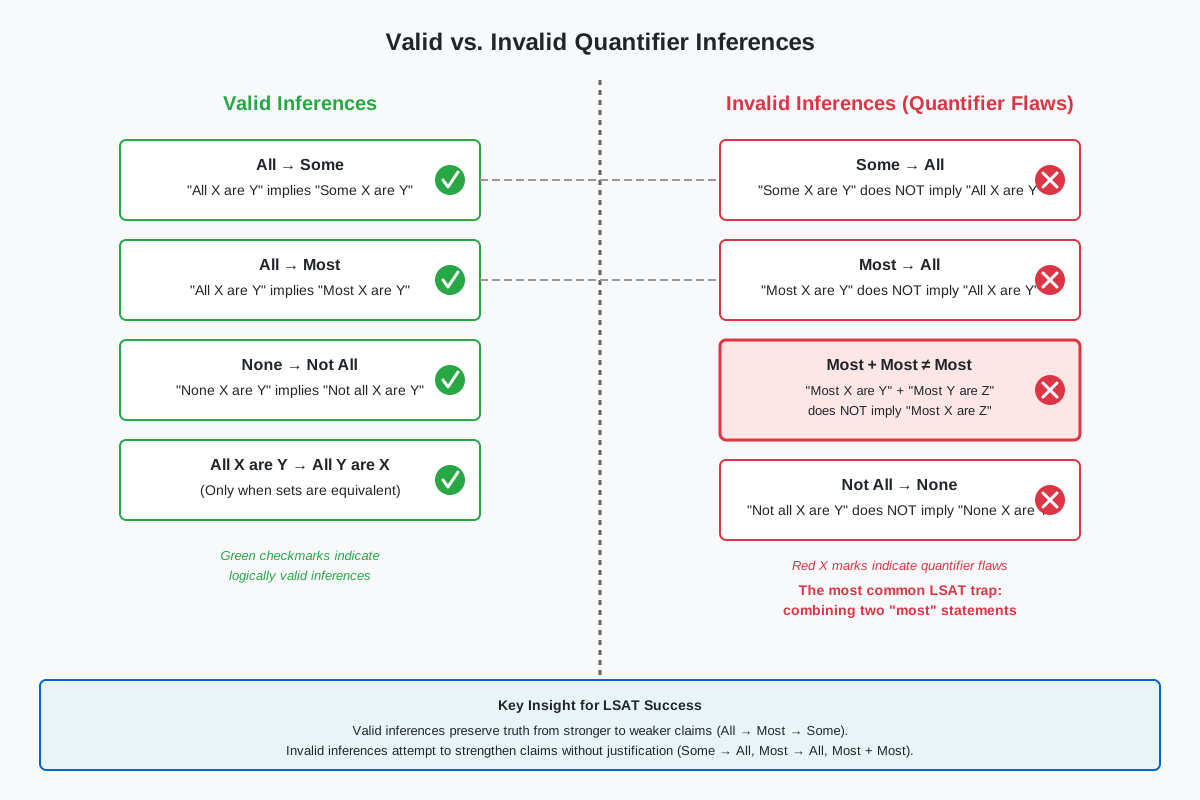
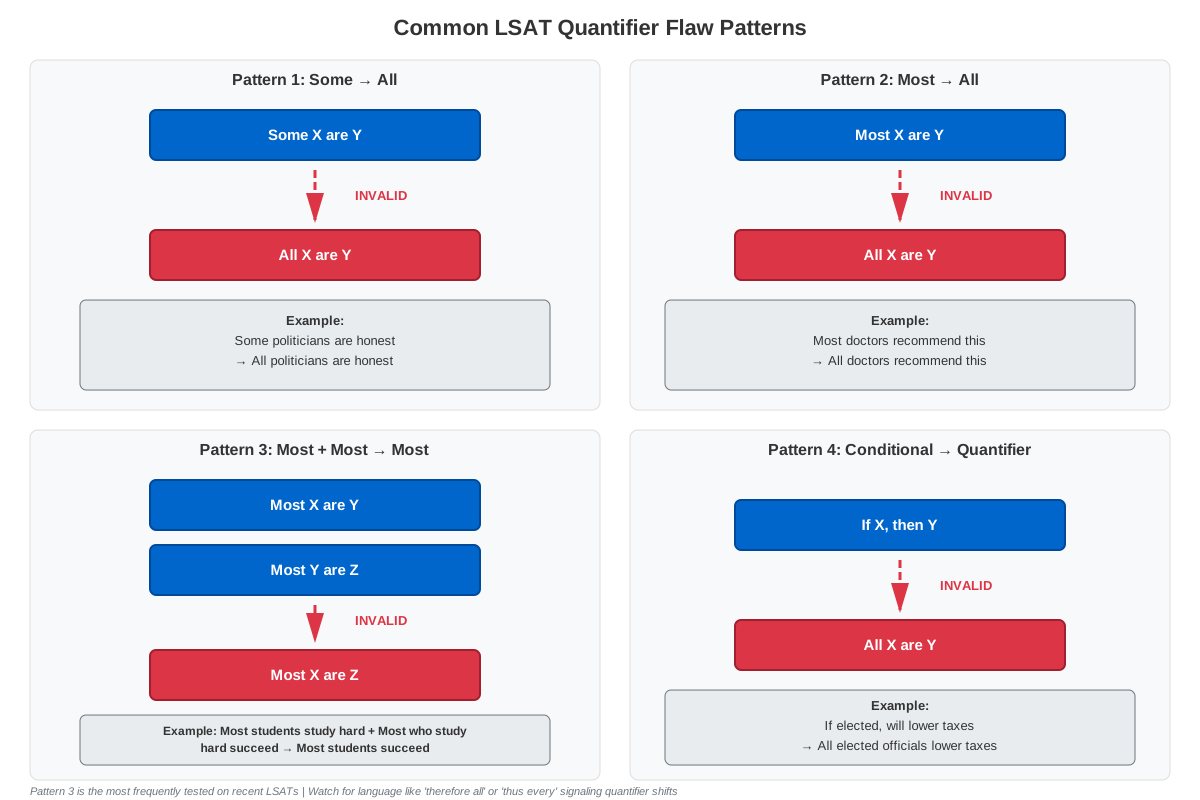
A quantifier flaw occurs when an argument treats statements with different quantifiers as if they support conclusions they cannot logically support. The most common patterns include:
Pattern 1: Some to All
- Premise: Some X are Y
- Invalid Conclusion: All X are Y
- Example: "Some politicians are dishonest. Therefore, all politicians are dishonest."
Pattern 2: Most to All
- Premise: Most X are Y
- Invalid Conclusion: All X are Y (or treating "most" as if it means "all")
- Example: "Most doctors recommend this treatment. Therefore, every doctor would recommend it."
Pattern 3: Invalid "Most" Combination
- Premise 1: Most X are Y
- Premise 2: Most X are Z
- Invalid Conclusion: Most Y are Z (or Most Z are Y)
- Example: "Most lawyers are detail-oriented. Most lawyers work long hours. Therefore, most detail-oriented people work long hours."
This third pattern is particularly tricky. Even though both premises share the same subject (X), we cannot validly conclude anything about the relationship between Y and Z. The overlap between the two "most" groups could be minimal or complete—we simply don't know.
Pattern 4: Absence of Universal to Universal Negative
- Premise: Not all X are Y (or "Some X are not Y")
- Invalid Conclusion: No X are Y
- Example: "Not all birds can fly. Therefore, no birds can fly."
Pattern 5: Reversing Quantified Relationships
- Premise: All X are Y
- Invalid Conclusion: All Y are X
- Example: "All roses are flowers. Therefore, all flowers are roses."
Valid Quantifier Inferences
Understanding what inferences ARE valid helps identify flaws by contrast:
Valid Inference 1: Universal to Particular
- If all X are Y, then some X are Y (assuming at least one X exists)
Valid Inference 2: Combining Universal and Particular
- If all X are Y, and some Y are Z, then some X are Z
Valid Inference 3: Contrapositive with Universal Quantifiers
- If all X are Y, then all non-Y are non-X
Valid Inference 4: Overlapping "Most" Statements
- If most X are Y, and most X are Z, then at least some Y are Z (there must be overlap)
- However, we cannot conclude that "most Y are Z" or "most Z are Y"
Quantifier Strength and Burden of Proof
Quantifiers exist on a spectrum of logical strength. Stronger claims require more evidence and are easier to disprove:
Strongest → Weakest:
All > Most > Many > Some > At least one
When an argument shifts from a weaker quantifier in the premises to a stronger quantifier in the conclusion, it commits a quantifier flaw. The conclusion claims more than the evidence supports. Conversely, shifting from a stronger premise to a weaker conclusion is typically valid (though it may be a weak argument for other reasons).
Quantifiers in Conditional Context
Quantifier flaws become more complex when combined with conditional statements. Consider:
- "All lawyers must pass the bar exam" (Universal + Conditional)
- "Some people who study hard succeed" (Particular + Conditional)
Arguments may commit quantifier flaws while also involving conditional reasoning errors. For instance: "Most successful people work hard. John works hard. Therefore, John will be successful." This argument commits both a quantifier flaw (treating "most" as "all") and a conditional reasoning error (affirming the consequent).
Concept Relationships
The quantifier flaw concept connects to multiple logical reasoning principles in a hierarchical structure:
Formal Logic Foundation → Quantifier Logic → Quantifier Flaws → Specific Question Types
Within quantifier logic itself, the relationships flow as follows:
Understanding Individual Quantifiers → Valid Quantifier Inferences → Invalid Quantifier Inferences (Flaws) → Identifying Flaws in Arguments → Selecting Correct Answer Choices
Quantifier flaws relate to prerequisite topics through these connections:
- Argument Structure: Quantifier flaws occur in the logical gap between premises and conclusion, so identifying this structure is essential for spotting the flaw.
- Conditional Logic: Many arguments combine quantifiers with conditionals (e.g., "All X are Y" can be expressed as "If X, then Y"), requiring integrated analysis.
- Necessary vs. Sufficient Conditions: Quantifier shifts often involve confusing what's sufficient for a conclusion with what's necessary, particularly when "some" or "most" appears.
The concept also connects forward to related topics:
- Sampling Flaws: These involve improper quantifier inferences from samples to populations (a specific type of quantifier flaw).
- Causal Reasoning: Causal arguments often commit quantifier flaws when generalizing from correlation data.
- Strengthen/Weaken Questions: Understanding quantifier flaws helps identify which answer choices properly address the quantifier gap.
High-Yield Facts
⭐ A "some" statement means "at least one" and is compatible with "all"—it does not mean "some but not all."
⭐ You cannot validly conclude anything definite about the relationship between Y and Z from "Most X are Y" and "Most X are Z."
⭐ "All X are Y" does NOT mean "All Y are X"—this reversal is always invalid.
⭐ Shifting from "some" or "most" in premises to "all" in the conclusion is the most common quantifier flaw pattern.
⭐ "Not all X are Y" is logically equivalent to "Some X are not Y"—it does NOT mean "No X are Y."
- The absence of evidence that "all X are Y" does not constitute evidence that "no X are Y."
- Two "most" statements about the same subject guarantee at least some overlap but nothing more specific.
- "Many" and "several" are logically vague quantifiers that cannot support precise inferences.
- A valid inference can only maintain or weaken the quantifier strength, never strengthen it without additional evidence.
- Quantifier flaws often appear disguised in everyday language that obscures the logical structure.
- The word "the" can sometimes function as a universal quantifier (e.g., "the tiger is endangered" means "all tigers").
- Existential import matters: "All unicorns are magical" may be vacuously true if no unicorns exist.
Quick check — test yourself on Quantifier flaw so far.
Try Flashcards →Common Misconceptions
Misconception: "Some" means "some but not all," so if some X are Y, then some X are not Y.
Correction: In formal logic, "some" means "at least one" and is compatible with "all." The statement "some X are Y" could be true even if all X are Y. It establishes a minimum, not a maximum.
Misconception: If most X are Y and most Y are Z, then most X are Z.
Correction: This inference is invalid. The two "most" statements could overlap minimally. For example, most students are right-handed, and most right-handed people are not students, so we cannot conclude most students are whatever most right-handed people are.
Misconception: "Not all X are Y" means the same as "No X are Y."
Correction: "Not all X are Y" means only that at least one X is not Y—it's compatible with most or many X being Y. "No X are Y" means zero X are Y, a much stronger claim.
Misconception: Quantifier flaws only appear in Flaw questions.
Correction: Quantifier flaws appear across all Logical Reasoning question types. In Assumption questions, the correct answer often bridges a quantifier gap. In Strengthen/Weaken questions, answer choices may exploit or repair quantifier relationships. In Parallel Reasoning questions, matching the quantifier structure is essential.
Misconception: If an argument uses the word "all," it cannot commit a quantifier flaw.
Correction: Arguments can commit quantifier flaws even when using "all" correctly in premises if they then make invalid inferences. For example, "All X are Y, and all Y are Z, therefore all Z are X" uses "all" throughout but commits a reversal error.
Misconception: "Most" means "almost all" or "the vast majority."
Correction: "Most" has a precise logical meaning: more than 50%. It could mean 51% or 99%, but arguments cannot assume it means closer to 100% without additional evidence.
Misconception: Combining any two quantified statements allows you to draw a conclusion about the relationship between the predicates.
Correction: Only certain combinations of quantified statements permit valid inferences. The specific quantifiers used and the logical structure of the statements determine what, if anything, can be concluded.
Worked Examples
Example 1: Identifying a Quantifier Flaw
Argument: "Most successful entrepreneurs take significant risks in their business ventures. Chen is a successful entrepreneur. Therefore, Chen must have taken significant risks in her business ventures."
Analysis:
Step 1: Identify the argument structure.
- Premise: Most successful entrepreneurs take significant risks
- Premise: Chen is a successful entrepreneur
- Conclusion: Chen must have taken significant risks
Step 2: Identify the quantifiers.
- "Most" in the first premise
- "Must" (equivalent to "all" or "definitely") in the conclusion
Step 3: Evaluate the logical inference.
The argument shifts from "most" to "must/all." The first premise tells us that more than 50% of successful entrepreneurs take significant risks, but this leaves room for some successful entrepreneurs who do not take significant risks. Chen could be in that minority group. The argument treats "most" as if it means "all," which is a classic quantifier flaw.
Step 4: Construct a counterexample.
Imagine 100 successful entrepreneurs: 60 take significant risks, 40 do not. The premise "most successful entrepreneurs take significant risks" is true. But Chen could be one of the 40 who do not, making the conclusion false even though the premises are true.
Step 5: Connect to learning objectives.
This example demonstrates how quantifier flaws appear in LSAT questions (Learning Objective 1), explains the reasoning pattern of shifting from "most" to "all" (Learning Objective 2), and shows how to identify the flaw systematically (Learning Objective 3).
How this would appear in different question types:
- Flaw question: "The reasoning is flawed in that it treats a characteristic of most members of a group as if it were a characteristic of all members of that group."
- Assumption question: "The argument assumes that Chen is not among the minority of successful entrepreneurs who do not take significant risks."
Example 2: Invalid "Most" Combination
Argument: "Most of the company's employees work in the marketing department. Most of the company's employees have graduate degrees. Therefore, most people with graduate degrees work in marketing departments."
Analysis:
Step 1: Identify the argument structure.
- Premise 1: Most employees → work in marketing
- Premise 2: Most employees → have graduate degrees
- Conclusion: Most people with graduate degrees → work in marketing
Step 2: Diagram the quantifier relationships.
Both premises are about "most employees," but the conclusion shifts to making a claim about "most people with graduate degrees" (a much larger group than just this company's employees).
Step 3: Identify the flaws.
This argument commits TWO quantifier flaws:
a) Invalid "most" combination: Even if we could conclude something about the relationship between marketing workers and graduate degree holders within this company, we cannot conclude that "most marketing workers have graduate degrees" or vice versa from these premises.
b) Scope shift: The conclusion expands from "this company's employees" to "people with graduate degrees" generally—a massive overgeneralization.
Step 4: Construct a counterexample.
Imagine a company with 100 employees:
- 60 work in marketing (most)
- 60 have graduate degrees (most)
- But only 20 employees both work in marketing AND have graduate degrees
- The other 40 marketing workers don't have graduate degrees
- The other 40 graduate degree holders work in other departments
Both premises are true, but there's no valid conclusion about "most" of either group. And certainly, we cannot conclude anything about graduate degree holders outside this company.
Step 5: Identify the correct answer approach.
In a Flaw question, look for answer choices mentioning: "treats evidence about a specific group as if it supports a conclusion about a much broader group" or "improperly infers a relationship between two characteristics from the fact that both are shared by most members of a group."
Exam Strategy
Trigger Words and Phrases
Watch for these quantifier words that signal potential flaws:
High-Alert Quantifiers: all, every, each, any, none, no, must, always, never, only
Medium-Alert Quantifiers: most, majority, usually, typically, generally, often
Weak Quantifiers: some, many, several, few, a number of, at least one
Exam Tip: When you see a shift from a weaker quantifier in the premises to a stronger quantifier in the conclusion, immediately suspect a quantifier flaw.
Systematic Approach to Quantifier Questions
- Identify all quantifiers in the argument (premises and conclusion)
- Map the logical structure: What groups are being discussed? What claims are made about each?
- Check for quantifier shifts: Does the conclusion use a stronger quantifier than the premises support?
- Test with numbers: Can you construct a scenario where the premises are true but the conclusion is false?
- Eliminate answer choices that don't address the quantifier issue
Process of Elimination Tips
In Flaw Questions:
- Eliminate answers that describe valid reasoning patterns
- Eliminate answers that describe flaws not present in the argument
- Keep answers that accurately describe the quantifier shift
In Assumption Questions:
- Eliminate answers that are irrelevant to the quantifier gap
- Keep answers that bridge the gap between the quantifier in the premise and the quantifier in the conclusion
- The correct answer often strengthens the quantifier (e.g., "All of the X that are Y are also Z" when the argument needs to connect most X to Z)
In Strengthen/Weaken Questions:
- Strengthen: Look for answers that provide evidence the stronger quantifier is justified
- Weaken: Look for answers that show the quantifier shift is unwarranted (e.g., providing a counterexample)
Time Allocation
Quantifier flaw questions should take approximately 1:00-1:30 minutes once you've mastered the patterns. Spend:
- 20-30 seconds reading and identifying the quantifier structure
- 20-30 seconds predicting the flaw or assumption
- 20-40 seconds evaluating answer choices
If you find yourself spending more than 2 minutes, you may be overcomplicating the analysis. Return to the basic question: "What quantifier appears in the premises, and what quantifier appears in the conclusion?"
Memory Techniques
The QUANTIFIER Acronym
Question every shift from weak to strong
Universal claims need universal evidence
All does not reverse to all
Not all ≠ none
Two "mosts" don't make a definite
Inferences must maintain or weaken strength
Few, many, several are too vague for precision
Identify the scope of each claim
Examine whether conclusion exceeds evidence
Reverse direction requires new evidence
Visualization Strategy: The Venn Diagram Test
When encountering quantifier statements, quickly sketch mental Venn diagrams:
- "All X are Y": Circle X completely inside circle Y
- "Some X are Y": Circles X and Y overlap partially
- "Most X are Y": More than half of circle X overlaps with circle Y
- "No X are Y": Circles X and Y don't touch
If the conclusion requires a diagram that doesn't follow from the premise diagrams, you've found a quantifier flaw.
The "Most" Rule Mnemonic
"Two MOSTS don't make a MUST"
This reminds you that combining two "most" statements cannot yield a definite conclusion about the relationship between the predicates.
The Strength Ladder
Remember quantifier strength with this visual:
ALL (top rung - strongest)
MOST (middle rung)
MANY (lower middle - vague)
SOME (bottom rung - weakest)
You can only climb down the ladder validly, never up without additional evidence.
Summary
The quantifier flaw represents a fundamental error in logical reasoning where arguments improperly shift between quantifiers of different strengths or make invalid inferences from quantified statements. The most common patterns include shifting from "some" or "most" to "all," invalidly combining two "most" statements, confusing "not all" with "none," and reversing quantified relationships. Understanding these patterns requires mastering what each quantifier means logically: "all" applies universally, "most" means more than half, "some" means at least one, and "none" means zero. Valid inferences maintain or weaken quantifier strength, while invalid inferences strengthen it without justification. On the LSAT, quantifier flaws appear across all Logical Reasoning question types, making this one of the highest-yield topics for test preparation. Success requires systematically identifying quantifiers in premises and conclusions, recognizing when shifts occur, and selecting answer choices that accurately describe or address the quantifier gap.
Key Takeaways
- Quantifier flaws occur when arguments shift from weaker to stronger quantifiers without adequate justification—most commonly from "some" or "most" to "all."
- "Some" means "at least one" in formal logic and is compatible with "all"—it establishes a minimum, not a maximum.
- Two "most" statements about the same subject cannot yield a definite conclusion about the relationship between the predicates, only that some overlap must exist.
- "Not all X are Y" means "at least one X is not Y," which is fundamentally different from "no X are Y."
- Valid quantifier inferences can only maintain or weaken the quantifier strength; strengthening requires additional evidence.
- Quantifier flaws appear in approximately 15-20% of Logical Reasoning questions across multiple question types, making pattern recognition essential for LSAT success.
- Systematic analysis—identifying quantifiers, mapping structure, checking for shifts, and testing with counterexamples—provides a reliable method for identifying and addressing quantifier flaws.
Related Topics
Conditional Logic Flaws: Understanding how "if-then" reasoning errors work complements quantifier flaw analysis, as many arguments combine both types of logical structures. Mastering quantifier flaws provides a foundation for recognizing when arguments confuse conditional relationships with quantified claims.
Sampling and Generalization Errors: These represent specific applications of quantifier flaws where arguments improperly generalize from samples to populations. The quantifier flaw framework directly applies to evaluating whether sample evidence supports universal or majority claims.
Necessary and Sufficient Assumptions: Quantifier flaws often appear in assumption questions where the correct answer must bridge the quantifier gap. Understanding the distinction between necessary assumptions (minimum required) and sufficient assumptions (enough to guarantee the conclusion) builds on quantifier logic principles.
Formal Logic Translations: Advanced LSAT preparation involves translating complex English statements into formal logical notation. Quantifier flaw mastery provides essential skills for this translation process, particularly in handling statements with multiple quantifiers or embedded conditionals.
Practice CTA
Now that you understand the core patterns and strategies for identifying quantifier flaws, it's time to apply this knowledge to actual LSAT questions. Work through the practice questions systematically, using the step-by-step approach outlined in this guide. Pay special attention to identifying the quantifiers in both premises and conclusions, and practice constructing counterexamples to test whether inferences are valid. The flashcards will help reinforce the key patterns and trigger words you need to recognize instantly on test day. Remember: quantifier flaws are among the most predictable and high-yield patterns on the LSAT—mastering them will significantly improve your Logical Reasoning score. Each practice question you complete strengthens your pattern recognition and builds the confidence you need to tackle these questions quickly and accurately under timed conditions.
Sign up free to keep reading
Create a free AnvayaPrep account to finish this LSAT guide on Quantifier flaw — plus flashcards and practice questions.