Overview
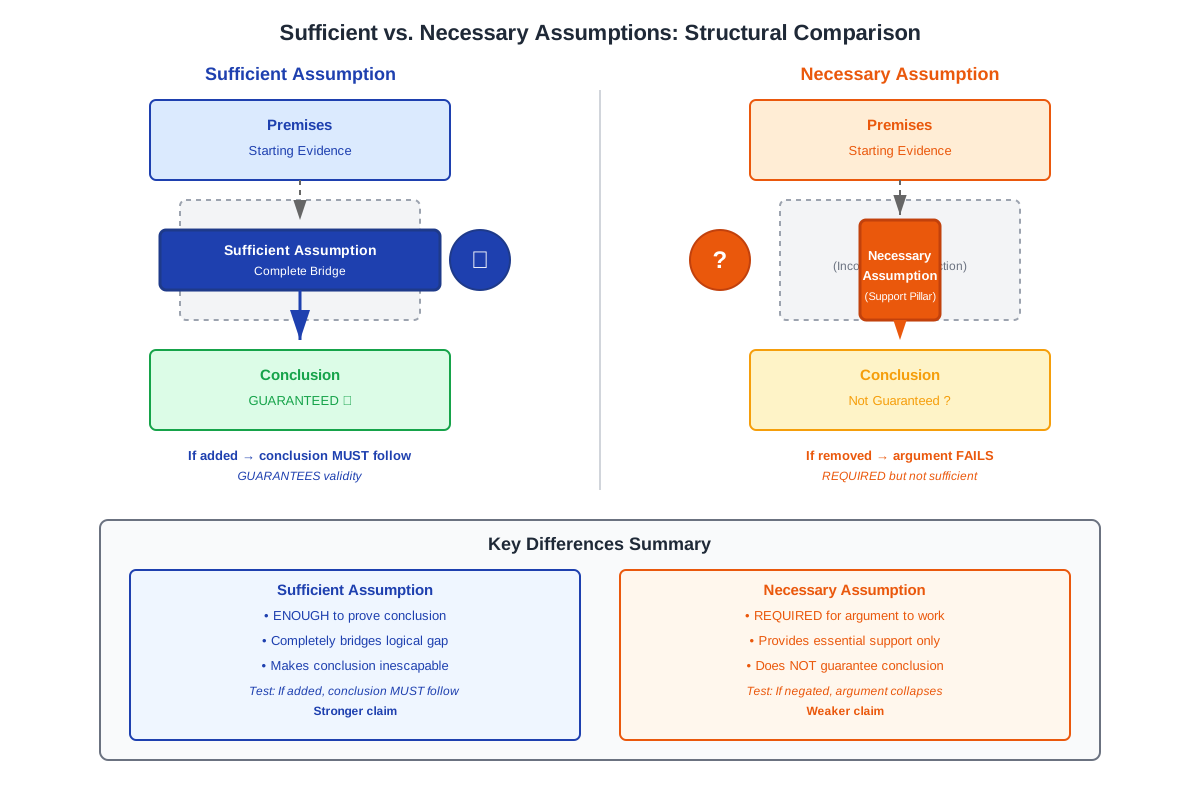
Sufficient assumptions represent one of the most critical question types within LSAT logical reasoning sections, appearing with remarkable frequency and testing a student's ability to identify what must be added to an argument to make it logically valid. Unlike necessary assumptions that identify what an argument requires to function, sufficient assumptions provide enough additional information to guarantee the conclusion follows from the premises. Mastering this question type is essential for achieving a competitive LSAT score, as these questions typically appear 2-4 times per logical reasoning section and demand precise analytical thinking.
The core challenge of sufficient assumption questions lies in recognizing logical gaps between premises and conclusions, then selecting the answer choice that perfectly bridges that gap. These questions test whether students can identify the exact piece of information that, when added to the argument, makes the conclusion inescapable. This skill extends beyond mere comprehension—it requires understanding formal logical relationships, recognizing argument structures, and evaluating the strength of inferential connections.
Within the broader landscape of assumption questions, sufficient assumptions occupy a unique position. While necessary assumption questions ask what an argument depends upon, sufficient assumption questions ask what would be enough to make the argument work. This distinction connects to other logical reasoning concepts including strengthening arguments, formal logic, and conditional reasoning. Understanding sufficient assumptions also builds foundational skills for tackling parallel reasoning questions, flaw questions, and principle questions, making this topic a cornerstone of LSAT preparation.
Learning Objectives
- [ ] Identify how sufficient assumptions appear in LSAT sufficient assumptions questions
- [ ] Explain the reasoning pattern behind sufficient assumptions and distinguish them from necessary assumptions
- [ ] Apply sufficient assumptions to solve LSAT-style problems accurately and efficiently
- [ ] Recognize the logical gap between premises and conclusions in arguments
- [ ] Evaluate answer choices using the "negation test" and "sufficiency test"
- [ ] Construct formal logical representations of sufficient assumption relationships
- [ ] Predict correct answers before reviewing answer choices based on argument structure
Prerequisites
- Basic argument structure: Understanding premises, conclusions, and inference patterns is essential because sufficient assumption questions require identifying where arguments have logical gaps
- Conditional reasoning fundamentals: Knowledge of if-then statements and their contrapositives helps recognize formal logical relationships that sufficient assumptions often establish
- Necessary assumptions: Familiarity with what arguments require provides contrast for understanding what would be sufficient to guarantee conclusions
- Argument evaluation skills: The ability to assess argument strength and identify reasoning flaws enables recognition of what information would complete an argument
Why This Topic Matters
Sufficient assumption questions represent approximately 10-15% of all logical reasoning questions on the LSAT, making them one of the highest-yield question types for focused study. Each LSAT typically contains 4-6 sufficient assumption questions across its two scored logical reasoning sections, and these questions often appear at medium to high difficulty levels, making them crucial for students aiming for scores above the 160 threshold.
In real-world applications, the reasoning skills developed through sufficient assumption practice translate directly to legal analysis, contract interpretation, and case argumentation. Lawyers constantly evaluate what additional facts or legal principles would be sufficient to establish a client's position or defeat an opponent's argument. This same analytical framework applies to policy analysis, scientific reasoning, and strategic decision-making across professional contexts.
On the LSAT, sufficient assumption questions typically appear with distinctive question stems such as "Which one of the following, if assumed, allows the conclusion to be properly drawn?" or "The conclusion follows logically if which one of the following is assumed?" These questions commonly test formal logical relationships, causal reasoning, categorical relationships, and comparative arguments. The LSAT frequently constructs these questions around abstract reasoning patterns, legal scenarios, scientific arguments, and policy debates, requiring students to focus on logical structure rather than content knowledge.
Core Concepts
Definition and Fundamental Nature
A sufficient assumption is a piece of information that, when added to an argument's premises, guarantees the conclusion must follow with logical certainty. The term "sufficient" means "enough"—the assumption provides everything needed to make the argument valid, even if other assumptions might also work. This contrasts with necessary assumptions, which identify what an argument requires but may not alone guarantee the conclusion.
The formal logical relationship can be expressed as: Premises + Sufficient Assumption → Conclusion (with certainty). When evaluating whether an answer choice provides a sufficient assumption, the test is straightforward: if you add this information to the argument, does the conclusion become inescapable? If yes, the assumption is sufficient; if the conclusion merely becomes more likely but not certain, the assumption strengthens but doesn't suffice.
Identifying Sufficient Assumption Questions
LSAT sufficient assumptions questions use specific language patterns in their question stems that signal what the question demands. Recognizing these patterns enables immediate strategic adjustment:
| Question Stem Language | What It Signals |
|---|---|
| "allows the conclusion to be properly drawn" | Pure sufficient assumption |
| "enables the conclusion to be properly inferred" | Pure sufficient assumption |
| "conclusion follows logically if" | Pure sufficient assumption |
| "justified in concluding...if" | Pure sufficient assumption |
| "properly inferred if which one is assumed" | Pure sufficient assumption |
These stems explicitly ask for information that makes the argument valid, distinguishing them from strengthen questions (which ask for support) or necessary assumption questions (which ask for requirements).
The Logical Gap
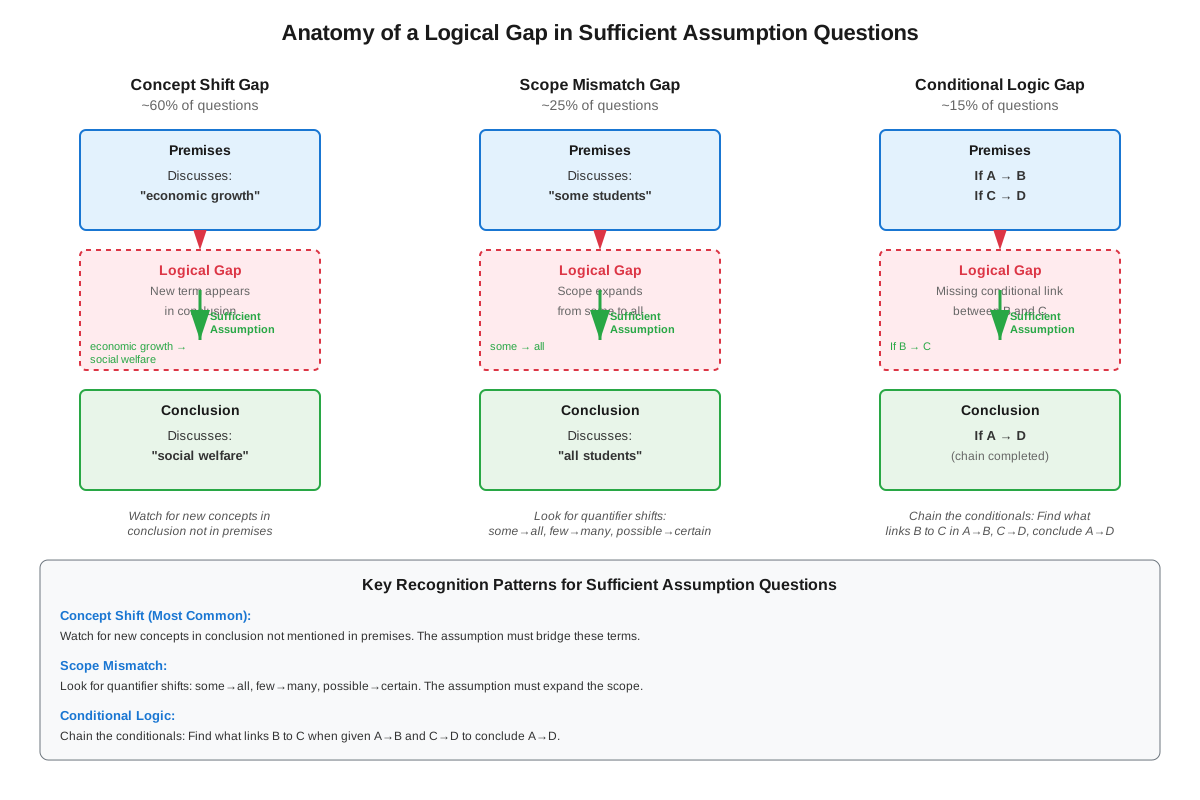
Every sufficient assumption question contains an argument with a logical gap—a disconnect between what the premises establish and what the conclusion claims. Identifying this gap is the crucial first step in solving these questions efficiently. The gap represents missing information that, when supplied, would complete the logical chain.
Common types of logical gaps include:
- Categorical gaps: Premises discuss one category while the conclusion discusses another (e.g., premises about "effective policies" but conclusion about "policies that should be implemented")
- Conditional gaps: Missing links in a chain of conditional statements
- Causal gaps: Premises establish correlation while conclusion claims causation
- Scope gaps: Conclusion makes broader claims than premises support
- Temporal gaps: Premises discuss one time period while conclusion addresses another
The Sufficiency Test
To determine whether an answer choice provides a sufficient assumption, apply this systematic test:
- Identify the conclusion: What is the argument trying to prove?
- Identify the premises: What evidence does the argument provide?
- Add the answer choice: Treat it as an additional premise
- Evaluate validity: Does the conclusion now follow with certainty?
If the answer to step 4 is "yes," the assumption is sufficient. If the conclusion becomes more likely but not certain, the answer choice strengthens but doesn't suffice. This distinction is critical—the LSAT frequently includes trap answers that support the argument without making it valid.
Formal Logic in Sufficient Assumptions
Many sufficient assumption questions involve formal logic relationships, particularly conditional statements. When an argument contains conditional reasoning, the sufficient assumption often completes a logical chain or establishes a necessary conditional relationship.
For example, if premises establish "A → B" and "C → D," while the conclusion claims "A → D," the sufficient assumption would be "B → C," completing the chain: A → B → C → D, therefore A → D.
Understanding these formal relationships enables prediction of correct answers before reviewing choices, dramatically improving accuracy and speed.
The Mechanistic Approach
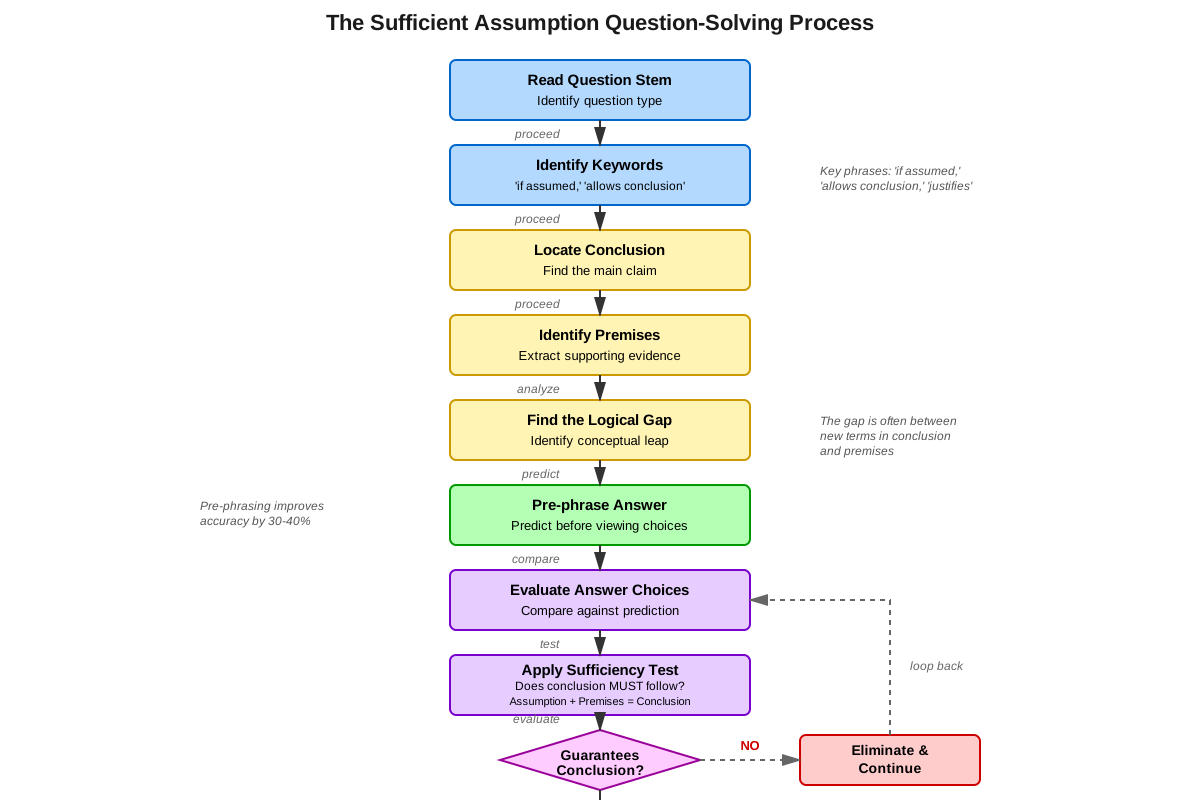
Successful sufficient assumption solving follows a mechanical process:
- Read and identify: Recognize the question type from the stem
- Isolate the conclusion: Identify exactly what must be proven
- Map the premises: Note what information is provided
- Spot the gap: Identify the logical disconnect
- Predict the bridge: Formulate what would connect premises to conclusion
- Evaluate choices: Test each answer using the sufficiency test
- Confirm: Verify the selected answer makes the conclusion certain
This systematic approach prevents common errors like selecting strengtheners instead of sufficient assumptions or choosing answers that address irrelevant aspects of the argument.
Concept Relationships
Sufficient assumptions connect intimately with multiple logical reasoning concepts, forming a web of related skills. Understanding these relationships deepens mastery and enables transfer of knowledge across question types.
The relationship map flows as follows: Basic argument structure → provides foundation for → Identifying logical gaps → enables → Recognizing sufficient assumptions → which connects to → Formal logic and conditional reasoning → and relates to → Necessary assumptions (through contrast) → while supporting → Strengthening arguments (as a special case where support guarantees validity).
Sufficient assumptions represent the strongest form of argument support—they don't merely make conclusions more likely (as strengtheners do) but make them certain. This positions sufficient assumptions at the apex of argument support concepts. Conversely, understanding necessary assumptions (what arguments require) provides contrast that clarifies what sufficient assumptions accomplish (what would be enough).
The connection to formal logic is particularly strong: many sufficient assumption questions can be solved through formal logical notation, treating the argument as a series of conditional statements where the sufficient assumption completes the logical chain. This relationship means that mastering conditional reasoning directly improves sufficient assumption performance.
High-Yield Facts
⭐ Sufficient assumptions make conclusions follow with logical certainty, not merely probability—if the conclusion could still be false after adding the assumption, it's not sufficient.
⭐ The correct answer will often connect two concepts that appear disconnected in the original argument—look for the gap between premises and conclusion.
⭐ Sufficient assumption questions typically have question stems containing "allows," "enables," "follows logically if," or "properly drawn/inferred"—these phrases signal sufficiency requirements.
⭐ The correct answer is often stronger and more absolute than necessary assumption answers—sufficient assumptions can be "overkill" while still being correct.
⭐ Wrong answers frequently strengthen the argument without making it valid—they make the conclusion more likely but not certain.
- Sufficient assumptions can be tested by adding them to the argument and checking if the conclusion becomes inescapable.
- Many sufficient assumption questions involve formal logic chains where the correct answer completes a conditional sequence.
- The logical gap in sufficient assumption questions often involves scope shifts, categorical jumps, or missing conditional links.
- Sufficient assumptions are always assumptions—they introduce new information not stated in the premises.
- Predicting the correct answer before reviewing choices dramatically improves accuracy on sufficient assumption questions.
- The negation test (used for necessary assumptions) is not the primary tool for sufficient assumptions—the sufficiency test is more direct.
- Sufficient assumption questions reward precise logical thinking over content knowledge or background information.
Quick check — test yourself on Sufficient assumptions so far.
Try Flashcards →Common Misconceptions
Misconception: Sufficient assumptions must be realistic or plausible in the real world. → Correction: Sufficient assumptions need only make the argument logically valid, regardless of real-world plausibility. The LSAT tests logical relationships, not factual accuracy. An assumption can be wildly implausible yet still sufficient if it bridges the logical gap.
Misconception: The correct answer will always be the shortest or simplest option. → Correction: Sufficient assumptions are often quite strong and may be lengthy because they need to guarantee the conclusion. Don't eliminate answers simply because they seem too comprehensive or absolute—sufficiency often requires strong claims.
Misconception: If an answer choice strengthens the argument, it must be the correct answer. → Correction: Strengthening is necessary but not sufficient (ironically). The correct answer must make the conclusion certain, not merely more likely. Many trap answers strengthen without sufficing.
Misconception: Sufficient assumptions and necessary assumptions are interchangeable concepts. → Correction: These are fundamentally different. Necessary assumptions identify what an argument requires (without which it fails); sufficient assumptions provide what would guarantee the conclusion (though other assumptions might also work). The same statement is rarely both necessary and sufficient.
Misconception: The correct answer will always directly restate part of the conclusion. → Correction: While sufficient assumptions must connect to the conclusion, they often introduce entirely new concepts that bridge gaps between premises and conclusion. The correct answer frequently contains terms not explicitly mentioned in the argument.
Misconception: You should use the negation test for sufficient assumption questions. → Correction: The negation test is designed for necessary assumptions. For sufficient assumptions, use the sufficiency test: add the answer choice to the premises and check if the conclusion must follow.
Misconception: Sufficient assumption questions are just harder versions of necessary assumption questions. → Correction: These question types test different logical skills. Sufficient assumptions require identifying what would guarantee validity; necessary assumptions require identifying what validity depends upon. The reasoning processes differ fundamentally.
Worked Examples
Example 1: Categorical Gap
Argument: "All the students who studied consistently throughout the semester passed the final exam. Therefore, the students who passed the final exam will succeed in their careers."
Question: Which one of the following, if assumed, allows the conclusion to be properly drawn?
Analysis:
Step 1 - Identify the conclusion: Students who passed the final exam will succeed in their careers.
Step 2 - Identify the premises: All students who studied consistently passed the final exam.
Step 3 - Spot the gap: The premise discusses "passing the final exam" while the conclusion discusses "career success." There's a categorical jump from academic performance to career outcomes. Additionally, the premise tells us about students who studied consistently, but the conclusion is about all students who passed (some might have passed without consistent study).
Step 4 - Predict the bridge: We need an assumption that connects passing the final exam to career success. Something like: "All students who pass the final exam will succeed in their careers" would be sufficient.
Step 5 - Evaluate answer choices:
(A) Students who succeed in their careers studied consistently in school. [This reverses the direction—it goes from career success to studying, not from passing exams to career success. Incorrect.]
(B) All students who pass the final exam will succeed in their careers. [This directly connects passing the exam to career success, making the conclusion follow with certainty. This is sufficient.]
(C) Most students who pass the final exam studied consistently. [This strengthens the connection between the premise and conclusion but doesn't guarantee career success for all who passed. Insufficient.]
(D) Consistent study habits are important for career success. [This is relevant but doesn't guarantee that passing the exam leads to career success. Insufficient.]
(E) The final exam accurately measures skills needed for career success. [This suggests a relationship but doesn't guarantee that passing leads to career success. Insufficient.]
Answer: (B)
Connection to learning objectives: This example demonstrates identifying the logical gap (categorical jump from exam performance to career success) and applying the sufficiency test to determine which answer makes the conclusion certain.
Example 2: Conditional Logic Chain
Argument: "If the company implements the new software system, employee productivity will increase. The company should implement any change that increases employee productivity. Therefore, the company should implement the new software system."
Question: The conclusion follows logically if which one of the following is assumed?
Analysis:
Step 1 - Identify the conclusion: The company should implement the new software system.
Step 2 - Identify the premises:
- Premise 1: New software → increased productivity
- Premise 2: Should implement any change that increases productivity
Step 3 - Spot the gap: This is a formal logic problem. We have "new software → increased productivity" and "increases productivity → should implement." But notice the second premise says "any change that increases productivity" should be implemented. The gap is whether implementing the software counts as a "change" in the relevant sense.
Step 4 - Predict the bridge: We need to establish that implementing the new software system qualifies as a "change" that the second premise covers. Something like: "Implementing the new software system is a change" would complete the logical chain.
Step 5 - Evaluate answer choices:
(A) The new software system is the only way to increase employee productivity. [This is too strong and unnecessary. Other methods could exist; we just need this one to work. Incorrect.]
(B) Implementing the new software system constitutes a change. [This completes the logical chain: new software → increased productivity, and implementing new software = a change, and changes that increase productivity should be implemented, therefore new software should be implemented. Sufficient.]
(C) Employee productivity is the most important factor in company success. [This is irrelevant to whether the software should be implemented based on the given premises. Incorrect.]
(D) The company has not previously implemented a software system. [This doesn't bridge the logical gap between the premises and conclusion. Incorrect.]
(E) Increased productivity will lead to higher profits. [This adds information beyond what's needed. The premises already establish that productivity increases warrant implementation. Incorrect.]
Answer: (B)
Connection to learning objectives: This example illustrates recognizing formal logical patterns in sufficient assumption questions and identifying how the correct answer completes a conditional reasoning chain.
Exam Strategy
Immediate Recognition Strategy
When approaching logical reasoning questions, immediately scan the question stem for sufficient assumption indicators: "allows," "enables," "follows logically if," "properly drawn," or "properly inferred." This instant recognition triggers the appropriate strategic approach and prevents confusion with other question types.
The Gap-First Method
Before reviewing answer choices, invest 15-20 seconds identifying the precise logical gap. Ask: "What concept appears in the conclusion but not adequately in the premises?" or "What logical leap does this argument make?" This prediction dramatically improves accuracy because you'll recognize the correct answer immediately rather than being seduced by attractive wrong answers.
Trigger Words and Phrases
Watch for these patterns in arguments that signal common sufficient assumption structures:
- Categorical shifts: "Therefore, all X are Y" when premises discuss different categories
- Causal language: "Therefore, X causes Y" when premises show only correlation
- Normative conclusions: "Should," "ought," "must" in conclusions when premises are purely descriptive
- Comparative claims: "Better than," "more important than" in conclusions without comparative premises
- Scope expansions: Conclusions about "all" or "every" when premises discuss "some" or specific instances
Process of Elimination Tactics
Eliminate answer choices that:
- Merely strengthen: If adding the choice makes the conclusion more likely but not certain, eliminate it
- Reverse the logic: Watch for answers that flip the direction of the required relationship
- Address irrelevant gaps: Some answers fix problems the argument doesn't have
- Introduce unnecessary information: While sufficient assumptions can be strong, they must connect to the actual gap
- Restate premises: Correct answers add new information, not just rephrase what's given
Time Allocation
Allocate approximately 1:20-1:30 per sufficient assumption question:
- 20-25 seconds: Read and understand the argument
- 15-20 seconds: Identify the gap and predict the answer
- 35-40 seconds: Evaluate answer choices
- 10-15 seconds: Confirm your selection
If you've clearly identified the gap, sufficient assumption questions can be solved quickly. If you're struggling to see the gap after 30 seconds, move to answer choices and test each systematically.
The Sufficiency Confirmation
Before finalizing your answer, perform this quick check: "If I add this answer choice to the argument as a new premise, does the conclusion absolutely must follow?" If there's any scenario where the premises plus your chosen answer could be true while the conclusion is false, you haven't found the sufficient assumption.
Memory Techniques
The BRIDGE Acronym
Remember the systematic approach to sufficient assumptions with BRIDGE:
- Break down the argument (identify premises and conclusion)
- Recognize the gap (spot the logical disconnect)
- Identify what's needed (predict the bridge)
- Determine sufficiency (test if conclusion becomes certain)
- Guarantee check (confirm no scenario defeats the conclusion)
- Eliminate alternatives (remove insufficient answers)
The Certainty Mantra
Remember: "Sufficient means certain, not just stronger." Repeat this when evaluating answers to avoid the common trap of selecting strengtheners instead of sufficient assumptions.
Visual Gap Mapping
Visualize arguments as bridges with missing planks:
[PREMISES] -------- ??? -------- [CONCLUSION]The sufficient assumption is the missing plank that completes the bridge. This visualization helps identify exactly what's missing and what would complete the connection.
The "If-Then-Must" Formula
For formal logic sufficient assumptions, remember: "If [premises] and [sufficient assumption], then [conclusion] must follow." The word "must" is key—it signals the certainty requirement.
Category Connection Mnemonic
For categorical gaps, remember "CATS": Conclusion And Terms Shift. When terms in the conclusion differ from premise terms, you need an assumption connecting those categories.
Summary
Sufficient assumptions represent a high-yield LSAT question type that tests the ability to identify what information would guarantee an argument's conclusion follows from its premises. Unlike necessary assumptions that identify what arguments require, sufficient assumptions provide enough information to make conclusions logically certain. Success on these questions depends on recognizing logical gaps between premises and conclusions, understanding that sufficiency means certainty rather than mere probability, and systematically testing whether answer choices make conclusions inescapable. The most common gaps involve categorical shifts, conditional logic chains, causal reasoning, and scope expansions. Effective strategy involves identifying the question type through stem language, predicting the logical bridge before reviewing answers, and applying the sufficiency test rather than the negation test. Students must distinguish between answers that strengthen arguments and those that guarantee conclusions—a critical distinction that separates correct answers from attractive traps. Mastering sufficient assumptions requires understanding formal logical relationships, recognizing argument structures, and developing the discipline to confirm that selected answers truly make conclusions certain rather than merely more likely.
Key Takeaways
- Sufficient assumptions make conclusions follow with logical certainty, not just increased probability—this is the defining characteristic that distinguishes them from strengtheners
- Question stems containing "allows," "enables," "follows logically if," or "properly drawn/inferred" signal sufficient assumption questions requiring specific strategic approaches
- The logical gap between premises and conclusions is the key to solving these questions—identify what's missing before evaluating answer choices
- Correct answers often connect two concepts that appear disconnected in the original argument, frequently introducing new terms that bridge categorical or logical gaps
- The sufficiency test (adding the answer to premises and checking if the conclusion must follow) is more effective than the negation test for these questions
- Common traps include answers that strengthen without sufficing, reverse logical relationships, or address irrelevant aspects of the argument
- Sufficient assumptions can be quite strong or even implausible—they need only make the argument valid, not realistic
Related Topics
Necessary Assumptions: Understanding what arguments require (rather than what would suffice) provides essential contrast and deepens comprehension of assumption types. Mastering sufficient assumptions makes necessary assumption questions clearer through comparison.
Formal Logic and Conditional Reasoning: Many sufficient assumption questions involve completing conditional chains or establishing logical relationships, making advanced formal logic skills directly applicable and highly valuable.
Strengthen Questions: These questions ask for support that makes conclusions more likely, representing a weaker form of what sufficient assumptions accomplish. Understanding sufficiency clarifies the distinction between strengthening and guaranteeing.
Flaw Questions: Recognizing logical gaps in sufficient assumption questions builds skills for identifying flaws, as flaws often represent missing assumptions that arguments fail to establish.
Principle Questions: Some principle questions function similarly to sufficient assumption questions, asking for general rules that would justify specific conclusions, making the reasoning patterns transferable.
Practice CTA
Now that you've mastered the conceptual framework for sufficient assumptions, it's time to cement your understanding through active practice. Attempt the practice questions designed for this topic, focusing on identifying logical gaps before reviewing answer choices. Use the flashcards to reinforce recognition of question stems and common gap patterns. Remember: sufficient assumption questions reward systematic thinking and precise logical analysis—skills that improve dramatically with deliberate practice. Each question you work through strengthens your ability to spot gaps instantly and predict correct answers, transforming these questions from challenging obstacles into reliable score-boosters. Your investment in mastering this high-yield topic will pay dividends throughout the logical reasoning sections and contribute significantly to achieving your target LSAT score.
Sign up free to keep reading
Create a free AnvayaPrep account to finish this LSAT guide on Sufficient assumptions — plus flashcards and practice questions.