Overview
Quantifier parallel reasoning represents one of the most sophisticated and frequently tested concepts in LSAT Logical Reasoning. This topic requires test-takers to recognize structural similarities between arguments that contain quantified statements—claims involving words like "all," "some," "most," "none," and "few." Unlike content-based reasoning, parallel reasoning questions demand that students focus exclusively on the logical structure of arguments, ignoring the specific subject matter while identifying matching patterns of quantification and logical relationships.
The LSAT tests quantifier parallel reasoning primarily through "Parallel Reasoning" and "Parallel Flaw" question types, which together constitute approximately 8-12% of all Logical Reasoning questions. These questions present an argument containing quantified statements and ask test-takers to identify another argument with an identical logical structure. Success requires fluency in formal logic and quantifiers, the ability to abstract arguments into their structural components, and the skill to match quantifier patterns precisely. Students who master this topic gain a significant advantage because these questions, while time-consuming for unprepared test-takers, become highly predictable and manageable with proper training.
Within the broader landscape of logical reasoning, quantifier parallel reasoning sits at the intersection of formal logic, argument structure analysis, and pattern recognition. It builds upon foundational understanding of categorical statements, conditional logic, and argument mapping while serving as a gateway to more advanced skills in identifying logical fallacies and evaluating argument strength. Mastery of this topic enhances performance not only on dedicated parallel reasoning questions but also improves overall analytical reading skills applicable to assumption, strengthen/weaken, and flaw questions throughout the LSAT.
Learning Objectives
- [ ] Identify how Quantifier parallel reasoning appears in LSAT questions
- [ ] Explain the reasoning pattern behind Quantifier parallel reasoning
- [ ] Apply Quantifier parallel reasoning to solve LSAT-style problems accurately
- [ ] Translate natural language arguments into formal quantifier notation
- [ ] Distinguish between valid and invalid quantifier-based inferences
- [ ] Recognize common quantifier patterns that appear repeatedly in parallel reasoning questions
- [ ] Evaluate answer choices efficiently by eliminating structural mismatches
Prerequisites
- Basic categorical logic: Understanding of universal and particular statements is essential for recognizing quantifier types and their logical properties
- Conditional reasoning fundamentals: Knowledge of sufficient and necessary conditions helps distinguish between different types of logical relationships in quantified arguments
- Argument structure identification: Ability to separate premises from conclusions enables proper mapping of parallel structures
- Negation principles: Understanding how to negate quantified statements is crucial for matching arguments with negative quantifiers
- Basic set theory concepts: Familiarity with relationships between groups (subsets, overlapping sets, disjoint sets) provides the conceptual foundation for quantifier logic
Why This Topic Matters
Quantifier parallel reasoning appears in virtually every LSAT administration, making it a high-yield topic that directly impacts test scores. Beyond the dedicated parallel reasoning questions, understanding quantifier logic enhances performance across multiple question types. When test-takers can quickly identify quantifier patterns, they gain speed and accuracy advantages that compound throughout the exam. The ability to abstract arguments into their logical structure—the core skill developed through this topic—transfers directly to legal reasoning, where attorneys must identify analogous cases and apply precedents based on structural similarities rather than superficial content matches.
On the LSAT, quantifier parallel reasoning appears most frequently in two question formats: standard Parallel Reasoning questions (which ask for structurally identical valid or neutral arguments) and Parallel Flaw questions (which require matching flawed reasoning patterns). These questions typically appear 2-3 times per Logical Reasoning section, with each question worth the same single point as any other question. However, their difficulty level and time consumption vary dramatically based on preparation—unprepared students often spend 2-3 minutes per question with low accuracy, while trained students can solve them in 60-90 seconds with high confidence.
The practical applications extend beyond test-taking. Legal professionals regularly employ parallel reasoning when arguing by analogy, citing precedents, and constructing arguments based on established logical patterns. Judges evaluate whether cases are "on all fours" (structurally parallel) with precedents. Legislators consider whether proposed laws parallel existing statutes in their logical structure. The cognitive skills developed through mastering quantifier parallel reasoning—pattern recognition, structural abstraction, and precise logical matching—represent fundamental competencies for legal analysis and critical thinking in professional contexts.
Core Concepts
Understanding Quantifiers in Logical Arguments
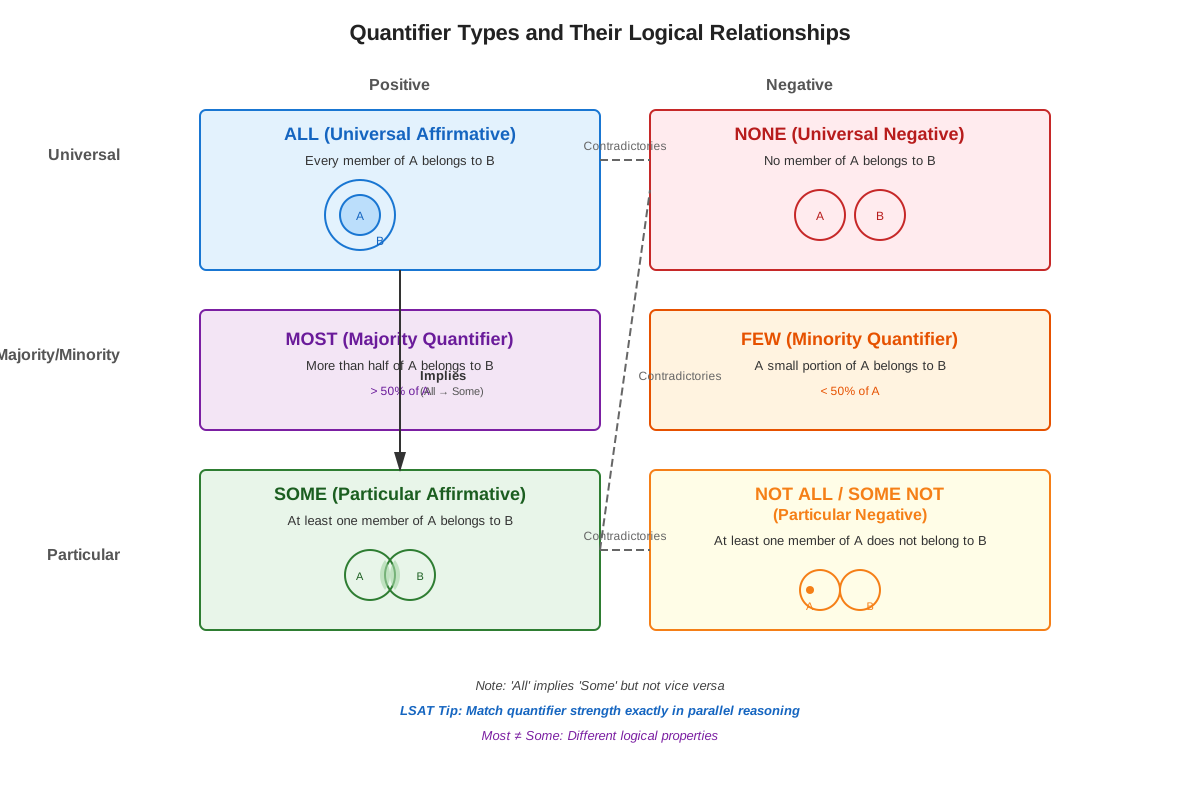
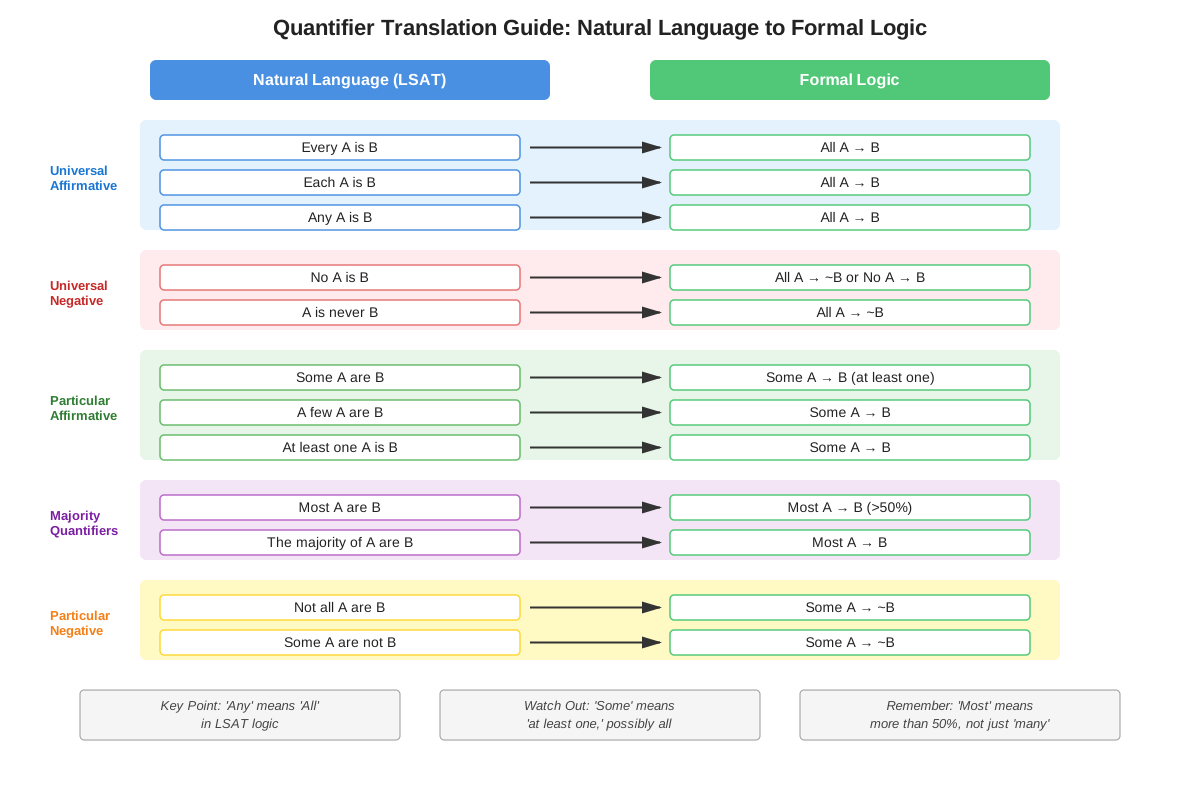
Quantifiers are words or phrases that specify the quantity or scope of a claim about a group or category. The primary quantifiers tested on the LSAT include:
| Quantifier | Logical Meaning | Symbolic Notation | Example |
|---|---|---|---|
| All/Every/Each | Universal affirmative | ∀x (A → B) | All lawyers are professionals |
| No/None | Universal negative | ∀x (A → ¬B) | No reptiles are mammals |
| Some/At least one | Existential affirmative | ∃x (A ∧ B) | Some doctors are researchers |
| Some...not | Existential negative | ∃x (A ∧ ¬B) | Some politicians are not honest |
| Most | Majority quantifier | >50% of A are B | Most students study regularly |
| Few/Many | Vague quantifiers | Unspecified proportion | Few people understand quantum physics |
Understanding these quantifiers forms the foundation of lsat quantifier parallel reasoning because matching arguments requires identical quantifier types in corresponding positions. An argument using "all" cannot parallel an argument using "most," even if the content seems similar.
The Structure of Quantified Arguments
Quantified arguments typically follow predictable structural patterns. The most common pattern involves two or more quantified premises leading to a quantified conclusion. Consider this structure:
- Premise 1: Quantifier₁ + Category A + Relationship + Category B
- Premise 2: Quantifier₂ + Category B + Relationship + Category C
- Conclusion: Quantifier₃ + Category A + Relationship + Category C
For parallel reasoning, the specific categories (A, B, C) are irrelevant—only the quantifiers and their relationships matter. An argument about "all dogs are mammals, and all mammals are animals, therefore all dogs are animals" parallels "all squares are rectangles, and all rectangles are polygons, therefore all squares are polygons" because both follow the identical structure: All A are B, All B are C, Therefore All A are C.
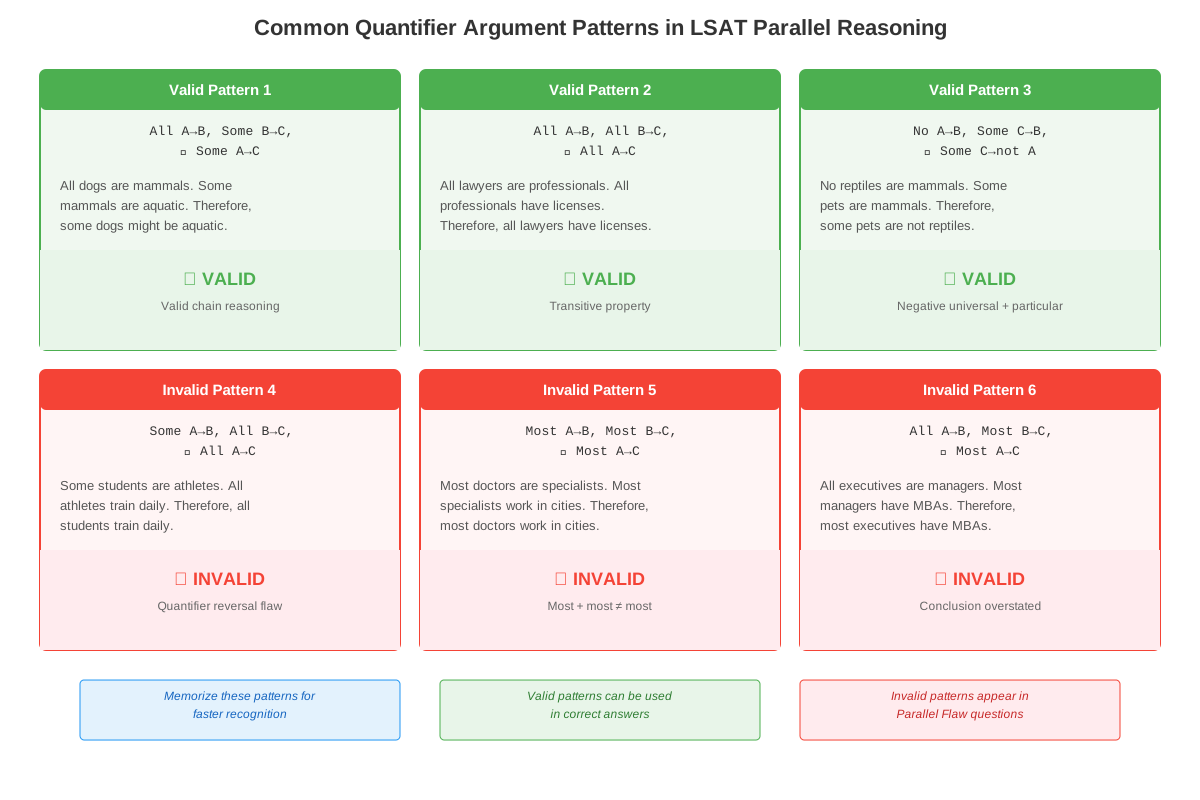
Valid Quantifier Inferences
Certain quantifier combinations produce valid inferences that appear repeatedly in LSAT parallel reasoning questions:
Universal Affirmative Chain (Barbara Syllogism):
- All A are B
- All B are C
- Therefore, All A are C
This represents the most common valid pattern. The conclusion necessarily follows from the premises through transitive property.
Universal Negative Pattern:
- All A are B
- No B are C
- Therefore, No A are C
This pattern combines universal affirmative and universal negative quantifiers to produce a valid negative conclusion.
Existential Introduction:
- All A are B
- Some things are A
- Therefore, Some things are B
This pattern moves from universal to particular (existential) claims validly.
Invalid Quantifier Patterns (Common Flaws)
Lsat quantifier parallel reasoning frequently tests recognition of flawed patterns. Understanding these helps identify Parallel Flaw questions:
Illicit Conversion (treating "All A are B" as if it means "All B are A"):
- All professional athletes are disciplined
- John is disciplined
- Therefore, John is a professional athlete
Undistributed Middle Term:
- All A are C
- All B are C
- Therefore, All A are B
This flaw occurs when two categories share membership in a third category, but the argument incorrectly concludes they're identical or overlapping.
Existential Fallacy (concluding something exists from purely universal premises):
- All unicorns are magical
- All magical creatures are rare
- Therefore, Some unicorns exist
Quantifier Shift (changing quantifier strength without justification):
- Most A are B
- Therefore, All A are B
Abstracting Arguments for Parallel Matching
The critical skill in quantifier parallel reasoning involves abstracting arguments—removing content while preserving structure. This process requires:
- Identify all quantifiers in premises and conclusion
- Map logical relationships (category membership, conditional relationships, causal claims)
- Note the argument's validity status (valid, invalid, or neutral)
- Create a structural template using variables (A, B, C) instead of content terms
- Match the template against answer choices systematically
For example, abstract this argument: "Most successful entrepreneurs take calculated risks. Maria takes calculated risks. Therefore, Maria is probably a successful entrepreneur."
Template: Most A are B. X is B. Therefore, X is probably A.
This template reveals an invalid inference (affirming the consequent with a "most" quantifier), which must be matched exactly in the correct answer.
Compound Quantifier Structures
Advanced LSAT questions feature compound structures combining multiple quantifier types:
- "All A are either B or C" (universal with disjunction)
- "Some A are both B and C" (existential with conjunction)
- "Most A are B, but few B are C" (mixed quantifiers with contrast)
These compound structures require careful attention to logical connectives (and, or, but, unless) in addition to quantifiers. The parallel answer must match both the quantifiers AND the logical connectives in identical positions.
Temporal and Modal Quantifiers
Some arguments include temporal or modal elements that function as implicit quantifiers:
- "Always" = All times
- "Never" = No times
- "Sometimes" = Some times
- "Usually" = Most times
- "Must" = Necessarily (all possible worlds)
- "Might" = Possibly (some possible worlds)
Recognizing these implicit quantifiers prevents mismatches where an argument about temporal frequency is incorrectly matched with an argument about necessity or possibility.
Concept Relationships
The concepts within quantifier parallel reasoning form an interconnected hierarchy. At the foundation lies quantifier identification—recognizing and categorizing quantifier types in natural language. This skill enables argument abstraction, the process of converting content-rich arguments into structural templates. Argument abstraction depends on understanding both valid quantifier inferences (which establish what conclusions legitimately follow from quantified premises) and invalid quantifier patterns (which reveal common logical flaws).
These foundational concepts converge in the practical skill of parallel matching, where test-takers systematically compare argument structures. Parallel matching requires simultaneous attention to compound quantifier structures (arguments with multiple quantifier types) and temporal/modal quantifiers (implicit quantifiers embedded in time or possibility language).
The relationship to prerequisite topics flows logically: Basic categorical logic provides the vocabulary and concepts for understanding quantifiers → Conditional reasoning fundamentals establish the logical relationships that quantifiers describe → Argument structure identification enables separation of premises from conclusions → Negation principles allow recognition of negative quantifiers and their logical properties → Set theory concepts provide the mathematical foundation for understanding quantifier relationships.
Progression to advanced topics follows naturally: Mastering quantifier parallel reasoning enables deeper understanding of formal logic proofs, modal logic, and predicate calculus. It also enhances performance on assumption questions (which often hinge on quantifier scope), strengthen/weaken questions (where quantifier shifts affect argument force), and flaw questions (which frequently involve quantifier-based errors).
High-Yield Facts
⭐ Parallel reasoning questions require identical quantifier types in corresponding positions—"all" cannot match "most," and "some" cannot match "many"
⭐ The content of arguments is irrelevant in parallel reasoning—arguments about completely different topics can be structurally identical
⭐ Valid arguments must be matched with valid arguments, and flawed arguments with identically flawed arguments—validity status is part of the structure
⭐ The conclusion's quantifier must match exactly—this is the most efficient elimination criterion because it appears last and is easiest to check
⭐ "Most" statements cannot chain validly—"Most A are B" and "Most B are C" does NOT validly conclude "Most A are C"
- Universal quantifiers (all, every, each, no, none) distribute over their subjects, while particular quantifiers (some, few, many) do not
- Negative quantifiers (no, none, not all, some...not) must be matched with negative quantifiers in the same logical position
- Conditional statements ("if...then") function as universal quantifiers and must match other conditionals or universal statements
- The number of premises must match exactly—a two-premise argument cannot parallel a three-premise argument
- Intermediate conclusions (sub-conclusions) must appear in the same structural position in parallel arguments
- Quantifier scope matters—"All A are not B" differs structurally from "Not all A are B"
- Implicit quantifiers (like "typically," "generally," "rarely") must be recognized and matched appropriately
- Causal language ("causes," "leads to," "results in") represents a specific type of relationship that must be matched with identical causal structure
- Comparative quantifiers ("more than," "fewer than," "as many as") require exact matching with other comparative structures
- Disjunctive quantifiers ("either...or") and conjunctive quantifiers ("both...and") must match in both quantifier type and logical connective
Quick check — test yourself on Quantifier parallel reasoning so far.
Try Flashcards →Common Misconceptions
Misconception: If two arguments reach similar conclusions about similar topics, they are parallel. → Correction: Parallel reasoning depends entirely on logical structure, not content similarity. Arguments about completely different subjects can be perfectly parallel, while arguments about the same topic with different quantifier patterns are not parallel.
Misconception: "Most" and "all" are close enough to be considered parallel since "most" means "almost all." → Correction: Quantifier precision is absolute in parallel reasoning. "Most" (>50%) and "all" (100%) represent fundamentally different logical relationships. "Most A are B" and "Most B are C" cannot validly conclude "Most A are C," while "All A are B" and "All B are C" validly concludes "All A are C."
Misconception: If an argument is invalid, any other invalid argument will be parallel to it. → Correction: Invalid arguments must share the identical flaw pattern. An argument committing the fallacy of affirming the consequent is not parallel to an argument committing the fallacy of undistributed middle, even though both are invalid.
Misconception: The order of premises doesn't matter as long as the same quantifiers appear somewhere in the argument. → Correction: Premise order and logical flow are structural features. An argument structured as "All A are B, therefore All B are C" is not parallel to "All B are C, therefore All A are B," even if both contain the same quantifiers.
Misconception: "Some" and "few" are interchangeable in parallel reasoning. → Correction: "Some" is a precise logical quantifier meaning "at least one," while "few" is a vague quantifier suggesting "a small number." These represent different quantifier types and cannot be matched in parallel reasoning questions.
Misconception: Parallel Flaw questions are easier than standard Parallel Reasoning questions because you only need to find any flaw. → Correction: Parallel Flaw questions require identifying the specific flaw type and matching it exactly. They are typically more difficult because test-takers must recognize both the argument structure and the precise nature of the logical error.
Misconception: If the conclusion uses a qualifier like "probably" or "likely," the premises must also contain probability language. → Correction: Probability qualifiers in conclusions often result from inductive reasoning patterns where the premises provide strong but not conclusive support. The parallel argument must match the strength of inference, not necessarily use identical probability words in premises.
Worked Examples
Example 1: Valid Universal Quantifier Chain
Original Argument: "All members of the debate team are skilled public speakers. All skilled public speakers have overcome fear of audiences. Therefore, all members of the debate team have overcome fear of audiences."
Step 1 - Identify Quantifiers:
- Premise 1: "All" (universal affirmative)
- Premise 2: "All" (universal affirmative)
- Conclusion: "Therefore, all" (universal affirmative)
Step 2 - Abstract the Structure:
- All A are B
- All B are C
- Therefore, All A are C
Step 3 - Assess Validity:
This is a valid syllogism (Barbara form). The conclusion necessarily follows through transitive property.
Step 4 - Evaluate Answer Choices:
(A) "Most professional musicians practice daily. Most people who practice daily improve their skills. Therefore, most professional musicians improve their skills."
- Structure: Most A are B, Most B are C, Therefore Most A are C
- Eliminate: Quantifier mismatch ("most" vs. "all") and invalid inference (most + most ≠ most)
(B) "All electric vehicles use battery power. All devices using battery power require charging. Therefore, all electric vehicles require charging."
- Structure: All A are B, All B are C, Therefore All A are C
- Match: Identical quantifier pattern and valid inference structure
(C) "All senators are elected officials. Some elected officials are governors. Therefore, some senators are governors."
- Structure: All A are B, Some B are C, Therefore Some A are C
- Eliminate: Quantifier mismatch in Premise 2 ("some" vs. "all") and invalid inference
(D) "All reptiles are cold-blooded. All cold-blooded animals are vertebrates. Therefore, some reptiles are vertebrates."
- Structure: All A are B, All B are C, Therefore Some A are C
- Eliminate: Conclusion quantifier mismatch ("some" vs. "all") and unnecessarily weak conclusion
Answer: (B) - This matches the original argument's structure perfectly with identical quantifiers in all positions and the same valid inference pattern.
Example 2: Parallel Flaw with Quantifier Shift
Original Argument: "Most successful novelists read extensively. Kenji reads extensively. Therefore, Kenji is probably a successful novelist."
Step 1 - Identify Quantifiers and Structure:
- Premise 1: "Most A are B" (Most successful novelists read extensively)
- Premise 2: "X is B" (Kenji reads extensively)
- Conclusion: "Therefore, X is probably A" (Kenji is probably a successful novelist)
Step 2 - Identify the Flaw:
This commits the fallacy of affirming the consequent with a "most" quantifier. The argument treats "Most A are B" as if it means "Most B are A," which is invalid. Reading extensively is common among successful novelists, but it's also common among many other groups (students, researchers, hobbyists), so being in group B doesn't make someone probably in group A.
Step 3 - Create Matching Template:
- Most A are B
- X is B
- Therefore, X is probably A
- Flaw type: Reverse inference from "most" statement
Step 4 - Evaluate Answer Choices:
(A) "Most professional athletes train intensively. Training intensively improves performance. Therefore, most professional athletes have improved performance."
- Structure: Most A are B, B causes C, Therefore Most A have C
- Eliminate: Different structure (introduces causation) and different flaw type
(B) "Most award-winning films have complex narratives. This film has a complex narrative. Therefore, this film will probably win awards."
- Structure: Most A are B, X is B, Therefore X is probably A
- Match: Identical structure and identical flaw (reverse inference from "most")
(C) "All professional chefs have culinary training. Marcus has culinary training. Therefore, Marcus is a professional chef."
- Structure: All A are B, X is B, Therefore X is A
- Eliminate: Uses "all" instead of "most" (though it commits a similar reverse inference flaw)
(D) "Most successful entrepreneurs take risks. Most people who take risks fail. Therefore, most successful entrepreneurs fail."
- Structure: Most A are B, Most B are C, Therefore Most A are C
- Eliminate: Different structure (two "most" premises) and different flaw type (invalid chaining)
Answer: (B) - This perfectly matches both the quantifier structure and the specific flaw pattern of the original argument.
Exam Strategy
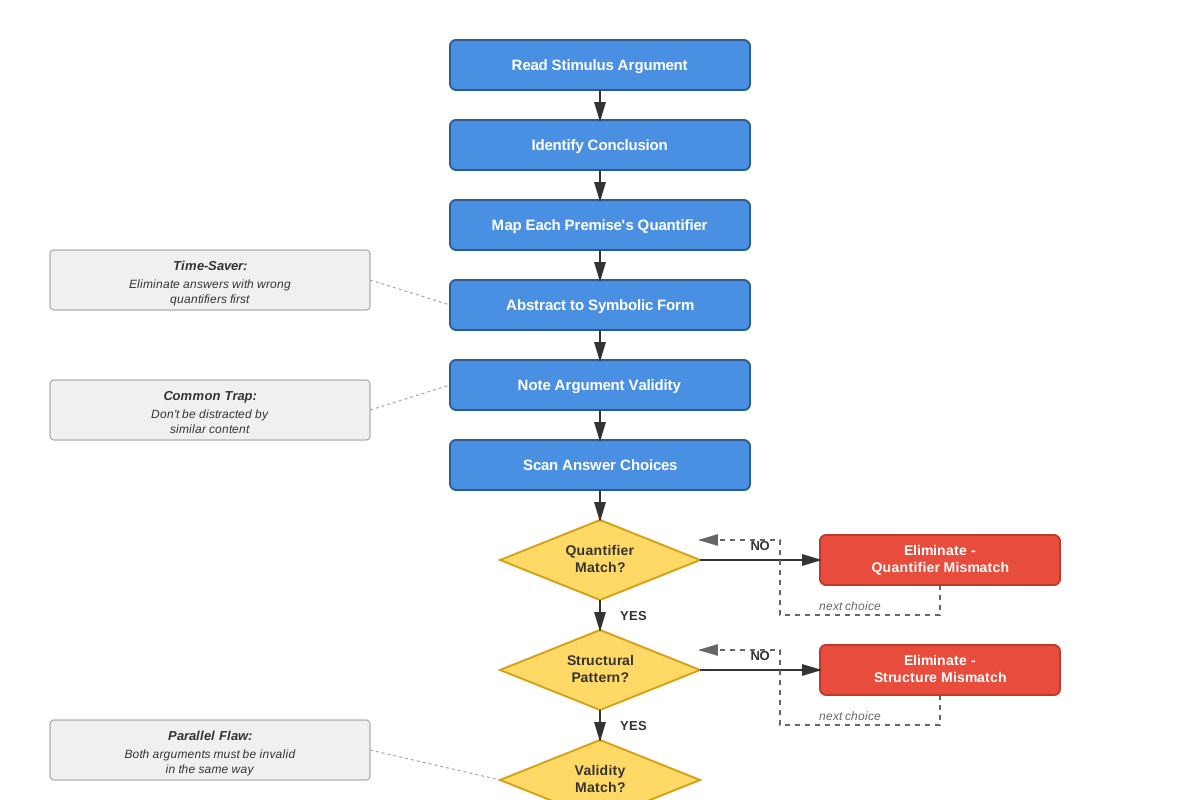
Systematic Approach to Parallel Reasoning Questions
Step 1: Read the question stem first to determine whether you're matching valid reasoning or flawed reasoning. This determines your evaluation criteria.
Step 2: Analyze the original argument's structure before reading answer choices:
- Circle or note all quantifiers
- Identify the conclusion
- Count the number of premises
- Assess validity (if applicable)
- Create a mental or written template
Step 3: Use the conclusion as your primary filter. The conclusion's quantifier and structure must match exactly. Eliminate any answer choice whose conclusion differs in quantifier type, strength, or logical form. This typically eliminates 2-3 answer choices immediately.
Step 4: Check premise quantifiers systematically. Work through remaining answer choices, comparing each premise's quantifier to the original. Eliminate mismatches.
Step 5: Verify logical relationships. Ensure that the relationships between categories (membership, causation, correlation) match the original argument's relationships.
Trigger Words and Phrases
Watch for these quantifier indicators:
Universal Affirmative: all, every, each, any, always, necessarily, must, only (when used as "all A are B")
Universal Negative: no, none, never, not any, cannot, impossible
Existential Affirmative: some, at least one, there exists, a few, several, many
Existential Negative: some...not, not all, not every, not always
Majority Quantifiers: most, majority, more than half, usually, typically, generally
Comparative Quantifiers: more than, fewer than, less than, as many as, at least as
Probability Indicators: probably, likely, possibly, might, could, may
Time Management
Allocate 90-120 seconds for parallel reasoning questions. If you exceed 2 minutes, make your best guess and move on—these questions can become time sinks that damage overall section performance.
Time-saving techniques:
- Eliminate based on conclusion first (15-20 seconds)
- Skip answer choices with obvious quantifier mismatches in the first premise
- If two answer choices remain after structural analysis, choose the one with more precise quantifier matching
- Practice abstracting arguments quickly through repeated exposure
Process of Elimination Tips
Eliminate immediately if:
- The conclusion uses a different quantifier type
- The number of premises differs
- The argument is valid when the original is flawed (or vice versa)
- A premise introduces a concept not present in the original argument's structure
- Logical connectives (and, or, if-then) differ from the original
Be cautious with:
- Answer choices that use the same content words as the original (often distractors)
- Arguments that "feel" similar but have subtle quantifier differences
- Answer choices that commit a different flaw than the original (in Parallel Flaw questions)
Memory Techniques
The QUANT Mnemonic for Parallel Reasoning
Quantifiers must match exactly
Understand the structure, not the content
Abstract to variables (A, B, C)
Number of premises must be identical
Test the conclusion first
Visualization Strategy: The Venn Diagram Method
For arguments with categorical quantifiers, quickly sketch mental Venn diagrams:
- "All A are B" = Circle A entirely within circle B
- "Some A are B" = Circles A and B overlap
- "No A are B" = Circles A and B completely separate
- "Most A are B" = More than half of circle A overlaps with circle B
Match the Venn diagram pattern of the original argument with answer choices.
The Quantifier Hierarchy Pyramid
Memorize quantifier strength from strongest to weakest:
        ALL/NONE (100%/0%)
              ↓
          MOST (>50%)
              ↓
        MANY/FEW (vague)
              ↓
        SOME (≥1)
Parallel arguments must use quantifiers at the same level of this pyramid.
The "Flaw Family" Acronym: ACES
Common quantifier flaws form the ACES family:
Affirming the consequent (treating "All A are B" as "All B are A")
Chaining "most" statements invalidly
Existential fallacy (concluding existence from universal premises)
Shifting quantifier strength without justification
When identifying Parallel Flaw questions, check which ACES flaw appears.
Summary
Quantifier parallel reasoning represents a high-yield LSAT topic that rewards systematic preparation. Success requires mastering the ability to abstract arguments into structural templates by identifying quantifier types, mapping logical relationships, and ignoring content. The core principle is that parallel arguments must match in quantifier types, number and order of premises, logical connectives, and validity status—while content remains completely irrelevant. Test-takers must distinguish between universal quantifiers (all, none), existential quantifiers (some), and majority quantifiers (most), recognizing that these cannot be substituted for one another. Valid quantifier patterns like the universal affirmative chain (All A are B, All B are C, Therefore All A are C) appear frequently and must be distinguished from invalid patterns like illicit conversion and undistributed middle terms. Efficient test-taking strategy involves checking the conclusion's quantifier first to eliminate mismatches quickly, then systematically verifying premise quantifiers. Understanding both valid inference patterns and common quantifier-based flaws enables accurate performance on both standard Parallel Reasoning and Parallel Flaw questions, which together constitute a significant portion of Logical Reasoning sections.
Key Takeaways
- Quantifier precision is absolute: "All," "most," and "some" represent fundamentally different logical relationships that cannot be substituted in parallel reasoning
- Structure trumps content: Arguments about completely different topics can be perfectly parallel if their quantifier patterns and logical relationships match exactly
- The conclusion is your best filter: Eliminate answer choices with mismatched conclusion quantifiers first to save time and improve accuracy
- Valid and invalid arguments require different matching criteria: Valid arguments must parallel other valid arguments with identical inference patterns; flawed arguments must match the specific flaw type
- "Most" statements don't chain: Unlike universal quantifiers, "Most A are B" and "Most B are C" does not validly conclude "Most A are C"
- Implicit quantifiers matter: Temporal words (always, never, sometimes) and modal words (must, might) function as quantifiers and must be matched appropriately
- Practice abstraction systematically: Develop the habit of converting arguments to variable notation (All A are B) to see structure clearly and match patterns efficiently
Related Topics
Conditional Logic and Sufficient/Necessary Conditions: Builds on quantifier reasoning by exploring "if-then" relationships, which function as universal quantifiers in formal logic. Mastering quantifier parallel reasoning provides the foundation for understanding how conditional statements can be chained, negated, and tested.
Formal Logic Proofs and Validity: Extends quantifier reasoning into complete logical systems where multiple inference rules combine. Understanding quantifier parallel reasoning enables progression to evaluating complex multi-step arguments for validity.
Categorical Syllogisms: Deepens the study of arguments with quantified premises, exploring all valid and invalid forms systematically. This topic represents the formal logical foundation underlying LSAT quantifier reasoning.
Assumption Questions with Quantifier Gaps: Applies quantifier reasoning to identify missing premises. Many assumption questions hinge on quantifier scope issues where premises use one quantifier type but the conclusion requires another.
Strengthen and Weaken Questions Involving Quantifiers: Uses quantifier reasoning to evaluate how additional information affects argument strength. Understanding quantifier relationships enables precise evaluation of whether new information supports or undermines quantified claims.
Practice CTA
Now that you've mastered the conceptual foundation of quantifier parallel reasoning, it's time to cement your understanding through active practice. Attempt the practice questions designed specifically for this topic, focusing on applying the systematic approach outlined in the Exam Strategy section. Work through each question by first abstracting the original argument's structure, then eliminating answer choices based on quantifier mismatches. Use the flashcards to drill quantifier identification and common flaw patterns until recognition becomes automatic. Remember: parallel reasoning questions reward methodical analysis over intuition. The more you practice structural abstraction, the faster and more accurate you'll become. These questions are highly learnable—consistent practice transforms them from time-consuming challenges into reliable points on test day. You've got this!
Sign up free to keep reading
Create a free AnvayaPrep account to finish this LSAT guide on Quantifier parallel reasoning — plus flashcards and practice questions.