Overview
The scope of quantifiers is a critical concept in formal logic and quantifiers that determines which parts of a logical statement are governed by quantifying terms such as "all," "some," "no," "most," and "any." Understanding quantifier scope is essential for accurately interpreting complex logical statements on the LSAT, particularly when multiple quantifiers appear in a single argument or when modifying phrases create ambiguity about what is being quantified. Mastery of this topic enables test-takers to avoid common traps in logical reasoning questions where the LSAT deliberately constructs statements with ambiguous or overlapping quantifier scopes.
On the LSAT, lsat scope of quantifiers appears frequently in questions requiring formal logic translation, conditional reasoning, and argument analysis. The test writers exploit students' tendency to misidentify what elements fall under a quantifier's influence, leading to incorrect inferences and flawed reasoning chains. Questions may present arguments where the scope of a quantifier is deliberately unclear, or where test-takers must recognize that two different interpretations are possible depending on how scope is assigned. This ambiguity becomes particularly important in Must Be True, Sufficient Assumption, and Flaw questions.
The scope of quantifiers connects intimately with other formal logic concepts including conditional statements, logical operators, and argument structure. When quantifiers combine with conditional relationships, understanding scope becomes essential for determining valid inferences. Similarly, recognizing how negation interacts with quantifier scope—such as the difference between "not all" and "all not"—forms the foundation for evaluating argument validity and identifying logical errors that the LSAT frequently tests.
Learning Objectives
- [ ] Identify how scope of quantifiers appears in LSAT questions
- [ ] Explain the reasoning pattern behind scope of quantifiers
- [ ] Apply scope of quantifiers to solve LSAT-style problems accurately
- [ ] Distinguish between different scope interpretations when multiple quantifiers appear in a single statement
- [ ] Recognize how modifying phrases and clauses affect quantifier scope
- [ ] Evaluate arguments for scope-related logical flaws and ambiguities
- [ ] Translate complex natural language statements into formal logic notation that correctly represents quantifier scope
Prerequisites
- Basic quantifier vocabulary: Understanding terms like "all," "some," "none," and "most" is essential because quantifier scope builds on knowing what these terms mean individually before analyzing their range of influence.
- Conditional logic fundamentals: Familiarity with if-then statements and their contrapositives is necessary because quantifiers often appear within conditional structures, and scope determines which elements are conditioned.
- Logical operators (AND, OR, NOT): Knowledge of how logical connectives work is required because quantifier scope interacts with these operators to create complex logical relationships.
- Argument structure identification: Ability to identify premises and conclusions is relevant because scope errors often occur in the logical connections between these components.
Why This Topic Matters
Understanding quantifier scope has practical applications beyond standardized testing. In legal reasoning, contracts, statutes, and case law frequently contain quantified statements where scope determines the breadth of application. A law stating "all vehicles are prohibited in the park" has different implications depending on whether modifying clauses fall within or outside the quantifier's scope. Similarly, in scientific research, the scope of quantifiers in hypotheses and conclusions determines the generalizability of findings.
On the LSAT, quantifier scope appears in approximately 15-20% of Logical Reasoning questions, either as the primary focus or as a component of more complex reasoning patterns. This topic is particularly prevalent in:
- Flaw questions where arguments commit scope shift errors or ambiguity fallacies
- Must Be True questions requiring precise inference from quantified statements
- Sufficient Assumption questions where the correct answer bridges a scope gap
- Parallel Reasoning questions where matching quantifier scope is essential for structural equivalence
- Formal Logic questions in both Logical Reasoning and Logic Games sections
Common manifestations include arguments that shift from "some" to "all," statements with ambiguous modifier placement, and reasoning that fails to account for what falls inside versus outside a quantifier's domain. The LSAT also tests scope through questions involving multiple quantifiers, where students must track which quantifier governs which elements, and through negation placement, where "not all" versus "all not" creates fundamentally different meanings.
Core Concepts
Defining Quantifier Scope
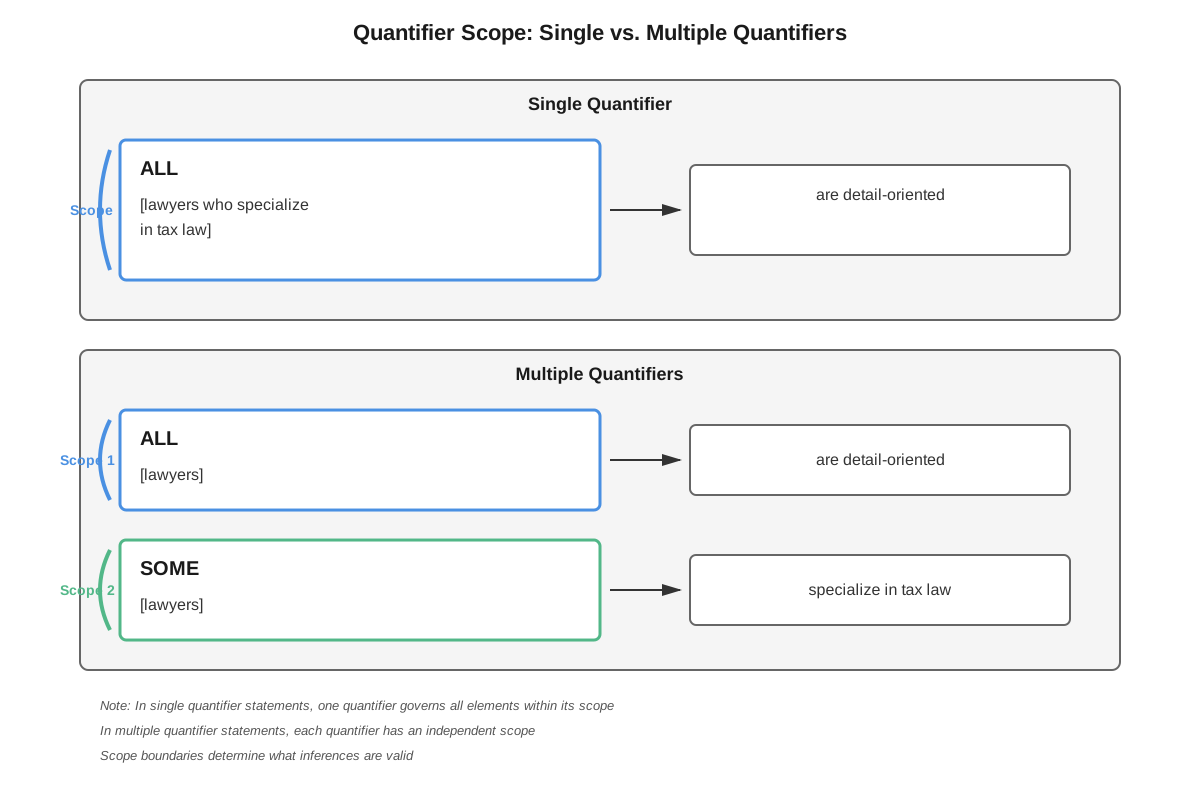
The scope of quantifiers refers to the portion of a logical statement that falls under the influence or governance of a quantifying term. Just as parentheses in mathematics determine which numbers are affected by an operation, quantifier scope determines which elements are subject to the quantification. When a statement reads "All lawyers who specialize in tax law earn high salaries," the quantifier "all" has scope over the entire subject class "lawyers who specialize in tax law," not merely "lawyers" in general.
Scope becomes critical when statements contain multiple elements, modifying phrases, or nested logical structures. The quantifier's reach determines what can be validly inferred from the statement. Misidentifying scope leads to invalid inferences—one of the most common logical errors the LSAT exploits.
Single Quantifier Scope
In statements with one quantifier, scope typically extends from the quantifier through the subject it modifies and includes any predicates or properties attributed to that subject. Consider these examples:
Example 1: "All students in the advanced seminar passed the exam."
- Scope: The quantifier "all" governs "students in the advanced seminar"
- The entire phrase "in the advanced seminar" falls within the scope
- Valid inference: Every member of the advanced seminar passed
- Invalid inference: All students (generally) passed the exam
Example 2: "Some politicians who campaigned on environmental issues voted against the climate bill."
- Scope: "Some" governs "politicians who campaigned on environmental issues"
- The modifying clause is within scope
- Valid inference: At least one politician with environmental campaign focus voted against
- Invalid inference: Some politicians (generally) voted against
The key principle is that restrictive modifiers—phrases that limit or specify the subject—fall within the quantifier's scope and must be maintained in any valid inference.
Multiple Quantifier Scope
When statements contain multiple quantifiers, each quantifier has its own scope, and these scopes can interact in complex ways. The order and placement of quantifiers fundamentally changes meaning:
Example 1: "Every professor teaches some course."
- First quantifier "every" has scope over "professor"
- Second quantifier "some" has scope over "course"
- Meaning: For each professor, there exists at least one course they teach
- Does NOT mean: There is one specific course that every professor teaches
Example 2: "Some course is taught by every professor."
- First quantifier "some" has scope over "course"
- Second quantifier "every" has scope over "professor"
- Meaning: There exists at least one course such that all professors teach it
- Fundamentally different from Example 1
This distinction—between "for all X, there exists some Y" versus "there exists some Y for all X"—is a high-yield LSAT concept. The test frequently presents arguments that conflate these different scope orderings.
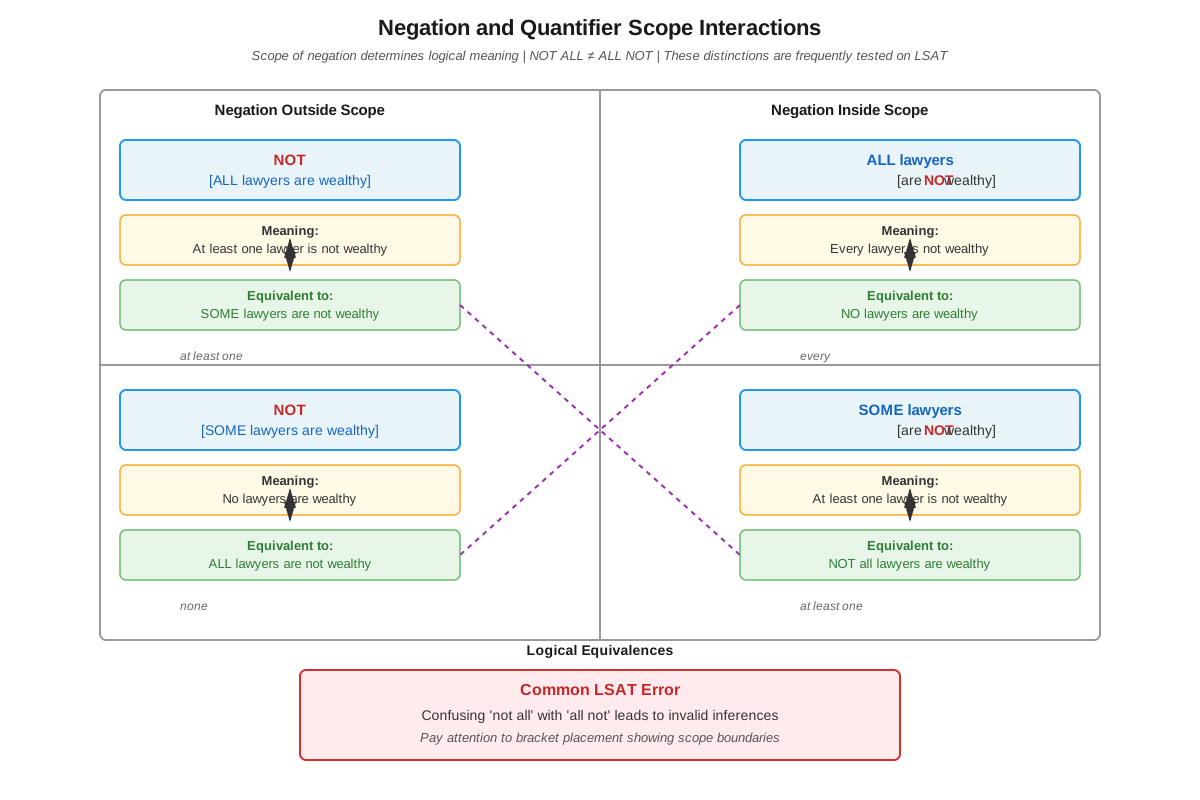
Scope and Negation
The interaction between quantifier scope and negation creates particularly important distinctions:
| Statement | Meaning | Formal Representation |
|---|---|---|
| Not all students passed | Some students did not pass | ¬(All S → P) |
| All students did not pass | Every student failed | All S → ¬P |
| Some students are not prepared | At least one student is unprepared | Some S → ¬P |
| No students are prepared | All students are unprepared | All S → ¬P |
The placement of negation relative to the quantifier's scope determines whether the negation applies to the quantification itself or to the predicate within the quantifier's scope. "Not all" negates the universal quantification, while "all not" maintains universal quantification but negates the predicate.
Scope Ambiguity
Natural language often creates scope ambiguity—statements that can be interpreted multiple ways depending on how scope is assigned:
Example: "All the students didn't complete the assignment."
Interpretation 1 (negation outside scope): Not all students completed the assignment (some did, some didn't)
Interpretation 2 (negation inside scope): All students failed to complete the assignment (none completed it)
The LSAT exploits such ambiguities in several ways:
- Presenting arguments that rely on one interpretation while the conclusion requires another
- Asking which interpretation makes an argument valid or invalid
- Testing whether students recognize that a statement is ambiguous
Scope Shift Errors
A scope shift occurs when an argument changes the scope of a quantifier between premises and conclusion, creating an invalid inference:
Example Argument:
- Premise: Some politicians who support education reform favor increased funding
- Conclusion: Some politicians favor increased funding for education reform
The scope shift: The premise quantifies over "politicians who support education reform," but the conclusion treats "increased funding" as specifically directed toward education reform, which wasn't established. The funding could be for anything.
Modifiers and Scope Boundaries
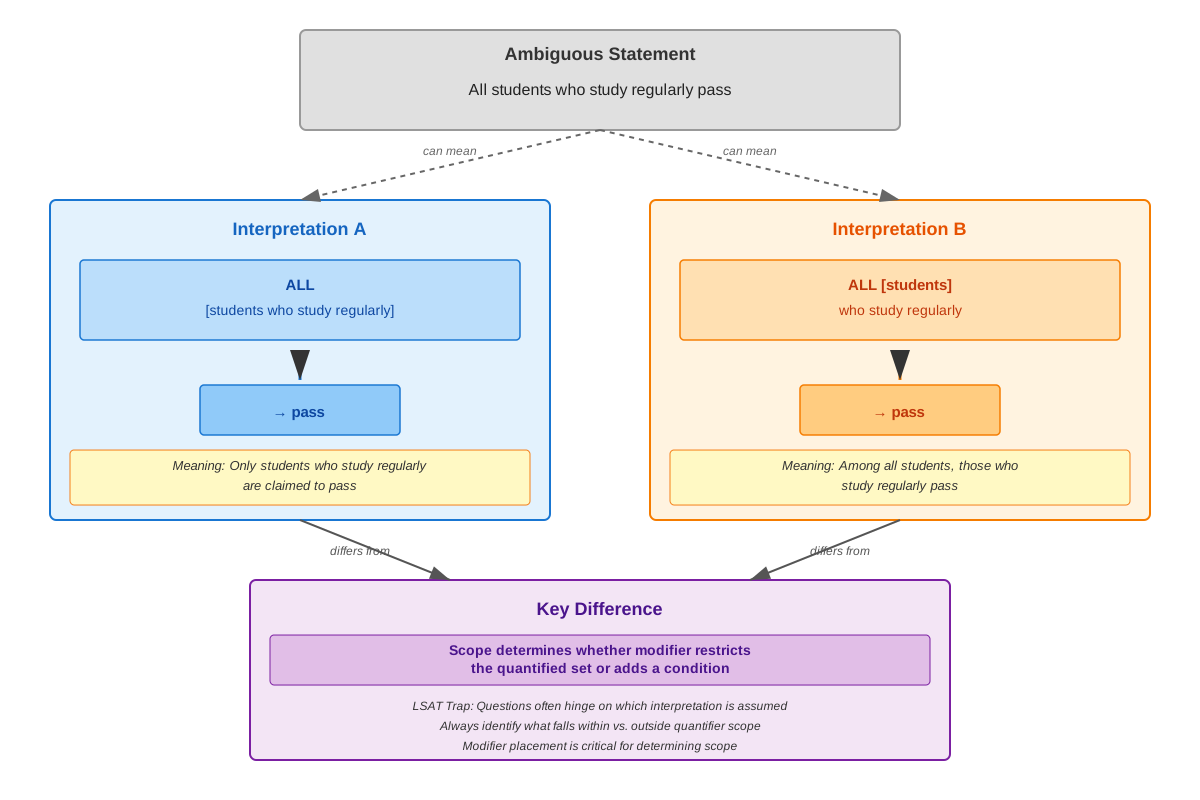
Determining where a quantifier's scope ends requires identifying which modifying phrases are restrictive (within scope) versus non-restrictive (outside scope):
Restrictive (within scope): "All students who studied diligently passed"
- "Who studied diligently" restricts which students are quantified
- Cannot infer anything about students who didn't study diligently
Non-restrictive (outside scope): "All students, who were well-prepared, passed"
- The comma-separated phrase provides additional information
- The quantification is over all students, with the preparation noted separately
On the LSAT, this distinction often appears without clear punctuation, requiring logical analysis to determine the intended scope.
Concept Relationships
The scope of quantifiers serves as a foundational concept that connects to multiple areas of logical reasoning. At the most basic level, quantifier scope builds directly on basic quantifier vocabulary, extending simple understanding of "all" and "some" into complex statements where determining what is quantified becomes the central challenge.
Quantifier scope → enables → Conditional logic translation: When translating "All A are B" into conditional form (A → B), understanding scope ensures that modifying phrases are correctly incorporated into the sufficient or necessary conditions. A statement like "All lawyers who specialize in tax law are wealthy" becomes (Lawyer AND Tax specialist) → Wealthy, not simply Lawyer → Wealthy.
Quantifier scope + Logical operators → creates → Complex formal logic statements: When quantifiers combine with AND, OR, and NOT operators, scope determines which elements are affected by each operator. The statement "All students who are seniors or juniors must register" has different meanings depending on whether "all" has scope over the entire disjunction or just one element.
Scope ambiguity → leads to → Argument flaws: Many LSAT flaw questions feature arguments that exploit scope ambiguity or commit scope shift errors. Recognizing these requires understanding how different scope assignments change meaning.
Multiple quantifier scope → connects to → Formal logic games: In Logic Games, rules often contain multiple quantifiers ("Each team has at least two members" versus "At least two members are on each team"), and scope determines how to represent and apply these rules.
Negation scope → relates to → Contrapositive formation: When forming contrapositives of quantified conditionals, understanding whether negation falls inside or outside quantifier scope determines the correct logical equivalent.
The relationship map: Basic Quantifiers → Quantifier Scope → Conditional Translation → Complex Arguments → Flaw Recognition → Valid Inference
High-Yield Facts
⭐ The scope of a quantifier extends over the entire subject phrase including all restrictive modifiers, not just the head noun.
⭐ "Not all X are Y" is logically equivalent to "Some X are not Y," but fundamentally different from "All X are not Y" (which means "No X are Y").
⭐ When multiple quantifiers appear, the order determines meaning: "Every X has some Y" differs from "Some Y belongs to every X."
⭐ Scope shift errors occur when an argument changes what is being quantified between premises and conclusion, creating an invalid inference.
⭐ Ambiguous modifier placement creates scope ambiguity, allowing multiple interpretations of the same statement.
- Quantifier scope determines which elements can be validly inferred from a statement and which cannot.
- Restrictive clauses (essential to identifying the subject) fall within quantifier scope; non-restrictive clauses (providing additional information) fall outside.
- The LSAT frequently tests whether students can recognize that changing quantifier scope changes the logical structure of an argument.
- Scope errors are particularly common in arguments that move from specific subgroups to general categories or vice versa.
- In formal logic notation, parentheses or brackets explicitly mark quantifier scope, preventing ambiguity present in natural language.
- Existential quantifiers ("some," "at least one") have narrower scope implications than universal quantifiers ("all," "every") when combined with other logical operators.
- The scope of "most" creates unique challenges because it doesn't combine with other quantifiers in predictable ways like "all" and "some" do.
Quick check — test yourself on Scope of quantifiers so far.
Try Flashcards →Common Misconceptions
Misconception: A quantifier applies only to the immediately following word.
Correction: Quantifier scope extends over the entire noun phrase including all modifying clauses that restrict or specify the subject. "All students who studied" has "all" governing the entire phrase "students who studied," not just "students."
Misconception: "Not all" and "all not" mean the same thing.
Correction: These are logically distinct. "Not all" negates the universal quantification (meaning "some are not"), while "all not" maintains universal quantification but negates the predicate (meaning "none are"). The placement of negation relative to quantifier scope creates fundamentally different meanings.
Misconception: When multiple quantifiers appear, they can be reordered without changing meaning.
Correction: Quantifier order is crucial to meaning. "Every professor teaches some course" (each professor has at least one course) differs fundamentally from "Some course is taught by every professor" (there's one course all professors teach). Reordering quantifiers changes the logical structure.
Misconception: If a statement is true for "all X that are Y," it's also true for "all X."
Correction: This commits a scope expansion error. The quantifier's scope includes the restricting condition "that are Y," so the statement applies only to the subset of X that are Y, not to all X generally. Removing the restriction invalidly broadens the scope.
Misconception: Scope ambiguity means a statement is logically flawed.
Correction: Scope ambiguity means a statement can be interpreted multiple ways, but each interpretation may be logically valid. The flaw occurs when an argument relies on one interpretation in the premises but requires a different interpretation for the conclusion, or when an argument fails to recognize that multiple interpretations exist.
Misconception: Commas always indicate scope boundaries.
Correction: While punctuation can signal scope, the LSAT often presents statements without clear punctuation markers, requiring logical analysis to determine scope. Additionally, comma usage in natural language is inconsistent, so logical structure rather than punctuation should guide scope determination.
Misconception: "Some" always has narrower scope than "all."
Correction: Scope breadth refers to which elements fall under a quantifier's governance, not to how many items are quantified. Both "some" and "all" can have equally broad scope over complex noun phrases; they differ in how many items they claim exist, not in what elements they govern.
Worked Examples
Example 1: Identifying Scope Shift
LSAT-Style Question:
Argument: "All the employees who received bonuses last year exceeded their sales targets. Therefore, all employees who exceeded their sales targets received bonuses."
Question: Which of the following describes the flaw in the argument?
Step 1: Identify the quantifiers and their scope
- Premise quantifier: "All" with scope over "employees who received bonuses last year"
- Conclusion quantifier: "All" with scope over "employees who exceeded their sales targets"
Step 2: Analyze the logical structure
- Premise: All (Bonus recipients) → Exceeded targets
- Conclusion: All (Target exceders) → Received bonuses
- The conclusion is attempting to state the converse of the premise
Step 3: Identify the scope issue
The premise quantifies over bonus recipients and tells us something about them (they exceeded targets). The conclusion quantifies over target exceders and tells us something about them (they received bonuses). This is a scope shift—the argument changes what is being quantified.
Step 4: Explain why this is invalid
The premise establishes that the set of bonus recipients is a subset of target exceders, but this doesn't mean all target exceders are bonus recipients. The scope shift creates an invalid inference because the quantifier in the premise governs a different group than the quantifier in the conclusion.
Step 5: Connect to learning objective
This example demonstrates how scope of quantifiers appears in LSAT Flaw questions. The reasoning pattern involves shifting what is quantified between premise and conclusion, creating an invalid inference that resembles affirming the consequent or confusing necessary and sufficient conditions.
Example 2: Multiple Quantifier Scope
LSAT-Style Question:
Passage: "Every committee member reviewed some proposal before the meeting. Therefore, some proposal was reviewed by every committee member before the meeting."
Question: The conclusion follows logically from the premise if which of the following is assumed?
Step 1: Analyze the premise scope
- "Every committee member" is the first quantifier
- "Some proposal" is the second quantifier
- Structure: For all members M, there exists some proposal P such that M reviewed P
- This allows different members to have reviewed different proposals
Step 2: Analyze the conclusion scope
- "Some proposal" is the first quantifier
- "Every committee member" is the second quantifier
- Structure: There exists some proposal P such that for all members M, M reviewed P
- This requires one specific proposal reviewed by all members
Step 3: Identify the scope difference
The premise has "every" taking wide scope over "some" (for each member, some proposal exists). The conclusion reverses this, giving "some" wide scope over "every" (some proposal exists for all members). These are logically distinct structures.
Step 4: Determine what assumption bridges the gap
For the conclusion to follow, we need to assume that the "some proposal" in each instance of the premise is actually the same proposal. The assumption would be: "There is one particular proposal that was reviewed by all committee members" or "Each committee member reviewed the same proposal."
Step 5: Explain the scope principle
This example illustrates that quantifier order determines scope and meaning. The argument commits a quantifier scope error by treating "every...some" as equivalent to "some...every." Only with an additional assumption that collapses the different possible proposals into one specific proposal does the conclusion follow.
Step 6: Connect to learning objectives
This demonstrates how to apply scope of quantifiers to solve LSAT-style problems, specifically Sufficient Assumption questions. The reasoning pattern involves recognizing when quantifier order creates different logical structures and identifying what assumption would make those structures equivalent.
Exam Strategy
Recognition Triggers
Watch for these phrases that signal quantifier scope issues:
- Multiple quantifiers in a single statement ("all...some," "every...any," "most...few")
- Modifying clauses after quantified subjects ("all students who..." "some politicians that...")
- Negation combined with quantifiers ("not all," "none," "not every")
- Ambiguous modifier placement where scope is unclear
- Shifts in what is quantified between premises and conclusion
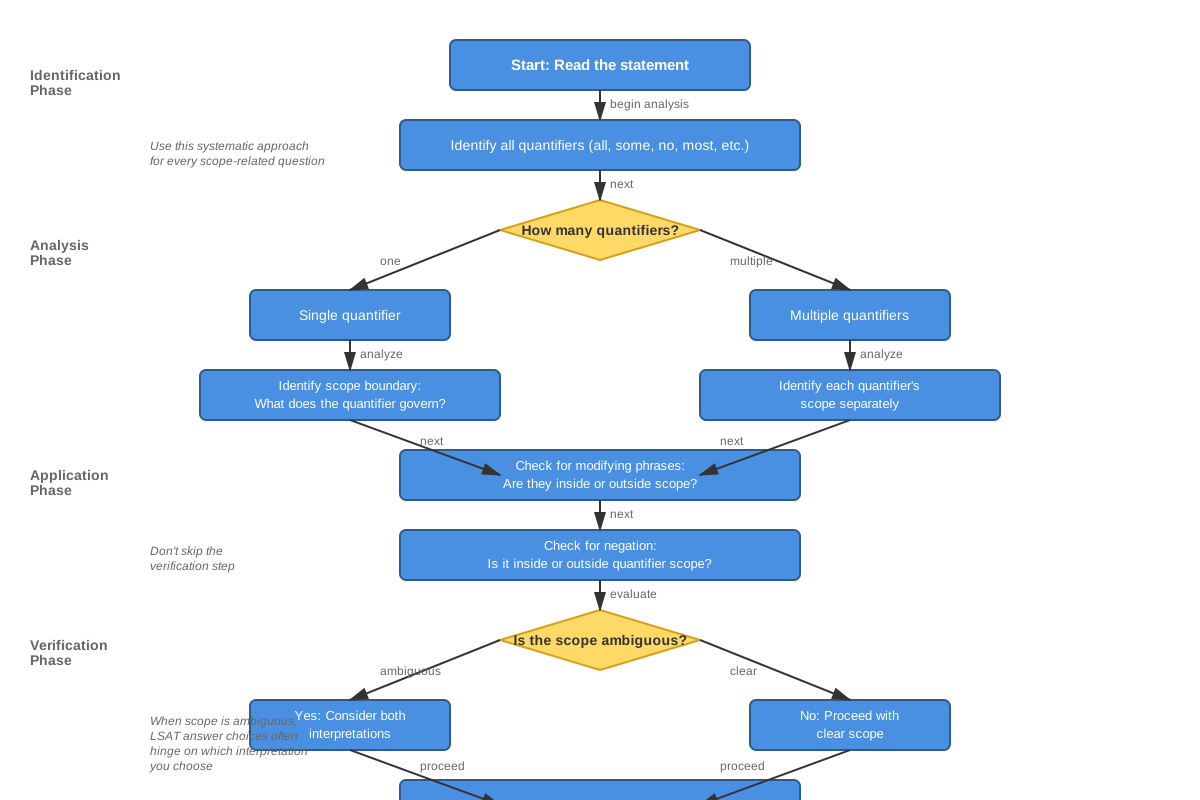
Approach Process
Step 1: Identify all quantifiers in the argument or statement. Mark each one and note what immediately follows it.
Step 2: Determine scope boundaries by identifying which phrases modify or restrict the quantified subject. Ask: "What exactly is being quantified?"
Step 3: Check for scope consistency between premises and conclusion. Does the argument maintain the same scope, or does it shift what is being quantified?
Step 4: Test for scope ambiguity by asking whether the statement could be interpreted multiple ways depending on scope assignment.
Step 5: Evaluate inferences by ensuring they maintain the original quantifier scope without expansion or contraction.
Process of Elimination Tips
Eliminate answers that:
- Expand quantifier scope beyond what the premises establish (moving from "some X that are Y" to "some X")
- Contract scope inappropriately (moving from "all X" to "all X that are Y" without justification)
- Reverse quantifier order without justification (treating "every...some" as equivalent to "some...every")
- Ignore restrictive modifiers within a quantifier's scope
- Confuse "not all" with "all not" or similar negation scope errors
Favor answers that:
- Maintain the exact scope of the original quantifiers
- Recognize scope ambiguity when present
- Identify scope shifts as logical flaws
- Correctly distinguish between different quantifier orderings
- Preserve restrictive modifiers in inferences
Time Allocation
For questions primarily testing quantifier scope:
- 15-30 seconds: Identify quantifiers and their scope
- 30-45 seconds: Analyze the logical structure and check for scope issues
- 30-45 seconds: Evaluate answer choices
- Total: 75-120 seconds for straightforward scope questions
For complex questions where scope is one component among several:
- Allocate proportionally more time but prioritize getting the scope analysis correct, as scope errors cascade into other logical errors
Exam Tip: When stuck between two answers, check whether they differ in how they treat quantifier scope. The LSAT frequently includes one answer that correctly maintains scope and one that commits a subtle scope shift.
Memory Techniques
SCOPE Acronym
Subject phrase - Identify what is being quantified
Clauses included - Determine which modifying clauses fall within scope
Order matters - Remember that quantifier order changes meaning
Placement of negation - Check whether negation is inside or outside scope
Expansion errors - Watch for invalid scope expansion or contraction
Visualization Strategy
Picture quantifier scope as a spotlight that illuminates certain elements:
- The quantifier is the spotlight source
- Everything within the beam (the scope) is governed by the quantifier
- Elements outside the beam are not subject to the quantification
- Multiple spotlights (multiple quantifiers) can overlap or illuminate different areas
- Moving the spotlight (changing scope) changes what is illuminated
Parentheses Technique
When analyzing complex statements, mentally insert parentheses to mark scope boundaries:
- "All students who studied passed" becomes "All (students who studied) passed"
- "Not all students passed" becomes "Not (all students passed)"
- "All students did not pass" becomes "All students (did not pass)"
This visualization makes scope explicit and prevents misinterpretation.
Quantifier Order Mnemonic
"Every-Some vs. Some-Every: Order Determines Reality"
Remember: "For every person, some food exists that they like" (everyone has at least one food they like) is completely different from "Some food exists that every person likes" (there's one food everyone likes). The first is almost certainly true; the second is almost certainly false. This dramatic difference illustrates why quantifier order matters.
Summary
The scope of quantifiers determines which elements of a logical statement fall under the governance of quantifying terms like "all," "some," "none," and "most." Mastering this concept requires understanding that scope extends over entire noun phrases including restrictive modifiers, that quantifier order fundamentally changes meaning when multiple quantifiers appear, and that negation placement relative to scope creates distinct logical structures. The LSAT extensively tests quantifier scope through arguments that commit scope shift errors, statements with ambiguous scope that allow multiple interpretations, and complex formal logic requiring precise scope tracking. Common errors include treating "not all" as equivalent to "all not," assuming quantifiers can be reordered without changing meaning, and expanding or contracting scope between premises and conclusions. Success on LSAT questions involving quantifier scope demands careful identification of what is being quantified, recognition of scope boundaries marked by restrictive clauses, and vigilant checking for scope consistency throughout arguments. This topic connects intimately with conditional logic, formal logic translation, and argument structure analysis, making it essential for high performance across multiple Logical Reasoning question types.
Key Takeaways
- Quantifier scope extends over the entire subject phrase including all restrictive modifiers, not just the head noun, determining what can be validly inferred from a statement.
- Quantifier order is crucial: "Every X has some Y" differs fundamentally from "Some Y belongs to every X," and these cannot be treated as equivalent without additional justification.
- Negation placement relative to quantifier scope creates distinct meanings: "Not all" negates the quantification itself, while "all not" maintains quantification but negates the predicate.
- Scope shift errors occur when arguments change what is being quantified between premises and conclusion, creating one of the most common logical flaws tested on the LSAT.
- Ambiguous modifier placement creates scope ambiguity, allowing multiple interpretations that the LSAT exploits in various question types.
- Valid inferences must maintain the original quantifier scope without expansion, contraction, or reordering unless explicitly justified by the argument.
- Recognizing quantifier scope issues requires systematic analysis: identify all quantifiers, determine scope boundaries, check for consistency, and evaluate whether inferences preserve scope.
Related Topics
Conditional Logic and Contrapositives: Understanding how quantified statements translate into conditional form and how to correctly form contrapositives while maintaining scope is the natural next step after mastering quantifier scope.
Formal Logic Translation: Converting complex natural language arguments into symbolic logic notation requires precise understanding of quantifier scope to ensure accurate representation.
Argument Structure and Validity: Analyzing whether conclusions follow from premises often depends on recognizing scope shifts and other quantifier-related errors, making this topic essential for advanced argument evaluation.
Categorical Logic and Syllogisms: Traditional categorical logic with its four statement types (All S are P, No S are P, Some S are P, Some S are not P) builds directly on quantifier scope principles.
Logic Games Quantifier Rules: Many Logic Games rules involve quantified statements where scope determines how to represent and apply the rules, making quantifier scope mastery valuable beyond Logical Reasoning.
Practice CTA
Now that you understand the scope of quantifiers, it's time to cement this knowledge through active practice. Attempt the practice questions to test your ability to identify scope issues, recognize scope shifts, and apply these principles to LSAT-style problems. Use the flashcards to reinforce high-yield facts and distinctions, particularly the differences between various quantifier-negation combinations. Remember: quantifier scope appears in approximately 15-20% of Logical Reasoning questions, making this one of the highest-yield topics for score improvement. Every question you practice strengthens your pattern recognition and speeds your analysis, bringing you closer to your target score. You've built the foundation—now apply it!
Sign up free to keep reading
Create a free AnvayaPrep account to finish this LSAT guide on Scope of quantifiers — plus flashcards and practice questions.