Overview
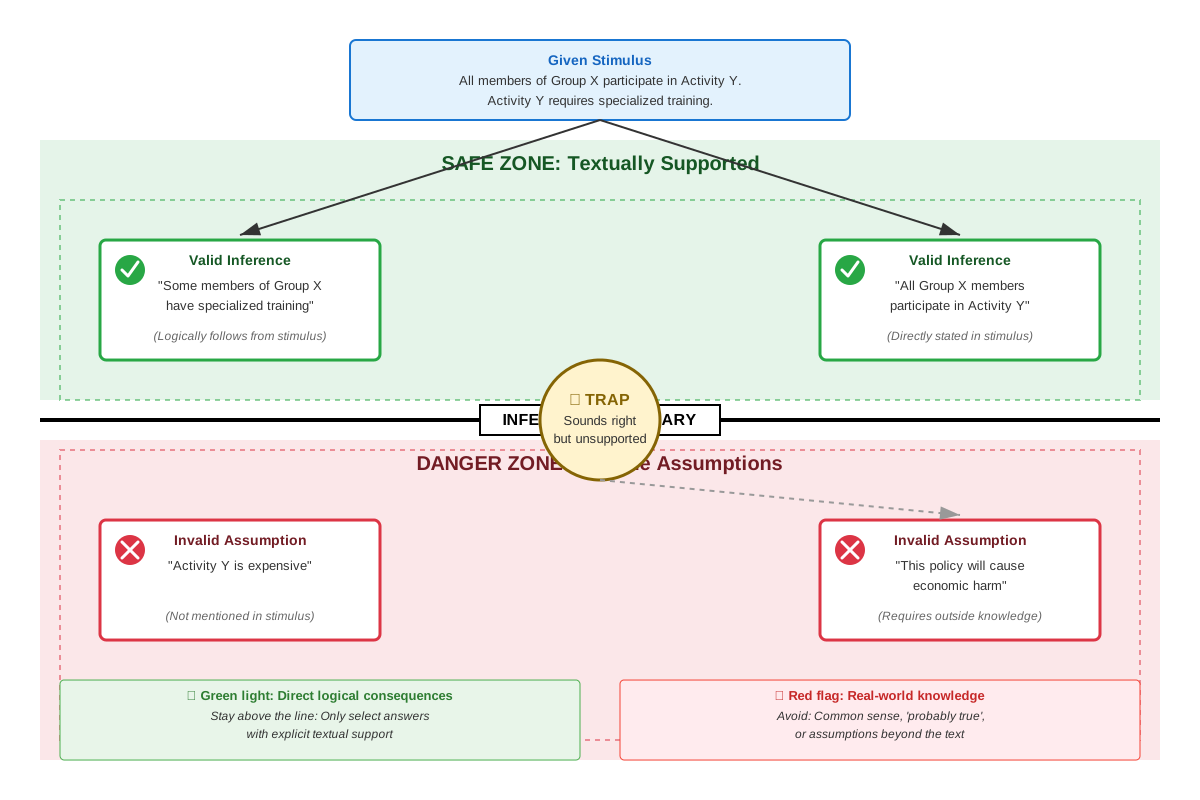
Avoiding outside assumptions is one of the most critical skills tested in LSAT Logical Reasoning sections, particularly within inference questions. This concept requires test-takers to draw conclusions based solely on the information explicitly provided in the stimulus, without importing external knowledge, personal beliefs, or common-sense assumptions that aren't directly supported by the passage. The LSAT rigorously tests whether students can distinguish between what must be true based on the given premises versus what might be true in the real world but lacks textual support.
Mastering this skill is essential because the LSAT is fundamentally a test of analytical reasoning, not general knowledge or real-world expertise. The exam deliberately crafts scenarios where common-sense answers may seem appealing but are technically incorrect because they require assumptions beyond the stimulus. Students who fail to avoid outside assumptions often select answer choices that "sound right" or "make sense" in everyday contexts but cannot be definitively proven from the passage alone. This distinction separates high scorers from average performers.
Within the broader landscape of Logical Reasoning, avoiding outside assumptions connects intimately with argument analysis, sufficient and necessary conditions, and formal logic. It serves as the foundation for Must Be True questions, Most Strongly Supported questions, and Main Point questions. This skill also reinforces the discipline needed for Assumption questions (where you identify what the argument depends on) and Strengthen/Weaken questions (where you must stay within the logical scope of the argument). Understanding how to avoid outside assumptions creates a mental framework that enhances performance across virtually all Logical Reasoning question types.
Learning Objectives
- [ ] Identify how avoiding outside assumptions appears in LSAT questions
- [ ] Explain the reasoning pattern behind avoiding outside assumptions
- [ ] Apply avoiding outside assumptions to solve LSAT-style problems accurately
- [ ] Distinguish between inferences that must be true versus those that could be true
- [ ] Recognize common trap answers that rely on outside knowledge or assumptions
- [ ] Evaluate answer choices by tracing each element back to explicit textual support
- [ ] Develop a systematic approach to eliminating answers that introduce unsupported information
Prerequisites
- Basic argument structure: Understanding premises and conclusions is essential because avoiding outside assumptions requires identifying what information the argument actually provides versus what it omits.
- Conditional reasoning fundamentals: Recognizing if-then relationships helps distinguish between what logically follows from given statements versus what requires additional assumptions.
- Reading comprehension skills: The ability to parse complex sentences and identify explicit versus implicit information forms the foundation for recognizing when assumptions are being introduced.
- Familiarity with inference question stems: Knowing question types like "Which one of the following must be true?" versus "Which one of the following is most strongly supported?" helps calibrate the level of certainty required.
Why This Topic Matters
In real-world applications, the skill of avoiding outside assumptions translates directly to legal reasoning, scientific analysis, and critical decision-making. Attorneys must base arguments on evidence presented in court, not on assumptions about what "probably" happened. Scientists must draw conclusions from experimental data without importing unverified hypotheses. Business analysts must make recommendations based on available metrics rather than hunches or industry folklore.
On the LSAT specifically, avoiding outside assumptions appears in approximately 25-30% of all Logical Reasoning questions, making it one of the highest-yield skills to master. This concept is tested most frequently in:
- Must Be True questions (8-10 per test): These require conclusions that are 100% supported by the stimulus
- Most Strongly Supported questions (4-6 per test): These allow slightly more inferential distance but still prohibit unsupported leaps
- Main Point questions (2-3 per test): These require identifying what the argument actually concludes, not what it should conclude
- Inference questions in Reading Comprehension (6-8 per test): These test the same skill across longer passages
The LSAT deliberately designs trap answers that appeal to test-takers' real-world knowledge, common sense, or stereotypical thinking. For example, a stimulus might state "Most doctors recommend exercise," and a trap answer might say "Exercise is healthy"—which seems obviously true but isn't actually stated or logically required by the premise. High scorers recognize that the LSAT operates in a closed logical universe where only the given information matters.
Core Concepts
The Closed Universe Principle
The fundamental concept underlying lsat avoiding outside assumptions is what can be called the closed universe principle: the stimulus creates a complete logical world, and only information explicitly stated or necessarily implied by that world can be used to evaluate answer choices. This principle requires a mental shift from everyday reasoning, where we constantly fill gaps with background knowledge, to formal logical reasoning, where gaps must remain gaps unless the text bridges them.
Consider this distinction: In everyday life, if someone says "The store closes at 9 PM," you might reasonably assume you can't shop there at 10 PM. On the LSAT, however, you cannot make that inference unless the stimulus explicitly states or necessarily implies that the store is not open after closing time. Perhaps "closes at 9 PM" means the doors lock but online ordering continues. The LSAT tests whether you can resist the temptation to import common-sense assumptions.
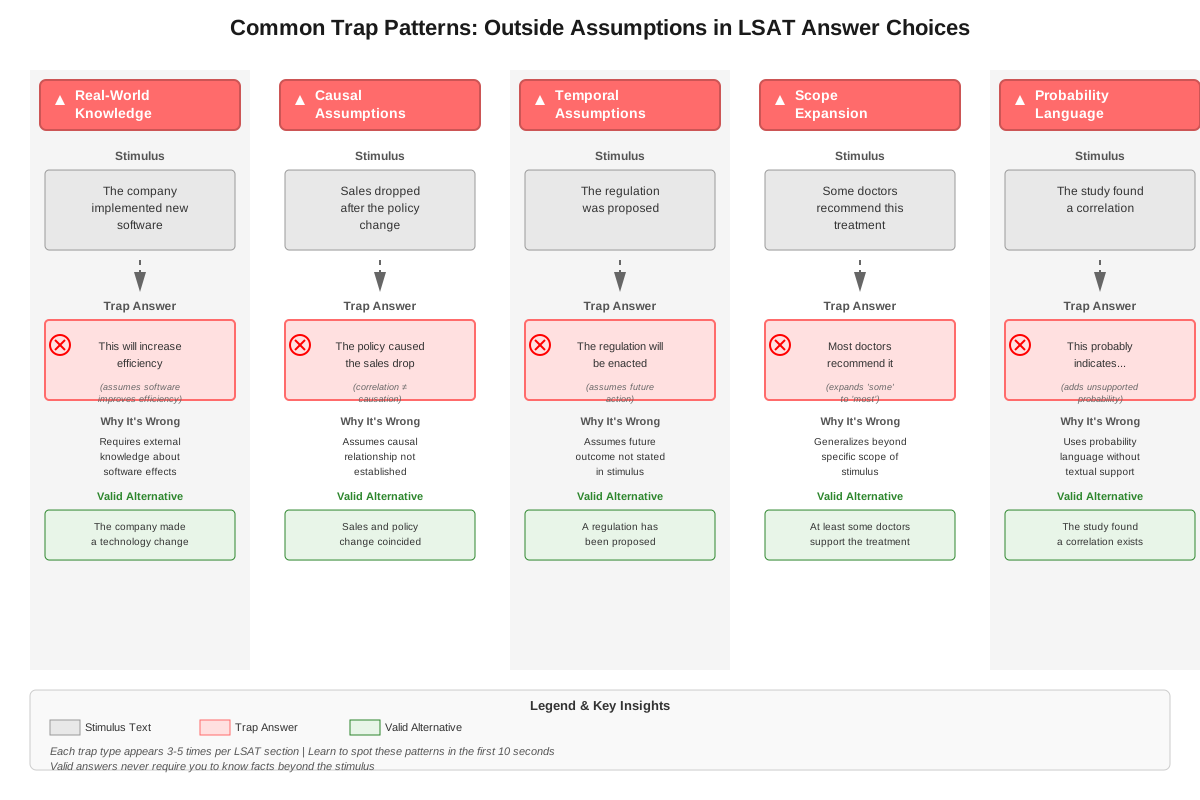
Types of Outside Assumptions to Avoid
| Assumption Type | Description | Example |
|---|---|---|
| Real-world knowledge | Facts you know from general education or experience | Assuming "Paris" refers to France without textual confirmation |
| Causal assumptions | Inferring cause-effect relationships not stated | Assuming correlation implies causation |
| Temporal assumptions | Adding time-based relationships not specified | Assuming events happened in a particular sequence |
| Quantitative assumptions | Inferring specific numbers or proportions | Assuming "many" means "most" or "majority" |
| Normative assumptions | Importing value judgments or "should" statements | Assuming what is typical is what ought to be |
| Scope expansion | Extending claims beyond their stated boundaries | Generalizing from "some doctors" to "doctors in general" |
The Must Be True Standard
Inference questions on the LSAT typically ask what "must be true" or is "most strongly supported" based on the stimulus. The "must be true" standard is the strictest: the correct answer must be true in 100% of scenarios consistent with the stimulus. If you can imagine even one scenario where the stimulus is true but the answer choice is false, that answer choice is incorrect.
This standard operates through logical necessity rather than probability or plausibility. Even if something is 99% likely to be true given the stimulus, it's incorrect if it's not logically required. For example:
Stimulus: "Every member of the committee voted for the proposal."
Must be true: "No committee member voted against the proposal."
Does NOT must be true: "The proposal will be implemented" (requires assumption about what happens after voting).
The Textual Support Test
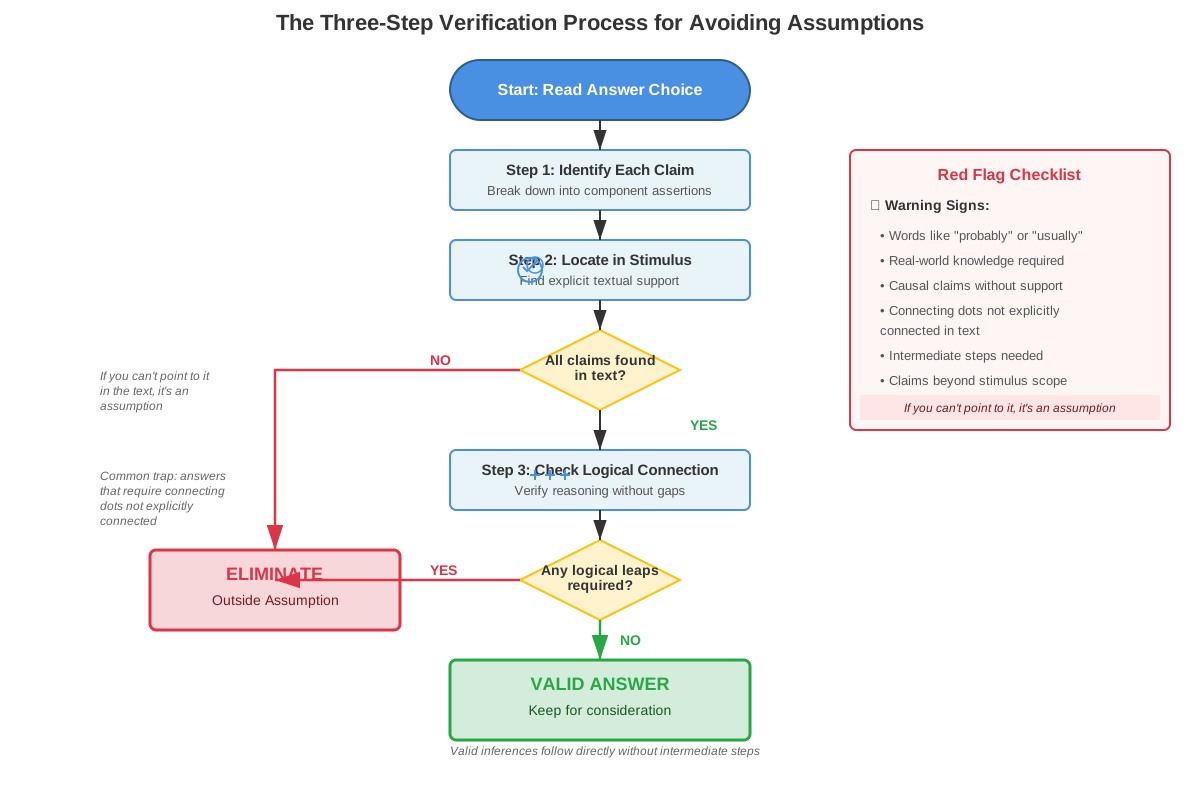
Every element of a correct answer must trace back to explicit textual support. This creates a three-step verification process:
- Identify each claim in the answer choice
- Locate textual support for each claim in the stimulus
- Verify the logical connection between the support and the claim
If any claim in an answer choice lacks direct textual support or requires an inferential leap beyond what the stimulus provides, that answer introduces an outside assumption and must be eliminated.
Necessary Versus Sufficient Inferences
Understanding the difference between necessary inferences (what must be true) and sufficient inferences (what could be true) is crucial for avoiding outside assumptions. A necessary inference is unavoidable given the premises; a sufficient inference is merely consistent with the premises but not required by them.
Stimulus: "All lawyers in the firm have passed the bar exam."
Necessary inference: "No one in the firm who hasn't passed the bar exam is a lawyer."
Sufficient but not necessary: "The firm has high standards" (this could be true but isn't logically required).
The LSAT frequently includes trap answers that present sufficient inferences as if they were necessary, exploiting test-takers' tendency to select answers that "make sense" rather than answers that "must be true."
Scope Limitations
Scope refers to the boundaries of what an argument addresses. Avoiding outside assumptions requires strict attention to scope limitations:
- Subject scope: If the stimulus discusses "European countries," conclusions about "all countries" exceed the scope
- Temporal scope: If the stimulus discusses "last year," conclusions about "always" or "in the future" exceed the scope
- Quantitative scope: If the stimulus says "some," conclusions about "most" or "all" exceed the scope
- Conditional scope: If the stimulus provides a conditional statement, conclusions that reverse or negate it improperly exceed the scope
Trap answers frequently violate scope by subtly expanding the subject matter, time frame, or degree of certainty beyond what the stimulus supports.
Concept Relationships
The skill of avoiding outside assumptions serves as the foundation for multiple interconnected Logical Reasoning competencies. At its core, this skill connects directly to formal logic and conditional reasoning: both require drawing only those conclusions that follow necessarily from given premises. When you master avoiding outside assumptions, you strengthen your ability to work with sufficient and necessary conditions because both skills demand precision about what is stated versus what is inferred.
This topic also connects intimately with argument structure analysis. To avoid outside assumptions, you must first accurately identify what premises an argument provides and what conclusion it draws. This creates a relationship map: Argument Structure → Avoiding Outside Assumptions → Valid Inference. You cannot determine whether an inference requires outside assumptions until you've clearly identified what assumptions the argument itself contains.
Furthermore, avoiding outside assumptions relates inversely to Assumption questions. In Assumption questions, you're asked to identify what unstated premise the argument depends on—essentially, you're finding the outside assumption the author made. Understanding how to avoid outside assumptions in inference questions helps you recognize when arguments rely on them in Assumption questions. This creates a complementary relationship: Avoiding Outside Assumptions (Inference) ↔ Identifying Required Assumptions (Assumption Questions).
The skill also enhances performance on Strengthen and Weaken questions because these question types require you to stay within the logical scope of the argument while adding new information. You must distinguish between new information that's relevant to the argument's logic versus new information that changes the subject or introduces tangential considerations.
High-Yield Facts
⭐ The LSAT operates as a closed logical system: Only information explicitly stated or necessarily implied by the stimulus can be used to evaluate answer choices.
⭐ "Must be true" means 100% certainty: If you can imagine even one scenario where the stimulus is true but the answer is false, eliminate that answer.
⭐ Common sense is often wrong on the LSAT: The exam deliberately creates scenarios where real-world knowledge leads to incorrect answers.
⭐ Every word matters: Quantifiers like "some," "most," "all," and "many" have precise logical meanings that cannot be interchanged.
⭐ Correlation does not imply causation without explicit textual support: The stimulus must state or necessarily imply a causal relationship for you to infer one.
- Temporal sequence (A happened before B) does not establish causation (A caused B) without additional support.
- Scope violations are the most common form of outside assumption in trap answers.
- "Could be true" is not the same as "must be true"—the LSAT tests this distinction relentlessly.
- Negating a conditional statement requires precise logical operations; informal negation introduces outside assumptions.
- Answer choices that introduce new concepts not mentioned in the stimulus almost always rely on outside assumptions.
- The correct answer to inference questions is often less interesting or dramatic than trap answers because it stays strictly within the stimulus's scope.
- Pronouns and referents must be clearly established in the stimulus; assuming what "it" or "they" refers to can introduce outside assumptions.
- Normative claims ("should," "ought," "better") cannot be inferred from purely descriptive premises without additional support.
- Statistical or probabilistic language ("likely," "probably") cannot be inferred from absolute statements without explicit support.
- Background knowledge about specialized topics (law, science, history) should be ignored unless the stimulus provides that information.
Quick check — test yourself on Avoiding outside assumptions so far.
Try Flashcards →Common Misconceptions
Misconception: If something is obviously true in the real world, it must be a valid inference from the stimulus.
Correction: The LSAT tests logical reasoning, not real-world knowledge. An inference is valid only if it follows necessarily from the stimulus, regardless of whether it's true in reality. The stimulus might describe an impossible or counterfactual scenario, and you must work within that scenario's logic.
Misconception: "Most strongly supported" questions allow you to make reasonable assumptions based on common sense.
Correction: While "most strongly supported" allows slightly more inferential distance than "must be true," it still prohibits introducing information not grounded in the stimulus. The difference is in degree of certainty (99% vs. 100%), not in permission to import outside knowledge.
Misconception: If the stimulus doesn't explicitly contradict an answer choice, that answer choice must be correct.
Correction: Consistency with the stimulus is necessary but not sufficient. The correct answer must be positively supported by the stimulus, not merely consistent with it. Many answer choices could be true without being inferable from the given information.
Misconception: Technical or specialized vocabulary in the stimulus allows you to apply your knowledge of that field.
Correction: Even when the stimulus uses specialized terms, you must rely only on how the stimulus defines or uses those terms. Your external knowledge of legal, scientific, or other specialized concepts is irrelevant unless the stimulus incorporates that information.
Misconception: Longer or more complex answer choices are more likely to be correct because they seem more sophisticated.
Correction: Answer choice length and complexity are irrelevant to correctness. In fact, longer answer choices often introduce more opportunities for scope violations and outside assumptions. The correct answer might be the simplest and most direct inference.
Misconception: If an argument seems weak or flawed, you should select an answer that "fixes" it or makes it stronger.
Correction: Inference questions ask what follows from the stimulus as written, not what would improve the argument. Selecting an answer that strengthens a weak argument introduces outside assumptions about what the argument should have said.
Worked Examples
Example 1: Must Be True Question
Stimulus: "Every employee who received a promotion last year had worked at the company for at least five years. Chen received a promotion last year."
Question: Which one of the following must be true?
Answer Choices:
(A) Chen is a valuable employee.
(B) Chen had worked at the company for at least five years.
(C) Most employees who have worked at the company for at least five years received promotions.
(D) Chen will continue to work at the company.
(E) The company rewards loyalty.
Analysis:
Let's apply the textual support test to each answer:
(A) Chen is a valuable employee.
- This requires an outside assumption that receiving a promotion indicates value. The stimulus never defines what makes an employee valuable or states that promoted employees are valuable. This imports a normative judgment not present in the text. ELIMINATE.
(B) Chen had worked at the company for at least five years.
- The stimulus states: "Every employee who received a promotion last year had worked at the company for at least five years." This is a conditional: If promoted → worked ≥5 years. The stimulus also states Chen received a promotion. By modus ponens (affirming the antecedent), we can conclude Chen worked at the company for at least five years. This is a necessary inference with complete textual support. CORRECT.
(C) Most employees who have worked at the company for at least five years received promotions.
- This reverses the conditional. The stimulus tells us promoted employees had worked ≥5 years, not that employees who worked ≥5 years were promoted. This is the classic conditional logic error of affirming the consequent. ELIMINATE.
(D) Chen will continue to work at the company.
- This makes a prediction about the future based on no textual support. The stimulus discusses only what happened last year. ELIMINATE.
(E) The company rewards loyalty.
- This interprets the promotion pattern as evidence of a company value or policy. While this might be a reasonable real-world interpretation, it requires assumptions about the company's motivations and what "loyalty" means. The stimulus provides no information about why the company promotes people or whether tenure equals loyalty. ELIMINATE.
Key Lesson: The correct answer (B) follows necessarily through formal logic (conditional reasoning) without requiring any information beyond the stimulus. All trap answers introduce outside assumptions—about value, reversed conditionals, future events, or company motivations.
Example 2: Most Strongly Supported Question
Stimulus: "A recent study found that people who drink coffee daily report higher stress levels than people who do not drink coffee daily. However, the study also found that people who drink coffee daily sleep fewer hours per night than people who do not drink coffee daily."
Question: Which one of the following is most strongly supported by the information above?
Answer Choices:
(A) Drinking coffee causes increased stress levels.
(B) People who sleep fewer hours experience higher stress levels.
(C) The correlation between coffee drinking and stress levels might be explained by differences in sleep duration.
(D) People should reduce their coffee consumption to lower their stress.
(E) Coffee interferes with sleep quality.
Analysis:
(A) Drinking coffee causes increased stress levels.
- The stimulus establishes correlation (coffee drinkers report higher stress) but never establishes causation. This is a classic outside assumption—inferring causation from correlation. The stimulus explicitly provides an alternative variable (sleep duration) that might explain the correlation. ELIMINATE.
(B) People who sleep fewer hours experience higher stress levels.
- While the stimulus tells us coffee drinkers both sleep less and have higher stress, it never establishes a direct relationship between sleep duration and stress levels. This would require assuming that the sleep difference explains the stress difference, which isn't stated. ELIMINATE.
(C) The correlation between coffee drinking and stress levels might be explained by differences in sleep duration.
- The stimulus presents two findings: (1) coffee drinkers have higher stress, and (2) coffee drinkers sleep less. The word "However" suggests the second finding is relevant to interpreting the first. This answer choice recognizes that sleep duration could be a confounding variable without asserting causation. The word "might" appropriately captures the level of certainty supported by the stimulus. CORRECT.
(D) People should reduce their coffee consumption to lower their stress.
- This is a normative recommendation requiring multiple outside assumptions: that the correlation is causal, that reducing coffee would reduce stress, and that reducing stress is desirable. None of these are supported by the stimulus. ELIMINATE.
(E) Coffee interferes with sleep quality.
- The stimulus states coffee drinkers sleep fewer hours but says nothing about sleep quality. Duration and quality are different concepts. This introduces an outside assumption. ELIMINATE.
Key Lesson: Even in "most strongly supported" questions, you cannot infer causation from correlation or make normative recommendations. The correct answer (C) stays within the logical scope by suggesting a possible explanation ("might be explained") rather than asserting a definitive relationship.
Exam Strategy
Approaching Inference Questions
When you encounter an inference question, implement this systematic approach:
- Read the stimulus carefully and identify all explicit claims
- Note quantifiers precisely (all, most, some, many, few)
- Identify any conditional relationships and their proper logical form
- Before looking at answers, predict what could be validly inferred
- Evaluate each answer choice by asking: "Can I point to specific text that supports every element of this claim?"
Trigger Words and Phrases
Watch for these question stems that test avoiding outside assumptions:
- "Which one of the following must be true based on the information above?"
- "If the statements above are true, which one of the following must also be true?"
- "The statements above, if true, most strongly support which one of the following?"
- "Which one of the following can be properly inferred from the passage?"
- "The information above provides the most support for which one of the following?"
Exam Tip: The phrase "must be true" requires 100% certainty; "most strongly supported" allows for 95-99% certainty but still prohibits outside assumptions. Both require textual grounding.
Red Flags in Answer Choices
Eliminate answer choices that contain these red flags:
- New concepts not mentioned in the stimulus
- Causal language (causes, leads to, results in) when the stimulus only shows correlation
- Scope expansion (changing "some" to "most," "European" to "all," "last year" to "always")
- Normative claims (should, ought, better, worse) when the stimulus is purely descriptive
- Predictions about the future when the stimulus discusses only past or present
- Extreme language (never, always, only, impossible) when the stimulus uses moderate language
- Reversed conditionals or other logical errors
Process of Elimination Strategy
Use this hierarchy when eliminating answers:
- First pass: Eliminate answers with obvious scope violations or new concepts
- Second pass: Eliminate answers requiring causal assumptions from correlational data
- Third pass: Check remaining answers for subtle scope issues or quantifier problems
- Final verification: Trace every element of remaining answers back to specific textual support
Time Allocation
For a typical inference question:
- 30-45 seconds: Read and understand the stimulus
- 15-20 seconds: Predict possible inferences
- 60-90 seconds: Evaluate answer choices
- Total: 2-2.5 minutes per question
If you find yourself spending more than 3 minutes, you're likely overthinking. Return to the textual support test: can you point to specific words in the stimulus that support each element of the answer?
Memory Techniques
The SCOPE Acronym
Use SCOPE to remember what to check in every answer choice:
- Subject matter: Does the answer discuss the same subject as the stimulus?
- Causation: Does the answer infer causation without textual support?
- Outside knowledge: Does the answer require real-world information?
- Predictions: Does the answer make claims about the future or hypotheticals?
- Extreme language: Does the answer use absolute terms unsupported by the stimulus?
The Textual Support Visualization
Visualize the stimulus as a locked box containing only certain information. The correct answer must be built entirely from materials inside the box. If an answer requires materials from outside the box (your knowledge, common sense, assumptions), it's incorrect. This mental image reinforces the closed universe principle.
The "Point to It" Rule
Develop the habit of physically pointing (or mentally pointing) to the specific text that supports each claim in an answer choice. If you cannot point to supporting text, the answer introduces an outside assumption. This kinesthetic or visual technique reinforces the textual support test.
The Correlation-Causation Reminder
Remember: "Together ≠ Therefore"
Just because two things occur together (correlation) doesn't mean one causes the other (causation). This simple phrase helps you catch one of the most common outside assumptions on the LSAT.
Summary
Avoiding outside assumptions is the cornerstone skill for LSAT inference questions and a critical competency across all Logical Reasoning question types. This skill requires operating within a closed logical universe where only information explicitly stated or necessarily implied by the stimulus can be used to evaluate answer choices. The LSAT deliberately designs trap answers that appeal to real-world knowledge, common sense, and everyday reasoning patterns, making this skill essential for distinguishing between what must be true versus what merely could be true or seems plausible. Mastery requires strict attention to scope limitations, precise understanding of quantifiers and conditional logic, resistance to inferring causation from correlation, and systematic verification that every element of an answer choice traces back to specific textual support. High scorers recognize that the correct answer to inference questions is often less dramatic or interesting than trap answers precisely because it stays strictly within the stimulus's boundaries. By implementing the textual support test, watching for scope violations, and maintaining discipline about the difference between logical necessity and real-world probability, test-takers can consistently identify valid inferences while avoiding the seductive appeal of answers that require unstated assumptions.
Key Takeaways
- The LSAT operates as a closed logical system where only explicitly stated or necessarily implied information is valid for drawing inferences
- "Must be true" requires 100% certainty; if you can imagine one scenario where the stimulus is true but the answer is false, eliminate that answer
- Common sense and real-world knowledge are often wrong on the LSAT—resist the temptation to import external information
- Every element of a correct answer must trace back to specific textual support in the stimulus
- Correlation does not imply causation without explicit support; this is one of the most common outside assumptions in trap answers
- Scope violations (expanding subject matter, time frame, or degree of certainty) are the primary way trap answers introduce outside assumptions
- The correct answer to inference questions is often simpler and less interesting than trap answers because it stays strictly within the stimulus's boundaries
Related Topics
Conditional Logic and Sufficient/Necessary Conditions: Mastering avoiding outside assumptions provides the foundation for advanced conditional reasoning, where you must draw only those conclusions that follow necessarily from if-then statements without importing additional assumptions about the relationship between conditions.
Assumption Questions: Understanding how to avoid outside assumptions in inference questions directly enhances your ability to identify required assumptions in Assumption questions, as these skills are complementary—one asks you to avoid assumptions, the other asks you to identify them.
Strengthen and Weaken Questions: The discipline of staying within an argument's scope while avoiding outside assumptions transfers directly to evaluating which new information genuinely affects an argument's logic versus which information is tangential or requires additional assumptions.
Formal Logic and Diagramming: As you advance, the skill of avoiding outside assumptions becomes essential for working with complex formal logic, where precise symbolic representation requires distinguishing between what is stated and what is assumed.
Practice CTA
Now that you've mastered the core concepts of avoiding outside assumptions, it's time to put this knowledge into practice. Work through the practice questions and flashcards to reinforce your understanding and develop the automatic recognition patterns that will serve you on test day. Remember: this skill improves dramatically with deliberate practice. Each question you analyze strengthens your ability to distinguish between valid inferences and seductive trap answers. The investment you make now in practicing this fundamental skill will pay dividends across every section of the LSAT. You've built the foundation—now build the mastery through consistent application!
Sign up free to keep reading
Create a free AnvayaPrep account to finish this LSAT guide on Avoiding outside assumptions — plus flashcards and practice questions.