Overview
Combining statements is one of the most fundamental and frequently tested skills in LSAT Logical Reasoning, particularly within inference questions. This technique requires test-takers to synthesize information from two or more separate statements to derive a conclusion that must be true based on the given premises. Unlike other question types that ask students to evaluate arguments or identify flaws, combining statements questions test pure deductive reasoning—the ability to recognize what logically follows when multiple pieces of information are considered together.
The LSAT regularly presents scenarios where individual statements appear disconnected or incomplete until they are properly combined. A statement might tell you "All lawyers are professionals," while another states "Some professionals work remotely." The key skill is recognizing which statements can be productively linked and what valid inferences emerge from that combination. This mirrors the analytical thinking required in legal practice, where attorneys must synthesize evidence from multiple sources, statutes, precedents, and testimonies to build coherent arguments.
Mastering lsat combining statements is essential because these questions appear with high frequency across all Logical Reasoning sections and form the foundation for more complex inference tasks. This skill connects directly to conditional reasoning, formal logic, and argument structure—all critical components of LSAT success. Students who excel at combining statements develop a systematic approach to information synthesis that serves them throughout the entire exam, from Reading Comprehension passages to Logic Games scenarios.
Learning Objectives
- [ ] Identify how Combining statements appears in LSAT questions
- [ ] Explain the reasoning pattern behind Combining statements
- [ ] Apply Combining statements to solve LSAT-style problems accurately
- [ ] Recognize which statements can be productively combined and which cannot
- [ ] Distinguish between valid inferences from combined statements and unsupported conclusions
- [ ] Execute the systematic process for combining multiple premises efficiently under time pressure
Prerequisites
- Basic formal logic notation: Understanding of "all," "some," "none," and "most" statements is essential because combining statements often requires translating everyday language into logical relationships
- Conditional reasoning fundamentals: Recognizing if-then relationships helps identify when one statement's conclusion can serve as another statement's premise
- Inference question structure: Familiarity with how inference questions are phrased ("Which one of the following must be true?") ensures proper application of combining techniques
- Argument components: Distinguishing premises from conclusions allows students to identify which elements can be combined
Why This Topic Matters
In legal practice, attorneys constantly synthesize information from multiple sources—witness testimonies that partially overlap, statutory provisions that interact, and case precedents that collectively establish a principle. The LSAT tests this real-world skill through combining statements questions, which assess whether candidates can integrate separate pieces of information to reach sound conclusions.
Combining statements questions appear in approximately 15-20% of all Logical Reasoning questions on the LSAT, making them one of the highest-yield topics for focused study. These questions typically appear as "Must Be True" inference questions, though the skill also applies to "Most Strongly Supported" variants. The LSAC (Law School Admission Council) considers this skill fundamental to legal reasoning, as evidenced by its consistent presence across all modern LSAT administrations.
On the exam, combining statements appears in several distinct formats: straightforward two-statement combinations where overlapping terms create a chain of reasoning; complex multi-statement scenarios requiring three or more premises to be synthesized; and subtle variations where numerical or quantitative information must be integrated. Recognition of these patterns is crucial because the LSAT often disguises combining opportunities through varied language, requiring students to identify synonymous terms or equivalent relationships across statements.
Core Concepts
The Fundamental Mechanism of Statement Combination
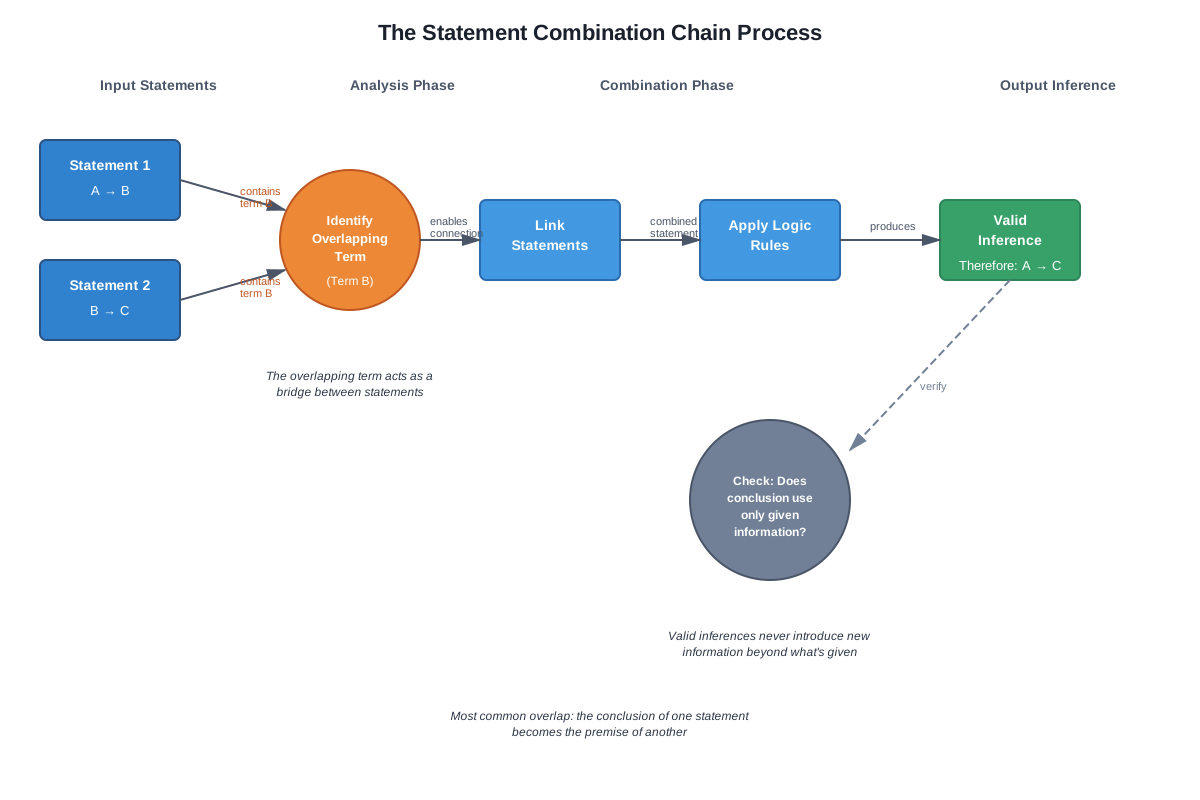
Combining statements operates on a simple but powerful principle: when two or more statements share a common term or concept, they can often be linked to produce a new inference that neither statement alone could support. This process mirrors the transitive property in mathematics—if A relates to B, and B relates to C, then A relates to C. However, logical statement combination requires careful attention to the type of relationship involved.
The most reliable combinations occur when statements create a logical chain. Consider these premises:
- All corporate attorneys work long hours
- Everyone who works long hours experiences stress
These statements share the term "work long hours," allowing them to be combined: All corporate attorneys experience stress. The middle term (working long hours) connects the first term (corporate attorneys) to the final term (experiencing stress).
Types of Statements That Combine Effectively
Different logical structures combine in distinct ways, and recognizing these patterns accelerates problem-solving:
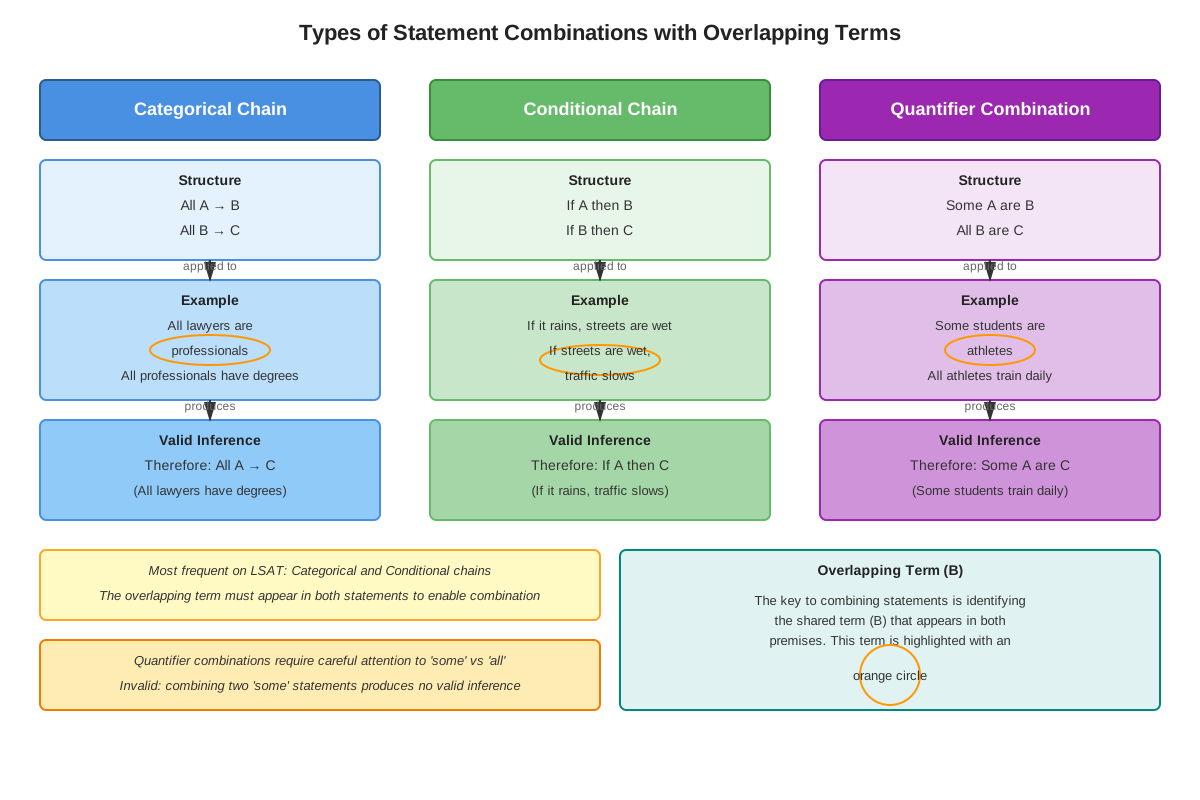
| Statement Type | Combination Pattern | Example |
|---|---|---|
| Universal affirmatives (All A are B) | Chain through shared terms | All dogs are mammals + All mammals are animals = All dogs are animals |
| Existential statements (Some A are B) | Limited overlap inferences | Some lawyers are poets + All poets are creative = Some lawyers are creative |
| Universal negatives (No A are B) | Exclusion chains | No reptiles are mammals + All dogs are mammals = No dogs are reptiles |
| Conditional statements (If A, then B) | Modus ponens chains | If rain, then wet + If wet, then slippery = If rain, then slippery |
The Overlap Principle
For statements to combine productively, they must share at least one term, concept, or category. This overlap principle is the gateway to valid combination. However, mere overlap is insufficient—the logical structure must permit valid inference. Consider:
- Statement 1: "Some politicians are lawyers"
- Statement 2: "Some lawyers are dishonest"
These statements share the term "lawyers," but they cannot be combined to conclude "Some politicians are dishonest" because both statements use "some," which doesn't guarantee overlap between the specific politicians and the specific dishonest lawyers mentioned.
Quantifier Interactions
Understanding how logical quantifiers interact is crucial for combining statements accurately:
All + All = All: When both statements use universal quantifiers and chain properly, the conclusion is also universal.
- All A are B + All B are C = All A are C
All + Some = Some: When a universal statement combines with an existential statement, the conclusion is existential.
- All A are B + Some B are C = Some A are C
Some + Some = No valid combination: Two existential statements sharing a term typically cannot be combined to produce a guaranteed inference because the "some" groups might not overlap.
Most + Most = Possible overlap: When both statements use "most" (more than 50%), there must be some overlap, but the extent is uncertain.
The Process of Systematic Combination
Effective statement combination follows a methodical approach:
- Identify all statements in the stimulus and number them for reference
- Extract key terms from each statement, noting repeated concepts
- Map relationships by identifying which statements share terms
- Test combinations by attempting to chain statements through shared terms
- Verify validity by checking whether the logical structure supports the inference
- Match to answer choices by finding the option that reflects the valid combination
Conditional Statement Combinations
Conditional statements (if-then structures) combine through a process called chaining. When the consequent (then-clause) of one conditional matches the antecedent (if-clause) of another, they link:
- If A, then B
- If B, then C
- Therefore: If A, then C
The LSAT frequently tests whether students can recognize these chains even when the conditional language is disguised through words like "only," "unless," "whenever," or "requires."
Negative Statement Combinations
Statements containing negations require special attention. The combination of positive and negative statements can yield powerful inferences:
- All A are B (equivalently: No A are non-B)
- No C are B (equivalently: All C are non-B)
- Therefore: No A are C
This pattern appears frequently in LSAT questions where exclusion relationships must be tracked across multiple statements.
Multi-Statement Synthesis
Advanced combining statements questions require synthesizing three or more premises. The approach remains systematic: identify all shared terms, build chains where possible, and recognize that some statements might serve as intermediate steps rather than appearing directly in the final inference.
Concept Relationships
The skill of combining statements serves as a foundational element that connects to virtually every other aspect of LSAT Logical Reasoning. At its core, combining statements relies on conditional reasoning—understanding how if-then relationships chain together is essential for recognizing when statements can be productively linked. This connection flows bidirectionally: mastery of conditional logic enables better statement combination, while practice with combining statements reinforces conditional reasoning skills.
Formal logic provides the theoretical framework for combining statements. The rules governing universal and existential quantifiers, the transitive property, and valid inference patterns all derive from formal logic principles. Students who understand these foundations can approach combining statements with confidence rather than intuition.
Within the broader category of inference questions, combining statements represents the most structured and rule-based approach. While other inference questions might require reading between the lines or recognizing implicit assumptions, combining statements questions reward systematic application of logical rules. This makes them among the most teachable and learnable question types on the LSAT.
The relationship map flows as follows:
Formal Logic Principles → Conditional Reasoning → Combining Statements → Complex Inference Questions → Argument Structure Analysis
Additionally, combining statements connects to sufficient and necessary conditions, as recognizing these relationships helps identify which terms can serve as linking points between statements. The skill also supports parallel reasoning questions, where recognizing the logical structure of combined statements helps match argument patterns.
High-Yield Facts
⭐ Statements must share at least one common term or concept to be combined productively—without overlap, no valid inference can be drawn from combination alone.
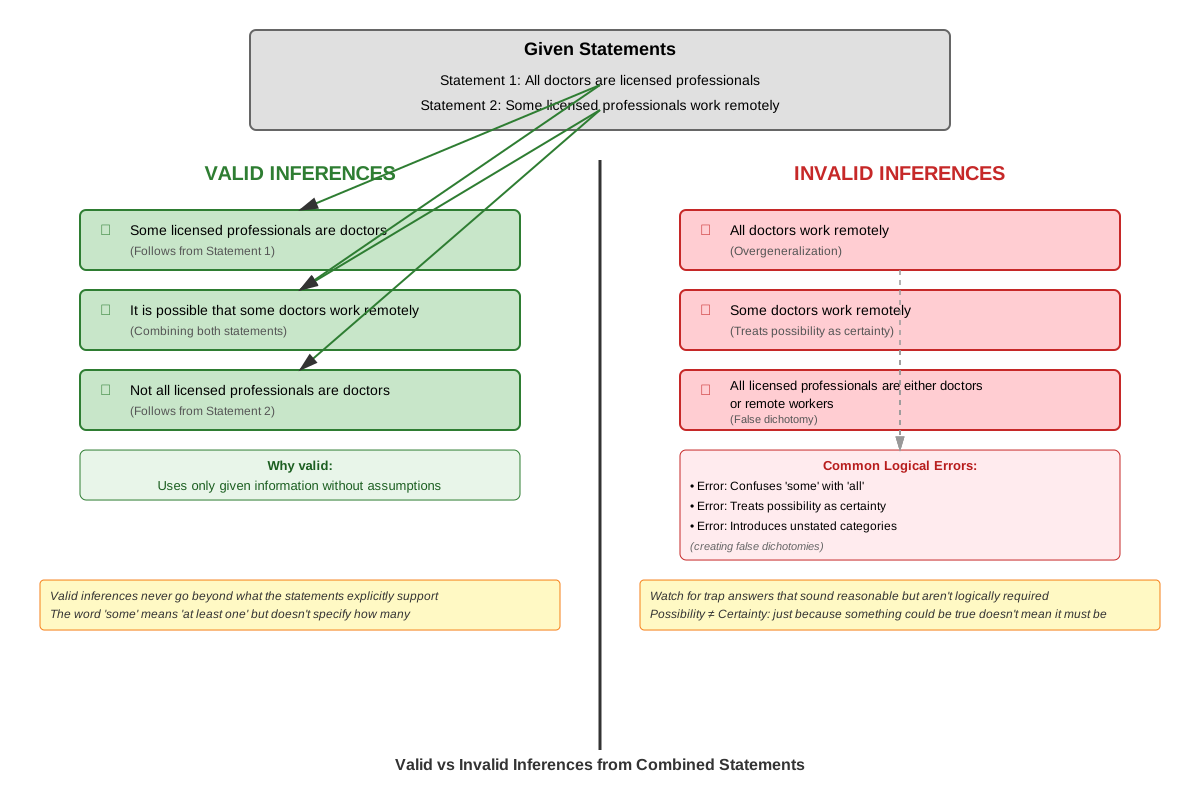
⭐ Two "some" statements sharing a term cannot be combined to guarantee a conclusion—the "some" groups might not overlap at all.
⭐ Universal statements (all, no, every) combine more reliably than existential statements (some, few)—they create definitive chains of reasoning.
⭐ When combining "All A are B" with "Some B are C," the valid conclusion is "Some A are C"—the universal statement guarantees the existential inference.
⭐ Conditional statements chain when the consequent of one matches the antecedent of another—this creates extended if-then relationships.
- Negative statements (no, none, not) require careful tracking to avoid reversal errors when combining with other statements.
- The order of statement combination sometimes matters—attempting different sequences can reveal different valid inferences.
- Three or more statements can be combined by building intermediate conclusions that then combine with remaining statements.
- Synonymous or equivalent terms across statements indicate potential combination opportunities even when exact wording differs.
- The LSAT answer choices often paraphrase valid combinations rather than stating them in the exact terms used in the stimulus.
- Quantifier strength decreases through combination—combining "all" with "most" yields at most "most," never "all."
- Temporal or causal relationships can serve as linking terms just as effectively as category memberships.
- Contrapositive relationships enable statement combination even when terms don't initially appear to overlap.
Quick check — test yourself on Combining statements so far.
Try Flashcards →Common Misconceptions
Misconception: If two statements share a common term, they can always be combined to produce a valid inference.
Correction: Shared terms are necessary but not sufficient for valid combination. The logical structure and quantifiers must permit the inference. Two "some" statements sharing a term, for example, typically cannot be combined because the "some" groups might not overlap.
Misconception: Combining statements always produces a conclusion that uses terms from both original statements.
Correction: Valid combinations can produce conclusions that exclude the middle term entirely. When "All A are B" combines with "All B are C," the conclusion "All A are C" doesn't mention B at all—the shared term drops out.
Misconception: More statements always mean more complex combinations.
Correction: Sometimes additional statements serve as distractors or provide information that cannot be combined with the other premises. Not every statement in a stimulus will contribute to the valid inference.
Misconception: If a conclusion sounds reasonable based on the statements, it must be a valid combination.
Correction: The LSAT tests logical validity, not plausibility. A conclusion might seem sensible in the real world but still be logically invalid based on the specific statements provided. Only what must be true based on the logical structure counts as a valid combination.
Misconception: Combining statements is the same as summarizing them.
Correction: Combination produces new information that wasn't explicitly stated in any single premise. Summarizing merely restates what was already said. The power of combining statements lies in deriving novel inferences through logical relationships.
Misconception: Conditional statements can be combined in any order as long as they share terms.
Correction: Conditional statements must chain in a specific direction—the consequent of one must match the antecedent of the next. Attempting to chain them backward (matching antecedents or consequents to each other) produces invalid inferences.
Misconception: "Most" statements combine just like "all" statements.
Correction: "Most" (meaning more than 50%) has special combination rules. Two "most" statements about the same group guarantee some overlap, but the extent is limited. "Most A are B" plus "Most A are C" guarantees only that some A are both B and C, not that most A are both.
Worked Examples
Example 1: Basic Two-Statement Combination
Stimulus: All members of the debate team are students who excel in logical reasoning. Some students who excel in logical reasoning are also talented musicians.
Question: Which one of the following must be true based on the statements above?
Answer Choices:
(A) All members of the debate team are talented musicians
(B) Some members of the debate team are talented musicians
(C) Most talented musicians excel in logical reasoning
(D) Some talented musicians are members of the debate team
(E) No members of the debate team are talented musicians
Solution Process:
Step 1: Identify and translate the statements
- Statement 1: All debate team members → excel in logical reasoning
- Statement 2: Some who excel in logical reasoning → talented musicians
Step 2: Identify the shared term
Both statements reference "students who excel in logical reasoning"—this is our linking term.
Step 3: Determine the combination pattern
We have "All A are B" (Statement 1) combined with "Some B are C" (Statement 2). This pattern yields "Some A are C."
Step 4: Apply the combination
Since all debate team members excel in logical reasoning, and some who excel in logical reasoning are talented musicians, it must be true that some debate team members are talented musicians.
Step 5: Match to answer choices
Answer choice (B) correctly states this inference.
Why other answers fail:
- (A) is too strong—we only know "some," not "all"
- (C) reverses the relationship and introduces "most" without support
- (D) reverses the direction of the inference
- (E) contradicts the valid inference
Learning objective addressed: This example demonstrates applying combining statements to solve LSAT-style problems accurately by showing the systematic process of identifying shared terms and applying quantifier rules.
Example 2: Multi-Statement Combination with Conditionals
Stimulus: Every attorney who specializes in environmental law must understand scientific principles. Anyone who understands scientific principles can evaluate technical reports. No one who cannot evaluate technical reports should serve on the regulatory commission.
Question: If the statements above are true, which one of the following must also be true?
Answer Choices:
(A) Every attorney who specializes in environmental law should serve on the regulatory commission
(B) Some people who can evaluate technical reports specialize in environmental law
(C) Every attorney who specializes in environmental law can evaluate technical reports
(D) Anyone who serves on the regulatory commission understands scientific principles
(E) Most attorneys who specialize in environmental law serve on the regulatory commission
Solution Process:
Step 1: Translate each statement into conditional form
- Statement 1: Environmental law attorney → understands scientific principles
- Statement 2: Understands scientific principles → can evaluate technical reports
- Statement 3: Should serve on commission → can evaluate technical reports (contrapositive of "cannot evaluate → should not serve")
Step 2: Identify chaining opportunities
Statements 1 and 2 chain directly: the consequent of Statement 1 matches the antecedent of Statement 2.
Step 3: Create the intermediate inference
Environmental law attorney → understands scientific principles → can evaluate technical reports
Therefore: Environmental law attorney → can evaluate technical reports
Step 4: Check if this combines with Statement 3
Statement 3 tells us what's required to serve on the commission, but our inference tells us what environmental law attorneys can do. These don't chain further because our inference ends with "can evaluate," while Statement 3 requires "can evaluate" as a necessary condition for serving, not a sufficient one.
Step 5: Match to answer choices
Answer choice (C) correctly states our valid inference: Every attorney who specializes in environmental law can evaluate technical reports.
Why other answers fail:
- (A) commits a sufficiency-necessity error—being able to evaluate reports is necessary for serving on the commission, not sufficient
- (B) reverses the direction and weakens to "some" without justification
- (D) reverses the conditional relationship
- (E) introduces "most" without any quantitative information in the stimulus
Learning objective addressed: This example demonstrates explaining the reasoning pattern behind combining statements by showing how conditional chains work and why certain combinations are valid while others commit logical errors.
Exam Strategy
When approaching combining statements questions on the LSAT, begin by identifying the question stem. Phrases like "must be true," "can be properly inferred," or "follows logically" signal that combining statements may be required. These questions reward systematic analysis over intuitive leaps.
Trigger words and phrases that indicate combining opportunities include:
- "All," "every," "each," "any" (universal quantifiers that chain reliably)
- "Some," "few," "several" (existential quantifiers requiring careful handling)
- "If," "when," "whenever," "only if" (conditional indicators)
- "No," "none," "never" (universal negatives)
- Repeated terms or concepts across sentences
Process-of-elimination strategy: Before attempting to combine all statements, scan the answer choices to identify what types of inferences they suggest. If all answers involve a particular term, focus on statements containing that term. Eliminate answers that:
- Use stronger quantifiers than the stimulus supports (e.g., "all" when only "some" is justified)
- Introduce terms that appear in only one statement without proper combination
- Reverse the direction of conditional or categorical relationships
- Claim certainty ("must be true") when only probability is supported
Time allocation: Combining statements questions should take 60-90 seconds on average. If you cannot identify a shared term within 20 seconds, the question might not primarily test combining statements—consider whether it requires assumption identification or implicit inference instead. Don't force combinations where none exist.
Systematic approach under time pressure:
- Read the stimulus and number each distinct statement (15 seconds)
- Circle or underline repeated terms (10 seconds)
- Attempt the most obvious combination first (20 seconds)
- Check answer choices against your inference (15 seconds)
- Eliminate clearly wrong answers and verify the remaining choice (20 seconds)
Exam Tip: When statements seem unrelated, look for synonymous terms or equivalent concepts. The LSAT often disguises combination opportunities by varying language. "Professionals" and "people who work in careers" might refer to the same group.
Common trap patterns: The LSAT frequently includes answer choices that sound like valid combinations but commit subtle errors. Watch for:
- Illicit conversion (reversing "All A are B" to "All B are A")
- Quantifier strengthening (upgrading "some" to "most" or "all")
- Affirming the consequent in conditional combinations
- Combining statements that share a term but lack the logical structure for valid inference
Memory Techniques
The CHAIN Mnemonic for systematic combining:
- Common terms: Identify shared concepts
- Hierarchy: Determine quantifier strength (all > most > some)
- Arrange: Order statements to create logical chains
- Infer: Draw the conclusion that must follow
- Negate distractors: Eliminate answers that violate logical rules
Quantifier Combination Rhyme:
"All plus all gives all for sure,
All plus some makes some secure,
Some plus some gives nothing pure,
Most plus most makes overlap sure."
Visual Strategy: Imagine statements as puzzle pieces. Shared terms are the connecting edges. Only pieces with matching edges (compatible logical structures) can fit together. This visualization helps recognize when statements cannot be combined despite sharing terms.
The Overlap Rule of Thumb: Draw three circles when dealing with "some" statements. If "Some A are B" and "Some B are C," visualize three circles where A and B overlap, and B and C overlap, but A and C might not touch at all. This prevents invalid "some-some" combinations.
Conditional Chain Acronym - ACTS:
- Antecedent of one statement
- Consequent of previous statement
- They must match to chain
- Sufficient to necessary flows forward
Summary
Combining statements is a high-yield LSAT skill that requires synthesizing information from multiple premises to derive conclusions that must be true. This technique appears in 15-20% of Logical Reasoning questions and tests the deductive reasoning essential to legal analysis. Success depends on recognizing shared terms between statements, understanding how different quantifiers interact (universal, existential, and conditional), and applying systematic combination rules. Universal statements (all, no, every) combine more reliably than existential statements (some, few), and conditional statements chain when the consequent of one matches the antecedent of another. The key to mastery is methodical analysis: identify all statements, extract shared terms, test combinations through logical rules, and verify that inferences follow necessarily rather than merely plausibly. Students must avoid common traps like combining two "some" statements, reversing conditional relationships, or strengthening quantifiers beyond what the premises support. With practice, combining statements becomes a reliable source of points on the LSAT.
Key Takeaways
- Combining statements requires shared terms and compatible logical structures—overlap alone is insufficient for valid inference
- Universal quantifiers (all, every, no) create stronger, more reliable combinations than existential quantifiers (some, few)
- Two "some" statements sharing a term typically cannot be combined because the "some" groups might not overlap
- Conditional statements chain when consequents match antecedents, creating extended if-then relationships
- Valid combinations produce conclusions that must be true, not merely could be true—the LSAT tests logical necessity
- Systematic analysis beats intuition: number statements, identify shared terms, apply combination rules, and verify against answer choices
- The middle term often disappears in the final inference—focus on what connects the first and last elements of the chain
Related Topics
Conditional Logic and Contrapositives: Mastering combining statements naturally leads to deeper work with conditional reasoning, including recognizing when contrapositive relationships enable statement combination even when terms don't initially appear to overlap.
Formal Logic Translations: Advanced students benefit from studying how to translate complex English statements into formal logical notation, making combination opportunities more visible and reducing errors.
Sufficient and Necessary Conditions: Understanding the distinction between sufficient and necessary conditions clarifies why certain statement combinations work while others fail, particularly in conditional chains.
Quantifier Logic and Venn Diagrams: Visual representation of quantified statements through Venn diagrams provides an alternative approach to combining statements that benefits visual learners.
Must Be True vs. Most Strongly Supported Questions: While combining statements appears most frequently in "must be true" questions, the skill also applies to "most strongly supported" questions where the standard of proof is slightly relaxed.
Practice CTA
Now that you understand the principles and patterns of combining statements, it's time to cement your mastery through deliberate practice. Attempt the practice questions associated with this topic, focusing on applying the systematic CHAIN approach to each problem. Use the flashcards to drill the quantifier combination rules until they become automatic. Remember: combining statements is one of the most learnable skills on the LSAT because it follows clear, consistent rules. Every practice question you complete builds the pattern recognition and logical fluency that will serve you throughout the exam. You've got this—now prove it through practice!
Sign up free to keep reading
Create a free AnvayaPrep account to finish this LSAT guide on Combining statements — plus flashcards and practice questions.