Overview
Most strongly supported questions represent one of the most frequently tested question types within the Logical Reasoning section of the LSAT. These questions, which fall under the broader category of inference questions, require test-takers to identify which answer choice follows most logically from the information presented in the stimulus. Unlike assumption or strengthen/weaken questions that ask you to add information to an argument, most strongly supported questions demand that you stay strictly within the bounds of what the passage explicitly states or necessarily implies.
The fundamental challenge of LSAT most strongly supported questions lies in their requirement for precise, conservative reasoning. Test-takers must resist the temptation to bring in outside knowledge or make logical leaps beyond what the stimulus warrants. The LSAT rewards those who can identify the answer choice that is most directly supported by the given information, even if that support falls short of absolute certainty. This question type tests your ability to recognize valid inferences—conclusions that must be true or are highly likely to be true based solely on the premises provided.
Within the broader landscape of Logical Reasoning, most strongly supported questions serve as a bridge between pure comprehension and complex argumentation. They test whether you can extract meaning from dense text, recognize logical relationships between statements, and distinguish between what is stated, what is implied, and what is merely possible. Mastering this question type builds foundational skills essential for tackling other inference-based questions, including "must be true" questions, "most reasonably inferred" questions, and even some reading comprehension tasks. The ability to draw warranted conclusions from given information is not only crucial for LSAT success but also fundamental to legal reasoning itself.
Learning Objectives
- [ ] Identify how Most strongly supported questions appears in LSAT questions
- [ ] Explain the reasoning pattern behind Most strongly supported questions
- [ ] Apply Most strongly supported questions to solve LSAT-style problems accurately
- [ ] Distinguish between strongly supported inferences and mere possibilities
- [ ] Evaluate the degree of support each answer choice receives from the stimulus
- [ ] Recognize common trap answers that go beyond the scope of the passage
- [ ] Synthesize information from multiple premises to reach valid conclusions
Prerequisites
- Basic logical reasoning structure: Understanding of premises and conclusions is essential because most strongly supported questions require identifying what follows from given premises
- Conditional reasoning fundamentals: Knowledge of if-then statements helps recognize valid inferences and contrapositive relationships that often appear in these questions
- Reading comprehension skills: The ability to parse complex sentences and identify key information is necessary to extract the relevant facts from the stimulus
- Argument structure recognition: Familiarity with how arguments are constructed enables test-takers to distinguish between stated facts and implied conclusions
Why This Topic Matters
Most strongly supported questions appear with remarkable frequency on the LSAT, typically comprising 15-20% of all Logical Reasoning questions across both sections. This translates to approximately 5-8 questions per test, making this question type one of the highest-yield areas for focused study. Unlike some specialized question types that appear only occasionally, most strongly supported questions are virtually guaranteed to appear multiple times on every LSAT administration.
In real-world legal practice, the skill tested by these questions—drawing warranted conclusions from available evidence—forms the bedrock of legal analysis. Attorneys must constantly evaluate what can be reasonably concluded from statutes, precedents, contracts, and testimony without overstepping the bounds of the evidence. The conservative reasoning required for these questions mirrors the careful interpretive work lawyers perform daily.
On the LSAT, most strongly supported questions commonly appear in several recognizable formats. The stimulus might present scientific research findings and ask what conclusion the data supports, describe a historical or social phenomenon and ask what can be inferred about its causes or effects, or provide statistical information and ask what comparison or trend is most justified. These questions test whether you can move from facts to reasonable conclusions without introducing unsupported assumptions or external knowledge. The LSAT particularly favors stimuli that contain multiple interconnected facts, requiring you to synthesize information from different parts of the passage to identify the best-supported inference.
Core Concepts
Defining Most Strongly Supported Questions
Most strongly supported questions ask test-takers to identify which answer choice is best supported by the information in the stimulus, even if that support falls short of logical necessity. The key distinguishing feature is the language of probability and support rather than certainty. Question stems typically include phrases like "most strongly supported," "most reasonably inferred," "most likely," or "the statements above provide the most support for which one of the following."
The critical distinction between these questions and "must be true" questions lies in the degree of certainty required. While "must be true" questions demand that the correct answer be absolutely, necessarily true based on the stimulus, most strongly supported questions accept answers that are highly probable or well-supported without being logically required. This difference means the correct answer might be strongly indicated by the evidence without being the only possible conclusion.
The Standard of Support
Understanding what constitutes "strong support" is essential for success on these questions. The correct answer must be more than merely consistent with the stimulus—it must be actively supported by the information provided. This means the stimulus gives you positive reasons to believe the answer choice is true, rather than simply failing to contradict it.
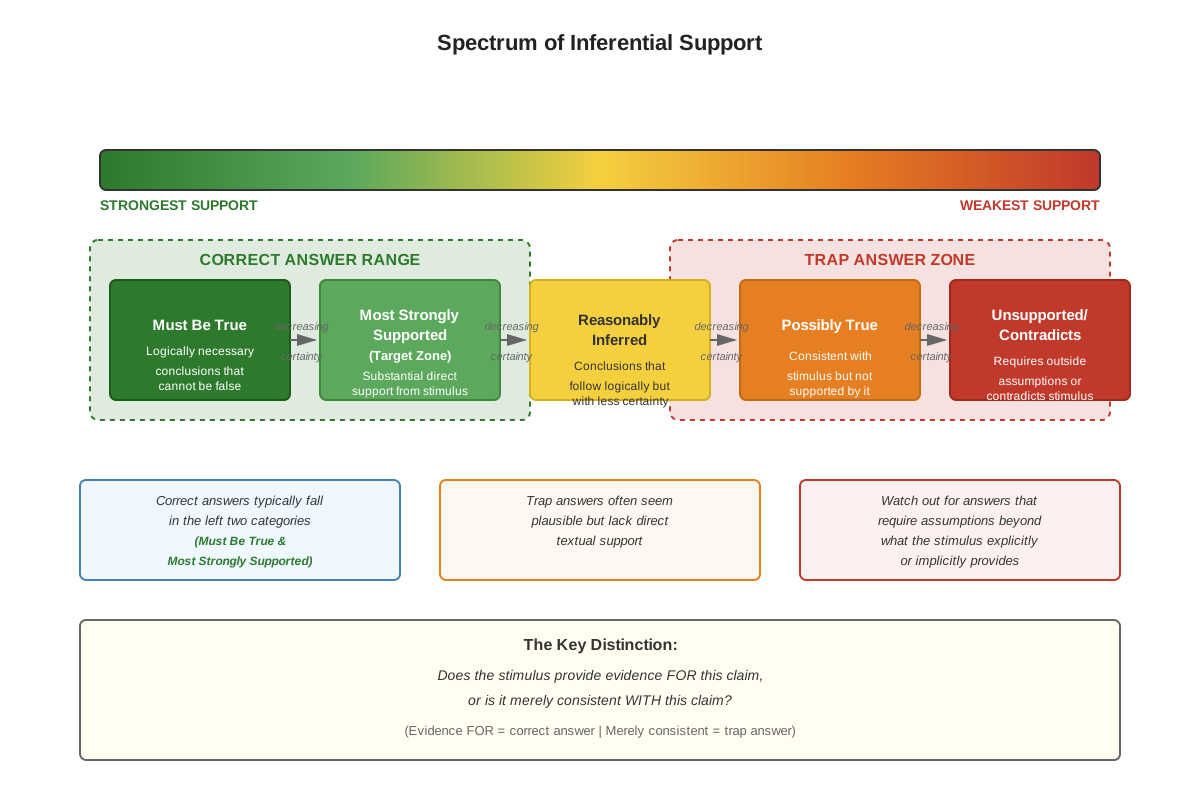
The standard operates on a spectrum:
| Level of Support | Description | Acceptable for Correct Answer? |
|---|---|---|
| Logically necessary | Must be true; no other possibility | Yes (strongest) |
| Highly probable | Very likely given the evidence | Yes |
| Reasonably supported | More likely true than false | Yes |
| Merely possible | Consistent but not indicated | No |
| Unsupported | No evidence either way | No |
| Contradicted | Evidence suggests it's false | No |
The Inference Process
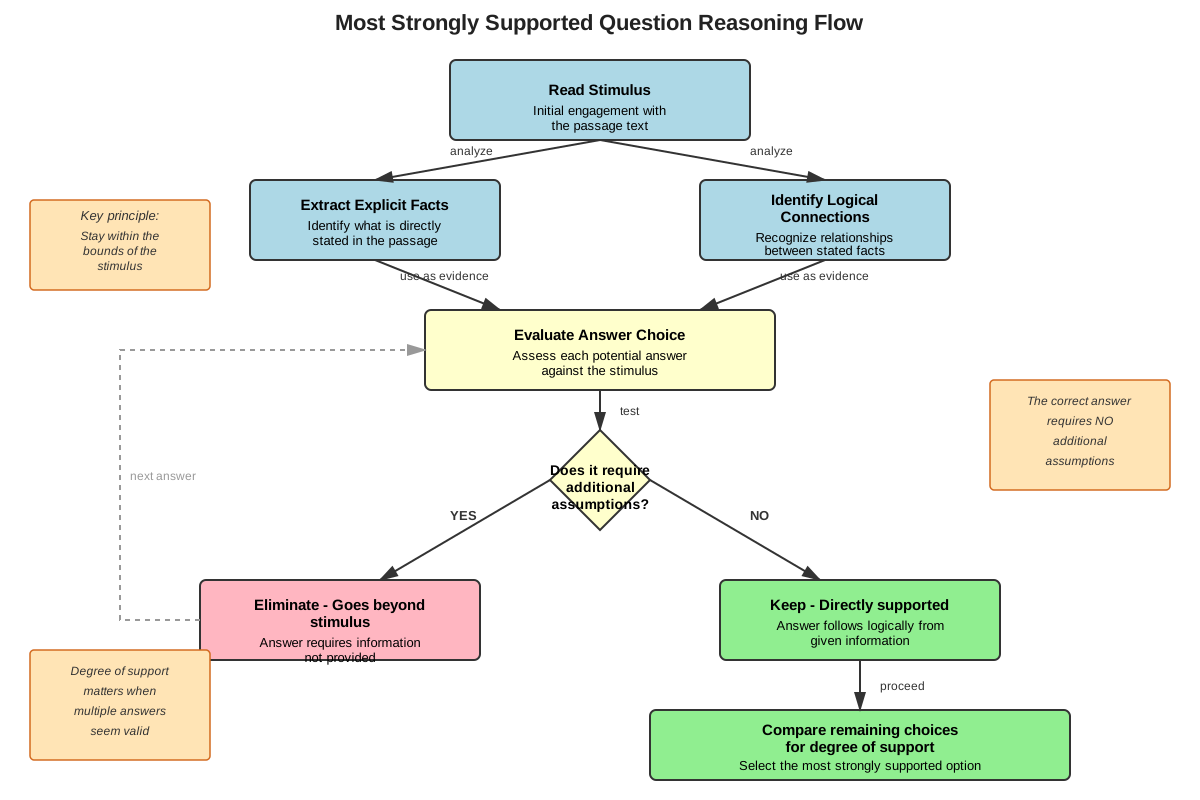
Drawing valid inferences requires a systematic approach. First, identify all factual claims in the stimulus—these are your premises. Second, look for logical relationships between these facts: Do they describe a cause-and-effect relationship? Do they present a comparison? Do they establish a conditional relationship? Third, consider what must follow or what is strongly indicated by combining these facts.
The inference process demands strict adherence to the scope of the stimulus. If the passage discusses "most scientists," the inference cannot extend to "all scientists." If the stimulus provides data about one time period, conclusions about other time periods require explicit support. This conservative approach prevents the most common error: selecting answers that seem reasonable based on general knowledge but aren't actually supported by the specific information given.
Common Inference Patterns
Certain logical patterns appear repeatedly in most strongly supported questions:
Comparative inferences: When the stimulus provides information about two or more items, the correct answer often involves a comparison between them. For example, if told that Product A costs more than Product B, and Product B costs more than Product C, you can infer that Product A costs more than Product C.
Quantitative inferences: Stimuli containing numbers, percentages, or quantitative relationships often support mathematical conclusions. If 60% of Group X has Property Y, and Group X contains 100 members, you can infer that 60 members have Property Y.
Temporal inferences: When the stimulus describes changes over time or sequences of events, the correct answer may involve conclusions about what came before, what came after, or what the trend suggests.
Causal inferences: If the stimulus establishes that one thing causes another, you can infer that when the cause is present, the effect is likely to follow, or that when the effect is absent, the cause was likely absent.
Scope Limitations
The concept of scope is paramount in most strongly supported questions. The scope encompasses what the stimulus actually addresses—the specific subjects, time frames, and contexts discussed. Correct answers stay within this scope, while wrong answers frequently violate it by introducing new subjects, extending beyond the stated time frame, or making claims about contexts not mentioned.
For instance, if a stimulus discusses the dietary habits of urban residents in one country, an answer choice about rural residents or residents of other countries exceeds the scope unless the stimulus provides information connecting these groups. Similarly, if the passage describes current conditions, conclusions about historical or future conditions require explicit temporal connections in the stimulus.
Degree Words and Qualifiers
Pay careful attention to degree words and qualifiers in both the stimulus and answer choices. Words like "some," "most," "all," "never," "always," "often," "rarely," "likely," and "possible" dramatically affect the strength of claims. An answer choice using "all" requires universal support from the stimulus, while one using "some" requires only partial support.
The LSAT frequently creates wrong answers by shifting these qualifiers. The stimulus might support "some X are Y," but the wrong answer states "most X are Y" or "all X are Y." Conversely, the stimulus might establish "most X are Y," but the wrong answer weakens this to "some X might be Y," which, while technically true, isn't the most strongly supported conclusion.
Concept Relationships
The concepts within most strongly supported questions form an interconnected framework. The definition of strong support establishes the foundation, determining what counts as an acceptable inference. This definition directly influences the inference process, which provides the methodology for moving from premises to conclusions. The inference process, in turn, relies on recognizing common inference patterns—the recurring logical structures that appear across different stimuli.
Scope limitations act as boundaries on the inference process, preventing test-takers from drawing conclusions that, while logical in abstract terms, aren't warranted by the specific information provided. These scope limitations work in tandem with degree words and qualifiers, which fine-tune the precision of both the stimulus claims and the answer choices.
The relationship to prerequisite knowledge is equally important. Basic logical reasoning structure provides the vocabulary and conceptual framework for understanding premises and conclusions. Conditional reasoning supplies specific inference rules (like the contrapositive) that frequently generate correct answers. Reading comprehension enables accurate extraction of the facts that serve as premises, while argument structure recognition helps identify which statements are given as facts versus which are already conclusions within the stimulus.
Looking forward, mastery of most strongly supported questions enables progression to more complex inference types, including principle questions (which ask what general rule is supported by specific cases) and parallel reasoning questions (which require identifying structurally similar inferences). The skills developed here—careful reading, conservative reasoning, and scope awareness—transfer directly to Reading Comprehension inference questions and even to the Analytical Reasoning section's rule-based deductions.
Concept Flow: Stimulus Facts → Identify Relationships → Apply Inference Patterns → Check Scope Limitations → Evaluate Degree Words → Select Most Strongly Supported Answer
High-Yield Facts
⭐ Most strongly supported questions appear 5-8 times per LSAT, making them one of the highest-frequency question types
⭐ The correct answer must be actively supported by the stimulus, not merely consistent with it
⭐ Scope violations are the most common type of wrong answer in these questions
⭐ Degree words (some, most, all, likely, possible) are frequently manipulated to create trap answers
⭐ The correct answer may be strongly supported without being logically necessary or certain
- Question stems include phrases like "most strongly supported," "most reasonably inferred," "most likely," or "provides the most support for"
- Combining multiple facts from different parts of the stimulus often yields the correct inference
- Comparative inferences (X is greater than Y) are among the most common correct answer types
- Temporal language in the stimulus (before, after, during) often signals temporal inferences in the answer
- Wrong answers frequently introduce new subjects or concepts not mentioned in the stimulus
- Quantitative information in the stimulus typically supports mathematical or statistical inferences
- The correct answer should feel conservative and closely tied to the stimulus language
- Extreme language in answer choices (always, never, impossible, certain) requires extremely strong support
- If two answer choices seem supported, the one requiring fewer assumptions is typically correct
- Causal language in the stimulus (causes, leads to, results in) often supports causal inferences in the answer
Common Misconceptions
Misconception: Most strongly supported questions require the answer to be absolutely, necessarily true based on the stimulus.
Correction: Unlike "must be true" questions, most strongly supported questions accept answers that are highly probable or well-indicated without being logically necessary. The correct answer needs strong support, not absolute certainty.
Misconception: If an answer choice is consistent with the stimulus and doesn't contradict it, it's the correct answer.
Correction: Mere consistency is insufficient. The correct answer must be actively supported by the stimulus—meaning the passage gives you positive reasons to believe it's true, not just fails to contradict it. Many wrong answers are consistent with the stimulus but receive no actual support from it.
Misconception: Outside knowledge and real-world facts should be used to evaluate answer choices.
Correction: Most strongly supported questions test your ability to draw inferences based solely on the information in the stimulus. Bringing in outside knowledge often leads to selecting answers that seem true in the real world but aren't supported by the specific passage provided. The correct answer must be supported by the stimulus alone.
Misconception: The correct answer will use the same language and terminology as the stimulus.
Correction: While the correct answer must stay within the scope of the stimulus, it often paraphrases or synthesizes information rather than directly quoting it. The LSAT tests whether you understand the logical implications of the stimulus, not just whether you can match words.
Misconception: Longer, more detailed answer choices are more likely to be correct because they seem more thorough.
Correction: Length has no correlation with correctness. In fact, longer answer choices often introduce additional claims that go beyond what the stimulus supports. The correct answer might be quite concise if it makes a single, well-supported inference.
Misconception: If the stimulus discusses a specific example, the correct answer must also be about that specific example.
Correction: The correct answer might generalize from the specific example to a broader principle, or it might draw a conclusion about what the example illustrates. The key is whether that generalization or conclusion is supported by the information about the example.
Quick check — test yourself on Most strongly supported questions so far.
Try Flashcards →Worked Examples
Example 1: Scientific Research Inference
Stimulus: "A recent study found that children who participated in music education programs for at least two years scored an average of 15% higher on standardized math tests than children who did not participate in such programs. The study controlled for socioeconomic status, prior academic achievement, and parental education levels. However, the researchers noted that participation in music programs was voluntary, and parents had to actively enroll their children."
Question: Which one of the following is most strongly supported by the information above?
Answer Choices:
(A) Music education causes improved mathematical ability in children.
(B) Children whose parents enrolled them in music programs may have differed in some relevant way from children whose parents did not.
(C) All children would benefit academically from music education.
(D) The correlation between music education and math scores cannot be explained by socioeconomic factors.
(E) Music education is the most effective way to improve children's math performance.
Analysis:
Let's work through each answer systematically:
(A) Claims a causal relationship. While the study found a correlation, the stimulus explicitly notes that participation was voluntary and parent-initiated. This suggests possible confounding variables. The stimulus supports correlation but doesn't establish causation. Eliminate.
(B) This acknowledges that because participation was voluntary and required parental action, there might be unmeasured differences between the groups (such as parental involvement, motivation, or other factors). The stimulus directly supports this by noting the voluntary nature of participation. This is a conservative inference that stays within the scope. Strong candidate.
(C) Uses the extreme word "all" and makes a universal claim. The study only examined children who participated for at least two years, and the results showed an average improvement, not universal improvement. This goes beyond what the stimulus supports. Eliminate.
(D) The stimulus states that socioeconomic status was controlled for, which means the correlation can't be explained by that specific factor. This answer is supported. However, compare it to (B): (D) restates something explicitly mentioned, while (B) draws a reasonable inference from the voluntary participation detail. Both are supported, but we need the most strongly supported answer.
(E) Claims music education is the "most effective" method. The stimulus provides no comparison to other methods of improving math performance. This exceeds the scope. Eliminate.
Comparing (B) and (D): Both are supported, but (D) essentially restates information explicitly given (that socioeconomic factors were controlled), while (B) draws a meaningful inference from the voluntary participation detail—that unmeasured differences might exist between groups. The inference in (B) is actually more strongly supported because it follows logically from the voluntary nature of participation combined with the study's findings.
Correct Answer: (B)
This example demonstrates how the correct answer often involves synthesizing multiple pieces of information (the correlation found + the voluntary participation) to reach a conservative conclusion that acknowledges limitations in the data.
Example 2: Business and Economics Inference
Stimulus: "In 2020, Company X's revenue from online sales was $50 million, while revenue from physical store sales was $30 million. In 2021, online sales revenue increased to $65 million, and physical store sales revenue decreased to $25 million. Company X's total operating costs remained constant at $60 million across both years."
Question: The information above most strongly supports which one of the following?
Answer Choices:
(A) Company X was more profitable in 2021 than in 2020.
(B) Customers increasingly preferred online shopping to in-store shopping at Company X.
(C) Company X's total revenue increased between 2020 and 2021.
(D) Physical stores became less important to Company X's business model.
(E) Company X should close all physical stores to maximize profit.
Analysis:
This question requires mathematical reasoning and careful attention to what can be calculated versus what requires additional assumptions.
(A) Profitability requires comparing revenue to costs. Let's calculate:
- 2020 total revenue: $50M + $30M = $80M; Costs: $60M; Profit: $20M
- 2021 total revenue: $65M + $25M = $90M; Costs: $60M; Profit: $30M
Company X was indeed more profitable in 2021 ($30M profit vs. $20M profit). This is directly calculable from the given information. Strong candidate.
(B) This makes a claim about customer preferences. While online sales increased and physical sales decreased, this could be due to many factors: store closures, reduced inventory in physical locations, marketing changes, or actual preference shifts. The stimulus doesn't provide information about customer preferences specifically. Eliminate.
(C) Total revenue calculation:
- 2020: $80M
- 2021: $90M
Total revenue did increase. This is also directly supported. Strong candidate.
Comparing (A) and (C): Both are mathematically supported by the stimulus. However, (A) requires one additional step beyond (C)—it requires subtracting costs from revenue to determine profit. Both are valid inferences, but (C) is more direct. Yet the question asks for "most strongly supported," and both are equally certain based on the math. We need to consider whether one provides more meaningful information or requires fewer steps.
Actually, both (A) and (C) are equally strongly supported—they're both mathematical certainties based on the given numbers. In a real LSAT question, there would typically be a distinguishing factor. Let's reconsider: (A) requires understanding that profit = revenue - costs, while (C) is simple addition. However, profit is explicitly calculable, so (A) is not making an unsupported leap.
(D) "Less important" is a qualitative judgment not directly supported. While physical store revenue decreased in absolute and relative terms, "importance" could involve factors beyond revenue (brand presence, customer service, product testing). Eliminate.
(E) This is a recommendation about what the company "should" do. The stimulus provides no information about the costs specifically associated with physical stores versus online operations, customer acquisition strategies, or long-term business implications. This far exceeds the scope. Eliminate.
Correct Answer: (A) or (C) (both are strongly supported, but (A) provides more meaningful business insight while still being directly calculable)
In an actual LSAT question, there would be a clearer distinction, but this example illustrates how quantitative information supports mathematical inferences and how you must distinguish between what's calculable (supported) and what requires business judgment (not supported).
Exam Strategy
Identifying the Question Type
The first critical step is recognizing that you're dealing with a most strongly supported question. Train yourself to spot the characteristic language: "most strongly supported," "most reasonably inferred," "most likely," "provides the most support for," or "the statements above, if true, provide the most support for which one of the following." This recognition triggers the appropriate mental approach—looking for strong support rather than logical necessity or argument flaws.
Reading the Stimulus Strategically
Approach the stimulus with the goal of identifying factual claims and their relationships. Unlike assumption or flaw questions where you're looking for gaps in reasoning, here you're gathering information that will support a conclusion. Mark or mentally note:
- Quantitative information (numbers, percentages, comparisons)
- Temporal markers (before, after, during, increased, decreased)
- Causal language (causes, leads to, results in)
- Scope limitations (specific groups, time periods, contexts mentioned)
- Conditional statements (if-then relationships)
Pre-Phrasing Strategically
While pre-phrasing (predicting the answer before looking at choices) is valuable for many question types, it's less reliable for most strongly supported questions because the correct inference might combine information in unexpected ways. Instead, after reading the stimulus, ask yourself: "What conclusions can I draw from this information? What comparisons, trends, or relationships are established?" This mental preparation helps you recognize the correct answer without over-committing to a specific prediction.
Evaluating Answer Choices
Use a systematic approach for each answer choice:
- Scope check: Does this answer introduce new subjects, time periods, or contexts not mentioned in the stimulus?
- Support check: Does the stimulus give me positive reasons to believe this is true, or is it merely consistent?
- Degree check: Do the qualifiers (some, most, all, likely, certain) match the strength of support in the stimulus?
- Assumption check: Does this answer require me to assume additional facts not provided in the stimulus?
Process of Elimination Triggers
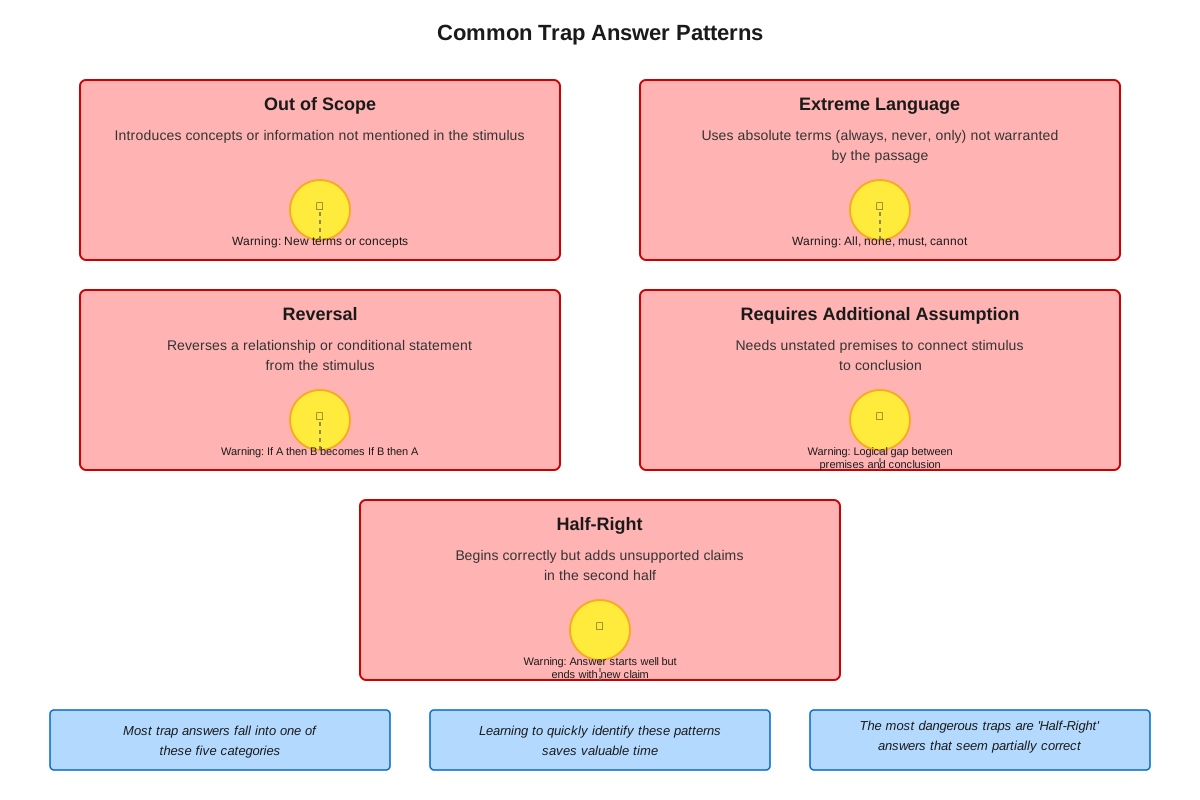
Certain features reliably indicate wrong answers:
- New concepts: Answer choices introducing subjects not mentioned in the stimulus are almost always wrong
- Extreme language without extreme support: Words like "always," "never," "impossible," "certain," or "only" require very strong support
- Causal claims from correlational data: If the stimulus shows a correlation but doesn't establish causation, answers claiming causation are typically wrong
- Scope expansion: Answers that extend beyond the specific groups, times, or contexts discussed in the stimulus
- Reversed logic: Answers that flip conditional relationships or reverse cause and effect
Time Management
Most strongly supported questions typically require 1:15 to 1:30 minutes. The stimulus often contains dense information requiring careful reading, but the inference itself is usually straightforward once you've understood the facts. If you find yourself spending more than 1:45 on one of these questions, you may be overthinking it. The correct answer should feel solidly supported, not like a stretch.
Exam Tip: If you're torn between two answer choices, ask yourself which one requires fewer additional assumptions. The correct answer in most strongly supported questions is typically the more conservative choice that stays closer to the explicit information in the stimulus.
Common Trap Patterns
The LSAT uses predictable patterns to create attractive wrong answers:
- The "real-world true" trap: Answers that are factually correct in reality but not supported by the specific stimulus
- The "one step too far" trap: Answers that start with supported information but then add an unsupported claim
- The "reversal" trap: Answers that reverse the direction of a relationship (if the stimulus says X leads to Y, the trap says Y leads to X)
- The "degree shift" trap: Answers that change "some" to "most" or "most" to "all"
Memory Techniques
The SCOPE Acronym
Use SCOPE to remember what to check in answer choices:
- Subjects: Are the same subjects discussed?
- Comparisons: Are comparisons supported by the stimulus?
- Outside knowledge: Am I using only stimulus information?
- Precision: Do degree words match the support level?
- Extensions: Does the answer extend beyond what's stated?
The Support Spectrum Visualization
Visualize a spectrum from left to right:
Contradicted ← Unsupported ← Possible ← Supported ← Strongly Supported ← Necessary
The correct answer must fall in the "Strongly Supported" or "Necessary" range. Train yourself to mentally place each answer choice on this spectrum.
The Three-Question Filter
Before selecting an answer, ask these three questions:
- "Does the stimulus talk about this?" (Scope check)
- "Does the stimulus give me reasons to believe this?" (Support check)
- "Am I adding any information not in the stimulus?" (Assumption check)
If the answer to questions 1 and 2 is "yes" and the answer to question 3 is "no," you've likely found the correct answer.
The Conservative Inference Principle
Remember: "Stay close to home." The correct answer in most strongly supported questions rarely ventures far from the explicit information in the stimulus. If an answer feels like a logical leap or requires creative thinking, it's probably wrong. The LSAT rewards conservative, careful reasoning in these questions.
Summary
Most strongly supported questions test your ability to identify which conclusion is best supported by the information in the stimulus, even if that support falls short of logical necessity. Success requires understanding that the correct answer must be actively supported—not merely consistent with the stimulus—and must stay within the scope of what's explicitly stated or directly implied. The key skills involve recognizing common inference patterns (comparative, quantitative, temporal, and causal), paying careful attention to degree words and qualifiers, and avoiding the temptation to bring in outside knowledge or make unsupported logical leaps. These questions appear 5-8 times per LSAT and reward conservative reasoning that stays close to the stimulus. The most common wrong answers violate scope by introducing new subjects or contexts, shift degree words to make claims stronger or weaker than the stimulus supports, or require additional assumptions not provided in the passage. Mastering this question type requires practice in distinguishing between what must be true, what is strongly indicated, what is merely possible, and what is unsupported.
Key Takeaways
- Most strongly supported questions require strong support for the answer, not absolute logical necessity
- The correct answer must be actively supported by the stimulus, not merely consistent with it
- Scope violations—introducing new subjects, time periods, or contexts—are the most common type of wrong answer
- Pay careful attention to degree words (some, most, all, likely, possible) in both stimulus and answer choices
- Combine information from multiple parts of the stimulus to identify the best-supported inference
- Avoid using outside knowledge; base your answer solely on the information provided in the stimulus
- Conservative reasoning that stays close to the explicit information typically leads to the correct answer
Related Topics
Must Be True Questions: These questions require answers that are logically necessary based on the stimulus, representing a higher standard of proof than most strongly supported questions. Mastering most strongly supported questions provides the foundation for understanding this stricter inference type.
Principle Questions (Inference Variant): These ask what general principle is most supported by specific examples in the stimulus. The inference skills developed in most strongly supported questions transfer directly to identifying supported principles.
Reading Comprehension Inference Questions: The same conservative reasoning and scope awareness required for Logical Reasoning most strongly supported questions apply to inference questions in the Reading Comprehension section, making this a transferable skill.
Parallel Reasoning Questions: Understanding what inferences are supported by given premises helps in identifying structurally similar reasoning patterns, as both question types require careful attention to logical relationships.
Assumption Questions: While assumption questions ask what must be added to an argument, understanding what is already supported (as in most strongly supported questions) helps identify what gaps remain that need assumptions.
Practice CTA
Now that you've mastered the core concepts of most strongly supported questions, it's time to put your knowledge into practice. Work through the practice questions to apply the strategies you've learned, paying special attention to scope limitations and degree words. Use the flashcards to reinforce high-yield facts and common inference patterns. Remember, these questions appear frequently on the LSAT, so every practice question you complete builds valuable pattern recognition skills. The more you practice identifying what is strongly supported versus what merely seems plausible, the more confident and accurate you'll become on test day. You've built a solid foundation—now strengthen it through deliberate practice!
Sign up free to keep reading
Create a free AnvayaPrep account to finish this LSAT guide on Most strongly supported questions — plus flashcards and practice questions.