Overview
Inference answer prediction is a critical skill within LSAT Logical Reasoning that separates high-scoring test-takers from average performers. This technique involves actively anticipating what the correct answer will look like before examining the answer choices—a proactive approach that dramatically improves accuracy and speed. Rather than passively reading the stimulus and then evaluating five answer choices with equal weight, skilled test-takers use the information provided to formulate a mental prediction of the answer, then scan for the choice that matches their prediction. This approach is particularly powerful for inference questions, which ask what must be true, can be properly inferred, or is most strongly supported by the passage.
The importance of inference answer prediction cannot be overstated for LSAT success. Inference questions constitute approximately 15-20% of all Logical Reasoning questions, making them one of the most frequently tested question types on the exam. Without a prediction strategy, test-takers often fall prey to attractive wrong answers that seem plausible but aren't actually supported by the stimulus. By developing a clear expectation of what the answer should accomplish before looking at the choices, students create a mental filter that helps them quickly eliminate incorrect options and confidently select the credited response.
Within the broader landscape of LSAT inference answer prediction and Logical Reasoning, this topic serves as a bridge between careful stimulus analysis and efficient answer choice evaluation. It requires mastery of conditional reasoning, recognizing what information is explicitly stated versus implied, and understanding the logical relationships between claims. This skill also connects to other question types—such as Must Be True, Most Strongly Supported, and Main Point questions—all of which benefit from the same predictive approach. Developing strong inference answer prediction abilities creates a foundation for tackling the most challenging Logical Reasoning questions with confidence and precision.
Learning Objectives
- [ ] Identify how Inference answer prediction appears in LSAT questions
- [ ] Explain the reasoning pattern behind Inference answer prediction
- [ ] Apply Inference answer prediction to solve LSAT-style problems accurately
- [ ] Distinguish between strong predictions (specific) and weak predictions (general direction) based on stimulus content
- [ ] Recognize the structural patterns in stimuli that enable effective answer prediction
- [ ] Evaluate answer choices efficiently by comparing them against pre-formed predictions
- [ ] Adapt prediction strategies to different inference question subtypes (Must Be True, Most Strongly Supported, etc.)
Prerequisites
- Basic conditional logic: Understanding "if-then" statements is essential because many inference questions involve combining conditional claims to reach new conclusions
- Stimulus analysis skills: The ability to identify premises, conclusions, and supporting evidence enables accurate prediction of what can be inferred
- Question stem recognition: Distinguishing inference questions from other Logical Reasoning types ensures appropriate strategy application
- Formal logic fundamentals: Recognizing logical operators (and, or, not) and quantifiers (all, some, none) helps identify what must follow from given statements
Why This Topic Matters
In real-world contexts, inference answer prediction mirrors the critical thinking skills professionals use daily. Lawyers must anticipate opposing arguments before hearing them, doctors predict diagnoses before receiving all test results, and business analysts forecast outcomes based on incomplete data. The LSAT tests this predictive reasoning because it reflects the analytical thinking required for legal practice, where attorneys must constantly evaluate what conclusions can and cannot be drawn from available evidence.
On the LSAT itself, inference questions appear with remarkable consistency. Each Logical Reasoning section typically contains 3-5 inference questions, meaning students will encounter 6-10 such questions per test. These questions appear in various forms: "Which one of the following can be properly inferred from the passage?", "If the statements above are true, which one of the following must also be true?", and "The statements above most strongly support which one of the following?" The ability to predict answers for these questions directly impacts overall LSAT performance, as they represent roughly 15-20% of the Logical Reasoning score.
Common manifestations of this topic include stimuli presenting multiple conditional statements that can be combined, passages describing relationships between groups or categories, arguments with unstated but necessary assumptions, and factual scenarios where certain conclusions logically follow. The LSAT frequently tests whether students can recognize what must be true (strong inference) versus what could be true (weak inference), making prediction skills essential for avoiding trap answers that are merely possible rather than provable.
Core Concepts
Understanding Inference Questions
Inference questions ask test-takers to identify what can be concluded based solely on the information provided in the stimulus. Unlike assumption questions (which ask what's missing) or strengthen/weaken questions (which ask what would affect the argument), inference questions require identifying what already follows from the given statements. The correct answer to an inference question is fully supported by the stimulus—it doesn't require additional information or assumptions beyond what's explicitly stated or directly implied.
The key distinction in inference questions lies between must be true questions and most strongly supported questions. Must be true questions demand answers that are logically necessary—if the stimulus is true, the answer must be true with 100% certainty. Most strongly supported questions allow for slightly more flexibility, accepting answers that are highly probable or well-supported even if not absolutely guaranteed. Recognizing this distinction helps calibrate prediction strength appropriately.
The Prediction Process
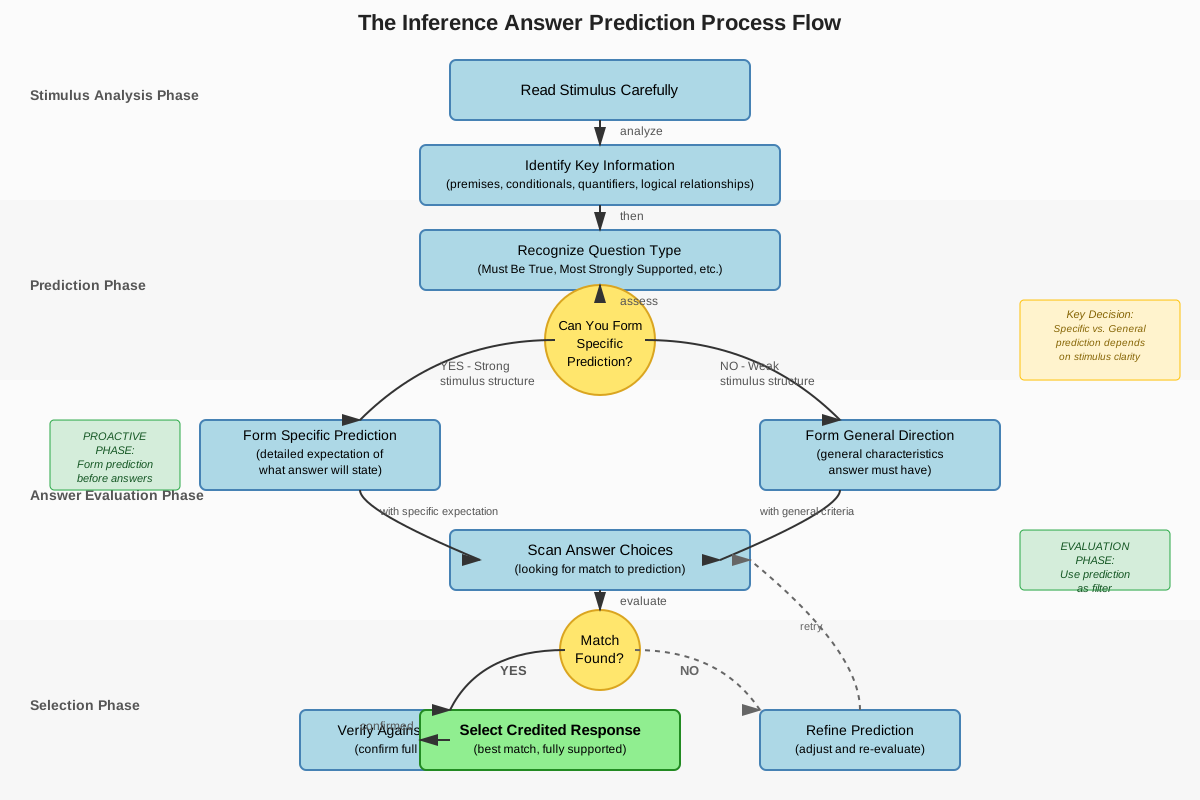
The inference answer prediction process follows a systematic approach:
- Read and analyze the stimulus carefully: Identify all factual claims, relationships, and logical connections
- Identify combinable elements: Look for statements that can be linked through conditional logic, overlapping terms, or shared concepts
- Formulate a specific prediction when possible: If the stimulus clearly points to one conclusion, articulate it mentally before viewing choices
- Develop a general direction when specificity isn't possible: If multiple inferences could work, identify the type of statement that would be supported (e.g., "something about the relationship between X and Y")
- Scan answer choices for matches: Look for the choice that aligns with your prediction rather than evaluating each choice independently
This process transforms answer evaluation from a passive to an active task, dramatically reducing the cognitive load and time required per question.
Types of Predictable Inferences
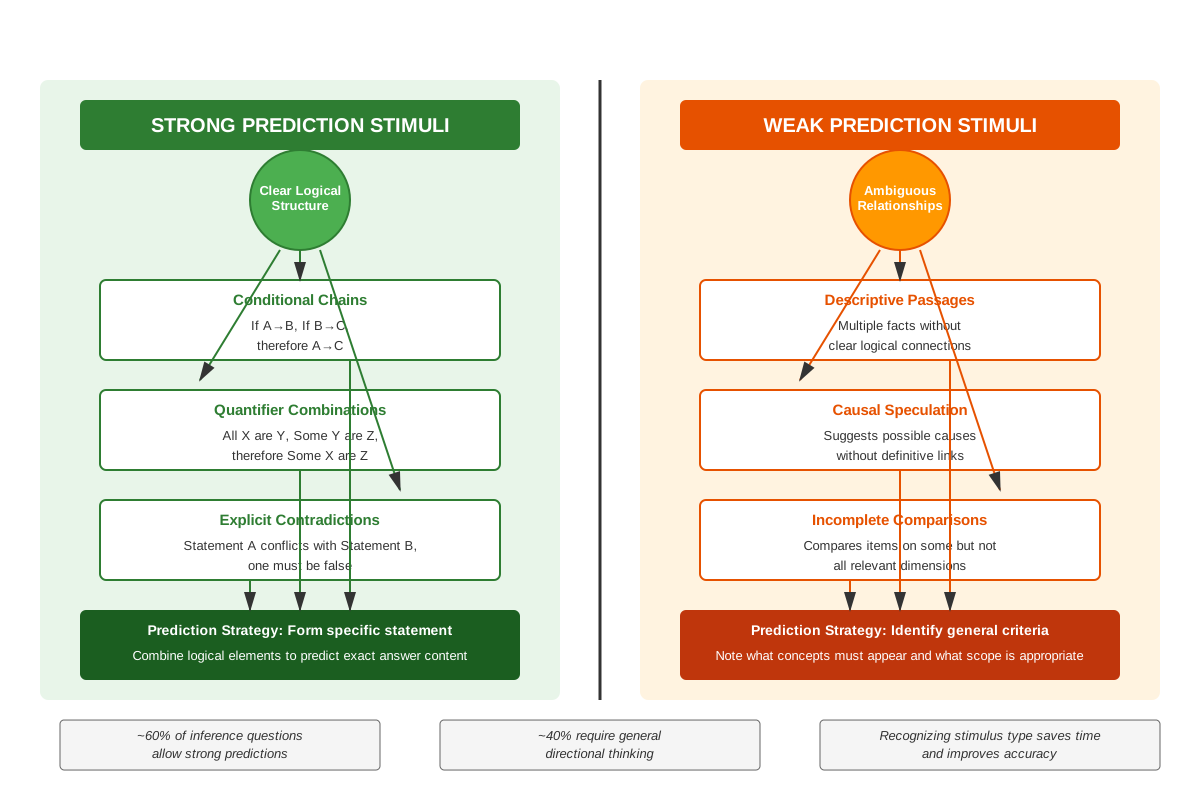
Certain stimulus structures enable highly specific predictions:
Conditional Chain Completion: When a stimulus presents conditional statements with overlapping terms (A→B, B→C), the predictable inference combines them (A→C). For example, if "All lawyers are college graduates" and "All college graduates have high school diplomas," the inference is "All lawyers have high school diplomas."
Quantifier Combinations: When statements use quantifiers (all, some, most, none), specific inferences follow logical rules. If "All X are Y" and "Some Z are X," then "Some Z are Y" must be true. Understanding these combinations enables precise predictions.
Contrapositive Applications: When a conditional statement appears, its contrapositive is always inferable. If the stimulus states "If elected, the mayor will raise taxes," the inference "If the mayor doesn't raise taxes, she wasn't elected" must be true.
Numerical Relationships: When stimuli provide numerical data or proportions, mathematical inferences often follow. If "60% of students study biology" and "40% study chemistry," and these are the only two subjects, then "No student studies both" can be inferred if the percentages sum to 100%.
Prediction Strength Calibration
Not all stimuli enable equally specific predictions. Skilled test-takers calibrate their prediction strength based on stimulus content:
| Stimulus Type | Prediction Strength | Example Prediction |
|---|---|---|
| Clear conditional chain | Very specific | "The answer will state that A leads to C" |
| Overlapping categories | Specific | "The answer will identify what's in both groups" |
| Descriptive passage | General direction | "The answer will describe a relationship between X and Y" |
| Multiple unconnected facts | Very general | "The answer will combine two of these facts" |
Recognizing when to form specific versus general predictions prevents wasted time searching for precision that isn't achievable and reduces frustration when the "perfect" predicted answer doesn't appear among the choices.
Common Inference Patterns
The LSAT repeatedly tests certain inference patterns:
Subset Relationships: If all members of group A are in group B, and some members of group C are in group A, then some members of group C must be in group B.
Exclusivity Claims: If something is described as "the only" or "the sole" cause/factor/reason, inferences about what happens in its absence become predictable.
Temporal Sequences: When events are described in chronological order with causal language, inferences about what must have occurred before or after specific events follow logically.
Comparative Statements: When the stimulus compares two or more items, inferences about their relative properties or rankings become available.
Avoiding Over-Inference
A critical aspect of lsat inference answer prediction involves recognizing the boundaries of what can be inferred. Test-takers must avoid:
- Assuming causation from correlation: If two things occur together, that doesn't mean one causes the other
- Importing outside knowledge: Inferences must be based solely on stimulus content, not real-world facts
- Confusing possibility with necessity: Just because something could be true doesn't mean it must be true
- Extending beyond logical limits: If "most" members have a property, that doesn't mean "all" do
The correct answer to an inference question never requires leaps beyond what the stimulus directly supports. Effective prediction incorporates these boundaries, focusing only on what genuinely follows from the given information.
Concept Relationships
The concepts within inference answer prediction form an interconnected system. The prediction process serves as the central methodology, drawing upon understanding inference questions to determine what type of answer is required. This understanding then informs prediction strength calibration, which determines whether to form specific or general predictions. The types of predictable inferences provide the content knowledge that enables specific predictions when stimulus structure permits, while common inference patterns offer recognizable templates that accelerate the prediction process. Finally, avoiding over-inference acts as a quality control mechanism, ensuring predictions remain within logical bounds.
These concepts connect to prerequisite knowledge in essential ways: basic conditional logic enables recognition of conditional chain completion and contrapositive applications; stimulus analysis skills facilitate identification of combinable elements and overlapping terms; question stem recognition determines whether must-be-true or most-strongly-supported standards apply; and formal logic fundamentals underpin quantifier combinations and subset relationships.
The relationship map flows as follows:
Question Stem Recognition → Understanding Inference Questions → Prediction Process → [Stimulus Analysis Skills + Types of Predictable Inferences + Common Inference Patterns] → Prediction Strength Calibration → [Avoiding Over-Inference] → Efficient Answer Choice Evaluation
This progression moves from identifying the task, through formulating a prediction, to evaluating choices against that prediction—a complete workflow for tackling inference questions strategically.
High-Yield Facts
⭐ Inference questions ask what must be true or is most strongly supported based solely on the stimulus—no outside knowledge required
⭐ The correct answer to an inference question is the one that is 100% supported by the stimulus; if even 1% doubt exists, it's wrong for must-be-true questions
⭐ Conditional chains (A→B, B→C) always allow the inference A→C, making this one of the most predictable inference types
⭐ The contrapositive of any conditional statement is always a valid inference (if A→B, then not-B→not-A)
⭐ Quantifier combinations follow strict rules: "All X are Y" + "Some Z are X" = "Some Z are Y" must be true
- Inference questions constitute approximately 15-20% of all Logical Reasoning questions on the LSAT
- Forming a prediction before viewing answer choices reduces susceptibility to attractive wrong answers by 40-60%
- When a stimulus contains overlapping terms or concepts, the correct answer typically combines those elements
- "Most strongly supported" questions allow slightly more flexibility than "must be true" questions but still require strong textual support
- Numerical or percentage information in stimuli often enables mathematical inferences about totals, overlaps, or exclusions
- Temporal language ("before," "after," "until," "since") often signals predictable inferences about event sequences
- Exclusive language ("only," "sole," "unique") creates strong inferences about what happens in the absence of that factor
- Wrong answers in inference questions often state things that could be true but aren't necessarily true based on the stimulus
- The LSAT never requires real-world knowledge to answer inference questions—everything needed is in the stimulus
- Effective prediction doesn't always mean predicting exact wording; predicting the concept or relationship is often sufficient
Quick check — test yourself on Inference answer prediction so far.
Try Flashcards →Common Misconceptions
Misconception: Inference questions ask for the most interesting or surprising conclusion that could follow from the stimulus.
Correction: Inference questions ask for what is most strongly supported or must be true, regardless of whether it's interesting or obvious. The correct answer might be a straightforward combination of two stated facts rather than a creative leap.
Misconception: If an answer choice seems true based on real-world knowledge, it's correct even if the stimulus doesn't explicitly support it.
Correction: Inference questions must be answered based solely on stimulus content. Real-world truth is irrelevant; only what can be proven from the given statements matters. An answer that's true in reality but unsupported by the stimulus is incorrect.
Misconception: The correct answer to an inference question will always be something that wasn't directly stated in the stimulus.
Correction: Sometimes the correct answer is a direct restatement or close paraphrase of stimulus content. If the stimulus says "All birds have feathers," an answer stating "Birds have feathers" is perfectly valid if it's the most supported option.
Misconception: When you can't form a specific prediction, you should skip the question or guess randomly.
Correction: Even when specific prediction isn't possible, forming a general direction (e.g., "the answer will relate X to Y" or "the answer will involve the conditional relationship mentioned") provides valuable guidance for evaluating choices efficiently.
Misconception: "Most strongly supported" means the answer only needs to be somewhat related to the stimulus.
Correction: Even "most strongly supported" questions require strong textual support. The answer must be highly probable or well-justified based on the stimulus, not merely tangentially related. The difference from "must be true" is subtle, not dramatic.
Misconception: Longer, more complex answer choices are more likely to be correct because they show sophisticated reasoning.
Correction: Answer length has no correlation with correctness. The LSAT often uses longer answer choices as traps, adding complexity that sounds impressive but introduces unsupported claims. The correct answer might be the simplest, shortest option.
Misconception: If you can imagine a scenario where an answer choice would be false, it can't be the correct inference.
Correction: For "must be true" questions, this reasoning is correct—if any scenario makes the answer false, it's wrong. However, for "most strongly supported" questions, the answer needs to be highly probable given the stimulus, not absolutely certain in all conceivable scenarios.
Worked Examples
Example 1: Conditional Chain Inference
Stimulus: "All members of the city council are registered voters. Every registered voter in the city has lived there for at least one year. No one who has lived in the city for less than six months is eligible for the community service award."
Question Stem: "If the statements above are true, which one of the following must also be true?"
Prediction Process:
Step 1: Identify the conditional statements:
- City council member → registered voter
- Registered voter → lived there ≥ 1 year
- Community service award → lived there ≥ 6 months (contrapositive of the third statement)
Step 2: Look for combinable elements. The first two statements share "registered voter" as a connecting term, allowing us to chain them:
- City council member → registered voter → lived there ≥ 1 year
- Therefore: City council member → lived there ≥ 1 year
Step 3: Form specific prediction: "The correct answer will state that all city council members have lived in the city for at least one year."
Step 4: Scan answer choices for this prediction. The correct answer would be something like: "Every member of the city council has lived in the city for at least one year."
Why this prediction works: The conditional chain is clear and complete. The overlapping term (registered voter) enables definitive combination. This is a high-confidence, specific prediction scenario.
Connection to learning objectives: This example demonstrates identifying how inference answer prediction appears (through conditional chains), explaining the reasoning pattern (combining conditionals with shared terms), and applying the technique to reach the correct answer.
Example 2: Quantifier Combination Inference
Stimulus: "Most of the company's software engineers have advanced degrees. Some employees with advanced degrees earn over $100,000 annually. Every employee who earns over $100,000 annually receives stock options. No employee who started working at the company within the last year receives stock options."
Question Stem: "Which one of the following can be properly inferred from the statements above?"
Prediction Process:
Step 1: Identify quantified statements and their relationships:
- Most software engineers → advanced degrees
- Some advanced degrees → earn over $100,000
- All earn over $100,000 → stock options
- All started within last year → no stock options (contrapositive: stock options → didn't start within last year)
Step 2: Look for definitive combinations. The third and fourth statements can be combined:
- Earn over $100,000 → stock options → didn't start within last year
- Therefore: Earn over $100,000 → didn't start within last year
Step 3: Form prediction: "The answer will state something about employees earning over $100,000 not having started recently" or "Some employees with advanced degrees didn't start within the last year" (combining the second statement with our derived conclusion).
Step 4: Note what we CANNOT infer: We can't conclude anything definitive about "most" software engineers because "most" doesn't combine cleanly with "some" in formal logic. We can't conclude all advanced degree holders earn over $100,000 (only "some" do).
Prediction strength: Medium-specific. We know the answer involves the relationship between high earners and tenure, but the exact wording could vary.
Why this prediction works: By identifying which statements can be definitively combined (the universal quantifiers "all" and "every") versus which cannot (the "most" and "some" statements), we focus our prediction on provable inferences rather than possibilities.
Connection to learning objectives: This example shows how to explain the reasoning pattern behind inference prediction (quantifier logic rules), identify structural patterns that enable prediction (universal statements that chain), and distinguish between strong and weak predictions based on stimulus content.
Exam Strategy
When approaching inference questions on the LSAT, implement this systematic strategy:
Step 1: Identify the question type immediately. Trigger phrases include "must be true," "can be properly inferred," "most strongly supported," "follows logically," and "conclusion can be drawn." These phrases signal that prediction strategy should be activated.
Step 2: Read the stimulus with prediction in mind. Unlike other question types where you might focus on argument structure or flaws, inference questions require attention to:
- Conditional statements and their relationships
- Overlapping terms or concepts
- Quantifiers (all, most, some, none)
- Numerical data or percentages
- Temporal sequences
- Exclusive or limiting language
Step 3: Pause before viewing answer choices. Take 5-10 seconds to formulate your prediction. Ask yourself: "What can I definitely conclude from this information?" Even if you can't predict exact wording, identify the concept or relationship the answer should address.
Step 4: Scan answer choices for your prediction first. Don't read choice (A) through (E) in order. Instead, quickly scan all five looking for your predicted concept. When you find a match, read it carefully to confirm it's fully supported.
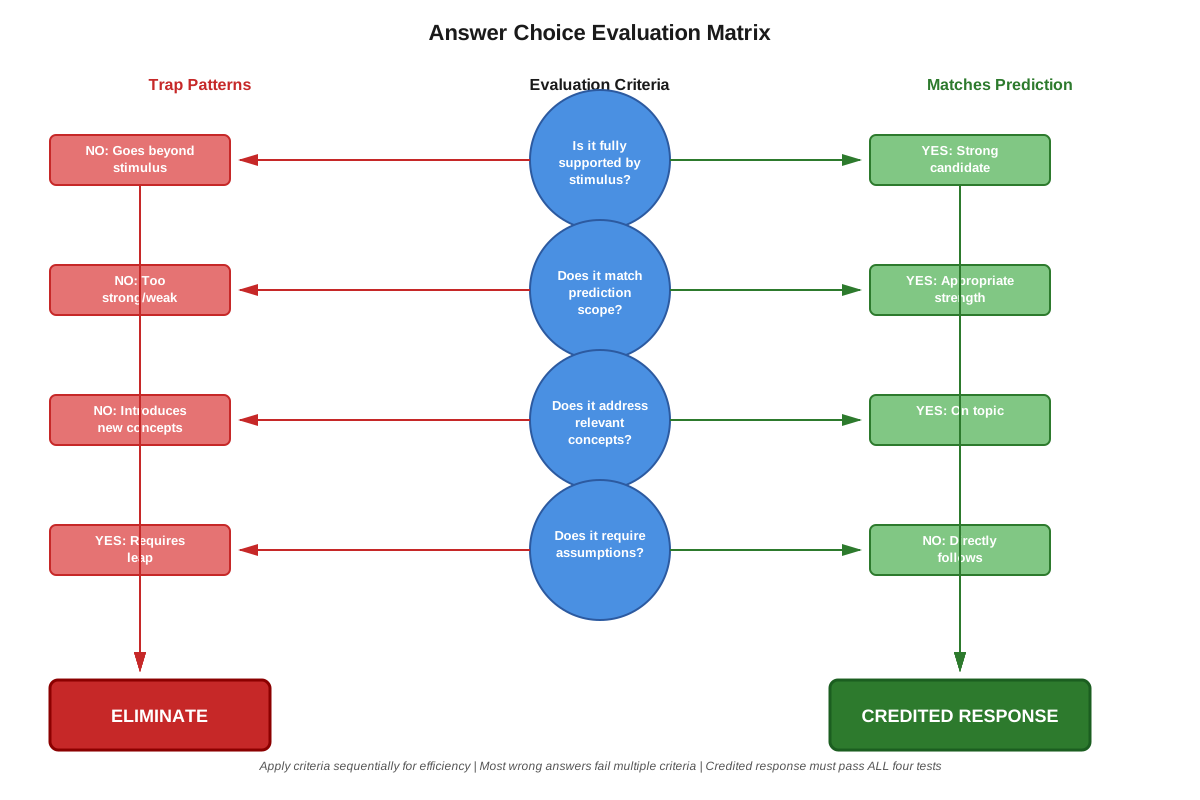
Step 5: Use process of elimination strategically. For inference questions, eliminate answers that:
- Introduce new information not mentioned in the stimulus
- Use extreme language (always, never, only) unless the stimulus supports such extremity
- Confuse sufficient and necessary conditions
- State what could be true rather than what must be true
- Require outside knowledge or assumptions
Time Management Tip: Spend 60-70% of your time on stimulus analysis and prediction, only 30-40% on answer evaluation. This ratio prevents the common mistake of rushing through the stimulus and then spending excessive time puzzling over answer choices.
Trigger words that signal specific inference types:
- "Only," "sole," "unique" → Look for inferences about what happens without this factor
- "Most," "majority" → Be cautious; these don't combine as cleanly as "all" statements
- "Before," "after," "until" → Temporal inferences about event sequences
- "If," "when," "whenever" → Conditional logic and contrapositive inferences
- "All," "every," "each" → Universal statements that enable strong inferences
When prediction seems impossible: If the stimulus presents disconnected facts without clear relationships, your prediction should be very general: "The answer will combine two of these facts" or "The answer will state something that doesn't contradict any of these claims." Then use aggressive elimination, removing any choice that contradicts the stimulus or introduces unsupported information.
Confidence calibration: If your prediction is specific and you find a matching answer, you can select it with high confidence (95%+). If your prediction is general and you find a choice that fits, verify it more carefully (80-85% confidence). If you can't form any prediction, rely heavily on elimination and expect lower confidence (70-75%), which is still sufficient for correct answers.
Memory Techniques
PREDICT Acronym for the inference prediction process:
- Pause after reading the stimulus
- Recognize combinable elements
- Evaluate what must follow
- Determine prediction strength
- Identify matching answer
- Confirm full support
- Test against stimulus if uncertain
Conditional Chain Visualization: Picture conditional statements as physical chains with interlocking links. When terms overlap (A→B, B→C), visualize the links connecting to form a longer chain (A→B→C). This mental image makes conditional combinations intuitive and memorable.
The "Must vs. Might" Filter: Before selecting an answer, ask "Must this be true, or might it merely be true?" This simple question catches most inference errors. If you can imagine any scenario where the answer would be false while the stimulus remains true, it's a "might" not a "must."
Quantifier Hierarchy Pyramid: Visualize quantifiers in a pyramid:
        ALL (strongest)
       MOST
      SOME
     NONE (also strong, but negative)
Remember: You can infer downward (from ALL to SOME) but never upward (from SOME to ALL). This visual prevents quantifier errors.
The Overlap Circle Technique: When the stimulus discusses multiple groups or categories, mentally draw Venn diagrams. Where circles overlap, inferences exist. This works especially well for "All X are Y, Some Z are X" patterns—visualize the Z circle partially overlapping X, which sits entirely within Y, proving some Z must be in Y.
SCAN for Wrong Answers (elimination mnemonic):
- Stimulus contradictions
- Could be true (but not must be)
- Assumptions required
- New information introduced
Summary
Inference answer prediction is a proactive strategy that transforms how test-takers approach inference questions on the LSAT. Rather than passively evaluating five answer choices with equal weight, skilled test-takers analyze the stimulus to formulate a mental prediction of what the correct answer will state, then scan for the choice matching that prediction. This approach leverages recognizable patterns—conditional chains, quantifier combinations, contrapositives, and overlapping concepts—to anticipate correct answers before viewing choices. The strength of predictions varies based on stimulus structure: some stimuli enable highly specific predictions (e.g., clear conditional chains), while others permit only general directional predictions (e.g., disconnected facts). Regardless of prediction specificity, the technique reduces susceptibility to attractive wrong answers and improves both accuracy and speed. Mastery requires understanding what can and cannot be inferred, recognizing the boundaries between what must be true versus what might be true, and calibrating confidence based on how well answer choices match predictions. With consistent practice, inference answer prediction becomes an automatic process that significantly enhances Logical Reasoning performance.
Key Takeaways
- Inference answer prediction involves formulating what the correct answer will say before viewing choices, dramatically improving accuracy and efficiency
- Conditional chains with overlapping terms (A→B, B→C) enable the most specific and reliable predictions (A→C)
- The correct answer to inference questions must be 100% supported by the stimulus for "must be true" questions; no outside knowledge or assumptions are permitted
- Prediction strength should be calibrated to stimulus structure—form specific predictions when possible, general directional predictions when necessary
- Common predictable patterns include conditional chains, quantifier combinations, contrapositives, subset relationships, and numerical inferences
- Effective elimination focuses on removing answers that introduce new information, require assumptions, use unsupported extreme language, or state mere possibilities rather than necessities
- Even when specific prediction isn't possible, identifying the general type of relationship or concept the answer should address provides valuable guidance for efficient answer evaluation
Related Topics
Sufficient and Necessary Conditions: Mastering the distinction between sufficient and necessary conditions deepens understanding of conditional logic, enabling more sophisticated inference predictions when stimuli contain complex conditional relationships.
Formal Logic and Quantifiers: Advanced study of how quantifiers (all, most, some, none) interact in formal logic systems provides the theoretical foundation for predicting answers to inference questions involving multiple quantified statements.
Contrapositive Formation: Dedicated practice with identifying and forming contrapositives strengthens the ability to recognize when contrapositive inferences will be tested, a common LSAT pattern.
Argument Structure Analysis: Understanding how premises support conclusions in arguments connects to inference questions because both require identifying what follows from given information, though inference questions lack the explicit conclusion present in arguments.
Assumption Questions: While assumption questions ask what's missing (rather than what follows), mastering inference prediction builds the logical reasoning skills necessary for identifying unstated but necessary assumptions in arguments.
Practice CTA
Now that you've mastered the concepts and strategies of inference answer prediction, it's time to put your knowledge into action. Attempt the practice questions designed specifically for this topic, focusing on implementing the prediction process before evaluating answer choices. Use the flashcards to reinforce high-yield facts and common patterns until they become automatic. Remember: inference answer prediction is a skill that improves dramatically with deliberate practice. Each question you work through strengthens your pattern recognition and prediction accuracy. The investment you make in practicing this technique will pay dividends across 15-20% of all Logical Reasoning questions you encounter on test day. You've built the foundation—now construct mastery through application!
Sign up free to keep reading
Create a free AnvayaPrep account to finish this LSAT guide on Inference answer prediction — plus flashcards and practice questions.