Overview
Inference with categories represents one of the most fundamental and frequently tested reasoning patterns on the LSAT Logical Reasoning section. This topic involves drawing valid conclusions about relationships between groups, classes, or categories based on given information about their membership, overlap, or exclusion. When the LSAT presents categorical statements—such as "All lawyers are professionals" or "Some students are not athletes"—test-takers must understand precisely what can and cannot be logically inferred from these relationships.
Mastering lsat inference with categories is essential because these questions appear consistently across multiple LSAT administrations, often comprising 15-20% of all logical reasoning questions. The ability to work with categorical relationships forms the foundation for understanding formal logic, conditional reasoning, and argument structure—all critical skills for LSAT success. These questions test whether students can distinguish between what must be true, what could be true, and what cannot be true based solely on the categorical information provided.
Within the broader landscape of inference questions, categorical reasoning serves as a bridge between pure formal logic and everyday argument analysis. While some LSAT questions present categorical relationships using formal logical notation (such as "All A are B"), others embed these relationships within more naturalistic language that requires careful parsing. Understanding how categories interact—through subset relationships, overlapping memberships, and exclusions—enables test-takers to navigate both straightforward logic games and complex reading comprehension passages where categorical distinctions determine correct answers.
Learning Objectives
- [ ] Identify how Inference with categories appears in LSAT questions
- [ ] Explain the reasoning pattern behind Inference with categories
- [ ] Apply Inference with categories to solve LSAT-style problems accurately
- [ ] Distinguish between valid and invalid categorical inferences under time pressure
- [ ] Translate natural language statements into categorical relationships
- [ ] Recognize when additional information is needed to draw a categorical conclusion
- [ ] Evaluate answer choices by testing them against categorical constraints
Prerequisites
- Basic set theory and Venn diagrams: Understanding how groups can overlap, be subsets of one another, or remain completely separate provides the visual and conceptual foundation for categorical reasoning
- Conditional logic fundamentals: Recognizing "if-then" relationships helps distinguish between sufficient and necessary conditions, which often appear in categorical statements
- Quantifier comprehension: Knowing the precise logical meaning of words like "all," "some," "none," and "most" is essential for accurate categorical inference
- Argument structure basics: Identifying premises and conclusions allows students to separate given information from what must be inferred
Why This Topic Matters
Categorical reasoning extends far beyond standardized testing into everyday critical thinking, legal analysis, and professional decision-making. Lawyers regularly work with categorical distinctions—determining whether a particular case falls within a legal category, whether a statute applies to a class of individuals, or whether evidence establishes membership in a relevant group. Medical professionals use categorical reasoning when diagnosing conditions (determining whether symptoms place a patient in a diagnostic category), and business analysts employ it when segmenting markets or identifying target demographics.
On the LSAT specifically, categorical inference questions appear in approximately 3-5 questions per Logical Reasoning section, making them among the most reliable question types students will encounter. These questions typically present as "Must Be True" questions, "Could Be True" questions, or "Cannot Be True" questions, each requiring precise understanding of categorical relationships. The LSAT tests categorical reasoning both directly—through questions that explicitly present categorical statements—and indirectly—through questions where categorical relationships are embedded within longer arguments or passages.
Common manifestations include: questions presenting multiple categorical statements that must be combined to reach a conclusion; questions asking what additional information would allow a categorical inference; questions requiring students to identify which diagram or representation accurately captures categorical relationships; and questions where answer choices present various potential inferences, only one of which necessarily follows from the given categories. The prevalence and variety of these questions make categorical inference mastery a high-yield investment of study time.
Core Concepts
Fundamental Categorical Statements
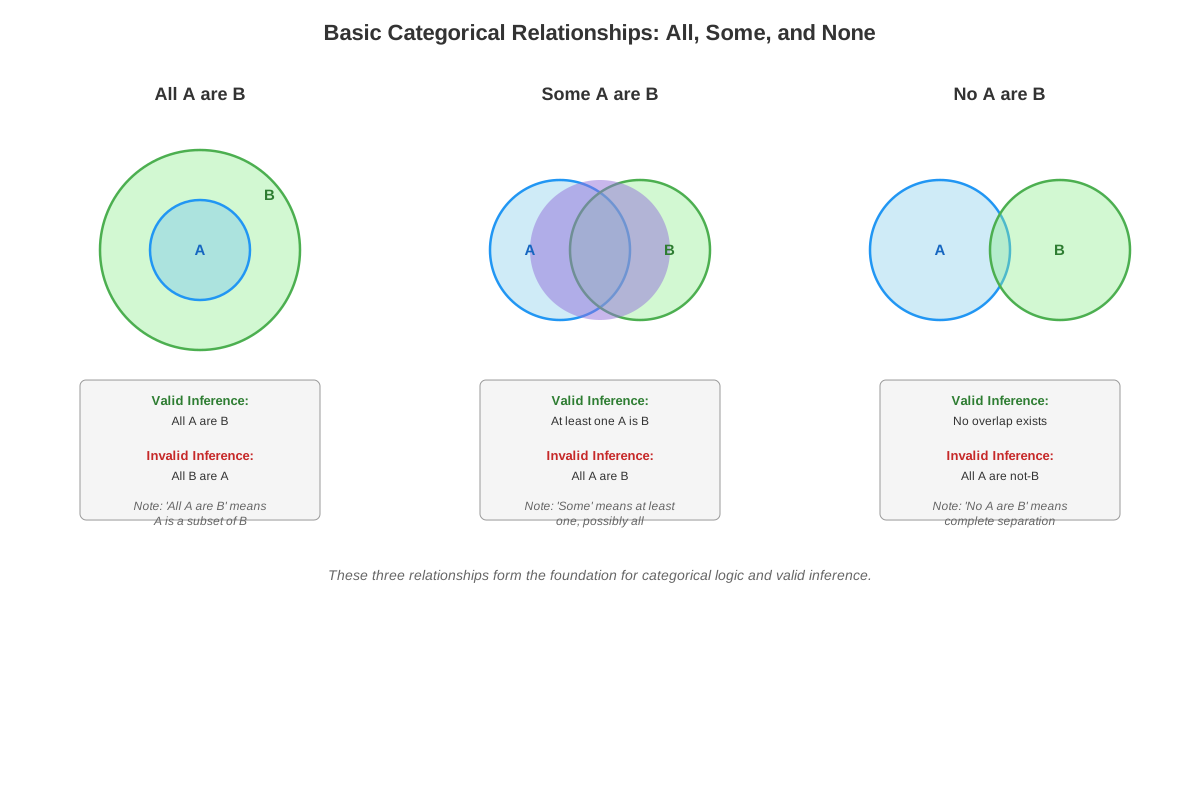
The foundation of categorical reasoning rests on four basic statement types, each with distinct logical properties. Universal affirmative statements take the form "All A are B," establishing that every member of category A is also a member of category B. This creates a subset relationship where A is entirely contained within B, but B may contain additional members beyond A. For example, "All dolphins are mammals" means the dolphin category is a subset of the mammal category.
Universal negative statements follow the pattern "No A are B," establishing complete exclusion between two categories with no overlap whatsoever. When the LSAT states "No reptiles are mammals," it establishes that these two categories are entirely separate—no creature can belong to both. This mutual exclusivity is absolute and works in both directions.
Particular affirmative statements use the form "Some A are B," indicating that at least one member of category A is also a member of category B. The word "some" in formal logic means "at least one" and possibly all, though typically not all in LSAT contexts. "Some politicians are lawyers" establishes overlap between these categories without specifying the extent of that overlap.
Particular negative statements state "Some A are not B," meaning at least one member of category A exists outside category B. This indicates that A and B are not in a complete subset relationship, though they might still overlap partially. "Some students are not athletes" tells us the student category extends beyond the athlete category, but students and athletes might still overlap.
Valid Inference Patterns
Several reliable inference patterns emerge from categorical statements. When given "All A are B," we can validly infer the contrapositive: "All non-B are non-A." If all dolphins are mammals, then anything that is not a mammal cannot be a dolphin. This contrapositive relationship is logically equivalent to the original statement and always valid.
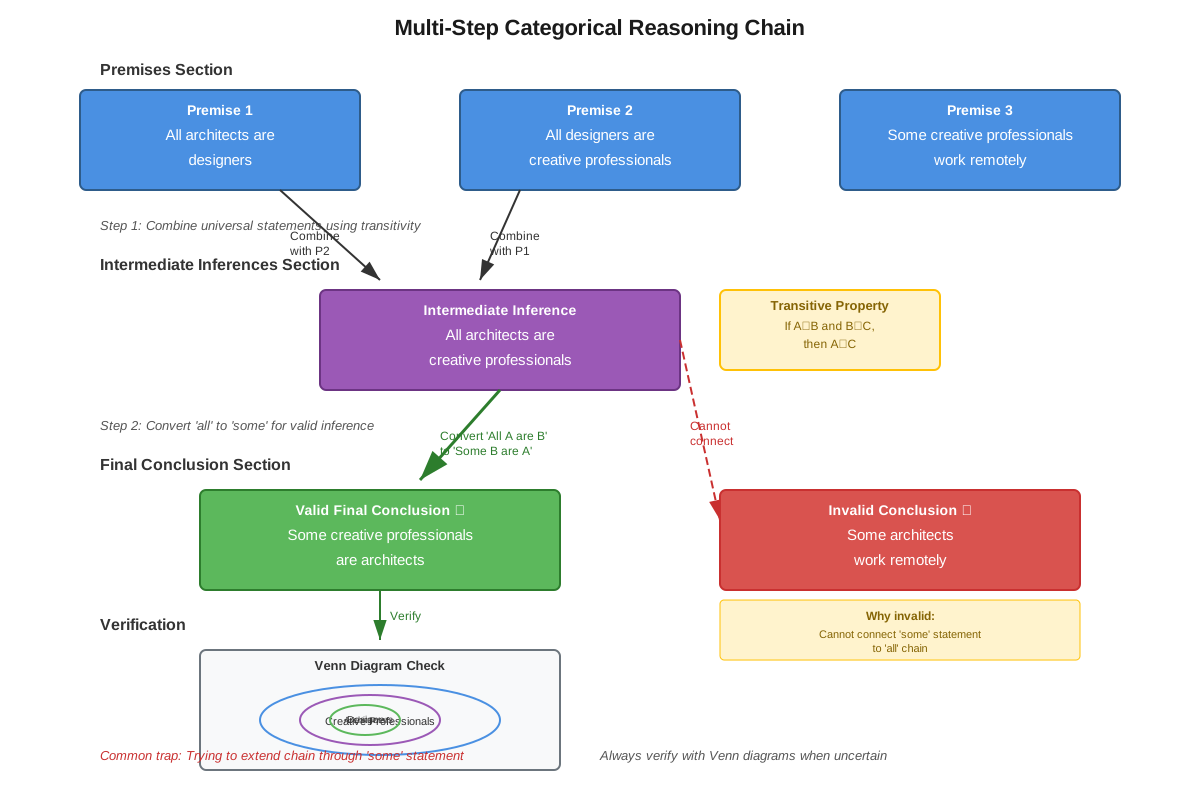
The transitive property allows chaining of categorical relationships. Given "All A are B" and "All B are C," we can conclude "All A are C." If all dolphins are mammals and all mammals are vertebrates, then all dolphins are vertebrates. This pattern extends through any number of links in the chain.
Combination inferences arise when multiple categorical statements interact. Given "All A are B" and "Some C are A," we can conclude "Some C are B." If all dolphins are mammals and some aquarium animals are dolphins, then some aquarium animals are mammals. This follows because the "some" that are dolphins must also be mammals.
Invalid Inference Patterns (Common Traps)
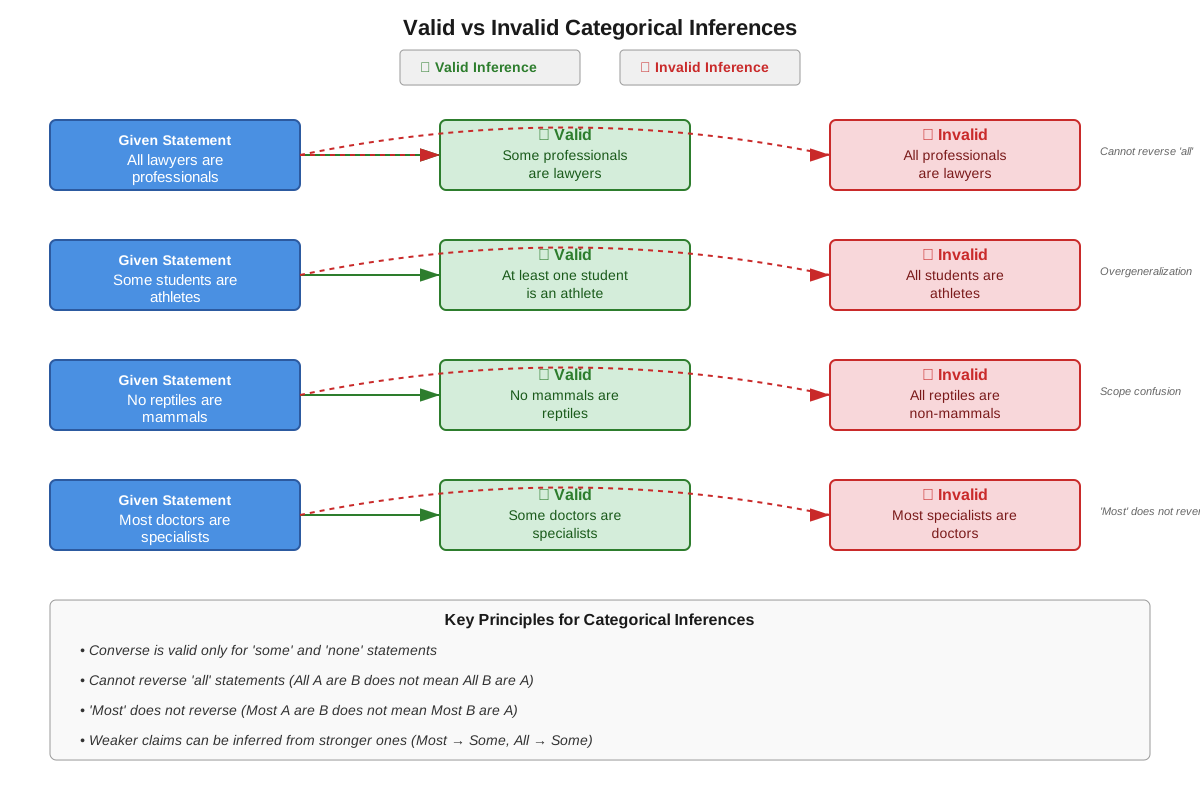
The LSAT frequently tests whether students fall for invalid inference patterns. Affirming the consequent occurs when someone incorrectly reverses a categorical statement. From "All A are B," one cannot conclude "All B are A." Just because all dolphins are mammals doesn't mean all mammals are dolphins—the mammal category is much larger.
Denying the antecedent represents another invalid pattern. From "All A are B," one cannot conclude "No non-A are B." Other things besides A might also be B. Even though all dolphins are mammals, this doesn't mean non-dolphins cannot be mammals.
Existential fallacy involves inferring the existence of category members when none may exist. From "All A are B," one cannot conclude "Some A exist" or "Some B exist." The statement might be vacuously true—true because category A is empty. "All unicorns are magical creatures" doesn't establish that unicorns exist.
Quantifier Relationships and Boundaries
Understanding precise quantifier meanings prevents errors. "All" means 100% of the category—every single member without exception. "Most" means more than 50%, establishing a majority but not totality. "Some" means at least one and possibly all, though LSAT usage typically implies "not all." "None" means 0%—complete absence of overlap.
The LSAT exploits ambiguity in everyday language. "Many" lacks precise logical meaning—it could mean a large absolute number or a large percentage. "Few" similarly remains vague. When the LSAT uses these terms, valid inferences become limited because the quantifier doesn't establish clear boundaries.
Categorical Diagrams and Visualization
Venn diagrams provide powerful tools for visualizing categorical relationships. A universal affirmative ("All A are B") appears as circle A entirely inside circle B. A universal negative ("No A are B") shows circles A and B completely separate. A particular affirmative ("Some A are B") displays overlapping circles with the overlap region marked. A particular negative ("Some A are not B") shows overlapping circles with a mark in the portion of A outside B.
When multiple categorical statements combine, drawing a single diagram incorporating all relationships helps identify valid inferences. If "All A are B," "Some B are C," and "No C are D," a comprehensive diagram reveals what must, might, or cannot be true about relationships between all four categories.
Categorical Syllogisms
A categorical syllogism consists of two premises and a conclusion, all categorical statements, sharing three categories total with each category appearing twice. The classic example: "All men are mortal" (premise 1), "Socrates is a man" (premise 2), therefore "Socrates is mortal" (conclusion). The LSAT tests whether students recognize valid syllogistic forms and reject invalid ones.
Valid syllogisms follow specific structural patterns. The middle term (appearing in both premises but not the conclusion) must be distributed (refer to all members) at least once. Negative premises require negative conclusions. Two negative premises yield no valid conclusion. These rules, while technical, underlie the intuitive reasoning the LSAT tests.
Concept Relationships
Categorical inference forms the foundation upon which more complex logical reasoning builds. The relationship flows: Basic categorical statements → Valid inference patterns → Complex multi-statement problems → Embedded categorical reasoning in arguments. Each level adds complexity while relying on the previous level's principles.
Within categorical reasoning itself, concepts interconnect tightly. Quantifier understanding enables accurate statement interpretation, which allows pattern recognition, which facilitates inference generation. Simultaneously, invalid pattern recognition (knowing what doesn't follow) works alongside valid pattern recognition (knowing what does follow) to eliminate wrong answers and identify correct ones.
Categorical reasoning connects backward to prerequisite knowledge: Set theory provides the mathematical foundation, conditional logic shares structural similarities (particularly in contrapositive relationships), and argument structure supplies the framework for distinguishing premises from conclusions. It connects forward to advanced topics: formal logic notation, sufficient and necessary conditions, and complex argument analysis all build upon categorical reasoning foundations.
The relationship between categorical statements and their contrapositives represents a particularly important connection. Every categorical statement has a logically equivalent contrapositive, and recognizing this equivalence doubles the inferences available from any given statement. This connects to the broader principle that logical equivalence allows substitution—any statement can be replaced with its logical equivalent without changing what can be inferred.
High-Yield Facts
⭐ "All A are B" means every A is a B, but does NOT mean every B is an A—the reverse is not automatically true
⭐ "Some A are B" means at least one A is a B, and possibly all A are B—"some" establishes a minimum, not a maximum
⭐ The contrapositive of "All A are B" is "All non-B are non-A"—these statements are logically equivalent and always have the same truth value
⭐ From "All A are B" and "All B are C," you can conclude "All A are C"—categorical statements chain transitively through shared middle terms
⭐ "No A are B" is logically equivalent to "No B are A"—universal negative statements work symmetrically in both directions
- From "Some A are B," you cannot conclude "Some B are A" is false, but you also cannot conclude it's true—the reverse might or might not hold
- Two particular statements ("Some A are B" and "Some B are C") do not allow any definite conclusion about the relationship between A and C
- "Most A are B" and "Most B are C" do not guarantee any overlap between A and C—the "most" portions might be entirely different members
- An empty category makes all universal statements about it vacuously true—"All unicorns are purple" is technically true if no unicorns exist
- "Only A are B" translates to "All B are A" (not "All A are B")—the word "only" reverses the expected direction
- Combining "All A are B" with "Some C are not B" yields "Some C are not A"—what's excluded from the larger category is excluded from the subset
- The statement "Not all A are B" is equivalent to "Some A are not B"—both indicate at least one A exists outside B
Quick check — test yourself on Inference with categories so far.
Try Flashcards →Common Misconceptions
Misconception: "All A are B" means the same as "All B are A"—these statements are interchangeable.
Correction: These statements are not equivalent. "All A are B" establishes A as a subset of B, while "All B are A" would establish B as a subset of A. These represent different relationships. For example, "All dolphins are mammals" is true, but "All mammals are dolphins" is false.
Misconception: "Some A are B" means "Some A are not B"—the word "some" implies "not all."
Correction: In formal logic, "some" means only "at least one" without any implication about whether all are included. "Some A are B" could be true even if all A are B. The statement establishes a minimum (at least one) but no maximum. To establish that not all A are B, you need the explicit statement "Some A are not B."
Misconception: From "All A are B" and "All C are B," you can conclude something definite about the relationship between A and C.
Correction: When two categories are both subsets of a third category, they might overlap completely, partially, or not at all. Knowing that all dolphins are mammals and all whales are mammals tells us nothing definite about the relationship between dolphins and whales—they could overlap or be completely separate mammal subgroups.
Misconception: "Most A are B" and "Most A are C" means most A are both B and C.
Correction: Two "most" statements about the same category guarantee some overlap but not that most members are in both categories. If most students are hardworking and most students are athletes, there must be some overlap (some hardworking athletes), but we cannot conclude that most students are both hardworking and athletes.
Misconception: If "Some A are B" is true, then "Some A are not B" must also be true.
Correction: These statements are independent. "Some A are B" could be true while all A are B (making "Some A are not B" false). The existence of some members in the overlap doesn't establish the existence of members outside the overlap.
Misconception: "No A are B" means the same as "Not all A are B."
Correction: These statements have vastly different meanings. "No A are B" establishes complete separation—zero overlap. "Not all A are B" (equivalent to "Some A are not B") means at least one A is not B, but there could still be substantial overlap between the categories.
Misconception: From "All A are B," you can conclude that A and B are different categories.
Correction: "All A are B" allows for the possibility that A and B are the same category—that they have identical membership. If all bachelors are unmarried men and all unmarried men are bachelors, these categories are coextensive (have the same members), and "All A are B" remains true.
Worked Examples
Example 1: Multi-Statement Categorical Inference
Question: Given the following statements, what must be true?
- All professors are educators
- Some educators are not administrators
- All administrators are employees
Step 1: Translate and diagram the statements
Statement 1: All professors are educators (Professors ⊂ Educators)
Statement 2: Some educators are not administrators (Educators and Administrators overlap, but Educators extends beyond Administrators)
Statement 3: All administrators are employees (Administrators ⊂ Employees)
Step 2: Identify what we can chain together
From statements 1 and 3, we cannot directly chain anything because they don't share a common term. However, statement 2 tells us about the relationship between educators and administrators.
Step 3: Consider each potential inference
Could we conclude "Some professors are not administrators"?
- We know all professors are educators (statement 1)
- We know some educators are not administrators (statement 2)
- But we don't know whether professors are among the educators who are not administrators, or among those who might be administrators
- This is possible but not necessary—CANNOT conclude
Could we conclude "Some educators are not employees"?
- We know some educators are not administrators (statement 2)
- We know all administrators are employees (statement 3)
- But non-administrators might still be employees through some other path
- This is possible but not necessary—CANNOT conclude
Could we conclude "All professors are employees"?
- We know all professors are educators (statement 1)
- But we don't know the relationship between educators and employees
- This is possible but not necessary—CANNOT conclude
Step 4: Look for what MUST be true
Actually, from the given statements, very little must be true beyond what's explicitly stated. This illustrates an important LSAT principle: multiple categorical statements often allow fewer definite inferences than test-takers expect. The correct answer to a "must be true" question might be a simple restatement or contrapositive of given information.
The contrapositive of statement 1: All non-educators are non-professors (MUST be true)
The contrapositive of statement 3: All non-employees are non-administrators (MUST be true)
Learning objective connection: This example demonstrates how to identify categorical relationships in LSAT questions (objective 1), apply the reasoning pattern by testing potential inferences (objective 3), and recognize when additional information is needed (objective 6).
Example 2: Quantifier Precision
Question: A study found that most successful entrepreneurs are risk-takers, and most risk-takers are optimists. Which of the following must be true?
(A) Most successful entrepreneurs are optimists
(B) Some successful entrepreneurs are optimists
(C) Most optimists are successful entrepreneurs
(D) Some risk-takers are successful entrepreneurs
(E) All successful entrepreneurs are both risk-takers and optimists
Step 1: Translate the quantifiers precisely
"Most successful entrepreneurs are risk-takers" = More than 50% of successful entrepreneurs are risk-takers
"Most risk-takers are optimists" = More than 50% of risk-takers are optimists
Step 2: Evaluate each answer choice
(A) Most successful entrepreneurs are optimists
- We know most successful entrepreneurs are risk-takers (>50%)
- We know most risk-takers are optimists (>50%)
- But the successful entrepreneurs who are risk-takers might be among the minority of risk-takers who are NOT optimists
- NOT necessarily true
(B) Some successful entrepreneurs are optimists
- Most successful entrepreneurs are risk-takers (>50%)
- Most risk-takers are optimists (>50%)
- If more than 50% of successful entrepreneurs are risk-takers, and more than 50% of risk-takers are optimists, there MUST be overlap
- At minimum, the overlap must include: (% of successful entrepreneurs who are risk-takers) + (% of risk-takers who are optimists) - 100%
- Since both exceed 50%, the overlap must be at least 1%
- This MUST be true
(C) Most optimists are successful entrepreneurs
- This reverses the direction—we know nothing about what percentage of optimists are successful entrepreneurs
- NOT necessarily true
(D) Some risk-takers are successful entrepreneurs
- We know most successful entrepreneurs are risk-takers, which means some risk-takers are successful entrepreneurs
- This MUST be true (though B is a stronger answer)
(E) All successful entrepreneurs are both risk-takers and optimists
- "Most" does not mean "all"
- NOT necessarily true
Step 3: Select the strongest answer
Answer (B) must be true based on the mathematical overlap of two "most" statements. Answer (D) also must be true, but (B) represents the more sophisticated inference that the LSAT typically rewards.
Learning objective connection: This example shows how to explain the reasoning pattern behind categorical inference (objective 2), particularly with quantifiers, and how to apply this reasoning to eliminate wrong answers and identify correct ones (objective 3).
Exam Strategy
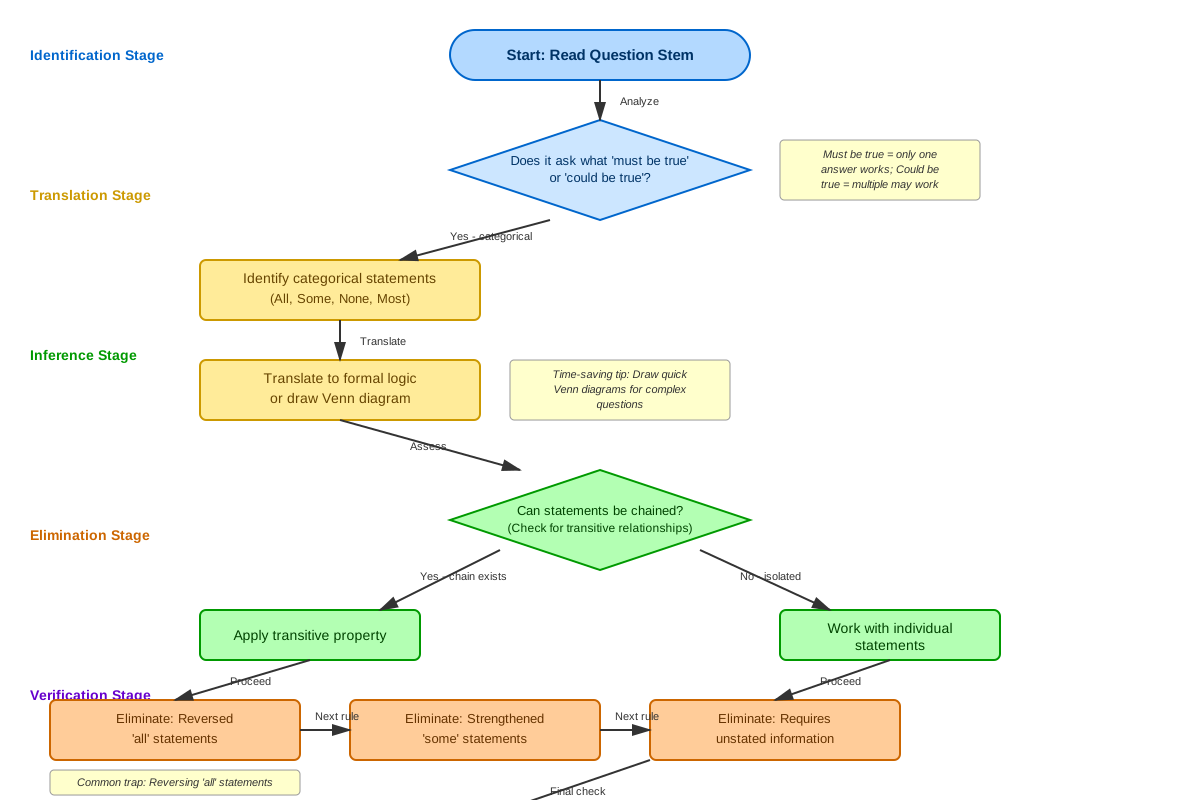
When approaching categorical inference questions on the LSAT, begin by identifying the question stem type. "Must be true" questions require certainty—the answer must follow necessarily from the given statements. "Could be true" questions require only possibility—the answer must be consistent with the given statements. "Cannot be true" questions require impossibility—the answer must contradict the given statements. This distinction determines your approach.
Trigger words signal categorical relationships: "all," "every," "each," "any" (universal affirmatives); "no," "none," "never" (universal negatives); "some," "several," "a few," "at least one" (particular affirmatives); "not all," "some...not" (particular negatives); "most," "majority," "more than half" (majority statements); "only," "the only" (reversed universal affirmatives).
Process of elimination works powerfully for categorical questions. For "must be true" questions, eliminate any answer that could be false—if you can construct a scenario consistent with the premises where the answer is false, eliminate it. For "could be true" questions, eliminate any answer that must be false—if the answer contradicts the premises, eliminate it. For "cannot be true" questions, eliminate any answer that could be true.
Diagramming strategy: Spend 15-30 seconds creating a quick visual representation of categorical relationships when three or more categories interact. Use circles for Venn diagrams or simple notation (A → B for "All A are B"). This investment pays off by preventing errors and revealing inferences quickly. However, for simple two-category statements, diagramming may waste time—develop judgment about when visualization helps.
Time allocation: Categorical inference questions typically require 60-90 seconds. Spend 20-30 seconds understanding the premises, 20-30 seconds considering what must follow, and 20-30 seconds evaluating answer choices. If a question requires more than 90 seconds, mark it and return if time permits—some categorical questions involve complex combinations that make them time-inefficient.
Common trap awareness: The LSAT frequently includes wrong answers that commit the "reversal error" (confusing "All A are B" with "All B are A") or the "some/most confusion" (treating "some" as if it means "most" or vice versa). When evaluating answers, explicitly check whether they reverse the given relationships or misinterpret quantifiers.
Contrapositive checking: When stuck, write out the contrapositive of each given statement. The correct answer might be a contrapositive or might follow from combining a statement with its contrapositive. This technique often reveals inferences that aren't immediately obvious.
Memory Techniques
AEIO Mnemonic for the four basic categorical statements:
- Affirmative universal: All A are B
- Exclusive universal: No A are B (Exclude all)
- Inclusive particular: Some A are B (Include some)
- Outside particular: Some A are not B (Outside some)
"REVERSE with CARE" for remembering when reversal is valid:
- Contrapositive: Always valid (reverse and negate)
- All statements: Never simply reverse
- Reciprocal negatives: "No A are B" = "No B are A" (valid)
- Existential statements: "Some A are B" doesn't guarantee "Some B are A"
"MOST + MOST = SOME" for remembering quantifier combination:
When two "most" statements share a term, you can always conclude "some" about the relationship between the outer terms, but never "most."
Visualization technique: Picture categories as physical containers. "All A are B" means the A container sits entirely inside the B container. "No A are B" means the containers are in separate rooms. "Some A are B" means the containers overlap with some items in the shared space. This concrete imagery helps prevent abstract logical errors.
"Only reverses" for remembering the tricky word "only":
"Only A are B" means "All B are A" (not "All A are B"). The word "only" reverses the expected direction. Visualize "only" as an arrow pointing backward.
Summary
Inference with categories constitutes a foundational skill for LSAT Logical Reasoning success, requiring precise understanding of how categorical statements—using quantifiers like "all," "some," "most," and "none"—establish relationships between groups. The core competency involves recognizing valid inference patterns (contrapositive, transitive chaining, combination inferences) while avoiding invalid patterns (reversal errors, existential fallacies, quantifier confusion). Students must translate natural language into categorical relationships, visualize these relationships through diagrams when helpful, and systematically evaluate what must be true, could be true, or cannot be true based solely on given information. Success requires distinguishing between the precise logical meaning of quantifiers and their everyday usage, understanding that "all" establishes subset relationships without implying reverse relationships, that "some" means "at least one" without upper limits, and that multiple categorical statements often yield fewer definite inferences than intuition suggests. Mastery enables confident navigation of Must Be True questions, accurate elimination of trap answers that commit reversal or quantifier errors, and efficient time management through strategic diagramming and contrapositive analysis.
Key Takeaways
- Universal statements ("All A are B") establish subset relationships but never automatically reverse—the contrapositive ("All non-B are non-A") is the only guaranteed equivalent transformation
- Quantifier precision is non-negotiable: "some" means at least one, "most" means more than half, "all" means 100%, and these distinctions determine what can be inferred
- Valid inference patterns include contrapositives, transitive chains, and careful combination of statements—invalid patterns include simple reversal, affirming the consequent, and denying the antecedent
- Multiple categorical statements often allow fewer definite conclusions than expected—what "could be true" is much broader than what "must be true"
- Diagramming serves as a powerful tool for complex multi-category problems but may waste time on simple two-category statements—develop judgment about when visualization helps
- The LSAT systematically tests whether students confuse possibility with necessity—wrong answers frequently present plausible scenarios that aren't logically required
- Trap answers exploit common errors: reversing relationships, misinterpreting quantifiers, assuming existence when none is established, and confusing sufficient with necessary conditions
Related Topics
Conditional Logic and Sufficient/Necessary Conditions: Categorical statements represent a specific type of conditional relationship, and understanding how "All A are B" relates to "If A, then B" deepens logical reasoning skills. Mastering categorical inference provides the foundation for more complex conditional reasoning.
Formal Logic Notation: Advanced LSAT preparation involves translating categorical statements into symbolic logic using quantifiers (∀ for "all," ∃ for "some") and logical operators. This formalization makes complex inferences more systematic and reliable.
Argument Structure and Assumption Questions: Many LSAT arguments embed categorical relationships within their reasoning. Recognizing these relationships helps identify unstated assumptions—often involving categorical leaps or missing links in categorical chains.
Logic Games with Grouping: Categorical reasoning applies directly to logic games involving group membership, where rules establish which elements can or must belong to which categories. The same inference patterns govern both Logical Reasoning and Logic Games questions.
Reading Comprehension Inference Questions: Categorical relationships frequently appear in LSAT Reading Comprehension passages, particularly in science and social science contexts. The ability to track categorical claims and their implications improves passage analysis and question accuracy.
Practice CTA
Now that you've mastered the core concepts of inference with categories, it's time to put your knowledge into action. Work through the practice questions systematically, applying the inference patterns and elimination strategies you've learned. Pay special attention to questions where your intuition conflicts with formal logic—these represent your highest-yield learning opportunities. Use the flashcards to reinforce quantifier meanings and valid inference patterns until they become automatic. Remember: categorical reasoning is a skill that improves dramatically with deliberate practice. Each question you analyze strengthens your pattern recognition and builds the confidence you need to excel on test day. You've built a solid foundation—now transform that knowledge into consistent performance through focused practice.
Sign up free to keep reading
Create a free AnvayaPrep account to finish this LSAT guide on Inference with categories — plus flashcards and practice questions.