Overview
Inference questions represent one of the most frequently tested and strategically important reading comprehension question types on the LSAT. These questions require test-takers to draw logical conclusions that are supported by the passage text without being explicitly stated. Unlike detail questions that ask about information directly mentioned in the passage, inference questions demand that students synthesize information, recognize implicit relationships, and identify what must be true based on the evidence provided.
Mastering LSAT inference questions is essential because they appear in virtually every Reading Comprehension section, typically comprising 20-30% of all reading questions. These questions test the core analytical skill that law schools value most: the ability to extract meaning beyond surface-level statements and recognize logical implications. Success on inference questions directly correlates with overall LSAT performance because they measure the same reasoning abilities tested throughout the exam—the capacity to understand what follows necessarily from given information.
Within the broader landscape of reading comprehension, inference questions occupy a middle ground between straightforward retrieval questions and complex application questions. They build upon basic comprehension skills while serving as a foundation for more advanced question types like "most strongly supported" and "author's attitude" questions. Understanding how to approach inference questions systematically provides students with transferable skills applicable to Logical Reasoning sections and even the Analytical Reasoning (Logic Games) section, making this topic a high-leverage investment of study time.
Learning Objectives
- [ ] Identify how Inference questions appears in LSAT questions
- [ ] Explain the reasoning pattern behind Inference questions
- [ ] Apply Inference questions to solve LSAT-style problems accurately
- [ ] Distinguish between valid inferences and unsupported assumptions
- [ ] Recognize common wrong answer patterns in inference questions
- [ ] Evaluate answer choices using the "must be true" standard
- [ ] Synthesize information from multiple parts of a passage to draw valid conclusions
Prerequisites
- Basic reading comprehension skills: The ability to understand main ideas, supporting details, and passage structure is necessary before attempting to draw inferences from text.
- Familiarity with LSAT passage types: Understanding the four passage categories (Natural Science, Social Science, Humanities, Law) helps contextualize the kinds of inferences commonly tested.
- Logical reasoning fundamentals: Basic understanding of logical relationships (if-then statements, necessary vs. sufficient conditions) supports the inference-drawing process.
- Vocabulary at college reading level: Inference questions often hinge on precise understanding of terminology and subtle distinctions in meaning.
Why This Topic Matters
Inference questions are not merely academic exercises—they mirror the analytical demands of legal practice. Attorneys must constantly read statutes, case law, and contracts to determine what logically follows from written text, identifying implications that may not be explicitly stated. This skill of "reading between the lines" while remaining anchored to textual evidence is precisely what inference questions assess.
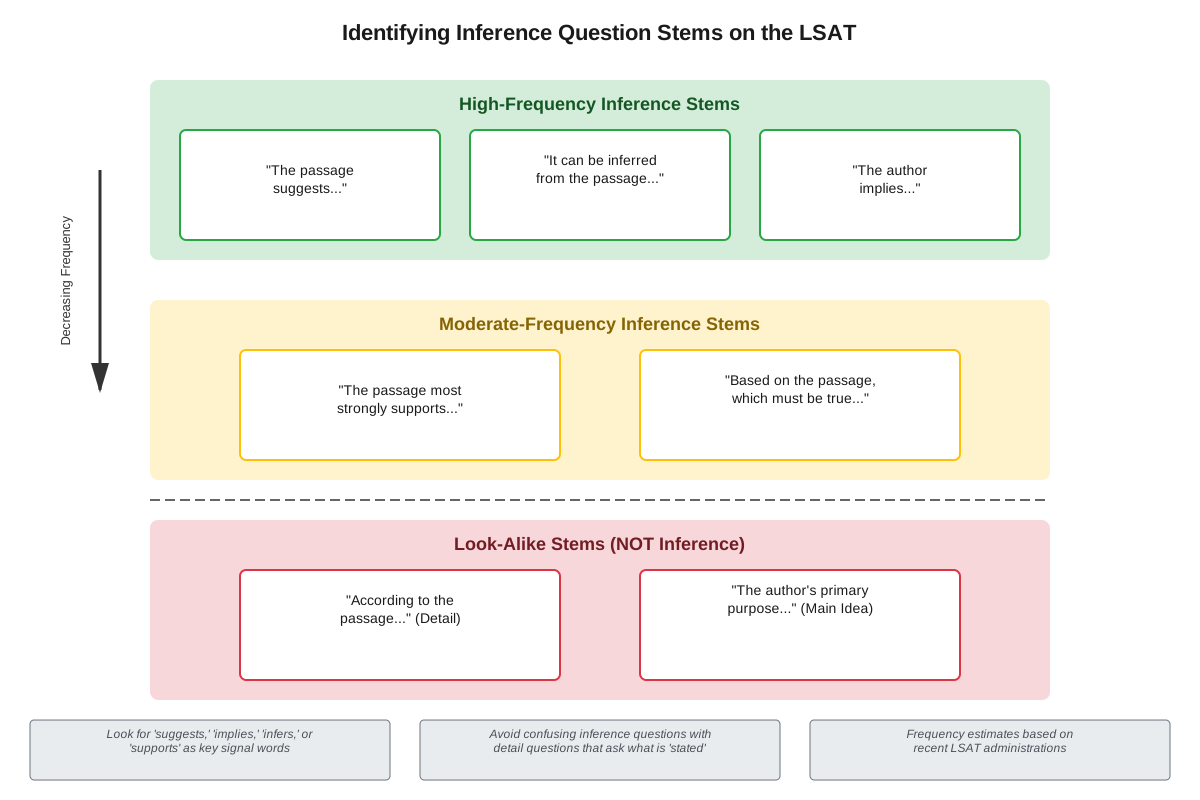
On the LSAT, inference questions appear with remarkable consistency. In a typical Reading Comprehension section containing four passages with 5-8 questions each (27 questions total), students can expect to encounter 5-8 inference questions. These questions are distributed across all passage types, though they appear most frequently in Natural Science and Law passages where technical precision and logical relationships are paramount. The LSAT uses various question stems to signal inference questions, including "The passage suggests," "It can be inferred from the passage," "The author implies," and "Based on the passage, which of the following is most likely true?"
The strategic importance of inference questions extends beyond their frequency. Because they test fundamental analytical reasoning, performance on these questions often predicts success on other question types. Students who master inference questions typically see improvement across their entire LSAT score because they've developed the disciplined, evidence-based reasoning that the exam rewards. Furthermore, inference questions often carry higher difficulty ratings than detail questions, meaning they can be crucial for breaking into higher score ranges (165+).
Core Concepts
What Constitutes a Valid Inference
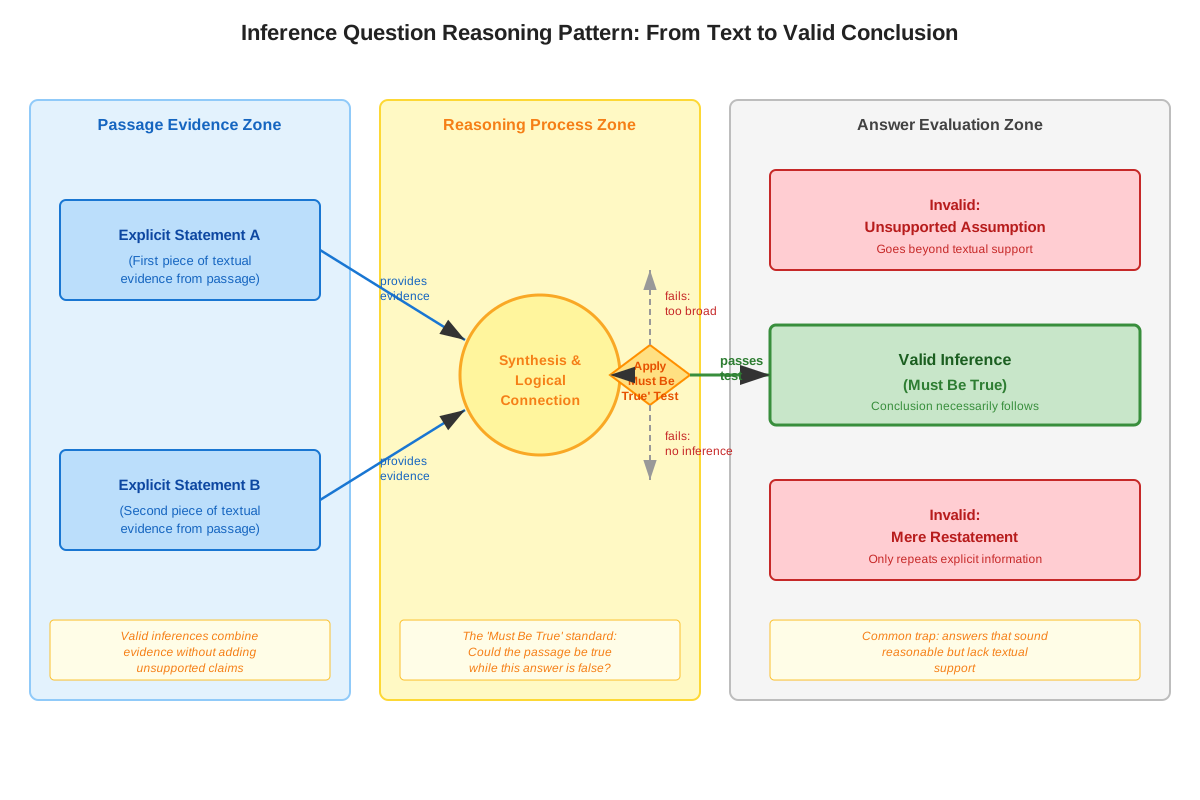
A valid inference on the LSAT is a conclusion that must be true based on the information provided in the passage. This standard is more stringent than everyday usage of "inference," which might include educated guesses or probable conclusions. On the LSAT, the correct answer to an inference question is one that cannot be false if the passage statements are true. This "must be true" standard is the cornerstone of approaching these questions correctly.
Valid inferences typically fall into several categories:
- Logical implications: If the passage states "All mammals are warm-blooded" and "Whales are mammals," the valid inference is that whales are warm-blooded.
- Contrapositive relationships: If the passage indicates that X requires Y, you can infer that without Y, X cannot occur.
- Combination inferences: Synthesizing two or more passage statements to reach a conclusion supported by their combination.
- Degree and scope inferences: Understanding what the passage's qualified language (some, most, all, typically) allows you to conclude.
The Inference Question Stem Variations
LSAT inference questions appear with diverse question stems, but all share the common requirement that the answer be supported by passage evidence. Recognizing these variations helps students quickly identify the question type and apply appropriate strategies:
| Question Stem Type | Example Phrasing | Key Characteristic |
|---|---|---|
| Direct inference | "The passage suggests that..." | Most straightforward; answer directly follows from passage |
| Author implication | "The author implies that..." | Focuses on author's unstated views or attitudes |
| Likely true | "Based on the passage, which is most likely true?" | Slightly softer standard but still requires strong support |
| Agreement | "The author would most likely agree with..." | Tests understanding of author's perspective |
| Continuation | "Which of the following would most logically continue the passage?" | Tests understanding of passage trajectory and implications |
Despite these variations, the fundamental task remains constant: identify the answer choice most strongly supported by passage evidence without requiring additional assumptions.
The Reasoning Pattern Behind Inference Questions
The cognitive process for solving inference questions involves a systematic approach that distinguishes strong test-takers from average ones. This reasoning pattern consists of several integrated steps:
- Locate relevant passage content: Inference questions often provide clues about where to look (line references, topic indicators, or contextual hints in the question stem).
- Identify explicit statements: Before inferring, clearly understand what the passage directly states. Misreading explicit content leads to invalid inferences.
- Recognize logical relationships: Determine how passage statements connect—causally, temporally, comparatively, or through other logical structures.
- Apply the "must be true" test: For each answer choice, ask whether it could be false given the passage information. If yes, eliminate it.
- Avoid assumption creep: The most common error is selecting answers that seem reasonable but require information beyond what the passage provides.
Strong vs. Weak Inferences
Understanding the spectrum from strongly supported to weakly supported inferences is crucial for LSAT success. Strong inferences are those that follow necessarily from passage statements with minimal logical steps. They typically:
- Combine two explicitly stated facts
- Apply a general rule to a specific case mentioned in the passage
- Recognize the contrapositive of a stated relationship
- Identify what must be true given qualified language (if the passage says "some X are Y," you can infer "at least one X is Y")
Weak inferences require additional assumptions, make leaps beyond passage scope, or introduce new information. Common characteristics include:
- Extreme language (always, never, only) when the passage uses moderate language
- Predictions about future events without passage support
- Causal claims when the passage only establishes correlation
- Specific details when the passage provides only general information
The Role of Passage Structure in Inference Questions
Passage structure significantly influences where valid inferences can be drawn. Understanding typical reading comprehension passage organization helps students locate inference-rich content:
- Contrasts and comparisons: When passages compare two theories, approaches, or phenomena, inference questions often test understanding of how they differ or what follows from their differences.
- Author's position vs. others' views: Passages frequently present multiple perspectives. Inferences about what the author believes must be distinguished from what others believe.
- Examples and illustrations: When passages provide specific examples of general principles, inference questions may ask what else would fit the principle or what the example demonstrates.
- Qualifications and limitations: Careful attention to hedging language ("typically," "often," "in most cases") is essential because inferences must respect these limitations.
Common Inference Question Traps
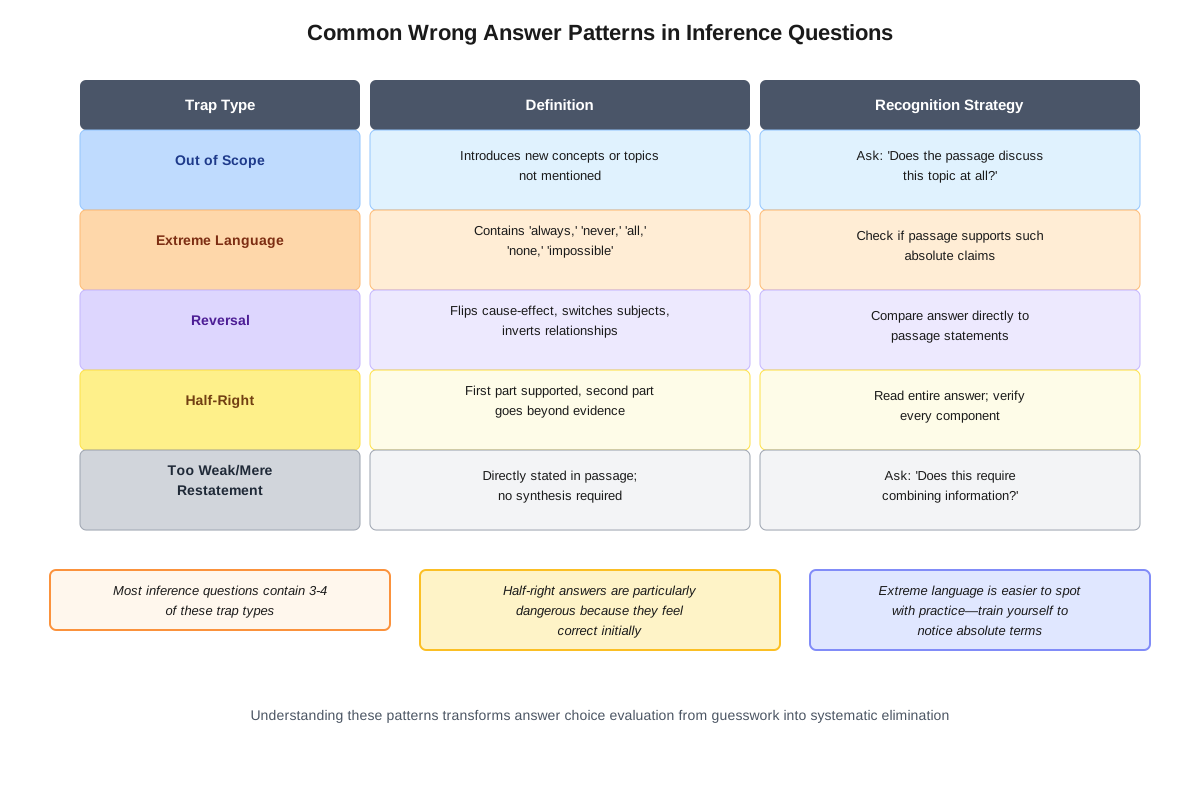
The LSAT systematically includes wrong answer choices that exploit predictable reasoning errors. Recognizing these traps is as important as identifying correct answers:
Out-of-scope answers introduce topics, concepts, or details not addressed in the passage. These are tempting because they may relate to the general subject matter, but they fail the "must be true" test because the passage provides no support.
Extreme answers take passage claims further than warranted. If the passage says "many scholars believe," an answer stating "most scholars believe" or "scholars unanimously agree" goes beyond what can be inferred.
Reversal answers flip the logical relationship stated in the passage. If the passage indicates "X leads to Y," a reversal answer might suggest "Y leads to X."
Distortion answers take passage content and twist it slightly, changing meaning in subtle but significant ways. These require careful comparison between answer choice language and passage language.
Concept Relationships
The concepts within inference questions form an interconnected system where mastery of one element supports understanding of others. The reasoning pattern serves as the central hub, connecting to all other concepts. Understanding what constitutes a valid inference (the "must be true" standard) directly informs how to apply the reasoning pattern—each step in the process aims to ensure the selected answer meets this standard.
The relationship between strong vs. weak inferences and common inference traps is particularly important: weak inferences become wrong answers through specific mechanisms (out-of-scope, extreme, reversal, distortion). Recognizing why an inference is weak helps identify which trap it represents.
Passage structure connects to inference question stem variations because different structural elements lend themselves to different question types. For example, passages with clear author commentary often generate "author implies" questions, while passages presenting multiple theories typically yield "most likely true" questions that require synthesizing information.
The conceptual flow can be mapped as:
Valid Inference Definition → Reasoning Pattern → Application to Stem Variations → Recognition of Strong vs. Weak Inferences → Identification of Common Traps → Strategic Use of Passage Structure
This progression moves from foundational understanding (what is an inference?) through methodology (how to find it?) to application (how to avoid errors?), creating a comprehensive framework for approaching any inference question.
High-Yield Facts
⭐ Inference questions require answers that must be true based on passage content—not merely probable or reasonable conclusions.
⭐ The correct answer to an inference question is often a modest, carefully qualified statement rather than a dramatic or sweeping claim.
⭐ Approximately 20-30% of Reading Comprehension questions are inference questions, making them one of the most common question types.
⭐ Wrong answers to inference questions typically fail by being out-of-scope, too extreme, reversed, or distorted from passage content.
⭐ Inference questions can be answered correctly even if you don't fully understand every detail of the passage—focus on the relevant section.
- Inference questions often test understanding of logical relationships (cause-effect, comparison, contrast) rather than factual recall.
- The phrase "most strongly supported" indicates an inference question and signals that you should apply the "must be true" standard.
- Correct inference answers frequently combine information from two different parts of the passage.
- Author attitude and tone are valid subjects for inference questions, particularly when the author uses evaluative language.
- Time-efficient inference question solving involves eliminating clearly wrong answers before deeply analyzing remaining choices.
- Inference questions about scientific or technical passages often test understanding of methodology, limitations, or implications rather than specific findings.
- The LSAT never requires outside knowledge to answer inference questions—all necessary information appears in the passage.
- Inference questions with line references or paragraph indicators are typically easier because they narrow the search space.
- Comparative passages (Passage A vs. Passage B) frequently include inference questions about how the authors would respond to each other's arguments.
- The most difficult inference questions require synthesizing information from multiple paragraphs or recognizing subtle implications of qualified language.
Quick check — test yourself on Inference questions so far.
Try Flashcards →Common Misconceptions
Misconception: Inference questions ask for the most interesting or insightful conclusion you can draw from the passage.
Correction: Inference questions ask for what must be true based on passage content. The correct answer may be relatively mundane or obvious—what matters is that it's fully supported, not that it's intellectually impressive.
Misconception: If an answer choice seems true based on common sense or general knowledge, it's a valid inference.
Correction: Valid inferences must be supported by passage content specifically. An answer that's true in the real world but unsupported by the passage is incorrect. The LSAT tests reading comprehension, not general knowledge.
Misconception: Inference questions require reading between the lines to find hidden meanings the author didn't directly express.
Correction: While inference questions test what's implied rather than explicit, valid inferences stay very close to passage content. "Reading between the lines" on the LSAT means recognizing logical implications, not speculating about unstated ideas.
Misconception: The correct answer to an inference question will use different words than the passage to avoid being too obvious.
Correction: While correct answers often paraphrase passage content, they may also use similar or identical language. Don't eliminate an answer simply because it closely tracks passage wording—evaluate whether it's supported.
Misconception: Longer, more detailed answer choices are more likely to be correct because they provide more information.
Correction: Length is not a reliable indicator of correctness. In fact, longer answers often include additional details that go beyond passage support, making them incorrect. Focus on support, not length.
Misconception: If you can imagine a scenario where an answer choice might be false, it cannot be the correct inference.
Correction: The question is whether the answer choice must be true given the passage content, not whether it's true in all possible worlds. If the passage information makes the answer necessarily true within the passage's context, it's a valid inference.
Misconception: Inference questions about the author's views require you to psychoanalyze the author's personal beliefs.
Correction: Author inference questions ask what the author's position is based on textual evidence—word choice, tone, arguments presented, and positions endorsed or criticized. Stay anchored to textual evidence rather than speculating about personal beliefs.
Worked Examples
Example 1: Scientific Passage Inference
Passage Excerpt:
"Recent studies have demonstrated that certain species of corvids—particularly ravens and crows—possess remarkable problem-solving abilities that were once thought to be unique to primates. In controlled experiments, these birds have successfully used tools, planned for future needs, and even demonstrated understanding of water displacement principles. However, researchers caution that while these behaviors indicate sophisticated cognitive processing, the neural mechanisms underlying corvid intelligence differ substantially from those in primates. Corvids have relatively small brains compared to primates, yet they achieve comparable cognitive outcomes through different neurological pathways."
Question: Based on the passage, which of the following can be most reasonably inferred?
Answer Choices:
(A) Corvids are more intelligent than most primate species.
(B) Brain size is not the sole determinant of cognitive capability.
(C) Future research will reveal that corvid and primate intelligence are neurologically identical.
(D) Tool use in birds evolved independently from tool use in primates.
(E) All bird species possess problem-solving abilities comparable to corvids.
Step-by-Step Solution:
Step 1: Identify the question type. The phrase "most reasonably inferred" signals an inference question requiring an answer supported by passage content.
Step 2: Locate relevant passage information. The key comparison involves corvid cognitive abilities, brain size, and neural mechanisms compared to primates.
Step 3: Evaluate each answer choice against the "must be true" standard.
(A) Corvids are more intelligent than most primate species.
This is too extreme. The passage states corvids achieve "comparable" cognitive outcomes to primates in specific tasks, not that they're more intelligent overall. Eliminate.
(B) Brain size is not the sole determinant of cognitive capability.
The passage explicitly states corvids have "relatively small brains compared to primates, yet they achieve comparable cognitive outcomes." This directly supports the inference that brain size alone doesn't determine cognitive ability. Strong candidate.
(C) Future research will reveal that corvid and primate intelligence are neurologically identical.
This contradicts the passage, which states the neural mechanisms "differ substantially." Eliminate.
(D) Tool use in birds evolved independently from tool use in primates.
While this might be true, the passage doesn't discuss evolutionary origins of tool use. This requires outside knowledge and assumptions. Eliminate.
(E) All bird species possess problem-solving abilities comparable to corvids.
The passage specifically discusses "certain species of corvids," not all birds. This overgeneralizes. Eliminate.
Step 4: Confirm the answer. Choice (B) is directly supported by the passage's statement that corvids achieve comparable cognitive outcomes despite smaller brains, making it a valid inference about the relationship between brain size and cognitive capability.
Correct Answer: (B)
Learning Objective Connection: This example demonstrates how to identify inference questions (Objective 1), apply the reasoning pattern of locating relevant content and testing answer choices (Objective 2), and accurately solve the problem by distinguishing supported inferences from unsupported assumptions (Objective 3).
Example 2: Humanities Passage Inference
Passage Excerpt:
"Art historian Maria Chen argues that the traditional interpretation of Renaissance portraiture as purely celebratory overlooks the subtle critiques embedded in many works. She points to Bronzino's portraits of the Medici family, noting that while superficially flattering, they employ symbolic elements—cold color palettes, rigid poses, and allegorical references—that suggest the artist's ambivalence toward his patrons' political power. Chen acknowledges that such interpretations remain speculative, as direct evidence of artists' intentions is scarce. Nevertheless, she maintains that contextual analysis of artistic choices provides valuable insights into the complex relationship between Renaissance artists and their powerful patrons."
Question: The passage most strongly supports which of the following statements about Chen's methodology?
Answer Choices:
(A) It relies primarily on documented statements from Renaissance artists about their intentions.
(B) It considers artistic techniques as potential sources of meaning beyond surface appearances.
(C) It definitively proves that Renaissance artists opposed their patrons' political power.
(D) It rejects all traditional interpretations of Renaissance art as fundamentally flawed.
(E) It focuses exclusively on the Medici family portraits to the exclusion of other works.
Step-by-Step Solution:
Step 1: Recognize this as an inference question about Chen's methodology based on the passage description of her approach.
Step 2: Identify key information about Chen's methods: she analyzes symbolic elements (color palettes, poses, allegorical references), acknowledges speculation due to limited direct evidence, and uses contextual analysis of artistic choices.
Step 3: Apply the reasoning pattern to each answer choice.
(A) It relies primarily on documented statements from Renaissance artists about their intentions.
The passage explicitly states "direct evidence of artists' intentions is scarce," indicating Chen's methodology doesn't primarily rely on documented statements. Eliminate.
(B) It considers artistic techniques as potential sources of meaning beyond surface appearances.
The passage describes Chen analyzing "symbolic elements" and "artistic choices" to find meanings that go beyond "superficially flattering" interpretations. This directly supports the inference that her methodology treats techniques as meaning sources. Strong candidate.
(C) It definitively proves that Renaissance artists opposed their patrons' political power.
The passage states Chen's interpretations "remain speculative" and suggests "ambivalence" rather than opposition. "Definitively proves" is too strong. Eliminate.
(D) It rejects all traditional interpretations of Renaissance art as fundamentally flawed.
Chen argues traditional interpretation "overlooks" certain aspects, not that it's entirely wrong. This overstates her position. Eliminate.
(E) It focuses exclusively on the Medici family portraits to the exclusion of other works.
The passage uses Medici portraits as an example ("She points to..."), not as Chen's exclusive focus. Eliminate.
Step 4: Confirm choice (B) accurately captures Chen's methodology as described: analyzing artistic elements to find meanings beyond obvious interpretations.
Correct Answer: (B)
Learning Objective Connection: This example shows how inference questions test understanding of implicit information (Chen's methodology isn't explicitly labeled but must be inferred from her described approach), demonstrates the reasoning pattern of eliminating answers that go beyond passage support, and illustrates distinguishing valid inferences from distortions and extreme statements.
Exam Strategy
Systematic Approach to Inference Questions
Develop a consistent process for every inference question:
- Identify the question type immediately by recognizing trigger phrases ("suggests," "implies," "most strongly supported," "can be inferred").
- Note any location indicators in the question stem (line references, paragraph numbers, or topic indicators) that narrow your search space.
- Return to the passage before looking at answer choices. Quickly review the relevant section to refresh your understanding of what's stated and what logically follows.
- Predict the general direction of the correct answer when possible. Even a vague prediction ("the answer will probably relate to the limitation mentioned in paragraph 3") helps you evaluate choices more efficiently.
- Evaluate answer choices systematically, eliminating those that clearly fail the "must be true" test before deeply analyzing remaining options.
Trigger Words and Phrases
Certain language in both question stems and answer choices provides crucial information:
Question Stem Triggers:
- "The passage suggests" = standard inference question
- "The author implies" = inference about author's unstated views
- "Most strongly supported" = find the answer with the strongest passage support
- "Most likely true" = slightly softer standard but still requires solid support
- "The passage indicates" = may be inference or detail question; check if answer is explicit or implicit
Answer Choice Red Flags:
- Extreme language (always, never, only, all, none, must, impossible) often signals wrong answers unless the passage uses equally strong language
- Comparative terms (more, less, better, worse) require passage support for the specific comparison
- Causal language (causes, leads to, results in) requires passage evidence of causality, not just correlation
- Future predictions (will, going to) need passage support for the prediction
Answer Choice Green Lights:
- Qualified language (some, many, often, typically, suggests, may) often appears in correct answers
- Paraphrases of passage content using synonyms
- Combinations of two passage statements
- Modest claims that stay within passage scope
Process of Elimination Strategy
Efficient elimination is crucial for time management:
First Pass—Eliminate Obviously Wrong Answers (15-20 seconds):
- Out-of-scope answers introducing new topics
- Answers contradicting passage content
- Extreme answers when passage uses moderate language
Second Pass—Evaluate Remaining Choices (30-40 seconds):
- Compare each remaining answer directly to passage content
- Ask "Could this be false given what the passage says?"
- Check for subtle distortions or unsupported assumptions
Final Verification (10-15 seconds):
- Confirm your selected answer is supported by specific passage content
- Verify you haven't fallen for a trap (reversal, distortion, extreme)
Time Allocation
For a typical Reading Comprehension section with 27 questions in 35 minutes:
- Standard inference question: 60-75 seconds
- Inference question with line reference: 45-60 seconds (narrower search space)
- Complex inference requiring synthesis: 75-90 seconds
If you're spending more than 90 seconds on an inference question, you're likely overthinking. Make your best elimination-based choice and move forward. You can return if time permits.
Exam Tip: Inference questions with specific line references or paragraph indicators are often easier than those asking about the passage generally. Consider tackling these first to build confidence and momentum.
Memory Techniques
The VALID Acronym for Inference Evaluation
Use VALID to remember the criteria for correct inference answers:
- Verifiable in the passage (supported by specific content)
- Avoid assumptions (doesn't require outside information)
- Logically follows (conclusion flows from premises)
- In scope (doesn't introduce new topics)
- Degree appropriate (matches passage's level of certainty)
The "Must Be True" Mantra
Before selecting any answer, mentally repeat: "If the passage is true, must this answer be true?" This simple question prevents the most common error—selecting answers that are merely plausible rather than necessary.
The SCOPE Visualization
Picture inference questions as requiring you to stay within a SCOPE:
- Specific to passage content
- Combining stated information
- Omitting outside knowledge
- Precise in degree and certainty
- Evidence-based, not speculative
Visualize drawing a circle around passage content—correct inferences stay within the circle, while wrong answers venture outside it.
The Three-Zone System
Mentally categorize answer choices into three zones:
- Green Zone: Clearly supported by passage (select these)
- Yellow Zone: Possibly supported but requires assumptions (be skeptical)
- Red Zone: Contradicts passage or out-of-scope (eliminate immediately)
This quick categorization speeds up elimination and focuses attention on genuine contenders.
The Comparison Table Memory Aid
For passages presenting multiple viewpoints, create a mental table:
| Viewpoint | Position | Support | Limitation |
|---|
This structure helps you track what can be inferred about each perspective and avoid attribution errors (confusing what Author A believes with what Author B believes).
Summary
Inference questions constitute a critical component of LSAT Reading Comprehension, testing the ability to draw conclusions that must be true based on passage content without being explicitly stated. Success requires understanding that valid inferences meet a strict "must be true" standard—they cannot be false if the passage is accurate. The systematic reasoning pattern involves locating relevant passage content, identifying explicit statements, recognizing logical relationships, applying the must-be-true test to answer choices, and avoiding unsupported assumptions. Strong inferences stay close to passage content, often combining two stated facts or recognizing logical implications, while weak inferences require additional assumptions or introduce out-of-scope information. Common traps include extreme answers, out-of-scope choices, reversals, and distortions. Effective strategy involves recognizing question stems, using passage structure strategically, eliminating wrong answers efficiently, and maintaining appropriate time allocation. Mastering inference questions not only improves Reading Comprehension scores but develops the analytical reasoning skills essential throughout the LSAT and in legal practice.
Key Takeaways
- Inference questions require answers that must be true based on passage content, not merely probable or reasonable conclusions—apply the strict "must be true" standard consistently.
- Approximately 20-30% of Reading Comprehension questions are inference questions, making them one of the highest-yield topics for focused study and practice.
- The systematic reasoning pattern—locate, identify, recognize relationships, test answers, avoid assumptions—provides a reliable framework for approaching any inference question.
- Wrong answers typically fail through predictable mechanisms: out-of-scope content, extreme language, reversed relationships, or subtle distortions of passage claims.
- Correct inference answers are often modest, carefully qualified statements rather than dramatic claims, and they frequently combine information from multiple passage locations.
- Efficient time management requires quick elimination of obviously wrong answers (15-20 seconds), careful evaluation of remaining choices (30-40 seconds), and final verification (10-15 seconds).
- Mastery of inference questions transfers to other LSAT sections and question types because it develops core analytical reasoning skills applicable throughout the exam.
Related Topics
Main Point Questions: After mastering inference questions, students should explore main point questions, which require identifying the passage's central claim. The skills developed for inference questions—staying anchored to textual evidence and avoiding unsupported assumptions—directly support main point question success.
Author's Attitude Questions: These questions ask about the author's perspective or tone, requiring inferences about unstated views based on word choice and argument structure. Mastering basic inference questions provides the foundation for these more nuanced inference tasks.
Strengthen/Weaken Questions in Logical Reasoning: The inference skills developed in Reading Comprehension transfer directly to Logical Reasoning, where strengthen and weaken questions require understanding what must be true given certain premises and what would support or undermine conclusions.
Comparative Reading Passages: The LSAT includes one comparative reading set per section, featuring two shorter passages on related topics. Inference questions about these passages often ask how authors would respond to each other's arguments, requiring synthesis of information across both texts.
Must Be True Questions in Logical Reasoning: These questions are essentially inference questions applied to shorter argument stimuli. Students who master reading comprehension inference questions find must-be-true questions in Logical Reasoning more manageable because the underlying reasoning pattern is identical.
Practice CTA
Now that you've developed a comprehensive understanding of inference questions—their structure, reasoning patterns, common traps, and strategic approaches—it's time to apply this knowledge through deliberate practice. Attempt the practice questions associated with this topic, focusing on implementing the systematic reasoning pattern and elimination strategies you've learned. Use the flashcards to reinforce high-yield facts and trigger words until recognizing inference questions and their traps becomes automatic. Remember that mastery comes through repeated application: each practice question is an opportunity to refine your approach and build the confidence that translates to test-day success. Your investment in understanding inference questions will pay dividends not only in Reading Comprehension but throughout the entire LSAT. Start practicing now, and watch your analytical reasoning skills reach new heights!
Sign up free to keep reading
Create a free AnvayaPrep account to finish this LSAT guide on Inference questions — plus flashcards and practice questions.