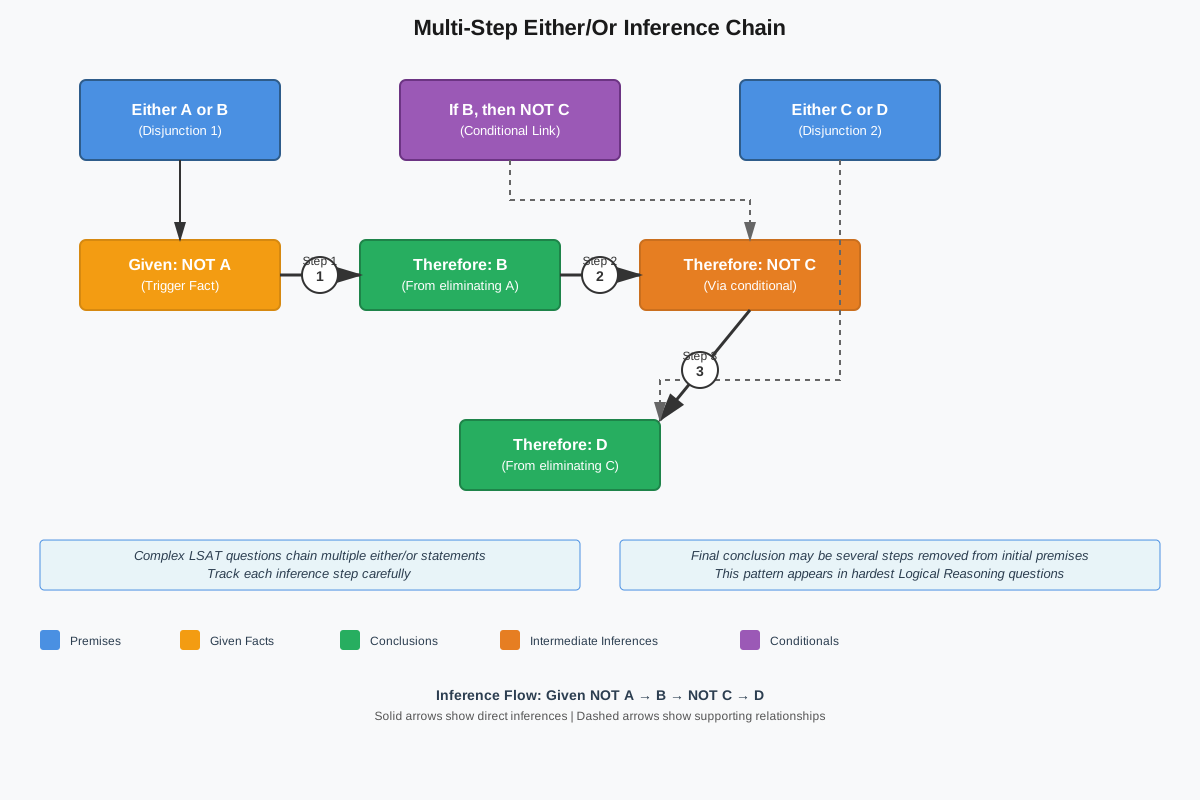
Overview
Inference with either or represents a critical reasoning pattern that appears frequently throughout the LSAT's Logical Reasoning sections. This pattern involves drawing valid conclusions from statements containing disjunctive claims—propositions that present two or more alternatives using "either...or" constructions or their logical equivalents. Understanding how to manipulate and derive inferences from these disjunctive statements is essential for success on inference questions, which consistently comprise approximately 15-20% of all Logical Reasoning questions on any given LSAT administration.
The logical structure underlying LSAT inference with either or questions builds upon fundamental principles of formal logic, particularly the rules governing disjunction and its relationship to negation. When the LSAT presents a statement like "Either A or B," test-takers must recognize that this creates a logical constraint: at least one of the alternatives must be true. More importantly, when combined with additional information—especially the negation of one alternative—this structure allows for definitive conclusions. This reasoning pattern appears not only in standalone inference questions but also permeates assumption questions, strengthen/weaken questions, and formal logic games in the Analytical Reasoning section.
Within the broader landscape of logical reasoning on the LSAT, inference with either or occupies a foundational position. It connects directly to conditional reasoning (since "Either A or B" can be reformulated as "If not A, then B"), contrapositive logic, and the principle of elimination. Mastering this topic enables students to navigate complex argument structures, recognize valid versus invalid inferences, and eliminate incorrect answer choices with confidence. The ability to quickly identify and manipulate disjunctive statements often separates high scorers from average performers, making this a genuinely high-yield area of study.
Learning Objectives
- [ ] Identify how Inference with either or appears in LSAT questions
- [ ] Explain the reasoning pattern behind Inference with either or
- [ ] Apply Inference with either or to solve LSAT-style problems accurately
- [ ] Convert disjunctive statements into their conditional equivalents and vice versa
- [ ] Recognize when additional information allows for definitive conclusions from either/or statements
- [ ] Distinguish between inclusive and exclusive disjunction in LSAT contexts
- [ ] Evaluate answer choices by testing them against disjunctive constraints in the stimulus
Prerequisites
- Basic conditional logic: Understanding "if...then" statements is essential because disjunctions can be reformulated as conditionals, and both reasoning patterns often appear together in LSAT stimuli.
- Contrapositive reasoning: The ability to form and recognize contrapositives directly supports working with either/or statements, as negating one disjunct leads to affirming the other.
- Logical operators and connectives: Familiarity with "and," "or," "not," and "if...then" provides the foundation for understanding how disjunctive statements function within larger argument structures.
- Basic inference question structure: Knowing what inference questions ask for (what must be true, what can be properly concluded) helps distinguish valid from invalid inferences from disjunctive premises.
Why This Topic Matters
In real-world reasoning, disjunctive thinking appears constantly in legal analysis, policy evaluation, medical diagnosis, and strategic decision-making. Attorneys regularly argue by elimination: "Either the defendant was at the scene or the witness is lying; the defendant has an alibi, therefore the witness is lying." Medical professionals use differential diagnosis: "Either the patient has condition X or condition Y; test results rule out X, so we treat for Y." The LSAT tests this reasoning pattern because it reflects the actual cognitive demands of legal practice and critical thinking in professional contexts.
On the LSAT specifically, inference with either or appears in approximately 3-5 questions per test across both Logical Reasoning sections. These questions typically manifest in several formats: pure inference questions asking "Which one of the following can be properly concluded?"; "must be true" questions; and occasionally in assumption or flaw questions where the reasoning depends on disjunctive premises. The pattern also appears embedded within more complex stimuli where multiple logical structures interact, making it essential to recognize quickly and manipulate accurately under time pressure.
Common manifestations include: (1) explicit either/or statements followed by information that eliminates one option; (2) implicit disjunctions where the stimulus presents two possibilities without using "either...or" language; (3) complex disjunctions with more than two alternatives; and (4) nested structures where disjunctions appear within conditional statements. The LSAT frequently tests whether students can recognize that eliminating all but one option from a disjunction allows them to conclude that the remaining option must be true—a straightforward logical principle that becomes challenging under test conditions with abstract content and time constraints.
Core Concepts
The Basic Structure of Disjunction
A disjunction is a compound statement asserting that at least one of two or more alternatives is true. In formal logic, this is represented as "A ∨ B" (read as "A or B"). On the LSAT, disjunctions appear in various linguistic forms: "Either A or B," "A or B," "A unless B," and even implicit constructions like "The solution must be X or Y." The fundamental logical property of disjunction is that it is false only when all disjuncts are false; if at least one disjunct is true, the entire disjunction is true.
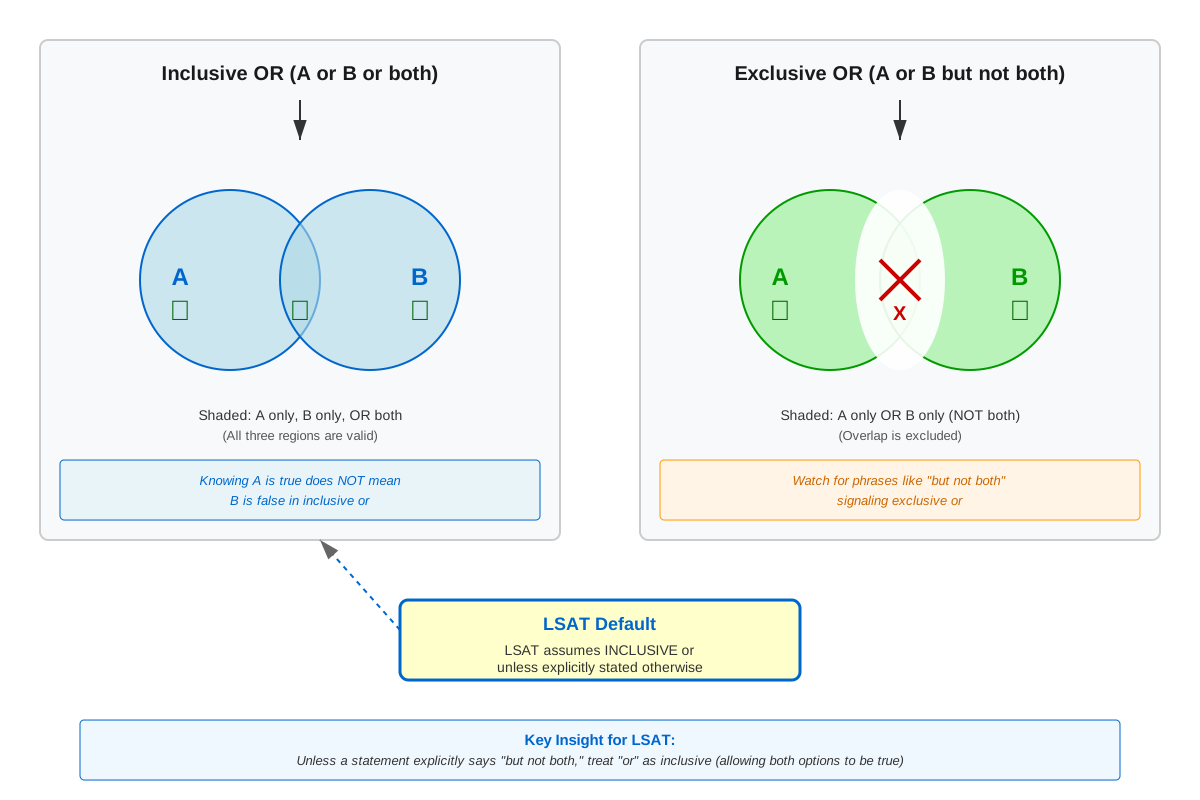
The LSAT primarily employs inclusive disjunction, meaning "or" allows for both alternatives to be true simultaneously. When a stimulus states "The committee will hire either an economist or a statistician," the LSAT interprets this as allowing the committee to hire both (unless context clearly indicates otherwise). This differs from everyday language, where "either...or" often suggests exclusivity. However, the test occasionally presents exclusive disjunction through additional context: "Either John or Mary will receive the promotion, but not both." Recognizing which type of disjunction is operative matters for determining what can be validly inferred.
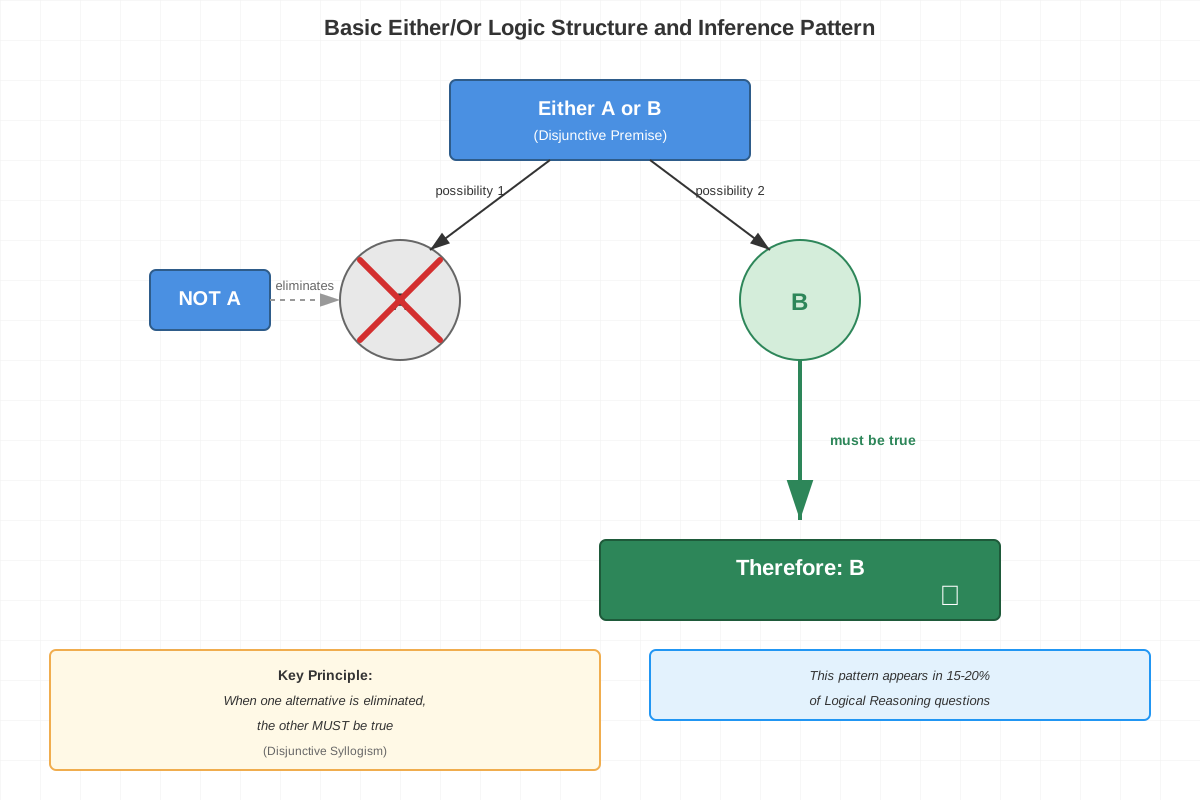
The Elimination Inference Pattern
The most frequently tested inference pattern with disjunctions follows this structure:
- Premise 1: Either A or B (or C, or D...)
- Premise 2: Not A (one alternative is eliminated)
- Valid Conclusion: Therefore, B (the remaining alternative must be true)
This pattern, sometimes called disjunctive syllogism or process of elimination, represents the core reasoning tested in LSAT inference with either or questions. The logical validity is absolute: if at least one alternative must be true, and all but one alternative are false, then the remaining alternative must be true.
Consider this example: "The manuscript was written either in the 15th century or in the 16th century. Carbon dating has definitively established that it was not written in the 15th century." The valid inference is that the manuscript was written in the 16th century. The LSAT tests this pattern with varying levels of complexity—sometimes with abstract content, sometimes with multiple disjuncts, and sometimes embedded within longer argument chains.
Converting Disjunctions to Conditionals
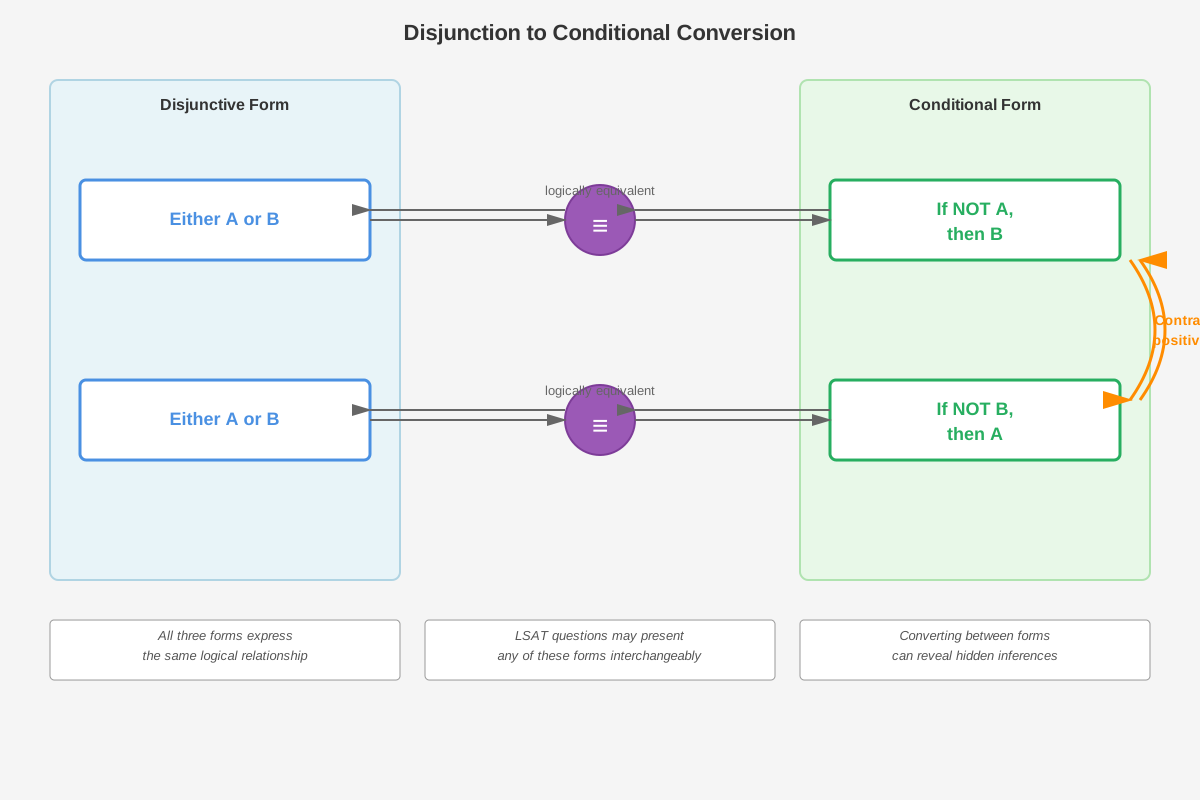
A powerful technique for working with either/or statements involves recognizing their equivalence to conditional statements. The disjunction "Either A or B" is logically equivalent to the conditional "If not A, then B" (and also to "If not B, then A"). This equivalence allows test-takers to leverage their conditional reasoning skills when working with disjunctions.
| Disjunctive Form | Conditional Equivalent 1 | Conditional Equivalent 2 |
|---|---|---|
| Either A or B | If not A, then B | If not B, then A |
| A or B or C | If not A and not B, then C | If not A, then B or C |
| A unless B | If not B, then A | If not A, then B |
This conversion is particularly useful when a stimulus contains both disjunctive and conditional statements, allowing for chain reasoning. For example: "Either the proposal passes or funding is cut. If funding is cut, the project terminates." Converting the disjunction yields: "If the proposal doesn't pass, then funding is cut." Combined with the second conditional, this produces: "If the proposal doesn't pass, then the project terminates."
Multiple Disjuncts and Partial Elimination
The LSAT sometimes presents disjunctions with more than two alternatives: "The culprit is either Adams, Brown, Chen, or Davis." When additional information eliminates some but not all alternatives, the valid inference is a narrowed disjunction. If we learn "The culprit is not Adams and not Brown," we can conclude "The culprit is either Chen or Davis." This represents a valid inference even though we cannot identify a single individual.
Understanding what can and cannot be inferred from partial elimination is crucial. From "Either A or B or C" and "Not A," we can validly conclude "Either B or C," but we cannot conclude "B" or "C" individually. The LSAT frequently includes incorrect answer choices that make this logical leap, asserting one specific alternative as true when only a narrowed disjunction is justified.
Implicit Disjunctions
Not all disjunctive reasoning on the LSAT uses explicit "either...or" language. The test frequently presents implicit disjunctions through context and logical structure. For example: "Only two explanations have been proposed for the phenomenon: theory X and theory Y. Recent evidence has conclusively refuted theory X." Although no "either...or" appears, the logical structure is disjunctive: either X or Y explains the phenomenon. The refutation of X allows the inference that Y explains the phenomenon.
Recognizing implicit disjunctions requires attention to language indicating exhaustive alternatives: "only two possibilities," "must be one of the following," "the only viable options are," or "no other explanation exists." These phrases signal that the stimulus has established a closed set of alternatives, creating a disjunctive structure even without explicit "or" language.
Negating Disjunctions
Understanding how to negate disjunctions is essential for working with complex logical structures. The negation of "Either A or B" is "Neither A nor B" (equivalently, "Not A and not B"). This follows from De Morgan's Laws in formal logic. On the LSAT, this principle appears when stimuli present what must be false or when working with the contrapositive of statements containing disjunctions.
For example, if a stimulus establishes "If the hypothesis is correct, then either prediction X or prediction Y will be confirmed," the contrapositive is "If neither prediction X nor prediction Y is confirmed, then the hypothesis is not correct." Recognizing this relationship allows test-takers to navigate complex inference chains involving disjunctions.
Concept Relationships
The concepts within inference with either or form an interconnected logical system. The basic disjunctive structure serves as the foundation, establishing what "either...or" means logically. This foundation enables the elimination inference pattern, which represents the primary application tested on the LSAT. The conversion to conditionals provides an alternative framework for understanding disjunctions, connecting this topic directly to conditional reasoning—arguably the most important logical structure on the LSAT.
Multiple disjuncts and partial elimination extends the basic elimination pattern to more complex scenarios, while implicit disjunctions tests whether students can recognize the underlying logical structure regardless of surface linguistic form. Finally, negating disjunctions connects to broader principles of logical negation and contrapositive reasoning.
The relationship map flows as follows:
Basic Disjunctive Structure → Elimination Inference Pattern → Application to LSAT Questions
↓
Conversion to Conditionals → Integration with Conditional Reasoning Chains
↓
Multiple Disjuncts/Partial Elimination → More Complex Inference Questions
↓
Implicit Disjunctions → Recognition Skills Across Varied Question Types
↓
Negating Disjunctions → Advanced Contrapositive and Negation Applications
This topic connects to prerequisite knowledge of conditional logic by providing an alternative formulation of conditional relationships. It connects forward to more advanced topics like formal logic games, complex argument structures, and multi-layered inference questions. Mastery of inference with either or also supports success on assumption questions (recognizing when an argument depends on eliminating alternative explanations) and strengthen/weaken questions (understanding how evidence might eliminate or support various alternatives).
Quick check — test yourself on Inference with either or so far.
Try Flashcards →High-Yield Facts
⭐ A disjunction "Either A or B" is true whenever at least one disjunct is true; it is false only when both disjuncts are false.
⭐ From "Either A or B" and "Not A," you can validly conclude "B"—this is the most frequently tested inference pattern with disjunctions.
⭐ "Either A or B" is logically equivalent to "If not A, then B" and also to "If not B, then A."
⭐ The LSAT typically uses inclusive disjunction, meaning "or" allows both alternatives to be true unless context indicates exclusivity.
⭐ From a disjunction with multiple alternatives where some but not all are eliminated, you can infer a narrowed disjunction but not a single definitive alternative.
- The negation of "Either A or B" is "Neither A nor B" (equivalently, "Not A and not B").
- Implicit disjunctions appear through language like "only two possibilities," "must be one of," or "no other explanation."
- When a disjunction appears in the consequent of a conditional ("If X, then either A or B"), eliminating both disjuncts allows you to conclude via contrapositive that X is false.
- "Unless" statements create disjunctions: "A unless B" means "Either A or B" and converts to "If not B, then A."
- Exclusive disjunction ("either A or B but not both") is less common on the LSAT but appears occasionally, typically signaled by explicit language like "but not both."
- Chain reasoning can combine disjunctions with conditionals: from "Either A or B" and "If B, then C," you cannot conclude C (because A might be true instead), but you can conclude "Either A or C."
Common Misconceptions
Misconception: "Either A or B" means exactly one is true (exclusive interpretation by default).
Correction: On the LSAT, "either...or" is inclusive unless context clearly indicates otherwise, meaning both alternatives can be true simultaneously. The disjunction only guarantees that at least one is true.
Misconception: From "Either A or B or C" and "Not A," you can conclude "B."
Correction: Eliminating one alternative from a multi-option disjunction only allows you to conclude a narrowed disjunction. Here, you can validly infer "Either B or C," but not any single alternative individually.
Misconception: "Either A or B" and "If A, then B" are equivalent statements.
Correction: These are distinct logical structures. "Either A or B" converts to "If not A, then B," not "If A, then B." The conditional "If A, then B" allows for both A and B to be false, while "Either A or B" requires at least one to be true.
Misconception: If a stimulus says "Either A or B" and later says "A is true," you can conclude "B is false."
Correction: In inclusive disjunction (the LSAT default), learning that one disjunct is true tells you nothing definitive about the other disjunct. Both could be true. Only learning that one is false allows you to conclude the other is true.
Misconception: Implicit disjunctions don't follow the same logical rules as explicit "either...or" statements.
Correction: Whether a disjunction is stated explicitly or implied through context, the same logical principles apply. If a stimulus establishes that exactly two alternatives exist, eliminating one allows you to infer the other, regardless of whether "either...or" language appears.
Misconception: From "Either A or B" alone, you can infer "If A, then not B."
Correction: This inference is only valid for exclusive disjunction. In inclusive disjunction (the LSAT default), "Either A or B" does not preclude both being true, so you cannot infer that one being true makes the other false.
Worked Examples
Example 1: Basic Elimination Pattern
Stimulus: "The ancient artifact was created either during the Bronze Age or during the Iron Age. Recent metallurgical analysis has conclusively demonstrated that the artifact contains no bronze whatsoever. Therefore, the artifact must have been created during the Iron Age."
Question: Which one of the following most accurately describes the reasoning pattern used above?
Analysis:
Step 1: Identify the disjunctive premise. The stimulus explicitly states "either during the Bronze Age or during the Iron Age," establishing two alternatives.
Step 2: Identify the elimination information. The metallurgical analysis eliminates the Bronze Age possibility (artifacts from the Bronze Age would contain bronze).
Step 3: Recognize the inference pattern. This is a classic disjunctive syllogism: Either A or B; Not A; Therefore B.
Step 4: Evaluate the validity. The reasoning is valid. Given that one of the two alternatives must be true, and one has been eliminated, the remaining alternative must be true.
Connection to Learning Objectives: This example demonstrates the most fundamental application of inference with either or—recognizing the basic elimination pattern and understanding why it produces a valid conclusion. The reasoning is sound because the disjunction establishes that at least one alternative must be true, and the additional evidence eliminates all but one alternative.
Example 2: Complex Disjunction with Conditional Reasoning
Stimulus: "The company will either expand into Asian markets or increase its domestic production capacity. If the company expands into Asian markets, it will need to hire multilingual staff. The company has announced that it will not hire multilingual staff. What can be properly concluded?"
Analysis:
Step 1: Identify all logical structures. We have a disjunction ("either...or") and a conditional ("If...then").
Step 2: Map the logical relationships:
- Premise 1: Either Asian expansion OR domestic capacity increase
- Premise 2: If Asian expansion, THEN hire multilingual staff
- Premise 3: NOT hire multilingual staff
Step 3: Apply contrapositive reasoning to the conditional. From "If Asian expansion, then hire multilingual staff" and "Not hire multilingual staff," we can conclude via contrapositive: "Not Asian expansion."
Step 4: Apply elimination to the disjunction. From "Either Asian expansion or domestic capacity increase" and "Not Asian expansion," we can conclude: "Domestic capacity increase."
Step 5: State the valid conclusion. The company will increase its domestic production capacity.
Connection to Learning Objectives: This example illustrates how inference with either or integrates with conditional reasoning, requiring students to recognize multiple logical structures, apply contrapositive reasoning, and then use elimination on the disjunction. This represents the type of multi-step reasoning frequently tested on harder LSAT questions.
Exam Strategy
When approaching LSAT questions involving inference with either or, begin by scanning the stimulus for explicit disjunctive language: "either...or," "or," "unless," or phrases indicating alternatives. Mark these structures immediately, as they signal potential elimination reasoning. Also watch for implicit disjunctions signaled by "only two possibilities," "must be one of," or similar exhaustive language.
Trigger words and phrases to watch for include:
- "Either...or"
- "Or" (especially when connecting complete clauses)
- "Unless"
- "Only two explanations/possibilities/options"
- "Must be one of the following"
- "The only viable alternatives are"
- "No other possibility exists"
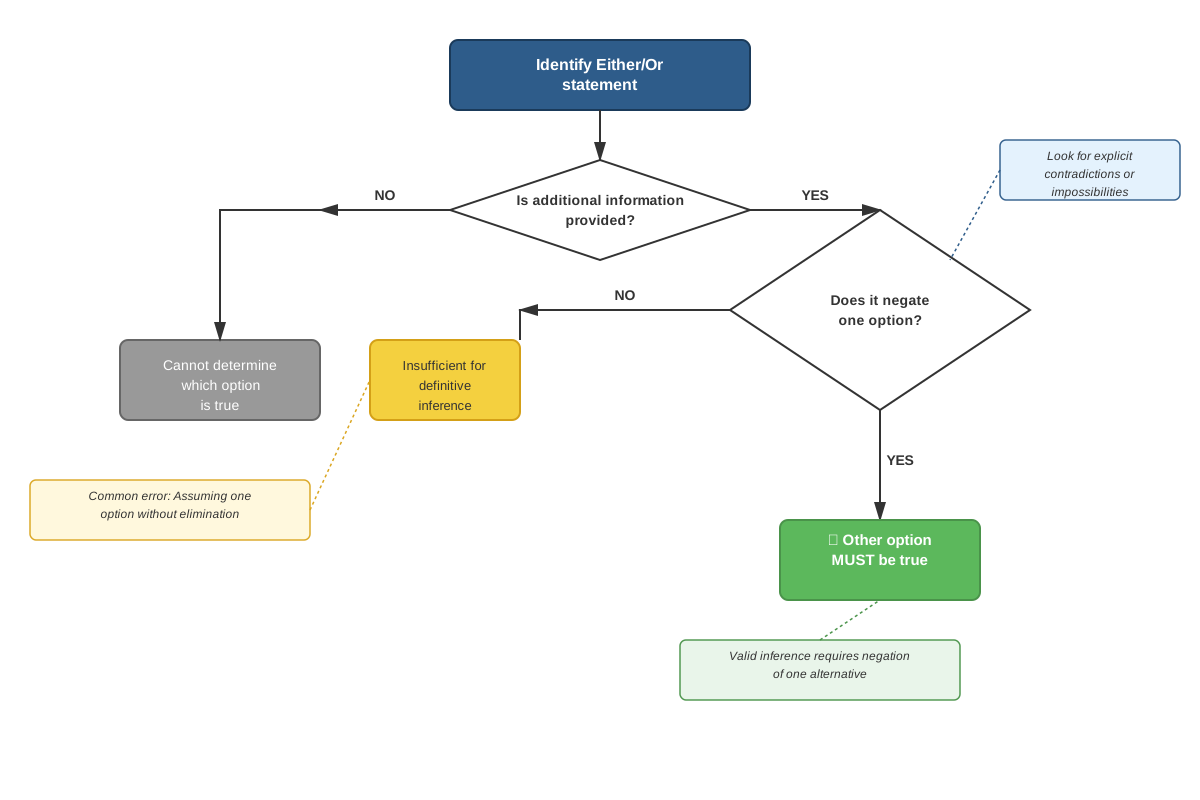
Once you've identified a disjunction, immediately look for information that eliminates one or more alternatives. This might appear as direct negation ("not A"), as evidence incompatible with an alternative, or as a contrapositive conclusion from conditional reasoning that eliminates an option. The combination of disjunction plus elimination is your signal that a definitive inference is likely available.
For process-of-elimination on answer choices, test each option against the disjunctive structure:
- Does this answer choice follow necessarily from eliminating alternatives? If the stimulus eliminates all but one option, that option must be true.
- Does this answer choice claim more than is justified? Watch for answers that assert a single alternative when only partial elimination has occurred.
- Does this answer choice confuse inclusive and exclusive disjunction? Incorrect answers often assume that one alternative being true makes others false.
- Does this answer choice reverse the logic? Some wrong answers present the contrapositive incorrectly or confuse sufficient and necessary conditions.
Time allocation: Inference with either or questions typically require 60-90 seconds once you've identified the pattern. Spend 20-30 seconds analyzing the stimulus to identify the disjunction and any elimination information, then 30-45 seconds evaluating answer choices. If you find yourself spending more than 90 seconds, you may be overthinking—these questions test straightforward logical principles, and the correct answer should follow clearly from the premises once you've identified the structure.
Exam Tip: If a stimulus presents "Either A or B" and then provides information about A (whether A is true or false), immediately ask yourself: "Does this information eliminate A or confirm A?" If it eliminates A, you can conclude B. If it confirms A, you typically cannot conclude anything definitive about B (unless you have exclusive disjunction).
Memory Techniques
Mnemonic for the basic pattern: "EEI" - Either/or statement, Eliminate one option, Infer the other. When you see a disjunction, look for elimination information, and you can infer what remains.
Visualization strategy: Picture a fork in the road with two (or more) paths. The disjunction tells you that you must take at least one path. When information "blocks off" one path, you know you must take the remaining path. This mental image helps solidify the elimination inference pattern.
Acronym for conversion: "NOT-THEN" - A disjunction "A OR B" converts to "If NOT A, THEN B." This reminds you that negating one disjunct in the conditional's antecedent leads to affirming the other in the consequent.
Memory aid for inclusive vs. exclusive: Remember "LSAT Loves Inclusive"—the default interpretation on the LSAT is inclusive disjunction unless explicitly stated otherwise. When you see "either...or," assume both could be true unless the stimulus says "but not both" or context clearly indicates exclusivity.
Rhyme for negation: "To negate OR, use AND with NOT" - The negation of "A or B" is "Not A and Not B." This rhyme helps recall De Morgan's Law for disjunctions.
Summary
Inference with either or represents a fundamental reasoning pattern on the LSAT, testing the ability to draw valid conclusions from disjunctive statements. The core principle is straightforward: when a stimulus establishes that at least one of several alternatives must be true, and additional information eliminates all but one alternative, that remaining alternative must be true. This elimination inference pattern appears in approximately 3-5 questions per LSAT, making it a high-yield topic for focused study. Success requires recognizing both explicit and implicit disjunctions, understanding the equivalence between disjunctive and conditional formulations, and avoiding common errors like confusing inclusive and exclusive disjunction or claiming more than partial elimination justifies. The pattern integrates closely with conditional reasoning, often appearing in multi-step inference chains that combine disjunctive syllogism with contrapositive reasoning. Mastery involves not just understanding the abstract logical principles but developing the ability to quickly identify disjunctive structures in varied linguistic forms and apply elimination reasoning accurately under time pressure.
Key Takeaways
- Disjunctions assert that at least one alternative is true; on the LSAT, "either...or" is inclusive by default, allowing both alternatives to be true simultaneously.
- The elimination inference pattern—Either A or B; Not A; Therefore B—is the most frequently tested application of disjunctive reasoning on the LSAT.
- Disjunctions convert to conditionals: "Either A or B" is equivalent to "If not A, then B" and "If not B, then A," enabling integration with conditional reasoning chains.
- Partial elimination from multi-option disjunctions yields narrowed disjunctions, not single definitive conclusions—a common trap in incorrect answer choices.
- Implicit disjunctions appear through language indicating exhaustive alternatives ("only two possibilities," "must be one of") and follow the same logical rules as explicit "either...or" statements.
- Watch for disjunctions combined with conditional statements, as these create opportunities for multi-step reasoning using both contrapositive logic and elimination.
- The negation of a disjunction uses "and" with negated components: the negation of "Either A or B" is "Neither A nor B."
Related Topics
Conditional Logic and Contrapositives: Mastering inference with either or provides a foundation for understanding how disjunctions and conditionals interrelate, as they are logically equivalent formulations. Advanced conditional reasoning questions often embed disjunctions within conditional chains.
Formal Logic in Analytical Reasoning: The Logic Games section frequently employs disjunctive constraints ("Either X or Y is selected, but not both"). Understanding inference with either or directly transfers to solving these game scenarios efficiently.
Necessary and Sufficient Conditions: The relationship between disjunctions and conditionals deepens understanding of necessary and sufficient conditions, as "Either A or B" establishes that having neither A nor B is sufficient to make the disjunction false.
Argument Structure and Assumption Questions: Many assumption questions involve recognizing that an argument depends on eliminating alternative explanations—essentially assuming a disjunction and eliminating all but one option.
Strengthen and Weaken Questions: Evidence that eliminates alternatives strengthens arguments relying on disjunctive reasoning, while evidence introducing new alternatives or supporting eliminated options weakens such arguments.
Practice CTA
Now that you've mastered the core concepts of inference with either or, it's time to cement your understanding through active practice. Attempt the practice questions associated with this topic, focusing on identifying disjunctive structures quickly and applying the elimination inference pattern accurately. Use the flashcards to reinforce the key principles, especially the conversion between disjunctive and conditional forms. Remember: understanding the logic is just the first step—developing speed and accuracy under test conditions requires repeated application. Each practice question you work through builds the pattern recognition skills that will serve you throughout the LSAT. You've got this!
Sign up free to keep reading
Create a free AnvayaPrep account to finish this LSAT guide on Inference with either or — plus flashcards and practice questions.