Overview
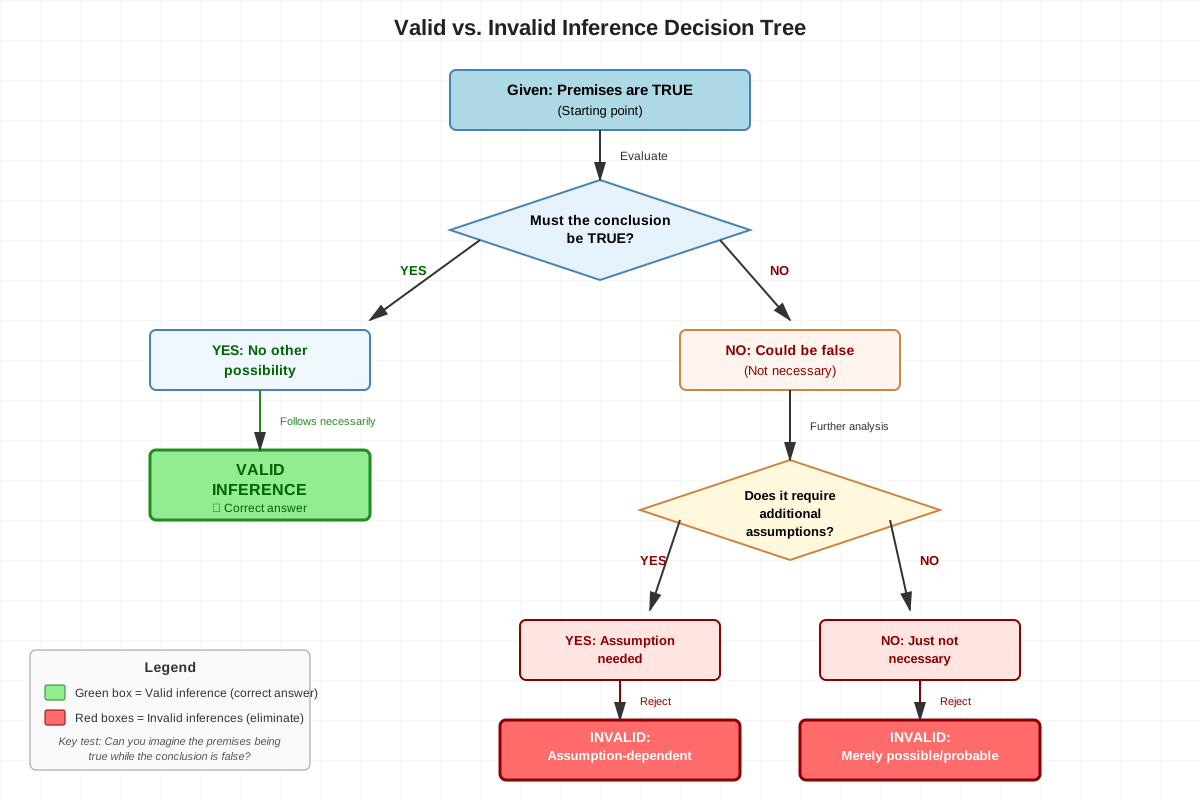
Valid inference is one of the most fundamental and frequently tested concepts in LSAT Logical Reasoning. At its core, a valid inference is a conclusion that must be true if the premises are true—it represents the logical bridge between given information and what can be definitively concluded from that information. Unlike questions that ask you to strengthen or weaken arguments, inference questions require you to identify what logically follows from the stimulus without introducing outside assumptions or speculation.
Understanding valid inference is essential for LSAT success because these questions appear in nearly every Logical Reasoning section, typically comprising 15-20% of all Logical Reasoning questions. The LSAT tests your ability to distinguish between what must be true, what could be true, and what is merely suggested by a passage. This skill extends beyond inference questions themselves—the ability to recognize valid inferences underlies your performance on assumption questions, must-be-true questions, and even some strengthen/weaken questions where you need to understand what logically follows from combining the stimulus with an answer choice.
The concept of lsat valid inference connects directly to formal logic, conditional reasoning, and argument structure—all pillars of LSAT Logical Reasoning. When you master valid inference, you develop the analytical precision needed to navigate the exam's most challenging questions. This topic serves as a gateway to understanding how the LSAT constructs correct answers: they are almost always statements that follow necessarily from the given information, even when the question type appears to be testing something else entirely.
Learning Objectives
- [ ] Identify how Valid inference appears in LSAT questions
- [ ] Explain the reasoning pattern behind Valid inference
- [ ] Apply Valid inference to solve LSAT-style problems accurately
- [ ] Distinguish between valid inferences and statements that are merely possible or probable
- [ ] Recognize common inference patterns including conditional reasoning, quantifier relationships, and comparative statements
- [ ] Evaluate answer choices systematically to eliminate invalid inferences
- [ ] Combine multiple premises to derive compound inferences
Prerequisites
- Basic formal logic: Understanding of logical connectors (if/then, and, or, not) is essential because valid inferences often depend on manipulating these relationships correctly
- Conditional reasoning fundamentals: Knowledge of sufficient and necessary conditions enables recognition of what must follow from conditional statements
- Argument structure: Familiarity with premises and conclusions helps distinguish between what is given and what must be inferred
- Quantifier logic: Understanding terms like "all," "some," "most," and "none" is critical because inference questions frequently test relationships between quantified groups
Why This Topic Matters
Valid inference represents the logical foundation of legal reasoning, which is why the LSAT emphasizes it so heavily. In legal practice, attorneys must constantly determine what conclusions follow necessarily from statutes, precedents, and evidence. A lawyer who draws invalid inferences risks making flawed arguments, while one who recognizes valid inferences can construct compelling cases and identify weaknesses in opposing arguments.
On the LSAT, inference questions appear in multiple forms: "Which one of the following must be true?", "Which one of the following can be properly inferred?", "If the statements above are true, which one of the following must also be true?", and "The statements above, if true, most strongly support which one of the following?" These questions typically account for 6-8 questions per test (out of approximately 50 Logical Reasoning questions total), making them one of the highest-yield question types to master.
Inference questions appear in passages discussing everything from scientific studies to business decisions to philosophical arguments. The LSAT deliberately uses diverse content to test your logical reasoning skills independent of subject-matter knowledge. Common passage types include: factual descriptions with multiple data points that must be combined; conditional statements that can be chained together; comparative statements about quantities, qualities, or relationships; and scenarios with constraints that limit possible outcomes. Recognizing these patterns allows you to anticipate what kinds of inferences the test-makers are likely to reward.
Core Concepts
What Constitutes a Valid Inference
A valid inference is a statement that must be true given the truth of the premises. This is a strict logical standard—not "probably true" or "reasonably concluded," but necessarily true. If you can imagine any scenario where the premises are true but the inference is false, then the inference is invalid. This concept of logical necessity distinguishes valid inferences from other types of reasoning you might encounter in everyday life.
The LSAT tests valid inference through deductive reasoning, where conclusions follow with certainty from premises. Consider this simple example: "All lawyers have passed the bar exam. Sarah is a lawyer." From these premises, you can validly infer that "Sarah has passed the bar exam." This conclusion must be true if the premises are true—there is no possible scenario where both premises hold but the conclusion fails.
The Must-Be-True Standard
When approaching lsat valid inference questions, the critical standard is "must be true." This phrase signals that you need absolute logical certainty, not mere plausibility. Many wrong answers on inference questions are statements that could be true or are likely true based on the passage, but they don't have to be true. The LSAT exploits this distinction ruthlessly.
For example, if a passage states "Most doctors recommend daily exercise," you cannot validly infer that "Dr. Johnson recommends daily exercise" (even though it's probable), nor can you infer that "Daily exercise is beneficial" (even though the doctors' recommendations suggest this). You can only infer statements about the relationship between doctors as a group and their recommendations—such as "Some doctors recommend daily exercise" or "It is not the case that no doctors recommend daily exercise."
Types of Valid Inferences
Conditional Inferences
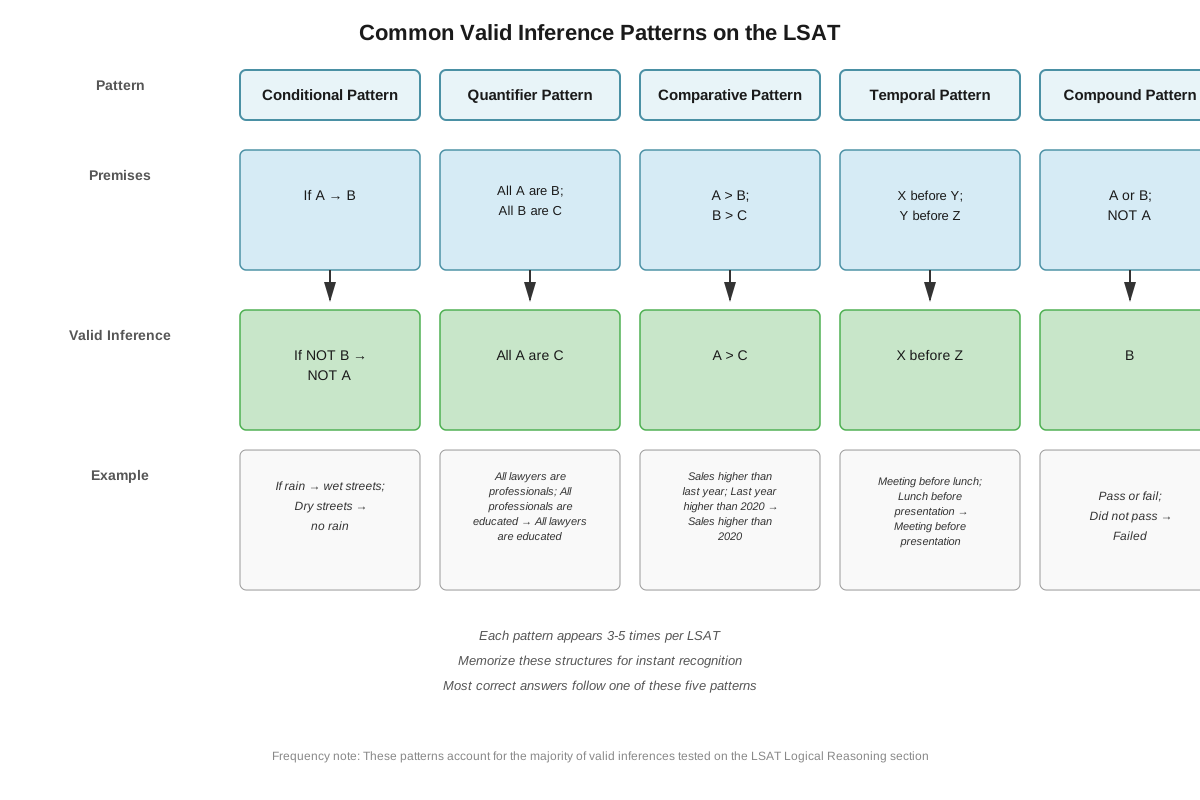
Conditional statements (if-then relationships) generate several types of valid inferences. From "If A, then B," you can validly infer the contrapositive: "If not B, then not A." You cannot validly infer the converse (If B, then A) or the inverse (If not A, then not B), though these are common trap answers.
Conditional chains allow for extended inferences. If you know "If A, then B" and "If B, then C," you can validly infer "If A, then C." The LSAT frequently presents multiple conditional statements that must be combined to reach the correct answer.
Quantifier Inferences
Statements with quantifiers (all, some, most, none) follow specific logical rules:
| Given Statement | Valid Inferences | Invalid Inferences |
|---|---|---|
| All A are B | If something is A, it is B; Some B are A (if any A exist) | All B are A; Most A are B |
| Some A are B | At least one A is B; At least one B is A | Most A are B; All A are B |
| Most A are B | More than half of A are B | All A are B; Some B are A |
| No A are B | If something is A, it is not B; If something is B, it is not A | Some A are not B (without knowing A exists) |
Comparative Inferences
When passages present comparisons, valid inferences must respect the logical boundaries of those comparisons. If "Product X is more expensive than Product Y," and "Product Y is more expensive than Product Z," you can validly infer "Product X is more expensive than Product Z." However, you cannot infer specific price points or percentage differences unless explicitly stated.
Combining Premises
Many LSAT inference questions require synthesizing multiple pieces of information. The key is to identify overlapping elements between premises. If Premise 1 tells you something about Group A and Group B, and Premise 2 tells you something about Group B and Group C, the valid inference likely involves the relationship between A and C through their shared connection to B.
Consider: "All members of the committee are lawyers. Some lawyers specialize in tax law. No tax law specialists work on weekends." While you cannot conclude that any specific committee member is a tax law specialist, you can validly infer that "Some lawyers do not work on weekends" (because some lawyers are tax law specialists, and no tax law specialists work on weekends).
The Scope Limitation Principle
Valid inferences cannot exceed the scope of the premises. If premises discuss "some employees," the inference cannot make claims about "all employees" or "most employees." If premises discuss correlation, the inference cannot assert causation. If premises present one person's opinion, the inference cannot state objective facts. Scope violations are among the most common reasons answer choices are incorrect on inference questions.
Negative Inferences
Sometimes what can be validly inferred is what cannot be true or what is not necessarily true. If a passage states "Some politicians are honest," you can validly infer "It is not the case that no politicians are honest" and "It is not the case that all politicians are dishonest." These negative inferences, while less intuitive, are logically valid and occasionally appear as correct answers.
Concept Relationships
The concepts within valid inference form an interconnected logical framework. Conditional inferences serve as building blocks that can be chained together through shared terms, creating extended inference chains. These chains often interact with quantifier inferences when conditional statements include quantified terms (e.g., "All A are B" can be rewritten as "If A, then B").
Comparative inferences function as a specialized type of relationship that follows transitive properties, connecting to conditional reasoning through statements like "If X is larger than Y, then Y is not larger than X." The must-be-true standard operates as an overarching principle that governs all inference types, while the scope limitation principle acts as a constraint that prevents invalid extensions of any inference type.
The relationship map flows as follows: Premises → Identify inference type (conditional/quantifier/comparative) → Apply relevant logical rules → Check against must-be-true standard → Verify scope limitations → Valid inference. This process connects to prerequisite knowledge of formal logic (which provides the rules) and argument structure (which helps identify premises versus conclusions).
Understanding valid inference enables progression to more complex Logical Reasoning topics: assumption questions (which ask what inference is required for an argument to work), strengthen/weaken questions (which test what inferences can be drawn when new information is added), and parallel reasoning questions (which require identifying matching inference patterns).
High-Yield Facts
- ⭐ A valid inference must be true if the premises are true—"could be true" or "probably true" is insufficient
- ⭐ The contrapositive of a conditional statement is always a valid inference; the converse and inverse are not
- ⭐ From "Most A are B," you cannot infer "Most B are A" or that any specific A is B
- ⭐ "Some" means "at least one" and is reversible: "Some A are B" means "Some B are A"
- ⭐ Valid inferences cannot exceed the scope of the premises in quantity, certainty, or subject matter
- From "All A are B" and "All B are C," you can validly infer "All A are C" (transitive property)
- Correlation statements do not support causal inferences without additional premises
- If two statements cannot both be true, and one is true, the other must be false (disjunctive inference)
- Combining "Most A are B" and "Most A are C" allows the inference "Some B are C" (overlap principle)
- Negative quantifiers follow specific rules: "No A are B" means "All A are not B" and vice versa
- Opinion statements ("X believes Y") only support inferences about what X believes, not about Y itself
- Conditional chains can be extended indefinitely: If A→B, B→C, C→D, then A→D
Quick check — test yourself on Valid inference so far.
Try Flashcards →Common Misconceptions
Misconception: If most A are B, then most B are A → Correction: Quantifier relationships are not automatically reversible. "Most" indicates a proportion of the first group, not the second. Most dogs are pets, but most pets are not dogs (since cats, fish, and other animals are also pets).
Misconception: A valid inference must be explicitly stated or strongly suggested in the passage → Correction: Valid inferences often require combining multiple premises in ways that aren't obvious. The correct answer may seem to come "out of nowhere" but follows necessarily from the logical relationships in the stimulus.
Misconception: If a statement is consistent with the passage, it's a valid inference → Correction: Consistency is not sufficient. Many statements could be true given the passage but don't have to be true. Valid inference requires necessity, not mere possibility.
Misconception: You can infer causation from correlation or temporal sequence → Correction: "X occurred before Y" or "X and Y occur together" does not mean "X caused Y." Causal inferences require explicit causal language in the premises or additional information establishing a causal mechanism.
Misconception: Stronger language makes an inference more likely to be correct → Correction: The opposite is usually true on the LSAT. Stronger claims (all, must, always) are harder to support and more likely to be wrong answers. Correct inferences often use qualified language (some, could, might) that stays within the scope of the premises.
Misconception: If you can't immediately see how an answer follows from the passage, it must be wrong → Correction: Some valid inferences require multiple logical steps or careful combination of premises. Before eliminating an answer, systematically check whether it could follow from the given information through valid logical operations.
Worked Examples
Example 1: Combining Conditional Statements
Stimulus: "All members of the debate team have strong public speaking skills. Everyone with strong public speaking skills has practiced extensively. No one who practices extensively lacks discipline."
Question: Which one of the following must be true?
Answer Choices:
(A) All disciplined people are members of the debate team
(B) Some people who practice extensively are members of the debate team
(C) All members of the debate team are disciplined
(D) Most people with strong public speaking skills are on the debate team
(E) Some disciplined people have strong public speaking skills
Solution Process:
First, identify the conditional relationships:
- Debate team → Strong speaking skills
- Strong speaking skills → Practiced extensively
- Practiced extensively → Disciplined (from "no one who practices extensively lacks discipline")
Chain these together: Debate team → Strong speaking skills → Practiced extensively → Disciplined
Therefore: Debate team → Disciplined
This means all members of the debate team are disciplined.
Evaluating answer choices:
(A) Reverses the logic—this is the converse, which is invalid. Many disciplined people might not be on the debate team.
(B) Uses "some," which is weaker than what we can prove, but let's check: We know debate team members have strong speaking skills and practice extensively, so if any debate team members exist, then some people who practice extensively are on the debate team. However, this depends on the debate team having members, which isn't stated. More importantly, (C) is stronger and definitely true.
(C) CORRECT. This follows necessarily from our conditional chain. Every debate team member must be disciplined.
(D) Introduces "most," which cannot be inferred. We know all debate team members have strong speaking skills, but we don't know what proportion of people with strong speaking skills are on the debate team.
(E) Could be true but doesn't have to be true. We know debate team members are disciplined and have strong speaking skills, but we don't know if any debate team members exist, and we don't know about disciplined people who aren't on the debate team.
Connection to learning objectives: This example demonstrates identifying valid inference in a must-be-true question, explaining the reasoning pattern of conditional chains, and applying systematic evaluation to reach the correct answer.
Example 2: Quantifier Relationships
Stimulus: "Most of the company's software engineers work remotely. All employees who work remotely must have high-speed internet access. Some software engineers specialize in cybersecurity."
Question: If the statements above are true, which one of the following must also be true?
Answer Choices:
(A) Most software engineers have high-speed internet access
(B) All software engineers who specialize in cybersecurity work remotely
(C) Some employees who have high-speed internet access are software engineers
(D) Most employees who work remotely are software engineers
(E) Some software engineers who specialize in cybersecurity have high-speed internet access
Solution Process:
Map the relationships:
- Most software engineers → work remotely
- All remote workers → high-speed internet
- Some software engineers → specialize in cybersecurity
From the first two statements: Most software engineers work remotely, and all remote workers have high-speed internet, so most software engineers have high-speed internet.
Evaluating answer choices:
(A) CORRECT. This follows from combining the first two premises. If most software engineers work remotely (more than 50%), and all remote workers have high-speed internet, then most software engineers have high-speed internet.
(B) Reverses the logic about cybersecurity specialists. We know some software engineers specialize in cybersecurity, but we don't know whether these particular engineers work remotely.
(C) Seems reasonable but requires assuming software engineers exist and that at least one works remotely. While (A) also requires software engineers to exist, "most" implies existence, whereas "some" in the premises about cybersecurity doesn't connect to remote work necessarily.
(D) Reverses the quantifier relationship. Most software engineers working remotely doesn't tell us what proportion of all remote workers are software engineers.
(E) We cannot connect the cybersecurity specialists to remote work or internet access. We know some software engineers specialize in cybersecurity, and we know most software engineers work remotely, but we cannot infer that any cybersecurity specialists are among the remote workers.
Connection to learning objectives: This example shows how to identify quantifier-based inference patterns, combine premises with different quantifiers, and distinguish between valid inferences and tempting but invalid reversals.
Exam Strategy
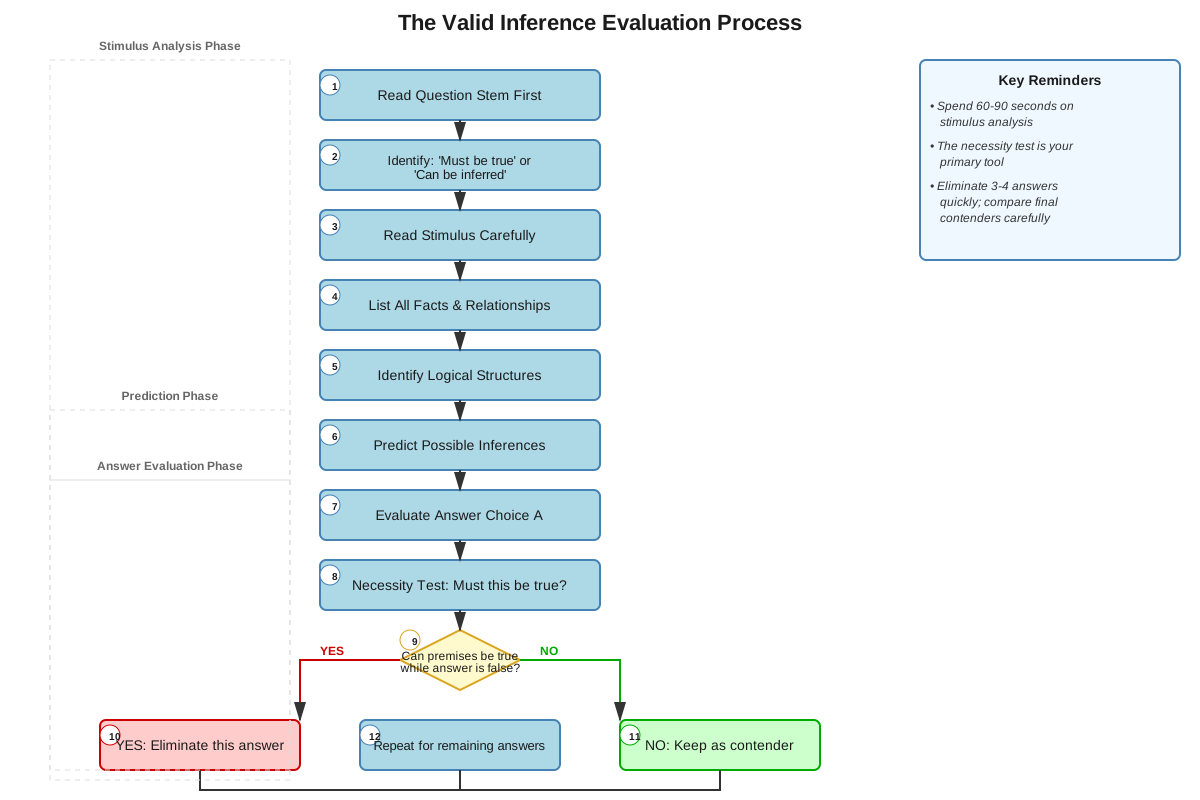
When approaching inference questions on the LSAT, begin by identifying the question type through trigger phrases: "must be true," "properly inferred," "follows logically," "if the statements above are true," or "most strongly supported." These phrases signal that you need to find a valid inference, not evaluate an argument or identify an assumption.
Read the stimulus carefully and map the logical relationships. For conditional statements, write out the if-then structure and identify any chains. For quantifier statements, note the specific quantities (all, most, some, none). For comparative statements, track the relationships (greater than, less than, equal to). Look for overlapping terms between premises—these are often the key to combining information.
Predict before looking at answers when possible. If you see a clear conditional chain or quantifier relationship, anticipate what must follow. However, don't spend too long on prediction; many inference questions require evaluating each answer choice systematically.
Use the "must be true" test rigorously. For each answer choice, ask: "Can I imagine any scenario where the premises are true but this answer is false?" If yes, eliminate it. This process-of-elimination approach is often more efficient than trying to prove answers correct.
Watch for scope violations. Wrong answers frequently introduce new concepts, strengthen quantifiers beyond what's justified (changing "some" to "most" or "all"), or make causal claims from correlational premises. If an answer discusses something not mentioned in the stimulus, it's almost certainly wrong.
Beware of reversal traps. Test-makers love to include answer choices that reverse conditional relationships or quantifier statements. Always check the direction of the logical relationship.
Time allocation: Spend 1:00-1:30 minutes on straightforward inference questions with clear logical relationships. Allow up to 2:00 minutes for complex questions requiring multiple premise combinations. If you're stuck after 2:00 minutes, make your best guess and move on—inference questions can be time-consuming, and you don't want them to prevent you from reaching easier questions later.
Exam Tip: On inference questions, extreme language (all, must, always, never) in answer choices is often wrong, while qualified language (some, could, might) is often correct. This is the opposite of many other question types, where you're looking for strong claims.
Memory Techniques
VALID acronym for checking inferences:
- Verify the premises support it
- Avoid scope expansion
- Logical necessity, not probability
- Identify the inference type (conditional/quantifier/comparative)
- Direction matters (don't reverse)
Quantifier hierarchy visualization: Picture a pyramid with "ALL" at the top (strongest claim, hardest to prove), "MOST" in the middle, "SOME" near the bottom (weakest claim, easiest to prove), and "NONE" at the base as the negative absolute. Valid inferences typically move down the pyramid (from stronger to weaker claims), not up.
Conditional chain mnemonic: "Follow the arrows, flip for contrapositive" - Remember that conditional statements flow in one direction, and the only automatic valid inference is the contrapositive (flip and negate both terms).
The "Must Be True" mantra: Before selecting an answer, literally say to yourself "This MUST be true given the premises." If you hesitate or think "probably" or "likely," it's wrong.
Scope circle technique: Visualize the stimulus as a circle containing all the information provided. Valid inferences must stay within this circle. If an answer choice introduces concepts outside the circle, it's invalid.
Summary
Valid inference is the cornerstone of LSAT Logical Reasoning, requiring students to identify conclusions that must be true given the premises. Unlike everyday reasoning that accepts probable or plausible conclusions, LSAT inference questions demand absolute logical necessity. The three primary inference types—conditional, quantifier, and comparative—each follow specific logical rules that must be mastered. Conditional inferences allow for contrapositives and chains but not converses or inverses. Quantifier inferences follow strict rules about what can be concluded from "all," "most," "some," and "none" statements. Comparative inferences respect transitive properties while avoiding unwarranted numerical conclusions. Success on inference questions requires recognizing these patterns, combining multiple premises through shared terms, and rigorously applying the must-be-true standard while avoiding scope violations. The ability to distinguish between what must be true, what could be true, and what is merely suggested separates high scorers from average performers on the LSAT.
Key Takeaways
- Valid inferences must be true if the premises are true—necessity, not probability, is the standard
- Conditional statements yield valid contrapositives but not converses or inverses; chains can be extended through shared terms
- Quantifier relationships follow specific rules: "some" is reversible, "most" is not, and "all" generates conditional inferences
- Scope limitations are critical—valid inferences cannot introduce new concepts, strengthen quantifiers, or assert causation without support
- Process of elimination using the "must be true" test is more reliable than trying to prove answers correct
- Wrong answers typically involve reversals, scope violations, or statements that are merely possible rather than necessary
- Combining multiple premises through overlapping terms is often required to reach the correct inference
Related Topics
Assumption Questions: Understanding valid inference is essential for assumption questions, which ask what unstated premise is required for an argument's conclusion to follow. Assumptions are the missing links that make inferences valid.
Conditional Logic and Formal Logic: Deeper study of conditional reasoning, including complex conditional chains, sufficient and necessary conditions, and formal logic notation, builds directly on valid inference principles.
Strengthen and Weaken Questions: These question types require understanding what inferences can be drawn when new information is added to a stimulus, making valid inference skills foundational.
Must Be False Questions: The inverse of must-be-true questions, these require identifying what cannot be true given the premises, using the same logical reasoning skills in reverse.
Parallel Reasoning: These questions ask you to identify arguments with matching logical structures, requiring recognition of inference patterns across different content.
Practice CTA
Now that you understand the principles of valid inference, it's time to put your knowledge into practice. Work through the practice questions systematically, applying the must-be-true standard and checking for scope violations. Use the flashcards to reinforce the logical rules for conditionals, quantifiers, and comparisons until they become automatic. Remember: valid inference is a skill that improves dramatically with deliberate practice. Each question you work through strengthens your ability to recognize logical patterns and avoid common traps. You're building the analytical precision that will serve you throughout the LSAT and beyond. Start practicing now—your improved score awaits!
Sign up free to keep reading
Create a free AnvayaPrep account to finish this LSAT guide on Valid inference — plus flashcards and practice questions.