Overview
Applying a general rule is one of the most fundamental reasoning patterns tested on the LSAT Logical Reasoning section. This pattern involves taking a broad principle, law, or generalization and using it to draw a conclusion about a specific case or instance. The reasoning moves from the universal to the particular—from "all X are Y" to "this is an X, therefore this is Y." This deductive structure appears frequently across multiple question types, including method, role, and structure questions, where test-takers must identify how an argument operates or what function a particular statement serves.
Understanding this reasoning pattern is essential because the LSAT consistently tests whether students can recognize when an argument applies a general principle to reach a specific conclusion. This skill extends beyond simply identifying the pattern; students must also evaluate whether the application is valid, whether the specific case truly falls under the general rule, and how this reasoning structure differs from other common patterns like analogical reasoning or causal arguments. The ability to quickly spot and analyze this pattern can save valuable time on test day and improve accuracy across numerous question types.
The relationship between applying a general rule and other logical reasoning concepts is foundational. This pattern represents one of the core building blocks of deductive reasoning, which itself underlies many LSAT arguments. When students master this concept, they develop a framework for understanding how premises support conclusions, how to identify gaps in reasoning, and how to predict what assumptions an argument requires. This pattern also connects directly to conditional reasoning, as general rules often take the form of conditional statements that are then applied to specific instances.
Learning Objectives
- [ ] Identify how Applying a general rule appears in LSAT questions
- [ ] Explain the reasoning pattern behind Applying a general rule
- [ ] Apply Applying a general rule to solve LSAT-style problems accurately
- [ ] Distinguish between valid and invalid applications of general rules in arguments
- [ ] Recognize the structural components (general principle, specific case, conclusion) in complex passages
- [ ] Evaluate whether a specific instance genuinely satisfies the conditions of a general rule
- [ ] Predict common wrong answer choices that misrepresent this reasoning pattern
Prerequisites
- Basic argument structure: Understanding premises and conclusions is essential because applying a general rule requires identifying which statement serves as the general principle and which represents the specific application
- Conditional reasoning fundamentals: Many general rules take conditional form (if-then statements), so recognizing sufficient and necessary conditions helps identify when a rule properly applies
- Deductive vs. inductive reasoning: Distinguishing these reasoning types is necessary because applying a general rule is a deductive pattern, and recognizing this helps predict how the argument should function
- Question stem interpretation: Familiarity with how LSAT questions are phrased ensures students can recognize when they're being asked about argumentative method or structure
Why This Topic Matters
In real-world contexts, applying general rules represents how legal reasoning, policy implementation, and ethical decision-making actually function. Lawyers must constantly take statutory language (general rules) and apply it to specific client situations. Judges interpret constitutional principles and apply them to particular cases. Policy makers create broad guidelines that administrators then apply to individual circumstances. The LSAT tests this skill because it directly reflects the analytical thinking required in legal practice.
On the LSAT itself, applying a general rule appears with remarkable frequency. Approximately 15-20% of Logical Reasoning questions involve this pattern either as the primary reasoning structure or as a component of more complex arguments. This pattern appears most commonly in Method of Reasoning questions (which ask "how does the argument proceed?"), Role questions (which ask about the function of a particular statement), and Parallel Reasoning questions (which require matching argument structures). Additionally, many Flaw questions test whether students can identify when a general rule has been misapplied or when a specific case doesn't actually meet the conditions of the stated rule.
The pattern typically appears in passages where an author cites a principle, policy, regulation, or general observation, then discusses a specific situation and draws a conclusion about that situation based on the general rule. Common signal phrases include "according to the principle that," "the policy states that," "given that all," and "since it is generally true that." Recognizing these structural markers allows test-takers to quickly identify the reasoning pattern and anticipate both correct answers and common traps.
Core Concepts
The Basic Structure of Applying a General Rule
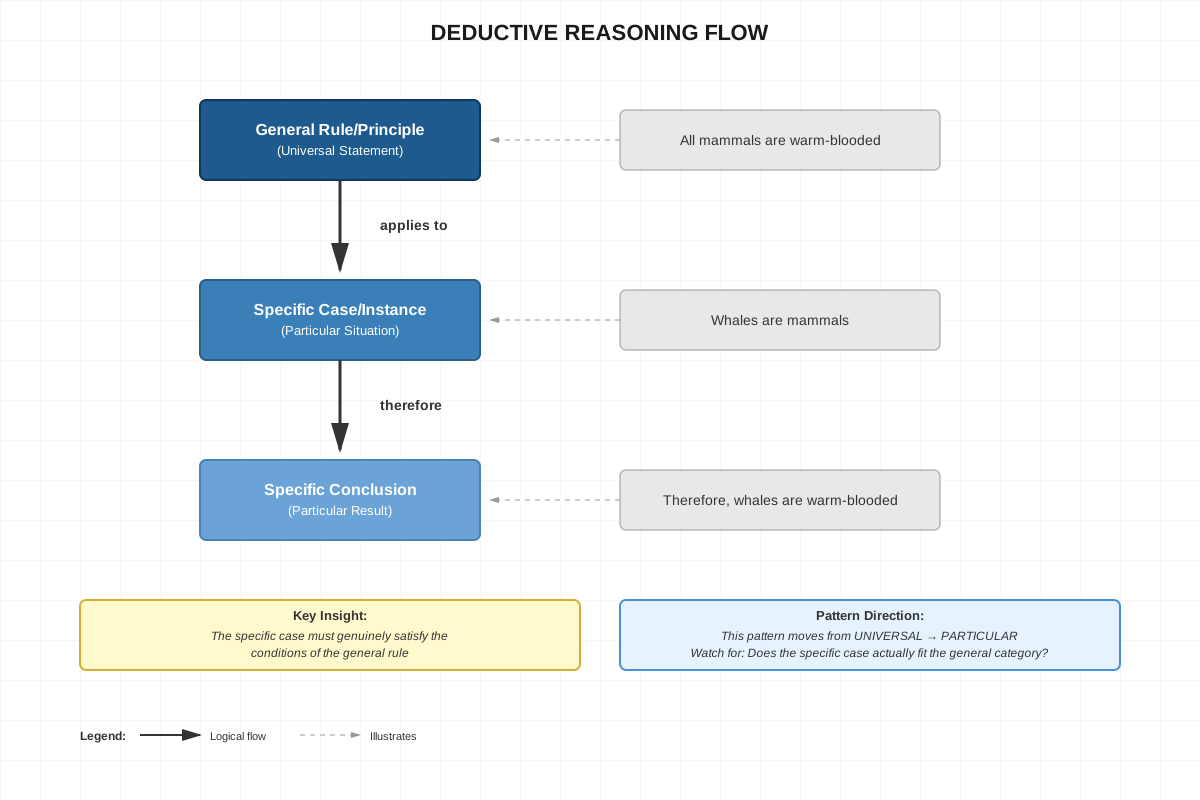
Applying a general rule follows a consistent three-part structure that students must internalize. First, the argument presents a general principle or rule—a statement that applies broadly to a category or class of things. Second, the argument identifies a specific case or instance that allegedly falls within that category. Third, the argument draws a conclusion about the specific case based on the general rule.
The logical form can be represented as:
- General Rule: All members of category X have property Y
- Specific Case: This particular thing is a member of category X
- Conclusion: Therefore, this particular thing has property Y
This structure represents valid deductive reasoning when properly executed. The conclusion follows necessarily from the premises if both the general rule is true and the specific case genuinely belongs to the category described in the rule. The strength of this reasoning pattern lies in its logical necessity—if the premises are true, the conclusion must be true.
Identifying the Components in LSAT Arguments
On the LSAT, these three components rarely appear in simple, textbook form. Instead, they're embedded in complex prose that may present them out of order, use sophisticated vocabulary, or include additional supporting information. Students must learn to extract the essential structure from surrounding context.
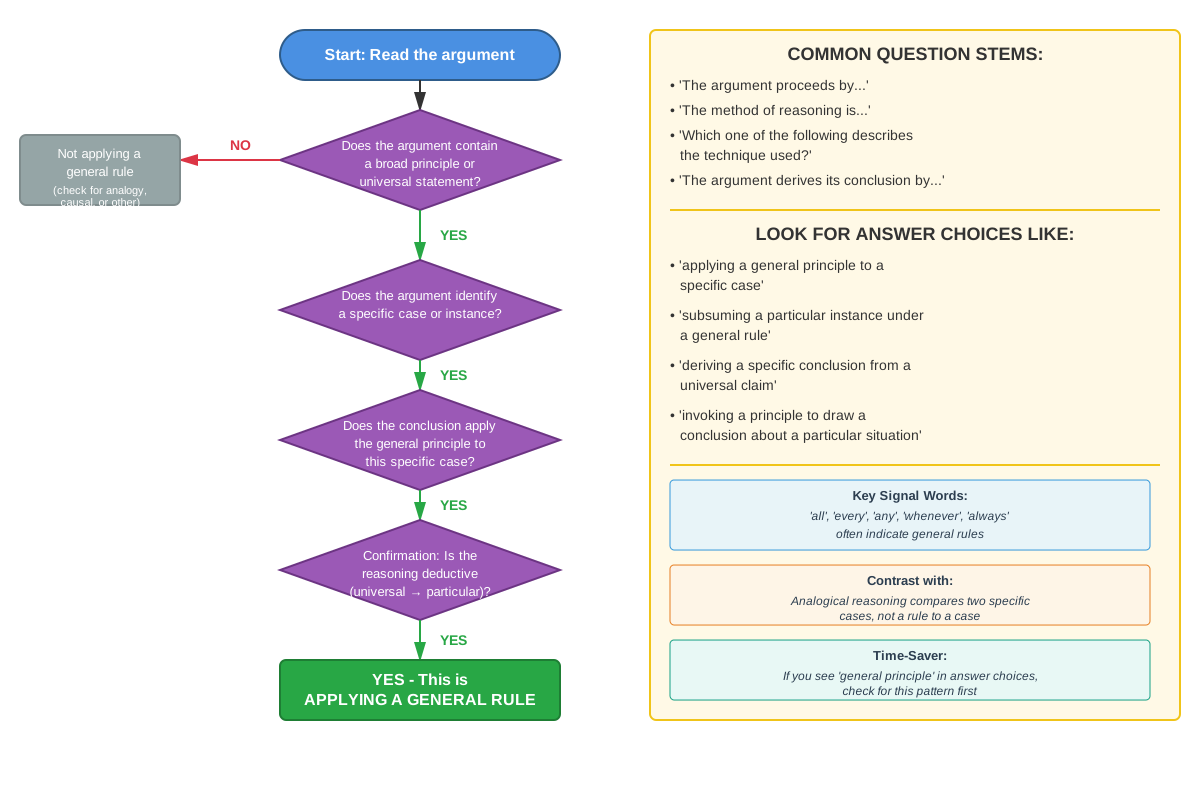
The general rule often appears with indicator words such as "all," "every," "any," "whenever," "always," or "in general." However, it may also be implied or stated as a policy, regulation, or accepted principle. For example: "Company policy requires that all employees who work overtime receive compensatory time off" presents a general rule about a category (employees who work overtime) and what applies to them (receiving compensatory time off).
The specific case typically involves particular individuals, events, or situations. Look for proper names, specific time references, or phrases like "in this instance," "this particular case," or "here." The argument must establish that this specific case falls within the category described by the general rule.
The conclusion draws the logical consequence of applying the rule to the case. It may be signaled by conclusion indicators like "therefore," "thus," "consequently," or "it follows that," but it might also appear as the first or last sentence without explicit indicators.
Valid vs. Invalid Applications
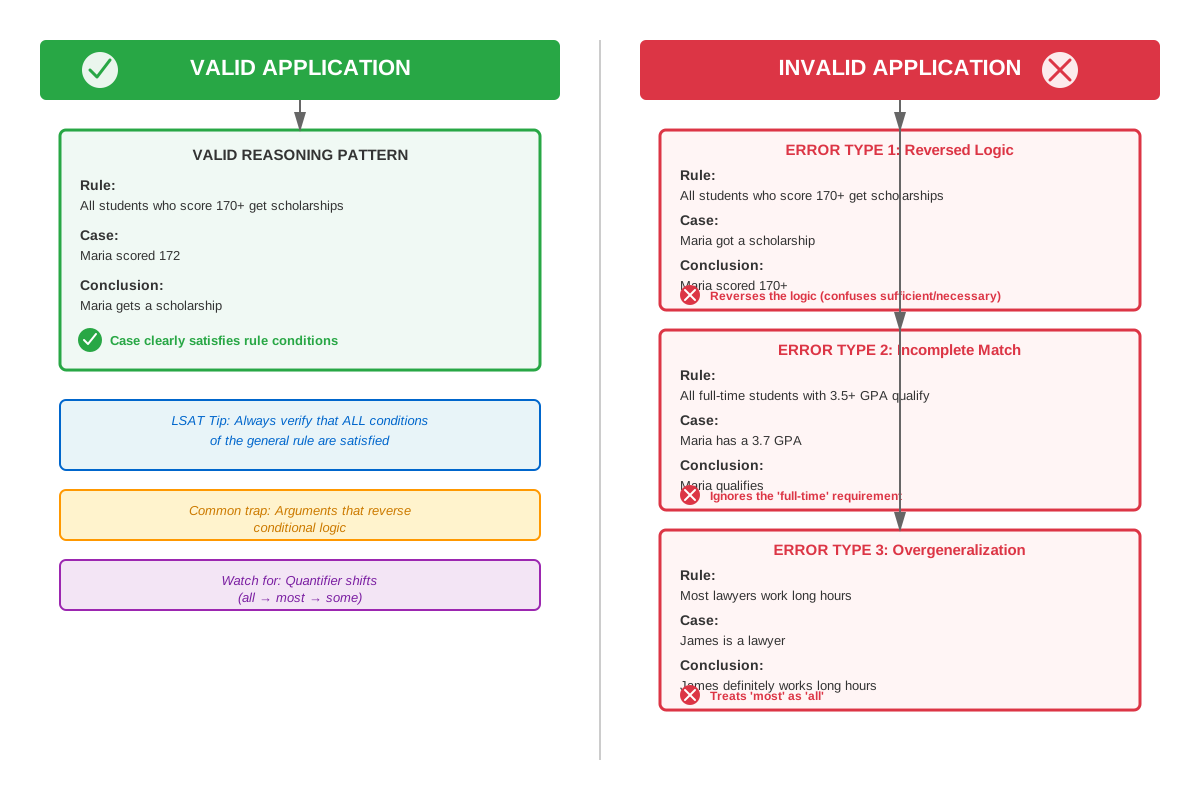
Understanding when an application is valid versus invalid is crucial for many LSAT questions, particularly Flaw questions and Strengthen/Weaken questions. A valid application occurs when:
- The general rule is accurately stated
- The specific case genuinely meets all conditions specified in the rule
- The conclusion correctly identifies what the rule dictates for that case
An invalid application typically fails in one of these ways:
| Type of Invalid Application | Description | Example |
|---|---|---|
| Category Mismatch | The specific case doesn't actually belong to the category in the general rule | Rule: "All birds can fly." Case: "Penguins are birds." Conclusion: "Penguins can fly." (Fails because the rule itself is flawed, or the case is an exception) |
| Incomplete Condition Satisfaction | The specific case meets some but not all conditions of the rule | Rule: "Students who complete all assignments AND pass the final receive credit." Case: "John completed all assignments." Conclusion: "John receives credit." (Missing the second condition) |
| Reversed Application | Applying the rule backward (confusing sufficient and necessary conditions) | Rule: "All scholarship recipients must maintain a 3.5 GPA." Case: "Maria maintains a 3.5 GPA." Conclusion: "Maria is a scholarship recipient." (The rule doesn't work in reverse) |
| Overgeneralization | Extending the rule beyond its stated scope | Rule: "Employees in Department A receive bonuses." Case: "John is an employee." Conclusion: "John receives a bonus." (Doesn't establish John is in Department A) |
Distinguishing from Similar Patterns
Applying a general rule must be distinguished from other common LSAT reasoning patterns. Analogical reasoning compares two specific cases and argues that what's true of one should be true of the other because of their similarities. Unlike applying a general rule, analogical reasoning moves from particular to particular, not from general to particular.
Causal reasoning argues that one event or condition brings about another. While a general rule might describe a causal relationship, the pattern of applying a general rule focuses on categorization and logical consequence rather than cause and effect.
Principle application is closely related but slightly different. When an LSAT question asks students to identify a principle that justifies a conclusion, they're often working backward—finding the general rule that would make the reasoning valid. Applying a general rule, by contrast, starts with the rule already stated and examines how it's used.
The Role in Method and Structure Questions
In method, role, and structure questions, students must identify how applying a general rule functions within an argument. Common correct answer choices for Method of Reasoning questions include:
- "applies a general principle to a specific case"
- "draws a conclusion about a particular instance based on a general claim"
- "uses a broad policy to determine the outcome in a specific situation"
- "derives a specific conclusion from a universal premise"
For Role questions, when a statement serves as the general rule, correct answers might describe it as "a principle that the argument uses to reach its conclusion" or "a general claim that supports the argument's specific conclusion." When a statement describes the specific case, it might be "a particular instance to which a general principle is applied."
Structure questions may ask students to describe the argumentative technique or identify parallel reasoning. Recognizing the general-to-specific movement is essential for matching argument structures correctly.
Concept Relationships
The concepts within applying a general rule form a hierarchical relationship. The basic structure (general rule → specific case → conclusion) serves as the foundation. Understanding this structure enables recognition of valid versus invalid applications, which requires analyzing whether each component properly connects to the others. This analytical skill then supports the ability to distinguish this pattern from similar reasoning types, as students can compare the structural features of different argument forms.
These internal concepts connect to prerequisite knowledge in important ways. Conditional reasoning provides the logical framework for many general rules, as they often take the form "if X, then Y." Understanding conditional logic helps students recognize when a specific case satisfies the sufficient condition and therefore must have the necessary condition. Argument structure knowledge allows students to identify which statements serve which functions—premise, conclusion, or intermediate step.
The relationship map flows as follows:
Conditional Reasoning → enables understanding of → General Rules → which are applied to → Specific Cases → producing → Conclusions → which can be evaluated as → Valid or Invalid Applications → leading to success on → Method, Role, and Structure Questions
This pattern also connects forward to more advanced topics. Understanding how general rules apply prepares students for Parallel Reasoning questions, where they must match argument structures. It supports Flaw questions, where misapplications of rules represent common error types. It underlies Principle questions, where students must either find the principle that justifies reasoning or apply a given principle to new situations.
Quick check — test yourself on Applying a general rule so far.
Try Flashcards →High-Yield Facts
⭐ Applying a general rule moves from a universal or broad statement to a specific conclusion about a particular case—this is deductive reasoning from general to particular.
⭐ The three essential components are: (1) general rule/principle, (2) specific case/instance, and (3) conclusion about that case based on the rule.
⭐ Valid application requires that the specific case genuinely satisfies ALL conditions stated in the general rule, not just some of them.
⭐ Common wrong answers in Method questions describe the reasoning as analogical, causal, or inductive when it actually applies a general rule.
⭐ The general rule may appear anywhere in the passage—first, middle, or last—and may not be explicitly labeled as a rule or principle.
- Signal phrases for general rules include "all," "every," "any," "whenever," "policy requires," "according to the principle," and "it is generally true that."
- Invalid applications often involve category mismatches, where the specific case doesn't actually belong to the category described in the rule.
- Reversed applications (treating necessary conditions as sufficient) represent a common flaw when general rules are misapplied.
- In Role questions, the general rule typically functions as a premise that supports the conclusion about the specific case.
- Parallel Reasoning questions often test whether students can match the structure of applying a general rule across different content areas.
Common Misconceptions
Misconception: Any argument that mentions a rule or principle is applying a general rule. → Correction: The argument must actually use that rule to draw a conclusion about a specific case. Simply mentioning a principle without applying it to reach a conclusion doesn't constitute this reasoning pattern.
Misconception: If the specific case is similar to the category in the general rule, the application is valid. → Correction: Similarity isn't sufficient; the specific case must actually be a member of the category or must satisfy all the conditions specified in the rule. "Similar to" doesn't equal "is a member of."
Misconception: Applying a general rule is the same as using an analogy. → Correction: Analogies compare two specific cases and argue they should be treated similarly. Applying a general rule uses a universal principle to reach a conclusion about a particular instance—the logical structure is fundamentally different.
Misconception: The general rule must be stated explicitly and clearly labeled. → Correction: General rules on the LSAT are often embedded in complex sentences, stated as background information, or presented as commonly accepted principles without explicit labeling. Students must extract the rule from context.
Misconception: If the general rule is true and the conclusion is true, the application must be valid. → Correction: Valid application requires that the specific case actually falls under the rule. Both premises and conclusion can be true while the reasoning remains flawed if the connection between them is improper.
Misconception: Applying a general rule always produces a certain conclusion. → Correction: While properly applied general rules in deductive reasoning do produce necessary conclusions, LSAT arguments may apply rules incorrectly, incompletely, or to inappropriate cases. Students must evaluate whether the application is sound.
Worked Examples
Example 1: Identifying the Pattern
Passage: "University regulations state that any student who misses more than three classes without documented medical reasons will receive a failing grade for the course. Chen missed four classes last semester, and none of these absences were due to medical reasons. Therefore, Chen received a failing grade for the course."
Analysis:
Step 1: Identify the general rule. The first sentence presents the rule: "any student who misses more than three classes without documented medical reasons will receive a failing grade." This is a universal statement about a category (students meeting certain conditions) and what happens to them (failing grade).
Step 2: Identify the specific case. The second sentence presents the particular instance: "Chen missed four classes last semester, and none of these absences were due to medical reasons." This establishes Chen as a specific individual whose situation is being examined.
Step 3: Verify the case meets the rule's conditions. Chen missed four classes (more than three) ✓, and none were for medical reasons ✓. Chen satisfies both conditions specified in the rule.
Step 4: Identify the conclusion. "Therefore, Chen received a failing grade for the course" applies the consequence stated in the rule to Chen's specific case.
Step 5: Evaluate validity. This is a valid application because Chen genuinely meets all conditions of the rule, and the conclusion correctly identifies what the rule dictates for cases meeting those conditions.
Connection to Learning Objectives: This example demonstrates how to identify all three components of the pattern and evaluate whether the application is valid—addressing objectives about identifying the pattern and applying it to solve problems.
Example 2: Method of Reasoning Question
Passage: "The city's noise ordinance prohibits construction work between 10 PM and 7 AM in residential areas. Last Tuesday, Acme Construction was operating heavy machinery at a residential site at 11 PM. The city was therefore justified in issuing Acme Construction a citation for violating the noise ordinance."
Question: The argument proceeds by:
(A) drawing an analogy between two similar situations
(B) applying a general regulation to a particular case
(C) establishing a causal relationship between two events
(D) generalizing from a specific instance to a broader principle
(E) questioning the validity of an established rule
Analysis:
Step 1: Identify the reasoning structure. The argument presents a regulation (general rule), describes a specific situation (Acme's actions), and concludes that the regulation applies to that situation.
Step 2: Eliminate clearly wrong answers.
- (A) is wrong because there's no comparison between two similar cases—there's a rule and one case.
- (C) is wrong because the argument doesn't claim the ordinance caused something or that Acme's actions caused the citation; it argues the citation was justified based on the rule.
- (D) is backward—the argument moves from general to specific, not specific to general.
- (E) is wrong because the argument accepts and applies the rule rather than questioning it.
Step 3: Confirm the correct answer. (B) accurately describes the structure: the noise ordinance is a general regulation, Acme's situation is a particular case, and the argument applies the regulation to conclude the citation was justified.
Connection to Learning Objectives: This example shows how to identify the pattern in a Method of Reasoning question and eliminate wrong answers that describe different reasoning patterns—addressing the objective about solving LSAT-style problems accurately.
Exam Strategy
When approaching LSAT questions involving applying a general rule, follow this systematic process:
Step 1: Identify the question type. Read the question stem first. Method of Reasoning questions ask "how does the argument proceed?" or "which one of the following describes the technique used?" Role questions ask about the function of a specific statement. Structure questions ask about the argument's organization.
Step 2: Locate the general rule. As you read the passage, actively search for universal statements, policies, principles, or broad claims. These often appear with quantifiers (all, every, any) or as stated regulations. Underline or mentally note this statement.
Step 3: Find the specific case. Look for particular individuals, events, or situations. These typically involve proper names, specific times, or demonstrative pronouns (this, that). Identify what makes this case specific rather than general.
Step 4: Verify the connection. Check whether the specific case actually satisfies the conditions in the general rule. This is where many flawed arguments fail, so careful verification is essential.
Step 5: Identify the conclusion. Determine what the argument claims follows from applying the rule to the case.
Exam Tip: Watch for trigger phrases that signal this pattern: "according to the principle," "the policy states," "given that all," "since it is generally true," "the regulation requires," and "based on the rule that."
Time allocation: Spend approximately 1:15-1:30 on questions testing this pattern. The structure is usually straightforward once identified, so don't overthink. If you can quickly spot the three components, you can eliminate wrong answers rapidly.
Process of elimination tips specific to this pattern:
- Eliminate answers describing analogical reasoning (comparing two similar cases)
- Eliminate answers describing inductive reasoning (generalizing from examples)
- Eliminate answers describing causal reasoning (one thing causing another) unless the general rule itself describes a causal relationship
- Eliminate answers that reverse the direction (specific to general instead of general to specific)
- For Role questions, eliminate answers that misidentify which component a statement represents
Common trap answers include those that describe the content rather than the structure. For example, if an argument applies a legal principle to a case, a wrong answer might say "relies on legal authority" (describing content) when the correct answer is "applies a general principle to a specific case" (describing structure).
Memory Techniques
Mnemonic for the three components: "GPS" - General rule, Particular case, Specific conclusion
Visualization strategy: Picture a funnel. The wide top represents the general rule that applies broadly. The narrow bottom represents the specific case. The liquid flowing through represents the logical process of application, and what comes out the bottom is the conclusion about that specific case.
Acronym for validity checks: "CATS" - Category match (does the case fit the category?), All conditions (are all conditions satisfied?), True application (does the conclusion correctly state what the rule dictates?), Structure sound (is the logical form valid?)
Memory phrase for distinguishing patterns: "General to Particular = Applying a rule; Particular to Particular = Analogy; Particular to General = Induction"
Trigger word list to memorize: Create a mental list of common signals:
- For general rules: "all," "every," "any," "policy," "regulation," "principle," "whenever"
- For specific cases: proper names, "this," "that," "in this instance," "here," "this particular"
- For conclusions: "therefore," "thus," "consequently," "it follows that," "must"
Summary
Applying a general rule represents a fundamental deductive reasoning pattern where arguments move from universal principles to specific conclusions. This pattern appears frequently on the LSAT, particularly in Method, Role, and Structure questions, making it essential for test success. The pattern consists of three components: a general rule or principle that applies broadly, a specific case or instance, and a conclusion about that case derived from applying the rule. Valid application requires that the specific case genuinely satisfies all conditions stated in the general rule. Students must distinguish this pattern from analogical reasoning (which compares two specific cases) and inductive reasoning (which generalizes from specific instances). Recognition of structural markers, careful verification of whether cases meet rule conditions, and understanding of how this pattern appears in different question types enable students to quickly identify and correctly answer questions testing this concept. Mastery requires both recognizing the pattern when it appears and evaluating whether the application is logically sound.
Key Takeaways
- Applying a general rule follows a three-part structure: general principle → specific case → conclusion about that case based on the principle
- This deductive pattern moves from universal/broad statements to particular/specific conclusions, distinguishing it from analogical and inductive reasoning
- Valid application requires the specific case to satisfy ALL conditions in the general rule, not just some or similar conditions
- The pattern appears most frequently in Method of Reasoning, Role, and Parallel Reasoning questions, accounting for 15-20% of Logical Reasoning questions
- Common flaws include category mismatches, incomplete condition satisfaction, and reversed applications (treating necessary conditions as sufficient)
- Signal phrases like "according to the principle," "policy requires," and "given that all" indicate general rules being applied
- Success requires identifying all three components even when they appear out of order or embedded in complex prose
Related Topics
Parallel Reasoning: Once students master identifying the structure of applying a general rule, they can match this structure across different content areas in Parallel Reasoning questions, which require finding arguments with identical logical forms.
Flaw Questions - Improper Application: Understanding valid application enables recognition of common flaws where arguments misapply rules, fail to verify that cases meet all conditions, or reverse conditional logic.
Principle Questions: These questions either ask students to find the general principle that would justify specific reasoning (working backward from application to rule) or to apply a given principle to new situations (extending the application pattern).
Conditional Logic Advanced Applications: Deeper study of conditional reasoning reveals how complex conditional chains and multiple conditions interact when general rules are applied to specific cases.
Sufficient Assumption Questions: These questions often require identifying what additional general rule would make an argument's reasoning valid, building on understanding of how rules apply to cases.
Practice CTA
Now that you understand the structure and application of general rules in LSAT arguments, it's time to reinforce this knowledge through active practice. Attempt the practice questions designed for this topic, focusing on identifying the three components in each argument and evaluating whether applications are valid. Use the flashcards to drill recognition of signal phrases and common wrong answer patterns. Remember: recognizing this pattern quickly and accurately will save you valuable time on test day and improve your performance across multiple question types. The more you practice identifying this structure, the more automatic it becomes—transforming a complex analytical task into a rapid pattern-recognition skill that boosts your score.
Sign up free to keep reading
Create a free AnvayaPrep account to finish this LSAT guide on Applying a general rule — plus flashcards and practice questions.