Overview
Necessary sufficient parallel flaw questions represent one of the most challenging and high-value question types within LSAT Logical Reasoning. These questions require test-takers to identify flawed conditional reasoning in a stimulus argument, then locate an answer choice that contains the exact same logical error in structure. Unlike standard parallel reasoning questions that ask students to match valid argument patterns, parallel flaw questions specifically target faulty reasoning involving necessary and sufficient conditions—a distinction that trips up even well-prepared students.
The LSAT frequently tests whether students can recognize when an argument confuses a necessary condition for a sufficient one, or vice versa. This confusion creates a logical flaw that invalidates the argument's conclusion. Mastering this topic requires both understanding conditional logic at a deep level and developing the ability to abstract argument structures away from their content. Students must see past the specific subject matter (whether the argument discusses politics, science, or everyday scenarios) to identify the underlying logical skeleton.
Within the broader landscape of logical reasoning, necessary sufficient parallel flaw questions sit at the intersection of multiple critical skills: conditional reasoning, argument structure analysis, and pattern matching. These questions build directly on foundational knowledge of sufficient and necessary conditions while requiring the advanced skill of parallel reasoning—the ability to recognize structurally identical arguments across different contexts. Performance on these questions often correlates strongly with overall LSAT scores, making them essential for students targeting competitive score ranges.
Learning Objectives
- [ ] Identify how Necessary sufficient parallel flaw appears in LSAT questions
- [ ] Explain the reasoning pattern behind Necessary sufficient parallel flaw
- [ ] Apply Necessary sufficient parallel flaw to solve LSAT-style problems accurately
- [ ] Distinguish between confusing necessary conditions for sufficient conditions and vice versa
- [ ] Diagram flawed conditional arguments using standard logical notation
- [ ] Eliminate answer choices that contain different flaws or valid reasoning
- [ ] Recognize common content variations that disguise identical logical structures
Prerequisites
- Conditional Logic Fundamentals: Understanding "if-then" statements, sufficient conditions, and necessary conditions is essential because parallel flaw questions test the misapplication of these relationships
- Argument Structure Analysis: The ability to identify premises, conclusions, and reasoning patterns enables students to abstract the logical skeleton from content-specific details
- Basic Formal Logic Notation: Familiarity with symbolic representation (A → B) helps visualize and compare argument structures efficiently
- Flaw Question Types: Prior exposure to identifying logical flaws in arguments provides the foundation for recognizing when those same flaws appear in parallel form
Why This Topic Matters
In real-world contexts, the ability to identify flawed conditional reasoning protects against persuasive but logically invalid arguments. Politicians, advertisers, and advocates frequently confuse necessary and sufficient conditions—claiming, for instance, that because all successful people work hard (hard work is necessary), working hard guarantees success (treating it as sufficient). Recognizing these errors enables critical evaluation of claims in professional, academic, and civic contexts.
On the LSAT, parallel flaw questions involving necessary and sufficient conditions appear with significant frequency. Approximately 3-5 questions per test section involve parallel reasoning, and roughly 40-50% of these specifically test conditional logic flaws. These questions typically appear in the medium-to-difficult range, making them crucial for students aiming to break into the 160+ score range. The question stem usually contains phrases like "flawed reasoning most similar to," "reasoning error most closely paralleled," or "exhibits a pattern of reasoning most similar to the flawed reasoning."
The LSAT presents these questions in diverse content areas—from scientific reasoning to social policy to everyday decision-making. This variety tests whether students truly understand the logical structure rather than simply memorizing content-specific patterns. A single test might include a flawed argument about medical diagnosis, followed by answer choices discussing restaurant selection, historical causation, economic policy, and athletic performance. Success requires seeing through these surface differences to the underlying logical identity.
Core Concepts
Understanding Sufficient and Necessary Conditions
A sufficient condition is one that, when present, guarantees the occurrence of another condition. In the statement "If it rains, the ground gets wet," rain is sufficient for wet ground. Symbolically: Rain → Wet Ground. The sufficient condition appears in the "if" clause and points toward the necessary condition.
A necessary condition is one that must be present for another condition to occur, but its presence alone doesn't guarantee that condition. In the same statement, wet ground is necessary for rain (in this logical relationship), but wet ground can occur without rain (sprinklers, flooding, etc.). The necessary condition appears in the "then" clause and is pointed to by the arrow.
The contrapositive of any conditional statement is logically equivalent to the original. For "If A, then B" (A → B), the contrapositive is "If not B, then not A" (~B → ~A). This equivalence is valid and crucial for correct conditional reasoning.
The Classic Necessary-Sufficient Confusion Flaw
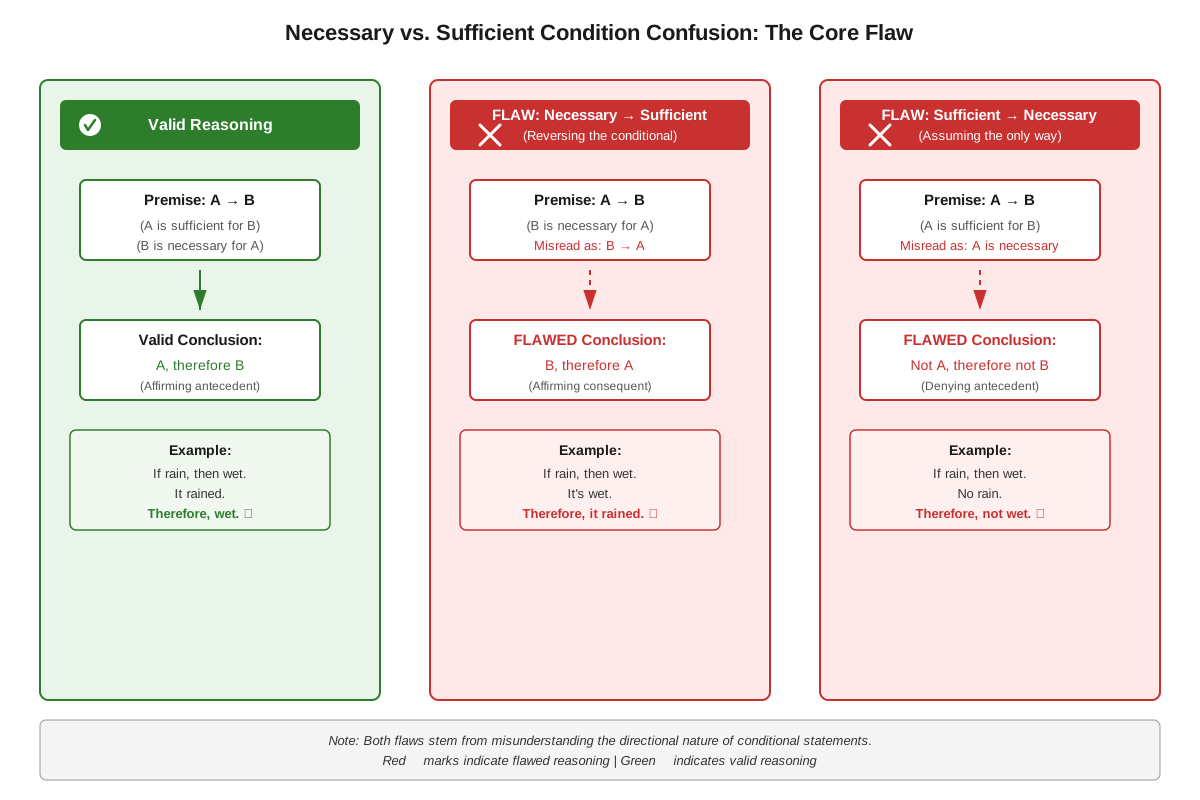
The most common flaw in lsat necessary sufficient parallel flaw questions involves treating a necessary condition as if it were sufficient. Consider this flawed argument structure:
Premise: All A's are B's (A → B)
Conclusion: Therefore, all B's are A's (B → A)
This commits the fallacy of affirming the consequent—assuming that because B is necessary for A, B must be sufficient for A.
Example: "All doctors have medical degrees. Jane has a medical degree. Therefore, Jane is a doctor." The argument treats having a medical degree (necessary for being a doctor) as if it were sufficient to make someone a doctor, ignoring that nurses, researchers, and others might also have medical degrees.
The Reverse Flaw: Treating Sufficient as Necessary
Less commonly, arguments flaw by treating a sufficient condition as if it were necessary:
Premise: A is sufficient for B (A → B)
Conclusion: A is necessary for B (B → A)
Example: "Studying guarantees passing the exam. Therefore, you cannot pass the exam without studying." This treats studying (sufficient for passing) as if it were necessary for passing, ignoring other ways to pass (prior knowledge, lucky guessing, etc.).
Structural Abstraction in Parallel Flaw Questions
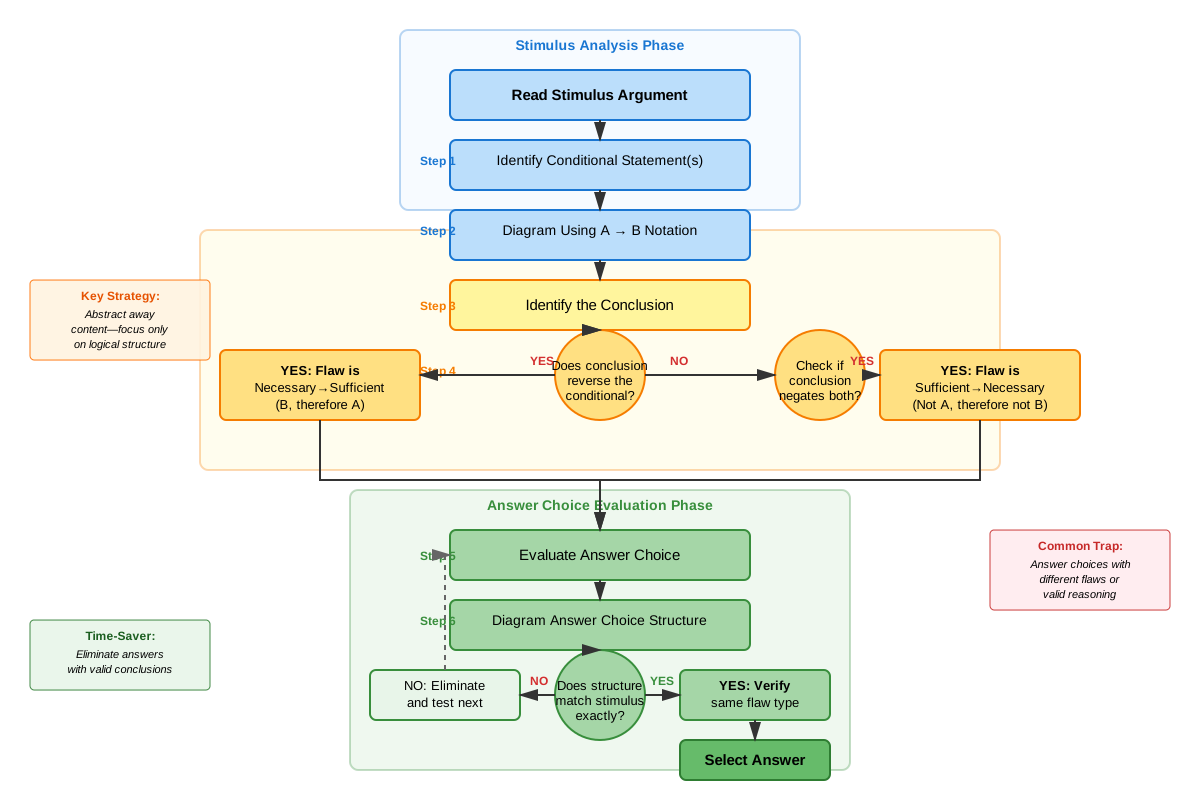
Success on parallel flaw questions requires abstracting the logical structure from specific content. The process involves:
- Identify the conditional relationship in the stimulus argument
- Diagram the stated relationship using arrows
- Diagram what the conclusion claims
- Identify the gap or reversal between what's established and what's concluded
- Match this exact structural flaw in the answer choices
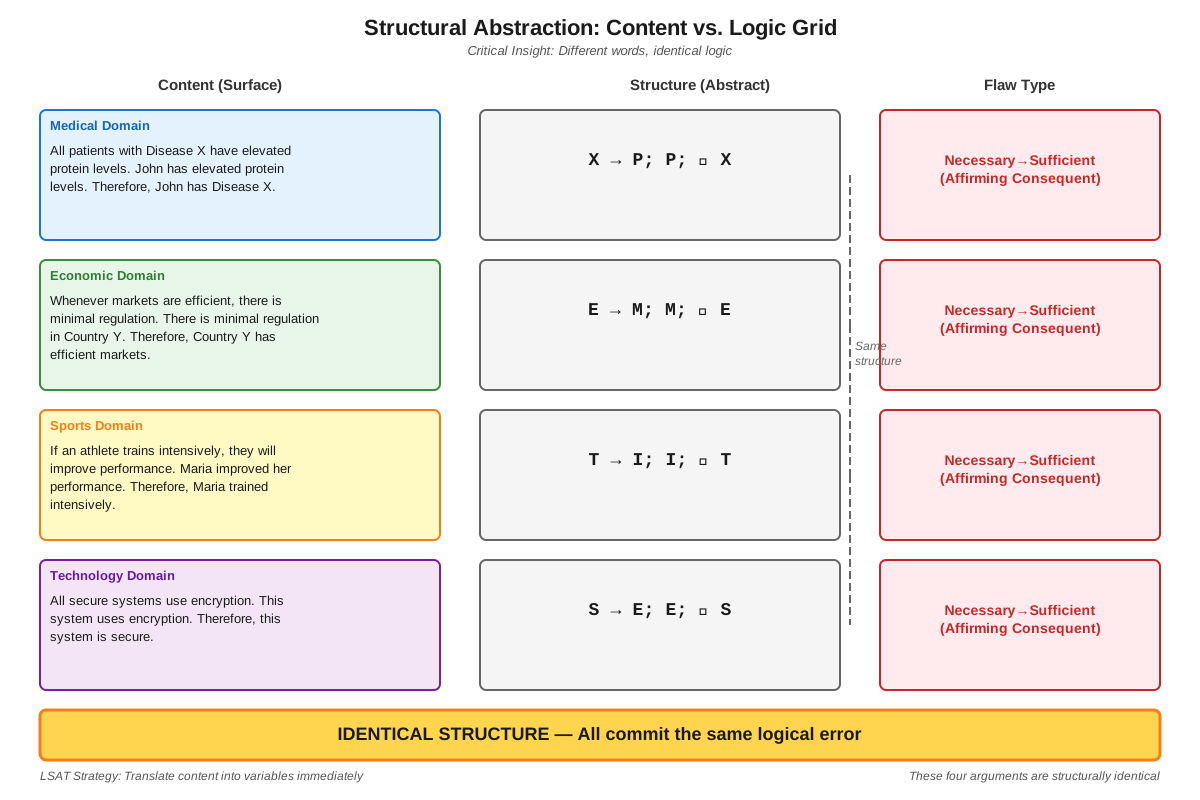
The content will differ dramatically between stimulus and correct answer, but the logical skeleton must be identical. An argument about medical diagnosis might parallel an argument about restaurant quality, provided both commit the same conditional reasoning error.
Common Structural Variations
| Flaw Type | Structure | Example Pattern |
|---|---|---|
| Affirming the Consequent | A→B, B, ∴A | All experts know this; you know this; you're an expert |
| Denying the Antecedent | A→B, ~A, ∴~B | If you study, you pass; you didn't study; you won't pass |
| Reversing Necessity | A→B, ∴B→A | Success requires effort; effort produces success |
| Confusing Sufficiency | A→B, ∴B→A | Rain causes wetness; wetness means it rained |
Diagramming Flawed Arguments
When encountering a necessary sufficient parallel flaw question, immediately diagram the argument:
Stimulus: "Every successful entrepreneur takes risks. Maria takes risks. Therefore, Maria will be a successful entrepreneur."
Diagram:
- Premise: Successful Entrepreneur → Takes Risks
- Conclusion: Takes Risks → Successful Entrepreneur
The flaw: reversing the conditional relationship, treating a necessary condition (risk-taking) as sufficient.
Correct parallel answer: "All professional athletes train daily. John trains daily. Therefore, John is a professional athlete."
Diagram:
- Premise: Professional Athlete → Trains Daily
- Conclusion: Trains Daily → Professional Athlete
The structures match perfectly despite completely different content.
Content Camouflage Techniques
The LSAT deliberately obscures structural parallels through content variation. Answer choices might:
- Use different grammatical constructions (active vs. passive voice)
- Employ varying sentence lengths and complexity
- Introduce emotionally charged or technical vocabulary
- Present arguments in different orders (conclusion-first vs. conclusion-last)
- Include additional premises that don't affect the core logical structure
Students must train themselves to see past these surface differences and focus exclusively on the conditional logic relationships.
Concept Relationships
The concepts within necessary sufficient parallel flaw questions form a hierarchical structure. At the foundation lies conditional logic fundamentals—understanding sufficient and necessary conditions. This foundation supports flaw identification, the ability to recognize when conditional relationships are misapplied. Flaw identification then enables structural abstraction, the skill of representing arguments in logical notation independent of content. Finally, structural abstraction makes possible parallel matching, the ability to recognize identical logical structures across different contexts.
These concepts connect to prerequisite knowledge in specific ways. Conditional logic fundamentals build directly on basic formal logic notation (A → B). Flaw identification extends general argument structure analysis by focusing specifically on conditional reasoning errors. Structural abstraction applies pattern recognition skills developed in standard parallel reasoning questions but adds the complexity of matching flawed rather than valid patterns.
The relationship map flows as follows:
Conditional Logic Mastery → enables → Flaw Recognition → requires → Structural Diagramming → facilitates → Content Abstraction → produces → Successful Parallel Matching
Additionally, necessary sufficient parallel flaw questions connect forward to more advanced topics like formal logic games and complex conditional chains in Reading Comprehension. The diagramming and abstraction skills developed here transfer directly to Logic Games, where conditional rules must be manipulated and combined.
Quick check — test yourself on Necessary sufficient parallel flaw so far.
Try Flashcards →High-Yield Facts
⭐ The most common flaw reverses a conditional statement: treating "A → B" as if it means "B → A"
⭐ Necessary conditions appear after the arrow; sufficient conditions appear before the arrow in standard notation
⭐ The correct answer must match both the flaw type AND the structural position of premises and conclusion
⭐ Content similarity between stimulus and answer choice is irrelevant—only logical structure matters
⭐ Approximately 40-50% of parallel reasoning questions on the LSAT involve conditional logic flaws
- The contrapositive (~B → ~A) is the only valid reversal of a conditional statement (A → B)
- Affirming the consequent (A → B, B, therefore A) is the most frequently tested conditional flaw
- Denying the antecedent (A → B, ~A, therefore ~B) appears less frequently but follows the same reversal pattern
- Wrong answers often contain different flaws or valid reasoning that superficially resembles the stimulus
- Diagramming the stimulus before reading answer choices saves time and increases accuracy
- Multiple sufficient conditions can lead to the same necessary condition without creating a flaw
- The presence of additional premises in an answer choice doesn't disqualify it if the core flaw matches
- Temporal or causal language ("causes," "leads to," "results in") often signals conditional relationships
- Quantifiers like "all," "every," "any," and "each" typically introduce sufficient conditions
- Phrases like "only if," "requires," and "depends on" typically introduce necessary conditions
Common Misconceptions
Misconception: If the content areas are similar between stimulus and answer choice, that answer is more likely correct.
Correction: Content similarity is completely irrelevant in parallel reasoning questions. The LSAT deliberately uses different content areas to test whether students understand logical structure independent of subject matter. An argument about medicine can perfectly parallel an argument about sports if the logical structures match.
Misconception: The correct answer must have the same number of premises as the stimulus.
Correction: Additional premises that don't affect the core logical flaw don't disqualify an answer choice. What matters is that the essential conditional relationship and the flaw in reasoning match exactly. An answer might include background information or additional context while still containing the identical logical error.
Misconception: Reversing any conditional statement is always a flaw.
Correction: Reversing to the contrapositive (~B → ~A from A → B) is logically valid. The flaw occurs when reversing without negating (B → A from A → B) or when negating without reversing (~A → ~B from A → B). Understanding which reversals are valid versus flawed is crucial.
Misconception: If an answer choice reaches a different conclusion than the stimulus, it can't be the right answer.
Correction: The conclusions will necessarily differ in content because the subject matter differs. What must match is the logical relationship between premises and conclusion—specifically, the type of conditional reasoning error committed.
Misconception: Parallel flaw questions are just about matching keywords like "all" or "if."
Correction: While indicator words help identify conditional relationships, successful parallel matching requires understanding the logical structure these words create. Two arguments can use completely different indicator words while committing identical logical errors. Focus on the relationships, not just the vocabulary.
Worked Examples
Example 1: Classic Necessary-Sufficient Reversal
Stimulus Argument:
"All members of the debate team have strong critical thinking skills. Jamal has strong critical thinking skills. Therefore, Jamal must be a member of the debate team."
Step 1 - Identify the conditional relationship:
The first sentence establishes: Debate Team Member → Strong Critical Thinking
Step 2 - Diagram the conclusion:
The conclusion claims: Strong Critical Thinking → Debate Team Member
Step 3 - Identify the flaw:
The argument reverses the conditional, treating a necessary condition (critical thinking) as if it were sufficient for being on the debate team. This is affirming the consequent.
Step 4 - Predict the parallel structure:
The correct answer will establish "If X, then Y," observe that Y is present, then conclude X must be present.
Evaluating Answer Choices:
(A) "Every rose in this garden is red. This flower is red. Therefore, this flower is a rose."
- Structure: Rose → Red; Red; ∴ Rose
- This matches perfectly! Establishes a conditional, affirms the consequent, concludes the antecedent.
(B) "Every rose in this garden is red. This flower is not red. Therefore, this flower is not a rose."
- Structure: Rose → Red; ~Red; ∴ ~Rose
- This is valid contrapositive reasoning, not a flaw. Eliminated.
(C) "Every rose in this garden is red. This flower is a rose. Therefore, this flower is red."
- Structure: Rose → Red; Rose; ∴ Red
- This is valid conditional reasoning (affirming the antecedent). Eliminated.
Answer: (A) matches the exact flaw structure despite completely different content.
Example 2: Complex Conditional with Multiple Elements
Stimulus Argument:
"To qualify for the scholarship, students must maintain a 3.5 GPA. Chen maintains a 3.5 GPA. Therefore, Chen qualifies for the scholarship."
Step 1 - Identify the conditional relationship:
"Must maintain" indicates necessity: Qualify for Scholarship → 3.5 GPA
(Having a 3.5 GPA is necessary for qualifying)
Step 2 - Diagram the conclusion:
The conclusion claims: 3.5 GPA → Qualify for Scholarship
Step 3 - Identify the flaw:
The argument treats a necessary condition as if it were sufficient. The scholarship might require additional criteria (essay, recommendations, financial need), but the argument assumes the GPA alone is enough.
Step 4 - Predict the parallel structure:
The correct answer will state that X is necessary for Y, observe X is present, then conclude Y must occur.
Evaluating Answer Choices:
(A) "To become a licensed pilot, one must pass a medical exam. Rodriguez passed the medical exam. Therefore, Rodriguez is a licensed pilot."
- Structure: Licensed Pilot → Pass Medical Exam; Pass Medical Exam; ∴ Licensed Pilot
- Perfect match! Treats a necessary condition (medical exam) as sufficient for the outcome (licensed pilot).
(B) "Passing a medical exam is sufficient to become a licensed pilot. Rodriguez passed the medical exam. Therefore, Rodriguez is a licensed pilot."
- Structure: Pass Medical Exam → Licensed Pilot; Pass Medical Exam; ∴ Licensed Pilot
- This is valid reasoning (affirming the antecedent when the condition is stated as sufficient). Eliminated.
Answer: (A) correctly parallels the flaw of treating a necessary condition as sufficient.
Exam Strategy
When approaching lsat necessary sufficient parallel flaw questions, follow this systematic process:
Step 1: Identify the question type by reading the question stem first. Look for phrases like "flawed reasoning most similar," "error in reasoning most closely paralleled," or "reasoning most similar to the flawed reasoning above."
Step 2: Diagram the stimulus argument before reading answer choices. Identify:
- The conditional relationship stated in the premises
- The conclusion's claim
- The gap or reversal between them
Step 3: Name the flaw in your own words. Is it affirming the consequent? Denying the antecedent? Treating necessary as sufficient? This prediction guides your answer choice evaluation.
Step 4: Eliminate aggressively based on structure, not content:
- Eliminate any answer with valid reasoning
- Eliminate answers with different flaws
- Eliminate answers where the conditional relationship points the wrong direction
Exam Tip: If you're struggling to diagram an argument, try the "substitute test." Replace the specific terms with generic variables (A, B, C) to see the structure more clearly.
Trigger words to watch for:
- Sufficient condition indicators: "if," "when," "whenever," "all," "every," "any"
- Necessary condition indicators: "only if," "must," "required," "necessary," "depends on," "unless"
- Conclusion indicators: "therefore," "thus," "consequently," "it follows that"
Time allocation: Spend 1:30-2:00 minutes on these questions. They require careful analysis but shouldn't consume excessive time. If you've correctly diagrammed the stimulus, answer choice evaluation should move quickly.
Process of elimination strategy:
- First pass: Eliminate answers with valid reasoning (often 2-3 choices)
- Second pass: Eliminate answers with different flaws than the stimulus
- Final evaluation: Compare remaining choices to your diagram for exact structural match
Memory Techniques
Mnemonic for conditional logic: "SANE" reasoning
- Sufficient points to Necessary
- Arrow flows from sufficient to necessary
- Necessary follows the arrow
- Error occurs when reversing without negating
Visualization strategy: Picture conditional statements as one-way streets. The arrow shows the only valid direction of travel. Reversing direction (without the contrapositive detour) causes a logical "traffic violation."
Acronym for common flaws: "ADAN"
- Affirming the consequent (most common)
- Denying the antecedent
- Assuming necessity is sufficient
- Neglecting the contrapositive (treating invalid reversals as valid)
Memory aid for parallel matching: "Content Camouflages, Structure Stays" - remind yourself that surface differences in subject matter are deliberate distractions from the underlying logical skeleton.
Diagramming shorthand: Develop consistent symbols:
- → for "if-then" relationships
- ~ for negation
- ∴ for "therefore"
- ≠ for "does not equal" when showing a flaw
Summary
Necessary sufficient parallel flaw questions test the ability to identify conditional reasoning errors and recognize identical logical structures across different content areas. The core skill involves understanding that sufficient conditions (appearing before the arrow) guarantee necessary conditions (appearing after the arrow), but not vice versa. The most common flaw reverses this relationship, treating a necessary condition as if it were sufficient—for example, concluding that because all A's are B's, all B's must be A's. Success requires diagramming arguments to reveal their logical skeleton, identifying the specific type of conditional error, then matching that exact structure in an answer choice despite completely different subject matter. Students must resist the temptation to match based on content similarity and instead focus exclusively on the logical relationships between premises and conclusions. Mastering this question type significantly impacts overall LSAT performance, as these medium-to-difficult questions appear regularly and correlate strongly with high scores.
Key Takeaways
- Necessary sufficient parallel flaw questions require matching logical structure, not content—arguments about completely different topics can commit identical reasoning errors
- The most frequently tested flaw reverses conditional statements, treating "A → B" as if it means "B → A"
- Diagramming the stimulus argument before evaluating answer choices dramatically increases accuracy and efficiency
- Sufficient conditions appear before the arrow and guarantee the necessary condition; necessary conditions appear after the arrow but don't guarantee the sufficient condition
- Valid reasoning in an answer choice immediately disqualifies it—parallel flaw questions specifically require matching the error, not correct logic
- The contrapositive (~B → ~A) is the only valid reversal of a conditional statement (A → B)
- Approximately 40-50% of parallel reasoning questions involve conditional logic flaws, making this a high-yield topic for score improvement
Related Topics
Formal Logic in Logic Games: The conditional reasoning skills developed through necessary sufficient parallel flaw questions transfer directly to Logic Games, where rules often establish conditional relationships that must be diagrammed and manipulated. Mastering parallel flaw questions builds the foundation for handling complex conditional chains in games.
Sufficient Assumption Questions: These questions require identifying what additional premise would make an argument valid, often involving conditional logic. Understanding how necessary-sufficient confusion creates flaws helps identify what's missing to fix those flaws.
Necessary Assumption Questions: The inverse of sufficient assumptions, these questions test what must be true for an argument to work. Recognizing conditional relationships helps identify unstated necessary conditions.
Strengthen/Weaken Questions with Conditional Logic: Many strengthen and weaken questions involve arguments with conditional reasoning. Understanding common conditional flaws helps predict what information would strengthen or weaken such arguments.
Practice CTA
Now that you've mastered the conceptual framework for necessary sufficient parallel flaw questions, it's time to cement your understanding through active practice. Attempt the practice questions designed specifically for this topic, focusing on applying the diagramming and structural abstraction techniques covered in this guide. As you work through problems, refer back to the worked examples and exam strategies to reinforce the systematic approach. Remember: these questions reward careful analysis and pattern recognition—skills that improve dramatically with deliberate practice. Challenge yourself with the flashcards to build automatic recognition of conditional indicators and common flaw patterns. Your investment in mastering this high-yield topic will pay dividends across the entire Logical Reasoning section!
Sign up free to keep reading
Create a free AnvayaPrep account to finish this LSAT guide on Necessary sufficient parallel flaw — plus flashcards and practice questions.