Overview
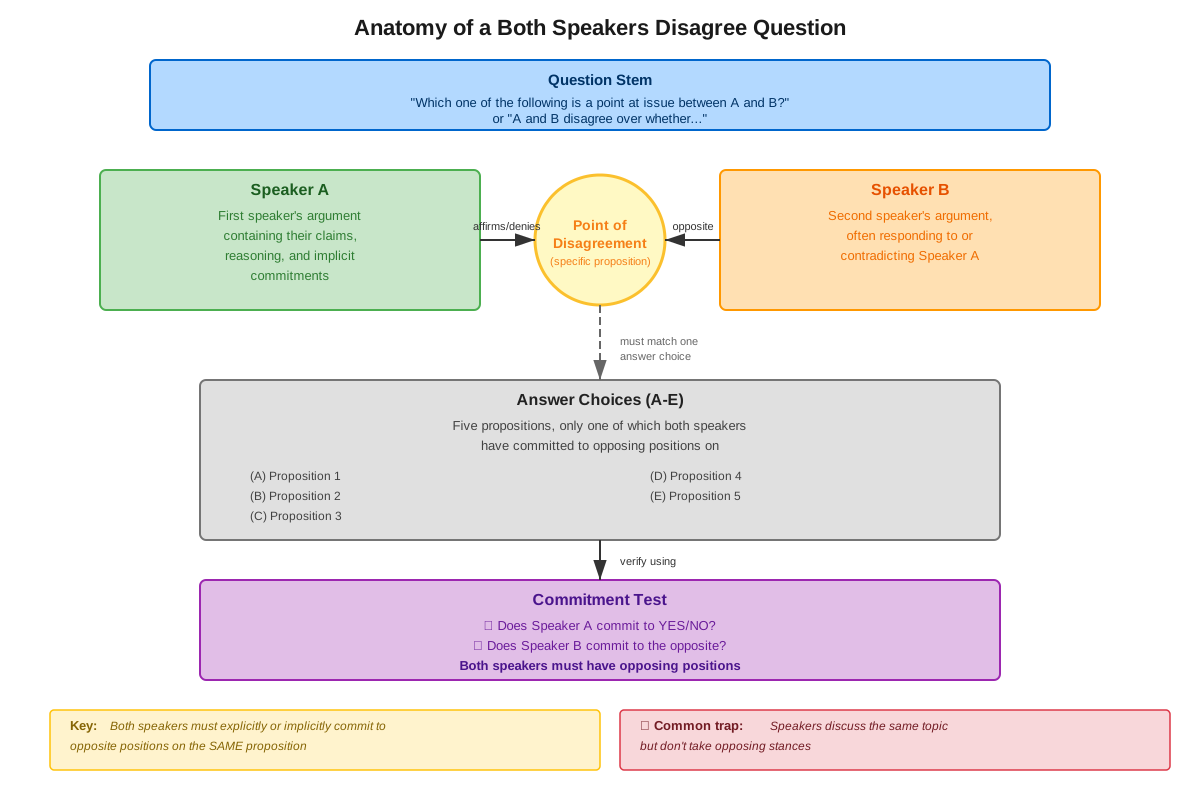
Both speakers disagree questions represent a critical category within LSAT Logical Reasoning sections, specifically falling under the broader umbrella of Point at Issue and Disagreement questions. These questions present a dialogue between two speakers and ask test-takers to identify a proposition about which both speakers have taken opposing positions. The fundamental challenge lies not merely in finding something the speakers discuss, but in pinpointing a specific claim where one speaker affirms what the other denies—or vice versa.
Mastering this question type is essential for LSAT success because it tests multiple analytical skills simultaneously: careful reading comprehension, the ability to distinguish between explicit statements and implied positions, and the capacity to recognize logical relationships between claims. These questions typically appear 2-4 times per LSAT administration, making them a high-yield area for focused preparation. Unlike some Logical Reasoning question types that require complex formal logic, both speakers disagree questions reward methodical analysis and a clear understanding of what constitutes genuine disagreement versus mere discussion of related topics.
Within the broader landscape of Logical Reasoning, this topic connects intimately with argument analysis, inference questions, and the identification of main conclusions. The skills developed here—particularly the ability to isolate precise claims and determine speakers' commitments—transfer directly to strengthening/weakening questions, assumption questions, and parallel reasoning tasks. Understanding disagreement structure also builds foundational skills for Reading Comprehension passages that present competing viewpoints.
Learning Objectives
- [ ] Identify how Both speakers disagree appears in LSAT questions
- [ ] Explain the reasoning pattern behind Both speakers disagree
- [ ] Apply Both speakers disagree to solve LSAT-style problems accurately
- [ ] Distinguish between genuine disagreement and mere discussion of related topics
- [ ] Evaluate answer choices using the "commitment test" to verify both speakers have taken opposing positions
- [ ] Recognize common trap answers that fail one or both sides of the disagreement requirement
Prerequisites
- Basic argument structure: Understanding premises, conclusions, and how claims relate to one another is essential because disagreement questions require identifying specific propositions within complex dialogues.
- Conditional reasoning fundamentals: Recognizing "if-then" statements and their logical relationships helps distinguish between what speakers explicitly commit to versus what merely follows from their positions.
- Inference skills: The ability to determine what must be true based on stated information is crucial since speakers' positions are sometimes implied rather than explicitly stated.
- Vocabulary precision: Understanding subtle differences in meaning between similar terms prevents misidentifying the scope or nature of disagreement.
Why This Topic Matters
In legal reasoning and professional discourse, identifying the precise point of contention between parties is fundamental. Lawyers must pinpoint exactly where opposing counsel disagrees to construct effective arguments. Judges must understand the specific legal question at issue. Policymakers need to isolate genuine disagreements from superficial differences to facilitate productive debate. The LSAT tests this skill because it directly predicts success in law school seminars and legal practice.
On the LSAT, both speakers disagree questions appear with notable frequency—typically 2-4 questions per test across the two scored Logical Reasoning sections. These questions are classified as "Point at Issue" questions and are considered medium difficulty, though they can range from straightforward to quite challenging depending on the complexity of the dialogue and the subtlety of the disagreement. The LSAC (Law School Admission Council) consistently includes these questions because they assess critical reading skills that correlate strongly with first-year law school performance.
These questions commonly appear in several formats: straightforward dialogues where two named speakers respond to each other; editorial-style exchanges where one person makes a claim and another responds; and multi-turn conversations where the disagreement emerges across several statements. The test writers frequently embed trap answers that describe topics both speakers discuss without representing genuine disagreement, or that mischaracterize one speaker's position. Recognizing these patterns dramatically improves accuracy and speed.
Core Concepts
The Definition of Disagreement
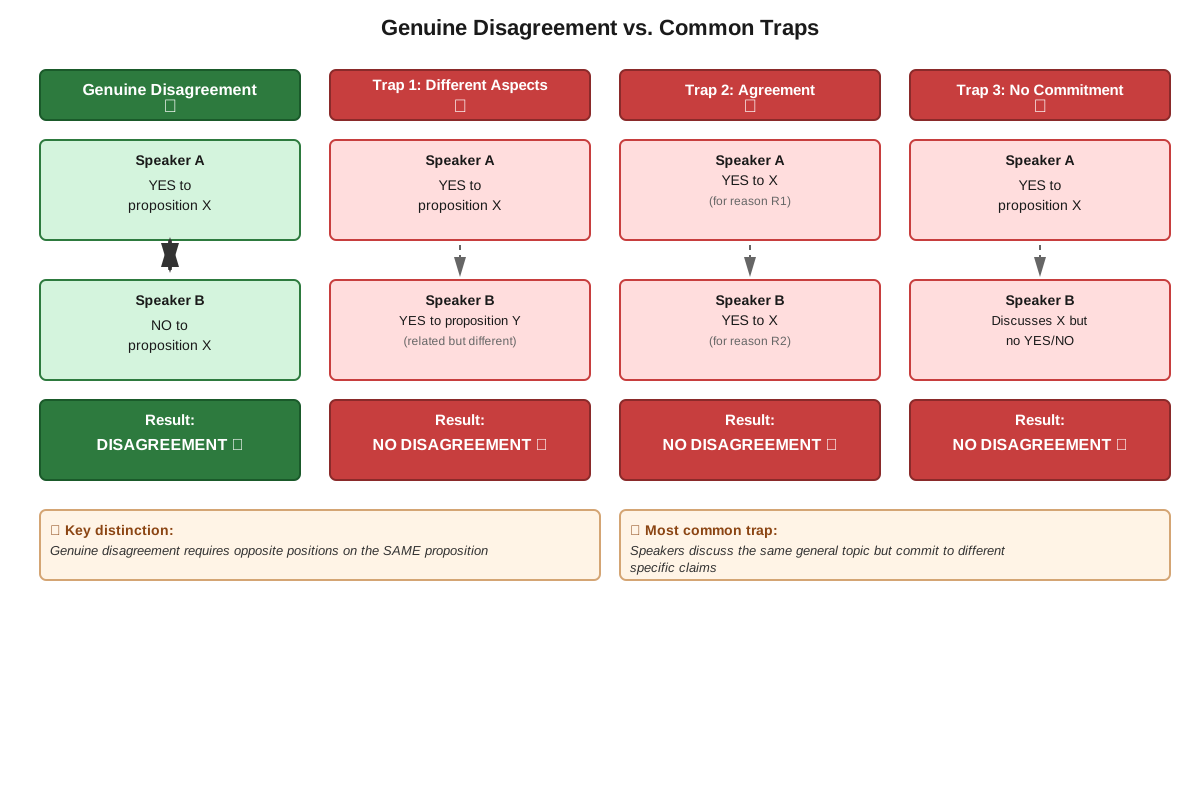
A genuine disagreement exists when one speaker would answer "yes" to a question while the other would answer "no" to that same question. This is the commitment test—the gold standard for evaluating whether an answer choice represents a true point of disagreement. Both speakers must have taken a definite position on the proposition in question, and those positions must be contradictory or contrary.
Consider this distinction: if Speaker A says "The policy will reduce crime" and Speaker B says "The policy will increase unemployment," they are discussing the policy but not necessarily disagreeing about any single proposition. However, if Speaker A says "The policy will reduce crime" and Speaker B says "The policy will not reduce crime," they have a clear disagreement about whether the policy reduces crime.
Explicit vs. Implied Positions
Speakers can express their positions either explicitly or through clear implication. An explicit position is directly stated: "I believe the new regulation is unnecessary." An implied position follows necessarily from what the speaker says: if a speaker argues "The regulation addresses a problem that doesn't exist," they are committed to the position that the regulation is unnecessary, even without using those exact words.
The LSAT frequently tests the ability to recognize implied positions. Test-takers must distinguish between:
- What a speaker definitely commits to (explicit or clearly implied)
- What a speaker might believe but hasn't committed to
- What is consistent with a speaker's position but not required by it
The Scope of Disagreement
The scope of disagreement refers to the precise boundaries of what speakers contest. A common trap involves answer choices that are too broad or too narrow relative to the actual disagreement. If Speaker A claims "Most modern art lacks technical skill" and Speaker B argues "Many contemporary painters demonstrate exceptional technical ability," they disagree about contemporary painters specifically—not necessarily about all modern art forms.
Scope errors include:
- Overgeneralization: An answer choice that extends the disagreement beyond what speakers actually addressed
- Undergeneralization: An answer choice that captures only part of the disagreement
- Category confusion: An answer choice that shifts the disagreement to a related but distinct topic
The Commitment Requirement
For an answer choice to be correct, both speakers must be committed to a position on the proposition. This is a two-part test:
- Speaker A's commitment: Does Speaker A's argument require accepting or rejecting the proposition?
- Speaker B's commitment: Does Speaker B's argument require accepting or rejecting the proposition?
If either speaker has not taken a position—even if the other speaker has—the answer choice fails. This is perhaps the most common source of wrong answers: choices where only one speaker has clearly committed to a position while the other merely discusses related issues without taking a definable stance.
Types of Disagreement
| Type | Description | Example |
|---|---|---|
| Direct contradiction | One affirms exactly what the other denies | A: "The plan will work." B: "The plan will not work." |
| Contrary positions | Both cannot be true, but both could be false | A: "All swans are white." B: "No swans are white." |
| Degree disagreement | Disagreement about extent or magnitude | A: "The effect is significant." B: "The effect is negligible." |
| Evaluative disagreement | Disagreement about value or desirability | A: "The outcome is beneficial." B: "The outcome is harmful." |
| Causal disagreement | Disagreement about cause-effect relationships | A: "X causes Y." B: "X does not cause Y." |
Question Stems
LSAT both speakers disagree questions use characteristic question stems that signal the task:
- "The dialogue provides the most support for the claim that the two speakers disagree about whether..."
- "On the basis of their statements, the speakers are committed to disagreeing about which one of the following?"
- "The point at issue between the two speakers is..."
- "The dialogue most strongly supports the claim that the two speakers disagree over..."
These stems all require the same fundamental analysis: finding a proposition where both speakers have taken opposing positions.
The Process of Elimination Strategy
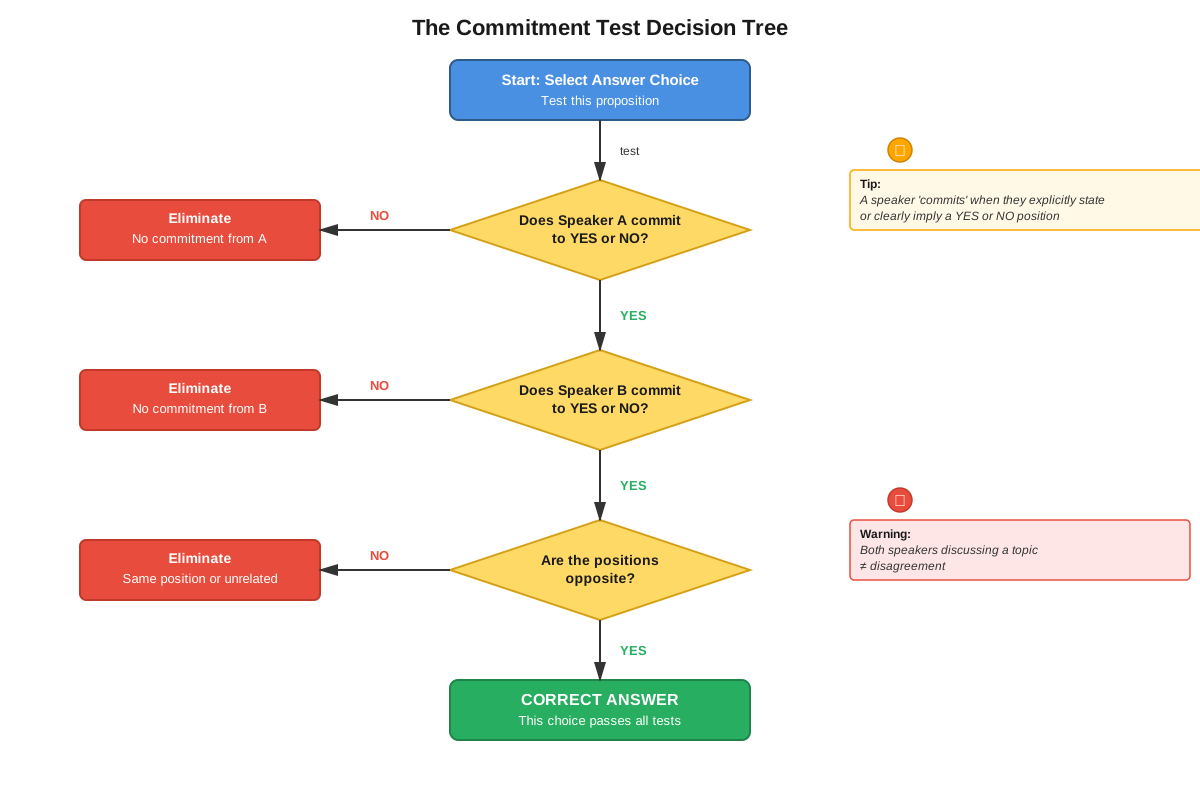
When evaluating answer choices, apply this systematic approach:
- Read Speaker A's argument and identify all positions to which Speaker A is committed
- Read Speaker B's argument and identify all positions to which Speaker B is committed
- For each answer choice, ask: "Would Speaker A answer yes or no to this?" and "Would Speaker B answer yes or no to this?"
- Eliminate any choice where either speaker lacks a clear position or where both speakers would give the same answer
- Select the choice where the speakers would give opposite answers
Concept Relationships
The core concepts within both speakers disagree questions form an interconnected analytical framework. The commitment test serves as the foundation, determining whether each speaker has taken a position. This connects directly to understanding explicit vs. implied positions, since commitments can be either directly stated or necessarily inferred. The scope of disagreement concept refines the commitment test by ensuring the proposition matches the precise boundaries of what speakers contest.
These internal concepts connect to prerequisite knowledge in specific ways: basic argument structure enables identification of speakers' main claims and supporting reasons, which reveals their commitments; inference skills allow recognition of implied positions; conditional reasoning helps determine what speakers are logically committed to based on their stated positions.
The relationship map flows as follows:
Question Stem Recognition → Identify Task (find disagreement) → Analyze Speaker A (explicit + implied commitments) → Analyze Speaker B (explicit + implied commitments) → Apply Commitment Test to each answer choice → Verify Scope matches actual disagreement → Select Answer where both speakers have opposing positions
This topic also connects forward to related Logical Reasoning question types. The analytical skills developed here transfer to Method of Reasoning questions (identifying how speakers respond to each other), Strengthen/Weaken questions (understanding what claims are at stake), and Principle questions (recognizing what general propositions speakers accept or reject).
High-Yield Facts
⭐ A correct answer requires both speakers to have taken a definite position on the proposition—if either speaker lacks commitment, the answer is wrong.
⭐ The commitment test asks: "Would Speaker A answer yes or no?" and "Would Speaker B answer yes or no?" If they give opposite answers, it's a genuine disagreement.
⭐ Speakers can disagree about a proposition even if they never use the same words—implied positions count equally with explicit statements.
⭐ The most common trap answer describes something both speakers discuss without representing a genuine disagreement about any specific claim.
⭐ Scope errors are frequent: the correct answer must match the precise boundaries of what speakers actually contest, not a broader or narrower version.
- Disagreement questions typically appear 2-4 times per LSAT, making them high-yield for focused preparation.
- A speaker's position can be determined by what their argument requires, not just what they explicitly state.
- If a speaker merely raises a question or discusses a topic without taking a stance, they are not committed to a position on that topic.
- Contrary positions (both cannot be true) and contradictory positions (one must be true, one must be false) both qualify as disagreements.
- The correct answer often involves a proposition that neither speaker states in exactly those terms but that both are committed to based on their arguments.
- Wrong answers frequently involve propositions where only one speaker has a clear position while the other is neutral or silent.
- Evaluative disagreements (about whether something is good/bad, beneficial/harmful) are as valid as factual disagreements.
- The speakers need not be aware they disagree—the test asks what they are committed to, not what they think they're arguing about.
Quick check — test yourself on Both speakers disagree so far.
Try Flashcards →Common Misconceptions
Misconception: If both speakers discuss the same topic, they must disagree about it.
Correction: Discussion of a topic does not constitute disagreement. Both speakers might discuss climate change while agreeing on every specific proposition about it. Genuine disagreement requires opposing positions on a specific claim, not merely addressing related subjects.
Misconception: The disagreement must be about the main conclusion of each speaker's argument.
Correction: Speakers can disagree about subsidiary points, background assumptions, or supporting premises while their main conclusions address different issues entirely. The disagreement might concern a single premise in a multi-step argument.
Misconception: If a speaker doesn't explicitly address a proposition, they have no position on it.
Correction: Speakers are committed to the logical implications of their stated positions. If Speaker A argues "All effective policies require public support" and "This policy lacks public support," Speaker A is committed to "This policy is not effective" even without stating it directly.
Misconception: Disagreement requires that speakers directly respond to each other's points.
Correction: Speakers can disagree even if they seem to be talking past each other. What matters is whether their positions, when properly understood, commit them to opposing answers to the same question—not whether they explicitly engage with each other's arguments.
Misconception: The correct answer will use language that appears in both speakers' statements.
Correction: The correct answer often paraphrases or abstracts from the speakers' actual words. Test-takers must focus on the propositions speakers are committed to, not the specific vocabulary they use. A speaker who says "The approach is misguided" disagrees with someone who says "The strategy is sound," even though they use different terms.
Misconception: Stronger disagreement makes for a better answer.
Correction: The intensity or importance of disagreement is irrelevant. A minor technical disagreement that both speakers are clearly committed to is superior to a major philosophical disagreement where one speaker's position is ambiguous.
Worked Examples
Example 1: The Museum Funding Debate
Dialogue:
Keisha: The city should not increase funding for the art museum. While the museum provides cultural value, the city faces a budget crisis, and essential services like road repair and public safety must take priority over cultural amenities.
Marcus: I disagree. The art museum generates significant tourism revenue that helps fund those very essential services you mention. Cutting museum funding would be counterproductive to the city's overall financial health.
Question: The dialogue provides the most support for the claim that Keisha and Marcus disagree about whether:
(A) the art museum provides cultural value to the city
(B) the city faces a budget crisis
(C) increasing museum funding would be counterproductive to the city's financial health
(D) road repair and public safety are essential services
(E) cultural amenities should ever receive city funding
Analysis:
Let's apply the commitment test to each answer choice:
(A) the art museum provides cultural value to the city
- Keisha explicitly states the museum "provides cultural value"—she would answer YES
- Marcus doesn't address cultural value; he focuses on economic benefits—NO POSITION
- ELIMINATE: Only one speaker is committed
(B) the city faces a budget crisis
- Keisha explicitly states "the city faces a budget crisis"—YES
- Marcus doesn't dispute this; he accepts it as background—NO CLEAR POSITION (or possibly agrees)
- ELIMINATE: No clear disagreement
(C) increasing museum funding would be counterproductive to the city's financial health
- Keisha argues against increasing funding due to budget priorities, implying increased funding would not serve financial health well—she would answer YES (it would be counterproductive)
- Marcus explicitly states "Cutting museum funding would be counterproductive," which means increasing funding would NOT be counterproductive—he would answer NO
- BOTH COMMITTED, OPPOSITE POSITIONS: This is the disagreement
(D) road repair and public safety are essential services
- Keisha explicitly calls these "essential services"—YES
- Marcus refers to "those very essential services," accepting Keisha's characterization—YES
- ELIMINATE: Both agree
(E) cultural amenities should ever receive city funding
- Keisha argues against increasing funding in this case but doesn't commit to never funding cultural amenities—NO CLEAR POSITION
- Marcus supports funding in this case but doesn't address the general principle—NO CLEAR POSITION
- ELIMINATE: Neither speaker addresses this broad principle
Answer: (C)
This example illustrates how the disagreement often involves a proposition that neither speaker states in exactly those terms. Keisha never uses the word "counterproductive," and Marcus discusses cutting rather than increasing funding, but both are committed to opposing positions on whether increasing funding would harm financial health.
Example 2: The Organic Food Debate
Dialogue:
Dr. Chen: Organic farming methods produce food that is no more nutritious than conventionally farmed food. Studies consistently show no significant difference in vitamin and mineral content between organic and conventional produce.
Dr. Patel: That's an incomplete picture. While nutrient levels may be similar, organic produce contains significantly lower levels of pesticide residues, which makes it healthier overall. Nutrition isn't solely about vitamin content.
Question: On the basis of their statements, Dr. Chen and Dr. Patel are committed to disagreeing about which one of the following?
(A) whether organic farming methods are more expensive than conventional methods
(B) whether organic produce contains lower levels of pesticide residues than conventional produce
(C) whether studies show similar vitamin and mineral content in organic and conventional produce
(D) whether organic produce is healthier overall than conventional produce
(E) whether nutrition is solely about vitamin content
Analysis:
(A) whether organic farming methods are more expensive than conventional methods
- Dr. Chen: NO POSITION on cost
- Dr. Patel: NO POSITION on cost
- ELIMINATE: Neither addresses this
(B) whether organic produce contains lower levels of pesticide residues than conventional produce
- Dr. Chen: NO POSITION (doesn't discuss pesticides)
- Dr. Patel: YES (explicitly states organic contains "significantly lower levels")
- ELIMINATE: Only one speaker committed
(C) whether studies show similar vitamin and mineral content in organic and conventional produce
- Dr. Chen: YES (cites studies showing "no significant difference")
- Dr. Patel: AGREES ("nutrient levels may be similar")
- ELIMINATE: Both agree
(D) whether organic produce is healthier overall than conventional produce
- Dr. Chen: NO (states organic is "no more nutritious," implying not healthier)
- Dr. Patel: YES (concludes organic is "healthier overall")
- BOTH COMMITTED, OPPOSITE POSITIONS: This is the disagreement
(E) whether nutrition is solely about vitamin content
- Dr. Chen: NO CLEAR POSITION (focuses on vitamins/minerals but doesn't claim that's all that matters)
- Dr. Patel: NO (explicitly states "Nutrition isn't solely about vitamin content")
- ELIMINATE: Dr. Chen hasn't committed to the position that nutrition is solely about vitamins
Answer: (D)
This example demonstrates how speakers can agree on specific facts (nutrient levels are similar) while disagreeing on the broader conclusion (overall health impact). Dr. Patel's statement "That's an incomplete picture" signals disagreement not with Dr. Chen's factual claim but with the conclusion Dr. Chen draws from it. The disagreement concerns the overall evaluation, not the specific data point.
Exam Strategy
When approaching LSAT both speakers disagree questions, implement this systematic process:
Step 1: Identify the question type by recognizing characteristic stems ("disagree about whether," "point at issue," "committed to disagreeing"). This triggers the appropriate analytical framework.
Step 2: Read Speaker A's statement carefully, noting:
- The main claim or conclusion
- Supporting reasons
- Any evaluative judgments (good/bad, effective/ineffective)
- Scope limitations (all, most, some, this particular case)
Step 3: Read Speaker B's statement, specifically looking for:
- Direct responses to Speaker A's claims
- Alternative explanations or conclusions
- Implicit rejections of Speaker A's reasoning
- Areas of potential agreement (to avoid trap answers)
Step 4: Before looking at answer choices, try to predict the disagreement in your own words. Ask: "What question would these speakers answer differently?"
Step 5: Evaluate each answer choice using the two-part commitment test:
- First, determine Speaker A's position: Yes, No, or No Position
- Second, determine Speaker B's position: Yes, No, or No Position
- Eliminate immediately if either speaker lacks a position or if both give the same answer
Exam Tip: The most efficient elimination strategy is to check whether BOTH speakers have a position before determining if they disagree. If either speaker is uncommitted, eliminate immediately without analyzing further.
Trigger words and phrases to watch for:
In question stems:
- "disagree about whether"
- "point at issue"
- "committed to disagreeing"
- "dialogue provides support for the claim that they disagree"
In answer choices that signal traps:
- Overly broad language (all, every, never) when speakers discussed specific cases
- Topics mentioned by both speakers but not contested
- Propositions where only one speaker has a clear stance
Time allocation: These questions typically require 60-90 seconds. Spend:
- 20-30 seconds reading and analyzing the dialogue
- 10-15 seconds predicting the disagreement
- 30-45 seconds evaluating answer choices
If you find yourself spending more than 90 seconds, you may be overanalyzing. Return to the basic commitment test: would each speaker answer yes or no?
Process of elimination priorities:
- First, eliminate choices where at least one speaker has no position
- Second, eliminate choices where both speakers agree
- Third, eliminate choices with scope errors
- Finally, verify the remaining choice by confirming both speakers would give opposite answers
Memory Techniques
The "YES/NO" Mnemonic: For each answer choice, write "Y," "N," or "?" next to each speaker's name. The correct answer shows Y/N or N/Y. Any other pattern (Y/Y, N/N, ?/Y, Y/?, ?/?) means eliminate.
The "BOTH" Acronym for the commitment test:
- Both speakers must have a position
- Opposite answers required
- Topic discussed ≠ disagreement
- Heed scope boundaries
Visualization Strategy: Picture a courtroom where each speaker must answer a yes/no question under oath. If either speaker would say "I don't know" or "That's not what I'm talking about," the question doesn't represent their disagreement. The correct answer is the question where one says "Yes" and the other says "No" definitively.
The "Two Sides of a Coin" Mental Model: Genuine disagreement means the speakers are on opposite sides of the same coin—not holding different coins. If Speaker A discusses the economic impact and Speaker B discusses the environmental impact, they're holding different coins (different topics). If Speaker A says the economic impact is positive and Speaker B says the economic impact is negative, they're on opposite sides of the same coin (genuine disagreement).
Scope Reminder - "GPS":
- General vs. specific (does the answer match the level of generality?)
- Precise boundaries (does it capture exactly what's contested?)
- Same subject (are we talking about the same thing?)
Summary
Both speakers disagree questions test the ability to identify propositions where two speakers have taken opposing positions. Success requires distinguishing genuine disagreement from mere discussion of related topics, recognizing both explicit and implied commitments, and maintaining precise attention to scope. The commitment test—asking whether each speaker would answer yes or no to a proposition—provides the most reliable method for evaluating answer choices. Common traps include answer choices where only one speaker has a position, where both speakers agree, or where scope errors shift the disagreement to a broader or narrower claim than what speakers actually contest. These questions appear regularly on the LSAT and reward systematic analysis: identify each speaker's commitments, apply the commitment test to each answer choice, eliminate choices where either speaker lacks a position or where both agree, and verify that the remaining choice captures the precise scope of disagreement. Mastering this question type builds critical analytical skills that transfer throughout Logical Reasoning and into law school itself.
Key Takeaways
- Both speakers must be committed to a position on the proposition for it to represent their disagreement—if either lacks a position, eliminate that answer choice immediately.
- The commitment test is decisive: Ask whether each speaker would answer yes or no; opposite answers indicate genuine disagreement.
- Discussion of a topic does not equal disagreement about any specific proposition regarding that topic—this is the most common trap.
- Implied positions count equally with explicit statements; speakers are committed to what their arguments logically require, not just what they explicitly state.
- Scope precision is essential; the correct answer must match the exact boundaries of what speakers contest, avoiding overgeneralization or undergeneralization.
- Systematic elimination is more efficient than searching for the right answer; eliminate choices where commitment fails before evaluating whether disagreement exists.
- These questions appear 2-4 times per test and are highly learnable through practice, making them excellent targets for score improvement.
Related Topics
Method of Reasoning Questions: Understanding how speakers respond to each other's arguments builds directly on disagreement analysis. Once you can identify what speakers disagree about, you can analyze how they attempt to challenge each other's positions.
Assumption Questions: Identifying unstated assumptions requires the same skill of determining what speakers are committed to beyond their explicit statements—a core competency in disagreement questions.
Strengthen/Weaken Questions: These questions often involve understanding what claim is at stake in an argument, which parallels identifying the precise proposition speakers contest in disagreement questions.
Parallel Reasoning: Recognizing structural similarities between arguments requires understanding the logical relationships between claims, a skill developed through analyzing how speakers' positions relate to each other.
Principle Questions: Determining what general principles speakers accept or reject involves the same analytical process as identifying their commitments in disagreement questions.
Practice CTA
Now that you've mastered the conceptual framework for both speakers disagree questions, it's time to cement your understanding through active practice. Attempt the practice questions associated with this topic, applying the commitment test systematically to each answer choice. Use the flashcards to reinforce high-yield facts and common trap patterns. Remember: these questions are highly learnable, and consistent practice with the systematic approach outlined here will translate directly into points on test day. Each practice question you analyze strengthens your pattern recognition and speeds your application of the commitment test. You've built the foundation—now build the automaticity that produces top scores.
Sign up free to keep reading
Create a free AnvayaPrep account to finish this LSAT guide on Both speakers disagree — plus flashcards and practice questions.